










All News - Page 98 of 1716 - Good News Network
Home Blog Page 98

Good News in History, May 23

Java creator James Gosling in 2008 - CC 4.0 BY-SA Peter Campbell

30 years ago today, the first version of the Java programming language was released, one of the most popular languages of computer code. It is intended to let programmers write once, run anywhere (WORA), meaning that compiled Java code can run on all platforms that support Java without the need to recompile. Currently on Java SE 24, the language has lost some of its former popularity, but was updated as recently as March, 2025. READ more about the Java language… (1995)
World’s Tallest 3D-Printed Structure Rises 4 Stories into the Air Like a Wedding Cake, Inspired by Local Bakeries

The village of Mulegns with the White Tower - credit, Benjamin Hofer Nova Fundaziun Origen
The village of Mulegns with the White Tower – credit, Benjamin Hofer Nova Fundaziun Origen

In the usually sleepy Swiss town of Mulegns, pop. 11, a dramatic white tower rises four stories into the Alpine air—the tallest 3D-printed structure on earth.

One might imagine such a technological marvel to be debuted in a square in the Silicon Valley cities of San Jose or San Francisco, or perhaps, being that it was accomplished by the Swiss, to garnish the slopes of Davos where millionaires gather to chin wag about the future of the world.

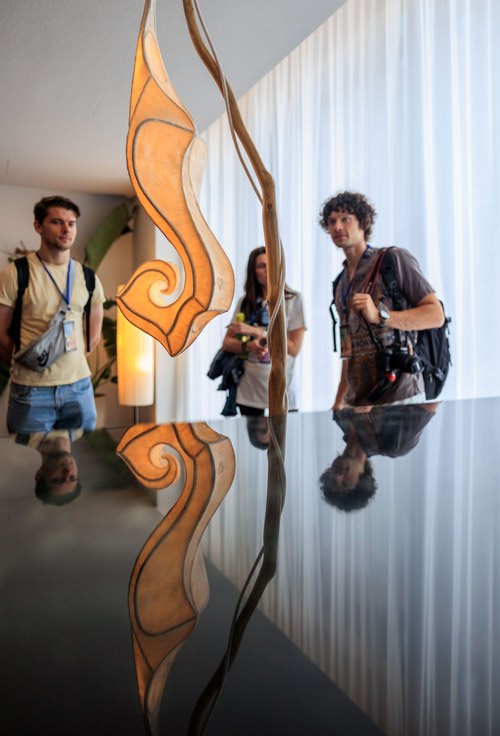
Instead, visitors came to Mulegns from all over Switzerland and further afield to see the ‘Tor Alva’ or white tower, for themselves. A tarp covering was removed by helicopter on the eve of the opening, revealing the delicate structure which now blends into the mountain landscape of the Julier Pass.

It’s an architectural landmark, a pioneering work of digital fabrication, and an instrument in the revival of Mulegns, a mountain village threatened by depopulation.

The Origen cultural foundation led the work in collaboration with ETH Zurich—Europe’s finest technical university, to celebrate culture and the arts and to give the village a new lease of life. Starting tomorrow, the Tor Alva will be open daily for guided tours. From July onwards, the space will also host staged performances, as it is intended to remain in Mulegns for at least 5 years.

The form of the structure is reminiscent of an ornate layered cake—a reference to the emigration history of confectioners from Graubünden who exported their skills from here to the whole of Europe. Thirty-two sculptured white concrete columns rise up over four stories, becoming thinner and more branched, before fanning out in an almost tree-like fashion to form the domed space at the top.

The tower was designed by architect Michael Hansmeyer and ETH Professor of Digital Building Technologies Benjamin Dillenburger. Instead of relying on traditional concrete formwork, they opted for an additive manufacturing process, whereby an industrial robot applies the concrete layer by layer into free-form elements without any supportive casting molds. The design is based on complex algorithms that generate the ornamental and the structural aspects at the same time.

The village of Mulegns with the White Tower – credit, Benjamin Hofer Nova Fundaziun Origen

To make this process possible, a specially developed concrete was needed. It had to be soft enough to bond the delicate structures, while hardening quickly enough to support the subsequent layers without support molds. Robert Flatt, ETH Professor of Physical Chemistry of Building Materials, developed a novel mixture for this purpose. Just before the concrete leaves the pressurized nozzle, two additives are blended into the mixture, allowing the characteristic droplet-like relief on the columns to be achieved.

“The tower combines the latest insights from research with the expertise of companies and experts. Building the tower here, at the foot of the Julier Pass, has also allowed our researchers to gain important practical experience,” said President of ETH Zurich Joël Mesot.

THE BEST OF SWITZERLAND: From Sewage-Filled Waters to Crystal Blue: Switzerland Rivers and Lakes Offer Hope for Cleaning Up Other Countries

What is special about this project is that the 3D-printed elements not only serve as a shell, but for the first time they are also load-bearing. Until now, a suitable method to reinforce 3D-printed concrete effectively has been lacking. This is now possible thanks to a newly developed reinforcement concept implemented using a robot-assisted innovation.

While one robot applies the concrete in layers, a second places a ring-shaped reinforcement in the new structure every few inches. These are supplemented by longitudinal rebars that are added after printing. The process, known as “reinforcement that grows” was developed by ETH professors Walter Kaufmann, Robert Flatt and Benjamin Dillenburger.

3D-PRINTING BREAKTHROUGHS: Holographic 3D Printing Has the Potential to Revolutionize Multiple Industries, Researchers Demonstrate

In addition, the researchers developed a new testing method which allows the load-bearing capacity of 3D-printed concrete to be reliably calculated for the first time. This is a key requirement to ensure that such buildings can in the future be tested just as safely as conventional reinforced concrete structures.

It took five months to print the columns, and the components were then assembled in and delivered to Mulegns via the Julier road.

SHARE This Monumental Achievement With Your Friends… 

Trees Can Warn Us When Volcanos Are Ready to Erupt–and NASA Satellites Can Read Their Signals

Mount Mayon seen from Space Shuttle mission STS-083 - credit, NASA
Mount Mayon seen from Space Shuttle mission STS-083 – credit, NASA

For the 10% of the global population that live near an active and potentially dangerous volcano, help may be forthcoming from an unlikely source: trees.

In advance of volcanic eruptions, carbon dioxide gases are released from the magma below the earth. The trees absorbing it become green and vibrant, a change that if tracked by satellite could be used to improve early warning and detection systems.

The idea comes from an all-American partnership between the Smithsonian Institute and NASA, with the former organizing a team of botanists and volcanologists, and the latter providing a variety of earth-monitoring satellites like Orbiting Carbon Observatory 2 and Landsat 8.

Parts of the US like northern California, southwest Alaska, and obviously Hawaii, stand at high risks of damage from volcanic eruptions. In 2009 for example, 300 flights were canceled when Ted Stevens Anchorage International Airport was shut down after Redoubt Volcano erupted clouds of volcanic rock and ash.

Before a volcano like Redoubt erupts, rising magma squeezes out emissions of carbon dioxide and sulfur dioxide that are visible from space. While sulfur dioxide is easily detectable from space, the carbon dioxide comes earlier in the pre-eruption process and is much harder to spot because of the already ample amounts of CO2 in the atmosphere.

The CO2-caused greening of vegetation is an effective proxy for the CO2 release, and easier to detect via satellite. When combined with seismic waves and changes in ground height, volcanologists could have an even better idea of what’s going on below a volcano.

A sign near Anchorage warning that the Rebout Volcano is active – credit, public domain

“A volcano emitting the modest amounts of carbon dioxide that might presage an eruption isn’t going to show up in satellite imagery,” said volcanologist Robert Bogue of McGill University in Montreal. “The whole idea is to find something that we could measure instead of carbon dioxide directly, to give us a proxy to detect changes in volcano emissions.”

Previously, that has meant measuring volcanoes directly, though because they’re often located in remote and hostile terrain, that isn’t always straightforward or safe.

NASA HELPING OUT DOWN BELOW: NASA Became “Beaver Believers” After Using Satellites To Measure Their Impact On US Rivers

“There are plenty of satellites we can use to do this kind of analysis,” volcanologist Nicole Guinn of the University of Houston told Sci-Tech Daily. Guinn was on the first team to show that tree greening could be used to detect early eruptions when they used the European Space Agency’s Sentinel-2 and NASA’s Terra satellite to examine and compare images of trees around Italy’s Mount Etna and found that greening had a strong correlation with volcanic activity.

The key is to measure the emissions of volcanoes as best as can be managed, and trees are a potential tool for doing that. Sulfur and carbon dioxide emissions, measured by equipment installed by members of the Smithsonian-NASA collaboration, helped predict an eruption of Mayon Volcano in the Philippines. Early warning systems combined with the emissions helped advocate for mass evacuations before the blast, which produced zero casualties.

VOLCANOLOGY: World’s First Magma Observatory Poised to Monitor Volcanoes While Generating Tons of Energy

Other members of the collaboration are just as eager to see how trees respond to greater levels of CO2 in the air for studying the future of the climate crisis as for helping predict volcanoes.

“We’re interested not only in tree responses to volcanic carbon dioxide as an early warning of eruption, but also in how much the trees are able to take up, as a window into the future of the Earth when all of Earth’s trees are exposed to high levels of carbon dioxide,” Josh Fisher of Chapman University in Orange, California, told Sci-Tech Daily.

SHARE This Hot News In Volcano Monitoring With Your Friends On Social Media…

Native Turtles Return to Yosemite After Being Overrun by Invasive Bullfrogs from the East

Sidney Woodruff holding a Northwestern pond turtle at a field site - credit Sidney Woodruff
Sidney Woodruff holding a northwestern pond turtle at a field site – credit Sidney Woodruff

In Yosemite National Park, the eradication of non-native American bullfrogs has led to the return of California’s only native turtle species.

The northwestern pond turtle has been proposed as a threatened species according to the US Endangered Species List, and their biggest threat is a frog from east of the Rockies.

A UC Davis Ph.D. candidate, Sidney Woodruff, has been conducting research on whether bullfrog elimination could lead to a return of the pond turtle, or if their decline was a multifaceted event.

Between 2016 and 2022, Woodruff chronicled the life and times of bullfrogs and the northwestern pond turtles in four sites inside Yosemite National Park.

Lead author of a study observing and documenting the effects of bullfrog removal, the young scientist has proven conclusively that these big mouthed bullies had to croak before the peaceful turtle can return.

At the start of her research, Woodruff described Yosemite, where the American bullfrog was introduced back in 1950, as so full of the amphibians that “constellations” of eyes would stare back at any light flashed into a pond. Their deafening bullfrog croak was all that could be heard, and more than a few park visitors probably imagined that was normal.

“One reason American bullfrogs are among the top worst globally introduced pests is because they eat everything—anything that fits into their mouth,” said senior author Brian Todd, a UC Davis professor in the Department of Wildlife, Fish and Conservation Biology, a co-author on the paper. “They’ve been causing declines to native species everywhere they’re introduced, which is around the world.”

Juvenile pond turtle and large American bullfrog tadpole – credit Sidney Woodruff UC Davis

Indeed, the gluttonous frog has been recorded invasively in southern Brazil, northern Colombia, Ecuador, Cuba, Japan, northern Italy, and Malaysian Borneo to name a few locations.

Even before the tadpoles have lost their tails, their mouths are already larger than a juvenile pond turtle. It’s believed they prey on the turtle’s young, as well as newts, salamanders, and other smaller frogs. They’re cold-blooded killers in the most literal sense.

The team undertook searches on foot during the day to locate and scoop bullfrog egg masses using paint strainers or fine mesh nets before laying them out in the sun to dry. Adults were captured at night and euthanized.

INVADERS DEFEATED: Fungus Devastating Frogs Worldwide May Have an Achilles Heel – And it May Save the Amphibians

During the eradication work, the population surveys pointed to a stark reality that if bullfrogs were present, turtles struggled to be. In ponds without bullfrogs, population counts were between twice and 100-times as high as ponds with bullfrogs. In the infested ponds, all observed turtles were large and heavy, suggesting that juveniles were being picked off for the most part.

In fact, it took more than 2 years for the study team to even see a juvenile turtle in a bullfrog-present pond that wasn’t recovered from a frog’s stomach—and that one only after bullfrogs were eradicated, highlighting the scant survival rate they would have suffered from.

THE SUCCESS OF SPECIES ERADICATION: Out-of-Control Invasive Crab Species Has Met its Match: Cute and Hungry Otters

“As bullfrog presence declined, we started to hear other native frogs call and see native salamanders walking around,” Woodruff said of their field work. “It’s nice to be able to go back to these sites and hear a chorus of native frogs calling again that previously would not have been heard.”

Todd told UC Davis Press that all across the state, the only freshwater turtles that should be there are the northwestern pond turtle, and without them, the state would lose “part of our natural heritage.”

HOP Over To Your Friends Social Media And Give Them A Croak About This News…

Unique Miami Recycling Company Gives Discarded Shoes New Traction

Sneaker Impact's Miami location with shoes piled up - credit Sneaker Impact
Sneaker Impact’s Miami location with shoes piled up – credit Sneaker Impact

In Miami’s Little Haiti neighborhood, a local business sorts through thousands of donated sneakers to decide the best way to keep them out of landfills.

Whether pristine or worn out, each pair will have a future either as recycled material or with a new owner who’s going to appreciate and continue to use them.

Sneaker Impact was founded by a man seeking a more environmentally friendly way to do business, and second-hand shoes is a good gig—the only competition is the landfill. Americans will own an average of 250 pairs of shoes in a lifetime, and that is unfortunately where many will end up.

“It’s all about accountability, sending the right product to the right market,” Sneaker Impact founder and CEO Moe Hachem told CBS News. “Sneakers are a necessity in the developing world. They are a form of transportation.”

Sneaker Impact receives around 1 million pairs of shoes every year through volunteer partners like running clubs, meaning that the cost to secure raw materials is virtually reduced to the labor of retrieving and sorting them.

Once in the Little Haiti facility, they are grouped together according to various criteria and stuffed into bags in orders of 200 to be sent around the world for resale.

“You’re not only reducing waste here at home, you are creating microbusiness opportunities in a developing country,” Hachem said.

MORE GREAT RECYCLING BUSINESSES: Chicago Bicycle Refurbishers Pedal Good to the World for 26 Years With 150,000 Bikes Saved from Landfills

Those that are condemned are shredded and sorted into foam and fabric, which are then sold as raw materials where they could be used to make carpet mats, floor mats, etc.

Sneaker Impact sells a gym sandal that’s made of 85% sneaker foam, a durable, flexible, and weather-resistent material that seems fragile because of the intense job it’s asked to do: namely, pound the pavement for hours at a time every week.

WATCH the story below from CBS Evening News..

RECYCLE This Story By Running It Over To Your Friends Wall On Social Media…

“There is always room at the top.” – Daniel Webster

Mohamed Nohassi for Unsplash+

Quote of the Day: “There is always room at the top.” – Daniel Webster

Photo by: Aditya Saxena (cropped)

With a new inspirational quote every day, atop the perfect photo—collected and archived on our Quote of the Day page—why not bookmark GNN.org for a daily uplift?

Mohamed Nohassi for Unsplash+

Good News in History, May 22

The AP Building - Alterego, CC BY-SA 3.0. (

179 years ago today, the Associated Press organized in New York City as a nonprofit news cooperative to reduce the cost of covering the events of the Mexican American War. The original AP was agreed upon by senior members and editors of The Sun, the New York Herald, the New York Courier and Enquirer, The Journal of Commerce, and the New York Evening Express. Today, AP operates 235 news bureaus in 94 countries, and covers the news in English, Spanish, and Arabic, winning 59 Poulitzer prizes along the way. READ more about the AP’s long history… (1846)

Stray Dog Rescued from the Streets Visits Dozens of Countries with Woman Who ‘Never Liked Dogs’

Heike Pirngruber and Butch the dog - credit Pirngruber, via SWNS
Heike Pirngruber and Butch the dog – credit Pirngruber, via SWNS

A woman who “never liked dogs” has been walking and biking around the world with a street dog that she found neglected and covered in fleas.

An Australian cattle dog, ‘Butch’ must now be among the most well-traveled dogs on the planet, having been taken in by a woman who spends all her days exploring the world.

Heike Pirngruber worked as a camerawoman for ZDF, Germany’s biggest broadcast station, over a decades-long career that ended 12 years ago when she decided to hit the road permanently. It’s taken her across over 104 countries on all inhabited continents to date.

She had been looking to travel across the Americas on a donkey in March 2020, before taking a break in a beach hut in Baja, California the following year.

Having been chased by dogs on more than one occasion during her travels, a lack of affection for the canine race grew into a dislike—all until her experience in the beach hut.

Cooking grilled chicken one night, a stray dog named Max—meek and mild—came to the front door, and Pirngruber’s friend Ronny convinced her to let him stay. The following day, Max came back with two friends.

During her sojourn in the beach hut, the three strays gradually nursed away her fear of dogs—a prerequisite to a lifechanging experience not long after.

“I never really liked dogs when I was a kid, but the first moment I had little Butch in my arms and knew he was mine now, I couldn’t believe how I felt,” Pringruber told England’s Southwestern News Service.

Butch the dog in his bike saddle – credit Pirngruber, via SWNS

Butch was chosen from among a litter of seven flea-ridden puppies that a pair of unscrupulous owners were looking to cast aside. Despite all the uncertainties and extra responsibilities that traveling with a dog would bring, she looked into Butch’s face and knew what she wanted to do.

“He’s my best friend, I love this guy to death and it’s awesome,” the Heidelberg native said. “Australian cattle dogs are a tough breed, they are basically made for the outdoors and Butch does not know any other way—he only knows life on the road and we’re connecting footsteps nearly every day.”

Heike Pirngruber and Butch the dog – credit Pirngruber, via SWNS

To begin their friendship, the duo spent a total of three years in the Americas together, walking across states in the US, riding a motorbike in Arizona and central Mexico, canoeing in New York and Vermont, and using a tuk-tuk to get around Chile and Argentina.

ALSO READ ABOUT: He Shares the Happiest Moments in People’s Lives While Traveling Through Every Country

With the tuk-tuk in particular, they saw thousands of miles of South America, both on and offroad.

“We’ve seen amazing places and scenery, and because Butch had the back seat in the tuk-tuk, he could sit in the shade or the sun—I think he really enjoyed that,” said Pirngruber.

“Then we flew to Madrid, Spain and I went home for just the third time in 12 years. But it’s been clear each time I came home I couldn’t stay there, as it wasn’t my lifestyle anymore, even if there is still a connection to people at home.”

ON THE ROAD WITH: ‘Road-Tripping Auntie’ Broke with Husband and Tradition to Travel Around China, Becoming Viral Celebrity

In November last year, after four months at home in Germany, they started out eastward through Europe, starting on a walk through Spain, and proceeding to Andorra, France, and Italy before taking a boat to Greece.

Heike Pirngruber and Butch the dog with their tuk-tuk – credit Pirngruber, via SWNS

Although Pirngruber does not plan much in advance, the pair are heading to Albania and the rest of the Balkans, before moving on to Turkey and eventually towards either India or Mongolia.

“I choose where we go mainly day by day. There are times when we want to get away from civilization and be by ourselves, and then other times I’m sitting at a square trying to get some contact with others, either in person or through my phone,” she said.

MORE WORLD TRAVELERS: English Couple Quit Their Jobs to Travel Four Years Around the World in a Van Becoming Social Media Stars

“But I’m not a planner, and that’s the fun in it. I know the rough route, but it’s about experiencing new places. I love culture, I love to understand the planet. I just carry the basics, I go ultralight, I carry my camera and my first aid kit and Butch’s medicines so he’s protected from ticks and the like.”

“And 99% of people are nice and overall, I’ve had some great encounters with people, even though there have been some bad experiences and moments as a solo female traveler. It’s a safe world to travel in, in general.”

SHARE This Woman’s Half-Crazy, Half-Dreamy Life On The Road With Her Pooch…

Seizures Bar Him from Swimming–So He Saves a Drowning Girl with His Drone

The drone lowers a life-preserver into the girl's arms - credit Robert Nay, released to the media
The drone lowers a life-preserver into the girl’s arms – credit Robert Nay, released to the media

From Pensacola comes the story of an improvised rescue that saved the life of a teenage girl who was caught in a riptide.

A seizure-prone fisherman used his specialized drone to lower a life-preserver into the water, allowing her to rest and recover enough to fight the tide and stay above water.

The girl’s father called the man a “guardian angel” and witnesses described it as a “true act of humanity.”

Pensacola shark fisherman Andrew Smith had just clocked out of work last Thursday when a friend convinced him to come back out. Arriving on the beach, a woman came running up to him and asked if he and the others nearby if they could swim.

Smith replied that he could not.

However, the victim’s lucky stars were shining down that sunny day, as the incident happened on 21 C section of Pensacola Beach—just beyond the restricted airspace of Fort Pickens—meaning that Smith had brought along his drone.

Afflicted by a seizure disorder, Smith uses the drone to set bait for the sharks, which other fishermen do on kayaks. Because of his seizures, Smith can neither kayak nor swim, but he thought he may be able to drop a life-preserver if he could get the drone close enough to the girl.

“I ran up and grabbed one of those [life-preservers] and ran back down to the drone,” Smith said. “I flew it out, and it was a terrible miss. I released it too early, it was really windy.”

Realizing what was on his mind, a bystander brought him another flotation device and encouraged Smith to try again while a Mr. Robert Nay began filming it with his smartphone.

DRONES FOR GOOD: Buddhist Nations Team Up to Use Heavy Lifting Drones to Clear Everest Slopes of Trash

On the second attempt, Smith nailed it. Gauging the wind more accurately, he lowered the device until he saw her grab it, then released it.

The fisherman described the pressure as intense, and at one point he felt like he was going to cry.

MORE RESCUES OUT AT SEA: Fisherman Hooks Woman Caught in a Riptide for a Once-in-a-Lifetime Rescue

“I was shaking pretty badly. It was nerve-wracking, I almost cried,” he told CBS 12. “If it wasn’t for that second drop, she wouldn’t have made it. The EMS, the cops, and the lifeguards said she wouldn’t have made it.”

SHARE This Unique Rescue Mission Accomplished With Your Friends… 

Students Decipher Title of Burnt Scroll from the Famous Library Buried by Vesuvius–Called ‘On Vices’

The scroll previously known only as PHerc. 172 was written by the Epicurean philosopher Philodemus. Vesuvius Challenge / Bodleian Libraries, Oxford University

The title of a 2,000-year-old Greek philosophical text has been read by computer scientists using AI to study scrolls buried by the eruption of Vesuvius.

On Vices was written by Philodemus, a Greek philosopher who lived at Pompeii nearly 200 years before Vesuvius’ eruption, and several centuries after the life of Epicurus, a prominent Athenian thinker whose ideas have been discovered among the scrolls before.

Around 800 unreadable papyri were found more than 200 years ago by farmers in the ruins of Herculaneum, a city destroyed by Vesuvius’ eruption, in a villa that may have belonged to Julius Caeser’s father-in-law.

GNN has previously reported on the initiative called the Vesuvius Challenge, organized by Silicon Valley figures Daniel Gross and Nat Friedman, who offered a total of $1,000,000 in prizes to anyone who can map out the words on the husks of papyrus charred into obscurity by the volcano.

Prizes were given out in 2023/2024 to Julian, a Swiss robotics student at ETH Zürich, who enabled the 3D mapping of the papyrus scrolls which can’t be unraveled without turning to ash; Youssef Nader, an Egyptian Ph.D. student in Berlin who decoded the first letters; and Luke Farritor, a college student and SpaceX intern from Nebraska, who decoded the first word (which was ‘purple’).

Then, the three young men formed a “superteam” and read the first sentence to be gleaned from this lost literary treasure in over 2,000 years.

“…as too in the case of food, we do not right away believe things that are scarce to be absolutely more pleasant than those which are abundant,” were what was revealed. The thoughts likely belong to an Epicurean philosopher.

In this new discovery, On Vices was read out independently by two separate teams, and confirmed by other words to be the work known as On Vices and Their Opposite Virtues and In Whom They Are and About What.

MORE POMPEIAN SECRETS: Alongside What Appears to Be Pizza, Recent Pompeii Excavations Reveal Yet More Hidden Treasures

The winners of the $60,000 First Title Prize are Marcel Roth and Micha Nowak, computer scientists at Germany’s University of Würzburg.

Output of ink detection model revealing the title, with transcribed letters overlaid – credit Vesuvius Challenge, released

According to Michael McOsker from University College London and Oxford University where the scrolls are kept, it’s generally been understood that the first book of On Vices was On Flattery (known from physically unrolled papyri). A statement from the Vesuvius Challenge says that the text of PHerc. 172, the scroll found to contain On Vices, does not seem to correspond with that of On Flattery, suggesting that if this is indeed book one, we will improve our general understanding of the work.

ALSO CHECK OUT: Exceptionally Well-Preserved Remains of a 5,000-Year-Old Woman from Elite Coastal Culture Found in Peru

On Vices has received special attention over the decades, not only because of its philosophical content, but also because in one of its books, Philodemus addresses some of his friends, namely Quintilius Varus, Varius Rufus, Plotius Tucca, and the great Vergil.

SHARE This Story Of An Incredible Use Of AI With Your Friends… 

This Stunning Perspective of the Sun and Moon Comes from New NASA Mission Set to Study Solar Wind

An image of stray sunlight and the moon taken on April 27 by the PUNCH mission's Narrow Field Imager during commissioning - credit, Southwest Research Institute
An image of stray sunlight and the moon taken on April 27 by the PUNCH mission’s Narrow Field Imager during commissioning – credit, Southwest Research Institute

An absolutely staggering new perception of our Moon and Sun was captured by a little-known NASA mission called PUNCH.

Showing a halo of light surrounding an eclipsed sun with the Moon passing through, it was taken during PUNCH’s commissioning stage—a step to ensure all the equipment is in alignment and functioning properly.

The Moon in the image is lit up by light reflected off the surface of Earth.

Launched on March 11th, the four-satellite constellation was designed to study to solar wind by using a science instrument called an occulter. With extreme precision, an occulter places a disk over the Sun before photographing it.

The large golden aura is formed from the incoming light reflected off the sun-side of the occulter, while a shred of light can be seen around the Sun’s corona, or crown. This is the Sun’s outermost atmosphere, and the easiest place the study the solar wind.

Solar wind amounts to about 300,000 tons (272,000 metric tons) of material which the Sun ejects into the solar system every second. Made up of charged particles, they are responsible for the Northern lights down on Earth, and also a variable amount of disruption to Earthborn electronics.

It’s believed that streamers and plasma loops bursting out of the Sun which PUNCH will photograph can be tracked and used to estimate and forecast space weather like the solar wind, perhaps allowing countries to better prepare for incoming magnetic storms which could disrupt communications or even cause sudden blackouts.

A solar prominence, or hot plasma loop, imaged by NASA’s Solar Dynamics Observatory in extreme ultraviolet light with Earth added for scale – credit NASA SDO

Complementing PUNCH’s mission will be the more famous craft called the Parker Solar Probe, which in 2021 became the first manmade object to enter the Sun’s atmosphere and exit it intact. Whilst doing so, it took some pretty epic photos itself, and the imaging potential of the two crafts will allow scientists to study our star in much greater detail.

WHAT ARE WE STUDYING IN SPACE THESE DAYS? NASA’s Lucy Mission Provides Humanity’s First Picture of Peanut-Shaped Giant Asteroid – (LOOK)

“[Parker Solar Probe] and PUNCH are both working to unite two separate branches of heliophysics into a unified whole,” PUNCH’s principal investigator, Craig DeForest, told Live Science in an email.

HISTORY OF SOLAR PHOTOGRAPHY: ‘Unprecedented’ New Photos of the Sun’s Surface Are Being Hailed as Landmark Achievement for Science

“PSP is carrying the techniques of space physics (in-situ sampling) inward to touch and measure the solar corona. PUNCH is extending the techniques of solar physics (scientific imaging) outward to measure how the solar corona touches us. The two missions complement each other beautifully.”

SHARE This Gorgeous Perspective Of Our Star And Moon On Social Media… 

“The supernatural is the natural not yet understood.” – Elbert Hubbard

Quote of the Day: “The supernatural is the natural not yet understood.” – Elbert Hubbard

Photo by: Aditya Saxena (cropped)

With a new inspirational quote every day, atop the perfect photo—collected and archived on our Quote of the Day page—why not bookmark GNN.org for a daily uplift?

Good News in History, May 21

45 years ago today, The Empire Strikes Back, produced by George Lucas opened in cinemas in UK and North America. Known now as Star Wars Episode V, it was the second film in the Star Wars film series and the sequel to the 1977 original Star Wars. COMPARE the oddly old trailer and the modern one… (1980)

Surgeons Perform World’s First Human Bladder Transplant at UCLA

Dr. Nima Nassiri with patient Oscar Larrainzar – Photo by Nick Carranza / UCLA Health

The first human bladder transplant was successfully carried out at University of California LA, an attempt that has been four years in the making.

There are naturally many unknowns associated with the procedure, which has previously only been done on cadavers, such as how well the transplanted bladder will function immediately and over time.

Bladder transplants have not been done previously, in part because of the complicated vascular structure of the pelvic area and the technical complexity of the procedure. However, urine drained immediately into the new bladder, and the patient’s kidney, which also had to be replaced, needed no post-procedure dialysis—the two worked in perfect tandem.

The surgery was completed at UCLA Medical Center. The team was led by Dr. Nima Nassiri, a urologic transplant surgeon and director of UCLA’s pioneering bladder replacement research program, with help from Dr. Inderbir Gill, founding executive director of USC Urology.

“This first attempt at bladder transplantation has been over four years in the making,” Nassiri said. “For the appropriately selected patient, it is exciting to be able to offer a new potential option.”

The patient had lost most of his bladder during a tumor removal, leaving the remainder too small and compromised to work. Both of his kidneys were also subsequently removed due to renal cancer to do earlier kidney disease. As a result, he was on dialysis for seven years.

The biggest risks of organ transplantation are the body’s potential rejection of the organ and side-effects caused by the mandatory immune suppressing drugs given to prevent organ rejection.

“Because of the need for long-term immunosuppression, the best current candidates are those who are already either on immunosuppression or have an imminent need for it,” Nassiri said, adding that it’s another of the unknowns associated with the procedure—how long immunosuppression will be necessary—which he and his team will be closely monitoring.

Nassiri and Gill collaborated for several years to develop the surgical technique. Numerous pre-clinical procedures were performed at Univ. of Southern California and Southern California’s organ procurement organization, to prepare for the first human bladder transplant.

During the complex, eight-hour procedure, the surgeons transplanted the donated kidney, following that with the bladder. The two were then connected using the technique that Nassiri and Gill pioneered.

“The kidney immediately made a large volume of urine, and the patient’s kidney function improved immediately,” Nassiri said. “There was no need for any dialysis after surgery, and the urine drained properly into the new bladder.”

MEDICINE HISTORY MADE: World’s First Whole-Eye Transplant Gives Arkansas Man New Hope After Terrible Accident

Millions of people around the globe experience some degree of bladder disease and dysfunction. Some develop terminal bladders that are either non-functioning and/or cause constant pain, repeated infections and other complications. Current treatment for severe terminal cases of bladder dysfunction or a bladder that has been removed due to various conditions includes replacement or augmentation of the urinary reservoir. These surgeries use a portion of a patient’s intestine to create a new bladder or a pathway for the urine to exit the body.

While these surgeries can be effective, they come with many short-and long-term risks that compromise a patient’s health such as internal bleeding, bacterial infection and digestive issues.

“A bladder transplant, on the other hand, results in a more normal urinary reservoir,” Nassiri said.

ALSO CHECK OUT: British Woman Gives Birth After Receiving Transplant Womb from Sister and Pro Bono Surgery at Hospital

“Bladder transplantation has been Dr. Nassiri’s principal academic focus since we recruited him to the UCLA faculty several years ago,” said Dr. Mark Litwin, UCLA Urology Chair.

“It is incredibly gratifying to see him take this work from the laboratory to human patients at UCLA, which operates the busiest and most successful solid-organ transplant program in the western United States.”

SHARE The News About This First-Time Transplantation Success… 

Snowy Owls Are Kept Safe from Jets at Boston Airport, Thanks to Dedicated Researcher

Logan International Airport under snowfall CC 2.5 Daniel Schwen(left) and a snowy owl CC 3.0. Sara
Logan International Airport under snowfall – credit CC 2.5 Daniel Schwen (left) and a snowy owl – credit, CC 3.0. Sara

A bird lover has been rescuing and relocating snowy owls from the Boston airport for over a decade, ensuring 900 of these majestic hunters can return home after winter.

The star of a recent award-winning documentary, Norman Smith, a raptor specialist at the Massachusetts Audubon Society, says it’s been an incredible experience to learn about these birds since he pulled the first one off the runway in 1981.

Logan Interntional Airport (BOS) is no stranger to snow, nor the owls of the same name that most people would associate with the Arctic. The reality is that BOS shares many similarities to their Arctic homes.

“It looks very much like the Arctic tundra,” Smith told CBS Boston. “It’s short, very short, mowed grass like it is in the Arctic. It’s surrounded on three side by water, so there’s plenty of food on the airport.”

A threat to an airplane and vice-versa, the awkward fact is that the five islands which make up East Boston contain the highest concentrations of snowy owls in the American northeast. They migrate here from the Arctic to spend the winter.

Many are attracted by the airport’s similarities to home, as Smith explained, but aside from a turbine engine, there are plenty of other hazards for them to face. One mature female had her feathers burned off after landing on a snow melter. Electrocutions and collisions with fences are other dangers.

If an owl becomes thusly injured, Smith will help transport them to the Blue Hills Trailside Museum in Milton, where they can undergo rehabilitation before Smith releases them back into wilder areas.

ALSO CHECK OUT: Airport Keeps Wildlife Away From Runways with Robot Disguised as Predator

The ones unable to be released are available for locals to see up close at the Mass Audubon property.

The Snowy Owls of Logan Airport, a documentary produced and directed by Anna Miller, recently won the Audience Choice Award at the American Conversation Film Festival.

SIMILAR PASSIONATE PROTECTORS: In the Amazon, One Woman’s Ingenious Canopy Bridges Are Helping Monkeys Cross the Road Safely

“It’s been an incredible experience to learn about these birds and see what they do, where they go, and how long they might live,” Smith said. “Together we can better understand, appreciate and care for the world in which we live.”

WATCH the documentary below… 

SHARE The Story Of The Owl Man Of BOS With Your Friends On Social Media… 

Refugee Makes History Becoming British Ambassador: ‘Mom Was Worried I Wasn’t English Enough’

Mr. Kanbar Hossein-Bor - credit, Gov.uk
Mr. Kanbar Hossein-Bor – credit, Gov.uk

An Iranian-born British lawyer has made history as the UK’s first High Commissioner to come to the country as a refugee.

Fleeing the post-revolutionary landscape to arrive in Great Britain without a word of English on his lips, Kanbar Hossein-Bor admitted his mother was rather nervous when she first heard he was planning to join the Foreign Office, equivalent of the US State Department.

“In her mind this was a bastion of the establishment, she was a little worried of rejection,” he told the Guardian, adding that her base fear was that he “wasn’t English enough.”

Born to a Balochi family in the tri-national landscape of the arid southeast of Iran where the country shares a border with Afghanistan and Balochistan (Pakistan), his mother fled to the UK, and Kanbar had to be smuggled eastward across the Asian landscape en route to France, and eventually England to start a new life in the quiet seaside town of Southhampton, far from the rural classrooms where he grew up chanting “death to America and Israel” with his classmates.

Now, he becomes the first refugee to hold a position of High Commissioner, a senior UK diplomat who acts as ambassador to other ‘Commonwealth’ nations.

Officially, Mr. Hossein-Bor is the High Commissioner to the Republic of Fiji, non-resident British High Commissioner to the Republic of Kiribati and His Majesty’s non-resident Ambassador to the Federated States of Micronesia and the Republic of the Marshall Islands.

Because these were former British colonial possessions, the UK’s ambassador is titled High Commissioner. A Balochi, Arabic, and Farsi speaker, Hossein-Bor’s “international outlook” was fostered through tales of the Persian Empire, and interactions with other members of his Baloch family.

STORIES FROM DIPLOMATS: Sense of Honor Transcends Western Tensions with Russia–Tending Graves and Welcoming Cosmonauts

A stateless and often suppressed ethnic group of more than 10 million people split between the three countries, the Baloch have at various points over the last 2,000 years ruled themselves through powerful tribal dynasties.

Hossein-Bor told the Guardian that, having received the position, a particularly wild feeling came when realizing that he held the same post as former British imperial officers whose job it was to divide and rule the Baloch tribes, reflecting on Sir Robert Sandeman in particular, who literally wrote the book on the subject which Hossein-Bor has read.

MORE BARRIER-BREAKERS: Jordan Recognized as First in the World to Eradicate Leprosy

“For me, to be his administrative successor—one of the great-grandchildren of the tribes— in the same building as him, both of us pursuing British national interests, albeit in a very different time, was quite a moment, because it reflects how the UK has changed, how I’m an instrument of change…”

SHARE This Inspiring Instrument Of Change In Britain With Your Friends… 

Fulfilling the Dream of Medieval Alchemists, Physicists Turned Lead into Gold (Accidentally)

Photo by Maximilien Brice, CC license

Physicists experimenting with a giant particle accelerator accidently proved medieval alchemists right: that base metals could be turned into gold.

While studying electromagnetic disassociation and beam losses, the physicists at CERN’s Large Hadron Collider (LHC) saw that the lead they started with had transformed into approximately 86 billion atoms of gold.

Don’t let the high number fool you—the nugget measured in the picogram range—less than a trillionth of the weight of a paperclip, however the experiment showed that fundamental transformations of metals are possible without smashing particles together at super-high speeds.

Indeed, the experiment was able to shave several protons off of the lead atoms by positioning it so that they just barely missed each other. When this happens, the scientists explain, powerful electromagnetic fields cause them to change into different elements.

Lead contains 82 protons. By losing just 3, it arrives at the atomic number of gold.

The experiment was part of the ALICE Collaboration—a funny acronym that stands for “A Large Ion Collider Experiment.” It’s currently studying quark-gluon plasma, a state of matter difficult if not impossible to observe here on Earth, that is believed to be very close to conditions in the universe during and just after the Big Bang.

A depiction of how the gold is created – credit CERN released

To summarize the complex theory of quantum chromodynamics, the ALICE team are trying to study why the sub-atomic particles quarks and gluons are always confined together and can’t be observed in isolation.

MORE THEORETICAL PHYSICS: Scientists Identify 7 Stars That Could be Hosting a ‘Dyson Sphere’–the Sci-Fi Concept Turned Realistic Hypothesis

Pursuant to that goal, the ALICE team, comprising almost 2000 scientists from 174 physics institutes in 40 countries, watched as the LHC provided collisions between lead ions, that recreated conditions similar to those just after the Big Bang. Under these extreme conditions, protons and neutrons “melt,” freeing the quarks from their bonds with the gluons.

“It’s impressive that our detectors can handle both major collisions that create thousands of particles and these smaller events that make just a few particles at a time,” Marco Van Leeuwen, who leads the ALICE project, said in a press release.

The collaboration has recently doubled the amount of gold it can produce, which only exists for an instant before breaking apart, and this is the first time they’ve been able to use their ALICE Detector instrument to study the gold they create.

MORE GOLDEN NEWS: ‘Starquakes’ Inside Universe’s Densest Objects May Have Seeded Earth with Large Amounts of Gold

“The results also test and improve theoretical models of electromagnetic dissociation, which, beyond their intrinsic physics interest, are used to understand and predict beam losses that are a major limit on the performance of the LHC and future colliders,” Jowett said in the release.

Turning lead into gold was a recurring theme in alchemy for thousands of years. It continually came up in experiments and writings by alchemists as the ultimate end of any practice. As recently as the 1500s, Caterina Sforza, the Lady of Imola, was experimenting with alchemy and managed to create talc, which, rather than being recognized for its use in protecting babies’ bottoms, was also, inevitably, believed to be capable of turning other metals like silver into gold.

SHARE This Cool Scientific Experiment And Results With Your Friends…  

“The sun, the earth, love, friends, and our very breath are all parts of the banquet.” – Rebecca Harding Davis

Quote of the Day: “The sun, the earth, love, friends, and our very breath are all parts of the banquet.” – Rebecca Harding Davis

Photo by: Quan Nguyen

With a new inspirational quote every day, atop the perfect photo—collected and archived on our Quote of the Day page—why not bookmark GNN.org for a daily uplift?

Good News in History, May 20

By Senado Federal Solenidades-Homenagens, CC license

90 years ago today, Uruguay’s Jose Mujica—the ‘World’s most humble President,’ was born. The 40th president of Uruguay became legendary for giving 90% of his salary to the poor, choosing to live on his austere farm (instead of the presidential palace), and using an old VW Beetle to get around town. He left office in March, 2015 due to his country’s one-term limit for presidents, and passed away just last week in advance of becoming a nonagenarian. READ some key historical facts about his tenure… (1935)

Dry Cleaner Gives Away his Services to Unemployed Folks Headed to Job Interviews: ‘Just Pay it Forward’

Photo by Waldemar on Unsplash

The owner of a California dry cleaner is showing those down on their luck that the community wants them to succeed—so he’s ensuring they look their best as they get ready for their next big break.

After talking to fellow owners of dry cleaners about how they could give something back to their communities, he decided to offer speedy cleaning and pressing of clothes for free to any unemployed customer heading to a job interview.

At Lux Cleaning and Alterations on 1610 W. Campbell in San Jose, owner Ali Shirkhodaei says the pro bono work is about fulfilling his long-held ambition to infuse his career with acts of kindness.

“I think it will definitely give them some hope that the community they live in cares about them,” he told San José Spotlight. “It’s not about just getting, it’s about giving. That’s the part that brings all of us joy.”

Immigrating to the United States from Iran in 1986, Ali wasn’t sure where he’d find work, even though he possessed a degree in molecular biology. When no white-collar career opportunities came knocking, he started Lux Cleaners, which became a super-successful business in the Silicon Valley.

He says about 5 to 10 people a week arrive to take advantage of his generosity. (See video below...)

@sanjosespotlight Ali Shirkhodaei, owner of Lux Cleaners & Alterations in Campbell, offers free cleanings to anyone unemployed and heading to a job interview. Read more at SanJoseSpotlight.com. #campbell #westvalley #siliconvalley #bayarea #drycleaning #smallbusiness #unemployed #smallactsofkindness ♬ Chill Kitty (Lofi) - The Machinist Beats

Spotlight reports that just recently, a woman came to him for a shirt pressing en route to a tech company interview and, afterward, she stopped by to tell Shirkhodaei that she got the job—all before leaving a 5-star Yelp review saying “I definitely felt the love of my community.”

Ali said he and his team were more excited than she was.

Spotlight described him as possessing a typical immigrant work ethic: finishing in four days what other tailors will do in four weeks, and cleaning complicated items like Indian sarees and wedding dresses. He does it all with a smile, hoping his customers pay forward the kindness elsewhere.

MORE SMALL BUSINESS CHARM: 

“That’s one of the things that I love about having a small business and dealing with people on a daily basis,” he told the Spotlight. “I see many different faces every day and believe me, a small smile can change their day.”

SHARE This Heart-Warming Local Story From Northern California With Your Friends…