













81 years ago toady, the microwave oven was patented by Percy Spencer. The self-taught engineer from Howland, Maine, employed by Raytheon at the time, noticed that microwaves from an active radar set he was working on started to melt a Mr. Goodbar candy bar he had in his pocket. The first food deliberately cooked with Spencer’s microwave oven was popcorn, and the second was an egg, which exploded in the face of one of the experimenters. READ more… (1945)
Strangers Showed Up to Man’s Destroyed House to Put Up a Tarp Having Seen His Televised Plea
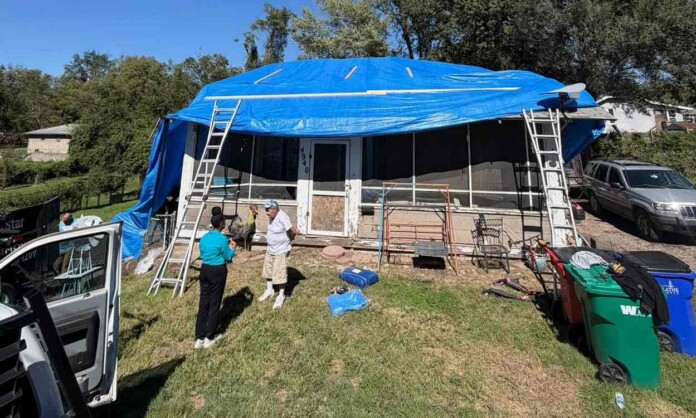
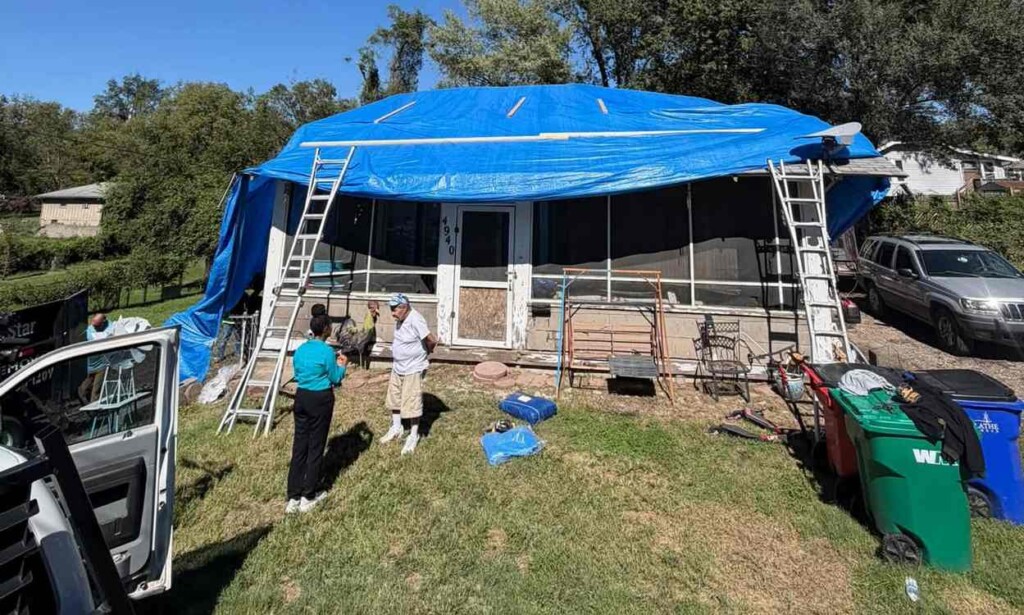
After a storm dumped a silver maple tree down through his roof, Kansas resident Gilbert Kirk told local news that he wasn’t looking for a miracle or an insurance handout.
He just wanted a tarp.
Two days later, last Friday, a stranger arrived at Kirk’s debris-laden front lawn in Wyandotte County, and said he’d be back in 30 minutes with a tarp, some lumber, and a crew to cover up the maple-shaped gash in Kirk’s house.
“OK, whatever, you know,” he remembered thinking, in a follow-up interview with KCTV 5. “And then the next thing I know, he’s back with a load of lumber… and the next thing I know, there were just trucks,” he said, gesticulating to his driveway.
When the storm arrived, 71-year-old Kirk and his dog Beetle were trapped under the collapsed roof for hours. Now, for the first time in weeks, they have a new roof over their heads, and with help from a small arsenal of stand-up fans, the man has the semblance of a home again.
“Oh, it’s unbelievable, the way the community has come together,” Kirk said. “It’s drying out inside now, and I’ve got fans running in there… and it’s just drying it out good.”
MORE COMMUNITY CAMARADERIE: Neighbors Get Swept Up in Man’s Viral Journey to Clean a NYC Street Block Every Day for 100 Days
KCTV called the men ‘strangers’ but the crew who installed the tarp on Kirk’s roof identified themselves in a Facebook post from the network as local residents Kirk Mata, Steven Vega, Dominic Foreman, and Brigette Henson, while another community member, Phil Lopez, commented that he first helped Mr. Kirk pull the silver maple tree out of his house.
“He [Kirk] has called me every day to tell me thank you,” Vega wrote, “We just did what was right and needed to be done.”
SHARE This Community Coming Together To Get A Man Out Of The Weather…
A Swarm of Seven Meteor Showers Will Light Up the Night Skies All October Long


October will feature nothing less than 7 separate meteor showers, but in terms of activity, one above all others merits an entry on your calendar.
The Orionids will peak on the night of Wednesday, October 21st, promising a maximum rate of 15 shooting stars per hour.
The Orionids are not only one of the most active meteor showers of the year, but they are among those most easily found, as even children can spot the 3 recognizable stars which form Orion’s Belt. The shower was named after the constellation because it seems the shooting stars radiate out of this region of the sky.
Orion will be in the east, and the only shame is that the Moon will be three-quarters waxing, and may limit visibility.
If that’s a true buzz killer, Consider this Saturday, (Oct. 10th) when the New Moon will coincide with the peak of the Southern Taurid Meteor Shower. Despite its name, this stream of comet debris is easily seen in the Northern Hemisphere, and can produce up to one shooting star every 10 minutes.
That might not seem like much, but it’s double what can be seen watching the Camelopardalids, the Delta Aurigids, the ε-Geminids, and the Leonis Minorids—all of which peak this October.
SHARE This Perfect Reason To Get Out Under The Stars With A Hot Drink…
Saudi Solar Park Proves Brilliant Breeding Ground for Threatened Sand Gazelles


In clearing two hurdles with one bound, Saudi conservationists have turned a large solar farm into a breeding shelter for a vulnerable species of native gazelle.
Located near the Red Sea coastline in a massive, 24,500-square-mile nature reserve, the solar plant is now hosting Arabian sand gazelles, a species of special consideration for wildlife managers.
Though commonly found across the world’s zoos, it’s believed only 3,000 of these small ungulates survive in the wilds of the Arabian Peninsula and Turkiye. Zoos are one thing, but a 250-megawatt solar power installation is another.
The plant serves the Kingdom’s 100% renewably-powered tourist resort, Amaala, but it’s now become the home for 38 gazelles. Spanning 1,200 acres, the wildlife-proof fencing surrounding the arsenal of panels ensures the gazelles can feed, breed, and explore without predation pressure.
The hope is that these several dozen can grow to over 500 which will then be used to reestablish a strong population within the massive reserve.
“Our rewilding goal is to build self-sustaining wildlife populations that can survive in the wild without ongoing human intervention,” said Andrew Zaloumis, the reserve’s director.
“This collaborative innovation not only accelerates that work but also introduces a novel ‘double-green’ framework with global scalability. We are calling it ‘ReWildingVoltaics.’”
Doesn’t really roll off the tongue, but branding is hardly the point.
Along with the sand gazelles, mountain gazelles and Arabian hares were also released into the solar park last October. In May, once it was clear the animals were settling in, male members were added in the hopes of establishing a self-perpetuating population.
SOLAR SYNERGY:
- Switzerland Set to Roll Out Solar Panels Between Railway Tracks–A World First
- Resourceful Singapore Finds Perfect Place for 86 MW Solar Farm–its Biggest Reservoir
- Researchers Harness Sunlight to Produce Both Power and Food—Using Light to Improve Each Harvest
It’s not the first idea of doing 2 different things with solar plants. GNN has reported on the benefits observed with pasturing sheep and growing crops around and underneath solar panels, and some of the principles apply to gazelle breeding. The panels offer easy shade that’s between 8 and 18 degrees cooler than under the Arabian sunshine.
The Saudi Gazette reported that the initiative supports the Saudi Green Initiative targets to protect 30% of the Kingdom’s land and sea and generate 50% of its electricity from renewable sources by 2030.
SHARE These Unlikely Allies To Wildlife With Your Friends…
‘You’re Walking!’ – Dad Surprises Children Having Recovered Ability to Walk After Serious Brain Injury
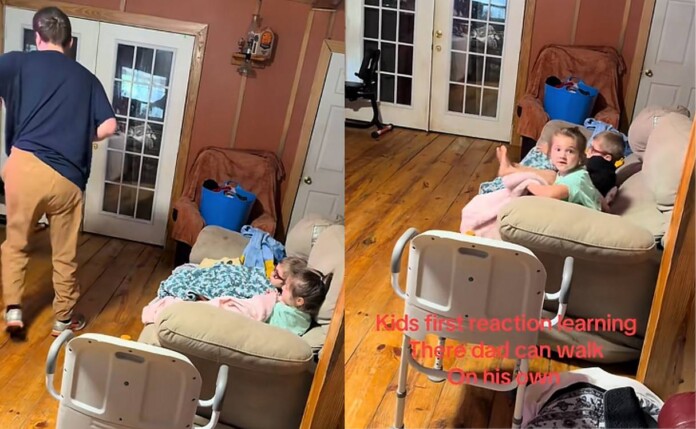
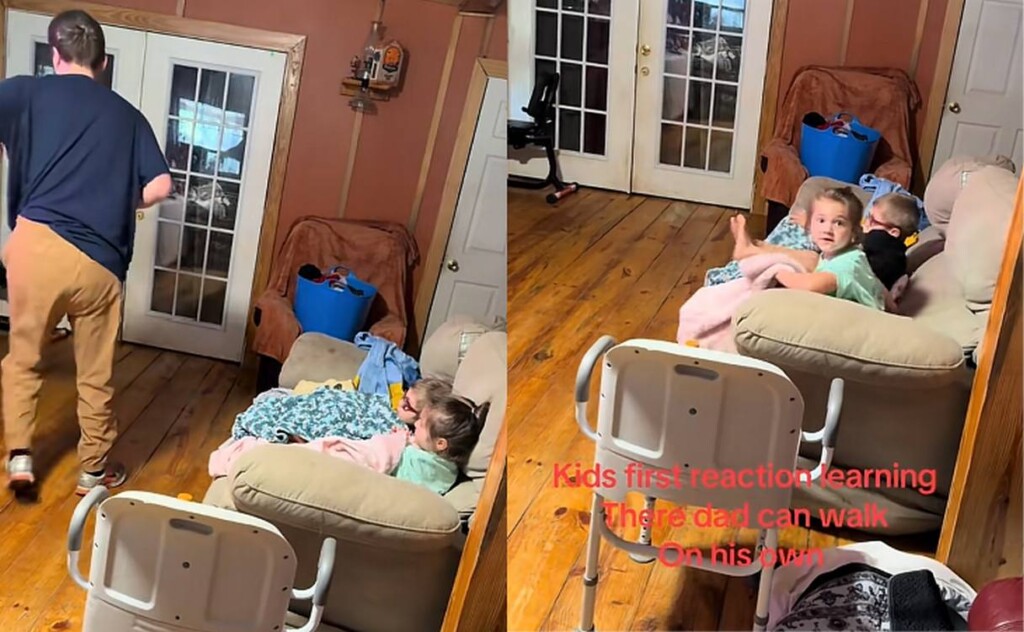
After 3 years of recovery from a brain injury sustained in a car accident, a father surprised his children by walking independently again.
Lounging on the couch enjoying some TV time, children are excellent at completely zoning out of everything else around them.
That’s why both the father’s older daughter and younger son did a double take as he ambled by across their view.
“Daddy!” says the daughter, “you’re walking!”
“Yeah, he can walk!” cheered the son, before they both got up and followed him out of the house.
“Dad you’re walking! You’re actually walking!” they continue.
The son asks dad to hold his hand as they walk off from the house into the pine forest surrounding it.
Captured on TikTok, this tiny, intimate chapter of a long and likely painful road to recovery resonated immensely with viewers, who liked it 1.7 million times, shared it 40,000 times, and left 16,000 comments.
Among those, someone pointed out that everything the children were saying: “hold my hand, you’re walking! be careful,” the father too, had likely said—when they were first learning how to walk.
WATCH the video below…
@glittersparkles901 Kids first reaction learning there dad can independently walk on his own after three years after an accident left him with a brain injury and unable to speak or walk we are still praying for the speech #momma ♬ original sound - glittersparkles
“The harder the struggle, the more glorious the triumph.” – Swami Sivananda

Quote of the Day: “The harder the struggle, the more glorious the triumph.” – Swami Sivananda
Photo by: Getty Images for Unsplash+
With a new inspirational quote every day, atop the perfect photo—collected and archived on our Quotes page—why not bookmark GNN.org for a daily uplift?

Good News in History, October 7

Happy 71st Birthday to the brilliant cellist Yo-Yo Ma, who was born in France. The Chinese-American musician was a child prodigy, performing from the age of five, when his mother, a singer, and father, a violinist, moved to New York City. READ more about this prodigious but also innovative musician… (1955)
Oldest Man in Oregon Credits Clean Diet and “Good Mind” for Reaching 108-years Young

A man who’s believed to be the oldest individual in the state of Oregon recently rung in 108-years-young with a cake and some words of wisdom.
“You don’t know what it’s like to be 100-plus. I’ve found out and I like it!” the Birthday Boy said beneath 3 large blue balloons forming 108, with Oregon Public Broadcasting behind the red light.
Dozens of people had gathered to celebrate Beryl Dillman’s birthday at Merrill Gardens assisted living facility in Eugene. As they sang ‘Happy Birthday’ he blew out the candles on a large white and gold cake, while 108 blue balloons cascaded down from above.
Comfortably passing the time at Merrill Gardens, Dillman is a living, walking, good example. His birthday proved the perfect time to meet another of his great grandchildren, Bella Sturges.
He uses a walker to get around, but is still quite prescient, and a good singer. While some centenarians credit, their nonconfrontational attitude, and others their exercise habits, the great-grandfather of 19 said he’s always maintained a cleaner diet.
“Part of the secret is to be careful what you drink and eat,” Dillman told OPB. “I never bothered with alcohol drinks and things like that.”
Most don’t associate the man with the diet, however, and readily brought up his positive attitude, his readiness to show love, overcome obstacles, and tell the truth.
“He’s always had such a positive attitude and a cheerful disposition,” his 72-year-old daughter Ruth Sturges said. “He’s always been a problem solver. So if there’s a stumbling block or barrier, he’s always looking for a way to fix it, not complain about it.”
“I’ve always tried to be careful what I say and what I do,” he opined on the occasion of his 106th Birthday, to KVAL News, where he also addressed his diet—don’t overeat.
WATCH Dillman celebrate his birthday in a video below from OPB…
SHARE This Elder’s Wisdom And Joy Surrounded By Family With Your Friends…
Nokia and NASA Team Up to Bring 4G to the Moon and Our Astronauts


Children of astronauts may soon be able to video call their parents in space, as NASA wants to bring terrestrial 4G to the Lunar surface.
Ostensibly to prepare for a semi-permanent human presence there, an outer spatial 4G network would significantly streamline and lower costs for off-world communications.
Partnering with Nokia’s Bell Labs, the simple 4G device will be constructed with a variety of off-the-shelf components, and is set to be launched into space aboard a SpaceX Falcon 9 rocket later this year at an undetermined launch window.
It will reach the Lunar surface via a landing craft made by the US company Intuitive Machines. Once there, and at least on paper, it will connect the lander via radio equipment to 2 small rovers that will be dispatched in search of water ice.
It’s a classic modern-NASA mission example of tying together US commercial innovation in pursuit of the agency’s science and exploration missions both present and future. Bell Labs was given a $14 million grant back in 2020 to develop the network and transmitters.
“The first challenge to getting a network up and running is having a space-qualified cellular equipment that meets the appropriate size, weight, and power requirements, as well as being deployed without a technician,” Walt Engelund, deputy associate administrator for programs at NASA’s Space Technology Mission Directorate, told CNN.
Currently, space missions like Artemis II which launched earlier this year, rely on traditional radio telecom systems, but going forward, NASA wants to have comms powerful enough to stream high-resolution video and upload big science datasets.
“Eventually, this effort will help establish a lunar communications network that could give our explorers the ability to beam scientific data back, confer with mission control, and talk to their families, as if they were walking down the street on their cellphones,” said Engelund, according to CNN.
THE SPACE ECONOMY: Scientists Successfully Mine Meteorites for Precious Metals on International Space Station
The Artemis Program isn’t just aiming to return humans to the Lunar surface, but also to investigate the potential of staying there on a semi-permanent basis. The 2 rovers, for example, that will land with the Nokia device, will be searching for water—not to confirm a scientific theory—but to ascertain the water’s potential as a resource for a Lunar base.
Water ice could, via electrolysis, provide breathable oxygen, spacecraft fuel, and drinking water at much lower prices than resupply missions launched from Earth.
4G networks enable the digital economy, and the idea would be to simply extend that network, and therefore that economy, to space, such that Lunar astronauts or non-astronaut visitors would have the same terrestrial network options—apps, messaging platforms, etc.—that they’d have on Earth.
ALSO CHECK OUT: Maiden Rocket Launch ‘a Grand Success’ for India’s First Private Spaceflight Company
And just as how space-born innovations have a way of making themselves useful back home, Bell Labs believes that networks which can survive conditions in space and on the Moon would instantly be transferable to Earth’s own harsh environments, like the Sahara Desert or Antarctica.
The best-case scenario predicted for the test landing would be for Intuitive Machines’ rovers to find water ice and transmit high-resolution video and images of it via the Bell Labs network down to Earth—a world-first, and a giant leap for telecommunications.
SHARE This Real World Vision Of An Off-World Future Today…
Illinois Community Members Honored for Helping Save Woman in Submerged Vehicle (WATCH)
On a stormy afternoon in Illinois in August, an elderly driver lost control of her vehicle as it plunged into a flooded retention pond.
Sinking up to its roof, multiple local community members immediately began to swim out to help, joined by 4 members of the Champaign Police Department (CPD).
Occurring on the 1900 block of North Prospect Avenue in Champaign, the 90-year-old woman was successfully rescued amid the downpour, and on September 29th, the rescuers were commended for their bravery.
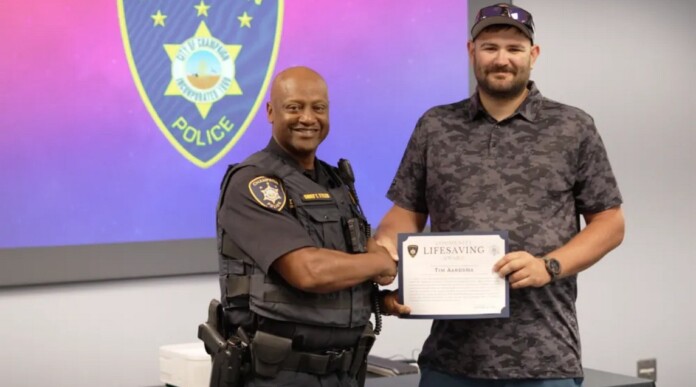
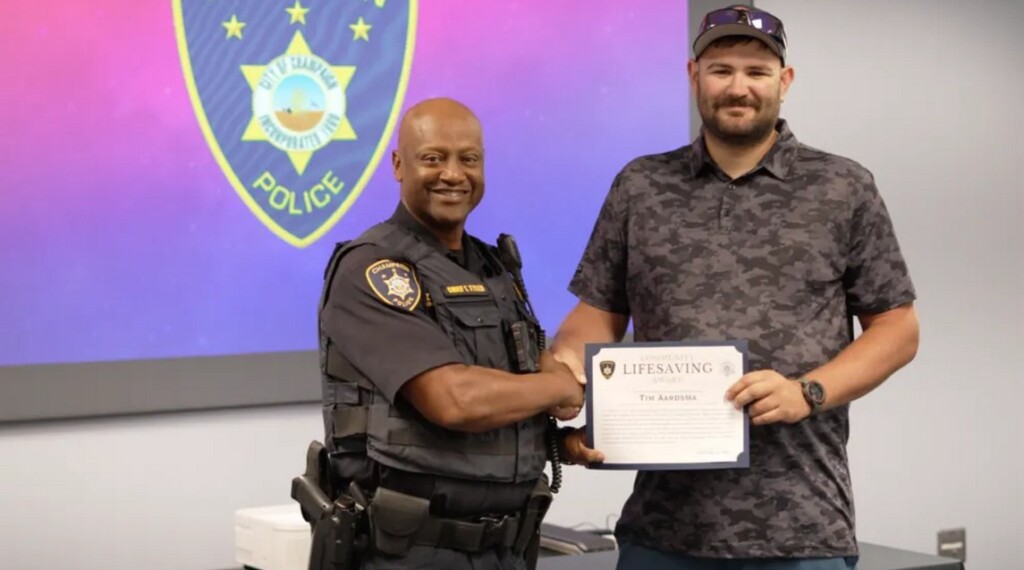
The 3 community members who went into the water were recognized with Community Lifesaving Awards at a small event, with Champaign Police personnel reading their heroic deeds for their families and friends.
Additionally, 4 officers who helped pull the driver out of the vehicle were also present, receiving the Chief’s Challenge Coin for setting their safety aside and taking extraordinary measures to keep everyone safe.
TEAM RESCUES: EMT Ran 1.5 Miles up 1,000 Feet of Elevation in 31 Minutes to Get Blood Transfusion for Injured Climber
The 90-year-old driver also attended, and thanked the people who helped her reach safety on that harrowing day.
The woman’s son, who identified himself as a US Coast Guard officer in the comment section of a Facebook post from the CPD, thanked everyone involved in the rescue, saying “I know full well how dangerous rescues can be and commend you for your quick and heroic actions.”
WATCH the story, including dash and body cam footage, below…
SHARE These Good Samaritans Receiving A Just Reward For Their Selfless Bravery…
Virginia Becomes Latest State to Enact ‘Clean Slate’ Law, to Help Residents Move on from Minor Offenses


Virginia’s new Clean Slate law came into effect last Thursday, meaning that thousands of misdemeanor offenses will be automatically sealed to help residents move forward with employment or loan opportunities.
The law automatically seals criminal records for Virginians who were convicted in various cases including certain misdemeanors like petit larceny and trespassing, or underage alcohol and or cannabis use.
Every adult will remember making mistakes as a teen, and the Clean Slate law is designed to ensure that these mistakes don’t weigh down potential career or financial paths by automatically sealing records 7 years after a conviction provided no subsequent conviction has been made.
ABC 7 news reporting on the law, heard from Lauren Young, a record-sealing resource attorney.
“It’s helping our local economies, and it’s giving people their dignity back. Obviously people are concerned about it. They are worried that people are going to be able to hide scary and dangerous offenses. But most of those aren’t eligible for sealing now anyway.”
Young referred to DUIs, child-sex offenses, domestic abuse, and other violent acts.
One context in which the Clean Slate law will truly be welcome is in cases of deferred disposition: whereby a court, facing a suspect who’s plead guilty, postpones sentencing and potentially removes the possibility of an entry on someone’s criminal record, provided the guilty party completes certain probationary conditions like paying court fees or fines, fulfilling community service, or attending educational courses, such as on defensive driving.
If the point is to allow the perpetrator to admit fault and a willingness to repair their relationship with the community, the ability for background checkers to find that sentencing seems inordinately harsh.
MORE STORIES LIKE THIS: Judicial Overhaul in India Decriminalizes Hundreds of Offenses That Previously Landed You in Prison
Regarding background checks, when criminal records are “sealed” they are not expunged, as other laws have mandated they be in other cases on which GNN has previously reported.
Instead, they are closed from public access. Background checking firms can still recover the records, as can government agencies under certain contexts, but it’s illegal to share the content of those records with others, such as a potential employer.
AMERICAN JUSTICE: Activist Wins 10-Year Battle to Ensure That Child Abuse Is Considered Above All Else in NY Custody Trials
Still others will benefit from this automatic sealing beyond those already mentioned. Whether charged with a misdemeanor or even some felonies, if an individual receives an acquittal, or if the judge orders the suit to be dismissed with prejudice—meaning it cannot be re-brought against the defendant—these records will also be sealed.
People whose records will not automatically be sealed may still have grounds to petition for them to be, as the law grants 2 new petitioning pathways detailed here.
Clean slate laws have been enacted in 14 states plus DC, according to a justice reform advocacy nonprofit the Clean Slate Initiative. They include diverse states such as Oklahoma, California, Virginia, and Utah.
SHARE This Big Step Forward In Helping Individuals Leave Mistakes In The Past…
“Problems are not stop signs, they are guidelines.” – Robert Schuller (Think about what you can do to move forward!)

Quote of the Day: “Problems are not stop signs, they are guidelines.” – Robert Schuller (Think about what you can do to move forward!)
Photo by: Rodion Kutsaiev for Unsplash+
With a new inspirational quote every day, atop the perfect photo—collected and archived on our Quotes page—why not bookmark GNN.org for a daily uplift?

Good News in History, October 6
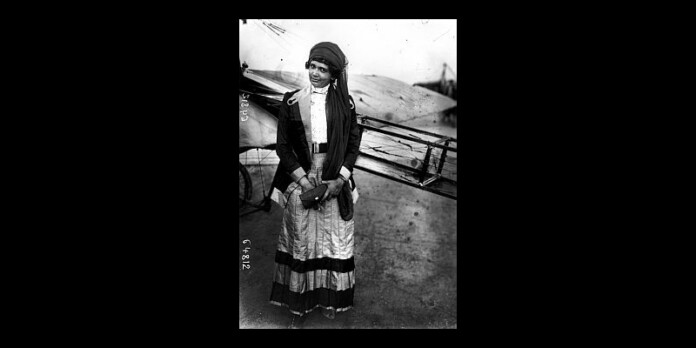
115 years ago today, Beatrix de Rijk became the first female licensed Dutch aircraft pilot. This pioneering aviator was born in Surabaya, modern-day Indonesia in the Dutch East Indies, to a Javan mother and a Dutch father. In the Netherlands, she was the first Dutch woman to drive a German automobile, but she found the car was too slow for her, so she bought an NSU motorbike instead, forfeited her inheritance, and left for Paris. READ how she got her wings… (1911)
Fighting Wildfires from Prison, A New Law Gives Ex-Cons Route to California Fire Dept. Jobs on Release


Rather than being stuck on the chain gang, California prisoners are often on the bucket brigade.
Roughly half of all California firefighters are incarcerated individuals. The pay is better than other prison jobs, and is reported to be a welcome break from the monotony of prison life.
Now, following the stewarded passage of a bill that’s been signed into law by Governor Gavin Newsom, formerly incarcerated firefighters will reenter society with a direct career pipeline.
Watched closely by CalMatters, the passage of AB 2483, also called the Formerly Incarcerated Firefighter Certification and Employment Program, will both ensure standardized certification protocols for firefighting and offer priority in hiring for certain entry-level positions at Cal Fire, the state firefighting force, to those who were previously imprisoned.
“The bill tells incarcerated firefighters that their hard-earned experience counts,” Royal Ramey, the chief executive of the nonprofit Forestry and Fire Recruitment Program, told CalMatters.
Ramey was himself a formerly-incarcerated firefighter, but being that the certificate he received stipulated he earned it in prison, he was reluctant to use it on his CV. Instead, he went all the way through a normal firefighting academy.
His goal in convincing California’s state assembly to vote yes on AB 2483 was to ensure that other incarcerated firefighters feel proud and confidant that certificates of training and experience received on the job in prison will be of benefit, not hinderance, to them on the outside.
BETTER ON THE OUTSIDE:
- Nonprofit Puts Ex-Cons to Work with Paid Apprenticeships as Machinists in California
- Formerly-Incarcerated Artisans Craft Tables Designed by Women in Prison, to Benefit Them When They Get Out
- Prisons Across the World Are Shaving Days Off Sentences for Every Book Read by Their Inmates
Ramey and his nonprofit worked with Sade Elhawary, a Los Angeles Democrat, to steward the bill through committee. The pair learned from Elhawary’s previous attempt to pass similar legislation, and addressed outstanding concerns held by Cal Fire’s union.
By 2028, the bill will see that returning ex-cons who fought fires in prison have a meaningful, unbarred pathway to a fulfilling job, potential 6-figure income, and a state pension.
SHARE This Great News For Diligent California Firefighters.
Star Quarterback Wants to Help Gen Z Handle Money with New Video Series ‘Finance with Fernando’


As starting quarterback, Heisman Trophy winner, #1 NFL Draft pick, and aspiring philanthropist, Fernando Mendoza seems all lined up for a dynamite career in football.
Yet as the holder of an MBA in Business Administration from Kelley School of Business at Indiana University, Mendoza has another interest he wants you to know about: financial responsibility.
The young man, who’s already accomplished so much, has partnered with US Bank to launch a new video series called Finance with Fernando, in which he hopes to help Gen Z manage money in the K-shaped economy.
“I’m Fernando Mendoza—star quarterback. But my true passion is fiscal responsibility,” he said in a video teaser for the series. “So get pumped for my educational video series—Finance with Fernando. A practical guide for Gen Z to make the most of their money.”
No episodes have been released yet, so it remains to be seen whether the 23-year-old has the chops to metaphorically make it on Wall Street. Aside from the impressive financial education backdrop, Mendoza has been quoted as sharing some pretty solid money-management insight.
In January, during his postgame press conference after Indiana’s 56–22 CFP semifinal win over Oregon in the Peach Bowl, he was asked—entirely regarding football—how he and the team avoided chasing the “instant gratification” that comes with big wins and keep focused through the whole of a season. His response doubles as excellent investment bedrock.
“Delayed gratification is a concept that was brought up by Stoicism and by the Stoics. I think it’s one of the greatest attributes.”
GNN reported on Mendoza before, when he signed a check for half-a-million dollars to the the National MS Society to accelerate progress toward a world free of multiple sclerosis.
This ‘Mendoza Family Fund’ was meant to build on years of creative fundraising for MS undertaken by Fernando and his brother Alberto, also a collegiate football star at Georgia Tech. Together they had raised $360,000 for MS research in honor of their mother who lives with the disease.
SHARE This Unstoppable Young Man Conquering Finance And Football…
Nonprofit Brings Free Music Education to More Than 20,000 Miami Students in 131 Schools

Down in Miami-Dade County, educators are seeing how school doesn’t mean a thing if it ain’t got that swing.
Showing up, taking an interest in school and the community therein, comes that much easier for the some 21,000 students benefiting from free music classes offered at 131 schools by Young Musicians Unite (YMU).
Together, YMU collaborates with schools and community partners to provide free music education that inspires personal growth, strengthens communities, and prepares the next generation of leaders.
Leading a trumpet sections takes guts, but it’s also fun, means making friends and learning the lifelong skill of wielding an instrument. That’s where 9-year-old Jayden Morisseau at Little River K-8 wants to be. The young man spoke with CBS News Miami.
“You get a lot of opportunities to go places, and you get better at playing your horns, and also, you got a good teacher that knows a lot of music,” he said, describing the class.
That “cool teacher” is Reinaldo Velez, a YMU student himself who now leads classes like the one at Little River.
“It brings some unity to everybody here as well,” Velez said. “Personality skills, there’s a lot of traits that can be learned along the way. How to fix an instrument, how to be able to help somebody when they’re in need.”
MUSIC IS NOT OPTIONAL:
- Parents Should Sing More to Their Babies For the Positive Impact on Infant’s Mood–And Their Own
- Guitar Center is Replacing Instruments Lost in L.A. Wildfires With New Initiative
- Eddie Van Halen’s Son Donates $100,000 to Kickstart Charity that Funds School Instrument Purchases
The CEO and Founder of YMU was himself a musician growing up in Miami, and credits music class with helping him find his voice and his beat, developing mastery over his instrument, and the suite of additional skills that have landed him as leader of one of the Southeast’s leading music education nonprofits.
“Kids need a reason to show up to school, and kids need an opportunity to be seen,” Gonzalez Zeira, CEO, told CBS. “And when they’re part of a music classroom, they’re part of something bigger than themselves.”
“Young Musicians Unite is an incredible program and their leaders are incredible advocates in our community for connecting our children with the world of arts and what it can do for them and their futures,” said Danielle Cohen Higgens, Commissioner for Miami-Dade County District 8,
WATCH the story below from CBS, or WATCH the original YMU song “No Moon At All”…
SHARE This Fantastic In-School Offering For Children In South Florida…
Orphaned, Rescued, and Rewilded, Female Gorilla Becomes a Mother in Historic Conservation Success


One of the first-ever eastern lowland gorillas to be successfully returned to the wild gave birth on May 21st in her new/old home of Virunga National Park in the Democratic Republic of the Congo (DRC).
Every new gorilla infant is its own conservation success story, but coming as the baby has from a mother who was almost cut off from her mountain home entirely, it becomes all the more special.
The mother, Lulingu, was one of four female gorillas moved at the end of 2024 from the GRACE sanctuary for rescued gorillas in North Kivu province to Virunga. Her baby was fathered by a wild silverback living on Mount Tshiaberimu, a sign that Lulingu had successfully integrated into the wild population.
Rescuers recovered Lulingu when she was just 18 months old after being taken from her family and sold into the illegal wildlife trade. She was the youngest orphaned gorilla ever brought to GRACE, the only sanctuary in the world for rescued eastern lowland gorillas.
GRACE provided Lulingu with around-the-clock care before another gorilla, Pinga, took over as her surrogate mother and welcomed her into the larger gorilla family at GRACE. That family included Mapendo, Ndjingala and Isangi—the other 3 females who would eventually return to the wild.
The release of these 4 females, all of whom have joined the silverback’s family group, was the culmination of a more-than-5-year rewilding process led by GRACE, Virunga National Park and local communities, with support from Gorilla Doctors, and Re:wild.
“This is a milestone for the gorillas,” said Katie Fawcett, executive and science director of GRACE Gorillas. “They’ve adjusted to living in the wild extremely well so far, but raising an infant in the wild can be a challenge even for experienced mothers. We’re cautiously optimistic that Lulingu will navigate motherhood well and that the baby will continue to survive. No matter what happens, this is another historic first for eastern lowland gorilla conservation.”
The birth is also an important step toward the conservation project’s central goals: providing a critical genetic boost to the small and isolated gorilla population on Tshiaberimu.
A gorilla monitoring team has been tracking the family group closely since the 4 females were released into the wild in December 2024 and has observed them mating with the dominant male. In addition to monitoring the gorillas’ feeding behavior, the team has been collecting urine samples non-invasively from leaves and using human pregnancy tests to detect elevated levels of hormones associated with pregnancy.
“None of the 4 females have required veterinary treatment for illness or injury since being rewilded—the outcome we always hope for,” said Dr. Cedric Kibengo, a field veterinarian with Gorilla Doctors involved in the reintroduction effort from the start. “With the arrival of Lulingu’s infant, we now have one more ‘patient’ under our care, and both mother and infant are healthy and doing well.”
CONGO’S WILDLIFE: New Species of Monkey Found in DR Congo Shows How Much There’s Left to Discover
Lulingu has already navigated a series of firsts since returning to the wild, adapting to a new habitat, diet, and social environment. These successes have made the monitoring team optimistic as she navigates another first: raising an infant.
“We have seen her nursing, cradling, and playing with the baby. The other young gorilla in her group has shown interest in the baby, and Lulingu has been very patient with him,” said Benoit Ishaba, park ranger, and head of gorilla monitoring on Mt. Tshiaberimu.
Lulingu’s new infant is also giving scientists and conservationists a rare opportunity to observe a rewilded eastern lowland gorilla raising her first infant and to better understand how the reintroduced females respond to and interact with a new baby.
MORE PRECIOUS CARGO: S. Carolina Aquarium Celebrates ‘Baby Boom’ of Critically-Endangered Penguin Chicks
Gorilla pregnancies typically last between 8 and 9 months. At least one of the other rewilded females may also be pregnant and could give birth in the coming weeks or months.
“Each healthy infant represents more than an addition to the population—it is a sign of resilience, recovery, and what is possible through long-term care, collaboration, and targeted protection,” said Mary Brown, Re:wild’s Africa program lead.
The partners will continue to closely monitor Lulingu and her baby as they take their place in the future of this Critically-Endangered primate.
SHARE This Amazing Turn Of Fortune For Lulingu And Her New Baby…
“Good judgment comes from experience, and a lot of that comes from bad judgment.” – Will Rogers

Quote of the Day: “Good judgment comes from experience, and a lot of that comes from bad judgment.” – Will Rogers
Photo by: charles deluvio
With a new inspirational quote every day, atop the perfect photo—collected and archived on our Quotes page—why not bookmark GNN.org for a daily uplift?

Good News in History, October 5
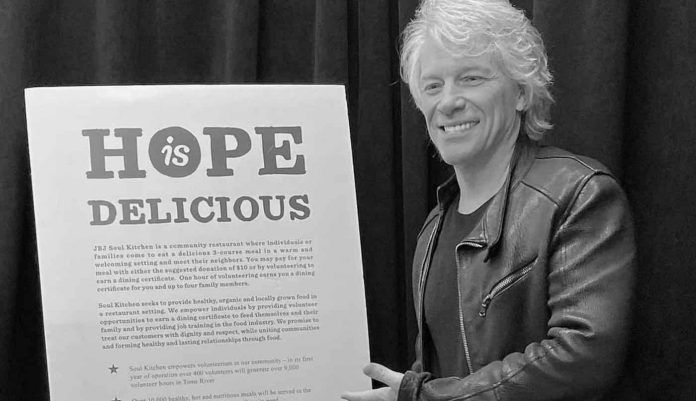
20 years ago today, the 60-year-old rock star Jon Bon Jovi, who’s sold 100 million records, launched a charity foundation to combat poverty issues like food and housing to ease economic despair. One of the flagship initiatives is his “JBJ Soul Kitchen” where guests pay what they want to eat well along the East Coast. WATCH a video showing their amazing effort to create a food bank on Long Island during the pandemic… (2006)
Pomegranates, Walnuts and Berries Could Unlock Heart Failure Treatment By Producing Urolithin A


A compound produced in the body after eating pomegranates improves heart function by up to 80%, particularly for a type of heart failure with limited treatment options.
Scientists at King’s College London have discovered that urolithin A – a natural compound produced in the body after consuming foods such as pomegranates, walnuts and some berries – improves the heart’s ability to relax, reduces scarring, and prevents harmful enlargement.
The finding may give hope to millions who have a type of heart failure where the heart retains its ability to pump blood but becomes stiff and less able to relax between beats—making it harder to fill with blood.
This is known as “heart failure with preserved ejection fraction” and accounts for around half of all heart failure cases—leading to breathlessness, fatigue, reduced ability to exercise, and an overall poor quality of life.
But it’s hard to treat because it’s driven by many factors—like aging, high blood pressure, and diabetes—and treatments are less effective.
Instead, clinicians focus on managing the underlying conditions and advise lifestyle modifications, such as weight loss and controlling blood sugar.
Urolithin A has attracted growing interest in recent years because of its links to healthy aging and mitochondrial function, a process in the body which generates energy.
MORE HEALTH BENEFITS: Eating Pomegranates Can Help Alzheimer’s Patients Alleviate Symptoms, Study Says
In a research first, the scientists discovered that urolithin A activates a protein called PKGlα, which plays an important role in both blood vessel function and heart muscle relaxation. Urolithin A targets a specific amino acid on the protein, activating a pathway resulting in cardiovascular benefits.
Treatments with urolithin A led to improved measures of heart function by up to 80% in animal models, compared to models that were not treated with urolithin A.
The laboratory experiment revealed that urolithin A increased the heart tissue’s ability to relax and reduced harmful scarring, also known as fibrosis, compared to controls. The compound also reduced enlargement of heart muscle cells compared to controls, helping to preserve normal cell function.
The researchers also tested urolithin A in engineered human heart tissue created from human stem cells. This is a cutting-edge laboratory model that closely mimics the structure and function of human heart muscle. Urolithin A significantly improved tissue relaxation in these cells, suggesting the findings could translate to human cardiac function.
Unlike many experimental compounds, urolithin A has already been evaluated in human studies and shows to have a favorable safety profile.
The study identifies both a promising new drug target and a naturally derived compound that could help address a significant challenge in cardiovascular medicine.
“This raises the exciting possibility of developing new treatments that improve clinical outcomes and quality of life for people living with the condition,” said Dr Joseph Burgoyne, senior author of the study, King’s College London.
MORE RESEARCH: Delicious Cancer Breakthrough: Pomegranates Found to Significantly Fuel Tumor-Fighting Immune Cells
“While there isn’t enough evidence to suggest that people should eat pomegranates to treat heart failure, these findings raise the possibility that dietary approaches that enhance urolithin A production may help alleviate this condition.”
Learn more about the study, funded by the British Heart Foundation, at King’s College London.
SHARE THE DELICIOUS HEALTH TIPS On Social Media…