












All News - Page 593 of 1733 - Good News Network
Home Blog Page 593

Next Time You’re Feeling Particularly Stressed or Anxious, This Study Says You Should Play Tetris

It can be easy to let yourself become overwhelmed by stress or anxiety during these turbulent times of social restrictions and coronavirus concerns—but this new study says that there is a very simple (and fun) way to ease your worried mind.

Research from the University of California shows that playing Tetris has a remarkable effect on a person’s mental health and performance.

Psychologist Kate Sweeny led the research by studying the game’s effects on the welfare of the university’s student population. During times of immense stress, such as undergoing final exams and considering future careers, Sweeny instructed the students to play the arcade game before measuring their relative levels of perceived anxiety.

Her research shows that by playing Tetris, overworked individuals often experienced a significant reduction in stress and anxiety and an influx in positive emotions.

LOOKAnimal Shelter Enlists Help of Pokemon GO Players to Walk Dogs

While most video games offer similar kinds of distraction, Tetris offers the perfect balance of challenge and accessibility; it’s difficult enough to keep players engaged, but simple and intuitive enough to allow players to stay relaxed and enjoy the experience. This specific mental state is referred to as “flow”—or “being in the zone”.

“Flow requires a delicate balance,” Sweeny said. “Flow is most readily achieved with activities that challenge the person somewhat, but not too much; have clear, achievable goals; and that provide the person with feedback about how they’re doing along the way.”

This is not the first study that has shown the benefits of Tetris, either—a 2009 study showed that people who practiced the arcade game over time experienced improved mental performance. This makes it a perfect activity for distraction, and a fantastic way to improve your mental wellbeing in a short amount of time.

MOREWatching Birds Near Your Home is Good For Your Mental Health

It has also been used to help addicts cope with their withdrawals and curb food cravings.

“The Tetris study is key because it experimentally manipulates flow and shows effects of that manipulation, which provides convincing evidence that flow actually causes well-being during waiting periods, not that it just happens to coincide with well-being,” Sweeny said.

Be Sure And Pass On This Fun Piece Of News To Your Friends On Social MediaPhoto by UC Riverside
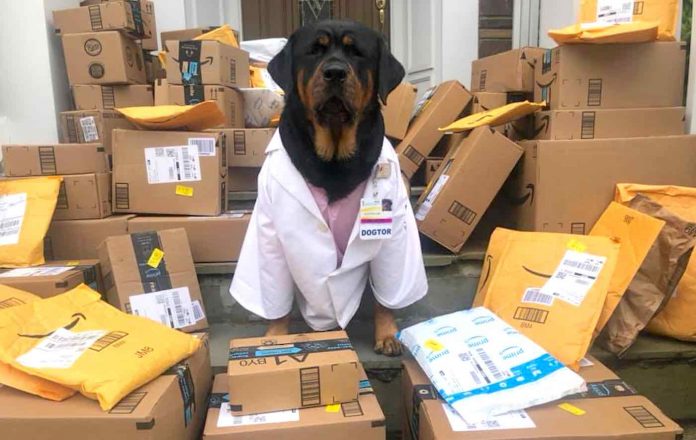
This Therapy ‘Dogtor’ is Delivering Thousands of ‘Hero Healing Kits’ to Hospital Workers on the Frontlines

This “dogtor” may not have a degree in medicine, but she has been helping to treat hardworking healthcare employees with joy and care packages.

Prior to the COVID-19 outbreaks, Loki the Rottweiler and her owner, Caroline Benzel, were familiar faces at the University of Maryland School of Medicine in Baltimore. Since Loki had such a friendly reputation with the hospital staffers and patients, she and Benzel would visit the hospital and cheer up the residents three days a week.

Because Benzel is just a second-year medical student, however, she was pulled out of school and off of the hospital frontlines after the novel coronavirus outbreaks.

Rather than spend her time in quarantine twiddling her thumbs beside her therapy dog, she began thinking up new ways to help her hospital community.

RELATED: Sam’s Club is Offering ‘Hero Shopping Hours’ to Healthcare Workers Regardless of Memberships

At first, Benzel and Loki would use FaceTime conversations to offer some virtual comfort and relief to the staffers—but Benzel eventually found the inspiration for her new passion project after she noticed the physical toll that protective medical gear had on healthcare workers.

Since the doctors and nurses have been forced to wear gloves and masks around the clock, many of them have been developing rashes and skin irritation from the constant friction.

Benzel and Loki then took to the internet and started asking their social media followers for donations to make “hero healing kits” with hydrating skin lotion, boxes of tea, baby powder, chapstick, chewing gum, and moisturizer for healthcare workers.

CHECK OUT: 99-Year-Old WWII Veteran Raises $3.3 Million for Hospital Workers Simply By Walking Laps of His Garden

In just a few short weeks, the dynamic duo has used their Amazon Wishlist to raise thousands of dollars and collect hundreds of gift donations.

“So far we have raised over 1,400 total kits, but are closer to +1,600 incomplete kits,” Benzel wrote on Loki’s Facebook page. “The donations keep coming in!! Needless to say, we are blown away by the kindness and generosity of people.”

Not only has their internet campaign helped to fuel their labor of love, Benzel says that community members across the country have reached out to her about launching “hero healing kit” initiatives in their own cities.

WATCH: 17-Year-Old ‘Angel’ Cashier Picks Up $173 Grocery Bill for Senior Shopper Who Found Himself Short on Cash

”We will be distributing the majority of these to 4 different hospitals over the next week,” continued Benzel, “AND THAT IS JUST THE BEGINNING.

“The hope was people would see what we are trying to do and be inspired to do the same in their respective areas, and that HAS HAPPENED! … [we have] inspired others to do similar projects in New Jersey, North Carolina, [Pennsylvania], and other parts of Maryland.

“THIS was was the dream, and it is coming to fruition: not only to help frontline workers/first responders, but to inspire others to do the same in their counties and states for their respective hospitals,” added Benzel. “Thank you again for all the love and support shown through all of this. We wanted to show our people keeping us safe some love, and because of you, we have been able to do that.”


Benzel says that she just started distributing her first batch of care packages this week to four different hospitals, and she is excited to deliver many more in the weeks to come.

If you would like to donate to Benzel’s mission, you can check out her Amazon Wishlist—otherwise, you can follow their progress on Loki’s Instagram and Facebook pages.

This is just one of many positive stories and updates that are coming out of the COVID-19 news coverage this week. For more uplifting coverage on the outbreaks, click here.

Be Sure And Share The Pawesome Story With Your Friends On Social Media…

As Coal Usage Declines, New Study Finds Dramatic Decrease in Asthma Symptoms and Hospitalizations

After several years of researching four coal-fired power plants, scientists have found that local residents experienced fewer asthma symptoms and related hospitalizations as the plants either retired coal as their energy source or installed stricter emissions controls.

Not only that, emergency department (ED) visits dropped dramatically along with the decrease in coal usage.

The research conducted in Louisville, Kentucky was published in Nature Energy this week by the Columbia University Mailman School of Public Health in collaboration with several other universities and research institutions.

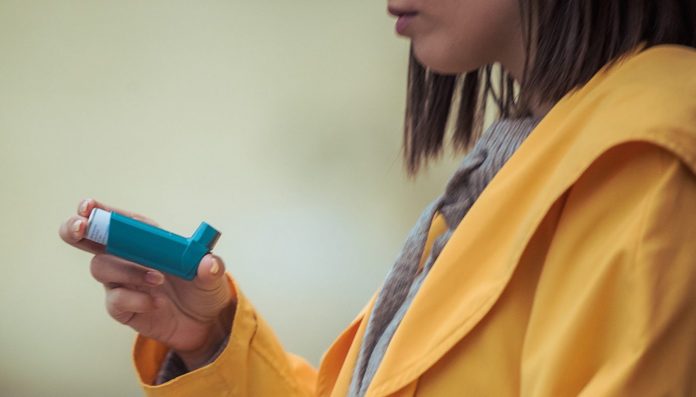
Starting with a pilot in 2012, the city of Louisville embarked on a project called AIR Louisville, which aimed to use data from Propeller Health’s digital inhaler sensors to gain insights into the impact of local air quality on the burden of respiratory disease in the community. The public-private collaboration equipped more than 1,200 Louisville residents with asthma and COPD with Propeller sensors, which attach to patients’ existing inhalers and deliver insights on medication use, symptoms and environmental factors to the Propeller app on their smartphone.

RELATED: Free Market Forces Will Obliterate Global Coal Reliance Within 10 Years, Says Study

Coal-fired power plants are known to emit pollutants associated with adverse health effects, including increased asthma attacks, asthma-related ED visits and hospitalizations.

In 2014, coal-fired power plants accounted for 63% of economy-wide emissions of sulfur dioxide (SO2) in the US. Historically, Kentucky has ranked among the top five states in the U.S. for emissions from power generation.

“AIR Louisville brought together local government, public and private partners and residents for a common mission: to leverage local data to make our city better and more breathable,” said Louisville Mayor Greg Fischer. “We are still seeing the results of AIR Louisville in this research, which demonstrates the public health impact of retiring coal as an energy source or further controlling coal-fired emissions.”

CHECK OUT: CO2 Emissions Stopped Rising Last Year Says IEA, Thanks to Growth in Renewables, Shunning of Coal

Between 2013 and 2016, one coal-fired power plant in the Louisville area retired coal as an energy source, and three others installed stricter emission controls to comply with regulations from the US Environmental Protection Agency. Researchers took advantage of these circumstances to analyze the impact of the coal-fired power plant energy transitions on residents’ respiratory health, using data from Propeller and local hospitals to assess how asthma-related symptoms, ED visits, and hospitalizations changed over time.

The study looked at the frequency of the total number of asthma-related ED visits and hospitalizations per ZIP code in Jefferson County, as well as the frequency of asthma rescue medication use among 207 people. Data on rescue medication use for asthma was used as a proxy for patients’ symptoms, as patients use their rescue medication for acute relief from symptoms such as coughing and shortness of breath.

“This study was unique in its ability to measure asthma morbidity based on both hospitalizations and daily symptoms, and to leverage an abrupt change in environmental exposure to more directly attribute changes in asthma exacerbation to changes in coal-fired power plant emissions,” said Dr. Joan Casey, lead author of the paper and assistant professor of environmental health sciences at Columbia University Mailman School of Public Health.

MORE: One of the Largest Native American Tribes Has Just Voted to End Their 100-Year Dependency on Coal

The researchers found that energy transitions in the spring of 2015 resulted in three fewer hospitalizations and ED visits per ZIP code per quarter in the following year, when comparing areas that had high coal-fired power plant emission exposure prior to the transition to those with lower levels. This translates into nearly 400 avoided hospitalizations and ED visits each year across Jefferson County.

At the individual level, the Mill Creek SO2 scrubber installed in June 2016 was associated with a 17% immediate reduction in rescue medication use, which was maintained thereafter. The study also found the odds of having high rescue use throughout a month (on average more than four puffs per day) was reduced by 32% following the June 2016 energy transition.

CHECK OUT: Appalachian Coal Miners Who Lost Their Jobs Are Being Retrained as Beekeepers – for Free

“This is the first study to use digital inhaler sensors to understand the health effects of reducing emissions from coal-fired power plants,” said study author Dr. Meredith Barrett, head of population health research for Propeller Health.

“We hope this evidence will encourage government officials to support stricter standards when regulating coal-fired power plants and encourage us towards cleaner power options, thereby protecting the health of the people who live near these facilities.”

Reprinted by Columbia University Mailman School of Health 

Power Up With Positivity By Sharing The Good News With Your Friends On Social Media…

Swiss Village Has Been Projecting World Flags Onto One of Their Tallest Mountains in Solidarity of Pandemic


Rather than raising a flag up on a flag pole, the nation of Switzerland is paying homage to their international neighbors struggling against COVID-19 by projecting different world flags onto the front of one of their most iconic Alpine mountains.

Light artist Gerry Hofstetter was commissioned to illuminate the famous Matterhorn mountain in Zermatt with different national flags to show solidarity towards countries that have been hit hardest by the novel coronavirus.

LOOK: Himalayan Mountaintops Visible for the First Time in 30 Years as Air Pollution Continues to Plummet in India

Now on every night since March 24th, the Matterhorn has displayed the flag of France, the US, India, Japan, Germany, the UK, Portugal, Spain, and many others.

“With this light projection, Zermatt wants to give people a sign of hope and solidarity in these difficult times,” reads the Zermatt Matterhorn tourism website. “The village shows solidarity with all the people who are currently suffering and is grateful to all those who are helping to overcome the crisis.”


Americans have been particularly touched by the gesture since the Zermatt website published a photo of the Star-Spangled Banner on the front of the 14,690-foot tall mountain with a caption reading: “As it stands, the USA is the country that has been most impacted by the COVID-19 crisis with the highest number of confirmed cases. Our thoughts are with all American people at this unprecedented time.

“May our message convey solidarity and give you hope and strength,” they added. “We look forward to meeting again at the foot of the Matterhorn. We are all in this together.”

WATCH: Beloved Opera Singer Unites Millions of Viewers With Livestreamed Easter Performance in Empty Cathedral

If you want to check out additional photos of the light displays or watch the livestreams of the illuminations, check out the Zermatt Matterhorn website.

This is just one of many positive stories and updates that are coming out of the COVID-19 news coverage this week. For more uplifting coverage on the outbreaks, click here.


Be Sure And Share This Inspiring Story Of Unity With Your Friends On Social Media…

We’ve Survived Before: NASA Invites Workforce to Stream Apollo 13 Film Tonight on 50th Anniversary of Rescue

NASA

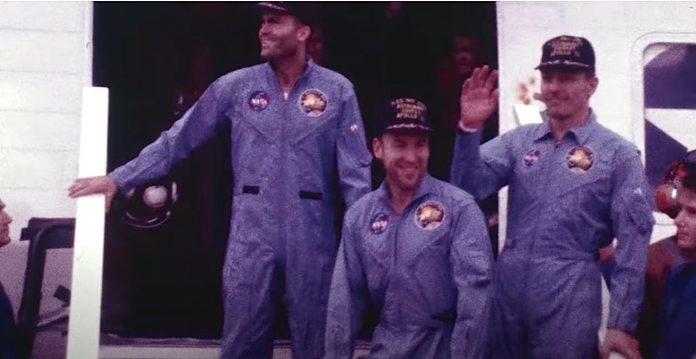
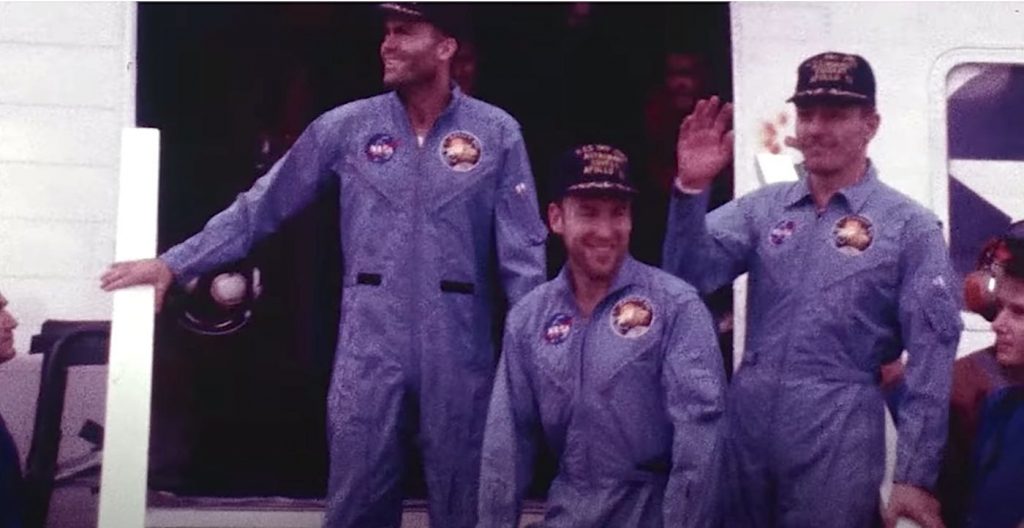
On this day 50 years ago, the determined astronauts who averted disaster aboard Apollo 13 landed safely back on Earth after four days fighting for their lives—and NASA is celebrating again, uniting with all its workers orbiting their homes in self-isolation.

Jim Lovell, Jack Swigert, and Fred Haise were on a mission to land on the moon—the third such mission conducted by NASA after President Kennedy had rallied the country for the challenge the decade before.

The 7th crewed mission of the Apollo space program was launched from Kennedy Space Center on April 11, 1970, but the Moon landing never took place. It was aborted after an oxygen tank in the Service Module (SM) exploded during routine tests two days after leaving Earth.

“Houston, we’ve had a problem.” Those were the famous words heard in the control room back in Texas.

The contents of the oxygen tanks leaked into space from the gaping wound in the wall. Without oxygen, needed for breathing and for generating electric power, the vehicle’s propulsion and life support systems could not operate. The smaller Lunar Module (LM), which was built only to land on the moon became the crew’s lifeboat.

Back home, engineers, mathematicians, and designers worked frantically in teams using simulators to figure out the correct emergency measures that would bring the crew home alive.

RELATED: World’s First All-Female Spacewalk Makes History for NASA

View of crippled Service Module after separation – NASA

Although the LM was designed to support two men on the lunar surface for two days, Mission Control in Houston improvised new procedures so it could support three men for four days. But, the crew experienced great hardship caused by limited power, a cold and wet cabin, and a shortage of potable water.

In order to get it pointed in the direction of Earth for reentry, their craft needed to be looped around the Moon.

POPULAR: This is the First Ever Image of a Black Hole and Scientists Are Calling It a ‘Dream Come True’

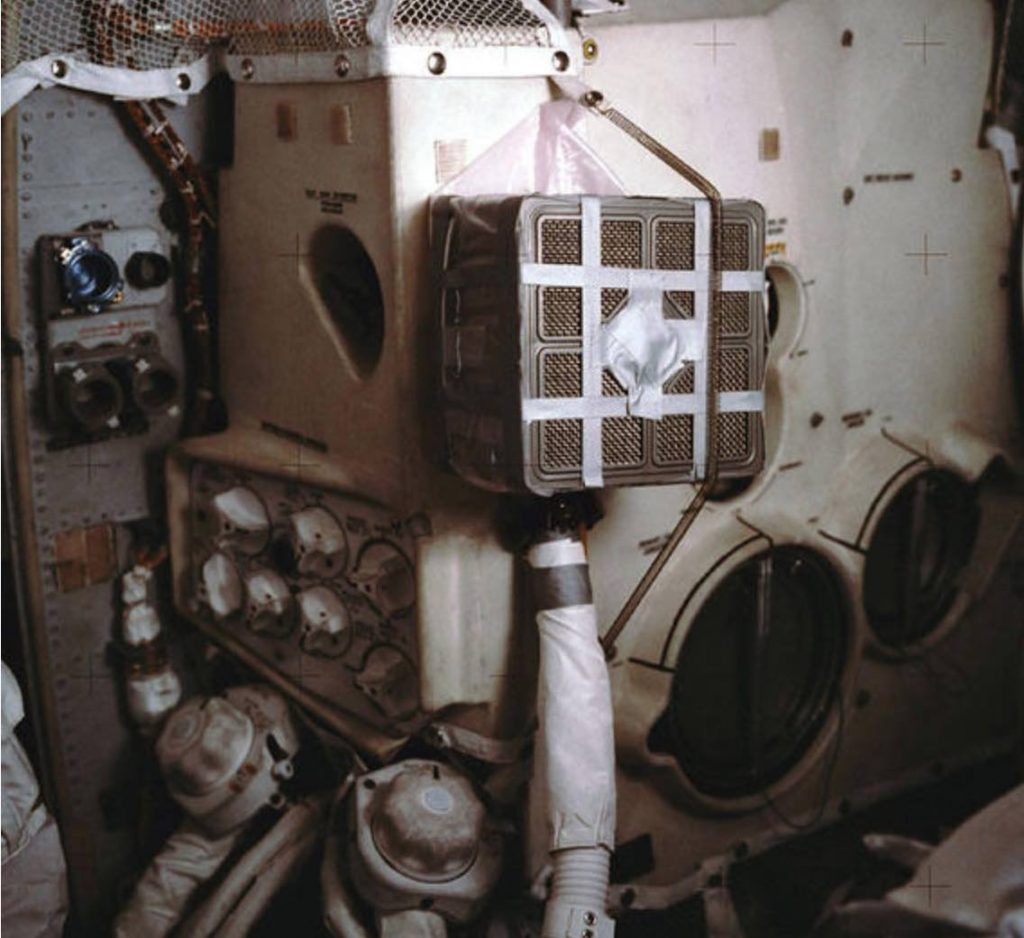
There was also a critical need to adapt the ship’s cartridges so that the carbon dioxide removal system would work. The crew and mission controllers were successful in improvising a solution—a device constructed using duct tape, maps, and other materials they had on board, as instructed by Houston control.

Inflight photo of device constructed by the crew from duct tape, maps, and other materials

All three astronauts had been U.S. Navy test pilots, accustomed to working in critical situations with their lives on the line—a fact which some have credited with the ultimate success of the rescue.

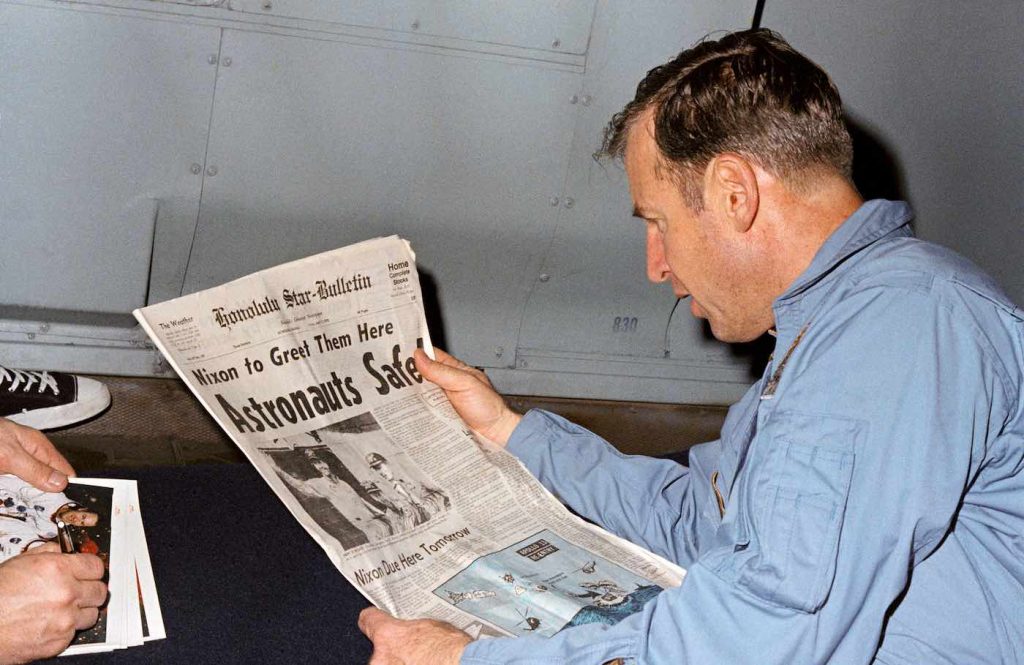
The astronauts’ peril briefly renewed interest in the Apollo program as tens of millions watched the splashdown in the South Pacific Ocean on television.

Jim Lovell reads a newspaper on the way back home –NASA

The story of the mission was dramatized, most notably, in the 1995 film Apollo 13, based on the memoir co-authored by Lovell the commander, entitled Lost Moon.

MORE: Teen Discovered New Planet 6.9 Times Bigger Than Earth Just Days into NASA Internship

NASA to Stream ‘Apollo 13’ for Families of its Workers at Home

Yesterday, NASA issued an agency-wide message to all NASA employees announcing a special viewing opportunity after obtaining licensing permission from Universal Studios:

“We would like to invite the NASA workforce and their families to collectively stream the 1995 movie ‘Apollo 13’ on Friday, April 17, at 8 p.m. Eastern.

“This is an inspiring story with much to remind us about perseverance, the importance of teamwork and how our culture of safety has advanced. With employees unable to gather at the centers while most of NASA is teleworking, NASA is bringing the movie to you.”


Streaming the heroic story—dramatized brilliantly by director Ron Howard and the actors Tom Hanks, Kevin Bacon, Bill Paxton, Gary Sinise, and Ed Harris—is the first agency-wide test of their new OCIO system, an innovative solution that could improve NASA’s telework capabilities.

Below is the 50th anniversary video published by NASA on YouTube remembering the teamwork that triumphed over adversity.

SHARE The Inspiration With Self-Isolating Friends Orbiting Social Media…

“It is the long history of humankind that those who learned to collaborate and improvise most effectively have prevailed.” – Charles Darwin

Quote of the Day: “It is the long history of humankind that those who learned to collaborate and improvise most effectively have prevailed.” – Charles Darwin

Photo: by Carl Jorgensen, public domain

With a new inspirational quote every day, atop the perfect photo—collected and archived on our Quote of the Day page—why not bookmark GNN.org for a daily uplift?

Lonely From Social Distancing? Here is One of Our Favorite Videos of Humanity Hugging It Out

It has been almost 14 years since Australian man Juan Mann first stood in a city square with a large cardboard sign that read “Free Hugs”—but his iconic campaign has left a lasting imprint on the world.

Mann popularized the slogan after he filmed his Free Hugs Campaign music video to the Sick Puppies song “All the Same” back in 2006—and it has since been viewed a whopping 78 million times.

So for all of you who may be feeling down and lonely during these turbulent times of social distancing, we’re reposting this video for #ThrowbackThursday to remind you that these stay-at-home restrictions are only temporary and our communities will be stronger as a result of it.

For more inspiration, here is Mann’s story about how he was first inspired to launch his Free Hugs campaign.

I’d been living in London when my world turned upside down and I’d had to come home. By the time my plane landed back in Sydney, all I had left was a carry on bag full of clothes and a world of troubles. No one to welcome me back, no place to call home. I was a tourist in my hometown.

Standing there in the arrivals terminal, watching other passengers meeting their waiting friends and family, with open arms and smiling faces, hugging and laughing together, I wanted someone out there to be waiting for me. To be happy to see me. To smile at me. To hug me.

So I got some cardboard and a marker and made a sign. I found the busiest pedestrian intersection in the city and held that sign aloft, with the words “Free Hugs” on both sides.

And for 15 minutes, people just stared right through me. The first person who stopped, tapped me on the shoulder and told me how her dog had just died that morning. How that morning had been the one year anniversary of her only daughter dying in a car accident. How what she needed now, when she felt most alone in the world, was a hug. I got down on one knee, we put our arms around each other and when we parted, she was smiling.

Everyone has problems and for sure mine haven’t compared. But to see someone who was once frowning, smile even for a moment, is worth it every time.

(WATCH the heartwarming video below)

Multiply The Good By Sharing This Inspiring Story With Your Friends On Social Media…

Sam’s Club is Offering ‘Hero Shopping Hours’ to Healthcare Workers Regardless of Memberships

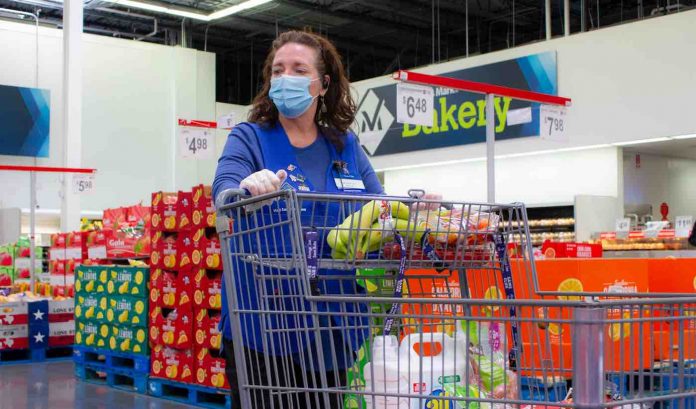
As a means of providing extra support to the healthcare workers and first responders on the frontlines of the novel coronavirus outbreaks, Sam’s Club has announced that they will be offering their exclusive “hero” shopping hours to medical employees, regardless of membership status.

Currently, company employees are given an exclusive 2-hour block of shopping time between 8AM to 10AM on Sunday mornings.

Starting on April 19th, however, the store associate “Hero Hours” will also be open to healthcare workers for free. Complimentary face masks will also be provided to shoppers at the door.

RELATED: LEGO Factory is Now Producing Thousands of Protective Plastic Face Masks for Medical Workers

The company says they were inspired to launch the initiative after several individual branch managers took it upon themselves to invite local hospital workers to shop with the store associates.

“Mr. Sam once said that the best ideas come from our associates and we believe this to be true now more than ever,” said Lance de la Rosa, Executive Vice President and CEO of Sam’s Club.

“Previously, a few of our clubs invited healthcare workers and first responders for early shopping hours with our associates,” he continued. “It’s inspiring to watch the ways our associates serve those around them. We’re following the lead of those thoughtful clubs by expanding the audience for this shopping period to include healthcare workers and first responders.”

CHECK OUT: 99-Year-Old WWII Veteran Raises $3.3 Million for Hospital Workers Simply By Walking Laps of His Garden

The expanded Hero Hours will reportedly continue until further notice across all Sam’s Club stores.

This is just one of many positive stories and updates that are coming out of the COVID-19 news coverage this week. For more uplifting coverage on the outbreaks, click here.

Be Sure And Share The Inspiring Example Of Kindness With Your Friends On Social Media…

Mom Has Been Bringing Joy to Neighbors By Drawing Amusing Chalk Cartoons on Her Sidewalk


A Florida mom has been taking to her sidewalk to spread some laughter and cheer amongst her community—and she has been doing it all with a few pieces of chalk.

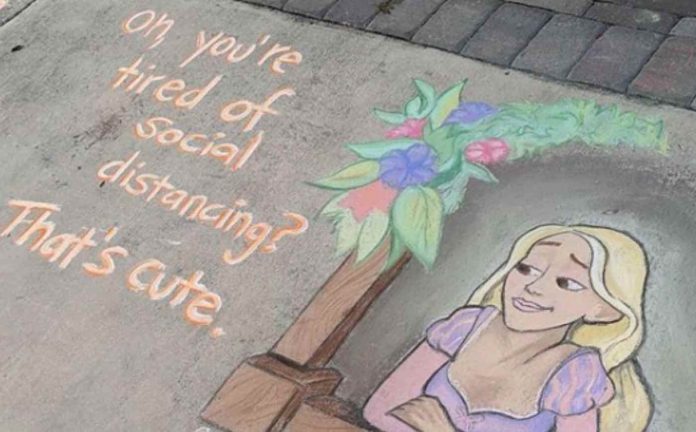
Casey Drake is a former science teacher, a mother-of-two, and a sidewalk artist who has been brightening up the streets of Winter Park with humorous illustrations of Disney characters coping with social distancing.

One of her drawings depicts Dorothy from The Wizard of Oz reminding people that there is “no place like home” during the outbreaks; another sidewalk drawing features an amused Rapunzel boasting about her social distancing skills.


“Laughter is the best medicine,” Drake told WKMG in the interview below. “We could all use a little bit of humor right now, I think.”

Drake says she was inspired to start drawing the cartoons after she saw other social media stories and news reports of people writing chalk messages of hope for passerby during the COVID-19 outbreaks.

In addition to the artworks brightening up the sidewalks, Drake says that drawing has become a much-needed source of therapy and stress relief during the shutdowns.


Although Drake admits that her labor of love does not have the same social impact as other national volunteer efforts, she hopes that her drawings can at least bring some joy to her neighbors.

“We need a mental break every once and a while from this,” she told reporters. “I know some people are sewing masks and donating things so even though this isn’t as important as those things, it still has a role. If somebody can just smile as they’re walking down the street and for a second kind of break out of the sadness of the moment and the fear, I think that’s a win.”

To check out more of Casey Drake’s artwork, be sure and visit her Instagram page.

This is just one of many positive stories and updates that are coming out of the COVID-19 news coverage this week. For more uplifting coverage on the outbreaks, click here.

(WATCH the interview below)

Brighten Up Your News Feed By Sharing This Sweet Story To Social Media…

Scientists ‘Blown Away’ By Discovery of Longest Animal Ever Recorded—And It’s Quite Beautiful

Photo by the Schmidt Institute


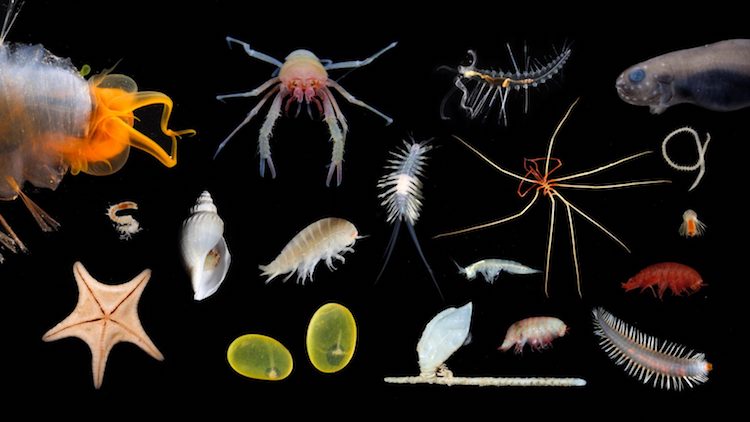
An estimated 150-foot siphonophore—seemingly the longest animal ever recorded—was discovered during a month-long scientific expedition exploring the submarine canyons near Perth, Australia.

Additionally, up to 30 new underwater species were found by researchers from the Western Australian Museum aboard Schmidt Ocean Institute’s research vessel Falkor.

The discovery of this massive gelatinous string siphonophore—a floating colony of tiny individual zooids that clone themselves thousands of times into specialized bodies that string together to work as a team—was just one of the unique finds among some of the deepest fish and marine invertebrates ever recorded for Western Australia.

RELATED: Scientists Discover a Complete Protein Found Nowhere on Earth That Fell From Space, May Hint at Planet’s Origin

Scientists from the Western Australian Museum, led by Chief Scientist Dr. Nerida Wilson, were joined by researchers from Curtin University, Geoscience Australia and Scripps Institution of Oceanography in exploring the Ningaloo Canyons in the Indian Ocean. Using an underwater robot, ROV SuBastian, they completed 20 dives at depths of up to 4,500 meters (14,700 feet) over 181 hours of exploration.

During the expedition, scientists collected the first giant hydroids in Australia, discovered large communities of glass sponges in Cape Range Canyon, and observed for the first time in Western Australia the bioluminescent Taning’s octopus squid, long-tailed sea cucumber, and a number of other molluscs, barnacle and squat lobster species. Some of the species collected will be exhibited at the Western Australian Museum.

The team have amassed an incredible collection of organisms which will help to shed new light on the biodiversity of Cape Range Canyon and Cloates Canyon off Ningaloo (Credit: Greg Rouse (Scripps Oceanography), Nerida Wilson (Chief Scientist) and the FK200308 team).

The team also found the largest specimen of the giant siphonophore Apolemia ever recorded—video of which was posted on Schmidt Ocean Institute’s Twitter account.

“We suspected these deep sea areas would be diverse but we have been blown away by the significance of what we have seen,” Wilson said. Added Dr. Lisa Kirkendale, head of aquatic zoology at the Western Australian Museum and co-principal investigator, “These specimens represent so many extensions in depth and range records for so many species, and will form an important new part of WA Museum collections.”

The expedition is part of Schmidt Ocean Institute’s year-long initiative in Australia and the Pacific to conduct a number of science and engineering expeditions with teams of scientists and researchers from around the world. Using the underwater robot SuBastian, scientists for the first time are able to explore deep sea canyons and coral reefs around Australia that have never been seen before. The footage and samples collected from the oceans that surround Australia will have important implications for the sustainability and protection of these underwater ecosystems—and for similar habitats worldwide that are in peril because of rising ocean temperatures and other environmental threats.

LOOK: ‘Unprecedented’ New Photos of the Sun’s Surface Are Being Hailed as Landmark Achievement for Science

Owned and operated by Schmidt Ocean Institute, a philanthropic nonprofit established by Eric and Wendy Schmidt in 2009, Falkor is the only year-round seagoing philanthropic research vessel in the world. The vessel is equipped with a state-of-the-art 4,500 meter-capable underwater robotic system, ROV SuBastian, that was used to visually explore and collect samples from critical deep ocean areas that had not been explored before.

The ship and ROV are both made available to the international science community at no cost, and the scientists agree to make their discoveries publicly available. The collection data for these specimens will be made publicly available.

“There is so much we don’t know about the deep sea, and there are countless species never before seen,” said Wendy Schmidt, co-founder of Schmidt Ocean Institute. “Our planet is deeply interconnected–what happens in the deep sea impacts life on land–and vice versa. This research is vital to advance our understanding of that connection–and the importance of protecting these fragile ecosystems. The Ningaloo Canyons are just one of many vast underwater wonders we are about to discover that can help us better understand our planet.”

CHECK OUT: Scientists Detect Tone Pattern in the Ringing of a Newborn Black Hole for the First Time, Proving Einstein Right Again

The science completed will allow the research team to formally describe many of the new species of animals that were found, develop ROV methodology for monitoring Marine Parks in Australia and screen deep water samples for environmental DNA in the Indian Ocean. The ROV SuBastian dives were livestreamed and are available in perpetuity on Schmidt Ocean Institute’s YouTube page, including video highlights, making the incredible diversity in the Ningaloo region available for the public to explore. The footage and specimens collected are important records within the Gascoyne Marine Park, serving as a permanent record of biodiversity in the canyons to build on in the future.

“Ongoing scientific exploration is vital to the effective management of our marine parks,” said Dr. James Findlay, director of Australia’s National Parks, who has been closely following the Falkor expedition, “and we are committed to partnering with other agencies to record and monitor these precious places.”

Reprinted from Schmidt Ocean Institute

(WATCH the video below)

It’s Not Hard To Sea That You Should Share This Exciting Story With Your Friends On Social Media…

Watch Notre Dame Cathedral Bell Ring Out for Healthcare Workers on the One-Year Anniversary of Its Fire

Notre Dame - CC, David-Merrett.

Yesterday marked the one-year anniversary of the fire that came within 30 minutes of destroying the beloved Notre Dame cathedral in Paris.

Now as a means of honoring its survival and encouraging locals to remain unified in the face of the novel coronavirus lockdowns, the cathedral’s bell rang out across Paris for the second time since the fire.

On April 15th at 8PM when city-dwellers typically take to their windows to applaud healthcare workers on the frontline of the pandemic, three people donned hazmat suits to protect themselves from the toxic lead particulates released by the fire and spent five minutes ringing the iconic bell—which is reportedly the second largest in the country.

WATCH: Beloved Opera Singer Unites Millions of Viewers With Livestreamed Easter Performance in Empty Cathedral

As reporters captured the iconic event on camera, hundreds of French citizens could be heard cheering and clapping from the streets for the duration of the homage.

“The restoration of Notre-Dame… is a symbol of the resilience of our people, of their capacity to overcome hardships, and to recover,” said French President Emmanuel Macron.

Although the structure of the bell’s belfry was undamaged by the fire, it has been rung only once since the blaze, and that was to honor the passing of former French president Jacques Chirac in September 2019.

CHECK OUT: In Historic Televised Speech, Queen Elizabeth II Offers Message of Global Support—‘We will succeed’

President Macron originally planned to have the cathedral fully restored within five years of the fire, but the pandemic—coupled with poor winter weather—has put the initiative behind schedule.

Regardless, restoration managers told Reuters that they at least want to have the cathedral ready to host Easter mass on April 16th, 2024.

This is just one of many positive stories and updates that are coming out of the COVID-19 news coverage this week. For more uplifting coverage on the outbreaks, click here.

(WATCH the AFP video below) – Feature photo by David Merrett, CC

Pay Homage To Positivity By Sharing The Inspiring Story To Social Media…

“When you realize you want to spend the rest of your life with somebody, you want the rest of your life to start as soon as possible.” – Nora Ephron

Quote of the Day: “When you realize you want to spend the rest of your life with somebody, you want the rest of your life to start as soon as possible.” – Nora Ephron

Photo: by GWC, copyright 2020

With a new inspirational quote every day, atop the perfect photo—collected and archived on our Quote of the Day page—why not bookmark GNN.org for a daily uplift?

Most British Women Have Become Comfortable With Their Natural Looks While in Lockdown, Survey Says

Photo by Skin Proud

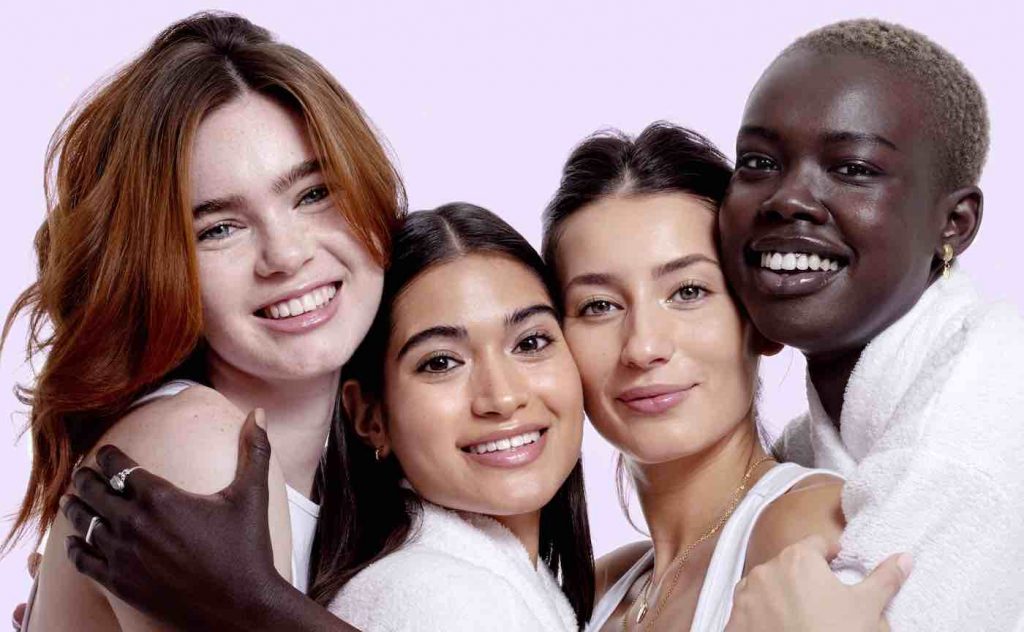
When asked whether they were comfortable in their own skin, 73% of British women agreed with the statement—despite the social pressures to look perfect at any age.

The poll of 2,000 adults found that most respondents were content with who they saw in the mirror. In fact, more than 67% said they prefer a “natural look”—both for themselves and for other people, as well.

We are seeing a lot of the natural look these days, as the COVID-19 lockdowns move into their second month. The self-isolation has induced 69% of respondents to wear less make-up than usual.

As a result, more than half have gone to the supermarket make-up free, while 28% have done a video call with a friend while bare-faced.

25 percent all those surveyed said they would be happy to show the “real them” at work— and they have felt comfortable looking natural while on video calls during the current pandemic.

MORE: These Are the 3 Most Promising Longevity Supplements From Scientific Research So Far

Almost 40% of those under age 24 have felt less pressured to look a certain way while isolated at home, with more than one-quarter saying they will be confident in embracing their natural look when the lockdown is lifted.

Although 81% of the women surveyed wear make-up an average of four days a week, 32% say they would confidently share a bare-faced photo. They might look better, too, in the coming days because—with more time on their hands—34% have taken better care of their skin than usual.

RELATED: How to Be Happier During COVID—Decades of Science Shows That Gratitude, Love, and Connection Can Save Your Life

The survey also found that nearly 40% of young people between the ages of 18 and 24 respond with feelings of empowerment when they see celebrities and influencers sporting a natural look for their skin. One-third of the Brits believe it is important for those in the spotlight to celebrate both perfections and imperfections.

Photo by Skin Proud

A large majority (80%) think it’s important for younger generations to grow up being proud of their skin, but they want everyone to celebrate their imperfections.

When it comes to skincare routines, however, only one-quarter of respondents wear SPF, one-fifth of them exfoliate, and 53% moisturize.

LOOK: Keep Your Eyes in Good Shape With These 4 Simple Ocular Stretches for Computer Users

The survey, which was commissioned by Skin Proud via OnePoll, encourages people to share their proud skin moments on social media with the hashtag #IAmSkinProud.

“It’s great to see how proud and confident the nation already are—we should all be embracing our skin, because ultimately that is what makes us who we are,” said Nora Zukauskaite, global head of marketing at Skin Proud. “We want to encourage people to feel proud of every freckle and mole.”

Be Sure And Share The Intriguing Survey Results With Your Friends On Social Media…

When Struggling Restaurant Tried to Sell Bourbon for $20K, Anonymous Veteran Buys It for Twice the Price

Photo by Suzanne Perry

An anonymous benefactor is being hailed for saving a family-owned Florida restaurant from ruin after the novel coronavirus shutdowns dealt a blow to their business.

The Datz Restaurant Group of Tampa had been struggling to stay afloat this month after transitioning to operating solely through delivery and takeout orders. The owners of the restaurant, Suzanne and Roger Perry, were forced to downsize their workforce from a team of 400 employees to just 27—and without some sort of financial windfall, they weren’t sure how long they would be able to sustain the team.

CHECK OUT: 17-Year-Old ‘Angel’ Cashier Picks Up $173 Grocery Bill for Senior Shopper Who Found Himself Short on Cash

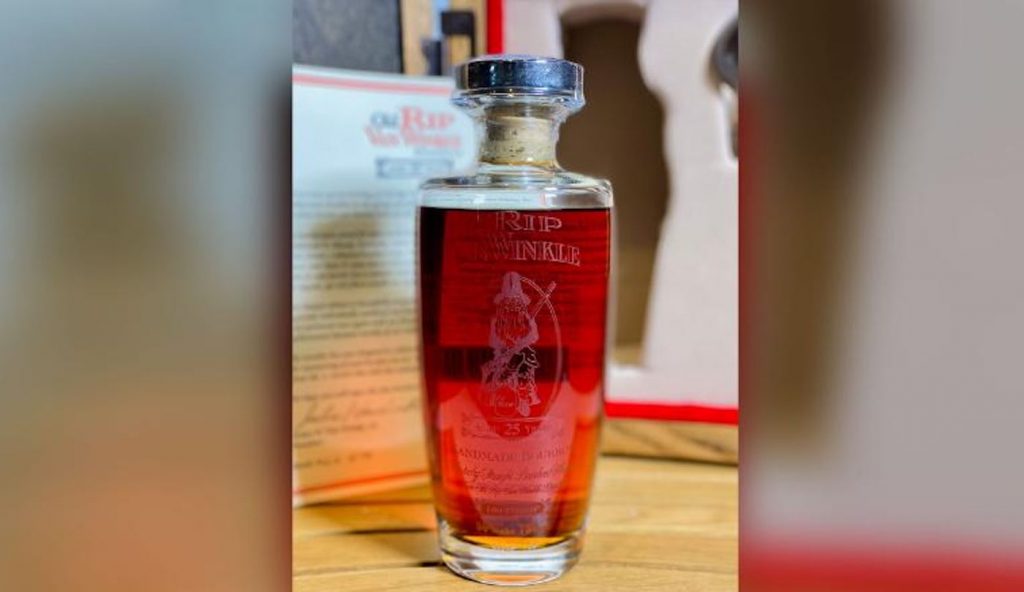
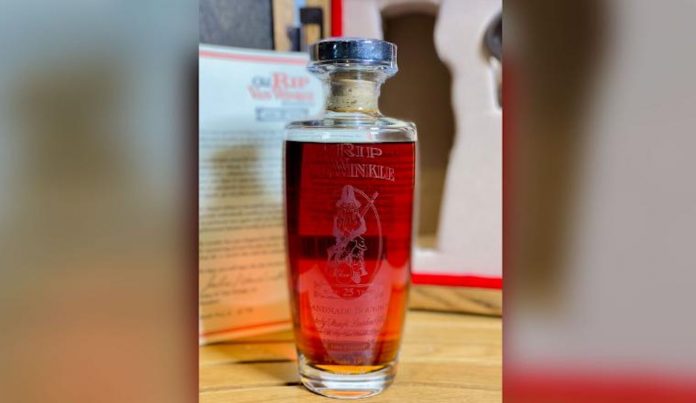
As a means of keeping their employees paid, the Perrys decided to sell the most valuable item in their restaurant: a 25-year-old bottle of Old Rip Van Winkle bourbon.

After doing some research on the value of the liquor, the Perrys offered to sell the bottle for $20,000 plus a 15% online discount.

Although many internet users tried to low-ball the Perrys on their price, they soon got a call from a local veteran who had regularly visited their restaurants in the past.

LOOK: Anonymous Donor Gives Away $82,000 Worth of Gift Cards to All 1,400 Residents of Small Iowa Town

Since the man was a bourbon collector, he offered to drop off a check for the full value of the bottle.

True to his word, the man dropped off the check at one of the Perrys’ establishments; however, the restauranteurs were later stunned to find that the man had written them a check for $40,000.

Thinking it was a mistake, they tried to return the check—but the man insisted that they keep it to support their business.

Photo by Suzanne Perry

“I was so moved by that,” Suzanne told CNN. “It was really touching that someone would reach so far into their own pocket to help us survive this.”

The Perrys have since been able to use the money to rehire a few of their laid off employees for another four weeks of work. Not only that, the restaurant group has served hundreds of meals to first responders and healthcare workers battling COVID-19.

MORE: 99-Year-Old WWII Veteran Raises $3.3 Million for Hospital Workers Simply By Walking Laps of His Garden

Although the man chose to remain anonymous for his good deed, Suzanne says that she knows him to be a humble veteran and local philanthropist who often hosts events to benefit the community—and she plans on using her business to return his kindness in the future.

“There are causes that he cares about deeply, causes that are really near and dear to his heart and I will support him in the form of catering events. I will promote them, I’ll do whatever I can,” she told the news outlet. “What he has done for me is going to come back to him a hundred times.”

This is just one of many positive stories and updates that are coming out of the COVID-19 news coverage this week. For more uplifting coverage on the outbreaks, click here.

Multiply The Good News By Sharing It With Your Friends On Social Media…

Newly-Developed Solar Cell Earns Two World Records for Its ‘Extraordinary’ Efficiency

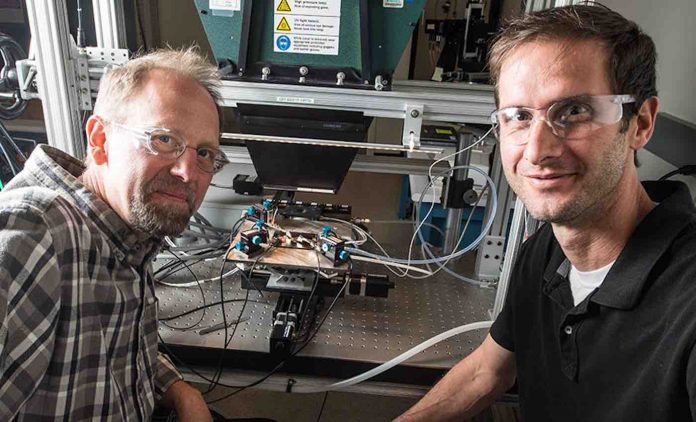
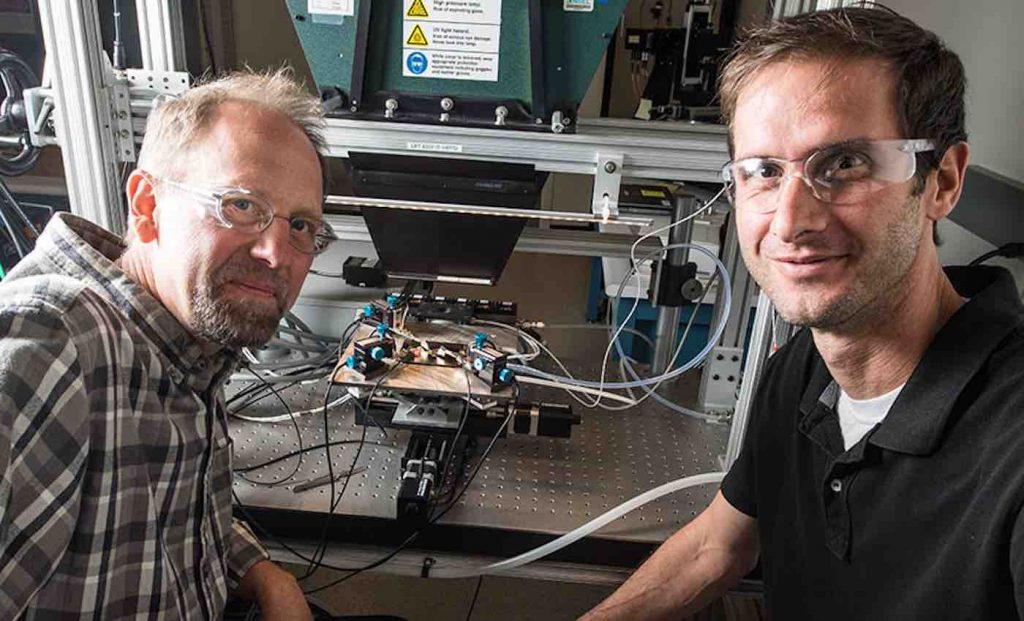
Scientists at the National Renewable Energy Laboratory (NREL) have fabricated a solar cell with an efficiency of nearly 50%.

For perspective, the average solar cell has an efficiency rate of 15% to 20%, meaning it’s capable of converting just a small fraction of absorbed sunlight into electricity.

The newly-developed six-junction solar cell, however, now holds the world record for the highest solar conversion efficiency at 47.1%, which was measured under concentrated illumination. A variation of the same cell also set the efficiency record under one-sun illumination at 39.2%.

“This device really demonstrates the extraordinary potential of multijunction solar cells,” said John Geisz, a principal scientist in the High-Efficiency Crystalline Photovoltaics Group at NREL and lead author of a new paper on the record-setting cell.

WATCH: After Five Years of Drought, Kenyan Region Finally Gets Clean Water Thanks to Solar-Powered Saltwater Plant

The paper appeared in the journal Nature Energy this week.

To construct the device, NREL researchers relied on III-V materials—so called because of their position on the periodic table—that have a wide range of light absorption properties. Each of the cell’s six junctions (the photoactive layers) is specially designed to capture light from a specific part of the solar spectrum.

The device contains about 140 total layers of various III-V materials to support the performance of these junctions, and yet is three times narrower than a human hair. Due to their highly efficient nature and the cost associated with making them, III-V solar cells are most often used to power satellites, which prize III-V’s unmatched performance.

LOOK: These New Solar-Pavement Driveways Made of Plastic Bottles Can Power the Average Household

On Earth, however, the six-junction solar cell is well-suited for use in concentrator photovoltaics, said Ryan France, co-author and a scientist in the III-V Multijunctions Group at NREL.

“One way to reduce cost is to reduce the required area,” he said, “and you can do that by using a mirror to capture the light and focus the light down to a point. Then you can get away with a hundredth or even a thousandth of the material, compared to a flat-plate silicon cell. You use a lot less semiconductor material by concentrating the light. An additional advantage is that the efficiency goes up as you concentrate the light.”

France described the potential for the solar cell to exceed 50% efficiency as “actually very achievable” but that 100% efficiency cannot be reached due to the fundamental limits imposed by thermodynamics.

MORE: Working in Secret, Bill Gates-Backed Solar Company Reveals Tech That Could Spell the End of Fossil Fuels

Geisz said that currently the main research hurdle to topping 50% efficiency is to reduce the resistive barriers inside the cell that impede the flow of current.

Meanwhile, he notes that NREL is also heavily engaged in reducing the cost of III-V solar cells, enabling new markets for these highly efficient devices.

Reprinted from the National Renewable Energy Laboratory

Photo by NREL

Power Up With Positivity By Sharing The Good News With Your Friends On Social Media…

LEGO Factory is Now Producing Thousands of Protective Plastic Face Masks for Medical Workers

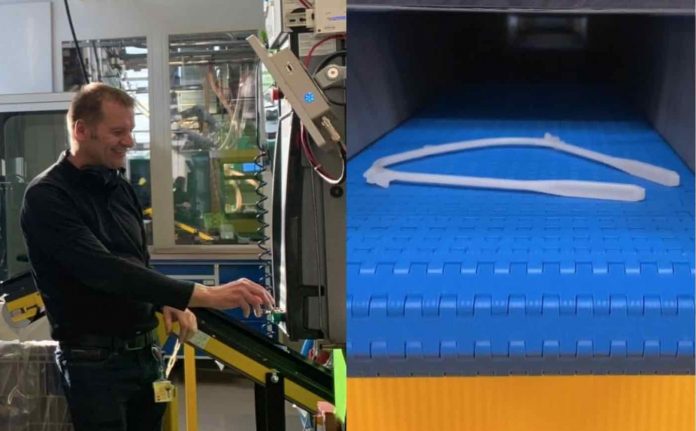
The LEGO Group is offering their assistance to healthcare workers on the frontlines of the COVID-19 crisis by using their facilities to produce thousands of protective facial visors.

According to an Instagram post that was published by LEGO earlier this week, the company’s Billund-based factory in Denmark has reworked some of their machinery to make more than 13,000 plastic masks per day. The masks will reportedly be distributed to hospitals and medical facilities across the country.

Although these visors do not offer the same kind of protection as N95 masks, individuals and businesses around the world have been producing the plastic shields—as well as homemade cloth masks—for medical workers to use as additional protection in high-risk areas.

“This week we began to make visors at our factory in Billund for healthcare workers on the frontline in Denmark,” wrote the company. “We are so incredibly proud of the team who made this happen. They worked around the clock to create designs and make moulds that can produce more than 13,000 visors a day. We are grateful to have such talented, dedicated and caring colleagues.”

LOOK: College Student Has Been Sewing Free Face Masks For Communicating With Hearing-Impaired Folks

LEGO also announced this week that they would be donating 500,000 brick sets to children in need during the novel coronavirus outbreaks. The company did not specify how the sets would be distributed, but they did ask their social media fans to show additional support to the NHS by building a LEGO brick rainbow in solidarity.

This is not the first time that corporations have stepped forward to help during the COVID-19 crisis. Famed engineer and inventor James Dyson designed a ventilator for the UK government in just 10 days—and then he volunteered to donate 5,000 of the devices. IKEA staffers also donated 50,000 N95 masks to a Swedish hospital after they discovered the coveted masks collecting dust in a warehouse. A Chinese tech company sent tens of thousands of respirator masks to Italian hospitals hard-hit by the virus. The New England Patriots even made headlines last week after they used their private team jet to transport 1.2 million N95 masks from China to New York and Boston hospitals in need.

This is just one of many positive stories and updates that are coming out of the COVID-19 news coverage this week. For more uplifting coverage on the outbreaks, click here.

Build Up Some Positivity By Sharing The Good News With Your Friends On Social Media…

Rube Goldberg’s Granddaughter is Asking You to Build a Machine That Drops a Bar of Soap into Your Hand


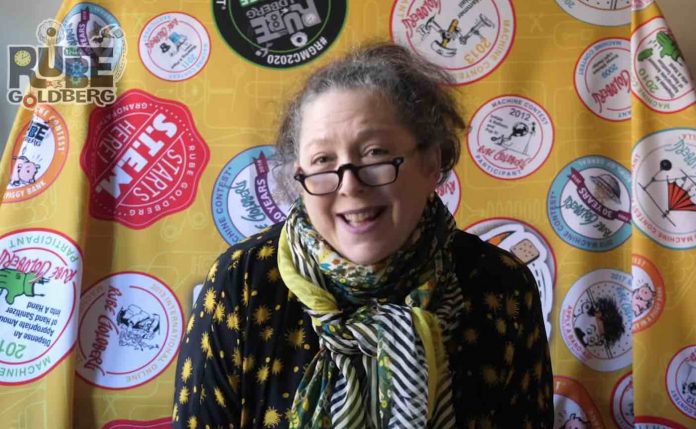
Engineer and cartoonist Rube Goldberg was renowned for illustrating overly-complex machines that were designed exclusively for simple household tasks.

Now, his granddaughter Jennifer George is inviting architects and engineers of all ages to make their own Rube Goldberg Machine while they are at home in quarantine.

Although participants in this year’s Rube Goldberg Machine Contest were originally supposed to design a machine that turned on a light switch, the novel coronavirus outbreaks inspired George to task participants with building a machine that drops a bar of soap into someone’s hand in just 10 to 20 steps.

RELATED: Still Bored in Quarantine? This Website Makes It Really Easy to Learn Morse Code

“It just seemed like the right task,” George told CBC. “Everyone has got a bar of soap somewhere in their house. And Rube Goldberg machines are made from everyday objects. So you don’t have to go shopping. You don’t have to buy anything.

“You just have to figure out a fun, sort of interesting way to [take] something you’ve looked at for years, turn it upside down and see if it has inherent kinetic properties. And hopefully it does.”

LOOK: Isolated Art Lovers Are Recreating Masterpieces Using Everyday Objects—and the Results Are Amazing

The annual contest, which is free and open to all ages, requires participants to take a continuous video of their machine in action. Once the video is uploaded to YouTube, participants can send the links to the Rube Goldberg website.

The contest will be open to international submissions until May 31st, after which three machine designs will be selected as the winners in mid-June. In addition to the winners being featured as the star engineers of the contest on the Rube Goldberg website, they will also receive a free swag bag from the organization.

(WATCH the contest introduction video below)

Build Up Some Positivity By Sharing The Fun News With Your Friends On Social Media…

“With your hands carve out your own destiny.” – Guru Nanak (born 551 years ago today)

Quote of the Day: “With your hands carve out your own destiny.” – Guru Nanak (born 551 years ago today)

Photo: by Josh Hild – public domain, cropped

With a new inspirational quote every day, atop the perfect photo—collected and archived on our Quote of the Day page—why not bookmark GNN.org for a daily uplift?

99-Year-Old WWII Veteran Raises $3.3 Million for Hospital Workers Simply By Walking Laps of His Garden

An English World War II veteran who has been walking laps around his back garden has raised over £2.6 million pounds ($3.3 million) for the NHS in just one week.

[UPDATE 4/20: He went on to raise 10x that much – After WWII Vet Makes History By Raising $33 Million for NHS, People Are Calling for Him to Be Knighted]

99-year-old Tom Moore says the NHS have been “marvelous” in helping him recover from a hip replacement and skin cancer on his head over the last couple of years.

As a way of saying thank you, the former civil engineer has been doing daily laps of his 25-meter-long (82-foot) garden with the aim of walking 100 lengths by his 100th birthday on April 30th.

Moore, who began his walks last Monday on April 6th, initially set a fundraising target of £1,000 for NHS Charities Together with the sole expectation of garnering support from his village of Marston Moretaine, Bedfordshire.

RELATED: Tyler Perry Picks Up the Tab for All Groceries Purchased During Senior Shopping Hour at 73 Supermarkets

After hitting international headlines last week, however, Moore has quickly smashed through his target and has now raised over millions for frontline health workers fighting the novel coronavirus.

“I thank the British public from the bottom of my heart,” Moore told BBC. “It’s difficult to imagine all these kind people who have donated so far. It’s just amazing.”

Moore’s daughter Hannah Ingram-Moore, who set up the fundraising page for him, has had to raise his target three different times from £1,000 to £100,000, then to £250,000 and £500,000.

LOOK: Man Uses His Savings to Fill Up Gas Tanks For Dozens of Nurses Heading to Nearby Hospital

She later took to Twitter to say: “We are overwhelmed by the response. It’s extraordinary.”

Although Moore has already smashed his original donation goal, he is now hoping to complete another 100 laps of his yard to continue raising money for the NHS. To support Moore’s charity efforts, be sure and visit his Just Giving crowdfunding page.

This is just one of many positive stories and updates that are coming out of the COVID-19 news coverage this week. For more uplifting coverage on the outbreaks, click here.

Multiply The Good By Sharing This Inspiring Story With Your Friends On Social Media…

Stressed? This Study Says You Simply Need a 20-Minute ‘Nature Pill’

If you are feeling particularly anxious today, this study from 2019 says that taking at least twenty minutes out of your day to stroll or sit in a place that makes you feel in contact with nature will significantly lower your stress hormone levels.

“For the first time” ever, researchers conducted a study on the most effective dose of an urban nature experience to counteract the effects of modern stress.

Healthcare practitioners are now free to use this discovery, published in Frontiers in Psychology, to prescribe “nature-pills” with the knowledge that they have a real measurable effect on stress.

“We know that spending time in nature reduces stress, but until now, it was unclear how much is enough, how often to do it, or even what kind of nature experience will benefit us,” says Dr. Mary Carol Hunter, an Associate Professor at the University of Michigan and lead author of the research. “Our study shows that for the greatest payoff, in terms of efficiently lowering levels of the stress hormone cortisol, you should spend 20 to 30 minutes sitting or walking in a place that provides you with a sense of nature.”

LOOKHow a Yoga Teacher is Saving First Responders Across America From Depression—With Downward Dog

At the time, the researchers said that nature pills could be a low-cost solution to reduce the negative health impacts stemming from growing urbanization and indoor lifestyles dominated by screen viewing. To assist healthcare practitioners looking for evidence-based guidelines on what exactly to dispense, Hunter and her colleagues designed an experiment that would give a realistic estimate of an effective dose.

Over an 8-week period, participants were asked to take a nature pill with a duration of 10 minutes or more, at least 3 times a week. Levels of cortisol, a stress hormone, were measured from saliva samples taken before and after a nature pill, once every two weeks.

“Participants were free to choose the time of day, duration, and the place of their nature experience, which was defined as anywhere outside that in the opinion of the participant, made them feel like they’ve interacted with nature. There were a few constraints to minimize factors known to influence stress: take the nature pill in daylight, no aerobic exercise, and avoid the use of social media, internet, phone calls, conversations and reading,” Hunter explains.

MOREThe Science Behind Why We Need More of the ‘Secret Sauce’ of Kindness

She continues, “Building personal flexibility into the experiment allowed us to identify the optimal duration of a nature pill, no matter when or where it is taken, and under the normal circumstances of modern life, with its unpredictability and hectic scheduling.”

“We also accommodated day-to-day differences in a participant’s stress status by collecting four snapshots of cortisol change due to a nature pill,” says Hunter. “It also allowed us to identify and account for the impact of the ongoing, natural drop in cortisol level as the day goes on, making the estimate of effective duration more reliable.”

The data revealed that just a 20-minute nature experience was enough to significantly reduce cortisol levels—but if you spent a little more time immersed in a nature experience, 20 to 30 minutes sitting or walking, cortisol levels dropped at their greatest rate. After that, additional de-stressing benefits continued to add up but at a slower rate.

CHECK OUT: Watching Birds Near Your Home is Good For Your Mental Health

“Healthcare practitioners can use our results as an evidence-based rule of thumb on what to put in a nature-pill prescription,” says Hunter. “It provides the first estimates of how nature experiences impact stress levels in the context of normal daily life. It breaks new ground by addressing some of the complexities of measuring an effective nature dose.”

Hunter also voiced her hopes for the study to form the basis of further research in the same field.

“Our experimental approach can be used as a tool to assess how age, gender, seasonality, physical ability and culture influences the effectiveness of nature experiences on well-being. This will allow customized nature pill prescriptions, as well as a deeper insight on how to design cities and wellbeing programs for the public.”

Plant Some Positivity By Sharing The Research With Your Friends On Social Media – Feature photo by Marco Antonio Ibarra Neri, CC