













All News - Page 6 of 1755 - Good News Network
Home Blog Page 6

Indian Home Stays Cool Without A/C Through Clever Clay Architecture

- credit, permission granted by justin_sebastian_photography
– credit, permission granted by justin_sebastian_photography

Every summer it seems there’s a part of the world experiencing record temperatures, so perhaps it’s time for architects to design buildings designed to resist heat as easily as possible.

GNN has reported, mostly in Asia, about firms that specialize in designing auto-cooling homes that leverage the laws of thermodynamics just as our ancestors did, and with terracotta roofs, perforated walls, and high ceilings, one Indian design team is doing just that.

Elemental Architects built a new family home for sisters Renu Krishnadas and Rekha Utham, located in sweltering Kerala. Having both established and enjoyed several decades of successful careers, they wanted to return to their 1.5 acres of family land set an hour outside the city of Kannur amid rice paddies.

When Elemental proposed a house without AC, the women were skeptical.

“I was the first person to say that summers in Kerala are very hot,” remembered Krishnadas. “I stayed for 21 days, and I never once switched on an AC. I did not feel the need for an AC at all. Even today, fans are good enough.”

Literally, the cool thing about the house which Elemental lead architect Amrutha Kishor built for them is that it acts like a fan all by itself.


The first step was identifying the direction of the natural airflow. Coming from the north, the house was built along a north-south axis to ensure the breeze could pass through the entirety of the living areas. Low-lying open brick walls or clay lattices called jali allow for air to pass through the northern face of the house and circulate air in the home.

As it heats up from activity or the Sun’s rays, it rises into high, angled ceilings which channel it out through a series of windows. These windows allow light in without the heat from the Sun as might occur with normal, eye level windows.

The openings in the jali and between the bricks not only let in air, but take advantage of a natural law: that air and water necessarily speed up when moving from a wide open space into a narrow space. In this way, the 2 building features, unlike normal windows, act like little pumps to accelerate air passing through them, cooling them down for the same reason that air exhaled to blow out a candle is cool while normal breathing is warm.

On top of this, the interior dividing walls are made with perforated clay blocks, which not only allow air to literally pass through them, but moisture as well.

Unique to India, and all the more to Kerala, the skeleton of the house is constructed of a local mineral called laterite, which Kishor described to the Better India as having “very low thermal transmission.”

CLEVER ARCHITECTURE: New York Building Proves Ice Is Nice for Staying Cool Without Power-Hungry A/C Units

“Exposed laterite was common back in the day, but now it’s not very common in buildings. We’ve tried to maintain that.”

In addition to absorbing and releasing heat more slowly than other materials, laterite can also absorb moisture; helpful in a state where humidity can often hang around 80%.

The last summer-stopping design is found in the pitched roofs, which are constructed with 2 layers of local clay tiles with a gap in between them to slow heat transmission from direct sunlight.

MORE STORIES LIKE THIS: Terracotta Is a 3,000-Year-Old Solution to Fighting Extreme Heat

All together, the house is like living, breathing, mammalian organism that through respiration can cool itself, and those dwelling within, even during the hottest summers.

Elemental have designed dozens of structures utilizing these principles, and maybe it’s time they become a little mainstream.

SHARE This Brilliant Way To Stay Cool Indoors With Architects You Know… 

Survey Finds Blackbirds to Have the Most Beautiful Songs in the Avian World–Science Explains Why

- SWNS
– SWNS

The next time you hear a blackbird singing in the dead of night, know that you’re listening to the most pleasant song in the world.

What the bird lacks in dressage it makes up for in repertoire, a new survey and study from the University of Tübingen found in which researchers set out to discover the key ingredients that make birdsong pleasant.

The blackbird topped the ‘pleasantness’ table with an average score of 4.52 out of 5, beating the willow warbler to first position (4.45) . The blackcap filled out the top 3.

“You don’t have to be a ‘bird person’ to find bird sounds beautiful,” said study author Dr. Nadine Kalb from Tübingen U. “Being able to recognize birds by their appearance or song did not affect how people rated calls.”

By asking people to listen to birdsongs and rate them for pleasantness, then cross-referencing the results with information about the calls’ acoustic characteristics, Kalb and co-authors identified key aspects that make some birdsongs seem more pleasant than others.

Participants rated the perceived pleasantness of 123 different bird songs on a scale from 1 (not very pleasant) to 5 (very pleasant). Calls which are varied, higher-pitched, and not too loud are considered most pleasant.

The research team suspected that some acoustic characteristics, such as a high amplitude—perceived as a loud noise—would be associated with a lower pleasantness rating.

But they also suspected some personal characteristics, such as individuals’ knowledge about birds, would influence pleasantness ratings, and so participants were also asked questions which measured their birding skills and their perception of birds.

“I’m very interested in human-bird relationships,” said senior study author Dr. Christoph Randler, also from the University of Tübingen.

“Bird sounds are often considered one of the most enjoyable aspects of spending time in nature, and previous research has shown that they can contribute to psychological restoration and well-being. However, not all bird sounds are perceived equally positively.”

For example, the barn owl finished rock bottom with an average pleasantness score of just 1.32.

A narrower bandwidth, which captures the range of frequencies a song used, and greater complexity, the number and variety of elements in the song, were perceived as more pleasant, as were birdsongs at a higher frequency or with a relatively low amplitude. The songs that scored highest also avoided a key frequency range where human hearing is highly sensitive.

“We might be wired to prefer more variable sounds with moderate amplitudes and frequencies because they signal a safe, healthy, and restorative environment where we can relax,” said Dr. Kalb.

MORE BIRDSONG BITES: South American Songbird Hailed as Most Expert Musician of the Animal Kingdom (LISTEN)

To follow up the research, they want to carry out larger studies with broader samples including more men, different cultures, and more experienced birdwatchers.

“I would love to investigate how bird sounds influence people in real-world environments,” Dr. Randler said. “That would help us better understand the role that healthy ecosystems play in supporting both biodiversity and human well-being.”

Top 20 Most Pleasant (Old World) Bird Songs
1. Common Blackbird (4.52 average pleasantness score)
2. Willow Warbler (4.45)
3. Blackcap (4.43)
4. Mistle Thrush (4.33)
5. Garden Warbler (4.30)
6. Dunnock (4.30)
7. Chaffinch (4.29)
8. Common Nightingale (4.26)
9. Common Linnet (4.26)
10. European Goldfinch (4.26)
11. European Pied Flycatcher (4.25)
12. Eurasian Wren (4.24)
13. Skylark (4.23)
14. Eurasian Golden Oriole (4.17)
15. Common Cuckoo (4.13)
16. Tree Pipit (4.08)
17. Common Redstart (4.08)
18. European Greenfinch (4.08)
19. Eurasian Treecreeper (4.05)
20. European Robin (4.04)

3 Million Oysters Eaten by New Yorkers Are Rebuilding the City’s Reefs

- credit, Billion Oyster Project
– credit, Billion Oyster Project

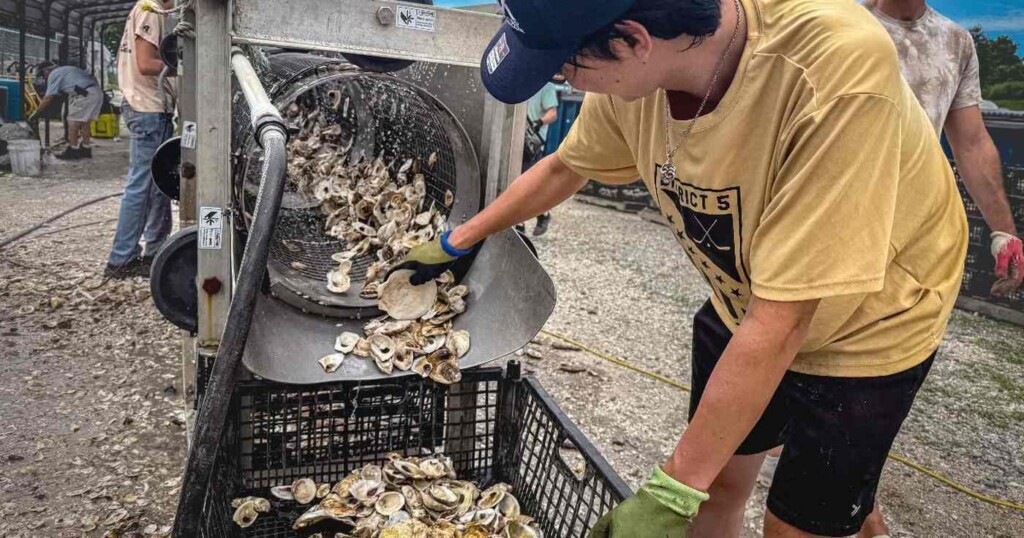
On Governor’s Island in New York City, a nonprofit is turning wasted oyster shells into new oyster reefs that filter pollutants from the harbor, absorb wave energy, and supply the city’s restaurant industry.

Called the Billion Oyster Project, the objective is to restore some 100 acres of lost, historic oyster reefs using the waste streams from dozens of partner restaurants.

To date, the project has achieved 20% of the eponymous aim, the project has nevertheless seen incredible results. Staff estimate the 200 million live oysters they’ve raised on 3.2 million pounds of discarded shells have filtered tens of trillions of gallons harbor water across 19 acres of restored reefs.

“Oysters are what we call a keystone species, meaning if the oysters are thriving in an environment all other biodiversity is thriving in that environment,” Bela Altman, Volunteer Coordinator for the Billion Oyster Project, told Reuters.

The project runs a hatchery on the southern part of Governor’s Island. Here, some 75 NYC restaurants divert oyster shells from municipal landfills to a very special dump.

“We take the oyster shells from restaurants and bring them to our shell pile,” Agata Poniatowski, education outreach coordinator for the project, told ABC News. Over time, the shells cure. “Once there’s no bacteria and no invasive species, no disease, we bring them to our hatchery.”

There, oyster larvae are released to populate the old shells, acclimatize to New York water, feed and mature. 10 million baby oysters can be raised at once, before being trucked by the bag out into the harbor and dumped into the reef sites to begin their new lives.

It’s been a long road to get to this point of efficiency and scale. ABC reports that the Billion Oyster Project was launched in 2008, with the 10-figure end point predicted to come by 2035.

DOING GOOD WITH OYSTERS: 

1 billion oysters would make a major difference to the city. Not only would it bring down the cost of oysters to the delight of restaurant goers, 100 new reefs would refresh the entire water volume of New York Harbor every 3 days.

In a world where climate change could amplify storm intensity, oyster reefs would help disperse the energy of incoming waves, reducing the risk of severe flooding.

WATCH the story below from Reuters… 

SHARE This Great Story On The Half Shell With Your Friends…

Common Supplement Rivals Antibiotics for Severe Gum Disease When Taken with Low-Dose Aspirin

- credit, Fitnessrezepte.net / Wikimedia Commons
– credit, Fitnessrezepte.net / Wikimedia Commons

A combination of omega-3 and low-dose aspirin performed about as well as antibiotics in a yearlong study of people with severe gum disease, or periodontitis.

It raises the possibility of an alternative treatment for some patients at a time when multiple pathogens are developing resistance to antibiotics.

The clinical study run by the São Paulo Research Foundation included 109 people with advanced periodontitis who were followed for one year.

Periodontitis is a chronic inflammatory disease that develops when bacteria accumulate below the gumline and damage the tissues that hold teeth in place. In advanced cases, the disease can destroy supporting bone, loosen teeth, and eventually cause tooth loss.

“Patients with severe disease have very deep [voids,] which act as reservoirs for bacteria associated with the disease. It’s a very challenging condition to treat,” says dental surgeon Nídia Cristina Castro dos Santos, the first author of the study and a professor and researcher at the Albert Einstein Israelite Hospital, Guarulhos University (UNG), in Brazil.

The participants were randomly divided into four groups. Everyone received a standard treatment for periodontitis called scaling. The procedure removes bacterial deposits and other material from below the gums. What differed among the groups was the additional treatment they received.

Participants in the control group were given placebo versions of the antibiotics, omega-3, and acetylsalicylic acid, or generic aspirin, packaged in capsules that looked like the active treatments.

A second group received the antibiotics metronidazole and amoxicillin. This combination has some of the strongest scientific evidence supporting its use in severe periodontitis. Patients took the antibiotics 3 times per day for 14 days.

A third group received 3 grams of omega-3 each day along with a daily dose of aspirin for 6 months. Researchers assessed the participants again after three, six, and twelve months.

After one year, about 58% of patients treated with antibiotics had reached the clinical target established by the researchers. That goal was defined as having no more than 4 remaining deep periodontal pockets.

The omega-3 and aspirin group achieved a nearly identical result, with 57.7% of participants reaching the same target.

The difference compared with standard treatment alone was substantial. Among patients who received scaling plus placebo, only 23.1% met the clinical goal, while a fourth group using antibiotics together with omega-3 and aspirin didn’t see any additional benefit over either strategy alone.

“The use of antibiotics isn’t considered the gold standard of treatment. Although metronidazole and amoxicillin yield good results in the most severe cases, their use should be evaluated on a case-by-case basis due to risks related to bacterial resistance and possible adverse effects,” says Castro dos Santos.

By Caroline LM

In an earlier study supported by the foundation, researchers found that omega-3 supplementation reduced inflammation and bone loss associated with periodontal disease in rats. The effect was particularly noticeable when supplementation was combined with physical exercise.

According to Castro, omega-3 works differently from conventional anti-inflammatory medications. Rather than simply blocking particular inflammatory pathways, omega-3 can contribute to the production of molecules that help the body naturally bring inflammation to an end and promote tissue repair.

Low-dose aspirin was included because it can enhance the production of these inflammation-resolving molecules. Researchers therefore suspected that combining omega-3 with aspirin might help the body gain better control over the persistent inflammation associated with periodontitis.

“We imagined that the combination of antibiotics and omega-3 would be most effective in controlling periodontitis in these patients. We also believed that the results for the group that used omega-3 with aspirin would be slightly lower than those for the antibiotic group. The result was surprising because the two therapies performed very similarly, paving the way for it to become a treatment option for these patients,” says Castro.

The researchers were also struck by how long the apparent benefits lasted, as participants in the non-antibiotics group continued to show results similar to those seen at the end of treatment even 6 months after supplementation had stopped.

According to Castro, the persistence of the effect raises the possibility that changing the way the body responds to inflammation could produce longer-lasting benefits. Researchers are still investigating exactly how this might happen.

For dental surgeon Magda Feres, the lead author of the study and a full professor at the Harvard School of Dental Medicine and the Graduate Program in Dentistry at UNG, the results suggest that targeting the inflammatory response could provide another option for certain patients.

ALSO CHECK OUT: Antiviral Chewing Gum Cuts Risk of Certain Head and Neck Cancers to Almost Zero in New Study

“The combination of omega-3 and low-dose aspirin achieved clinical benefits comparable to those of the metronidazole and amoxicillin protocol, opening up a real alternative for those who can’t take antibiotics, especially patients with allergies or intolerance to these medications,” she says.

The potential to treat some cases without antibiotics is particularly relevant because antibiotic resistance is considered one of the major threats to global public health.

“Demonstrating that it’s possible to treat severe periodontitis by modulating the body’s own response is new and relevant information that helps preserve antibiotics for when they are truly indispensable,” says Feres.

DENTISTRY ADVANCES: New Gel Regrows Dental Enamel–Which Humans Cannot Do–and Could Revolutionize Tooth Care

Despite the promising results, the researchers stress that omega-3 and aspirin should not yet be viewed as a routine replacement for antibiotics in severe periodontitis. Researchers are also conducting microbiological analyses to understand what happens to bacteria inside periodontal pockets during treatment.

Preliminary findings suggest that the therapies may reduce bacterial species associated with periodontal disease while increasing microorganisms linked to healthier gums.

“It’s an important step forward, but not the end of the story. Therefore, the message is one of cautious optimism: we have a promising, scientifically plausible alternative to antibiotics in select cases. Routine replacement will require more evidence,” she concludes.

SHARE This Probiotic Way To Potentially Treat Gum Disease… 

“Space is the breath of art.” – Frank Lloyd Wright

Frank Lloyd Wright’s Fallingwater – Credit: fuzheado / Flickr CC BY-SA 2.0

Quote of the Day: “Space is the breath of art.” – Frank Lloyd Wright

Photo by: fuzheado via CC BY-SA 2.0

With a new inspirational quote every day, atop the perfect photo—collected and archived on our Quotes page—why not bookmark GNN.org for a daily uplift?

Frank Lloyd Wright’s Fallingwater – Credit: fuzheado / Flickr CC BY-SA 2.0

Good News in History, September 3

Happy Birthday to Shaun White, the three-time Olympic gold medalist in half-pipe snowboarding, who turns 40 today. He was a champion skateboarder in his teens after undergoing two open-heart surgeries as an infant. He became first person to compete in and win both the Summer and Winter X Games in two different sports–including historic wins four years in a row and tallying more X-Games gold medals than anyone. READ more about White… (1986)

Belligerents in 6-year Military Standoff Agree to Swap Rifles for Ballots

The signing of an agreement addressing the first two milestones of the Libyan Political Roadmap - credit UN photo, by Bryony Taylor UNSMIL
The signing of an agreement addressing the first two milestones of the Libyan Political Roadmap – credit UN photo, by Bryony Taylor / UNSMIL

A civil war, military standoff, and a state experiencing double-government are all hopefully set to end after Libya’s rival factions agreed to hold elections.

The breakthrough occurred in a signing ceremony Sunday at the United Nations Support Mission to Libya in Tripoli, and follows a period of tireless negotiations by the UN lasting over 2 years.

Following a NATO-backed insurrection which toppled the government in 2011, rival political and rebel factions succumbed to a civil war that lasted from 2014 to 2020. In 2021, negotiations on national elections collapsed, leaving the country split between the UN-recognized government in Tripoli, and the forces of the army under General Khalifa Haftar in the eastern city of Tobruk.

Though Tripoli maintained international recognition, the state of its own political and military structure was precariously balanced between a coalition of parties and factions who weren’t always on the same side.

Mercifully, the guns have been silent for the last 6 years, leading to the Sunday’s breakthrough which saw a date set for future elections in 2 years’ time, during which contentious issues involving electoral law, the eligibility of candidates, and the national elections body are to be resolved.

“Today’s signing represents an important step in overcoming the political and institutional impasse that has delayed Libya’s electoral process,” UN Special Rep. for the Secretary General, Hanna Tetteh said in her remarks at the signing ceremony. “The agreement demonstrates what can be achieved when Libyans constructively engage in dialogue and seek practical and implementable solutions to outstanding issues.”

MORE DIPLOMACY SUCCESSES: Nobel-Worthy Prime Minister Attempts to End Century of Ethnic Hatred for Armenians

A potential elections framework suddenly seemed possible after the UN held a series of discussions that involved two representatives of Libya’s 4 existing political institutions: the Government of National Unity (UN recognized), the Libyan National Army (General Haftar’s side), the High Council of State, and the House of Representatives.

Shibani Abu Hamoud, head of the army’s general command, said this forum would work with the UN’s mission “to develop a framework within one month of the signing of the agreement to follow up on all matters related to its implementation.”

NORTH AFRICA NEWS: Timbuktu’s Medieval Manuscripts Return Home After a Decade Away Safe from Insurgents

The agreement signed on Sunday includes a provision that if Libya’s House of Reps. and the High Council of State fail to achieve a breakthrough in this one-moth period, the parties will move forward towards the elections with “a constitutional document,” the New Arab reported, with support from the UN Security Council.

All major Libyan political players have called for elections repeatedly over the last 6 years, and economic re-development and internal security in the country has rapidly improved.

SHARE This Huge Change For Peace And Democracy In A Troubled Nation… 

Stray Cat Nursed Back to Health by Train Staff, Climbs the Ranks to Become Stationmaster

Tama, the stationmaster of Kishi Station in 2007 - CC 3.0. Sanpei, via jp.wikipedia
Tama, the stationmaster of Kishi Station in 2007 – CC 3.0. Sanpei, via jp.wikipedia

Japan is nothing if not a servant to tradition; even if the tradition is a little strange.

Admittedly a little less strange than the annual Kanamara Matsuri festival in Kawasaki (parental guidance suggested) the custom of railway lines promoting cats to the rank of stationmaster certainly raises eyebrows, but also spirits, it must be said.

In the port town of Choshi, near Tokyo, employees of a struggling railway company found either a stray or abandoned cat last October skulking around the station, thin, sick, and eyes frozen shut.

With plenty of space at the station, the tabby was nursed back to health by the platform staff before signing up as an ‘apprentice’ in January. Then, in July, Nakano-san achieved the rank of stationmaster, and was awarded with a neat cap and medallion for her collar.

Her CV includes such crucial skills as “pushing computer mouses off the desks” and “sleeping on paperwork.”

She now figures prominently in Choshi Electric Railway Co. public relations content as a mascot, and her July debut saw the rail hub of Nakanocho Station swarmed with reporters to catch a glimpse of the new boss.

In all seriousness though, being too close to Tokyo to stand out but too far away to comfortably visit, Choshi Railway felt that more needed to be done to draw interest in the city’s numerous historic temples, lighthouses, and characteristic waterfront area.

MORE FROM JAPAN: 

To that end, the 4-legged stationmaster seemed a good idea. They had good reason to believe it was too. In January, at Wakayama Electric Railway Co.’s Kishi Station in the city of Kinokawa, officials welcomed their third stationmaster cat.

In 2007, the station announced Japan’s first-ever cat stationmaster: Tama. After Tama passed away in 2015, she was succeeded by Nitama (literally, “looks like Tama”) who also passed away in last November. Now, Kishi Station is run by Yontama (literally, “Fourth Tama,” after the ‘third Tama’ was adopted back into private house life).

CAT JOBS: Meet the Oxford Library Cat Who’s Purr-fectly Content Being the Unofficial College Mascot

The publicity from Tama’s original 2007 appointment led to an increase in passengers by 17% for that month as compared to same period from the previous year. A study estimated that the publicity surrounding Tama has contributed 1.1 billion yen to the local economy, and she was widely credited with saving Nishi Station from closing.

Yontama previously served as stationmaster at Idakiso Station in Wakayama City, and vowed to “follow in Nitama’s ‘pawprints’.”

SHARE This Cute And Curious Tradition From Japan On Social Media…

Original Picasso Stolen 8 Years Ago Found Hanging in Vacant Apartment by Milwaukee Landlord

Torero, by Picasso - credit, Milwaukee Police Department
Torero, by Picasso – credit, Milwaukee Police Department

Whether it’s cleaning out an attic or a Wisconsin apartment, in one landlord’s case, finding an original Pablo Picasso work might seem like an unbelievable stroke of luck.

GNN knows slightly better—every year pieces by the most famous Spanish artist seem to turn up all over the place.

Milwaukee landlord Timothy Dertz was cleaning out after a tenant had left, and found a striking depiction of a man behind a door in the farthest room.

“A very odd placement for such a piece of art,” he thought at the time, according to local news.

Dertz brought it to an antique dealer to see if there was any indication it might be valuable: the Picasso signature in green crayon seemed to be a good place to start.

The two men then dug deeper and found an identical piece by Picasso; an etching made by the artist in 1949 called Torero. Moreover, the piece was reported stolen from a Milwaukee art gallery in 2018 where it was valued at between $35,000 and $50,000.

Anxious he would somehow become associated with the unsolved criminal act, Dertz wasted no time in bringing it to the police station and recounting all he had learned. In August, Milwaukee police contacted Mr. Bill DeLind, owner of the art gallery where the piece was allegedly stolen. He confirmed it was the real deal.

PICASSO GETS AROUND: Painting Found in Italian Villa Basement Turns Out to Be Original Picasso

“I never expected to see it again,” DeLind tells the Washington Post. “The fact that it would turn up 8 years later in perfect condition is just jaw-dropping.”

At the time, the gallery had put out a reward worth $5,000 for information leading to the etching’s return, increasing it in increments periodically until, with their insurance having compensated them for the loss, they gave up hope of finding Torero. 

MORE STORIES LIKE THIS: Stolen 18th-Century Painting of St. Francis Returned to a Mexican Church

Yet if the art world is anything, it’s archival. Indeed, Smithsonian Magazine quoted the founder of the FBI’s Art Crimes Unit as saying that the bureau always advises victims of art theft to sit tight, as stolen pieces often show up through gallery and auction house due diligence processes.

Even antique dealers like the one contacted by Dertz can only properly appraise works of art if they know what they are. Knowing what they are inevitably involves learning where they came from, and that often sees paintings reunited with rightful owners, as GNN has reported—about Picasso works no less.

SHARE This Lost And Found Story Among Milwaukee’s Art World… 

Last-Minute Flood Warning Saved Over 900 Nepal Students, School Principal Said

Security footage of the 2026 Nepal-China Floods hitting the Gyirong border crossing

More than 900 students and 16 faculty members escaped before the tragic flood on the border with China and Nepal destroyed a school.

They are alive today because of a truly last-minute warning by the school’s accountant, who like Paul Revere, ran through the building shouting “the flood is coming, the flood is coming!”

His warning, while the student body sat unawares in their classrooms, is the reason that the 900 members are alive today.

On the fateful day when a collapsing glacier mouth caused a flash flood that destroyed several towns and claimed hundreds of lives, the headmaster of the Tribhuvan Trishuli Secondary School in the town of Bidur was told by the school accountant that the destructive force was surging toward them.

Several teachers had received frantic calls from family and friends, but the accountant first got wind of the oncoming disaster when a friend from the very first town hit called to raise the alarm.

Indeed the story features 2 heroes, for at the speed the water was traveling, the accountant’s friend’s warning meant the school had 14 minutes to evacuate before, as it would come to happen, the waters utterly flattened it.

MORE STORIES LIKE THIS: Solitary Rescuer Leads 165 Children to Safety During Recent Texas Flooding–Hailed as a Hero

Headmaster Rajendra ​Dawadi became the organizing force in a panicked escape, calling bus drivers bringing yet more students to the school to turn around and seek higher ground. Parents, teachers, and locals piled students into cars, buses, and motorbikes to send them across a bridge to higher ground as the school was built on something of a peninsula along the Trishuli River.

According to Reuters, it was after the final bus crossed the most recently built bridge that the waters arrived, erasing the school as the students might erase a spelling error.

SHARE This Incredibly Fortunate Escape That Saved 900 Children… 

“Life is a lot like jazz… It’s best when you improvise.” – George Gershwin

By Pierre Goiffon

Quote of the Day: “Life is a lot like jazz… It’s best when you improvise.” – George Gershwin

Photo by: Pierre Goiffon

With a new inspirational quote every day, atop the perfect photo—collected and archived on our Quotes page—why not bookmark GNN.org for a daily uplift?

By Pierre Goiffon

Good News in History September 2

Photo by Nathan Congleton, CC license

Happy 62nd Birthday to Keanu Reeves, the actor who might be called one of the nicest guys in show business. The Canadian started his career with humor and light-hearted films like Bill and Ted’s Excellent Adventure, before moving onto becoming an action star with his protagonist role as Neo in The Matrix trilogy, Point Break, and the John Wick movies. In addition to his career as an actor and musician, Reeves is the co-writer and creator of the BRZRKR comic book franchise. GNN reported on its release. READ more about this charismatic star… (1964)

Pokémon Fans Rally to Help Child After He Was Scammed Out of His Most Valuable Card

Edited and cropped from original image shared by Eric Bahn via X

A heartwarming story of a community putting values above value comes from the convention floor of Pokémon XP.

At the August 29th event in San Francisco, venture capitalist Eric Bahn shared that his son was scammed while trading Pokémon cards with an adult.

“Lost his most valuable cards in a fraudulent trade by some guy in a booth,” Bahn wrote on X. “Very tough lesson for him. Sucks to see an adult take advantage of a child.”

A series of personality card collectors quickly replied to the comment offering to help, if possible, make the boy’s collection whole again.

The first was a YouTuber by the channel name “Deep Pocket Monster,” a play on words with the Japanese translation of Pokémon [pocket monsters].

In an earlier reply, Bahn revealed that his son had lost a “PSA 9 Rayquaza VMAX #218 from Evolving Skies” an exceptionally valuable card the lad had spent a long time trading up to.

Deep Pocket Monster, who Bahn’s son had met just hours before he was scammed, replied that he would “reach out via DM,” saying he’d love to help out.

Sonoroman, whose profile lists him as Pokémon’s “Premier Event Manager for Latin America and Oceania,” saw this reply and left one of his own, saying that if he can locate the card in his vast collection, he’d be happy to hand it over. Alternatively, the gentleman card collector said he’d have a surprise for Bahn’s son if the pair decided to return to the convention.

Sonoroman wasn’t the only one in the thread who offered to make the boy’s collection whole again if they had this rare Rayquaza card—a US Army veteran made the same offer. Bahn thanked everyone who had reached out, supported the family, or offered gifts, saying it helped his son learn a second lesson—that there are far more good people in the world than bad people.

It’s unclear if the card was ever indeed replaced, but as inflation has driven up asset prices considerably over the last 20 years, and as the first launch of Pokémon Trading Cards back in 1997 drifts further and further into history, many cards are attracting hair-raising valuations. 

Some of these offers to replace the card may have represented 4 or even 5-figure sums.

The story was first reported by Dextero, which writes on gaming and collectibles.

SHARE This Swarm Of Good Souls Doing What They Can To Help One Of Their Own…

WHO Declares Uganda Ebola-free After 42 Days Without New Cases

Ugandan authorities receive a Certificate of Recognition of their country's end to the recent Ebola outbreak - credit, WHO released
Ugandan authorities receive a Certificate of Recognition of their country’s end to the recent Ebola outbreak – credit, WHO released

Even as their Congolese neighbors battle the worst Ebola outbreak in its history, Uganda has registered 42 days without any new cases.

The achievement was marked by the WHO, heavily involved in supporting the two countries in their struggle against the lethal virus, to declare Uganda Ebola-free.

“Uganda has reached 42 days since the last confirmed imported Ebola case was discharged on 16 July 2026, with no documented onward transmission associated with the case, marking an end to the outbreak,” the WHO posted on X.

“WHO commends the Government of Uganda, health workers, communities and partners for the strong measures taken to contain the outbreak and prevent wider spread.”

“Continued vigilance remains essential as transmission continues in neighboring areas of the Democratic Republic of the Congo, with risk of importation. WHO will continue supporting the Ministry of Health and partners as Uganda transitions from intensive emergency response to risk-based readiness.”

Uganda too, has been helping to support the DRC, ringing in their own clean bill of health with the announcement that the country’s health service would open two Ebola clinics across the border.

ALSO CHECK OUT: UN Summit on HIV/AIDS Shows Incredible Progress in Infection Rates, Deaths, Treatment Access

A border is a line on a map that cannot be found in the real world if not marked by a fence or a river. In other words, neither Ebola—nor any virus—acknowledges where one country begins and another ends, and a healthier DRC ultimately means a healthier Uganda.

To wit, it’s believed the entire Ugandan outbreak centered around individuals who traveled across the border.

CELEBRATE Uganda’s Triumph Over Ebola With Your Friends…

Good Samaritan Helps Mother After Seeing Her Destroyed Home on the News: “He’s been a blessing”

From the Bronx comes the story of a Good Samaritan who donated what he could spare to help a woman he’d seen on the news newly-impoverished at the hands of a house fire.

Months later, and history now shows that it was this gesture of generosity which transformed the fire from a force of destruction, to a moment of rebirth.

On June 28th, Nina Chambers was sifting through the ashes of her life. Her Bronx apartment containing everything she and her 3 children had and needed was engulfed in a fire, destroying it all.

At the time, Chambers was interviewed by Naveen Dhaliwal with CBS News NY, and explained that she was living in a hotel while she figured out what to do.

Replacing necessities and the hotel fees rapidly drained her bank account until the mother of 3 was receiving notice of an overdraft on her account by TD Bank.

Watching from Long Island was Scott Evans, and he felt he could, and should, do something.

“This was something, one of the things that I could do something about,” he said. “I’m blessed that I can do it. We have no mortgage. We have no car payments.”

Walking into a TD Bank, they said it was against company policy to allow him to directly put money into Chambers’ account, so instead he contacted Dhaliwal, who connected him with Chambers.

His message was simple and saintly: what can I do to help?

SIMPLE GESTURES IN COMPLICATED TIMES: Community Rallies Around Local Autistic Barista After His Tip Jar Was Stolen

“It’s priceless. You don’t meet people that do those type of things for nothing. It’s rare,” Chambers said, 8 weeks after Evans gave her $3,000 to help her get back on her feet—which she did.

Graduating from college with a degree human services, she has secured a new apartment as well. Though it’s messy, it’s home, and things are back on the right track.

WATCH the story below from CBS… 

SHARE This Beautiful Connection Between

“Poetry is the art of creating imaginary gardens with real toads.” – Marianne Moore

Michael Newton

Quote of the Day: “Poetry is the art of creating imaginary gardens with real toads.” – Marianne Moore

Photo by: Michael Newton

With a new inspirational quote every day, atop the perfect photo—collected and archived on our Quotes page—why not bookmark GNN.org for a daily uplift?

Michael Newton


Good News in History, September 1

Isle of Graia - public domain

881 years ago today, Ibn Jubayir was born in Moorish Spain. This pilgrim and talented writer went on the Hajj to Mecca in 1183, and penned a valuable, beautiful, first-hand account of the places and people he saw, which included the Crusader states of Acre and the island of Sicily as controlled by the Norman dynasty. He included epic descriptions of the monuments of ancient Egypt, the cities of Iraq, and the goings on at Mecca during the holy month, while also mundane relatable things like the customs que in Alexandria, and the most comfortable kind of saddle to use when riding a camel. READ more about this traveler… (1145)

US Cities Are Terminating Flock Camera Contracts at Record Pace After Nationwide Pushback

A typical flock camera with a solar panel - credit, Julian Focareta, licensed via CC 4.0. to Wikimedia from Flock Safety
A typical flock camera with a solar panel – credit, Julian Focareta, licensed via CC 4.0. to Wikimedia from Flock Safety

In April, millions of readers came to GNN for the scoop on Maryland’s first-in-the-nation ban on “surveillance pricing” in retail grocery stores.

Now, municipal governments around the country are ending their association with Flock Safety, a company that has cloaked the streets of the nation in surveillance cameras that automatically read license plates using AI.

Ars Technica, reporting on the proliferation of Flock cameras and their alleged misuse, released a recent report citing data that shows how in August alone, 93 US jurisdictions ended their contracts with Flock.

The data came via Secure Justice, an Oakland-based advocacy group, and shows that since 2021, 214 jurisdictions have installed, and then removed, Flock cameras. As public outcry grew against what a Berkeley law professor described as “yet another Silicon Valley product… threatening to change people’s lives [that no one asked for]” the rate of these removals has increased dramatically.

Ars Techinca received a statement from Flock Safety which said that contract cancellations were outnumbered by new county and municipal partnerships by 10 to 1, and that further improvements to its privacy standards were underway.

The United States is one of the only nations on Earth with any constitutional and/or legal protections against surveillance, so Americans don’t always look for safeguards. But Flock cameras seemingly have triggered the nation. From the citizenry to the Senate, people are calling for their removal over privacy, abuse, and mass-data-collection concerns.

Senator Josh Hawley (R-MO) announced that he was “investigating Flock Safety’s collection, retention, and dissemination of the data generated by its artificial intelligence surveillance cameras.”

Hawley wrote a statement announcing the investigation, saying that in a few short years, Flock has assembled an unprecedented national surveillance network, boasting more than 120,000 cameras across 49 states and more than 20 billion vehicle scans every month.

“Instead of serving discrete local investigations, as contemplated by our constitutional processes and safeguards, these camera networks harness artificial intelligence to pool what they capture into a national database that customers can search,” wrote Senator Hawley.

Florida Governor Ron DeSantis called their growth across his state “out of control.”

“I’m all about law enforcement having tools to hold criminals accountable… [but] when I see, like, a police officer using this to track an ex-girlfriend, I’m like, you know what the hell’s going on?” DeSantis said in a speech.

WFLA news reported on two abuse instances under investigation in the Sunshine State. The first, as DeSantis referred to, was when a Haines City police officer was arrested by his colleagues after it was found he had used Flock to track his estranged wife’s movements. Another instance, from Sarasota, involved an officer checking the surveillance of the same plate number over 300 times without investigative reason.

A collection of such abuse cases compiled on Flock Safety’s Wikipedia page shows that stalking by police partners dominates documented misuse of the technology.

Additionally, Business Insider reported that dozens of misreads by Flock cameras have led to mistaken interactions between citizens and law enforcement that have turned violent. In Toledo, Ohio, driver Brandon Upchurch was mauled by a police dog after a Flock camera misread the “7” on his license plate as a “2.”

LIBERTY AND LAW: Governor Issues Largest Ever Pardon of US Cannabis Convictions with 175K Marylanders Getting Clemency

In Roseville, California, Flock incorrectly read the plate in 71% of 1,427 stolen-vehicle and felony alerts that were issued during 2023 and 2024, a separate Business Insider investigation found.

“Maybe in the past it didn’t feel like every red light cam really meant a pair of eyes was watching you, but with AI, that’s increasingly becoming the reality,” Jake Laperruque, deputy director of the Center of Democracy and Technology’s Security and Surveillance Project, said in an emailed correspondence with Ars Technica.

“Flock lets its cameras be searched for keywords and people, cities are incorporating real-time facial recognition into camera networks, Border Patrol is using AI to scan [license plate] data for driving patterns, and pulling people over whenever the AI deems their driving ‘suspicious.’”

MORE STORIES LIKE THIS: Coalition Pushed for Cycling Lanes and Better Buses and Got Them, Transforming Manila in the Process

Flock routinely states that its cameras have helped law enforcement prevent hundreds of potential crimes, return thousands of stolen cars, and catch hundreds of wanted criminals. In response to the growing privacy concerns, Flock CEO Garrett Langley recently announced that the data retention period for any photo has been shortened from 30 days to just 7.

Ultimately, Flock cameras are right at the heart of the age-old debate on surveillance. Proponents suggest that being able to rely on mass-data collection of private behavior would allow for robust public safety strategies, while opponents argue that doing so violates the citizenry’s right to privacy, and the relinquishment of that right in the name of safety is a bargain not worth the price.

SHARE What Can Be Accomplishment By An Informed And Irate Citizenry… 

In London, Children’s Lungs Grow Faster as Traffic Pollution Falls

- credit, Fas Khan via Unsplash
– credit, Fas Khan via Unsplash

A visceral reminder of the dangers of air pollution comes now via an uplifting study which found lung development in children was faster in London’s ultra low-emissions zone (ULEZ).

It compared children between the ages of 6 and 9 living in Central London’s ULEZ with those living in the nearby suburb of Luton. Just over 3,400 agreed to participate.

The study period extended to before the implementation of the ULEZ in 2019, and found that as exhaust emissions like nitrogen dioxide diminished, the advance in children’s lung capacity quickened.

Children were tested for lung function on a device that measures how much air an individual can forcefully breathe out in one second, a measure for lung power, development, and recovery in the case of lung cancer patients.

PPM measurements of exhaust particles fell faster in London than in Luton over the study period, and the scientists at Queen Mary University observed a concurrent acceleration in the development of London children’s lung power, which was recorded as an additional 233 milliliters of air breathed into the device per year, compared with 223 milliliters observed in children from Luton.

At the outset of the study, Luton had less air pollution in the city, and it was the Luton children whose lungs were developing faster. 4 years after the implementation of the ULEZ, the Londoners had bridged the gap with their suburban peers.

Lung development is a key predictor of aspiratory problems in life. The study also found that in Central London, the proportion of children with impaired lung function fell from 14% to 9% as pollution levels dropped. Such impairments may include asthma, and bear consequences for health later in life.

MORE CLEAN AIR STORIES: 

In general, even though many cities regularly sit far above the World Health Organization’s recommendations for limits on fine particulate matter, cities around the world are reducing air pollution and London stands among them.

In March, GNN reported that 19 out of 100 cities worldwide surveyed for air quality were found to have substantially improved since 2010. The 19 included several of what could be called megalopolis-type cities like Hong Kong and Beijing. Another 7 on Mainland China achieved large pollution reductions.

San Francisco, Warsaw, Bangkok, Amsterdam, Rotterdam, Rome, Heidelberg, Berlin, and Paris round out the list.

SHARE This New Generation Breathing Cleaner Air With Your Friends… 

Florida Teens Design Charity App to Help Generous Locals Deliver ‘Pizza for a Purpose’

- credit, @pizzawithapurpose
– credit, @pizzawithapurpose

Two South Florida teens with a penchant for volunteering have used their IT skills to build an app that facilitates the donation of pizzas from local restaurants to local charities.

It streamlines the donation process, allowing anyone to send fresh pizzas from any nearby restaurant to any nearby charity of their choice.

Designed 2 years ago by 8th grader Aashrita Kaza and her brother Anish, the Pizza for a purpose app has led to the donations of 25,000 slices of pizza to food insecure families in places like Broward County.

“The reaction really warms our hearts, their faces just light up the second they get the pizza,” Aashrita told CBS News for the ‘Miami Proud’ segment. “It’s very rewarding because it makes everything we do worth it.”

MORE STORIES LIKE THIS: Waitress Has Fed 270,000 Meals to Homeless Floridians Thanks to a Family That Gives Their All

The idea first came to the siblings when volunteering at local charities. They had some understanding that there are adults who can’t always afford fresh pizza, but what really drove them on was seeing food insecure children as well, something they admitted they didn’t know existed in 21st century America.

Pizza for a Purpose is available on the Apple App Store.

WATCH the story below from Miami Proud… 

SHARE These Two Teens Brilliantly Tackling Food Insecurity In Florida…