All News - Good News Network
Home Blog

High Tech Jacket Prototype Pulls Drinking Water From Thin Air – Up to 1.5 Pints Per Day

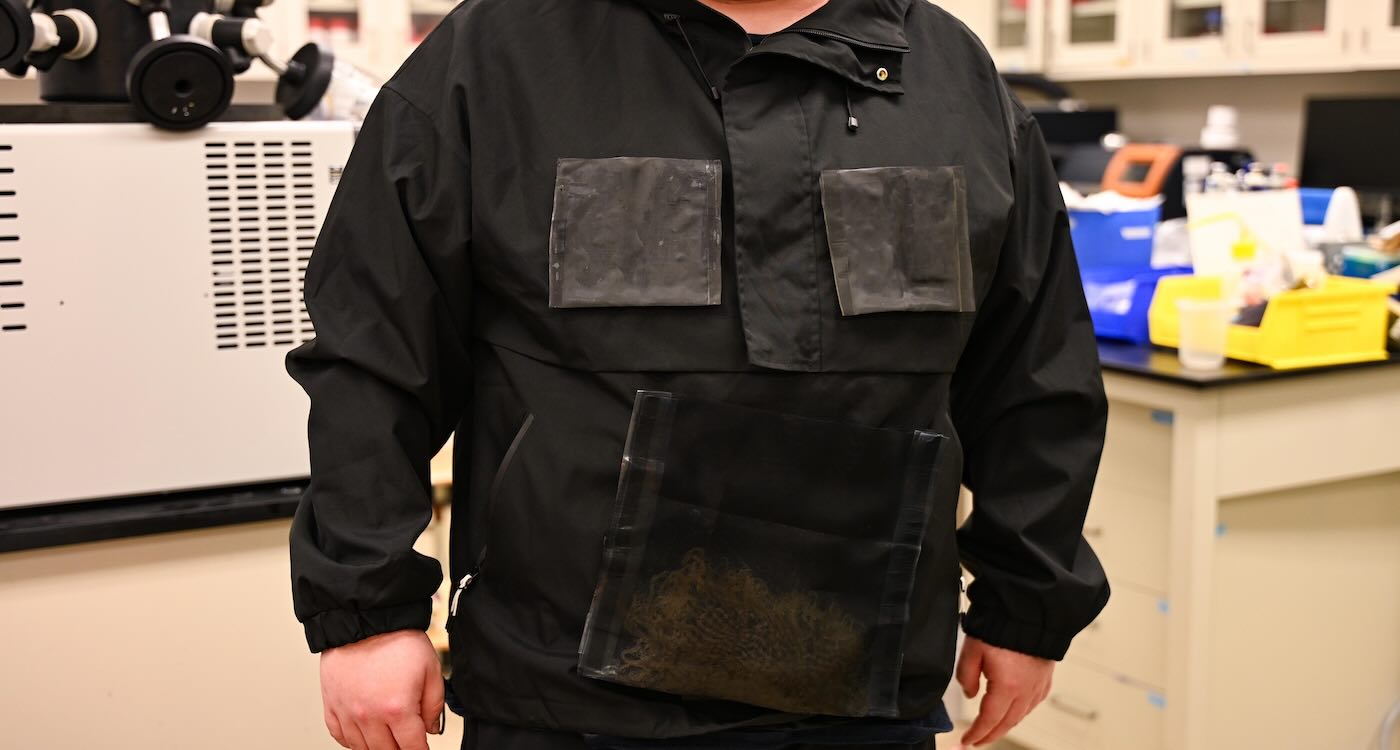
The detachable harvesting units in the jacket are placed in a foldable collector piece and heated to produce the water – Credit: University of Texas-Austin / SWNS

A new high tech jacket developed by engineers at the University of Texas can pull drinking water from thin air.

With the advance in fabric technology, the jacket can collect up to one-and-a-half pints of drinkable water a day, say scientists.

They suggest the ground-breaking technology could benefit anyone who spends a lot of time in areas without easy access to drinking water, like hikers, campers, runners, agricultural workers, and soldiers.

“Water harvesting from air is usually imagined as a stationary device such as a box, a panel. We wanted to rethink the form,” said research co-leader Professor Guihua Yu. By focusing on the fibers rather than building another bulky device, the researchers overcame a common problem in the field.

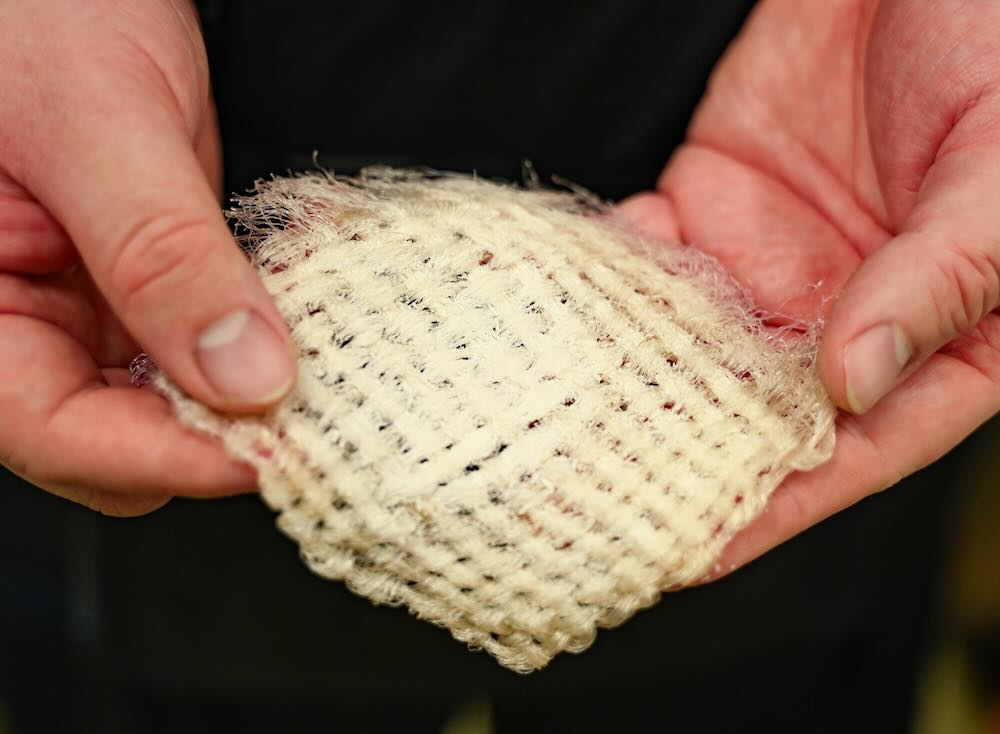
He explained that the textile incorporated into the jacket collects moisture and funnels it to detachable harvesting units, which are then “placed in a foldable collector and heated to produce the water”.

The jacket produced between 400 and 900 milliliters (0.7 to 1.5 pints) of drinkable water per day, depending on humidity levels, according to a study published in the journal Science Advances.

Compared with conventional water-harvesting materials, the textile showed a three- to 10-fold improvement at scale.

University of Texas – Austin / SWNS

“The important advance here is that the team did not simply make another material that absorbs water,” said study co-author Professor Keith Johnston.

“They designed a pathway for water to move quickly, from vapor in the air to liquid on the fiber surface, and then into the interior of the textile.

The researchers are now eyeing applications beyond clothing – including backpacks, tents, emergency shelters and other outdoor gear, allowing items people carry every day to help collect water. They also plan to look at applying the technology to remote field operations, disaster response, and water access in arid or infrastructure-limited regions.

A separate device developed by the same research team pulled a record amount of drinking water from the air using solar power—in both the arid climate of the Chihuahuan Desert and the humidity of Austin, Texas.

In tests, the researchers captured 1.3 liters (2.3 pints) of clean water per day in both locations. That equates to 4.3 liters (7.5 pints) of water per kilo of moisture-capturing materials per day—more than any other research group has achieved, according to a paper published in the journal Nature Water.

“This is a big stride toward practical atmospheric water harvesting,” said study co-lead author Weixin Guan.

OTHER ADVANCEMENTS:
• Ultrasonic Device Dramatically Speeds Harvesting of Water from the Air – Drinkable in Minutes Instead of Hours
‘Milking’ the Air for Water: Zero-Energy Technique Doubles Survival Rate for Young Trees to Reforest After Fires
Device Pulls Dozens of Liters of Water from the Air–Already Being Installed in Jordanian Desert Homes

At the center of the team’s work is AirGel, a specially-engineered hydrogel fabric made from biomass-derived materials. The fabric absorbs moisture from the air, then releases it when warmed.

“This goal has been incubated over years of work, from molecular design to real-world operation, and it is especially meaningful to see those pieces finally come together in a field-ready system,” said Guan.

The University’s research commercialization unit, has filed a patent application for the technology.

SHARE THE POSSIBILITIES With Hikers on Social Media…

Two ‘Super-Puff’ Planets Lighter Than Candy Candy Discovered by Researchers

Illustration planets TOI-791b and TOI-791c with host star TOI-791 Credit: NASA/Daniel Rutter

Two ‘super-puff’ planets lighter than candy candy have been discovered by scientists—and they’re bigger than Jupiter.

They are among the lowest-density giant planets ever detected, according to a new study.

The two planets orbit a dwarf star located around 1,110 light years from Earth in the southern constellation of Volans.

Although both planets—named TOI-791b and TOI-791c—are around the size of Jupiter, researchers say they are “extraordinarily” diffuse.

Jupiter’s density is 1.33 grams per cubic centimeter, while TOI-791b has a density of just 0.038 grams per cubic cm, and TOI-791c’s density is just 0.047—that’s 28 to 35 times lighter.

The new planets’ densities are even lower than cotton candy, which typically has a density of about 0.05 grams per cubic centimeter. In contrast, Earth’s density is 5.5 grams per cubic centimeter, according to the study published in the journal Monthly Notices of the Royal Astronomical Society, led by University of Oxford scientists working with researchers from the University of Birmingham and the Université Côte d’Azur in France.

The planets are “siblings” believed to have formed together from the same disc of gas and dust surrounding their young star.

They are also locked in a rare gravitational relationship known as a 5:3 mean-motion resonance, meaning that for every five orbits completed by the inner planet, the outer planet completes almost exactly three.

The research team says that gravitational interaction causes the planets to repeatedly “tug” on one another, producing measurable shifts in the timing of their transits across the host star.

“Only a handful of these super-puffy planets are known, and it is even rarer to find two in the same system,” said lead author Dr. George Dransfield, from Oxford.

“Their extremely low densities make them fascinating targets for understanding how planetary systems form and evolve.”

They were found by citizen scientists – and an Antarctica telescope was critical

They were first identified as possible planets by citizen-science volunteers participating in the Planet Hunters TESS project, which searches NASA data for possible new worlds.

MORE FASCINATING PLANETS:
Welcome to the Gas Giant Planet Where Clouds Turn to Stone
They Found a Lemon-Shaped Planet Where Rain Turns to Diamonds

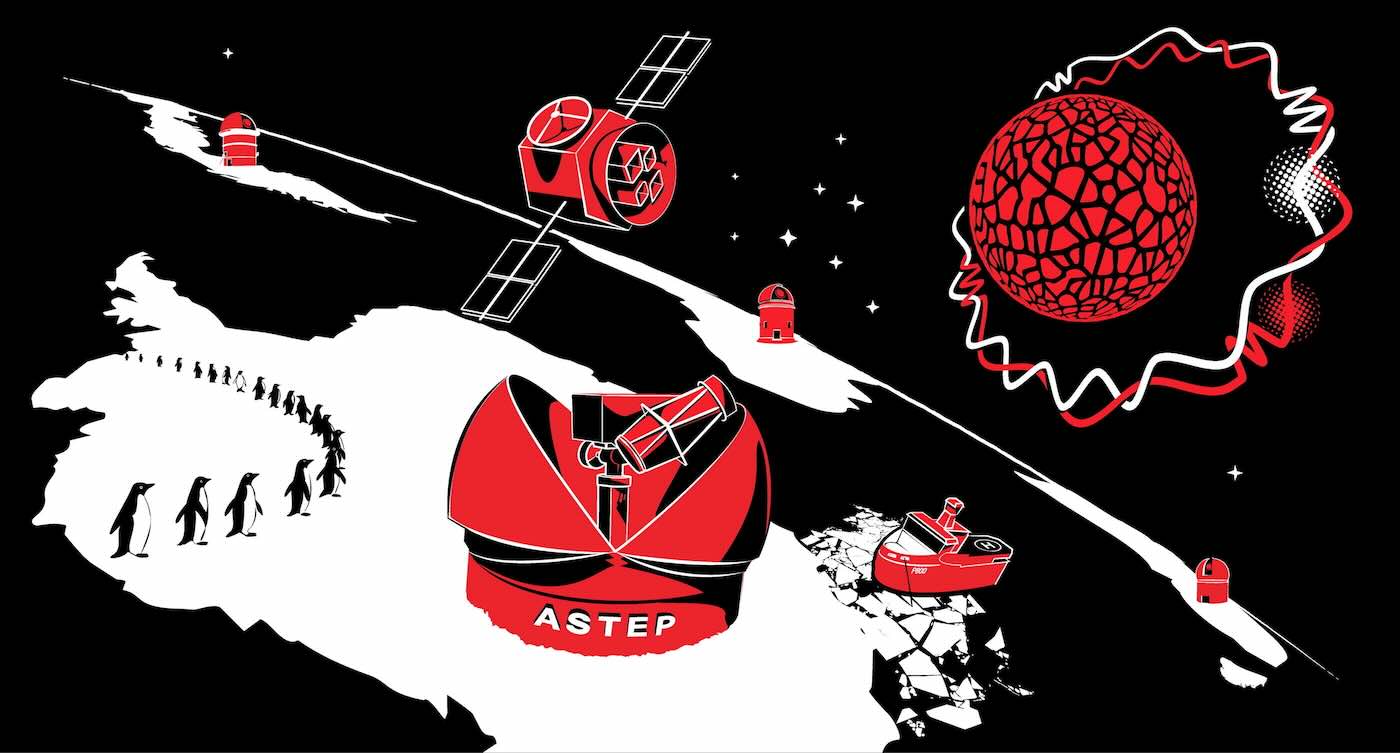
Scientists then measured the planets’ densities by combining observations of their sizes and masses using telescopes located around the world, including Antarctica (where the ASTEP is located—Antarctic Search for Transiting ExoPlanets).

Illustration of the Antarctic ASTEP and other telescopes observing the TOI-791 system – via SWNS

The Antarctic winter provided a unique advantage for one of their telescopes: months of continuous darkness enabled astronomers to capture the planets’ exceptionally long transits, each lasting more than 11 hours, in a single uninterrupted observation—the longest continuous planetary transits ever observed in their entirety from the ground.

Transits are crucial for the research because when a planet passes in front of its host star the view slightly dims the star’s light, and the amount of dimming reveals the planet’s size.

The researchers detected subtle variations in the timing of the transits, caused by the two planets gravitationally tugging on one another as they orbit the star. By analyzing the timing shifts, the team was able to estimate the planets’ masses and calculate their remarkably low densities.

“Bringing together observations from Antarctica, space telescopes, and observatories across several continents was essential to revealing the true nature of these extraordinary planets,” said co-author Professor Tristan Guillot, from the Université Côte d’Azur

Astronomers are still debating how super-puff planets form.

The researchers intend to carry out further investigations to understand more about how the puff-planets formed, and to rule out some of the explanations.

INCREDIBLE SPACE PHOTOS:
Stunning Photo Captures Gaseous Wings of Butterfly Nebula from the Gemini Telescope (LOOK)
Clearest Images Ever Taken of Solar Flare Reveal Unprecedented Detail 

“We propose to carry out space-based observations using the James Webb Space Telescope to assess if the puffy atmosphere contains carbon-, nitrogen-, and oxygen-bearing species, revealing new insight into how these unusual planets formed,” explained study co-author Professor Amaury Triaud, from the University of Birmingham.

DO A SOLID FOR ASTRONOMY-LOVERS By Sharing the Awe on Social Media…

Woman Wins Lottery And Immediately Gives Neighbor 5,000 to Take the Family on Vacation

Honorata Jamrozik and husband win lottery - Omaze SWNS
Honorata Jamrozik and husband win lottery – Omaze / SWNS

A 48-year-old woman who won a million in the lottery immediately gave her neighbors a gift of five thousand, so they can travel on their first family vacation abroad.

Honorata Jamrozik scooped up the life-changing tax-free prize in the UK Omaze Monthly Millionaire Draw—and her first act was selfless generosity.

The kind-hearted foster care mother surprised her neighbors of 14 years with the cash to spend on a family getaway.

“It’s a life-changing prize for us, but also for our friends and family,” said the woman from Dartford, Kent, who says she can go back to fostering kids thanks to the influx of money. “Now we can help make life easier for our loved ones—and that is the best feeling in the world.

“Good neighbors are one of life’s true blessings. They have been wonderful since the day we moved in, and they feel like family to us.

“Being able to give them money for a holiday so they can make some magical memories together makes me so happy.”

Polish-born Honorata, who’s lived in the UK for 25 years, had been grieving the loss of her father just two weeks earlier, and she learned about her new fortune after returning from his funeral in Poland.

And she’s convinced he’s the one who ‘sent it’ to her: “He’ll always be the angel sitting on my shoulder, and I know it was him who sent this gift to me.”

SURPRISE FOR GRADS: Commencement Speaker Tells Audience he’s Paying Off Final Year of Their School Loans, in Honor of Father

Honorata Jamrozik and her husband celebrating – Omaze / SWNS

Honorata had spent seven years providing foster care—work she adored—before having to give it up, so she could care for her elderly parents back in Poland, which required a lot of traveling back and forth.

She says her big windfall now means she’ll be able to return to the role she loves.

“I just wanted to change the lives of kids who haven’t had an easy start in life.

“I’m blessed that I was able to help children of all ages find a better future. I absolutely love fostering—and this win means I can carry on doing what I love. Winning just makes everything so much easier.”

CHECK OUT THESE GENEROUS PEOPLE:
Osaka Stunned by Anonymous Gift of Gold Bars to Fix Aging Water Pipes
Thousands Donate Hay to Help Nebraska Ranchers Who Couldn’t Feed Their Herds After Wildfires Burn Every Acre

The mom-of-two won the prize worth £1 million British pounds ($1.3mil), as part of her £15 monthly subscription ($20).

Her husband of almost 20 years had no idea that she’d been entering the drawings. He’d always been dismissive when it came to luck—as neither of them had ever won anything before.

“I’ll never forget that moment for as long as I live,” she recalled

“My husband always joked I had more chance of being struck by lightning than winning a million pounds. I guess I better be extra careful next time there’s a storm outside.”

As well as paying for their neighbor’s dream getaway, the couple will also book their own once-in-a-lifetime trip to mark their 20th wedding anniversary in October.

“We can afford to do something really special for our 20th anniversary now—go on a big family holiday somewhere lovely, I’ve already started planning!

“We will take my mother as she deserves a break more than anyone, I’m so happy we can enjoy this win together.”

“Helping the people we love is what this win is all about for us.”

MILLIONAIRES SHARE THE WEALTH:
Boss Gifts His Employees $240 Million in Bonuses After Selling Family Company
New Hampshire Man Had No Car and No Furniture, But Died with a Big Secret, Leaving His Town Millions

The Omaze Monthly Millionaire Draw runs every month, guaranteeing one UK winner £1 million, tax-free, each time.

At the same time it is changing Honorata’s life forever, Omaze raises money for good causes across the UK through its prize drawings, with more than £140 million raised to support UK charity partners since launching in 2020.

MAKE HER AN EXAMPLE By Sharing That Generosity on Social Media…

Intrigue From 17th C. Shipwreck Carrying Moroccan Gold Coins is Solved After 30 Years

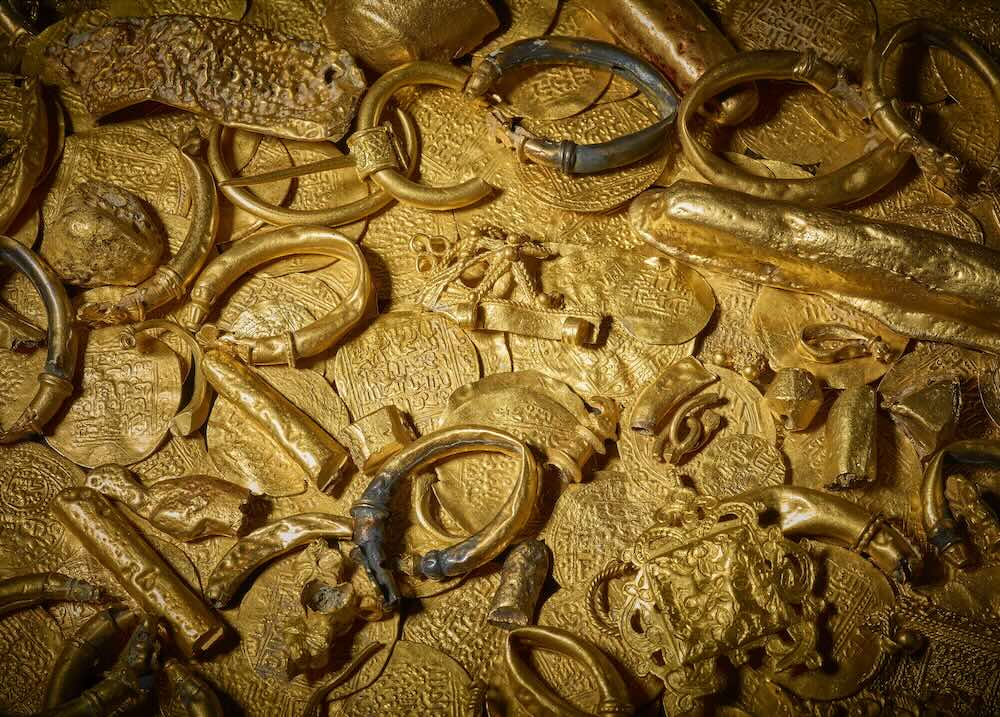
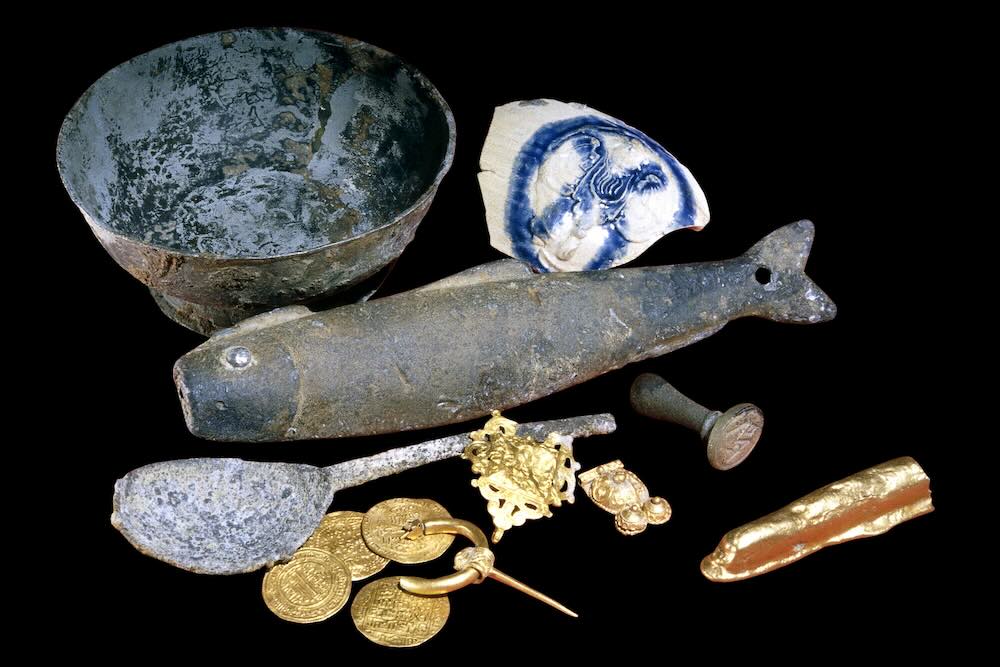
Gold recovered from centuries-old shipwreck discovered off the south coast of England by South West Maritime Archaeology – Professor Dave Parham/SWNS
Gold recovered from centuries-old shipwreck discovered off the south coast of England by South West Maritime Archaeology – Prof. Dave Parham/SWNS

A shipwreck off the British coast, including a treasure of hundreds of gold coins, has finally been identified after 30 years.

The 400-year-old ship discovered off the coast of Devon, England, has now been identified as the Dutch trading ship ‘Dom van Keulen’, which sailed from Morocco for the Netherlands in the autumn of 1633.

Found by the South West Maritime Archaeology Group, its cargo included 9,000 Barbary ducats (widely used European coins made of gold or silver), and gold Moroccan coins, along with 320 goat skins, 150 bags of gum arabic, and 64 bags of saltpeter.

The announcement came in a new book, From Morocco to the Coast of England: The Story of the Dom van Keulen and its Remarkable Cargo.

“It is thought that most of the cargo was salvaged at the time, but more than 400 coins remained on the seabed until they were discovered by the Archaeology Group in 1995,” said Professor Dave Parham, professor of maritime archaeology at Bournemouth University and the book’s co-editor who collaborated with the British Museum on the research.

Independent Historian, Ian Friel, who helped identify the ship, has uncovered documents in the National Archive relating to its voyage from Morocco to the Netherlands during which the crew “met with much tempestuous weather”.

The ship sprang a leak and sank close to the coastal town of Salcombe, off the south coast of England, but the entire crew survived.

MORE TREASURE STORIES:
• Family Unearths Treasure of 1,500 Medieval Coins While Excavating for New Swimming Pool
Man Finds Surprise of a Life in His Field: 700 Coins from Civil War ‘The Great Kentucky Hoard’

The 400 coins, along with other cargo from the wreck, are currently on display at the British Museum—all having originated along the Barbary Coast, today’s Morocco.

African gold coins recovered from the Dutch wreck – SWNS / British Museum
Selection of treasure from the Moroccan Sa’dian dynasty (16th-17th century AD) found in Salcombe Bay, Devon – SWNS / British Museum

“The discovery of African gold from under the sea off the coast of Devon was an amazing discovery,” said Jeremy D. Hill, head of research at the British Museum. “It raised so many questions about how it came to be there.”

Answering those questions required a team of experts collaborating for years.

The story can now be told—and it provides tangible evidence of the flourishing 17th-century maritime trade linking Morocco, the Low Countries, and Britain.

It also illuminates the history of trade in African gold and the wealth and architecture of the Sa‘dian Sharifs, an Arab dynasty that ruled Morocco from 1549 to 1659.

VIKING WOWNorway’s Largest-Ever Trove of Viking Age Coins Is ‘Historic Find’ By Metal Detectors

“It reminds us how much there is still to be found under our seas,” added Hill.

SHARE THE GOLDEN TREASURE With Your Mateys on Social Media…

“Wine is constant proof that God loves us and loves to see us happy.” – Benjamin Franklin

Getty Images for Unsplash+

Quote of the Day: “Wine is constant proof that God loves us and loves to see us happy.” – Benjamin Franklin

Photo by: Getty Images for Unsplash+

With a new inspirational quote every day, atop the perfect photo—collected and archived on our Quotes page—why not bookmark GNN.org for a daily uplift?

Getty Images for Unsplash+

Good News in History, June 28

2010 photo by Angela George; and with Anne Bancroft in 1991, by Georges Biard – CC license

Happy 100th Birthday to Mel Brooks, the comic and writer who became the legendary director of comedies like Blazing Saddles, Young Frankenstein, and The Producers. One of the most successful film directors of the 1970s, Brooks was married to actress Anne Bancroft for 41 years until her death in 2005. He co-wrote TV’s Get Smart, and recorded the LP The 2000 Year Old Man, which propelled him into an exclusive club of entertainers honored with the EGOT grand slam—for winning an Emmy, a Grammy, an Oscar and a Tony. WATCH his bio and interview from several years ago… (1926)

Two Garden Ornaments Thought to be ‘Worthless Concrete’ Turn Out to be Italian Marble Busts Worth Thousands

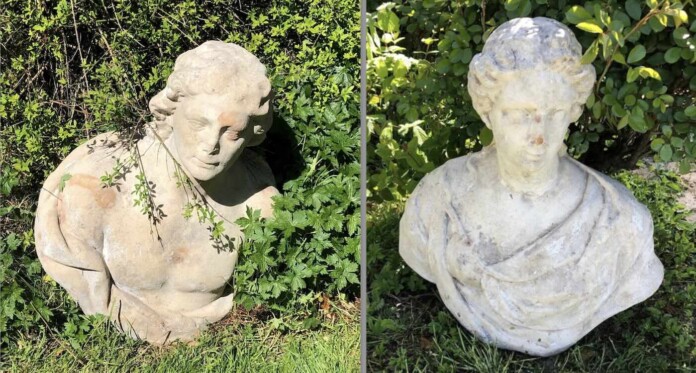
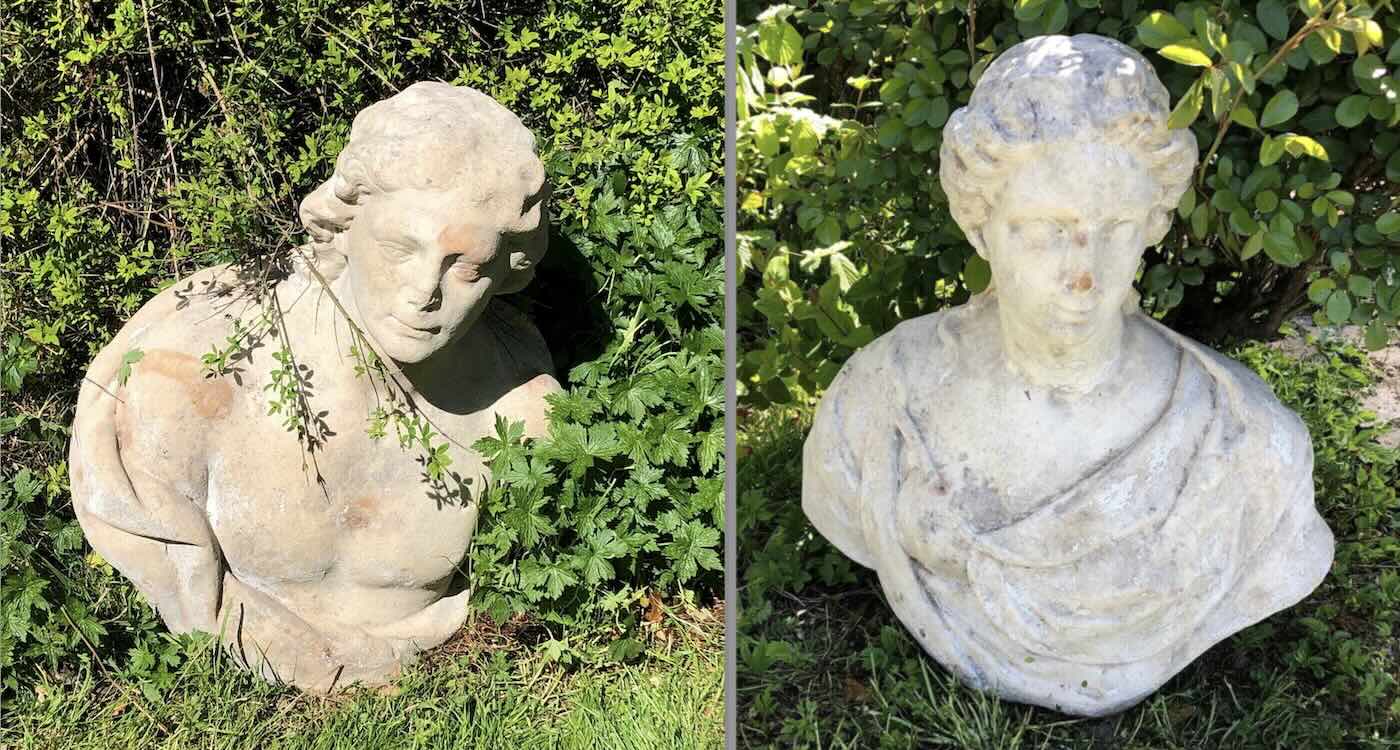
2 marble busts found in a garden by Hansons Auctioneers - SWNS
2 marble busts found in a garden by Hansons Auctioneers – SWNS

Two “worthless” garden statues thought to be made of cheap concrete were discovered to be rare 18th-century Italian marble masterpieces, earning the homeowner a nice payday after their sale.

An estate-sale expert spotted the tatty chipped busts in the undergrowth around a house that was being cleared out in Kent, England.

The owner used them as garden decorations, thinking they were low value concrete figurines, but closer inspection revealed the statues were carved in the early 1700s by craftsmen in Florence, Italy.

Placed up for auction this week, the two Florentine busts—one depicting Apollo and the other Diana—sparked a bidding war between collectors and architectural salvage companies.

They fetched around $3,000 each, with the hammer falling to a round of applause.

They were discovered by Hansons Auctioneers’ Justin Matthews during a routine house valuation in the village of Boughton Monchelsea.

“The owner thought they were mass produced and made of concrete and was surprised when I told him I thought otherwise.”

Dating from 1720-1730, the busts probably came to Britain during the Grand Tour era when wealthy travelers scoured Europe for classical treasures.

Italian marble bust of Diana after cleaning by Hansons Auctioneers – SWNS

GRANDMA’S BEST SURPRISE: Crock Sitting on Her Porch for 40 Years Fetches $32k After She Hoped for $100 on her Birthday

“Both may once have formed part of a much larger architectural scheme, perhaps decorating a grand staircase, formal garden, or a classical façade before eventually making their way to England.”

The figures would have been instantly recognizable to Georgian collectors in the 1700s but their heavily weathered look after centuries of erosion, lichen, and surface deposits hid their true value, until experts later uncovered the hand-carved marble beneath the grime.

Apollo—god of music, poetry and the sun—is depicted bare-chested and draped in the classical Roman style. Diana—goddess of the hunt and moon—appears in flowing robes in the neo-classical style popular across Europe at the time.

CHECK ALL YOUR OLD TABLES: 400-Year-old Ming Dynasty Table Worth $80k Inherited From Relative Who Loved Anything Asian

“Many comparable pieces imported to Britain during the Georgian era were lost, broken up, or dispersed as estate collections were dismantled over the centuries,” said Justin.

“The survival of the pair is remarkable.”

SPUR YOUR GARDENING FRIENDS By Sharing the Find on Social Media…

Drones are Saving Hundreds of Fawns From Mower Deaths in Germany (WATCH)

Credit: Erika Fletcher

A Bavarian wildlife rescue organization is using thermal imaging drones to locate and rescue vulnerable fawns hidden in tall meadow grass ahead of the annual mowing season.

Every spring, thousands of fawns are killed by mowing machinery across Germany. Baby deer instinctively freeze when threatened, a natural defense mechanism that protects them from predators but leaves them vulnerable to farm equipment.

Traditionally, this work was done on foot—with volunteers walking through the meadows in lines—an extremely labor-intensive task for this volunteer rescue group founded in 2020.

Now, with the thermal imaging of DJI drones, the rescue group, Rehkitz-Rettung Mangfalltal, can locate these hidden animals more quickly and efficiently before mowing begins, especially with the drone’s AI technology features that help pilots reliably spot fawns, baby hares, and ground-nesting birds.

Since integrating drone technology into their workflow, the group’s annual count of rescued fawns has ballooned from 10-15 in previous years to between 300 and 350 fawns today.

In a case study, operators used the Matrice 4 Series’ precision positioning controls to spot heat signatures in vegetation, verify them visually, and direct ground teams to the exact location. (See the video below…)

DRONES FOR GOOD:
Seizures Bar Him from Swimming–So He Saves a Drowning Girl with His Drone
Drones Find Dozens of Landmines Littering Ukraine So They Can Be Defused
Nations Team Up to Use Heavy Lifting Drones to Clear Everest Slopes of Trash

Whenever the thermal camera detects a heat source, its location is pinned with centimeter-level accuracy using the drone’s GPS and shared instantly with the ground team.

The German case study also provides a video step-by-step guide on the rescue process, including drone operations from an altitude of 80–100 meters and how to handle fawns once they are found.

Thanks to the Rehkitz-Rettung Mangfalltal volunteers and drone pilots, farmers are able to happily proceed with mowing—confident that fields have been safely cleared of hidden animals. WATCH the Reuters news video below…

FAWN-OVER THEIR COMPASSION By Sharing the Good News on Social Media…

Hospital Opens Roof Garden Where Critical Care Patients Can Enjoy the Outdoors for Hours With Full Care

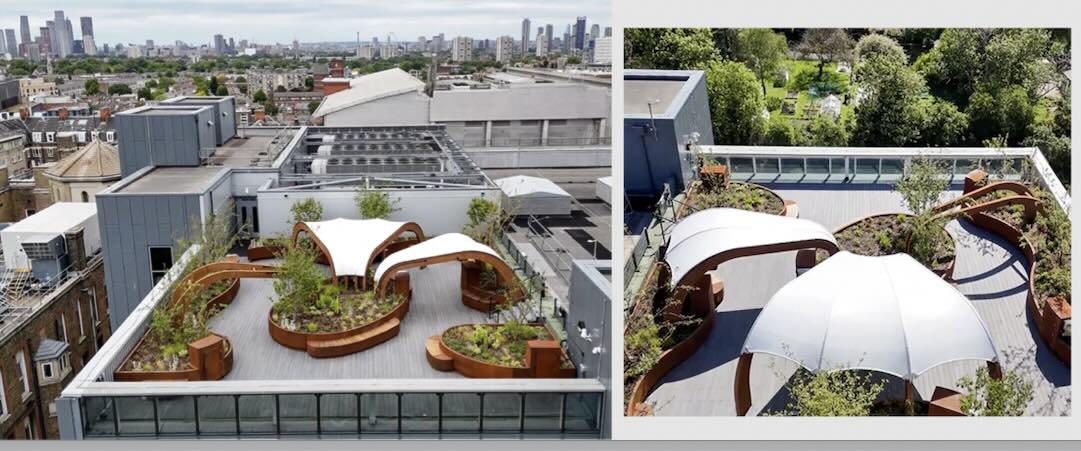
The King’s Critical Care Roof Garden - Courtesy King’s College Hospital
The King’s Critical Care Roof Garden – Courtesy King’s College Hospital

A hospital in south London opened a garden on its rooftop where Critical Care patients can spend hours in the fresh air and sunlight.

ICU patients visiting the rooftop garden receive “full life support” while experiencing the therapeutic benefits of the natural surroundings.

Located on top of the hospital’s 60-bed critical care unit, King’s College Hospital says their roof garden has space for up to six beds.

The best part is that each patient can be safely cared-for—without being disconnected from essential life-support systems.

Six specially-designed weatherproof cabinets keep the patients close to power, data, and medical gas supplies, just like they would receive on the unit.

The hospital’s team will also be able to research how exposure to fresh air, greenery and sunlight can reduce stress, lower blood pressure, and improve the well-being of patients—and the families and staff who care for them.

Weather-proof medical box provides life support on the King’s Critical Care Roof Garden – Courtesy King’s College Hospital

Dr. Tom Best, Clinical Director of King’s Critical Care, said many of their patients spend weeks or even months receiving intensive care—and research shows that time spent in nature can improve recovery outcomes.

“It’s important to treat the whole person and this outdoor critical care unit helps meet our goal of caring for the mind as well as the body,” he said in a media release.

YOU MIGHT LOVE: A Daycare Rewilded its Yard and the Children Became Healthier: Now the Whole Nation Is Doing it

Iona Joy, Director of Grants at the King’s College Hospital Charity, said the garden—the first of its kind in the UK—is about dignity, humanity, and innovation.

“We are transforming intensive care into compassionate care—where science, technology, and empathy work together to save and rebuild lives.”

“When you’re stuck inside all day there’s no motivation to try and get back to normal life,” said Holly, who is waiting for a vital heart operation and spends hours at a time on the outdoor ward.

“Even if it was thunderstorms, I’d be out here,” she told the BBC. “It’s lovely.”

The garden designers, landscape architect Nigel Dunnett—a professor at the University of Sheffield—and Sarah Price—a three-time winner of the Chelsea Flower Show—formed a planting strategy.

The King’s Critical Care Roof Garden from above – Courtesy King’s College Hospital

Aromatic species, including rosemary, sage, and oregano, were incorporated alongside native species and tactile plants, such as lamb’s ear, to actively encourage engagement rather than passive observation.

NATURE PRESCRIPTIONS ARE DOCTOR’S ORDERS:
‘Nature Prescriptions’ Improve Both Physical and Mental Health, 28 Studies Say
Fisherman Creates First Program that Lets Doctors Give Angling Prescriptions for Anxiety – Now Wins King’s Award

The low-maintenance garden has become a vital extension of the King’s Critical Care Centre, which supports over 5,000 patients and 15,000 loved ones each year.

As part of the research for the department, the Critical Care team will study patients’ long-term outcomes, with an additional focus on how families and staff benefit from using the space, particularly in managing stress levels.

Professor Clive Kay, Chief Executive of King’s College Hospital NHS Foundation Trust, says the roof garden is dedicated to those with serious and life-threatening conditions.

“It’s been built with purpose and guided by the needs of patients and their families—and reflects a deep commitment to dignity, support, and hope.”

SHARE THIS AMAZING IDEA With Hospital Workers and Friends on Social Media…

Your Weekly Horoscope – ‘Free Will Astrology’ by Rob Brezsny

Our partner Rob Brezsny, whose latest book is Astrology Is Real: Revelations from My Life as an Oracle, provides his weekly wisdom to enlighten our thinking and motivate our mood. Rob’s Free Will Astrology, is a syndicated weekly column appearing in over a hundred publications. He is also the author of Pronoia Is the Antidote for Paranoia: How All of Creation Is Conspiring To Shower You with Blessings. (A free preview of the book is available here.)

Here is your weekly horoscope…

FREE WILL ASTROLOGY – Week of June 27, 2026
Copyright by Rob Brezsny, FreeWillAstrology.com

CANCER (June 21-July 22):
Now is an auspicious time to declare a sweeping amnesty and observe a personal season of pardon. To the best of your ability, release your clenched feelings about people who have caused you pain. Banish blame! Purge any lingering resentment and regret that has curdled into self‑reproach. Celebrate atonement and absolution! Most vital of all, exonerate yourself. Shed the guilt you’ve carried for missteps and missed chances. And please offer yourself a sweet gift: a ritual of renewal.

LEO (July 23-Aug. 22):
If you happen to be swallowed whole by a dragon or whale sometime soon, don’t freak out. It’s far preferable to being chomped into bits first, which absolutely won’t happen. You may indeed spend a brief spell inside the creature’s dark belly, but I confidently predict you will ultimately be deposited on the outside in one intact piece, after which you will only need to find your meandering way back home. The whole episode may be confounding or humbling, but I bet it will also scrub you free of a load of old karma.

VIRGO (Aug. 23-Sept. 22):
Bees perform what scientists call a “waggle dance” to communicate the location of flowers to their hive-mates. But the directions are sometimes imprecise, and the apparent sloppiness actually helps the hive. It forces other bees to explore more broadly, discovering new food sources that the original bee missed. Perfect information would make them too efficient to be adaptable. Your precision is one of your gifts, Virgo, but right now I think you need strategic vagueness and fuzzy logic. Leave some directions unclear. Mistakes and misunderstandings might lead to discoveries that your perfect plans would have eliminated.

LIBRA (Sept. 23-Oct. 22):
In ancient Greek thought, kairos referred to the opportune moment. It meant the right timing, when circumstances aligned for action to be most effective. The term chronos, on the other hand, was about sequential time, which blindly marched forward without any regard for special moments or auspiciousness. Most of us are more or less hypnotized by chronos-consciousness. We measure our lives by calendar dates and external schedules. But in the coming weeks, Libra, I recommend you stay on high alert for kairos-rich pivots. For now, suspend inquiries like “Am I on schedule?” and ask, “Are the circumstances ripe?”

SCORPIO (Oct. 23-Nov. 21):
Ravens are strongly motivated to engage in elaborate play: aerial acrobatics, complex games, sliding down snowbanks, and sharing food with non-relatives. These behaviors lack an immediate payoff, yet support learning, motor skill development, and social relationships. They seem to be both emotionally rewarding and indirectly advantageous for survival and success over the long term.​ Let’s apply this to you, Scorpio. Let’s conclude that delight isn’t wastefully frivolous and that pleasure doesn’t need to justify itself through productivity. In the coming weeks, you may face pressure to explain or defend your joy, as if to prove it’s worth it in some utilitarian way. Refuse. Like the ravens, engage in purposeless beauty and fun simply because it feels so good.

SAGITTARIUS (Nov. 22-Dec. 21):
Glaciologists studying ice cores can read Earth’s climate history going back 800,000 years. Each layer contains trapped air bubbles. These are time capsules that preserve the atmospheric composition of each moment. The ice remembers everything. You accumulate similar records, Sagittarius. Each of your experiences leaves its trace. And in the coming weeks, you will have extra access to these archived layers of your own history. Memories and patterns you thought were lost will surface with intriguing clarity. I hope you study these revelations to glean insight about your long-term patterns and cycles. It’s time to see the Big Picture.

CAPRICORN (Dec. 22-Jan. 19):
Many people forget, but you know: Structure is the foundation for freedom, not a suppression of it. While others fantasize about escaping responsibility, you know that mastery is key to every emancipation. When properly practiced, your flair for discipline adds vigor as well as rigor. More than any other sign of the zodiac, you are adept at using limits to give unlimited possibilities their specific shape. I trust you will express all these Capricornian powers to the max in the coming weeks. People in your life need them even more than usual.

AQUARIUS (Jan. 20-Feb. 18):
Horticulturists practice “deadheading.” They remove spent flowers from plants to encourage new vitality. Faded flowers drain energy that could go toward fresh growth. Plants that have been deadheaded produce more abundant blooms than those left to manage their own decay. I recommend a metaphorical version of this practice to you, Aquarius. You’ll be wise to deadhead your emotional garden. Certain attachments, once vibrant and nourishing, have expired. They’re not evil or wrong; they’re simply finished. It’s best not to keep directing precious energy toward maintaining their faded forms. With gratitude for the old beauty, clear the way for new beauty.

PISCES (Feb. 19-March 20):
For maximum safety, be as uninteresting as possible. Shun risks that might shake up your beliefs and avoid adventures that could expose you to people who aren’t similar to you. If you really want to be certain about preserving your security and stability, as I’m recommending, the surest method is to retreat to your power spot and do nothing at all. WAIT! STOP! Dear Pisces, everything I just said was pure misdirection! I was joking! In fact, the opposite is true. The true way to nurture genuine safety and security is to pursue what sparks your curiosity and lights up your zeal. And the coming days are likely to provide you with plenty of chances to do exactly that.

ARIES (March 21-April 19):
The interesting struggles you’ll wage in the coming weeks will require your vulnerability: showing up exactly as you are when you might rather fight or escape. Your warrior nature probably prefers a clear enemy or a definable problem you can confront, but the truer conquest will come from laying down your weaponry. I suggest you meet aggression with curiosity and engage chaos with receptive stillness. At least for now, your greatest strength will be to remain undominated by your own reactive impulses. Think of it as an advanced martial art.

TAURUS (April 20-May 20):
In accordance with astrological omens, I invite you to be inspired by this wisdom from artist Pablo Picasso: “I am always doing that which I cannot do in order that I may learn how to do it.” He’s proposing that we treat a lack of expertise not as an embarrassment, but as a doorway. Instead of waiting until we feel ready, trained, and confident, he suggests we head into territory where we fumble, guess, and feel awkward. Our discomfort may lead to gratifying growth. So I dare you to ask yourself whether there’s a capacity or skill you’d love to add to your repertoire but are too shy or timid to try. Then take small, imperfect steps toward it, trusting that each move will teach you how to do what once felt impossible.

GEMINI (May 21-June 20):
Hummingbirds keep track of every flower they visit and know how long it will take each one to replenish its nectar. They maintain mental maps of many feeding sites and visit them on precise schedules. To ensure their survival, they can’t waste energy on flowers that aren’t ready yet. Your mind could work like this if you want it to, Gemini. Which people, places, and projects need time to refill before you visit them again? Who have you been approaching too frequently, seeking their nectar before it has had time to regenerate? In the coming weeks, practice strategic patience with your resources. In your secret conversations with yourself, call yourself “Hummingbird.”

WANT MORE? Listen to Rob’s EXPANDED AUDIO HOROSCOPES, 4-5 minute meditations on the current state of your destiny — or subscribe to his unique daily text message service at: RealAstrology.com

(Zodiac images by Numerologysign.com, CC license)

SHARE The Wisdom With Friends Who Are Stars in Your Life on Social Media…

“Do not let what you cannot do interfere with what you can do.” – John Wooden

Credit: Getty Images for Unsplash+

Quote of the Day: “Do not let what you cannot do interfere with what you can do.” – John Wooden

Photo by: Getty Images for Unsplash+

With a new inspirational quote every day, atop the perfect photo—collected and archived on our Quotes page—why not bookmark GNN.org for a daily uplift?

Credit: Getty Images for Unsplash+

Good News in History, June 27

176 years ago today, a hero of the Japanese nation was born on the Greek island of Lefkada. Scarcely could one find a life as strange and colorful as that lived by Patrick Lafcadio Hearn, who was the first Westerner to write extensively on everyday life in Japan. His unrivaled affection for the country that would become his home and resting place “lies in the glimpses he offered of an older, more mystical Japan lost during the country’s hectic plunge into Western-style industrialization and nation building,” wrote the Times. “His books are treasured as a trove of legends and folk tales that otherwise might have vanished because no Japanese had bothered to record them.” READ about his incredible life… (1850)

370,000 Acres of Rainforest and Granite Peaks Now Protected in French Guiana

Hilly terrain in French Guiana - credit Lesly Derksen, unsplash
Hilly terrain in French Guiana – credit Lesly Derksen, unsplash

As part of new wildlands protection law, the French Government has announced the creation of a new nature reserve in French Guiana spanning 370,000 acres.

Called the Rocky Peaks of Armontabo, the reserve includes giant, isolated granite mountains surrounded by intact rainforest of rich biodiverse value.

The same law also protected 7 other landscapes in France proper, but by comparison add up to little more than 2,400 acres.

French Guiana contains over one-thousand species of tree, and has one of the highest forest-integrity index scores of any territory on Earth, with 41% of its land area comprised just of the Amazon Rainforest alone. Other forest biomes are also present.

It’s already host to one of the world’s largest national parks, Guiana Amazon National Park—also technically the largest in “Europe.”

The Armontabo Peaks are a feature of a geo-eco region called the Guiana Shield which stretches across the Guianas, Brazil, Venezuela, and Colombia, and which is one of the most biodiverse places on Earth.

Their reserve takes the amount of French territory under “strong protections” closer to the country’s goal of 10% by 2030, and almost achieves the goal for 180,000 hectares of additional protections in Guiana by the same date.

“In concrete terms, this translates into less pressure on natural environments and stronger protection for species and habitats,” says Monique Barbut, France’s minister for ecological transition, biodiversity and international climate and nature negotiations.

The northeast corner of South America is rapidly becoming one of the most protected areas on Earth. Along with Armontabo and Guiana Amazon in French Guiana, neighboring Suriname announced protections for 25 million acres last year.

RAINFORESTS ON THE UP AND UP: America’s Largest Rainforest Safe from Logging Thanks to Alaska Court Ruling

The country is 90% forested, so virtually every last one of those acres will protect trees and the Amazon-style rainforest they form.

Re:wild, a conservation organization working actively in the Amazon and other South American landscapes, reports that more than 700 birds, 100 species of amphibians, and many charismatic mammals such as lowland tapirs, jaguars, giant river otters, and 8 different primates range throughout the country.

MORE SOUTH AMERICAN PROTECTIONS: Locals Finally Save ‘the Yosemite of South America’ After Decade Long Battle with Industrialist Who Owned it

“I’ve worked in Suriname for 50 years and I am absolutely delighted that President Geerlings-Simons has made this historic and unprecedented commitment to maintain Suriname’s forest cover at this level within her first two months in office,” said Russell Mittermeier, chief conservation officer at Re:wild.

“This sets a new standard for the Amazonian region as a whole, which has suffered from serious deforestation in recent decades.”

SHARE These Big New Rainforest Protections With Your Friends… 

Unique Double Cochlear Implant Surgery Lets Twins Hear Mom’s Voice For the First Time–Together

Mom Emily with Artie, Jack, and their older brother - family photo
Mom Emily with Artie, Jack, and their older brother – family photo

In what is believed to be the first surgical program of its kind in Australia, a pair of profoundly deaf twins have received cochlear implants at the same time.

The marathon 8-hour surgery involved 4 implants on 4 ears and 2 boys, all done in order to minimize the impact of pre and post surgical preparation on the family, and for the twins—who survived a premature birth—to make another important milestone together: hearing mom’s voice for the first time.

Artie and Jack were born prematurely due to a genetic condition, and though they’ve grown up healthy in many ways, they couldn’t hear a fire engine if it were next to their head.

A cochlear implant is a small device that transmits sound directly to the hearing nerve while bypassing the ear. It’s fixed under the skin and held in place with a magnet that connects to an external device mounted above the ear helix.

In April, ear-nose-and-throat surgeon Rithvik Reddy operated on both at once in what is believed to be the first time this procedure has been organized this way.

After a recovery period, Artie and Jack went to the Shepherd Center, a provider that helps children who experience hearing loss in New South Wales, to calibrate the implants to each child’s needs, and, at long last, turn them on.

Their mother, Emily Porter, spoke with ABC News AU about that moment.

“It was incredible and emotional … for them to turn their head to the sound of my voice and see their little eyes widen at the sound of that was just, it’s just mind-blowing.”

In comparison to other Australian states, New South Wales has for years had less revenue for cochlear implant funding assistance.

HEARING LOSS REVERSED: 10 out of 10 Patients with Congenital Deafness Have Hearing Restored in Children’s Gene Therapy Trial

Covering Artie and Jack’s surgery, ABC News spoke with the NSW government and Health Minister Ryan Park to inquire about the deficit compared to other states, and received a reply that AUD$20 million would be provided in next year’s budget to organizations like the Shepherd Center—specifically for helping parents afford cochlear implants and surgery.

“I think this will be one of the most important decisions I make as a part of this budget and indeed during my time as a health minister,” said Minister Park. “These kids deserve the very best start to life and we’re hopefully playing a role in delivering that for them and their families.”

GOOD AUSTRALIA: Salt Water Restores Native Queensland Ecosystems After Dozens of Tidal Gates Removed

Though they will need extensive therapy for the rest of their childhood, Mrs. Porter and her husband Ewan are looking forward to the future—and to every morning when they and their first born son Tommy, get to turn on Artie and Jack’s implants, and bring them back into the wonderful world of sound which for so long they had lived apart from.

“They smile … you can tell that they’re understanding what you’re saying. You’re talking to them … it really is a gift and a miracle,” Mr. Porter said.

SHARE This Touching Moment For A Beautiful Family And Promise Of Help For More Families… 

Firemen Rushed a 5-year old’s Fingertips to Hospital Where She Recovered and Painted a Thank-You Picture for Them

Olive meets the firefighters who saved her fingers - Essex Fire and Rescue Service
Olive meets the firefighters who saved her fingers – Essex Fire and Rescue Service

A 5-year-old who had her fingertips sliced off in a freak merry-go-round accident recently visited the station of the firefighters who saved them.

As Olive was rushed to the hospital, a group of 8 “Red Watch” volunteers at the Essex County Fire and Rescue Service frantically searched for the severed digits in the grass.

Finding all of them and putting them on ice, the firefighters hopped in their engine and with sirens blaring, delivered them to Broomsfield Hospital where they were successfully reattached.

8 weeks after the incident, Olive was able to visit Rayleigh Weir Fire Station to meet the team, bringing the perfect thank-you gift: paintings of them and their fire engine done with the same hand that was operated on.

“We’re incredibly grateful for what they did that day. Their determination and care meant so much to us as a family,” said Olive’s mother Linda, remarking how quickly everything had happened, but how the Red Watch didn’t waste a second.

“Our firefighters showed great professionalism, determination and care in supporting Olive and her family,” said group manager Dave Walpole, who leads the South East Command at Essex Fire and Rescue.

MORE FIREFIGHTERS AT WORK: 

“While Olive was receiving treatment, crews remained focused on doing everything they could to assist. It’s great to see how well she is recovering, and I know Red Watch loved welcoming her to the station.”

While visiting, the Red Watch presented Olive with a certificate of bravery, signed by Chief Fire Officer, Rick Hylton.

SHARE This Happy Ending To A Harrowing Incident In Essex On Socials… 

Italy’s Forest Cover is Larger Than Agriculture Land for the First Time Since the Middle Ages

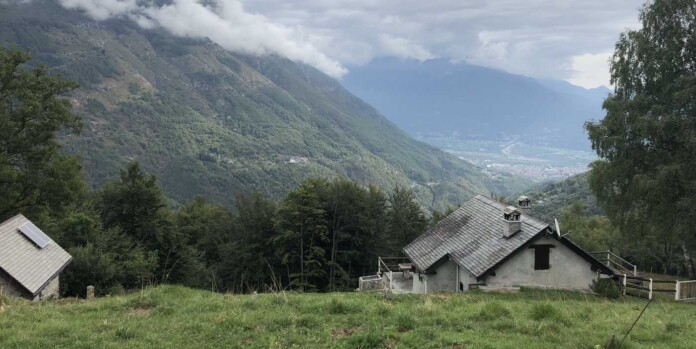
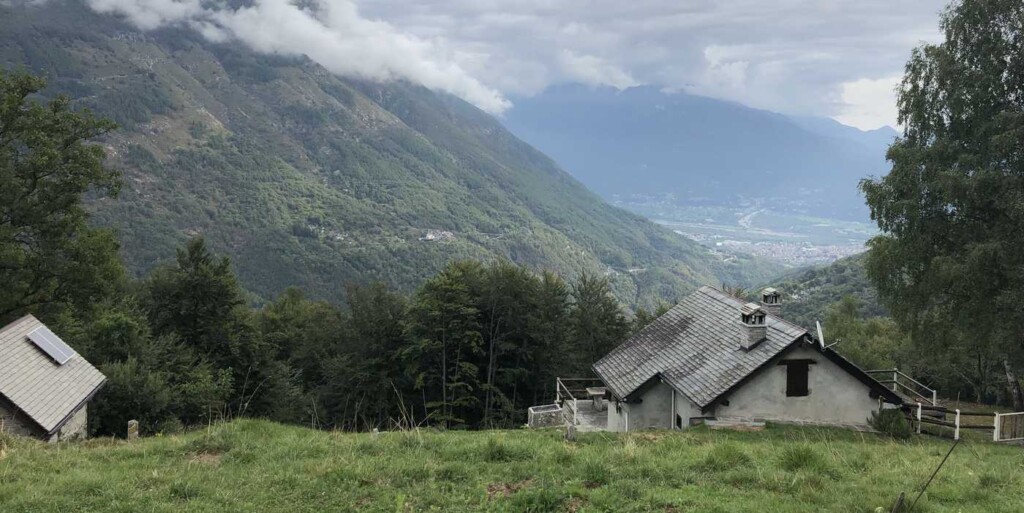
A view from a mountain town down into the Valle Ossola, Piemonte region - credit, Andrew Corbley
A view from a mountain town down into the Valle Ossola, Piemonte region – credit, Andrew Corbley

For the first time since the Middle Ages, Italy has more woodland than agricultural land.

Forests now stretch across 60,000 square miles of the Italian Peninsula, overly concentrated in mountain areas, but which nevertheless represent the gradual reversion of cultivated land to woodland again.

The milestone was officially hit in 2020, but only revealed this week thanks to a report published by National Union of Mountain Municipalities and Entities.

The report stresses the forest’s role providing work for free as a major net benefit from this reforestation.

In a single Italian municipality, called Marcetelli in the Rieti Province, where 94% of the land is covered in trees, the combined natural functions of the forests to store carbon, filter water and air, and to prevent erosion, would cost some $9.5 million if industrial solutions had to be sought.

Additionally, the increase in forested acreage is creating a somewhat ironic reversal of rural Italy’s emigration crisis.

For the last 2 decades, young people have increasingly left mountain and rural-plains areas for the big cities, resulting in the abandonment of marginal land or traditionally farmed/pastured lands, as well as an emptying of small towns—many of which have habitation records going back to medieval times.

Since 2021, however, 932 Italian municipalities showed a positive net migration of 10 per 1,000 inhabitants, with a significant share of these municipalities being located in heavily forested areas.

Discounting the coastlines, Italy’s geography is pretty straightforward. The Alps give way to the pre-Alpine hills which fall into the North Italian Plain, which give way to the Apennines until you reach the far south. These three mountain regions and the 3,598 municipalities nested therein account for three-quarters of Italy’s total forested area, even though they harbor just 13.5% of the country’s population.

It’s a statistic that captures their rurality, but also highlights the benefit beyond these trends in migration.

For locally endangered species like bears and wolves, more woods in mountain areas will go a long way toward supporting their populations.

There are ample opportunities to use these new forests for eco-tourism and sustainable forestry, while expansion of habitat for animals like wild boar and red deer offers increased bounty for Italy’s hunters who supply so many national restaurants with these favored game meats.

NOTIZIE D’ITALIA: Italy Unifies its Historic Pilgrimage Trails to Offer Slower, More Intimate Tourism

The report nonetheless points out that many of these forests weren’t just appearing out of nowhere—they’re taking over agricultural land where farmers and ranchers used to ply there own trade.

All things being equal, however, the supply of farmland and pasture in Italy was clearly in a glut, otherwise the demand for agricultural products would have kept farming families there to satisfy it. In economic terms, the demand for living close to nature has grown, while the demand from living in farming communities has declined.

A GREENER EUROPE: Herd of Bison Reintroduced in Europe Are Climate Heroes–Helping Store CO2 Equal to 43,000 Cars

Therefore, though the report colors the loss of farmland as an economic decline, it cannot be logically said to be so.

Those seeking to experience some of these rich woodland ecosystems on a trip to the Peninsula can find in the data some clear signals: of the 5 most-wooded municipalities in Italy, 2 are in the province of Perugia, and 2 are found in Udine.

SHARE This Positive Trend Towards A Greener Italian Landscape…

“Ninety-nine percent of the failures come from people who have the habit of making excuses.” – George Washington Carver

Credit: Getty Images for Unsplash+

Quote of the Day: “Ninety-nine percent of the failures come from people who have the habit of making excuses.” – George Washington Carver

Photo by: Getty Images for Unsplash+

With a new inspirational quote every day, atop the perfect photo—collected and archived on our Quotes page—why not bookmark GNN.org for a daily uplift?

Credit: Getty Images for Unsplash+

Good News in History, June 26

Left, US release cover, right original UK release

29 years ago today, the first installment of the Harry Potter book series – Harry Potter and the Philosopher’s Stone, was published in the UK under Bloomsbury. It won most of the British book awards that were judged by children. The book reached the top of the New York Times list of best-selling fiction in August 1999 and stayed near the top of that list for much of 1999 and 2000. It has been translated into at least 73 other languages, and sold 120 million copies, making it the third best-selling book of all time. READ more about the book’s acclaim… (1997)

Million Dollar Makeover Turns Old Railroad Bridge into City’s Trendiest Venue With a View

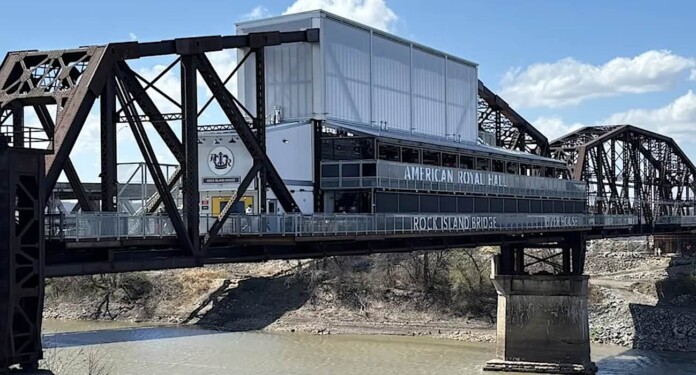
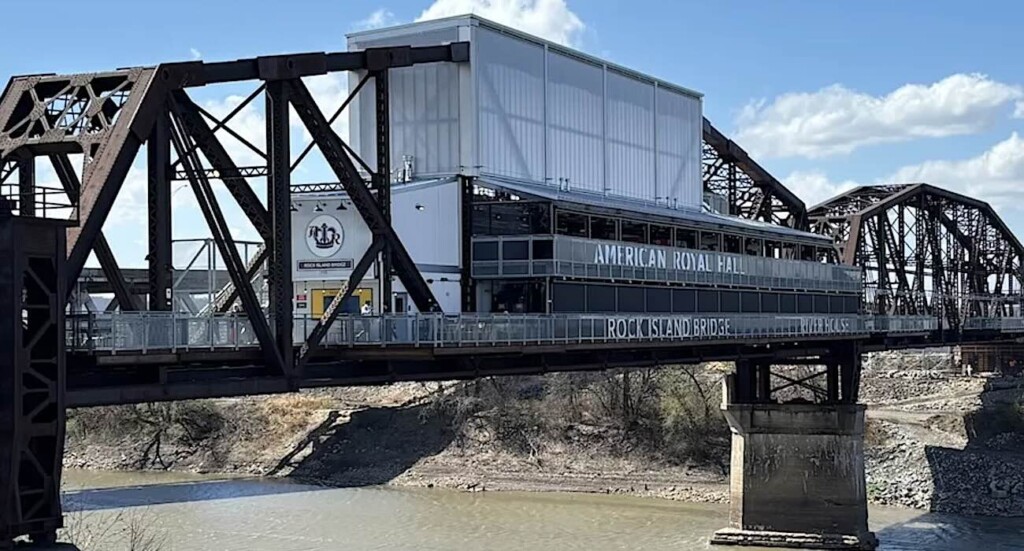
Former railroad bridge now serves as a public gathering space over the Kansas River – Credit: Thornton Tomasetti

GNN has previously reported on heritage American architecture finding new life as hospitality and entertainment centers.

On the Kansas River, a 120-year-old railroad bridge has been infused with the labor and love of both states the trains used to pass through, and has been resurrected into a restaurant and event space plus walking path.

The Rock Island Bridge opened this April, with a full opening of all areas slated for mid-summer. Its CEO, Mike Zeller, holds a 66-year lease on the structure received from the united authority of Wyandotte County Kansas and Kansas City Missouri.

Zeller was the “band leader” behind the project, which started on a boat trip up the Kansas where he passed the old rail bridge which seemed like others he remembered loitering on as a young man; an object that something should be done with

10 years later, in 2017 he founded the company that would lead the bridge’s renovation: Flying Truss LLC, which after several years of begging, pitching, and brainstorming, managed to coalesce a coalition which Zeller called a “P6 approach” for public-private-philanthropy-people-purpose-process.

Speaking with Engineering News Record, Zeller said that some 35 local businesses donated materials and labor for the job—everything from the big neon entrance sign made by Hammer Out Design, to a local legal firm which worked pro bono for 7 years.

Many ideas were floated out, from being entirely a part of the city’s burgeoning trail network to a place were food vendors would work out of shipping containers. Eventually it was agreed that there’d be a two-story restaurant, an event venue, and an open-air space that would connect with the levee-top trails being built by Kansas and Missouri governments—costing $16 million.

A pretty standard rail crossing, the Rock Island Bridge was about 18-feet wide and utilized 3 steel trusses built by Andrew Carnegie’s steel firm. Trusses are those cage-like structures that sit atop flat river bridges to add stability.

After structural analysis found the bridge able to support 3.16 million pounds before any elements were removed, such as the old rail track and concrete, primary contractor. L.G. Barcus and Sons, Inc. determined that not much needed to be done to the original components. A few bolts needed to be replaced and some rust addressed, but that was it.

For the new structure, 15-foot cantilevers would support a wrap-around deck for restaurant space. Intriguing challenges awaited Barcus, such as what would happen if everyone moved to one side of the bridge to watch fireworks, and how to fit the second and first stories of the restaurant under the 300-foot-long central truss without covering them up.

BRIDGES AS VENUES: Contest Winner Turns Bridge into the Longest Walking Art Gallery in South Korea

As far as the trusses were concerned, existing machinery called lift gates had been well maintained, and Barcus was the original contractor on a 1952 project to raise the trusses to meet the heights of newly-built levees following a flood. With nothing more than a new motor and new grease, not only could the trusses be raised to accommodate the second story of the restaurant, but to satisfy the US Army Corps of Engineers’ standards for both a 750-year flood and the levees they were building along the Kansas River.

All the new support steel and cantilevers added up to around 680,000 pounds—well within the weight constraints.

Opened in April, it’s already one of the highlights of the city’s many venues. The truss beams occasionally plunge right through the walkway—even the tables, but they transmute the charm of the old architecture into the place—just like the steel railroad track acting as the footrests along the restaurant’s bar.

SIMILAR STORY IN SCOTLAND: Scotland’s Largest Greenhouse Set to Be Preserved as ‘Living Ruin’ and New Event Space

At the conclusion of the project, the cost was a mere $20 million, funded through a mixture of private investment (60%) public funding and grants (30%) and philanthropic donations (10%), which Zeller said had helped “create something spectacular for Kansas City that our kids and our grandkids are going to enjoy,” … “a gift from about 200 Kansas Citians to our city.”

Kansas City Magazine, attending the opener, wrote that Rock Island Bridge is free to enter and walk across, “and Zeller says visitors can also expect fun events, from farmers markets and live musicians to ticketed concerts and more.”

SHARE This Amazing American Renovation With Your Friends On Socials…

Musée d’Orsay Opens Gallery Dedicated to Still-Unclaimed Artworks Stolen by Nazis in WWII

‘Madame Alphonse Daudet’ by RENOIR - Credits © Musée d'Orsay-dist RMN Grand Palais/Patrice Schmidt (right) The Paris museum - by Jean-Pierre Dalbéra (CC BY 2.0)
‘Madame Alphonse Daudet’ by RENOIR – Credits © Musée d’Orsay-dist RMN Grand Palais/Patrice Schmidt (right)
The Paris museum – by Jean-Pierre Dalbéra (CC BY 2.0)

The world-famous Musée d’Orsay has opened the doors to a very unique gallery—its dream would be to get rid of all the paintings inside.

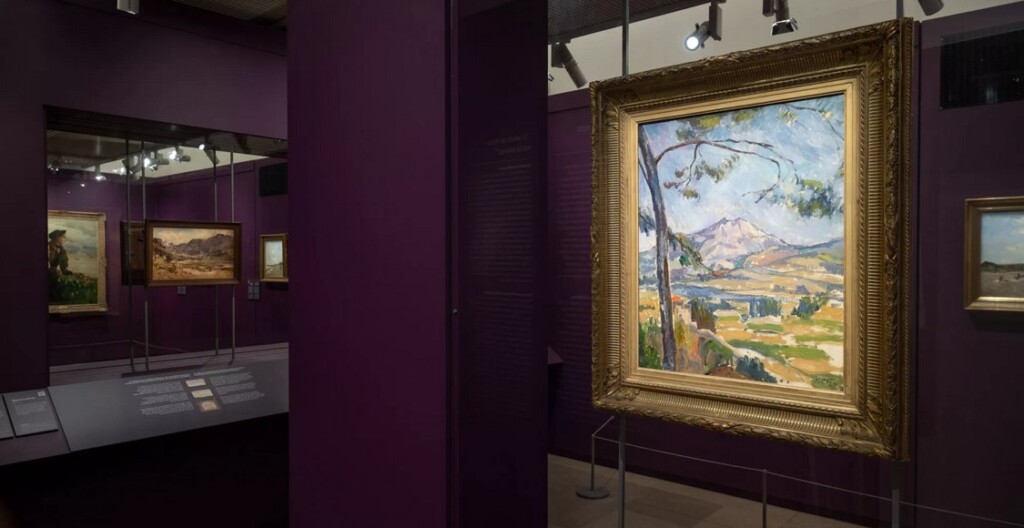
That’s because it exhibits a rotating selection of 225 works that were stolen when the Nazis occupied Paris during the Second World War. Currently 12 paintings, including works by Renoir and Degas, and a sculpture from Rodin are on display.

To Whom Do These Belong is part of the museum’s efforts to reckon with the city’s past, and, if at all possible, to find the rightful inheritors of these masterworks.

Though the north of France resisted Nazi occupation, the south, governed by the Vichy regime, collaborated with the Germans including in carrying out the Holocaust.

By the end of the conflict, over 100,000 items of cultural property had been looted. Some 60,000 works were recovered in Germany and Austria after the war; many of them had been sold on the art market and were easily traceable. 45,000 were restituted, while 15,000 went without identified owners according to a statement from the museum.

Most of these 15,000 were sold by France in the early 1950s, except for 2,200 of them, which were selected to be entrusted to the custody of various museums. Today, the museums are “duty-bound” to keep them in trust of their original owners and to investigate the provenance of their arrival in state hands.

Credit: Musée d’Orsay © L. Striffling

Over the last thirty years, 15 of these works conserved at the Musée d’Orsay have been returned to their rightful owners. 225 others remain because of uncertain origin, and in a few case because it has been established that they were not stolen or plundered.

Credit: Musée d’Orsay © L. Striffling

“The opening of this room on the permanent itinerary enables rotating exhibition with a view to providing a glimpse of the investigative work underway. A selection of 13 works is currently on exhibition there, highlighting the legacy’s complexity and the issues involved in it,” the statement read.

“Suspended between past and present, each of them testifies to ongoing provenance research, revealing the diversity of situations, both as regards quality and background. Others are on display in the Museum and are now identifiable by their special (purple) labels, or are on long-term loan to many other French museums.”

CREATIVE MUSEUM EXHIBTIONS: Visitors Can Now Watch the Restoring of a Masterpiece Bellini in Venice (Check out the Video)

CNN spoke with a British man of German origin whose family inheritance was looted by the Nazis. He, like other individuals highlighted in the Musée d’Orsay, has worked for years to establish clear evidence for the return of his family’s stolen property—some of it identified in German museums.

“I think it’s great that its [the looted works] going on display and it’s going to be an actual room set aside for art that is stolen,” said the man, named Antony Easton.

MORE STORIES LIKE THIS: Concealed for 100 Years by Empress Who Defied Hitler, Royal Jewels Thought Lost are Set for Public Exhibit

The established facts accompany each work, including when it was sold in France, where it was brought in the Third Reich, and who painted it, but the key part—who owned it—is unknown for each of the 13 exhibited works apart from one.

That one is Le Souper au Bal (The Supper at Ball) by Edgar Degas and was acquired in 1919 by the Jewish collector Fernand Ochsé, who went on to be deported and murdered in Auschwitz. 22 years later, it arrived in Germany at the Brame gallery via a Mr. M. Coutot. It’s unknown if anyone from Ochsé’s family or extended family lives or was aware he owned the piece.

SHARE This Inspiring Work In The Famous French Museum With Your Friends…