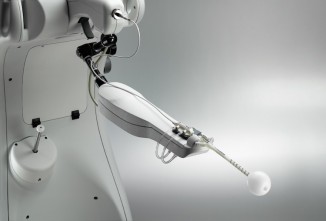
Reachi, a communication now in the hands of the Filipino Red Cross, can help emergency responders stay in touch even when cell signals are down.
When the power goes out, this device, which is solar powered, will stay on.
The Danish designers responsible for the device, Pernille Skjødt and Ida Stougaard, initially entered their invention in the Global Social Ventures Competition, Now, they’re hoping to distribute the device to the 1.8 million volunteers in the Philippines’ Red Cross 143 program.
“Once the regular communication lines and power lines are damaged, it is difficult to establish an overview of a disaster,” the duo explained in their Masters Thesis. “Early information can improve the planning and prioritization of relief for a more effective response, and potentially save lives.”
The mesh network will allow people carrying a mesh-enabled device to send short text messages through each other, as each device creates a link that spans 1km in range. Pairs of two volunteers will meet at a specific place at a specific time on the day after a disaster has occurred to text the device. Reachi has no vulnerable electrical ports, the silicone keypad creates a watertight sealing, and all additional joints are glued together for a water proof design.
Their first test market will be in the Philippines, an area prone to 30 natural disasters each year.
“As each device creates a link, the volunteers are able to communicate through each other,” the two designers explained. “This way, a signal is guaranteed, without the need of vulnerable, physical structures.”
Entrepreneurs across the country are creating ideas and social enterprises designed to confront our world’s biggest challenges. But there’s one catch: starting a social enterprise isn’t easy.
Enter the Halcyon Incubator, a program of S&R Foundation designed to support early-stage social entrepreneurs with, most notably, a residency program where up to 8 start-up hopefuls will work and live together in the historic Halcyon House in Georgetown. This four-month residency is coupled with a living stipend, and free workspace for eight months to ensure that social entrepreneurs from any socioeconomic background can succeed with a great idea and exit the program with a plan for action. Best of all? It is free to those who are accepted and fellows don’t have to give up any equity in exchange.
“Social entrepreneurs are going to fundamentally change how we solve problems in the next few decades,” says Ryan Ross, Program Manager of the Halcyon Incubator. “By providing an immersive program for the fellows, the program can significantly increase the social impact of the ventures.”
At Halcyon, fellows are also provided with many of the trappings of a traditional incubator or accelerator, including mentorship, programming around key entrepreneurial skills, and access to funders. While these are all vitally important to the experience, Halcyon has carved a unique niche with its synergistic residency component.
Andrew Foote, co-founder of Sanivation with its unique business model for toilets, is a current fellow at the Halcyon Incubator. He believes that by reimagining how sanitation services are delivered to the urban poor in developing countries, it can save the lives of thousands of people. Sanivation is a social enterprise that installs toilets in homes in Kenya for no upfront cost, and then transforms the waste collected into charcoal briquettes that can then be used for clean fuel.
Sanivation, along with fourteen other ventures housed currently at Halcyon, provide a veritable wellspring of ambitious plans to make the world a better place. These folks are “drenched in hope,” as one observer put it.
Foote described it this way, “Halcyon has provided me with the time, space, and mentorship to not just have the audacity to say Sanivation is going to serve 1 million people in 5 years, but to have a concrete and vetted action plan about how we are going about do it.”
Halcyon has also taken a unique approach by accepting both for-profit and non-profit startups. “We are looking for ambitious and sustainable ventures that are creating innovative solutions. This goal can be realized across sectors,” says Ross.
The program accepts applications twice a year and is currently recruiting its next round of fellows. Do you have a startup or an idea that will change the world? The application for the Washington DC based program can be found online and is due by Thursday, May 7th at 5 pm EDT.
Spread the Word to Give More People the Option of Applying… (below)
What’s your favorite memory of your mom that is something she did that no one else did, something quirky or endearing that really makes you smile?
All this week, we want to collect everyone’s favorite ‘mom-isms’ and compile them for a Good News Network Mother’s Day post on Sunday. Please share yours in the comments below, or use Twitter and Facebook with the hashtag #MyMomism
To start us off, I’ve asked my Good News Network team to share their favorite endearing memories of mom…
Terry Turner, Writer
We heard plenty of “momisms” in our house and they sounded like her own language. Three of my favorites are “permalet” (something the beauty parlor does to your hair); “fax” (which referred to everything involving the Internet, social media, texting or any other digital format — as in, ‘fax me when you get there’); and “jijantic” (something big –– as in, ‘Godzilla is a jijantic lizard’). I still can’t pronounce gigantic correctly after hearing her use this so often.
Charlie Towne, GNN business partner
In grade school the guys would stop on their bikes at our house, which was the last stop before school – they would gather in the kitchen while Mom finished my lunch. If they got too rowdy she would “remind” them that she had been a world wrestling champion––and had the belt to prove it. She was all of 80 pounds but somehow was able to perpetuate this story for a long time without having to produce the evidence – despite constant requests from the guys to see her belt… Love her madly and miss her.
By Sun Star
Kristy Cooper, Contributor
When I think of mom’s cute traits I immediately smile about her lifelong fitness addiction. Nowadays, everyone AND their grandmothers stay in shape. The billion dollar fitness industry is widely embraced. However, when I was little, this was considered quirky and definitely not the norm. Back when fast food ruled, mom made us drink wheat germ while my friends guzzled Kool-Aid. I opened my lunch box to find a dessert of carrots with raisins, while my friends had Twinkies and cupcakes. Mom was the resident “Jane Fonda” teaching aerobics every day after work and dragging me and my two sisters along. Decades later, we are all grateful for mom’s enthusiasm. The youngest runs marathons, the middle wins fitness competitions and I have a nutrition degree.
McKinley Corbley, Editorial Assistant
My mom is really into music. She’s always said that if she wasn’t a business woman, she would’ve been a singer. Whenever a new album is released by any of her favorite bands, you’d better BELIEVE that you are going to be hearing it 254,834 times. Not only would the album be accompanied by her harmonized singing, but a kind of wiggly grooving that could’ve maybe been dancing? (I’m kidding, Mom.) My fondest memory of this is when we went out together and Blurred Lines started playing on the jukebox. Mom jumped off her stool and started boogying about the bar. “Mom, this song is awful, have you listened to the lyrics, what’re you doing!?”
“But it’s just so catchy!” she exclaimed gleefully.
Photo by wishymom
Helaina Hovitz, Deputy Editor
My mom likes to pretend that she doesn’t love animals, but she does. I’ve seen her sneaking kisses to our dog when she thinks nobody’s looking, and talking to him in a baby voice when she brushes his paws.
I remember back in third grade, when I brought home my first pet, Sally the hamster, she pretended she wasn’t that into her. Sally was originally our class pet, and I’d volunteered to take care of her over winter break. I grew attached to her and asked the class if I could keep her. One day, when Sally didn’t wake up from her nap, I marched into my mom’s room and announced, through tears “Sally’s dead!” We put her in a box and buried her in the backyard and my father and I said a few words. I was very upset. I cried all night. My mom cried too.
(Top photo by Irelynkiss)
Tell Us Your Favorite Mom-ism Below, or Post on Twitter/FB with #MyMomism
A new survey finds that 60 percent of Americans who have reached their 100th birthday say they do not “feel old.” On average, they feel more than two decades younger than they are.
They point to a positive attitude as the key to a long, happy life.
According to the tenth annual UnitedHealthcare poll of 100 adults over 100, more than 60% of centenarians see themselves as “very positive people.”
“Year after year, we hear from centenarians that there is a correlation between healthy aging and a healthy mindset,” said Rhonda Randall, D.O., chief medical officer of UnitedHealthcare Retiree Solutions. “It’s a good reminder for us all to take care of our mental, emotional and social health.”
They also acknowledged the importance of family, with half saying they would rather spend time with their family than with anyone else in the world–although comedic actress Betty White was a close second. Thanks to modern technology, 83 percent of centenarians said they were able to keep in touch with family members on a daily or weekly basis.
When asked who they thought of as a role model growing up, nearly half of centenarians chose their parents over any other individual, teacher, or celebrity.
What a way to welcome the month of May with the arrival and the naming of a new royal.
The Kensington Palace tweeted Monday that Duke William and Duchess Catherine had named their baby girl, Charlotte Elizabeth Diana.
Her name, Elizabeth, is connected to her great-grandmother and her great-great grandmother. The name, Diana, is connected to William’s late, beloved mother.
The baby girl will be known as Her Royal Highness Princess Charlotte of Cambridge
Cheering onlookers hailed it a miracle as rescuers pulled a 101-year-old man from beneath the ruins of his house where he was buried for a week following the Nepal earthquake.
Funchu Tamang had only minor injuries and survived for seven days on flour and water as he waited for people to dig him out.
Rescue crews airlifted the man to a hospital where he’s recovering from injuries to his left ankle and hand. Doctors say Tamang is in stable condition and his family is with him.
And there’s another glimmer of hope in the country — five babies born to survivors in a makeshift, tent-hospital in Katmandu — giving Nepalese reason to celebrate survivors born a century apart.
April’s 7.9 quake is the second major earthquake Tamang has survived. He was in his 20s when an magnitude 8.0 quake woke him from his sleep in the very same village on January 15, 1934.
As Nepalese struggle to recover from the devastation of last week’s 7.9-magnitude earthquake, art therapy is helping children cope with the traumatic experience.
Children are especially vulnerable during emergencies. Over the years, art therapy has been used in disaster relief as a highly feasible means of reaching out to traumatized children and victims of natural catastrophes and war. Children put on paper the unspeakable – their fears, their emotions, their mourning. The creative process allows them to reveal their suffering, thereby relieving themselves of their psycho-emotional burden.
Sneha Shrestha, founder of Nepal’s first Children’s Art Museum is collecting funds to provide art therapy to children affected by the earthquake.
“We know that our role is going to be so vital over the next several years helping children cope with the disaster,” Shrestha said.
Several organizations have been delivering tonnes of humanitarian supplies to Nepal as part of ongoing efforts to reach at least 1.7 million children living in areas hardest hit by the earthquake.
A group of museum volunteers is now collaborating with UNICEF in child friendly spaces set up in informal camps across Kathmandu. Even as simple as a tent or an outdoor classroom, these ‘oasis’ play an enormous role in giving a child a sense of normalcy amid chaos. Children are given a safe space to run, interact, and play together.
“The spaces we have set up in informal camps offer children a chance to have fun and continue learning when going to school is no longer an option – while providing them with psychosocial support,” Rupha Joshi, an emergencies communication officer for UNICEF, said.
Children need stimulation and play on a regular basis. Child friendly spaces are widely used in emergencies as a first response to children’s needs and an entry point for working with affected communities. According to the International Child Art Foundation research shows that earthquakes increase the rates of mental health problems in the communities they strike. Art therapy services were found to be instrumental in accessing young victims’ internal processes and helping children be children again.
The world is awash in seawater that we can’t drink or use for crops. To help people in drought-stricken areas from California to India, new technologies are harnessing the sun to make saltwater drinkable.
MIT researchers recently won an award for their system that can remove salt from 2,100 gallons of water a day. To provide the necessary energy, the team used solar power and so was able to keep operating costs low.
Their system works through a process called electrolysis. Salt in water is made up of positive and negative ions. In the MIT system, the salt water passes between two electrodes with opposite electrical charges and the salt ions are pulled to the sides of the stream, leaving a current of fresh, drinkable water flowing down the middle.
The researchers won the $140,000 Desal Prize for desalination innovations from the U.S. Agency for International Development. The prize money will help the team continue its work, testing the process in 16 villages across India.
A California desalination project Good News Network told you about last year also uses solar power to create fresh water. The WaterFX project doesn’t turn sunlight into electricity, but concentrates the heat of the sun, using solar arrays, to cook the salt right out of the water.
WaterFX officials have promised to cut the cost of desalination in half and the MIT system is nearly twice as efficient as older desalination systems — cleaning 90% of the water it treats. Chemists, engineers and humanitarian groups hail both systems as potential game changers in the effort to bring drinkable water to people around the world.
WaterFX did not return our phone calls when we tried to get an update on their progress.
A small study that looked at diets rich in cheese found some yummy results.
The report published by Danish scientists offers another possible theory to explain why the French don’t seem to suffer from cardiovascular disease, even while eating high saturated fat and high cholesterol diets.
Red wine is one possible reason. Cheese might be another. The average French person eats 57 pounds of cheese each year, significantly more than people in other countries.
The study, published in the Journal of Agricultural and Food Chemistry, and funded by Dairy interests in Denmark, found that those who ate cheese had higher levels of butyric acid, a compound which has been been linked to reduced obesity and higher metabolism. The higher butyrate levels were also linked to a reduction of inflammation and cholesterol.
(READ more in the Telegraph) – Photo by Skånska Matupplevelser, CC
Red Mailbox with Cash Hundred Dollar Bills Sticking Out Isolated on White Background.
Aetna became the latest large corporation to announce a voluntary minimum wage hike. The health insurer joins Wal-mart, Target and McDonald’s in enacting large raises for its lowest earning workers.
Around 5,700 Aetna employees in the U.S. earned the new wages in checks issued on April 24 which paid $16 per hour.
On average, the company’s CEO Mark Bertolini said, it means an 11% raise for employees, but some, who were earning $12/hour, got a 33% increase.
Most of the employees benefiting are the public face of the company to customers every day, centered in customer service departments, claims administration, and and billing.
Higher hourly wages also lead to the possibility of higher bonus and 401(k) contributions.
The new documentary, I Am Big Bird, profiles Caroll Spinney, the man who has been Sesame Street’s Big Bird for over 40 years.
He’s dined with heads of state, won Emmys and been named a living legend by the Library of Congress. But the 81-year-old puppeteer can’t bare to say goodbye to the character he cherishes, so will continue donning the yellow feathered suit, keeping his white-haired, bearded presence happily hidden underneath.
While Caroll’s peers have long since slipped into cozy retirements or passed away, he has held on with no intention of retiring. He has handpicked a successor who has waited, quite literally, in the wings, as the understudy for almost 20 years. Caroll also is the hand and voice of Oscar the Grouch, but Big Bird is the true expression of his soul, a character that he cherishes like a child.
Pure love runs through Caroll’s life: he found it first in his mother, a woman who not only handcrafted his first puppets, but protected Caroll from an abusive father. When Caroll’s first marriage to a woman “embarrassed” by his career ended in divorce, Caroll would find Debra, the love of his life. And then there was Jim Henson, who grew from boss to friend and whose death shattered Sesame Street colleagues.
The unconditional love that envelops Caroll’s life is captured in the hours of home video that went into the documentary, I AM BIG BIRD.
The film opens May 5th in selected theaters and on iTunes and On Demand. Check the locations and learn more at IamBigBird.com
If he had gotten credit when he made the discovery, seven-year-old Diego Suárez would, instantly, have been the most popular kid in his school. As it was, scientists needed 11 years to figure out just what an amazing discovery the little boy made back in 2004. They announced this week he had uncovered an entirely new species of dinosaur.
Little Diego discovered Chilesaurus diegosuarezi while his geologist parents were studying rocks in Chile. He and his sister were collecting decorative stones when he stumbled onto the fossils. He found so many fossils, in fact, scientists now believe the new species was probably the most common dinosaur in the region 145 million years ago.
Palaeontologists first thought Diego had found fossils of several different Jurassic species. Only after finding a full skeleton, did they realize they were working with what some of them called an “evolutionary jigsaw puzzle.” With its mash-up of features from several different dinosaur groups, Chilesaurus has a long neck, like the herbivorea, but a small head and two-fingered hands. Although closely related to the notorious carnivore Tyrannosaurus rex, this one preferred to graze upon plants. Their findings were published this week in the journal, Nature.
“It’s amazing to have found this new species,” Diego, now an 18-year-old university student, told USA Today. “I feel this incredible joy from being able to be part of something big.”
Diego may be happy with the honor more than a decade later, but how cool would it have been to be seven years old — and have your own dinosaur named after you?
(READ more from the University of Birmingham) – Photo from Manuel Suarez – Illustration by Gabriel Lio
Israel has vowed to fully rebuild a village in Nepal that was destroyed by last Saturday’s earthquake.
“We decided to adopt a village in Nepal, to assist with its reconstruction and to do our utmost to help,” Foreign Minister Liberman announced Thursday.
The work on the yet undetermined village will include clearing away the debris, building infrastructure and houses, and making sure residents have drinking water.
Israel is currently operating a field hospital in Kathmandu, and will likely begin the new project after that closes, and after they get assistance from Nepal as to which village to help, he said.
With the winter ice melted on the Great Lakes, the blue waters of northern Lake Michigan are clear enough to give airplane pilots a great view of some legendary shipwrecks lying on the lake bottom.
During a routine April flyover, an aircrew from The U.S. Coast Guard Air Station in Traverse City captured some unique photos of a handful of the many shipwrecks along the Lake Michigan shoreline.
This photo (click to enlarge) shows the wreckage of the Rising Sun, a 133 foot long wooden steamer that became stranded just north of Pyramid Point in 1917, near Leland, Michigan.
Her wreckage now rests in 6 to 12 feet of water.
See the rest of the photos posted by the Coast Guard on Facebook, and also, check out this list of the 13 most famous shipwrecks of Lake Michigan at Lakepedia.com
A Virgina couple hunting for gems in the great outdoors stumbled upon something much more precious.
Beau Ouimette had his camera handy last year when he and wife discovered a severely injured baby fox. Apparently orphaned, the one-month-old kit was “severely dehydrated, weak and had a bloody wound to it’s neck.” Fortunately, Ouimette’s wife is a veterinarian and both have been vaccinated against rabies. The couple scooped up the baby and brought it home to begin nursing her back to health.
A few days later the little one was strong enough to be taken to the Blue Ridge Wildlife Center in Millwood, Virginia where 2,000 native animals are rehabilitated each year.
After six months outside, the kit became healthy and was eventually released back into the wild.
WATCH Ouimette’s videos that show them bonding with the injured baby and saying goodbye, once.
Electric car maker Tesla Motors has rolled out a new battery for homes and businesses that they say could end electric bills while creating a cleaner world. In announcing the Powerwall Home Battery, billionaire CEO Elon Musk called it “a fundamental transformation about how the world works — about how energy is delivered across the earth.”
It is an opportune moment for such an introduction, a time when solar panels and battery costs are falling fast. The Powerwall is based on the same technology used in Tesla’s cars — which have the longest range of any electric autos on the road. But these are big enough to power whole houses, and can be scaled-up or used with other batteries to supply electricity to businesses. Tesla says the battery will let owners cut the cord with traditional electric companies, by allowing them to produce and store their own electricity. Coupled with solar panels, the batteries can power homes, stores and factories around the clock.
“The problem with solar power is the sun doesn’t shine at night,” Musk mused during his press conference (in video below). His new battery changes that. He says it overcomes a lot of problems with older battery systems, by cutting costs, increasing reliability and lasting longer. That means people can use their solar panels during the day to provide electricity and be assured there’s enough juice in the Powerwall to get them through the night and any cloudy days.
The standard, 10 kilowatt-hour Powerwall home system will cost around $3,500 with the first deliveries coming this summer. Even without solar panels, the batteries can charge overnight, when electricity from power companies is cheaper, then power the house during peak billing hours. Tesla executives say that alone could cut electric bills by 25% for most people.
Musk also believes his new battery will address social and humanitarian issues. He says it can supply power to remote places where the stringing of power lines is costly or impossible — on high mountain peaks, in distant jungle villages or in empty deserts. And he sees it as a way to cut the amount of greenhouse gases pumped into our air by making solar power more reliable.
A pilot program has tested 300 of the systems in the San Francisco region. Larger one-megawatt versions of the system have also been installed to power 11 California Wal-Mart stores and a 200,000 square foot Cargill packing plant.
(WATCH a Bloomberg video below – or the 18-min announcement at the bottom)
When disaster struck, twenty of Nepal’s most impoverished–and most fortunate–young ladies immediately stepped in to help their neighbors.
The young women of the Unatti Foundation‘s group home have been cooking for thousands of their neighbors impacted by last Saturday’s 7.8 magnitude earthquake. They have also been helping to distribute first aid kits, and one young lady is even tending to injured civilians directly.
“Our area was hit pretty heavily, and everyone has been weathering the night outside in open rice and vegetable fields, as they’re fearful of going into their homes,” Stephanie Waisler-Rubin, the Unatti foundation’s founder and president, told People.com.
Girls as young as four have been preparing rice and lentils, and others, like 19-year-old Sangita, have directly administered emergency health services to those who have been hurt. Sangita has lived at the group home for 13 years and is two months shy of completing her nursing college education.
The Unatti Foundation has been providing food, shelter, and education for girls in the underserved region of Bhaktapur for the past 13 years.
(WATCH their FB video below – not available on YouTube or website)
This teacher left her students with more than just a love of learning.
Before her recent passing, Violet Laack of Chilton, Wisconsin, allocated all of the funds from her estate–worth about $1 Million–to the students of Calumet County, where she had taught for fifty years.
Laack may not have had any children of her own, but she made a world of difference in the lives of those she taught.
“She had energy, enthusiasm. She had a sparkle in her eye all the time,” Nanci Micke, a former student of Laack’s, told WBAY. She now works in the communications field and credits her English teacher for her success. “She gave me that sense of empowerment and confidence to move forward.”
While she was surprised that Laack was able to accrue so much money, Micke’s not the least bit surprised that she would donate it all in the name of education.
Before eco-designing with recycled materials became a “thing”, there was Phyllis Hill. She and her husband James recently celebrated their 66th wedding anniversary unveiling once again her treasured keepsake gown.
In 1948, one year before their wedding, James offered his WWII silk parachute to his best gal, Phyllis, saying she could do whatever she wanted with it. The next time he saw it, his bride was wearing it while walking down the aisle.
The Gibson, Indiana couple has been approached by the Smithsonian Institution in Washington, DC about donating the gown for their collection, but the Hills decided they’d like to pass it down within the family. Fortunately, the museum has another U.S. parachute wedding dress from that era in their collection, a nylon model that saved Maj. Claude Hensinger’s life in 1947. That gown was worn by his bride, daughter and son’s wife before being gifted to the Smithsonian’s archive.
Evidence that Pit Bulls are actually incredibly sweet just keeps piling up.
When Amanda Granados adopted Roxy the Pit Bull from a Los Angeles animal shelter, her 14-year-old son Joey was so excited that he gave his mother a hug and a kiss for the first time ever.
Joey, who has Asperger syndrome, had never before let his mother hug or kiss him.
“I get emotional thinking about it,” Granados told TODAY. “For all those years, he wouldn’t hold my hand, he wouldn’t hug me — it was all part of the autism — but this dog has taught him how to give and show affection. He holds my hand now! He hugs me! The first time I got a kiss on the cheek was when Roxy came home.”
Joey had been asking his mother for a dog for some time, and once she caught wind of a Best Friends adoption event taking place nearby and saw Roxy’s photo (above), she knew it was fate.
Like teenagers living with Autism, Pit Bulls are also commonly “misunderstood,” a connection that she believes helped bring the two pals together.
Joey now finds it easier to make friends, after previously spending most of his free time alone.
“Roxy has a very goofy and loving personality. She lights up the room with she enters,” Granados told Good news Network. “Joey has been training her, he taught her to give high fives, shake, sit and he even taught her to give hugs. He takes care of her, walks her, and feeds her.”
Photo credits: Best Friends Animal Society and Amanda Granados