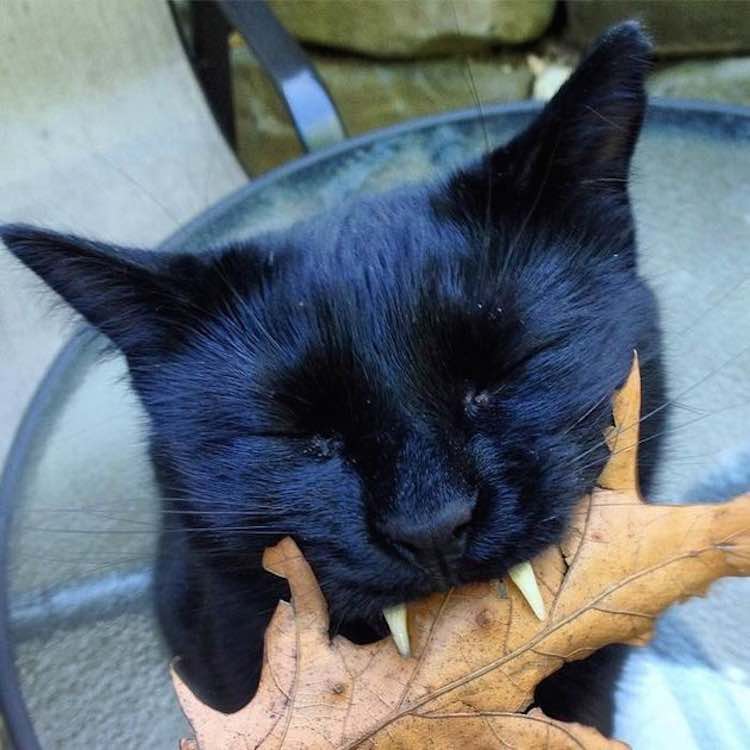
Monkey has a lot more than adorably good looks – he’s got a pretty impressive set of chompers.
Fondly dubbed “the Vampire Cat”, this 6-year-old feline has won the hearts of the internet ever since his owner Nicole Rienzie started sharing his unique photos on Instagram.
Nicole first found Monkey in 2010 when she was driving in the car with her mother, and he sprinted out into the middle of the road. Startled, Nicole got out of the vehicle to check out the frightened kitten.
He was thin, flea-bitten, and had severe conjunctivitis in both eyes, but because Nicole wasn’t very emotionally healthy following the death of her father and close friend, she figured that her and the little cat could heal each other.
While at a barbecue party for the homeless, these do-gooders learned that a little girl living in poverty was celebrating her birthday in two days – so they dashed out to the store for a surprise.
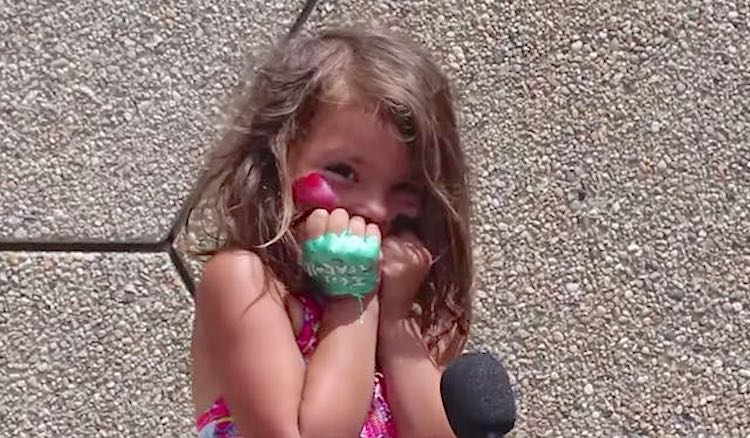
The Prayksters – a group of Christian entertainers intent on playing jokes while doing good deeds in the community – were interviewing Bella, an adorable 4-year-old girl who was homeless.
When they heard Bella say that it would soon be her birthday, they went out to the store to buy her favorite toy–Barbie dolls.
The resulting surprise–caught on video– was so heartwarming, that you may need to grab more than one tissue.
The thoughtful gifts may not do much to help the family’s living arrangements, but it made a big difference for Bella’s happiness.
“Yes they are still in a shelter,” Praynkster Jeff Agosta told the Good News Network. “She has lived there most (if not all) of her life… We have taken them out to eat, learned about the family’s situation, and got them some things they desperately needed.”
Quietly flourishing in diverse fields, female immigrants have become an economic phenomenon in the U.S.
Immigrants made up 13.2% of the total U.S. population in 2014, yet they accounted for 20.6% of all entrepreneurs, according to the Partnership for a New American Economy, a bipartisan group dedicated to modernizing the country’s immigration policy. These businesses add billions in taxable revenue to the U.S. economy, yet this social-economic phenomenon is still relatively unnoticed to most.
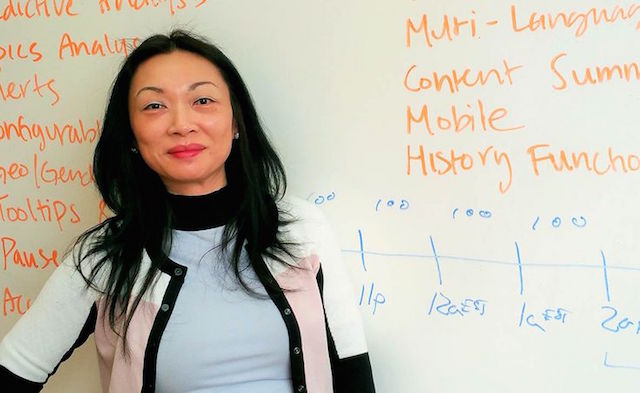
Female-immigrant owned businesses make up 40% of all immigrant-owned businesses. In fact, female immigrants are 2x more likely to start businesses than their American-born counterpart. They often use their personal savings, and show little fear when charging into atypical industries such as technology—like Mina Lux, Co-Founder and CEO of Meelo.
With her own tech start-up, Mina’s accomplishments have been recognized with honors such as the Entrepreneur of the Year Award from the University of Ottawa Faculty of Engineering and TiE50 Top Tech Start-up in 2016. Her company combines causal reasoning and human behavior patterns to help businesses discover, specialize and refine knowledge automation. An experienced entrepreneur, her first start-up, an email service provider called FloNetwork, sold for $80 million.
Mina often jokes that she is a professional immigrant, “I am actually a Taiwanese, a Canadian and an American.”
Ms. Lux often gives talks to young minds on entrepreneurship. When asked about the risks of starting a company, she answered, “I don’t really think about it. I have read that the act of immigration is such a risk, that immigrants can handle a higher level of uncertainty. Maybe that experience has help me however, I think the key is the ability to ‘dream’.” Ms. Lux continues, “Immigrants take the risk because of a dream. It’s the passion of making a better life and having that chance to actually carry it out— an opportunity unavailable elsewhere. That’s always been the root of my strength.”
Mina is just one of the inspiring women immigrants making a positive impact in the United States. Another example comes from New York City, where five Mexican women have set up their own cleaning cooperative that specializes by using eco-friendly, non-toxic products in people’s homes and businesses.
While most young couples want to get to know each other better through exploring clichéd romantic tourist destinations, these two set an example by devoting their time to making a difference.
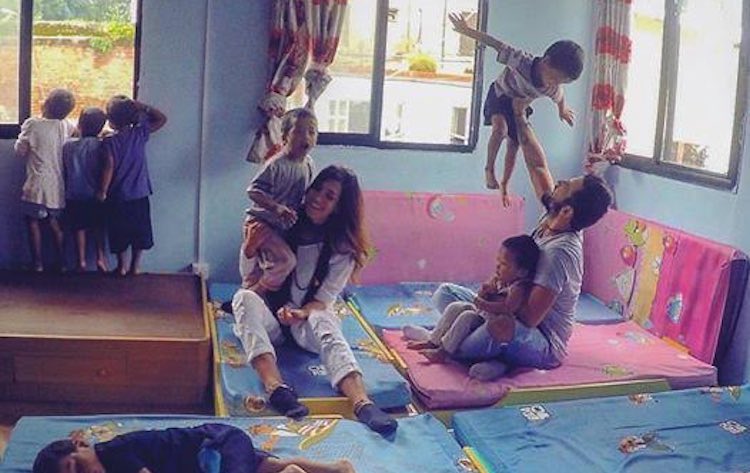
Sarin Jeghelian and Sevag Demirjian, a couple from Beirut, Lebanon, have been traveling for a while, but their most recent one-week holiday was all about volunteering.
They took a volunteer trip abroad to Nepal to work with orphaned kids in the nation’s capital of Kathmandu through the use of Volunteering Solutions – an international volunteering agency.
An interview with Sarin illustrates the reasons behind the expedition and how their volunteering experience in Nepal affected them.
Why did you chose the orphanage program in Nepal?
Sarin: We chose the program because despite Nepal’s popular appeal to tourists, it is one of the poorest and least developed countries in the world, with over 25% of its population living below the poverty line. A country of contrasts, Nepal is home to a dramatic landscape and a rich culture. Hence, volunteering in Nepal was a fantastic way to make our mark on a cause that we care about and learn new things along the way. Volunteering with disadvantaged youth and children will make you appreciate what you usually take for granted.
Why did you choose to volunteer and what was it like?
Sarin: The core purpose of volunteering with Volunteering Solutions was to simply do good in any way possible and of course to care for the disadvantaged children by drawing a smile on their face, by giving them the affection needed and by simply playing with the children. Also, volunteering promotes well-being and personal development for the person participating. Moreover, volunteering is a great way to meet new people, make new friends, and give something back to your community.
Sarin: A sense of achievement and motivation. What better way is there to connect with your community and give a little back?! Fundamentally, volunteering is about giving your time, energy, and skills freely. Unlike many things in life, there is a choice involved in volunteering.
We learned that no man or woman is an island. People and societies depend on each other for survival. Communities are suffering, but at the same time we can really bridge that gap through volunteering.
Sarin: As a couple, you can continue to relive the amazing moments you had overseas and be proud of your accomplishment. Best of all, you have someone who will listen to you reminisce when you both return home, and someone who just “gets it”.
While it was for a short period of time, both Sarin and Sevag had a life-changing experience in Nepal working together for the welfare of the poor and underprivileged children. They also got to know a magnificent country in a unique way– like a local.
Dronacharya holds a bachelors degree in Electrical Engineering. He writes and shares his personal experiences to help motivate others to travel and volunteer as much as they can. You can find more of his work on Huffington, SocialEarth, VolunteersMagazine, Cultural Trip, etc.
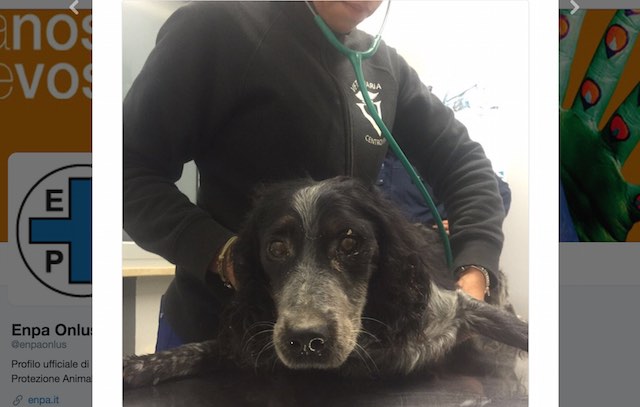
Thanks to rescue efforts led by trained canines and firefighters, this trapped pooch was rescued from beneath the rubble of a home following Italy’s earthquake.
Even though the mutt was almost totally buried, his muzzle was left uncovered by the dirt, allowing him to breath.
Rescuers carefully set about clearing the debris and dust until the pet scrambled to safety.
Despite being buried, the dog was remarkably unharmed —and was fondly dubbed Ulysses by his saviors. Ulysses was declared healthy by the nation’s animal protection agency and is waiting to be reunited with his family.
The country has been rocked by tremors and quakes since August, but the most recent 6.6 magnitude earthquake last Sunday was the strongest in the nation’s history. Though there have been over 200 aftershocks, there has been no reported deaths.
(WATCH the video below) – Photo by Enpa Onlus, via Twitter
Click To Share This Pawesome Pet’s Story With Your Friends
Marking the 73rd consecutive month of job growth, the U.S. Bureau of Labor Statistics announced that 161,000 jobs were created during the month of October, bringing the unemployment rate down to 4.9%.
Average hourly earnings for employees on private (non-farm) payrolls also rose by 10 cents, to $25.92, after an 8 cent increase in September.
Thus far in 2016, employment growth has averaged 181,000 per month, with an average of 19,000 jobs created in health care and 13,000 in hospital services.
The U.S. economy recently surged to its fastest pace of growth in two years, with America’s gross domestic product in July, August and September expanding at an annual rate of 2.9 percent.
Rounding out the positive economic picture, the number of people who lost jobs or completed temporary employment declined by 218,000 last month. There also was a decline in the number of people not currently looking for work because they believe no jobs are available for them—estimated at 487,000 in October, down by 178,000 from a year earlier.
Work Against Negativity: Click To Share – Photo by Got Credit, CC
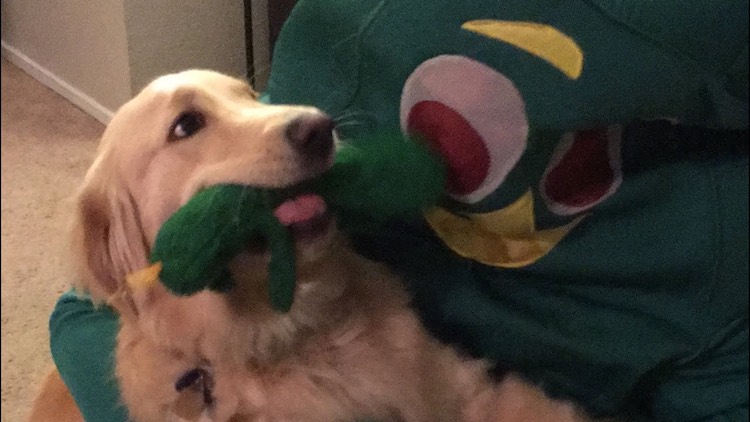
Just like the old animated cartoon, it looks like ‘Pokey’ has just been reunited with his Gumby.
Emily Crisp’s boyfriend Ben Mesches wanted to bring a surprise to her Golden Retriever Jolene– so he dressed up as a life-size version of her favorite chew toy: a stuffed Gumby doll.
When Jolene sees Ben round the corner in the green felt get-up, her face suggests this is too good to be true.
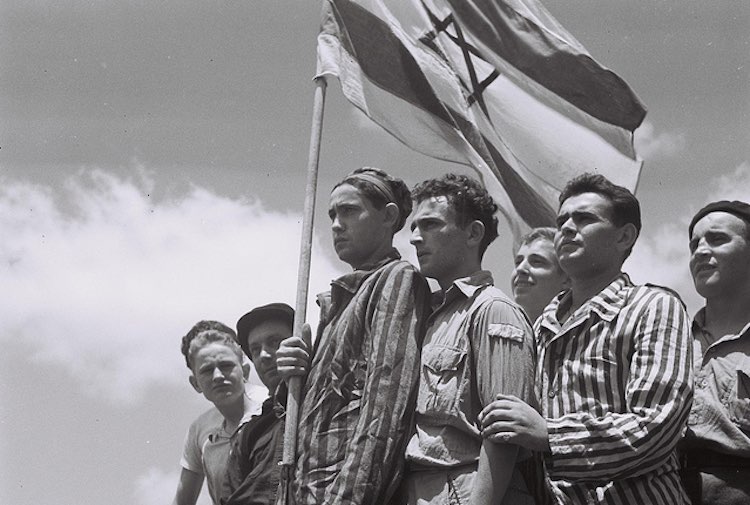
70 members of the Israeli national legislature passed a bill this Tuesday that protects Holocaust survivors‘ monthly stipends from taxation.
The German government pays Israeli survivors $578 a month, but since it has always been distributed as taxable income, the payments were whittled down to about $354.
The new bill, however, revised the stipend definitions so that the receivers will be given their full payments without deductions.
Three lawmakers from the Joint Arab List – Ayman Odeh, Dov Khenin, Abdullah Abu Maaruf, and MK Tali Ploskov (Kulanu) —spearheaded the effort.
“I had the privilege to be part of the initiative for this important bill, which corrects an ongoing wrong against the Holocaust survivors,” Odeh said in a statement. “I am especially proud that we managed to assist in that the Holocaust survivors who are still with us can live decently.”
[UPDATED with corrected headline}
Multiply The Good: Click To Share – Photo by Government Press Office, CC
These workers may be cute, but they’re also only a fraction of the cost of employing traditional toxic sprays and machinery.
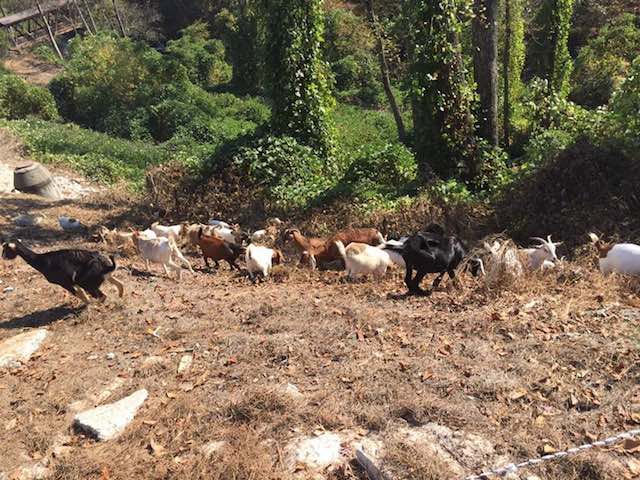
Roswell’s Old Mill Park in Roswell, Georgia hired 33 goats to clear their park trails of kudzu – a pesky invasive vine native to the U.S.
“Using goats for clearing invasive plants has become a popular green practice in the past several years, as removing this type of vegetation ordinarily requires heavy machinery or toxic chemicals to manage,” said the park on Facebook. “Using goats for clearing is less expensive, less damaging to the landscape, and a lot of fun to watch!”
Typical extermination methods reportedly cost $10,000, but renting goats from the local company Get Your Goat only costs about $1,300.
Since a goat can eat 10 to 12 pounds of foliage a day, these diligent employees will be hard at work for the next 10 days munching away at the greenery.
There are also two Great Pyrenees dogs keeping watch over the herd.
If This Story Floats Your Goat, Click To Share With Your Friends – Photo by City of Roswell
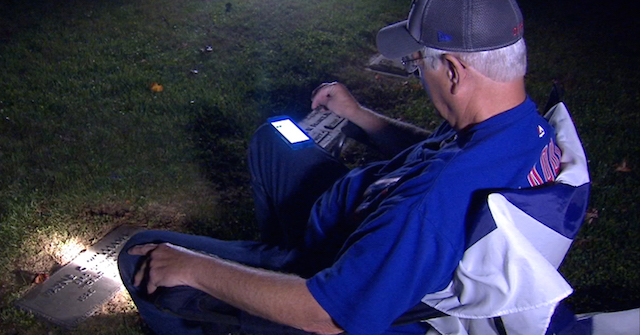
Cubs fans all over America have been celebrating the historic World Series win by posting on social media and partying in bars – but Wayne Williams celebrated by sitting in a graveyard.
That’s because he was upholding a decades-old promise to his father, Wayne Williams Senior.
Wayne Jr. drove over 650 miles from Fuquay-Varina, North Carolina to Greenwood Forest Lawn Cemetery in Greenwood, Indiana with flashlight and portable radio in hand so he could sit next to his dad’s grave and listen to Game 7.
The 68-year-old has been a lifelong Cubs fan since he spent most of his life in Chicago before moving closer to his daughter’s home in North Carolina. His father had been a WWII Navy veteran who fought at Normandy and D-Day. He eventually died of advanced kidney cancer at age 53 in 1980.
“My dad and I had kind of made a pact that when – not if – the Cubs made the World Series, we would watch the games together,” Williams told the News Observer. “He would have said, ‘I told ya, I told you they woulda won.’ ”
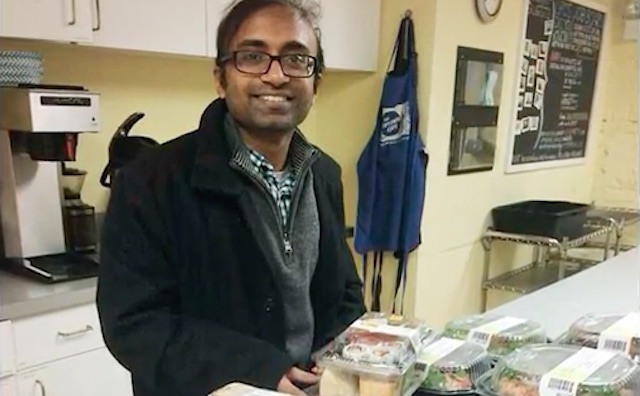
As a graduate student at the University of Illinois at Urbana-Champaign in 2012, Raj Karmani, the founder of Zero Percent, was a regular at a neighborhood bakery. The store was always fully stocked with more than a dozen different bagel flavors, and that got Karmani thinking. “I wondered, ‘When all those beautiful bagels are made fresh each day, what happens to the ones that don’t sell?’” So Karmani asked the bakery’s owner, and learned that he did his best to donate what he could to area nonprofits. Still, many of those bagels were thrown out at closing time. Karmani vowed to change that.
Then a computer science student, Karmani first built the app that would become Zero Percent during a hackathon. “Technology is going to be the core of this solution,” he says. Zero Percent’s app allows restaurants, schools and other institutions that sign on to easily note what kinds of food they have available and in what quantity, and when they would like to have it picked up. The system then notifies a local nonprofit, giving them the option to pick up the food. In Chicago, where the startup is based, Zero Percent also hires drivers to make daily, pre-scheduled pickup and drop-off runs.
That a city like Chicago would have such a need for surplus food initially surprised Karmani, who grew up in Pakistan. “Coming to the United States, I felt I came to a country that is the richest and most powerful country in the world, and that I had left poverty and hunger behind,” he says. But his conversation with the bakery owner opened his eyes to two huge problems in the U.S.: the dual issues of hunger and food waste. “Forty percent of the food produced in the United States goes to waste,” Karmani says. That translates to more than $22 billion worth of prepared and perishable food every year. “That’s why we named the company Zero Percent,” he explains. “We wanted to bring that statistic down to zero percent.”
Restaurants and other businesses pay a fee to participate in the program. In return, Zero Percent streamlines the process of donating excess food. “It’s just a great way to know that we’re feeding others who need it,” says Jon Naylor, a managing partner at Blackwood BBQ in Chicago. It’s a morale-booster for staff, and they mention it during interviews with new potential hires, Naylor says. Customers also like to hear that the restaurant is giving back to the community, he adds.
The participating institutions can also gain financial benefits. Zero Percent’s functionality includes a dashboard that shows them exactly what they’ve donated and where their donations have gone. This makes it easy for them to document donations for tax purposes. It also helps them track how much excess food they’re ordering and making, so they can make their operations more efficient. “We had a lot of lettuce leftover at the beginning,” says Timothy Muellemann, a manager at Sopraffina in Chicago. “Since we began using Zero Percent, we’ve been able to see the items that we had been ordering too much of, and it’s helped us keep that in check,” he says.
The benefits for local nonprofits are obvious — fresh, healthy, prepared food they can serve to those who need it most. Besides going to soup kitchens and food pantries, Zero Percent provides surplus food to after-school programs and organizations that serve underprivileged populations. “What’s amazing is that we get so much fresh, nutritious food from Zero Percent,” says Kylon Hooks, a program manager at Chicago’s Broadway Youth Center, which primarily serves homeless LGBTQ youth. Hooks says that getting healthy food from a high-quality source has an emotional benefit too. “It gets young people to think, ‘I’m worth eating this way,’” he says. “Zero Percent is an invaluable resource.”
Since its launch in 2013, Zero Percent has distributed more than 1 million meals to almost 150 nonprofits in the Chicago area. But Karmani has his sights set on bigger goals. “I firmly believe that food waste can be entirely eliminated,” he says. “I’m still striving to reach that utopia of zero food waste. I’m not going to congratulate myself until we have, step by step, shown that we can move the needle on food waste, first in Chicago, and then elsewhere.”
The 2016 AllStars program is produced in partnership with Comcast NBCUniversal and celebrates social entrepreneurs who are powering solutions with innovative technology. Visit NationSwell.com/AllStars from November 1 to 15 to vote for your favorite AllStar. The winner will receive the Tech Impact Award, a $10,000 grant to help further his or her work advocating for change.
The Caddyshack and Ghostbusters star has been a lifelong Chicago Cubs fan since he grew up in Evanston, Illinois – so for the last seven Cubs versus Indians World Series games, the beloved celebrity partied hard.
During Game 3 at Wrigley Field, Murray seized the microphone to lead the crowd in a rousing chorus of “Take Me Out To The Ball Game”.
Oh yeah, and he was singing it like Daffy Duck.
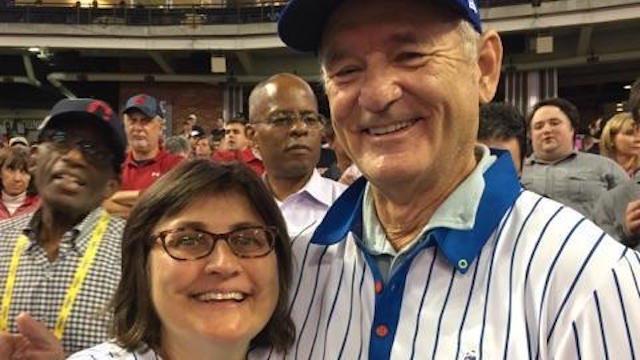
For Game 6, Karen Michel had come all the way from Indiana in hopes that she could somehow get a remaining ticket from the box before it sold out.
When her hopes were dashed, however, Karen spotted none other than Bill walking through the crowd. She followed him for a bit until the movie star turned around and offered her a ticket.
While the two chatted it up from a celebrity box in the stands, the Cubs ended up dominating the game with a 9-3 lead.
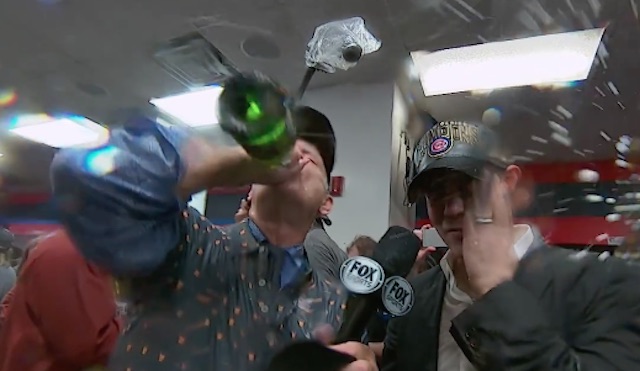
Bill made his way into the Cubs locker room following the 8-7 10th inning win where he carried a bottle of champagne in one hand and a microphone in the other. After interviewing the athletes on their achievement, the Cubs manager Theo Epstien sprayed Murray with a celebratory jet of champagne.
(WATCH the video below)
Take Your Friends Out To The Ball Game: Click To Share – Photo by Karen Michel
This college student found a simple way to prevent thousands of Cambodians from contracting easily-treatable diseases and viruses.
When Samir Lakhani was in Cambodia for the summer building fish ponds with an NGO called Trailblazer Cambodia Organization, he saw a mother washing her child with laundry detergent. Soap is often considered a luxury in the nation, so many families either resort to rubbing their bodies in ash or using industrial cleaning supplies like the mother and child.
Samir, however, didn’t think that that was good enough for the country’s people – so the Pittsburgh University college student started pondering ways to supply soap to poor Cambodians.
One stroke of genius later, Samir realized that Siem Reap – a nearby tourist hotspot consisting of over 2 million visitors a year – was also home to over 500 hotels and guesthouses.
The student eventually concocted a formula of sanitizing and recycling hotel soap bars that would have been destined for the trash.
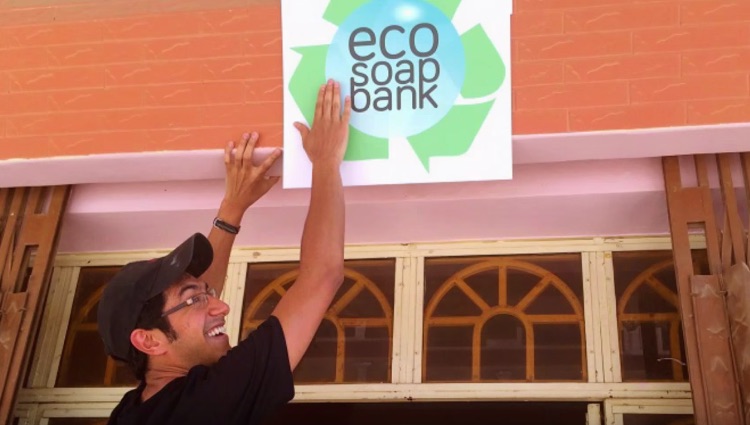
When Samir went back to school, he finished his degree in environmental studies, started crowdfunding for his brain child, and found corporate sponsorship for what would become the Eco-Soap Bank organization two years later.
Since the project’s debut, they have provided 650,000 Cambodians with clean bars of soap. They employ 30 workers who can sell the eco-friendly products as a source of income for themselves, but their “hygiene ambassadors” bring soap to local schools and educate the youth on proper hand-washing techniques.
In the United States, hotel chains throw out 2.6 million bars of soap every day – but thanks to Samir, those products will find new homes in the hands of less fortunate families.
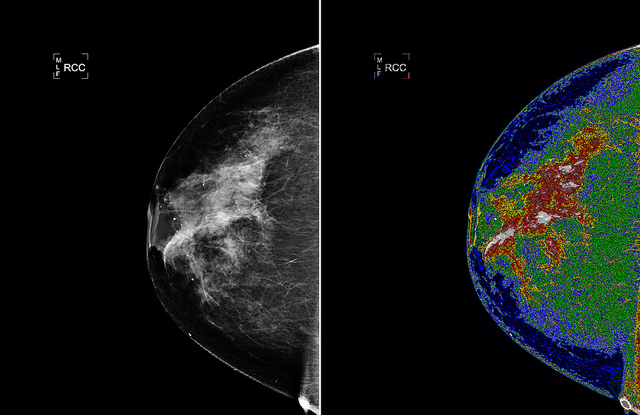
A breast cancer tumor, credit NASA/Goddard Space Flight Center.
Each year, around one million women in the Netherlands undergo mammograms for early detection of possible breast cancer. It’s an unpleasant procedure involving X-rays which can be a contributor to the onset of cancer.
Researchers at Eindhoven University of Technology, however, are working on a ‘breast-friendly’ method, without radiation, that is more accurate and generates 3D rather than 2D images. They published their proof of concept last month in the online journal Scientific Reports.
In the regular screening method the breast is squeezed tight between two plates in order to produce one or more good X-ray photos. Apart from being unpleasant, it is not without risk because of the harmful rays. Moreover, it is often unclear whether the anomaly found is a cancer or not. More than two-thirds of the cases where something worrying can be seen on the X-ray photos is false-positive: after the analysis of biopsies they are not found to be cancers. This is why science is seeking alternatives.
Researchers at TU Eindhoven have now cleared a major scientific hurdle towards a new technology in which the patient lies on a table and the breast hangs freely in a bowl. Using special echography (inaudible sound waves) a 3D image of the breast is made where cancer can be identified; the researchers therefore expect there to be many fewer false-positive results.
The new technology builds on the patient-friendly prostate cancer detection method developed at TU/e whereby the doctor injects the patient with harmless microbubbles. An echoscanner allows these bubbles to be precisely monitored as they flow through the blood vessels of the prostate. Since tumors and healthy tissue have different blood vessel structures, the presence and location of tumors become visible. This method works well for the prostate and this is now being widely tested in hospitals in the Netherlands, China and, soon, Germany. For breast cancer the method had not yet been suitable due to motion and because the breast is too large, which seriously limits the possibilities of a standard echoscanner.
Researchers Libertario Demi, Ruud van Sloun and Massimo Mischi have now developed a variant of the echography method that is suitable for breast investigation. The method is known as Dynamic Contrast Specific Ultrasound Tomography. Echography with microbubbles uses the fact that the bubbles will vibrate in the blood at the same frequency as the sound produced by the echoscanner, as well as at twice that frequency; the so-called second harmonic. By capturing the vibration, you know where the bubbles are located. But body tissue also generates harmonics, and that disturbs the observation.
For the new method the researchers are using a phenomenon that Mischi happened upon by chance and later investigated its properties together with Demi. They saw that the second harmonic was a little delayed by the gas bubbles. The researchers have now developed a new visualization method. The more bubbles the sound-wave encounters on its route, the bigger the delay. By measuring the delay, the researchers can thus localize the gas bubbles and do so without any disturbance because the harmonic generated by the body tissue is not delayed, and is therefore discernible. This difference, however, can only be seen if the sound is captured on the other side. So this method is perfectly suited to organs that can be approached from two sides, like the breast.
The researchers are currently putting together an international, strong medical team to start performing preclinical studies. Application in practice is certainly ten or so years away, Mischi expects. Moreover, he forecasts that the technology that has been developed will probably not operate on a standalone basis but in combination with other methods, which will create a better visualization. One of the candidates for this elastography, a variant of echography whereby the difference in the rigidity of the tumor and healthy tissue can be used to detect cancer.
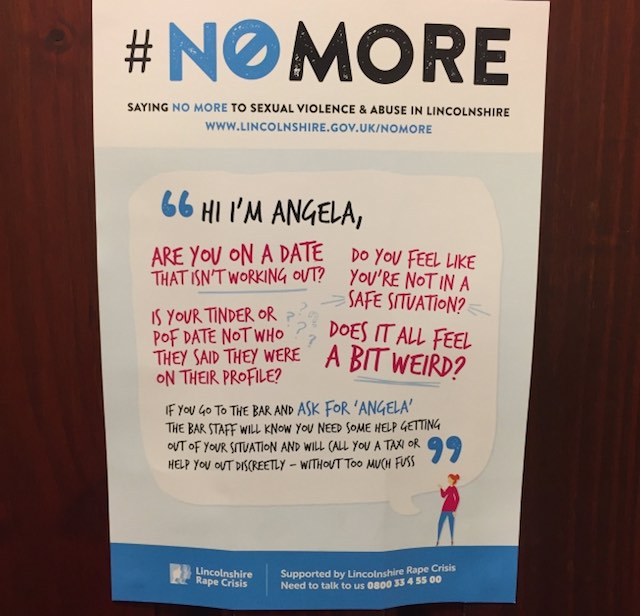
This poster taped up in front of the women’s bathroom advises women on bad or dangerous dates to go to the bar and ask for Angela.
That’s because Angela is the pub’s code word for patrons who feel uncomfortable or endangered.
Spearheaded by the Lincolnshire City Council in Lincolnshire, England, the poster has been applauded as a clever way of making women feel safer in public spaces.
The poster reads: “Are you on a date that isn’t working out? Is your Tinder or POF [Plenty of Fish] date not who they said they were on their profile? Do you feel like you’re not in a safe situation? Does it all feel a bit weird? If you go to the bar and ask for ‘Angela,’ the bar staff will know you need help getting out of your situation and will call you a taxi or help you out discreetly—without too much fuss.”
The poster was created as part of the city council’s #NoMore campaign to end sexual assault. It’s been gaining traction on social media since a Twitter user published a photo of the notice to 30,000 retweets and counting.
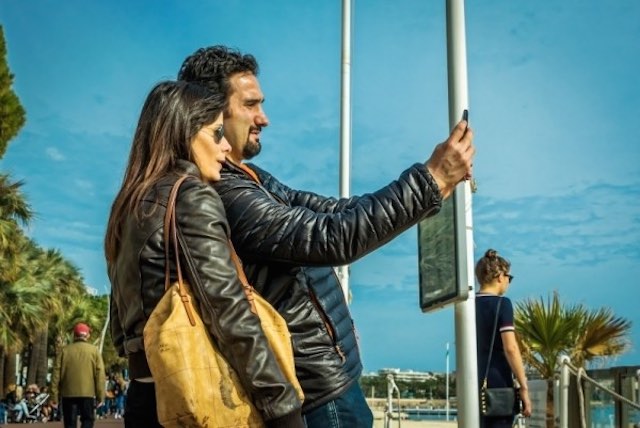
Tapping into social media posts on Instagram, Flickr and Panoramio gave North Carolina State University researchers a trove of information about people’s opinions of scenic European landscapes. A new study shows that geotagged photos – complete with millions of comments – can provide data for predictive models to help guide land use policy, conservation planning and development decisions worldwide.
“Social media offer the possibility of transforming the way researchers collect data on how we perceive and value the environment around us,” says Derek van Berkel, a postdoctoral researcher with NC State’s Center for Geospatial Analytics and co-lead author of the study in Proceedings of the National Academy of Sciences. “Crowdsourced information provides an exciting alternative to small-scale social surveys, which are expensive and laborious to administer.”
The research comes as land use in Europe and worldwide continues to shift because of urbanization. Land devoted to agriculture, mining and forestry may be managed for recreation, leisure activities and tourism instead, van Berkel says.
Crowdsourced predictive models could help residents of the Swiss Alps make decisions about whether mountain meadows are best suited for grazing cattle, suburban housing or a new ski resort. French residents could choose between allowing large-scale agricultural production or investing in preserving traditional hedgerows around fields because of their beauty and environmental value as habitat for birds and pollinating insects.
“We found that Panoramio, Instagram and Flickr provided comparable data that was reliable as an indicator of which landscapes visitors value most on a continental scale,” van Berkel says. “It’s difficult to put a numerical value on beauty and inspiration, but policymakers need to know which locations have aesthetic and cultural worth so that they can develop strategies to preserve those landscapes and think in terms of amenity-driven visitors and agricultural tourism to boost local economies.”
Researchers created algorithms to filter data from Instagram and Panoramio, which are widely used across Europe, and Flickr, which is more common in Central and Western Europe. They mapped the geographic distribution of images in Europe and ranked sites into four quartiles, from most- to least-visited locations. In analyzing visitor patterns, researchers found the most-valued landscapes included mountainous areas, locations near rivers and lakes, and areas near population centers.
“These landscapes are clearly providing ecosystem services highly valued by society,” says Ross Meentemeyer, director of NC State’s Center for Geospatial Analytics and a co-author of the study. “Using social media to uncover and quantify people’s interest in ecosystem services is an exciting new approach to understanding the important connection between natural resources and human health and wellbeing.”
Instagram, a mobile app for photo sharing, offered a particularly rich source of data for the study because it allows users to attach comments and hashtags to their photos. Photo-sharing data provides a snapshot of the values of millennials, a key demographic group for future land use decisions, van Berkel says.
“Geospatial analytics allows us to study how urbanization changes the landscape and to predict the consequences of those changes,” van Berkel says. “Our goal is to model what will happen in different scenarios – something like what you’d see in Sim City – but using a computer model driven by real data about real places.”
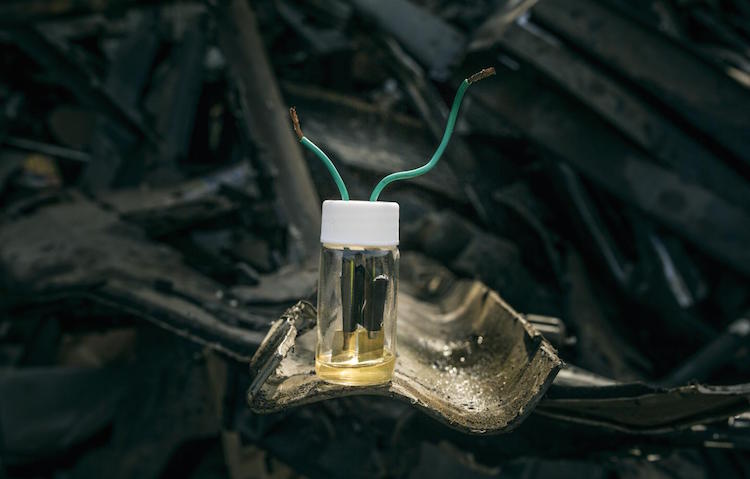
Take some metal scraps from the junkyard; put them in a glass jar with a common household chemical; and, voilà, you have a high-performance battery.
“Imagine that the tons of metal waste discarded every year could be used to provide energy storage for the renewable energy grid of the future, instead of becoming a burden for waste processing plants and the environment,” said Cary Pint, assistant professor of mechanical engineering at Vanderbilt University.
To make such a future possible, Pint headed a research team that used scraps of steel and brass – two of the most commonly discarded materials – to create the world’s first steel-brass battery that can store energy at levels comparable to lead-acid batteries while charging and discharging at rates comparable to ultra-fast charging supercapacitors.
The research team, which consists of graduates and undergraduates in Vanderbilt’s interdisciplinary materials science program and department of mechanical engineering, describe this achievement in a paper titled “From the Junkyard to the Power Grid: Ambient Processing of Scrap Metals into Nanostructured Electrodes for Ultrafast Rechargeable Batteries” published online this week in the journal ACS Energy Letters.
The secret to unlocking this performance is anodization, a common chemical treatment used to give aluminum a durable and decorative finish. When scraps of steel and brass are anodized using a common household chemical and residential electrical current, the researchers found that the metal surfaces are restructured into nanometer-sized networks of metal oxide that can store and release energy when reacting with a water-based liquid electrolyte.
The team determined that these nanometer domains explain the fast charging behavior that they observed, as well as the battery’s exceptional stability. They tested it for 5,000 consecutive charging cycles – the equivalent of over 13 years of daily charging and discharging – and found that it retained more than 90 percent of its capacity.
Unlike the recent bout of exploding lithium-ion cell phone batteries, the steel-brass batteries use non-flammable water electrolytes that contain potassium hydroxide, an inexpensive salt used in laundry detergent.
“When our aim was to produce the materials used in batteries from household supplies in a manner so cheaply that large-scale manufacturing facilities don’t make any sense, we had to approach this differently than we normally would in the research lab,” Pint said.
The research team is particularly excited about what this breakthrough could mean for how batteries are made in the future.
“We’re seeing the start of a movement in contemporary society leading to a ‘maker culture’ where large-scale product development and manufacturing is being decentralized and scaled down to individuals or communities. So far, batteries have remained outside of this culture, but I believe we will see the day when residents will disconnect from the grid and produce their own batteries. That’s the scale where battery technology began, and I think we will return there,” Pint said.
The Vanderbilt team drew inspiration from the “Baghdad Battery,” a simple device dating back to the first century BC, which some believe is the world’s oldest battery. It consisted of a ceramic terracotta pot, a copper sheet and an iron rod, which were found along with traces of electrolyte. Although this interpretation of the artifacts is controversial, the simple way they were constructed influenced the research team’s design.
The team’s next step is to build a full-scale prototype battery suitable for use in energy-efficient smart homes.
“We’re forging new ground with this project, where a positive outcome is not commercialization, but instead a clear set of instructions that can be addressed to the general public. It’s a completely new way of thinking about battery research, and it could bypass the barriers holding back innovation in grid scale energy storage,” Pint said.
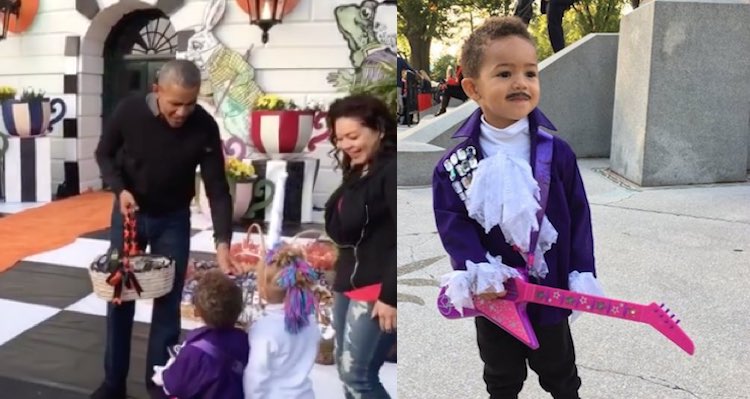
Without missing a beat, the POTUS serenaded the nephew with “Purple Rain” before dropping some sweets in his basket and wishing them a happy Halloween.
OMG, my heart is exploding right now. Dad of the year just passed out candy to everyone on the flight so his 3 year old could trick or treat pic.twitter.com/vfsAcYNrhr
This story is sweeter than all of the Halloween candy in the world combined.
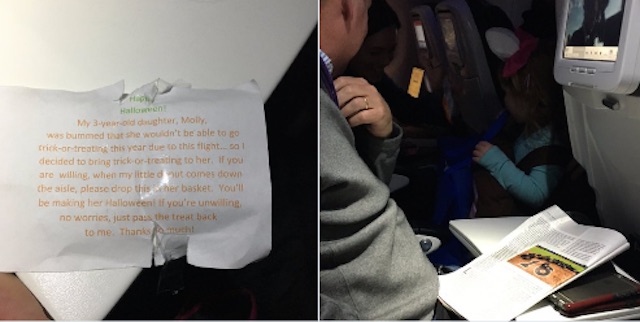
A father and his 3-year-old daughter Molly were flying out of Logan International Airport from Boston to San Francisco. Unfortunately for the toddler, they were flying on Halloween night.
Not wanting to spoil the magical holiday, the dad passed out candy and notes to all the plane passengers.
“My three-year-old daughter, Molly, was bummed that she wouldn’t be able to go trick-or-treating this year due to this flight,” the note read, “so I decided to bring trick-or-treating to her.”
“If you are willing, when my little donut comes down the aisle, please drop this in her basket. You’ll be making her Halloween! If you’re unwilling, no worries, just pass the treat back to me. Thanks so much!”
Sure enough, Molly – dressed to the nines in her donut costume – tottered down the aisles trick-or-treating all the passengers.
A woman named Stephanie Kahan posted about the cute incident on Twitter where it got retweeted nearly 60,000 times and “loved” over 100,000 times.