















39 years ago today, Star Trek: The Next Generation debuted on syndicated TV. Spanning 178 episodes over seven seasons, it starred English actor Patrick Stewart as Captain Jean-Luc Picard of the Starship Enterprise. It received many accolades, including 19 Emmy Awards, two Hugo Awards, five Saturn Awards, and a Peabody Award. READ more about how the show got started… (1987)
Newly Identified Frog-like Creature Named by Student Scientists After Their Moms
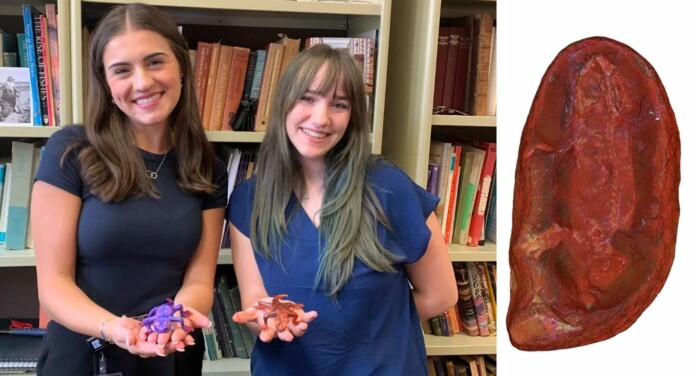
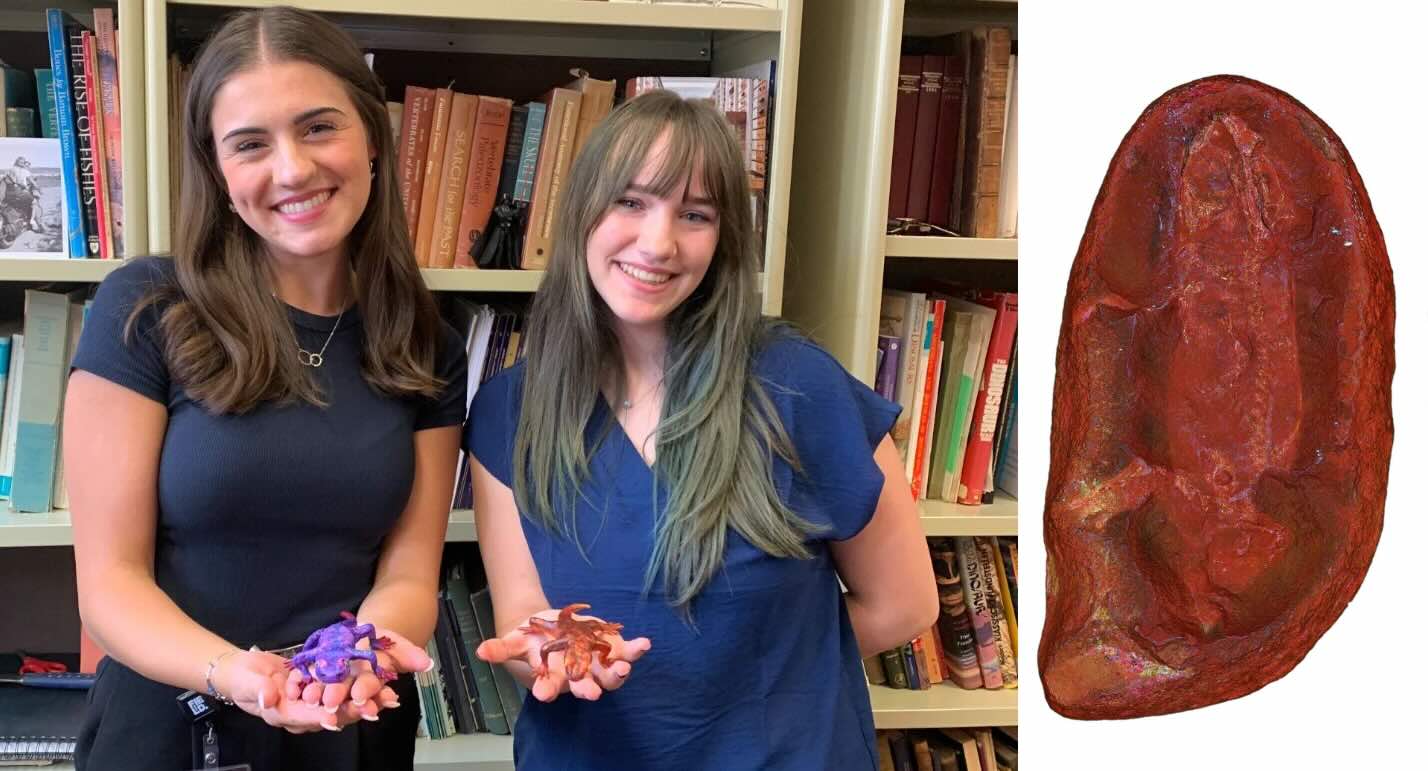
A newly identified frog-like creature that lived before the dinosaurs has been named by the student scientists who discovered it—and they named it after their moms.
Allison Sefcovic and Payton Kohlberg described the early amphibian that lived in what is now the United States over 300 million years ago, and then named it in honor of their mothers.
As luck would have it, both mothers happen to be called Jean.
Jeanerpeton mazonensis is said to mean, “Jean’s crawler from Mazon Creek”, and now describes the early ancestor of today’s amphibians.
It looked a salamander, but was squat and chubby like a frog, according to the study published in the Journal of Vertebrate Paleontology.
J. mazonensis lived 309 million years ago, long before the dinosaurs, in the area around present day Chicago, which was a swampy river delta swarmed with early land-dwellers, giant insects, and strange swimming animals.
What was once a hot bed for new forms of life to flourish and evolve, became one of today’s richest Carboniferous period fossil deposits
Because the Mazon Creek area was a river delta during the Carboniferous period, the researchers explained that sediment was quickly deposited on dead animals and plants—a “perfect recipe” for fossilization.

Today, Mazon Creek is home to one of the world’s best fossil sites, with fossils that preserve records of soft tissues and fine details that are normally lost.
“What’s really cool about Mazon Creek is that it preserves all of these unusual details—things like toe pads and body outlines,” said study co-author Ms. Sefcovic, an intern at the Field Museum in Chicago.
“In the fossil of Jeanerpeton, we can see some of the scales on its back and tiny ‘belly ribs’ called gastralia.
“You can even see the eye impressions. It’s so cool to see.”
She says the findings point to a 309-million-year-old origin of classic traits we see in today’s frogs and salamanders.
The fossil specimen was found several years ago by an amateur collector and donated to the Field Museum. At a glance, the fossil was classified as another species with a well-established presence in the region, Amphibamus grandiceps.
Sometimes, poorly-understood specimens are lumped together into what scientists call a “waste bin taxon”, which serves as a metaphorical dumping ground for specimens that seem related but haven’t been well-studied yet.
Study co-author Dr. Cam So, a postdoctoral researcher at the Field Museum, said: “What we’re finding from the Field Museum’s collection are a bunch of things that historically were grouped together into this waste bin taxon known as Amphibamus grandiceps.
“Jeanerpeton is one of those species.
“And now, we’ve found enough evidence to support it being an anatomically distinct animal.
“With this publication, we officially pull Jeanerpeton out of this waste bin taxon.”
Payton and Allison were part of last year’s group of Women in Science Interns at the Field Museum.
They, along with Dr. So, are all part of the lab group of Arjan Mann, the Field’s assistant curator of fossil fishes and early tetrapods.
“Before working in the Mann Lab, I didn’t know much about paleontology,” said Ms. Kohlberg.
“My experience at the Field and in the Women in Science program has made me more confident in my abilities to try something new.”
FROGGY GOOD NEWS:
• Japanese Team Finds Frog Bacteria That Wipes Out Cancer Tumors With a Single Dose
• A Leap of Hope: Endangered Frogs First Seen by Charles Darwin Give Birth in London to Help Avoid Extinction
“It is scary to take on a project when you feel like you don’t know as much as you should. But I learned with my practical experience that it is possible to overcome that fear with hard work.”
Dr. So says the description of J. mazonensis opens a door for researchers as they continue to chronicle the biodiversity that lived in Mazon Creek millions of years ago.
SEND THIS HOPPIN’ TO YOUR MOMS – Share it on Social Media…
CA Researchers Identify Odors That Repel Honeybees From Pesticides


In a win for pollinator conservation, researchers at the University of California, Riverside, have identified chemical compounds that can safely repel honey bees from pesticide-treated crops.
The research offers a potential solution to one of agriculture’s most urgent challenges: pesticides leading to the ongoing decline of honey bees.
Biologist Anandasankar Ray, an expert on insect olfactory behavior, tackled the central problem around this plan to protect them—namely the extreme complexity of the honey bee olfactory system.
With more than 200 odor receptors capable of detecting a vast array of volatile compounds, finding scents that repel bees was a major challenge—until now.
“Bees rely heavily on their sense of smell to forage, but that sensitivity makes it tough to find odors that push them away instead of drawing them in,” Ray said. “Our goal was to find a way to use scent as a deterrent—safely and effectively.”
To do this, Ray’s team collaborated with honey bee researchers in the lab of his colleague Boris Baer, a professor of entomology. The researchers created a machine-learning model trained on both the chemical structures of odorants and previously recorded behavioral responses of bees. The model was refined with new behavioral data the team obtained in the lab from honey bees and Drosophila (fruit flies), allowing for a more accurate prediction of insect olfactory responses.
Once optimized, the system screened more than 50 million compounds, ultimately identifying about 130 that were predicted to have strong potential as bee repellents.
Then they put top-performing candidates to the test in their lab, and honey bees exhibited clear avoidance behaviors when exposed to these candidates, aligning closely with the model’s predictions.
GREAT BEE NEWS:
• Unique Honeybees Found Only in California Can Fend Off Deadly Varroa Mites
• Oregon Records 5 Years of Zero Pesticide-Related Deaths in Bees
Subsequent field experiments with freely foraging bees confirmed that all seven compounds tested reliably repelled bees from honey combs without harming them.
“By keeping bees away from harmful pesticides, we can potentially reduce their risk of exposure without compromising the protection of crops,” said Professor Ray in a media release.
A contributing factor to bee population decline and colony collapse likely is unintended exposure to pesticides. While some pesticides that are harmful to bees have been banned or restricted, Ray said there is potential to further lower risks by using the pesticides with repellents that can minimize bee contact.
The bee-repelling compounds have other applications, too.
“In certain public environments—hospitals, office buildings, and residential areas, for example—reducing the formation of beehives can help avoid human-bee conflicts,” he said. “Also, some agricultural practices want to avoid pollination altogether, particularly with seedless fruit varieties.”
According to Ray, who is co-inventor on a patent application for the compounds, the research published in the journal eLife is a step toward developing bee-friendly pesticide formulations—products that safeguard pollinators while still meeting the needs of modern agriculture.
“Protecting pollinators doesn’t have to come at the expense of food security,” Ray said. “We believe our work will help guide further exploration of machine learning-guided solutions in environmental protection and sustainable farming practices.”
“It is generally thought you need abundant data to do any kind of machine learning, but that’s not true for olfaction,” Ray said. “This is a powerful demonstration of how machine learning can help solve real-world ecological problems.”
SPREAD THE BUZZ BY Sharing On Social Media…
Archaeologists Risked Their Lives to Save 30,000 Treasures from ISIS Terrorists—New Study Shows How
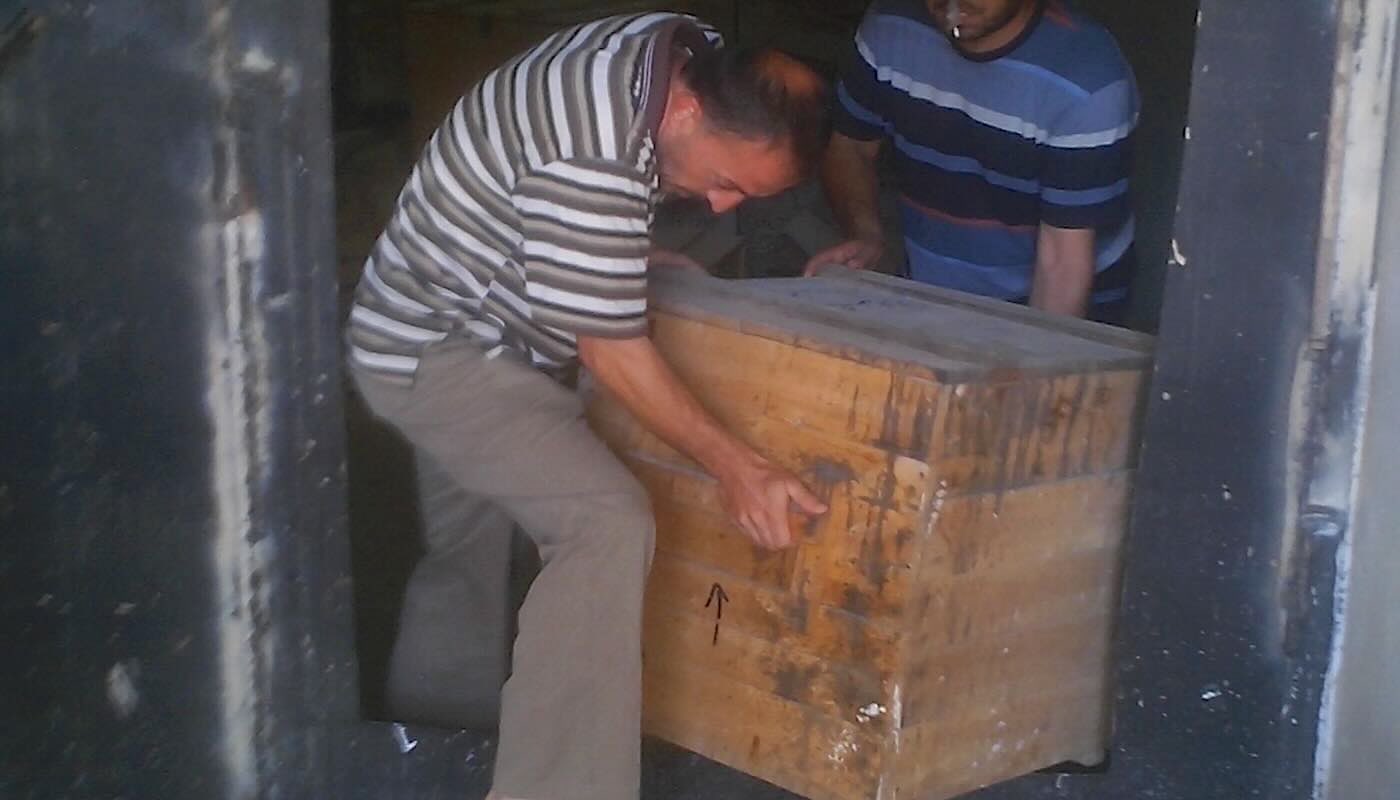
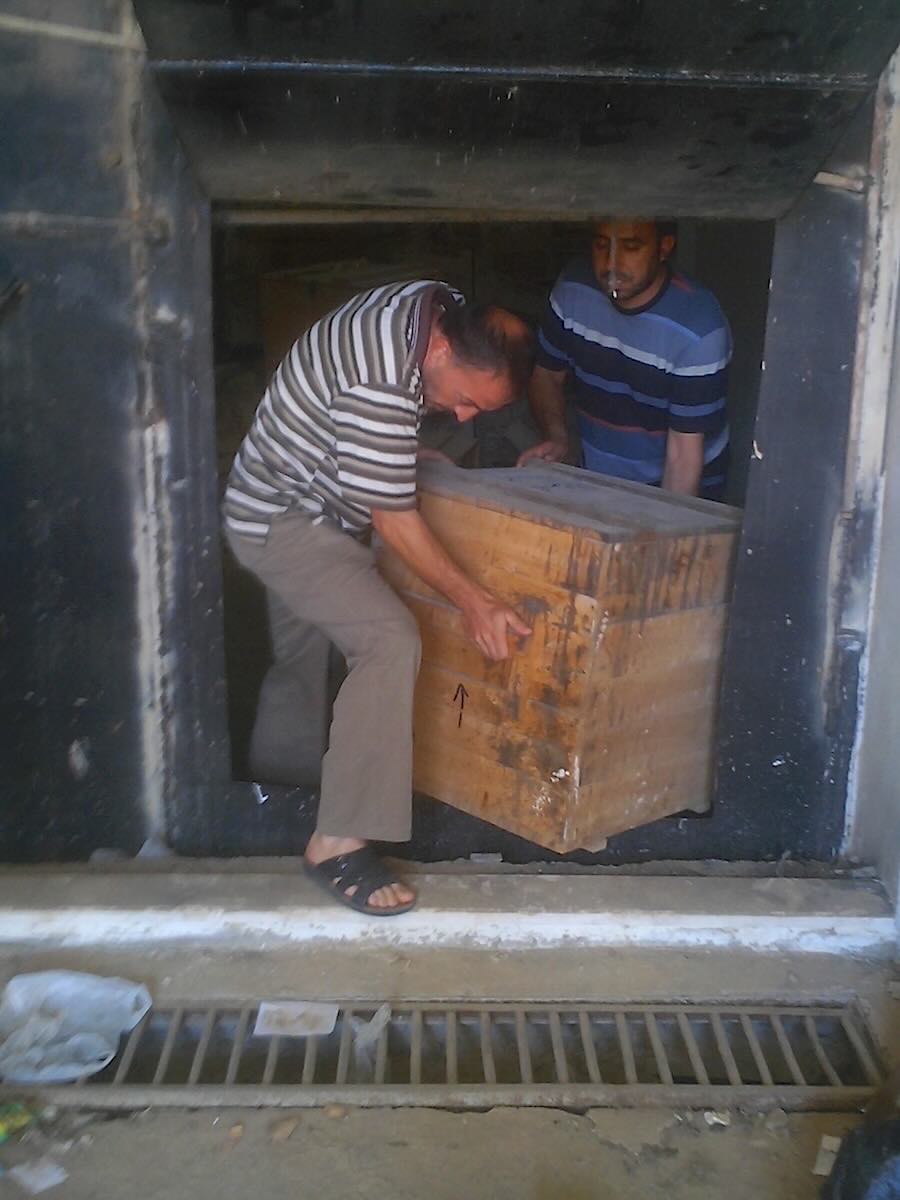
A new study reveals how archaeologists risked their lives to save thousands of historic treasures from imminent destruction by Islamic State terrorists.
They rescued around 30,000 “priceless” artifacts from the Deir ez-Zor Museum as the city faced imminent capture by the Islamic State of Iraq and Syria (ISIS) in 2014 and 2015.
Deir ez-Zor is the capital of the province of the same name in Syria, and the region contains key oil and gas fields, which made it a fiercely contested battleground during Syria’s 15-year civil war.
Study author Maamoun Abdulkarim said the significance of the heroic rescue effort extends beyond the number of artifacts saved.
The Professor of Archaeology and History at the Emirati University of Sharjah examines the operation as a case study in protecting cultural heritage during wartime in the new paper, published in the journal Museum Management and Curatorship.
Prof. Abdulkarim says it was particularly significant given the damage inflicted on museums and archaeological sites by ISIS across the Middle East.

The study explains that conducting a rescue mission during active hostilities requires more than logistical planning.
“It fundamentally involves decision-making, institutional resilience, trust, and the ability to adapt rapidly to changing circumstances,” said Prof. Abdulkarim.
“There is rarely a perfect moment to act during an armed conflict; often, delaying a decision in search of greater certainty poses a greater danger than acting under uncertainty.”
Prof. Abdulkarim oversaw the rescue operation a decade ago as the head of Syria’s Directorate-General of Antiquities and Museums.
At the time, Deir ez-Zor was severely restricted, with the museum connected to the military airport only through a narrow and highly vulnerable corridor, rendering the mission “exceptionally dangerous”.
Present-day Syria forms part of the broader Mesopotamian cultural sphere, where some of the world’s earliest and most influential civilizations flourished. Before the outbreak of the civil war in 2011, Syria was home to 35 archaeological museums spread across the country.
Although not the largest among them, the Deir ez-Zor Museum ranked among the country’s most valuable institutions, with its priceless collections from renowned Mesopotamian sites, including Halaf, Dura-Europos and Mari.

The period following 2014, when ISIS expanded its control over large parts of Syria and Iraq, represented “an important example of the sort of looting, destruction, and illicit trafficking of sites and museums that took place in this context.”
“This period formed a critical juncture, as it coincided with the fall of Mosul in Iraq, the looting of that museum, and the destruction of antiquities from Nineveh and Assyria.
“These occurrences compelled Syrian antiquities authorities to promptly reevaluate protection policies and expedite emergency measures in cities that were at risk of siege or collapse.”
Amid the catastrophic circumstances, Prof. Abdulkarim says he came to understand that leadership was not about making easy decisions, but about having the courage to make the necessary decisions at the right moment—even when the personal and professional consequences could be severe.
“My foremost priority was the protection of cultural heritage, and I was prepared to bear whatever personal and professional risks and consequences those decisions might entail.”
During his tenure in Syria until 2017, around 300,000 museum items were rescued and relocated to secure sites.
“The artifacts accounted for the overwhelming majority of the country’s museum collections—including approximately 30,000 objects from the Deir ez-Zor Museum.”
He says, for him, artifacts are far more than priceless objects – embodying the collective memory and identity of humanity, transcending the borders of the countries in which they are found.
“We did not rescue 30,000 objects simply to save 30,000 museum pieces. We were protecting thousands of years of memory that war threatened to erase.
“The 30,000 objects rescued from Deir ez-Zor represent more than just museum pieces; they hold thousands of years of human history and are part of the identity and memory of the communities in the Euphrates region.”
He says timing is often the “decisive factor” in any rescue mission. Waiting for every uncertainty to be resolved, he warns, can mean missing the critical window for action.
“In a cultural emergency, waiting for perfect conditions can become more dangerous than acting under uncertainty.
“The most valuable resource during a crisis is not always money or technology. Sometimes it is trust, the trust between colleagues who can make the right decision when there is no time left for normal procedures.”
DON’T HIDE THIS COOL ART STORY – Share on Social Media…
New York City Collects $131 Million From DoorDash for Delivery Workers Unfairly Paid After $13 Billion Earnings


The New York City Department of Consumer and Worker Protection (DCWP) announced a historic $131.5 million enforcement action against DoorDash for systematic violations of the local Delivery Worker Laws.
The settlement will place more than $115 million directly into the pockets of delivery workers and pay for $16 million in civil penalties and costs. More than 260,000 workers were underpaid by DoorDash, including workers who were not paid at all, or were paid late for work they had already performed.
It’s the largest worker settlement in New York City history.
“DoorDash underpaid more than 260,000 workers, and today we are getting that money back,” said Mayor Mamdani. “When a worker earns a wage, they deserve to be paid that wage, on time and in full.”
He reminded the public that no corporation is above the law—especially when it earns $13.7 billion in revenue, like DoorDash did in 2025, a 28% increase compared to their 2024 revenue of $10.72 billion.
“Today, New York City’s delivery workers are showing that opaque algorithms will not have the final word when it comes to how much they are paid for the hard work they do,” said DCWP Commissioner Samuel A.A. Levine.
The settlement is about more than recovering money that workers are owed. It also puts in place a new monitoring system ensuring DoorDash follows the law going forward—one that gives workers a direct role in identifying violations and gives the City data it needs to act.
A Princeton University partner, the Workers’ Algorithm Observatory, will develop software that will allow the drivers to share their DoorDash trip and earnings data directly with the agency. It will allow DCWP to monitor DoorDash’s compliance with minimum pay, maximum trip distances, trip disclosures, pay transparency, and tip transparency.
DCWP’s citywide investigation began after dozens of workers filed reports with the Department.
The agency found that DoorDash failed to pay thousands of workers at all for work they had performed and failed to pay thousands more on time. These workers will receive compensation calculated at approximately 200% of the amount they were underpaid.
For example, a worker who was owed $1,000 but received no payment will receive $3,000. A worker who was paid $1,000 later than allowed under the law will receive $2,000.
Workers don’t even need to file a claim or submit evidence to receive payment. DCWP has identified all individuals owed money through its analysis of DoorDash’s records—and payments will be sent out this fall.
MORE IMPROVEMENTS FOR NYC: New York City is Putting ‘The Park’ Back in Park Avenue – And Adding a Protected Bike Lane (LOOK)
The case’s Settlement Administrator will send personalized emails to each worker who experienced an underpayment from April 22, 2022 to June 28, 2026. Workers will be able to choose between an electronic payment and a check by mail.
More details of the case is available at nyc.gov/doordash.
As part of the investigation, DCWP obtained terabytes of data from DoorDash, including billions of rows documenting the company’s treatment of delivery workers. DCWP’s Research and Analytics Division analyzed the data to identify more than 152 million individual payment transactions and 110 million working hours connected to the investigation.
DoorDash will be required to make software updates to prevent the company from offering a delivery to a worker in New York City unless that worker’s time is being recorded as compensable on-call time or trip time. The updates will also provide workers with additional information about their work time and pay and ensure DoorDash complies with the Minimum Pay Rule for “batched” trips, ending the unlawful practice of paying a lower rate for certain legs of a trip.
“Amidst a cost of living crisis, delivery workers deserve to rest assured that work completed means compensation earned,” said Council Member and Consumer and Worker Protection Chair Harvey Epstein.
The city passed a minimum wage law in 2021 which is adjusted annually for inflation and currently sits at $22.13 per hour.
“DoorDash thought they could shortchange their workers and get away with it,” said Council Member Sandy Nurse. “As DoorDash pulls in record profits, the workers who make them rich are entitled to their fair share.”
SEND A DELIVERY OF GOOD NEWS By Sharing This on Social Media….
“However difficult life may seem, there is always something you can do and succeed at.” – Stephen Hawking

Quote of the Day: “However difficult life may seem, there is always something you can do and succeed at.” – Stephen Hawking
Photo by: Joshua Earle for Unsplash+
With a new inspirational quote every day, atop the perfect photo—collected and archived on our Quotes page—why not bookmark GNN.org for a daily uplift?

Good News in History September 27

Happy 50th Birthday to Il Capitano—Francesco Totti. The most iconic Italian football forward of the 21st century, Totti spent a 25-year professional career in the red and orange on the AS Roma team—and is remembered as one of the greatest players of his generation. In 619 appearances for Roma he scored 250 goals, the second most of any player in the history of Italian football, and won a single Serie A title, two Coppa Italia titles, and two Supercoppa Italiana titles. For Italy, he was crowned a world champion in the 2006 FIFA World Cup after playing a pivotal attacking role in all seven games. READ more about Roma’s greatest player… (1976)
Nike Founder Phil Knight Gives Away a Billion Dollars – the Largest Single Donation to a Public University


Phil Knight, who co-founded Nike alongside his former track coach at the University of Oregon (Bill Bowerman), has sprinted back to his alma mater with a huge philanthropic gift.
And, when Mr. Knight called up the school president earlier in September, it’s fair to say he left a few jaws needing to be picked up off the floor.
The news—that he and his wife Penny were going to be making a donation of $1 billion to U. of Oregon—has allowed the school to move forward long-standing plans to establish an entirely new college—one of engineering.
Knight’s name is already easily found across the school campus, from the law center to the sports complexes to the library, and his foundation had already given the university $1 billion in combined gifts over the decades. The institution is sometimes referred to as the University of Nike.
“One of the most successful businesspeople in the history of humanity, and one of the most generous philanthropists in the history of humanity, has said higher education is worth an investment of this magnitude,” Oregon president Karl Scholz said in an interview, adding that the staggering gift was “a screaming endorsement of the importance of what we’re doing.”
The university’s vice-president Bob Guldberg says the money will allow the school to combine a variety of disparate educational offerings into a full-bore undergraduate program for engineering in a state that is experiencing, according to the New York Times, a shortage of engineers.
Guldberg and Scholz have for years kept Mr. Knight abreast of their plans for the University of Oregon, but Scholz said that the call he received was not on his planner for that day as he sat in a San Francisco airport terminal.
ALSO CHECK OUT: Charles Barkley Keeps $1M Promise After 2 New Orleans Students Solve Pythagorean Theorem
The Times believes that the gesture is the largest single donation to an American public university in history. Oregon has for years enjoyed the company of out-of-state students, though staff are expecting this to dry up in the coming years, such that Scholz has recently planned $65 million worth of budget cuts.
Larger donations have been made—several times by Michael Bloomberg—to private universities like Johns Hopkins, and other 10-figure contributions have been made in recent American history to university medical centers—including one by Mr. Knight last year.
“To make an audacious dream a reality requires more than a vivid imagination,” Mr. Knight said.
MORE SUCH NEWS: Bloomberg Gives Away Another $600 Million to Fund Medical Students–This Time, for 5 Historically Black Colleges
“It also requires the sort of opportunity that our great American universities, both public and private, have historically provided. This is no time to abandon them.”
SHARE The News Of Nike Knight’s Incredible Philanthropy…
Nonprofit Puts Ex-Cons to Work with Paid Apprenticeships as Machinists in California
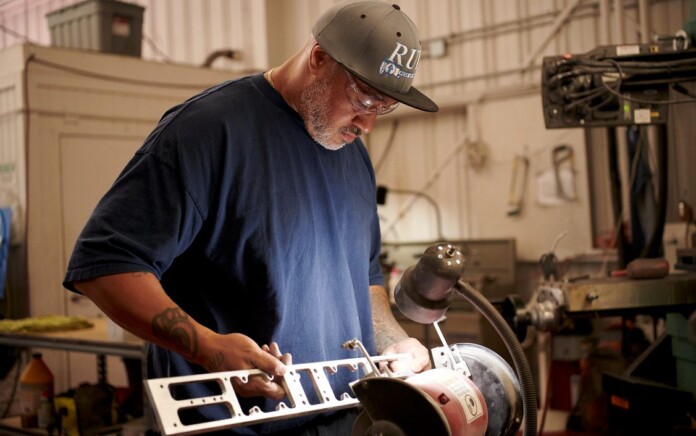
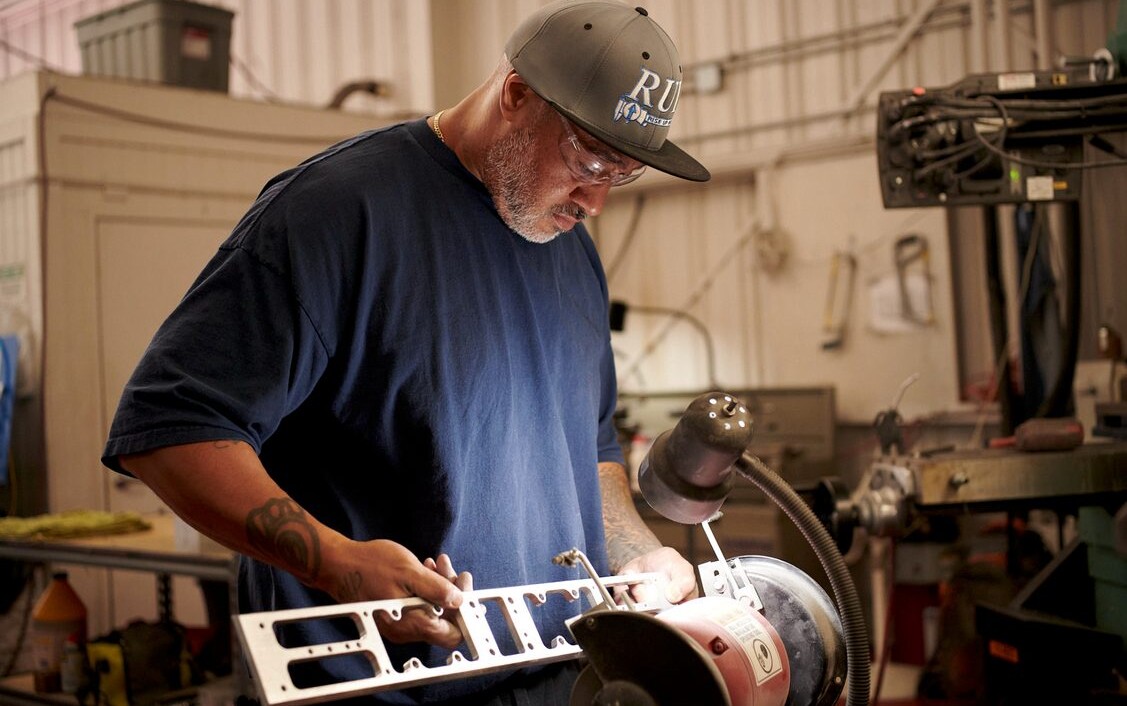
In a converted machine shop in southeastern San Diego, men who spent decades in prison are learning critical trade skills just weeks out of incarceration thanks to an inspirational nonprofit.
Rise Up Industries has spent over a decade helping men metaphorically exchange their felony records into machinist certifications, joining a paid apprenticeship program with therapy and case management built in.
But the work itself is anything but metaphor: the machine shop fills contracts for aerospace and medical device parts, automotive components, camera and faucet hardware, BMX parts, and fishing lures.
This dose of reality was tailor-made to suit America’s reality, where the nation infamously tops the Developed World for incarcerated people per capita, yet where a felony conviction makes it extremely difficult to find work.
Rise Up’s own tracking shows only 3% of program graduates re-offend compared to a national rate is roughly 66% over a 3-year horizon, according to the Bureau of Justice Statistics.
Komisi Savaiinaea served more than 2 decades of prison time, but graduated from the apprenticeship program and has found a sense of responsibility that has clearly enriched his life.
“I was very intimidated and skeptical about the whole thing,” he admitted to GNN in an interview. “I’d never had any experience with machining, it had been many years since I went to school, I’m not too savvy with technology, so I was a bit fearful of the whole thing.”
“But after touring through the shop and speaking with the members who were on the machines, it really helped put it into perspective—they had no prior machining experience either.”
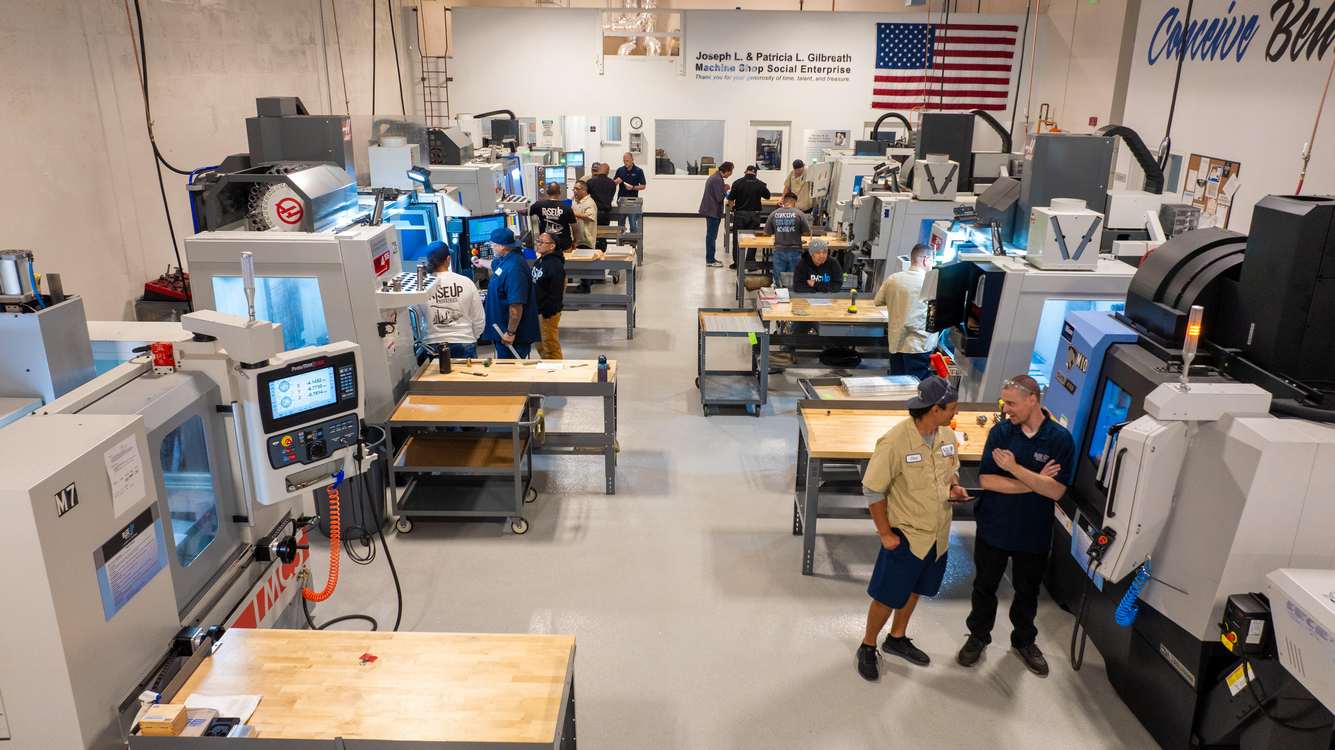
There wasn’t much to it—just a crash course in trigonometry courtesy of tutors there on the machining floor—”if these gentlemen on the floor can get it, you know, I believe in myself, I think I can get it as well,” Komisi said.
What did he have to lose, he opined looking backward: he knew the only other opportunity would be working at construction sites, paycheck to paycheck, and how long could that last?
Giving back
Most participants are formerly gang-involved, like current apprentice Anthony Walkens. In 1998, Walkens was found guilty of gang-related homicide charges and sentenced to 55 years to life. He did 27 years of time in correctional institutes throughout California.
Speaking with GNN, Walkens said that in what would become his last 10 years, a change came about him and his personality, and he became eligible for parole in 2025. His experience entering the Rise Up Industries machining apprenticeship program was remarkably similar to Komisi—how could it be otherwise after half-a-human-life beyond bars.
“When I first came through the door, I was overwhelmed, I thought I had bit off more than I could chew. But the welcome I got here from people like Komisi, it reassured me that I would be able to do this,” says Walkens. “When Komisi first started, he had this same experience, and coming from the same scenario as I, it started being more comfortable.”
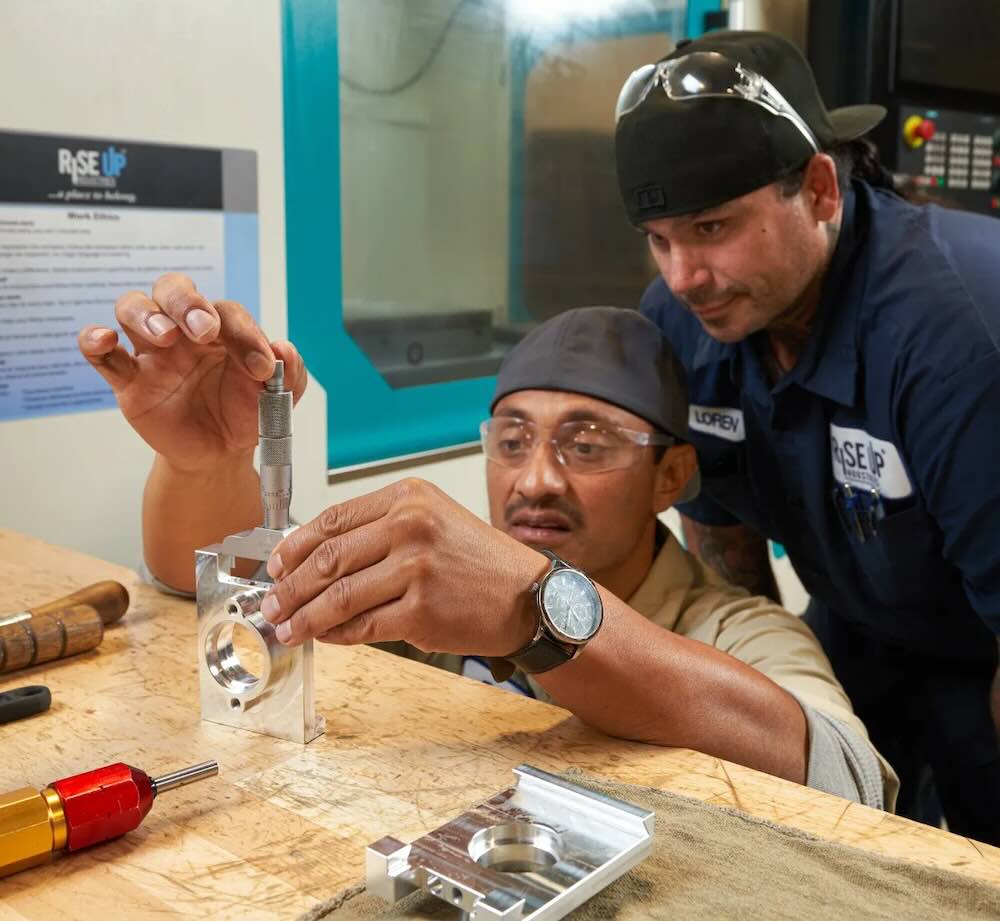
Komisi recently took a position as a supervisor in the machine shop, where he was described to GNN as “a consistent source of encouragement and guidance for current participants.”
“It’s more gentle, they can relate to it better,” he says of welcoming fellow ex-cons. “So it allows me to continue my learning and be of service to others.”
LIFE AFTER PRISON: Formerly-Incarcerated Artisans Craft Tables Designed by Women in Prison, to Benefit Them When They Get Out
“San Diego has a strong advanced manufacturing sector and a significant need for skilled workers, so CNC machining became the central employment pathway in our program,” said Executive Director Jonathan Yackley in a written statement.
In addition to the training, tutoring, and case management, Rise Up Industries made sure that therapy and clinical help was available. Komisi himself is a cancer survivor—necessitating a pause in his work between ’23 and ’24, but he’s also availed himself of therapy to support his role as a husband of more than 30 years.
“I’ve been with her through dysfunction, addiction, and it looks different coming home in a responsible state of mind in a pro-social setting,” he says.
HOPE BEHIND BARS: Daddy-Daughter Dance in Notorious Prison Turns ‘Worst of the Worst’ into Loving Fathers Again
“Over the years, we have learned that technical training alone is not enough,” says Yackley. “Someone can leave incarceration with a certificate and still face the same isolation, trauma, instability and lack of opportunity that contributed to incarceration in the first place.”
“Sustainable change happens when demanding career training is combined with behavioral health care, case management, education and a community in which people know they belong—Komisi is a powerful example. The leadership skills he once used in prison now help him supervise a manufacturing team, encourage new participants and serve his community.”
“It’s really a beautiful place,” said Walkens, “kind of like a family setting.”
SHARE This Beautiful, Transformational Opportunity Reforming California One Machinist At A Time…
“Go as far as you can see; when you get there you’ll be able to see farther.” – Thomas Carlyle

Quote of the Day: “Go as far as you can see; when you get there you’ll be able to see farther.” – Thomas Carlyle
Photo by: Na Inho
With a new inspirational quote every day, atop the perfect photo—collected and archived on our Quotes page—why not bookmark GNN.org for a daily uplift?

Good News in History September 26

Happy 81st Birthday to singer-songwriter Bryan Ferry whose “elegant, seductive croon” and Mod stylings influenced a generation of glam art rock in the 70s. He was the lead singer and songwriter for Roxy Music, achieving three No.1 albums and 10 singles that reached the top 10 in the UK, including, Street Life, Love Is the Drug, Dance Away, Angel Eyes, Jealous Guy, Avalon, and More Than This... WATCH a great retrospective video… (1945)
Your Weekly Horoscope – ‘Free Will Astrology’ by Rob Brezsny

Our partner Rob Brezsny, whose latest book is Enlightenment for Rebels: Celebrating Our Wild and Sacred Earthly Selves, provides his weekly wisdom to enlighten our thinking and motivate our mood. Rob’s Free Will Astrology, is a syndicated weekly column appearing in over a hundred publications. He is also the author of Pronoia Is the Antidote for Paranoia: How All of Creation Is Conspiring To Shower You with Blessings. (A free preview of the book is available here.)
Here is your weekly horoscope…

FREE WILL ASTROLOGY – Week of September 26, 2026
Copyright by Rob Brezsny, FreeWillAstrology.com

LIBRA (Sept. 23-Oct. 22):
In the 18th century, Libran philosopher Denis Diderot was instrumental in creating the Encyclopédie. It wasn’t the first compendium of the world’s knowledge, but it was the most ambitious and comprehensive. In 28 volumes, it assembled contributions from a large number of writers, including leading figures of the French Enlightenment. Robust collaboration was key to its enduring influence. In the coming weeks, Libra, I’m hoping that you, like Diderot, will be an initiator and facilitator of rich cooperation. Conversations, partnerships, and shared projects could generate insights that none of the participants would have discovered alone. By inviting multiple perspectives into the discussion, you will help cultivate a fertile weave of ideas.

SCORPIO (Oct. 23-Nov. 21):
In the volcanic seas around Iceland, underwater eruptions sometimes build entirely new islands that rise from the waves as bare, black rock. During the ensuing years, wind and waves and seabirds seed them with life. Mosses, lichens, hardy plants, and nesting birds slowly transform the raw lava into a living shore. I’m rooting for you to instigate a similar process, Scorpio. My prediction: A development that initially seems stark or unfinished could become fertile ground for growth. Your perceptive instincts will recognize possibilities before they are obvious to others. Be patient with beginnings that look raw.

SAGITTARIUS (Nov. 22-Dec. 21):
I invite you to achieve minor miracles that will enable you to brag at parties about how you created something out of nothing. Not in a loud, egotistical way, but with a sly glimmer in your eye, as if you’re sharing secrets about how reality can be coaxed into generosity if you approach it with imagination and chutzpah. Yes, dear Sagittarius, I’m ecstatic to inform you that now is a favorable moment to turn scraps into usefulness, boredom into invention, and vague hunches into tangible results. Be alert! Be on the lookout! Scout around for raw materials that have been overlooked or dismissed. Half-abandoned projects? Mercurial inclinations? Fugitive fantasies? Seemingly idle conversations that reveal marvelous glints and gleams? These are examples of the “nothings” you can turn into treasures.

CAPRICORN (Dec. 22-Jan. 19):
I’ve got a rough, tough assignment for you: Dare yourself to be startled by your own exquisite beauty. Be bold and even brazen in appreciating what a marvelous creature you are. Can you summon the necessary audacity? I think you can. Please notice the ways you have underestimated your gifts, minimized your impact, or edited out your brilliance to make others comfortable. Allow yourself to feel the tender shock of recognizing that you’re more interesting and mysteriously compelling than you’ve been trained to believe. PS: This will help you call on even deeper inner resources in the coming weeks.

AQUARIUS (Jan. 20-Feb. 18):
Aquarian writer Virginia Woolf was a fount of interesting ideas. Sometimes she pushed her active mind to track them down and capture them, but on other occasions, she enjoyed gathering gems that arrived as her imagination wandered and drifted. These “moments of being” provided her with small treasures while she was walking in nature, taking a bath, or doing nothing in particular. I believe that you are now primed to experience many such pleasurable eruptions of insight. In the coming weeks, pauses and lulls and intermissions will open unexpected portals.

PISCES (Feb. 19-March 20):
For the low price of $199, I could expertly dispel that annoying curse you’ve been lugging around. But I would feel sleazy taking your cash when you are fully capable of zapping the curse yourself. So instead I will recommend that you perform the banishing ritual, then write yourself a check for $199. Here’s how. Step 1: Visualize an object that represents the curse. Imagine hurling it into a beach bonfire and watching it burn. Step 2: Bring to mind a person you believe contributes to the curse. Envision a rope that ties the two of you together, waist to waist. Then imagine yourself revving up a chainsaw, slicing through the binding, and declaring, “You have no power over me!” Step 3: Roll on the floor as you laugh and cry tears of giddy release.

ARIES (March 21-April 19):
In the practice of niwaki, Japanese gardeners shape trees so they look both natural and artfully composed. They prune and style the branches to dramatize the tree’s inherent character. Their goal is to collaborate. I recommend you experiment with a similar approach in the coming weeks, Aries. Try partnering with the living processes in your sphere rather than simply imposing your will on them. Ask yourself: What is trying to flourish here? Can I coax out some useful beauty? How can I coordinate my own intelligence with nature’s intelligence?

TAURUS (April 20-May 20):
Your spirit creatures for the coming weeks are the slow-moving giant tortoises of the Galápagos Islands. They can live for more than a century. They conserve energy, move deliberately, and carry their protection with them. I believe you will benefit from embracing their ways in the coming weeks, Taurus. Refuse to be rushed or pressured, either by others or yourself. Proceed at the precise rate you need to. Your natural strength will thrive through your incremental steadiness. PS: Consider giving yourself a tortoise nickname.

GEMINI (May 21-June 20):
A master perfumer composes a fragrance in three layers. The top notes are what you smell first. They’re vivid and volatile. The next layer blooms gradually, unfurling the heart notes of the fragrance. Underneath everything are the deep, resinous base notes, which don’t fully reveal themselves for hours and cling longest to the skin. Let this be a metaphor to guide your joys and pleasures in the coming weeks, Gemini. Relish the bright top notes that flare and vanish, but persist long enough for the heart to open, and longer still for the deep base notes to emerge. Gather all the rich delights, not just some.

CANCER (June 21-July 22):
It’s hard, scary work for a crab to molt its shell and grow a bigger one. As it waits for its new protection to grow, its soft, tender body is exposed and vulnerable. That’s why it often hides in rock crevices, neither moving nor eating until its armor returns. Your situation, dear Cancerian, isn’t nearly as dire as the poor, defenseless crab’s. But as you power through your own personal molting season, I urge you to enhance your psychic protection. You need to feel extra safe and secure.

LEO (July 23-Aug. 22):
Bats navigate by echolocation. They send out sounds and interpret the echoes. But when competing for food, they may also jam each other’s sonar, generating acoustic interference that makes navigation harder for rivals. A similar phenomenon occurs in human populations. Some of the noisy talk we hear is other people’s jamming signals. Consciously or unconsciously, they’re creating interference that may make it harder for us to navigate. Now is a good time for you to learn better how to distinguish between real information and meaningless hubbub. Refine your filters.

VIRGO (Aug. 23-Sept. 22):
Jan Tschichold (1902–1974) was a brilliant typographer who revolutionized graphic design. He left his mark on millions of books. But later in life, he rejected some of his own rules, returning to classical typography and critiquing his earlier work as too rigid. In this spirit, dear Virgo, I will ask you if some of your long-standing rules no longer serve you. Is it possible that some of your own “best practices” may have calcified into unexamined dogma? The coming months will invite productive heresy against your past selves. You’re allowed to contradict your earlier convictions. Hint: Your vigorous evolution requires it.
WANT MORE? Listen to Rob’s EXPANDED AUDIO HOROSCOPES, 4-5 minute meditations on the current state of your destiny — or subscribe to his unique daily text message service at: RealAstrology.com
(Zodiac images by Numerologysign.com, CC license)
SHARE The Wisdom With Friends Who Are Stars in Your Life on Social Media…
Australian Biologists Livestream A Remote Desert Waterhole and All its Wild Visitors
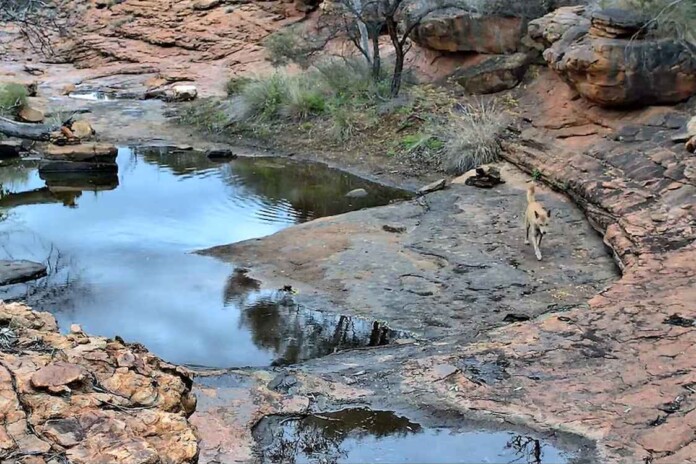
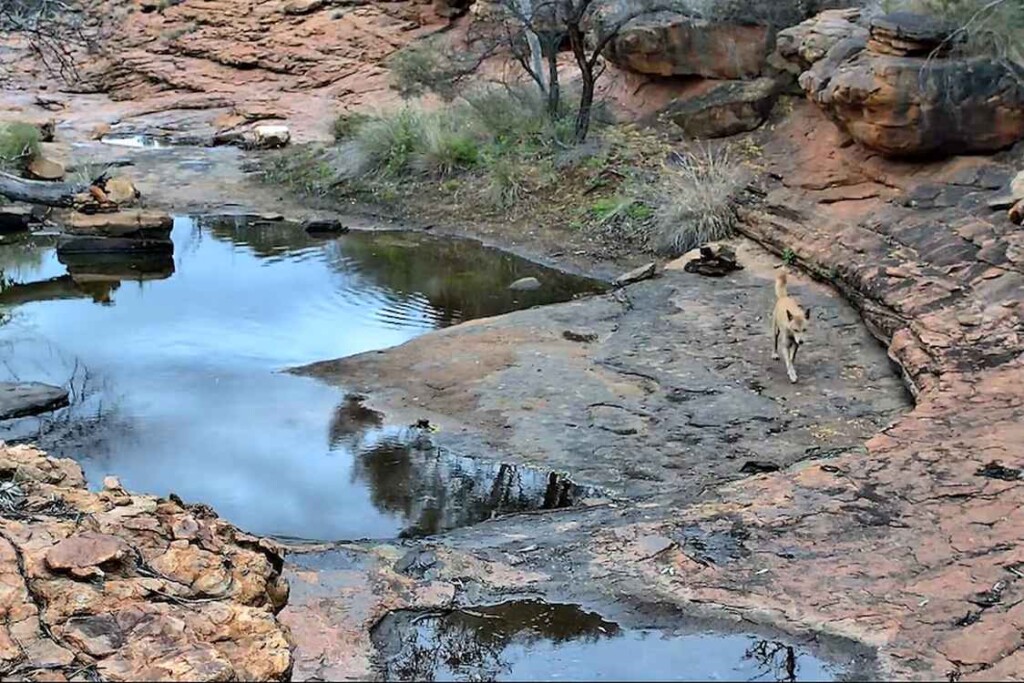
1.2 miles from the nearest car park, down a track which few hikers ply, in a national park few will have the opportunity to visit, a lonely camera livestreams the comings and goings of a desert waterhole to the world.
For the dingoes, wallabies, frogs, occasional feral cat, and even a wedge-tailed eagle who have so far been recorded stopping for a drink, life carries on as it always has. They remain undisturbed even as thousands of people, from Sacramento to Samarkand, have watched them from their devices.
Located in Watarrka National Park, the waterhole livestream was organized by Northern Territories Parks and Wildlife, and Charles Darwin University’s Research Institute for the Environment and Livelihoods.
The idea was dreamt up by fresh water ecologist Jennifer Davis, who had used motion activated cameras to snap photos or clips of passing wildlife at waterholes for years.
She told ABC News AU that it was only recently when advancements in solar power, satellite internet, and compact computing reached the point that she could unite all three—with the help of a little camouflage paint—to take a permanent watch on the waterhole.
“The livestream allows us to see what’s coming in, what’s drinking, what the behaviors are and how they might also change as the planet warms,” Professor Davis told the Australian network.
Watarrka National Park is an ancestrally-important landscape for the Matutjara people, and is internationally renowned for the sandstone walls and gorges surrounding Kings Canyon at the park’s heart. It’s a place of great beauty and ecological importance, but at 818 miles south of Darwin and 201 miles southwest of Alice Springs, it’s a place that few—even Australians—will ever get to visit.
SIMILAR STORIES:
- Students Work to Fundraise to Save Habitat Where They Watch Bald Eagle Chicks on Livestream
- Good Samaritan Saves Farmer’s Pig, Calls 911 After Joining Livestream and Seeing Barn On Fire
Dingoes are spotted more regularly than other creatures, while wallabies are also common visitors. The waterhole is a temporary one, and may vanish after long periods without rain. On the other hand, rain tops up the pool, at which point frogs take up refuge in the water.
The livestream also brings the sounds of nature, such as frogs croaking, birdsong, and the pitter-patter of rainfall.
“As a freshwater ecologist, I’m really keen to see when there’s water present…we’re looking for what’s happening with global warming because, at this site, the only real impact on the amount of water present is going to be climate change,” Davis said.
STREAM This Story Over To Your Friends On Social Media…
Teens Set World Record for Most Sports Balls Recycled in One Day, Diverting 2,675 Pounds from Landfills


In March, GNN reported on the attempt by teens to set a Guinness World Record for the most racquet sport balls recycled in a single day, and we’re happy to tell you: they pulled it off.
It took awhile, but last weekend a group of teen environmentalists from California collected about 22,000 mostly pickle and tennis balls—a haul weighing 2,675 pounds—and saw them trucked off to a special recycling facility.
Calling themselves Another Bounce, and working under the US-based 501(c)3 Habits of Waste, the teens hope to take a point off the 500 million tennis, pickle, and racquet balls sold, served, and tossed in the US every year.
Another Bounce focuses on collecting balls from LA-based clubs & parks and sending them to a specialized recycling facility, as well as advocating for manufacturers to consider end-of-life solutions for their products.
“This record is a powerful visual reminder of the enormous amount of waste generated by sports,” commented Habits of Waste founder Sheila Morovati, who landed in GNN’s headlines in 2018 for setting her own Guinness World Record for collecting over a million gently-used crayons to donate to 700 teachers.
“By diverting more than 20,000 balls from landfills, we’re showing what’s possible when we rethink the systems we’ve come to accept as the norm.”
Over the weekend of September 19th, student-athletes, families, local advocates, and community members turned out to donate used balls, with organizers offering free ice cream to every family or community member who donated a grocery bag full of balls, and free new pickleballs courtesy of Selkirk.
Experts believe that between 1 and 5% of tennis and padel balls avoid the landfill or incinerator. The ultimate destiny for the other 99 to 95% will either be a 400-year decomposition, or a big puff of greenhouse gas. GNN has reported on other efforts to divert this massive waste stream from global landfills, including through the use in bespoke furniture.
Collected balls from Another Bounce’s event will be turned into new balls and/or other sustainable materials, in partnership with recycling partner Ridwell.
TENNIS TALES: Wimbledon’s Unsung Hero is Rufus the Hawk (Video)
The recycled plastic is then used to create a variety of products. The pelletized post-consumer resin ends up in various commercial and industrial products like nursery plant pots, carpeting, plastic packaging, and more.
“I am so impressed with the work that they’re doing to remove these balls from the waste stream because the impacts of the trash, the plastic and the pollution on our environment, especially on our sensitive marine habitat, is so impactful,” said LA City Councilmember Traci Park, who was in attendance to root on the organization.
RECYCLING EVERYTHING: Leaving No Molecule Behind: ‘Landfill of the Future’ Turns Farming Waste Into Soaps, Compost, and Candles
Park wasn’t the only politician to cheer the young athletes for such sustainable sportsmanship. Malibu Mayor Bruce Silverstein invited the group to draft a city ordinance that would further their aim of seeing sports balls diverted from waste streams.
“I think it’s a great idea and I’d like to invite this group to prepare something. Actually prepare a draft legislation and present it to our staff so we can have an agenda item with the actual proposal.”
“Today marks the beginning of a much bigger movement for sustainability in sports, and I’m excited to continue working alongside these teens to advocate for city ordinances and infrastructure needed to create real change,” said Morovati.
SHARE This Great Story Of Teens Serving Their Community…
Millions Channeled to Irrigation Improvements, Leak Repairs Along Colorado River by Corporate Coalition


On Monday, e-commerce giant Amazon announced a $20 million investment to conserve water in the Colorado River Basin that’s currently stressed by a mixture of demand and historic drought.
In launching the Colorado River Basin Collaborative, (CRBC) and joining existing organizations the Water Resilience Coalition and The Climate Pledge, the firm hopes to help create the largest corporate water conservation effort focused on a single US watershed.
The Colorado River supplies water to nearly 40 million people and more than 5 million acres of farmland across seven US states and Mexico. But 25 years of droughts have reduced annual river flow by 20%, while its two largest reservoirs, Lake Powell and Lake Mead, are now below 30% capacity.
Interior Secretary Doug Burgum recently signed off on a management plan for the watershed extending through 2028 that will see reductions in deliveries of Colorado River water among the Lower Basin states of Nevada, California, and Arizona, of 1.25 million acre-feet in each year of the next 2 years.
Unable to pull levers on these big decisions, the new CRBC and participating companies working under the Water Resilience Coalition will help around the margins, with plans to fund a range of water conservation projects across the basin, including irrigation efficiency, canal lining, urban leak detection and repair, and groundwater recharge.
CRBC spokesmen told GNN that Amazon is currently supporting two initial projects. The first is a $2.2 million commitment over 3 years with the Municipal Water District of Orange County, which serves 3.2 million residents. The funding will expand leak detection to communities that may not have the resources to conduct this work on their own, as well as to support leak repairs.
Huge amounts of water can be easily lost through diversion to agricultural lands, both through canal delivery and through irrigation machinery.
DEALING WITH DROUGHT:
- New Desalination Plant Gives San Diego So Much Water it’s Helping Other States Suffering Drought
- Hungary’s Famous Thermal Baths Are Saving the Country’s Famous Grasslands from Desertification
- A Rich Rainfall is Set to End Mexico’s 6-Year Drought
Arable, an agricultural technology company, has been backed by Amazon to identify and implement irrigation efficiency on tribal farmland in the Lower Colorado River Basin. The project uses AWS-powered sensors that give farmers real-time data on when their crops need water, helping them draw significantly less water from Lake Mead.
The initiative has already secured more than $33 million in corporate commitments, and has an eventual aim of raising $100 million. Matt Kistler, chief executive officer of the Water Resilience Coalition, said bringing companies together can help coordinate money and speed up projects.
“The Colorado River Basin is one of the most important watersheds in North America, and its future depends on collaboration at scale.”
Give Your Friends On Social Media A DRINK Of This Good Water News…
Portuguese Company Turns Cork Wood into Limitless Material, Even to Insulate Spacecraft

In Portugal, a 150-year-old business making corks is showing that it’s absolutely possible to teach an old dog new tricks.
Having cultivated cork oak trees since the time of the monarchy, Corticeira Amorim have popped open the potential of this humble material, transforming it into a sustainable piece of sophisticated technology that can line the deck of a cruise ship, and even insulate a space ship.
Cork oak forests are quite the unusual sight, and the plantation at Herdade Rio Frio is one of the largest planted cork oak forests of them all. Here, this twisty, gnarly species of oak grows well in the hot, dry Mediterranean climate, and they can produce the bark layer which goes into making cork for up to 200 years.
Each tree can be harvested 9 times after they reach maturity at 25 years. Operating on such long time horizons, it’s no surprise that Corticeira Amorim has deep roots—roots the leaders of this business want to protect.
Monica Pinna traveled to Corticeira Amorim’s cork factory in Portugal to report for Euronews what bubbling up in the science of making cork products.
The multinational company has 4,000 employees, and makes some €1 billion in revenue every year. The cork from its trees make its way into some 30 products, many resembling—in no way at all—the cork one pulls from their wine bottle.
Indeed, taken from their website, Corticeira Amorim’s cork goes into making river cruise ship decking, a cork-concrete solution for the Lisbon Cruise Terminal, and the thermal heat shield for the European Space Agency’s Intermediate eXperimental Vehicle (IXV) re-entry spacecraft. Aerospace applications for NASA, Boeing, and SpaceX followed the IXV’s success. Corticeira Amorim has even developed a 3D-printer-compatable material out of cork.
SURPRISING SUBSTANCES:
- Scientists ‘Cultivate’ Metal Instead of 3D Printing it–and it’s 20x Stronger
- Chemical Process Produces Critical Battery Metals from This Unloved Mineral with No Waste
- This Home Siding Made from Rice Husks Saves Thousands of Trees and Diverts Crop Waste from Landfills
“Developed to mitigate hydrocarbon spills into the oceans caused by large oil tankers, CorkSorb is currently used in numerous industries where oil leaks occur,” the company boasts regarding yet another application for this tree bark. “Cork absorbs only the crude which can be reused later in other activities.”
It’s been used throughout the applied art and design industry, and tiny cork pellets coming as a byproduct of cork production are turned by Corticeira Amorim into a new filler for artificial turf sports fields. The natural shock absorption and frictional resistance means that, if the company is to be believed, cork-turf fields see 40% fewer injuries than shredded rubber fields. Real Madrid—perhaps the most famous soccer club in the world—use Corticeira Amorim cork on their training fields.
For many of the cork oak woodworkers in the fields of Rio Frio south of Lisbon, or at the processing plant at Mozelos, not far from the city of Porto, this glitzy innovation in their ancestral craft isn’t seen. Their days carry on much as they always have, an element of protection afforded by a truly special firm, breaking barriers with a truly special material.
POP Open This Bottle Of Good News In Sustainable Industry On Social Media…
“The future starts today, not tomorrow.” – Pope John Paul II

Quote of the Day: “The future starts today, not tomorrow.” – Pope John Paul II
Photo by: Philippe Bout
With a new inspirational quote every day, atop the perfect photo—collected and archived on our Quotes page—why not bookmark GNN.org for a daily uplift?

Good News in History September 24

72 years ago today, the London street scene was made all the more iconic with the introduction of the Routemaster 8 (RM8) from AEC—becoming the double-decker red bus so associated with the British capital. A pioneering design, the Routemaster outlasted several of its replacement types in London, survived the privatization of the former London Transport bus operators, and even spread to other cities in the UK. READ a tad more about this iconic automobile… (1954)
Bikes Outnumbered Cars on Scottish Rush Hour Route for the First Time Ever


A combination of e-bike rentals and segregated bike lanes has boosted cycling in the Scottish capital to the point that bikes outnumbered cars during a May morning rush hour for the first time in history.
The data, analyzed by the Scottish cycling charity Cycling Scotland, identified other areas where bike traffic is growing, including multiple roads in Glasgow that recorded more bike journeys than ever before.
The Scotsman, reporting on the news, cited what it called “overwhelming popularity” in the e-bike rental program in Edinburgh as accounting for the majority of the additional bike rides.
Since its launch last September, 1.46 million trips have been made on the e-bikes
The data came from a 48-hour nationwide traffic survey in mid-May that recorded traffic of all kinds along thoroughfares all over urban Scotland. Bicycle journeys accounted for 67,000 on those two days—up 25% year-over-year.
One of the longest streets in Edinburgh, running from the city center towards its eponymous port district, Leith Walk features extensive shopping areas and vibrant character. It was here that, for the first time ever, bikes outnumbered cars between 8 a.m. and 9 a.m.
Many, many more people are cycling in Glasgow as well, particularly on routes like Clyde Street, Garscube Road—and Victoria Road, where cycling accounted for 16% of all traffic.
“I am pleased to see Cycling Scotland’s latest figures on cycle lane use in Edinburgh and Glasgow,” said Cabinet Secretary for Economy, Tourism and Transport Stephen Flynn in a statement.

“The record levels of use particularly on Glasgow’s South City Way and Edinburgh’s City Centre West-East Link demonstrates that the infrastructure we are providing is helping more people than ever travel by bike for everyday journeys.”
Cycling Scotland spoke with Kirsty Milton-Moir, a National Health Service health visitor whose role involves visiting families to check on babies’ development, about her experience using the new cycle lanes to get to work and appointments in Glasgow.
BLOSSIMING BIKES:
- Coalition Pushed for Cycling Lanes and Better Buses and Got Them, Transforming Manila in the Process
- Bostonians Wanted More Bike Lanes: Now They Have Them, and Traffic Is Down
- 165-Mile Bike Trail Through Minnesota Finally Completed After 30 years, One of the Longest in America
“I’ve found that cycling is much quicker than driving, so that’s cut a massive proportion of time from my visits. It gives you the headspace you need and allows me time to reflect and think about how best I can support the families on my caseload,” she said.
“Seeing all the people cycling on the cycle lane is amazing. I feel so much safer on the cycle lane where I know that that area is for people on bikes, and there are no cars.”
Secretary Flynn said that Scottish authorities have an additional $280 million in various infrastructure and mobility projects sill in the works, and the early success with the sheltered cycling lanes Milton-Moir spoke of was extremely encouraging.
CYCLE This Story Down Social Media’s Bike Lanes To Your Friends…
Long-Lost Gertrude Abercrombie Painting Bought by a Bargain Hunter for $30 Could Fetch $250,000


At a Michigan estate sale in July, a “treasure hunter” noticed an undisturbed painting hanging in a hallway depicting a series of seashells on a dark grey and black field.
More than the shells, it was the signature located in the bottom-left corner, which read “Abercrombie ’51” that piqued his interest.
Though the hunter didn’t know it at the time, his turning over of $30 for the piece was to be one of the best bargains he’d ever secure, as the surname belonged to renowned post-War surrealist painter Gertrude Abercrombie.
In a simply delicious coincidence, not only did the buyer find the piece, hanging on the wall, ignored by other perusers, but he made a detour on a family vacation in Milwaukee to visit a touring Abercrombie exhibition called “Gertrude Abercrombie: The Whole World Is a Mystery.”
Therein, he saw an archival picture of nothing less than his “$30” artwork within the exhibition catalogue. One could say he was enlivened by the discovery.
After a nationally-recognized Abercrombie expert authenticated the piece as an original, Freeman’s Auctions in New York agreed to handle the sale of the piece, with the opening bid set at $75,000.
Zachary Wirsum, the Head of Department: Post War and Contemporary Art at Freeman’s, said in a statement about the find that he himself had only just told someone at the exhibit that Abercrombie’s works still surface once in awhile at estate sales.
“Little did I know that one of those ‘once in a while’s would occur less than a month later,” he said.
MORE BARGAINS OF THE CENTURY: Woman Finds 4 Plates for $6 Made by Picasso–She Started Crying in the Thrift Store
Alderman Merriam’s Shells was completed in late 1951, and, according to Abercrombie’s own records, given early in 1952 to Dr. John Reynolds as payment for an operation.
It depicts several shells in the collection of Robert Merriam, who served as the Chicago Alderman of the 5th ward from 1947-55, which included the Hyde Park neighborhood where Abercrombie lived for most of her life, per Freeman’s Auctions.
Freeman’s lot note on the painting includes this description of the item and its resonance within Abercrombie’s life.
LOST PAINTINGS FOUND: Two Lost ‘Jungle Book’ Original Paintings Found in Family’s Home After a Century–They had No Clue What They Were
“Throughout the artist’s career, she painted rooms, usually spare and ascetic, closed and impenetrable, which resonated with her own feelings of loneliness and insecurity. Abercrombie also did many paintings in which tents, a more precarious kind of enclosure, feature prominently.”
“The shell is another kind of home, at once protective and confining, a contained space that may have also appealed to Abercrombie thematically. She even played with this idea in her compositions that depict a woman, rather than a snail, emerging from a shell.”
SHARE This Amazing Double-Stroke Of Luck For A Man And The Art World…