Support for Paris is flooding into France from around the world, after scores of people were killed in deadly attacks yesterday.
In a statement, Chinese President Xi Jinping said he was prepared to join France to “combat terrorism and protect the safety of all people” around the world.
In additions to condemnation from Western world leaders, Iranian President Hassan Rouhani also called the attack an “inhuman crime”.
Buildings across the globe were lit up to show support for Paris. The spire atop the new One World Trade Center, the Sydney Opera House, San Francisco’s City Hall and other towers and bridges in Canada, New Zealand and Mexico, were all lit up in blue, white and red – the colors of the French flag.
Supporters on social media have turned their profile photos into French flags, and photos of the Eiffel Tower grounds draped in the American stars and stripes in 2001, following 9/11 have reminded people of the solidarity that inevitably follows tragedy.
American Natasha McIntosh Westhoff wrote on Facebook, “We know your sunrise Paris- the one where the dust is settling, and you are trying to make sense of the senseless… But we also know – it never lasts. Because no matter what hatred does in the dark of night… it didn’t stop the light… in the brightest city in the world… We know, you will only shine brighter.”
(WATCH a video below from Reuters, “Support for Paris Floods In” *NOTE: It take a moment to load)
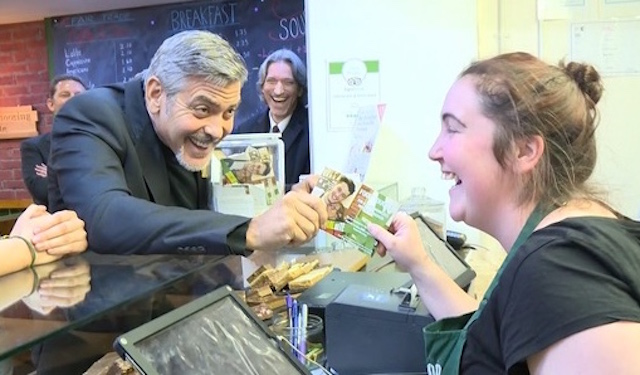
Actor George Clooney invited a few hundred people to grab a sandwich and help the homeless in Scotland.
The movie star and social activist responded to an invitation to stop by Social Bite, a sandwich shop in Edinburgh, Scotland that hires the homeless and donates all it’s profits to charity.
Clooney snapped a few selfies with the Social Bite staff inside, and praised their good work. AP reports he spent $1,000 – to buy meals for the needy, and bought a sandwich from himself himself.
“This place is great,” he said, drumming his hands on the counter and ordering food. “Fantastic, guys!”
(WATCH the ITV News video below) – Photo: ITV News
Here at Good News Network, World Kindness Day is one of our favorite days of the year. It’s an occasion where everyone can go out of their way to show compassion to friends, family – even strangers.
That’s why we compiled a list of ideas for you to try on World Kindness Day to spread a little joy.
1. Bring in a Treat to Local Firefighters or Senior Homes
Community makes the world go round, and it doesn’t matter how old you are. Whether you’re a 103-year-old woman volunteering to serve coffee or a companionable young person just hanging out, old folks homes are a prime target if you are looking to do a good deed. Local firehouses are also a great place. Just bring in flowers or bran muffins to make everyone feel good.
2. Giving Out Hugs
Who doesn’t love a good hug? You can devote your day to hugging strangers, or look to your friends and family to see who may need one. Either way, it’s a warm gesture that can brighten someone’s day, including yours.
3. Pay Attention To Less Appreciated Spaces
There are plenty of little ways to brighten up your community. Maybe you can tidy up that trash on your walk to work; or perhaps pull some weeds at the park or elderly neighbor’s yard; or you can give a little love to your local cemetery.
4. Take Care Of Someone Sick
There’s nothing like a warm bowl of soup when you’re suffering from a cold. See if your coworker with the bad cough could use some hot tea with honey, or just leave someone a ‘Get Well Soon’ note.
5. Use Your Skills To Help Someone Else
Are you a nanny? Give a struggling family an hour or two of free babysitting. Are you a landscaper? Try doing a bit of work for your neighbor. Are you a dentist? Maybe you can help with someone’s smile. Whatever your craft may be, there’s always someone out there in need of an expert.
6. Sit With Someone Who’s Lonely
No one likes being lonely, so take a seat with someone who is dining alone at a restaurant. Head over to a nursing home and have a chat with the elders, or head over to your local animal shelter to play with some neglected puppies.
7. Write Someone A Note
You can sign up to write anonymous love letters to those who need a pick-me-up. Or, you can type a letter or email to a friend you have neglected to keep in your world. Sit down with some pen and paper, or a keyboard, and let your kind words flow!
8. Do Something For The Homeless
Homeless folks probably need kindness the most. Whether it’s buying them a sandwich, slipping them a few bucks, or just keeping them company, show them some love today.
9. Don’t Forget Those Closest To You
Cook your spouse or roommate a surprise dinner, or welcome them home at the front door with such warm enthusiasm, they’ll wonder what they did to deserve it. Take your inspiration from this guy, who welcomed his wife home from the airport with a trumpet serenade.
10. Mow Someone’s Lawn Or Rake Their Leaves
If you enjoy mowing the lawn, use your positive attitude for a neighbor. If you don’t like raking leaves, it makes the kindness all the more significant when you toil for 30 minutes on someone else’s yard. Try knocking on a stranger’s door and see if their yard could use some love.
11. Pull Into a Drive-thru to Pay for Someone’s Order
Using a classic anonymous trick for restoring a stranger’s faith in humanity, pull into a drive-thru and pay for the person behind you. You don’t even have to buy anything for yourself–just tell the worker it’s World Kindness Day. You might even start a chain reaction of drivers covering the bill for the car behind, like this one.
12. Tip Someone
Working in food or retail can be one of the most stressful gigs on the planet. Extend your kindness to your cabbie with a theme park ticket, or give your pizza driver a hefty tip… a REALLY hefty tip. If you want to get extra creative, pay a gratuity to someone who doesn’t normally receive any appreciation like the garbage haulers or your postal worker.
This is the cake Star Wars fans have been looking for.
The levitating confection appeared to spin in mid-air, stealing the show at last weekend’s Cake International convention in Birmingham, England.
Baker Christine Jenson of Peboryon Cakes is not giving away the secret to how she accomplishes this Star Wars-worthy special effect. She swears it’s “The Force” causing the cake to levitate–and you may seriously believe her after watching the video below.
Afterall, if Yoda can lift an X-Wing fighter out of the swamps of Dagobah, then this should be, well, a piece of cake.
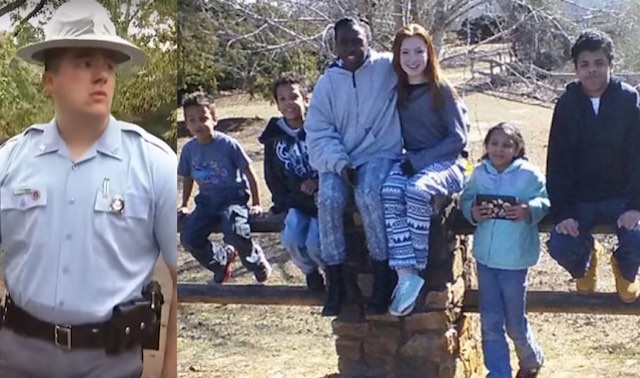
A Georgia State Trooper’s graceful handling of four children under tragic circumstances has ended up raising nearly a half million dollars for their futures.
Trooper Nathan Bradley had the difficult job of knocking at the door of a family home in Newborn to report the car crash that had killed both parents on October 31. Crystal and Donald Howard had gone out to get more face paint for the kids— ages six to 13 — before taking them Trick or Treating on Halloween.
The couple’s four children appeared at the door dressed in their costumes, and with no adults there, Bradley couldn’t bring himself to tell the kids about their parents. Instead, he decided to save their Halloween.
He took them out for dinner to each of their favorite places, radioed headquarters and rallied his fellow troopers who ended up throwing an impromptu Halloween party. A sleepover at the State Police barracks kept them busy until their grandmother could drive up from Florida, seven hours away.
Only after giving the kids happy Halloween memories, and with the grandmother finally there, was the painful news broken to the children.
He told reporters afterward that he had come to love the children. Although he’d already gone above and beyond his responsibilities as a law enforcement officer, he wanted to do more.
He set up a GoFundMe page for Justin, Amiah, Daimean, and Trayvion, hoping to raise $7,000 so their parents’ remains could be sent to Florida, near their new home with grandma. When the total started skyrocketing, Bradley asked that anything beyond that amount to go toward a college fund.
Nine days later, more than 12,000 people have donated nearly a half million dollars to the Howard orphans.
(WATCH the NBC News video) — Photo: NBC News video
Monarch Butterflies are flooding into their winter home in Mexico right now as their population makes a stunning comeback. Heroic efforts to save the iconic butterflies are credited with what could be a quadrupling of their numbers over what was recorded last year.
“We are calculating that three to four times more butterflies will arrive compared to last year,” Mexican Environment Secretary Rafael Pacchiano said in a press conference.
Every autumn, Monarchs make an epic 2,500 mile migration from as far north as Canada to head for warmer weather in Mexico.
The Monarch population had dropped 90% over 20 years because of illegal logging and pesticide use that destroyed milkweed plants the butterflies need to feed and lay their eggs. But last year, an estimated 56.6 million of the species wintered in central Mexico’s evergreen forests— recovering somewhat from the all-time low of 35 million in 2013.
In recent years, Canada, the U.S., and Mexico have taken sweeping steps to protect Monarch habitat and migration routes. They cracked down on illegal loggers and restricted pesticide use.
The U.S. also spent $3.2 million earlier this year to restore 200,000 acres of Monarch habitat from California to the Midwest — including 750 new habitats formed in schoolyards. More than a million dollars of that fund went toward paying farmers to maintain habitat for the butterflies.
“The magic of the monarch butterfly is that little patches matter,” U.S. Fish and Wildlife Service Director Dan Ashe said in announcing the fund back in February. He said tiny patches of habitat “can make a difference on a continental scale.”
The conservation goal of the North American nations is to maintain at least 225 million Monarchs coming to Mexico–which looks like a goal they will achieve in 2015.
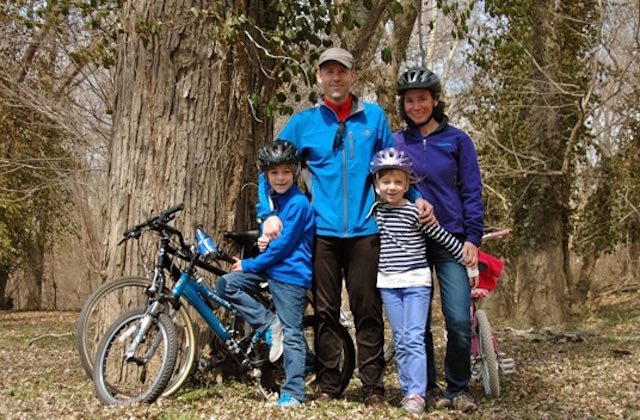
Skyler Palmquist, age 8, and Cayden Palmquist, age 10, are hopeful about what might be accomplished in Paris at the United Nations Climate Change Conference, but wondered why they needed to wait for an international agreement before they took action on carbon emissions.
So, they issued a challenge from their home in Frederick, Maryland: How Low Can We Go challenges friends, schools, businesses, and towns, to take fossil fuel use “as low as we can go” on November 30, 2015, to show support for the conference in France.
“Our kids have grown up playing outside and want to protect the places they love. So, a few weeks ago, we sent out a challenge by way of a homemade video, narrated by Skyler and Cayden, that we posted on YouTube,” explained Ingrid Palmquist. “How Low Can We Go is a collective action that anyone can take, from anywhere, to send the message that we are ready and willing to reduce our carbon emissions. The kids are asking us all to unplug, park it, turn it off, or switch to 100% renewable clean energy for November 30.”
The siblings were especially excited when their grandmother was the first to accept the challenge. Their school, the Lucy School in Middletown, MD, also responded that it would accept the How Low Can We Go challenge, and is planning school-wide participation. Then local businesses, and folks near and far, joined the effort. “We’ve had responses from Finland, England, Ghana and Abu Dhabi, to name a few. The video has been seen in 23 countries,” said Mark Palmquist.
Skyler and Cayden are encouraging kids who take the How Low Can We Go challenge to spend time outside on November 30. “That’s where real life is,” says Cayden. “Real life isn’t in a screen.”
“We want the people meeting in Paris to know that we are serious, and that we really can do this. We really mean it,” says Skyler.
How Low Can We Go uses November 30, the kick-off date for the U.N. Climate Conference, as a rallying point, and asks us to take a close look at our reliance on fossil fuels. The challenge involves consuming less energy altogether, or switching to a renewable energy source, and then carrying forward into the future the adaptations made on November 30.
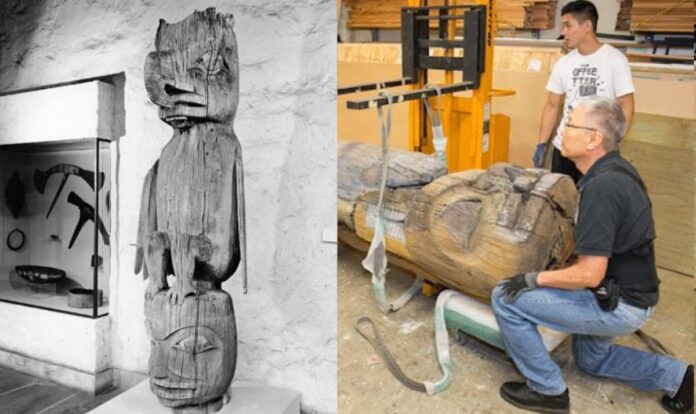
A 30-foot tall totem pole is returning home to its native Alaska after an 84-year odyssey that landed it in the backyards of some of the most famous Hollywood mansions.
Famed actor John Barrymore, grandfather of actress Drew Barrymore, encountered it in an unoccupied village, according to NPR, and carted it off aboard his 120-foot yacht. He claimed that he purchased it during the cruise to Alaska in 1931.
But that doesn’t suit the traditions of the Tlingit (pronounced klink-kit) people to whom it belonged.
It was cut into three pieces and displayed in Barrymore’s California garden until his death in 1943. It was then purchased by horror film legend Vincent Price who later donated it to the Honolulu, Hawaii Museum of Art where the pieces went on display in 1981 (pictured left).
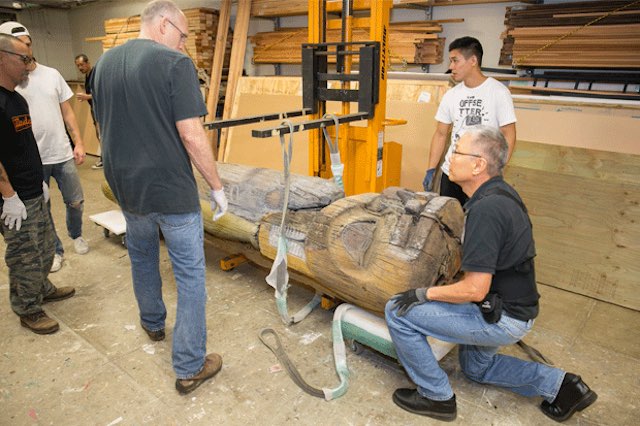
The museum decided earlier this year to return the totem to its rightful resting place, and after weeks of careful packing and planning, the pole was turned over to the Tlingit tribe October 22 during a ceremony in Honolulu. It was then flown to Seattle, Washington and placed aboard a ship for its voyage to Craig, Alaska where it was scheduled to arrive today.
Jonathan Rowan, one of the Tlingit people in Hawaii for the ceremony had one more job before the pole’s long journey home – he carved a replica of the original that will be placed in the tribe’s current home of Klawock, Alaska.
Just like the television show Extreme Home Makeover, we love to bring you stories of people coming together to surprise a deserving family or community group with a newly redesigned home, school, or community center. Who doesn’t get a little choked-up seeing the looks on those faces gazing at the new rooms for the first time?
Often, corporations are backing those good deeds, providing the materials, the furniture, and even the laborers and tools to make these dreams come true. Home Depot, Disney, and Century 21 are just a few that regularly contribute.
Some companies pay their workers to volunteer. On October 16th, Samsung offices across the U.S. and Canada officially closed their doors for the second of two annual “Days of Service” that enabled 4,200 employees to serve in their local communities for more than 50 nonprofit organizations.
“If we are going to be a successful corporate partner we have to be giving back in our communities,” said a vice president for Samsung Electronic America. And these words are backed with action: Samsung employees have donated more than 45,000 volunteer hours since 2014.
Creating Success Beyond Charity
For more than twenty years, Toyota has taken the charitable notion one step further. By sharing their know-how and knack for efficiency, the automaker has transformed charities, organizations, and hospitals with their philosophy of “continuous improvement”.
Illustrative of the old adage, “GIVE a man a fish and he will eat for a day,” this unique not-for-profit arm of Toyota is, instead, “TEACHING a man to fish,” which will make him more abundant for a lifetime…
They call it their Toyota Production Support Center, a 501(c)3 that helps community organizations adapt more efficient ways of doing their day-to-day work.
Central to these efforts is the sharing of principles from the Toyota Production System (TPS), first developed in the 1940s which is based on the notion that small, continuous improvements drive a higher quality of work.
“By eliminating problems, we’re getting incrementally better,” Toyota Advisor Scott Porter explained. “We fix little things all day long, and the collective of all those little things helps overall performance significantly.”
The car company partnered with filmmakers to create a series of short films to document some of the most valuable projects that Toyota has nurtured in recent years. The goal is the betterment of people’s lives through the betterment of the organizations.
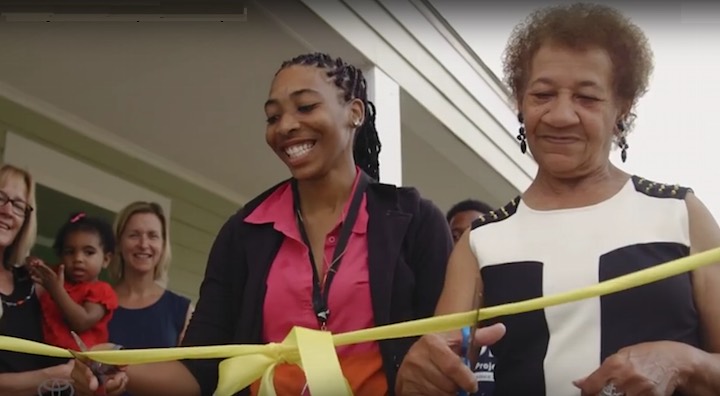
One of the poignant partnerships was with the St. Bernard Project, which is rebuilding family homes lost in Hurricane Katrina. With an influx of Americorps volunteers to work on more homes, the founders were surprised that it hadn’t sped up the building time. Before Toyota stepped in to identify improvement opportunities, it was taking the group 116 days on average to complete a home. Afterward, it was cut almost in half, to 61 days.
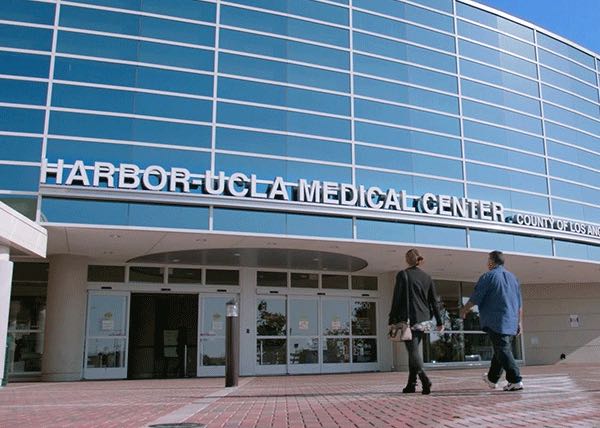
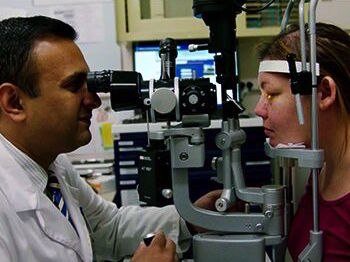
Another organization helped by Toyota was a busy county eye clinic at Harbor-UCLA hospital, where patients were slowly going blind waiting months for medical services. The wait list was hundreds of patients long, but busy doctors and administrators didn’t know how to fix it. With a new color-coded filing system and moving the supplies to where the doctors needed them most often, and the shift to a culture of observation, they were able to eliminate the surgical backlog within two years.
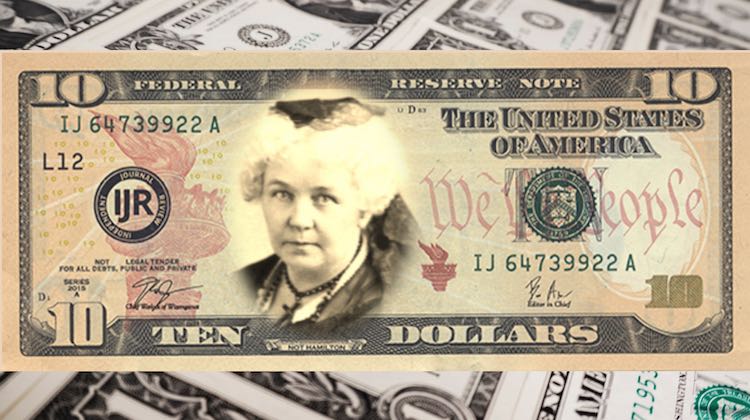
Most Americans don’t know who Elizabeth Cady Stanton is, and putting her picture on the new $10 bill may be a good way to teach them about her.
The new, commemorative bill will be issued in 2020, the 100th anniversary of the 19th Amendment’s ratification giving American women the right to vote.
A nationwide poll in August, two months after the U.S. Treasury announced the plan, found six women favored: First Lady Eleanor Roosevelt (29%), abolitionist Harriet Tubman (20%), explorer Sacagawea (11%), aviation pioneer Amelia Earhart (11%), suffragist Susan B. Anthony (11%), and Supreme Court Justice Sandra Day O’Connor (4%).
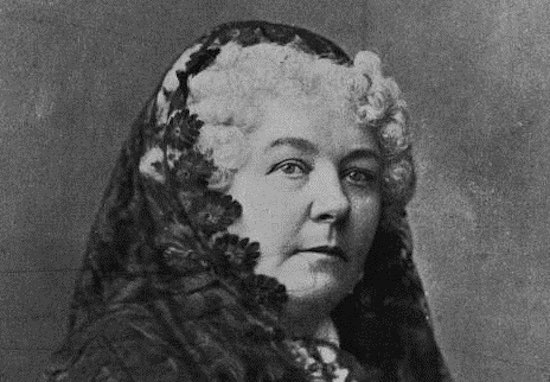
Elizabeth Cady Stanton, who was born 200 years ago today, isn’t even in the running for having her portrait honored by the nation’s currency — but as founder of the women’s movement in her country, she should be.
Her father raised her in New York as he would any son–the lawyer encouraged her to enter traditionally male-dominated spheres.
At age 33, when Stanton was already a leading abolitionist, fighting alongside her husband to end slavery, she took on a new and more personal fight. She delivered a “Declaration of Sentiments” at the first women’s rights conference in Seneca Falls, New York. Modeled on the Declaration of Independence, it listed 16 “sentiments” describing the many rights denied to women by their patriarchal government and society.
These included the rights to own property, to have a voice in lawmaking, and to vote.
Stanton’s Declaration was controversial at the time, but abolitionist Frederick Douglas called it a “grand movement for attaining the civil, social, political, and religious rights of women.”
She would eventually form, and later lead, the National Woman Suffrage Association in 1869 with Susan B. Anthony, who is better known to most Americans–maybe because she was featured on a dollar coin minted in 1979 through 1981.
But Stanton would die 18 years before American women won the right to vote.
Maybe for us, a century later, the right thing to do might be to remember the woman who began the struggle a full 70 years before the 19th Amendment became a reality.
Vote To Share This Story With Your Friends… (Photo credits: IJR $10 Bill Generator; Pictures of Money, CC)
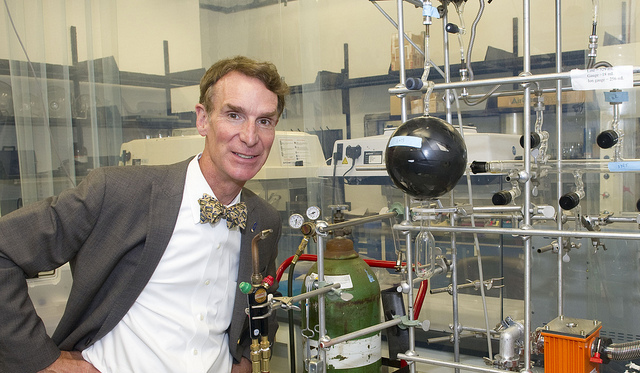
One of his theories includes bigger, better, and more efficient batteries, which could store larger amounts of electricity and produce less waste. Another, the use of microbubbles — similar to the “shade balls” used in California reservoirs to prevent water loss during the drought — to make lakes and ponds reflect sunlight back into space and cool the planet.
Nye also argues that electric, self-driving cars could cut air pollution on the roads — and serve as power sources at home.
“My goal is to change the world!” Nye told Salon. “We’ve got to go into this knowing we have a hard challenge but that we’re going to win this fight, and we’re going to save the earth for humanity.”
Known for popularizing science for laymen and teaching a generation of American kids about science through his television show, “Bill Nye, the Science Guy,” Nye has concentrated his focus in recent years on calling attention to climate change and possible solutions.
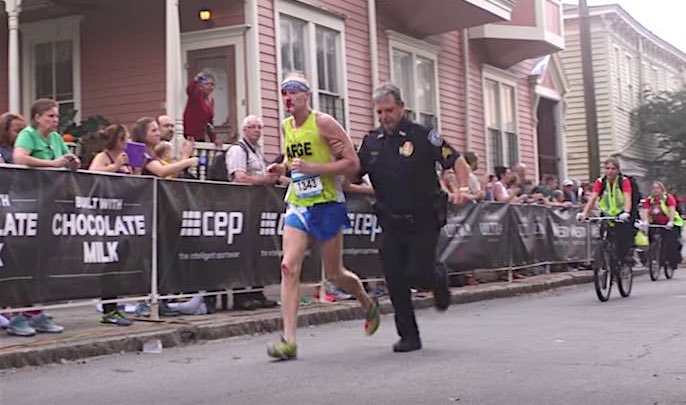
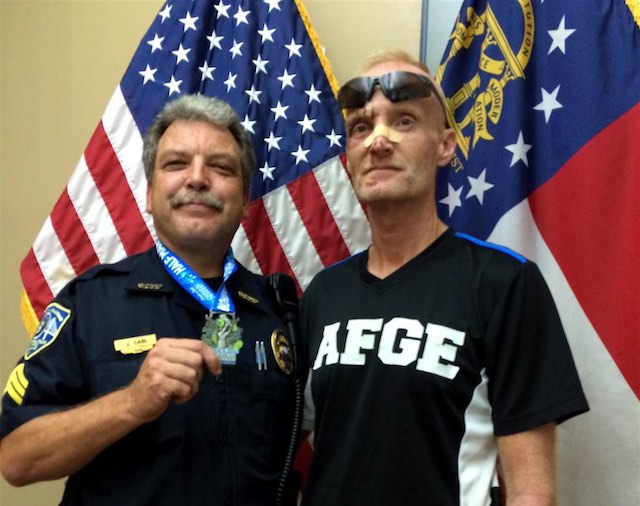
This marathon runner thought a police officer deserved a medal for his actions, so he gave him his own.
Robert McCoy had just made the final turn, and could see the finish line in the distance, during the Rock ‘n’ Roll Marathon in Savannah, Georgia. After running 26 miles, he had to know that all the effort was about to pay off.
That’s when he took a nasty fall, scraping his face, knees, and shoulder.
Sgt. John Cain of the Savannah-Chatham Metropolitan Police Department saw him tumble and rushed to help him.
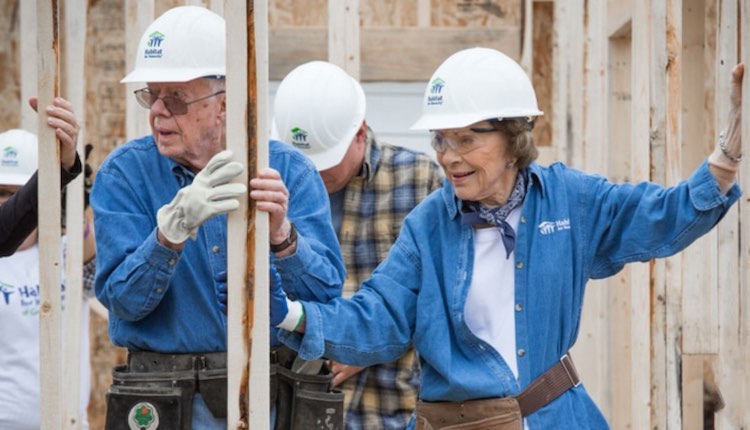
The Georgia elder did have to cancel a planned trip to Nepal to help Habitat rebuild homes destroyed by the recent earthquake, but it had nothing to do with his cancer. The organization decided civil unrest in the region might make the project to dangerous for volunteers.
The house in Memphis is going to Arlicia Gilliams, a 25-year-old single mom who’s putting 350 hours of “sweat equity” into helping build her future home. She said she was thrilled getting to work alongside the former president. Country music stars Trisha Yearwood and Garth Brooks also volunteered on the job site with Carter.
Carter says he’s all business on a Habitat project and doesn’t want to be bothered while he’s working. He says if volunteers are talking to him or taking pictures with him, no one’s getting any work done.
He plans to keep up that kind of pace as long as his health will let him.
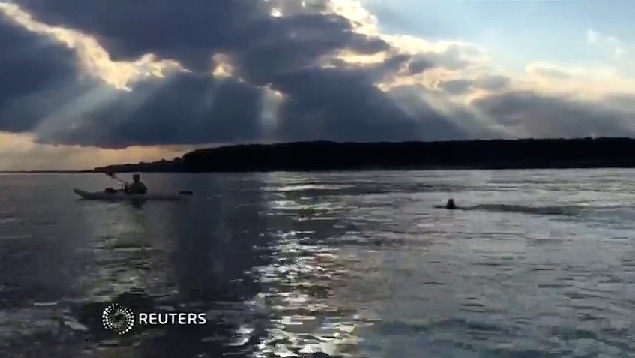
Navy combat veteran Chris Ring is swimming the entire length of the Mississippi River on a quest to become the first American to complete the 2,552 mile-long span from Minnesota to the Gulf of Mexico.
The veteran has been in the water nearly seven hours every day to bring honor and awareness to his fellow solders killed in battle and their “Gold Star” Families.
After starting his swim on the anniversary of D-Day in June, the veteran is hoping to complete his mission in early December–swimming past ten states on his way to the finish line of the fourth longest river in the world.
Watch the Reuters video below: NOTE* It may take a few moments to load… (Photo used with permission)
Ten years ago, Mark and Tori Baird got a knock on their door from a Marine who’d just returned from Iraq.
The soldier was wondering if they had any jobs around the house that could help him earn $100 which he needed for an electricity bill.
The retired couple offered to give the Marine $100, but he refused the charity.
Five hours later, after doing odd jobs for the couple in the yard and home, the Marine left with a hundred bucks. The encounter sparked the idea for the Bairds to start a job board called “Hire Marines”.
The website took off, and Mark and Tori even got a call from the Admiral of the Navy who asked if sailors could also use the service. The Bairds were thrilled and renamed their web site, Hire Patriots, with the goal of providing work for veterans.
(LEARN more about the job board’s success at Brad Aronson’s blog) – Photo credit: Mario Tama/Getty Images
What started off as a student government project has become a full-scale, full-time resource for students in one North Carolina community who are living with food insecurity.
At Washington High School, this food pantry remains fully stocked with non-perishable goods for students to take if they need it.
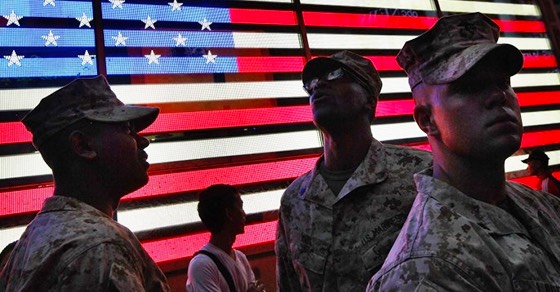
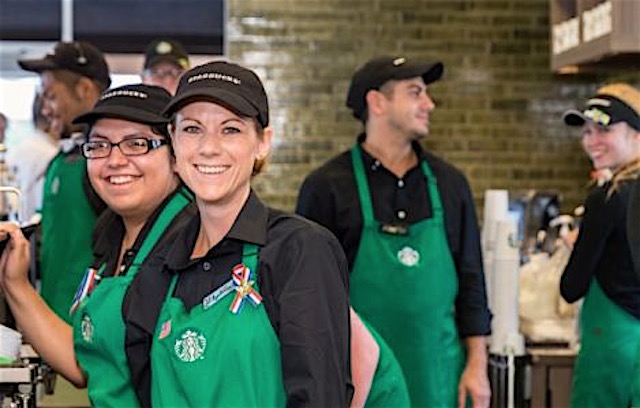
People who’ve traded a military uniform for a barista’s smock at Starbucks will now earn more than just a paycheck. They will get free tuition for a family member toward a college degree.
If a Starbucks employee is a U.S. veteran, or still an active-duty service member, the coffee chain will offer four-years of college tuition to their spouse or one of their children through Arizona State University’s online degree program. Because many active duty service members move so much, obtaining an online degree is often a preferable option.
The Seattle, Washington-based company announced the policy Sunday, just ahead of Veterans Day, November 11.
The perk is an expansion of the Starbucks College Achievement Plan begun last year which pays tuition for any employee working 20 or more hours per week. The company pays for four years of online college credits toward one of 50 undergraduate degrees through the Arizona university’s online education program.
The company realized veterans weren’t taking advantage of the program because they already had education opportunities through the G.I. Bill, a set of benefits the U.S. government offers to military service members. So it decided to pass the benefit on to their family members.
Starbucks’ hopes to used the free tuition to recruit more veterans. The company promised in 2013 to hire 10,000 veterans and military spouses by 2018. So far, they’ve hired 5,500 toward that goal.
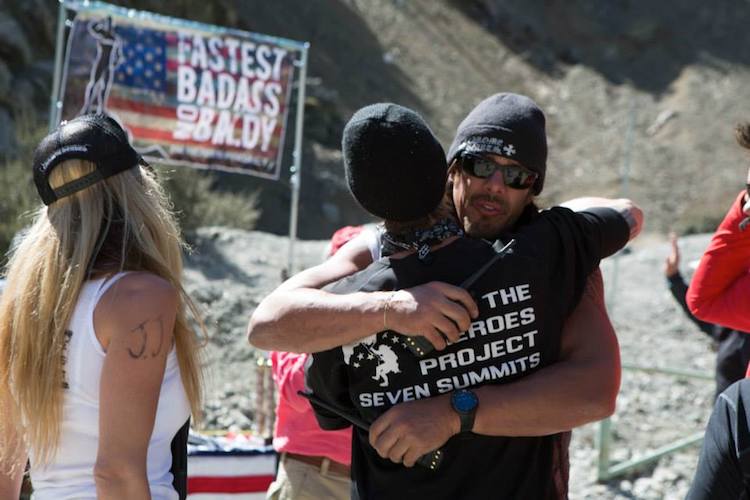
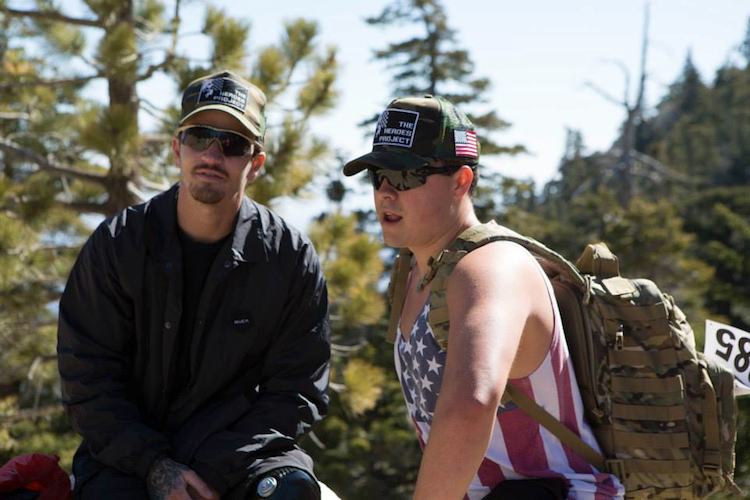
A former member of the biker gang Hell’s Angels has founded a nonprofit to give severely wounded veterans the opportunity to become heroes once again.
By taking them on mountaineering expeditions that scale the world’s most challenging summits, Tim Medvetz and his Heroes Project has helped them rediscover their strength and sense of pride.
The biker needed such a journey himself, after a motorcycle accident in 2001 left him wondering whether he’d walk again. Turned off by standard physical therapy, he tried to find another way to regain his footing.
“I felt like I was dying,” he said. “I needed a punch in the mouth.”
It turned out, Mount Everest was that punch in the mouth—he climbed it on his second attempt, and threw his pain pills away shortly after.
For the past six years, Medvetz has been sharing his program with hundreds of amputees who are learning that they are still the amazing men and women they always were.
Today, on Veteran’s Day, he is leading a group toward the summit of Africa’s highest peak, Mount Kilimanjaro.
Through two different divisions, his Heroes Project helps these veterans regain their own footing.
Climbs for Heroes supports climbing programs for wounded marines, soldiers and veterans, and documents the trips on video to use for advocacy and empowerment purposes. Hope for Heroes works to support and help expand other existing community service programs that support veterans.
(WATCH the video below from 60 Minutes) Photo credits: Heroes Project on Facebook
There has been a vast amount of awareness raised and action taken for children with autism over the past decade—but people over the age of 18 are often left with few options when they age out of “the system.”
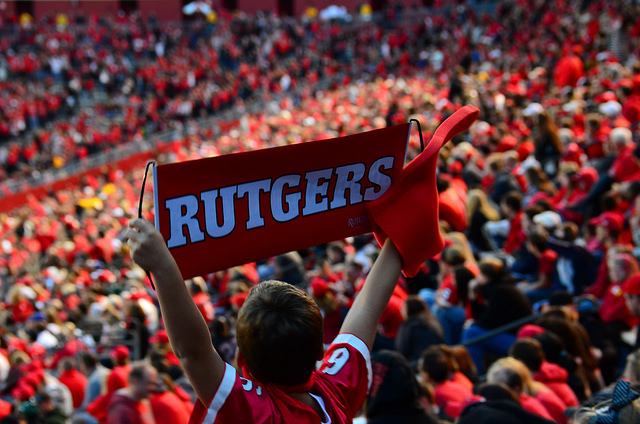
Rutgers University is launching a new initiative to help. When it opens in 2018, the Rutgers Center for Adult Autism Services will be offering up to 60 adults with autism the chance to work independently at specific jobs on campus, and giving 20 of those individuals the chance to live on-site alongside college students.
Rutgers President Robert Barchi said the New Jersey university intends to demonstrate how educational institutions can become part of the answer by providing a model that integrates academic research, student training and community inclusion of adults with autism.
“Rutgers has tremendous autism expertise and unmatched services that can be employed to create a model unlike anything that currently exists,” Barchi said. “Ultimately, the findings that grow out of our work will help inform education, intervention and public policy.”
The school in New Brunswick is raising funds to be able to construct two buildings that will make the opportunity possible.
The first, which is slated to open in the fall of 2018, will house a program that offers office employment to people during the week. Conference rooms and computers will be used to conduct “life skills training”. A second building nearby will house 20 adults with autism spectrum disorder. 20 Rutgers graduate students will also live there in apartments, each equipped with kitchen, dining room, living room and laundry room.
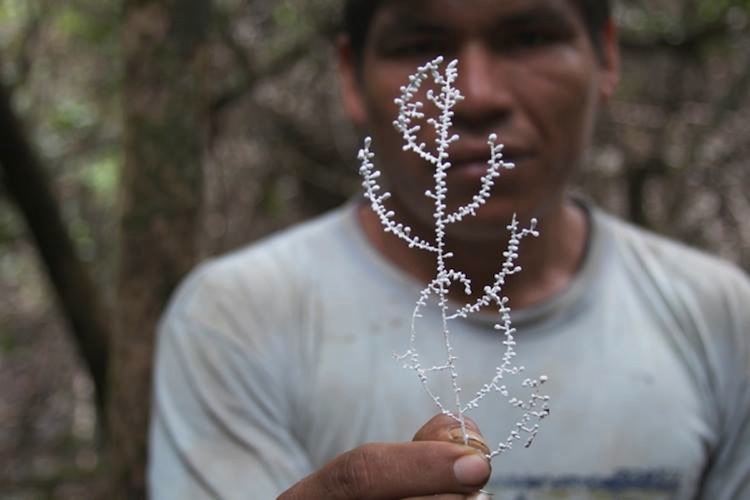
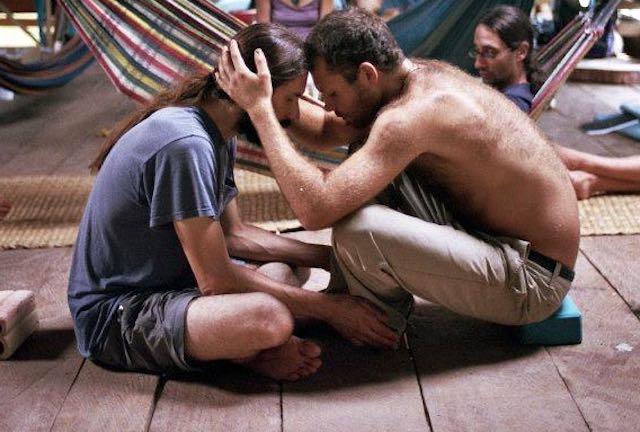
After eight very sick individuals volunteered to be flown to the Amazonian jungle to try a holistic treatment approach, five of them came back remarkably improved.
A film called The Sacred Science documents their 30 days of encampment during which each serious illness was turned over to the power of plants, herbs, indigenous wisdom, and mental and spiritual exploration.
Though it first debuted in 2012, the film is an enduring resource touting the benefits of going beyond modern medicine. Now, it is available for free to view online, and offers lessons about how ancient medicine can potentially cure modern illnesses–from Parkinson’s and Crohn’s Disease, to a variety of cancers and diabetes–and how something as simple as a plant can have healing powers.
Filmmaker Nick Polizzi embarked on the project in 2011, putting out a call for applications from seriously ill patients who wanted to immerse themselves in alternative healing concepts on the border between Brazil and Peru. He received over 400 applications within 48 hours.
“I wanted to use real patients, and I wanted them to be more desperate than average patients, willing to journey into the middle of the Amazonian jungle, thousands of miles away from a modern hospital, and put it all on the line to find ‘a cure’,” he told Good News Network.
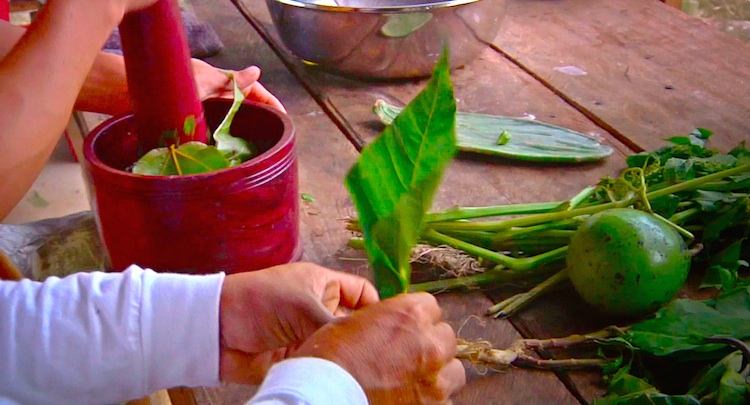
The combination of different wellness modalities, plants, herbs, diet, and spiritual work that each patient experienced was unique to their respective situation. Beyond just the consumption of the plants themselves, the external environment was also seen as critical to the healing process. So, the patients stayed in jungle huts a mile away from any other patients, spending much of their month in “the solitude of nature.”
This, Polizzi said, helped foster the crucial, spiritual component of the journey.
“If you ask a shaman or a medicine woman which plant cures cancer, there’s no one answer. You can’t sit in a hotel room and drink herbs,” he said. “If you look into ancient folk medicine from indigenous cultures, all the way to ancient Chinese medicine, they looked at the entire situation, the deeper parts of who you are in your soul.”
5 Patients Reported Remarkable Improvement
After the journey was completed, five of the patients experienced significant improvement in overall health. Two were disappointed with the experience and one person with a terminal disease, who was only expected to live a week before arriving in the jungle, ending up living two pain-free weeks before passing away there.
Though the subject matter may seem controversial and ripe for criticism, the documentary earned the respect of doctors from around the world at multiple film festival screenings.
“They would warn me, ‘Those are some top doctors in the front row,’” Polizzi said. “But nobody really challenged what they saw. I think having doctors involved on our end had something to do with that.”
While everyone may not be able to fly to South America to cure what ails them, they can come to understand that medicine is not just about treating symptoms.
“Acupuncture and yoga both seem simple enough, but you look at the roots of these practices–more than movement or needles in your body, it’s about your energy that links to that,” he said. “The Sacred Science team is on a mission to bring awareness to the medicinal value of these traditions and help preserve these fragile cultures from extinction.”
The film offers insight about how to use specific native nutritional practices to “turbo-boost” your body’s healing power and how to take a fresh look at the “root cause” of disease—the cause that lies deep within us—and how to find and heal it. Watch the trailer below, and also get a free screening of the full documentary at this link.