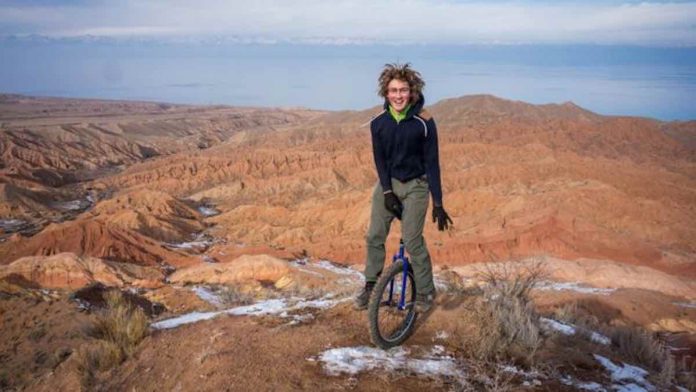
A 21-year-old man has just become the first person to travel around the world on a unicycle – and he has raised thousands of dollars for charity in the process.
Over the course of the last 40 months, Ed Pratt has unicycled over 21,000 miles (33,000 kilometers).
His journey has raised over $393,000 (£300,000) for the School in a Bag charity, which provides school supplies and educational equipment to disadvantaged children around the world. The nonprofit’s CEO says that the money will benefit roughly 15,000 needy kids.
The young man set out from his home in Somerset, England in 2015 as a means of finding something meaningful to do after finishing with school. His trip ended up taking 16 months longer than he expected due to rough weather conditions.
The teen’s route took him east across Europe, Asia, New Zealand, and Australia before he crossed over to the USA and ended in England.
Last week, he crossed a finish line that had been set up near the School in a Bag’s office.
“He left school in search of a challenge and adventure,” his parents told the BBC. “Anyone who has followed his journey around the world will know that he has created just that.”
(WATCH the interview below)
Pedal The Good News To Your Friends By Sharing To Social Media – Photo by Ed Pratt
These herds of goats wandering the countryside may seem like an innocuous part of the scenery, but they’re actually performing a very important job for the government.
As a means of preventing any more wildfires from ravaging the landscape, Portugal is now financing dozens of goat herds to munch away at the dry vegetation that helps wildfires to flourish.
Goats are an environmentally-friendly way of keeping greenery in check, and they’re stunningly good at it. Additionally, the government funding helps support goat herders and farmers in rural parts of the country.
When the Associated Press reported the news in June, they interviewed 61-year-old goatherd Daniel Fernandes. The Portuguese man described how his goat herd saved his family home in 2004 when wildfires crept in on the trees surrounding their residence.
Because the goats had already eaten and trampled the grass surrounding their home, however, the flames left them unharmed.
While the initiative may be new to Portugal, drought-susceptible regions of the US, such as San Francisco and Arizona, have been using goats as wildfire prevention for over a decade.
“The goat clearance scheme is one of the key reasons the Bay Area hasn’t had a recurrence of a catastrophic fire in decades,” says Tom Klatt, former manager of the Office of Emergency Preparedness at UC Berkeley and the author of UC Berkeley’s 2007 Fire Mitigation Program Annual Report.
The Portuguese government has taken additional measures for wildfire prevention. According to reports, the nation has added 1,000 more firefighters to their response force and hired several water-dumping planes and a few dozen response helicopters.
(WATCH the video below)
If This Story Gets Your Goat, Be Sure And Share The News With Your Friends – Photo by euronews
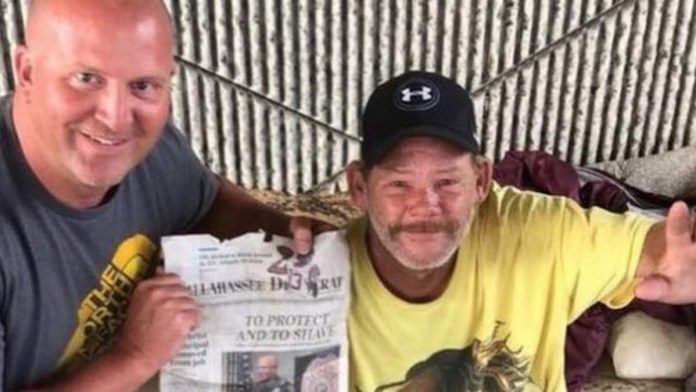
Officer Tony Carlson made headlines last week after a bystander filmed him shaving a homeless man’s beard in a gas station parking lot.
The spontaneous barbershop experience was prompted because the homeless man was told that he wouldn’t be able to start working at McDonald’s unless he shaved his beard.
Well, Carlson’s efforts to protect and shave paid off: an update from the police department says that the man got the job with a little help from the Florida government.
Carlson described the incident at a press conference with the Tallahasse Police Department, saying that Phil, the homeless man with the beard, had approached him the previous week asking if he knew anything about fixing clippers. Upon taking a look at the clippers, Carlson saw that the gadget was simply missing some screws.
As luck would have it, Carlson happened to have some replacement screws on hand. After tightening the screws, the clippers worked fine.
Phil then started to shave in the gas station parking lot – but because he didn’t have a mirror, he was having some trouble. Carlson then offered to help him shave.
Video of the heartwarming deed, which was reposted by the Tallahasse Police Department, was shared thousands of times. Social media users praised Carlson’s kindness and urged the department to keep them updated on whether Phil landed the job or not.
“I didn’t do anything spectacular. It happens all the time,” says Carlson. “It just so happened that this time somebody caught it on film. Officers all over the place in other cities are always doing things like this that don’t get the attention.
“I think of us more as peace officers first, law enforcement officers second,” he added. “You know, you go to a scene and you try to resolve it with a positive ending and something that’s going to last.”
A few days after the video went viral, Carlson then made a post explaining how his family had gone out to dinner and saw Phil sitting under a bridge. Carlson and his kids bought some cheeseburgers for their new friend and stopped by Phil’s camp to say hi.
“Phil was surprised and excited to see me,” wrote Carlson. “He pulled out the Tallahassee Democrat front page, that had me and him on it, and showed it to me. He then told me he had talked to the manager at McDonald’s and he was set to get a job, but he still needed to get his ID/SS card.
“I then told Phil I had good news about that and told him I had been contacted by Senator Marco Rubio’s office here in town. They stated they had also seen the story and wanted to help Phil get his ID and Social Security card.
“I told Phil when I got to work on Thursday I would print out the paperwork they emailed to me and bring it by for Phil to fill out. They also said Phil could come by their office and they would help him with the process.
“Phil was super excited and assured me he would be ready for Thursday.”
(WATCH the interview below)
Share The Story Of This Sweet Shave With Your Friends – Photo by Tallahasse Police Department
Quote of the Day: “What is essential is invisible to the eye. It is only with the heart that one can see rightly.” – Antoine de Saint-Exupery
Photo: by Yogendra174, CC
With a new inspirational quote every day, atop the perfect photo—collected and archived on our Quotes page—why not bookmark GNN.org for a daily uplift?
The Lesson: Living in a society that frequently asks, “what do you want to be when you grow up?” can have a detrimental effect on growing up. It can often feel like we’re expected to commit to one thing forever, and embracing too many passions can be isolating. However, Emilie Wapnick’s encouragement of multipotentialites – people who have many different interests and creative pursuits in life – argues that not everyone has “one true calling.” For those feeling lost or stuck, she suggests an alternate way of living: exploring those curiosities so you can lead a happier, more authentic life.
Notable Excerpt: “The notion of a narrowly focused life is romanticized in our culture. [There’s] this idea of destiny or one true calling … but what if you’re someone who isn’t wired this way? What if there are a lot of different subjects that you’re curious about, and many different things you want to do? … You might feel alone. You might feel like you don’t have a purpose. And you might feel like there’s something wrong with you. There’s nothing wrong with you. What you are is a multipotentialite.”
The Speaker: In addition to being an award-winning author, career coach, blogger, and community leader, Emilie Wapnick is the founder and creative director at Puttylike, a place for people with many interests and creative pursuits.
Books: Wapnick’s book, “How to Be Everything” offers feel-good, encouraging advice on how to find your place in the world.
(LISTEN to the inspiring talk below or read the transcript) – Photo by Shabai Liu, CC
Good Advice? SHARE It – And, CHECK OutMoreon our Good Talks Page…
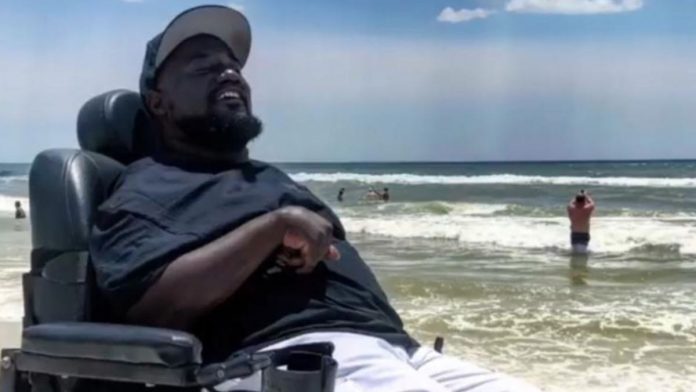
It has been 21 years since this man has left his hometown – so when his friends recently surprised him with his first-ever trip to the beach, he was understandably awestruck.
The last time that David Thomas ventured outside of Jefferson County, Alabama, he was a 15-year-old boy on a field trip.
Though he has always dreamed of going to the beach, his cerebral palsy has made it difficult for him to get around because of his wheelchair.
Upon hearing about this, his friends from church took the 36-year-old man on a vacation to Panama City, Florida. They even got him a special wheelchair so he could traverse across the sands.
Listening to the waves crash on the beach, watching the water, and feeling the sand between his toes, Thomas was overcome with emotion.
“It was a place I always wanted to go,” he told WJHG. “It took me years to get here but God made a way for me to get here. I never imagined it looking like this, but it’s beautiful. I love it and don’t want to go home.”
“I never really go anywhere so it’s just like a dream come true,” he added. “This one moment I’ll never forget. No matter how old I may be, I will never forget this.”
Thomas hopes that his “dream come true” will inspire other people with disabilities to keep hope and never give up on their dreams.
(WATCH the full video below)
Be Sure And Share This Inspiring Tale With Your Friends – Photo by Izas Fuller
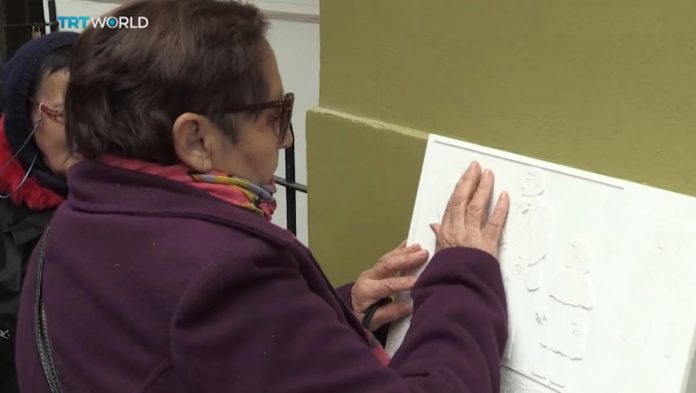
As a means of making art more inclusive and available to everyone, this city has just installed tactile plaques that allow blind people to “see” the many murals decorating the streets.
The plaques were recently installed throughout Chile’s capital city of Santiago. The installations feature raised reliefs of the street art, as well as braille descriptions of the work. A downloadable app that corresponds with the plaques even has audio descriptions of the artworks.
The miniature artworks will benefit the 2.8 million Chileans who have been diagnosed with some sort of visual impairment, which is about 16.7% of the population.
Though braille and tactile touch panels are often featured in museums, this is the first time that such measures have been taken with street art.
The “Manos a la pared” (“Hands to the Wall”) project plaques can be found throughout Barrio Lastarria, which is one of the city’s most touristy neighborhoods.
“The initiative was born from the union of three restless women who met in the Diploma of Cultural Management of the Pontificia Universidad Católica de Chile,” says Paula Cancino, president of the Association for Inclusive Culture, according to We Urbanist. “This project was conceived under the premise of breaking [down] the barriers that impede access to arts and cultures.”
(WATCH the video below)
Show Your Friends This Great Piece Of News And Share To Social Media – Photo by TRT World via Showcase
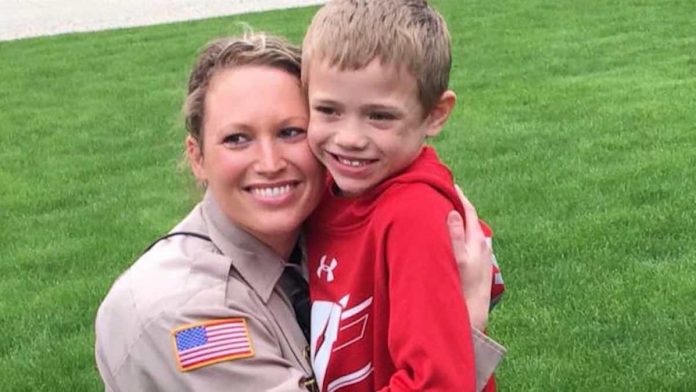
It has been a year and a half since Kristi Goll posted a desperate plea to Facebook asking strangers to get themselves tested and see if they could be an organ donor for her son – and though the situation was dire at the time, the story has a happy ending.
Jackson Arneson, who was 8 years old at the time, was born with a condition called posterior urethral valves, meaning that his kidneys would slowly lose function until they stopped working altogether. In February 2017, he was given a grim prognosis: if he couldn’t find a replacement kidney with O positive blood and plenty of matching antigens, then he most likely would not survive the year.
All of Jackson’s available family members got tested to see if they were a match, but to no avail. Goll then made a Facebook post asking strangers to get tested, and the message was shared thousands of times.
One month after publishing the post, they still couldn’t find a match. Then, it was finally seen by Lindsey Bittorf of the Milton Police Department.
Bittorf, who does not live far from Goll’s home in Janesville, Wisconsin, was struck by the mother’s emotional plea. After seeing the post, she spent an entire day at the hospital getting psychologically and physically tested to see if she could be a match for Jackson.
“If roles were reversed and it were my kid, I would move hell and earth for my kid, too,” Bittorf told CNN.
Despite the odds being pretty low, doctors were surprised to find that Bittorf was an ideal match.
When Bittorf got the test results, she decided to surprise Goll and Jackson with the good news; she had never met the family, and they did not yet know that she was trying to be a donor. She collaborated with Jackson’s grandparents to orchestrate the time and place, and then she showed up on the family’s doorstep with two wrapped presents containing framed pictures declaring she was Jackson’s kidney donor.
Goll was initially surprised to see a police officer standing at her door – but she was even more stunned when she opened the gift and saw what was inside. The emotional mother couldn’t help but burst into tears.
“I took an oath to serve and protect my community and now my kidney will serve and protect you,” Bittorf told Jackson.
Bittorf and Jackson underwent the four-hour surgery back in June 2017. Though he has been in and out of the hospital over the course of the last year to make sure that the kidney is working and recovering, Jackson is alive and relatively well – and it is all thanks to a woman who used to be a total stranger.
Not only that, they’re now best friends.
“I’ve told her so many times,” Goll told WMTV of her gratitude towards Bittorf. “I don’t even know how you thank somebody for doing that for you. You know, I mean as something that’s so priceless.”
(WATCH the 2017 interview below)
Pass On The Positive Story Of Friendship To Your Friends – Photo by Gutzman Photography
New Zealand just became the first nation in the world to mandate paid leave for domestic violence victims.
Any worker who is subjected to domestic violence is eligible for 10 days paid leave so they can take the necessary actions to separate from their partner, protect their family, move locations, or take legal action. The victim is not required to show any proof of the violence, and the legislation will also require employers to offer additional workplace safety measures, such as changing work locations or contact information.
The legislation, which was approved this week by 63 votes to 57, will go into full effect in April.
Green MP Jan Logie, who has spent the last seven years working on the measure, worked in a women’s shelter before she became a politician – and as representatives cheered for the bill, she was reportedly seen with tears in her eyes.
“Part of this initiative is getting a whole-of-society response. We don’t just leave it to police, but realize we all have a role in helping victims. It is also about changing the cultural norms and saying ‘we all have a stake in this and it is not OK’,” said Logie, according to The Guardian.
Legislators hope that the initiative will be the first of many steps taken to help domestic violence victims in New Zealand, which currently experiences the highest rates of domestic violence of any other developed country.
“Domestic violence doesn’t respect that split between work and life. A huge amount of research tells us a large number of abusive partners bring the violence into the workplace,” said Logie. “Be that by stalking their partner, by constant emails or phone calls or threatening them or their workmates. And some of that is about trying to break their attachment to their job to get them fired or get them to quit so they are more dependent on their partner.”
Be Sure And Share The Good News With Your Friends – RepresentativePhoto by Banc de Sang i Teixits
Dogs pretty commonly love three things: their humans, treats, and good sticks.
And judging by how hard Lupe the dog was fighting for her stick, it must have been a really good stick.
Anne Peavey of Washington state was walking through a park with her family when she saw the pup trying to get a massive tree branch through a small gate.
Absorbed in the task at hand, Lupe kept running into the gate with the stick sticking horizontally out of her mouth – nevertheless, she persisted.
“We were coming off the river through the school playfield when we ran into her,” Peavey told Caters Clips. “Her owners were a bit ahead of her and didn’t appear to have noticed that she was struggling to get the big stick through the gateway.”
Peavey and her family kept offering words of encouragement to Lupe until finally, she managed to drag the stick through the gate – and the crowd went wild.
(WATCH the amusing video below)
Be Sure And Share The Pawesome Clip With Your Friends – Photo by Caters News Agency
Quote of the Day: “Become a reservoir of joy, an oasis of peace, a pool of serenity that can ripple out to all those around you.” – Desmond Tutu
Photo: by Stanley Zimny (Thank You for 31 Million views), CC license
With a new inspirational quote every day, atop the perfect photo—collected and archived on our Quotes page—why not bookmark GNN.org for a daily uplift?
An honest-hearted cab driver is being praised for returning hundreds of dollars worth of fare to a Chinese-American tourist after they accidentally overpaid.
The Chinese driver, Zhang Peng, had been working in the capital city of Xian in the Shaanxi province when he checked the online wallet of his WeChat app and saw that one of his passengers had paid 6,500 yuan for a 65 yuan fare.
For perspective, that’s paying about $950 for a $9.50 ride.
Peng suspected that the payment had been a mistake – and based on the time of the payment, he guessed that it had been made by four tourists who he had picked up from the train station and dropped off at a nearby hotel.
When he failed to contact the group through his dispatchers, he simply went to the hotel where he had dropped them off and explained the situation to the clerk at the front desk.
The man who made the payment came downstairs to meet the cab driver and was stunned to hear about his mistake. It was his first time visiting the Chinese city, and he says that he had been confused by the app’s online payment system.
“These systems like WeChat Pay and Alipay are all new to me,” he said, according to the South China Morning Post.
“I don’t really know how to use them. In the US when I pay, there’s usually a space for decimal points, so I thought I had to do the same here and ended up accidentally paying so much more.”
He was even more stunned when Peng turned down a reward and insisted on refunding him all of the excess fare.
Needless to say, the tourist left him a sparkling review on WeChat.
“I can’t believe it,” he wrote. “For some people, money is their only goal, and 6,500 yuan is a lot of money. I felt so excited yesterday because you returned it. I really appreciate it.”
Be Sure And Share The Good Deed With Your Friends – Photo by Senfwurst, CC
An implantable bioartificial kidney may be ready for human trials by the end of the year, according to a recent update from the researchers.
If approved by the FDA, the breakthrough creation could save thousands of patients currently on the transplant list for a new kidney.
The Kidney Project, which is the coalition heading the contraption’s development, published an update today saying that they have been asked to conduct additional preclinical testing before receiving approval for human trials.
“While the request for additional evidence was not anticipated, it is a measure of the revolutionary nature of our project that there is no precedent for safety reviews of similar technology and materials,” wrote the organization. “In that light, it is understandable that the research ethics boards are requesting additional data to document the safety of the bioartificial kidney.”
The project, which is headed by researchers from the University of California San Francisco (UCSF), the University of Vanderbilt, and the National Institute of Biomedical Imaging and Bioengineering (NIBIB), says that they are optimistic about receiving approval for the trials by late 2018 or early 2019.
The coalition first started causing buzz on the internet after they published their groundbreaking research back in February.
Creating an artificial implantable kidney would be an epic advance in medicine and could address a chronic shortage of donor kidneys needed for transplant. Researchers have been at this quest for the past 15 years and keep coming upon one extremely knotty problem: how to keep the blood flowing smoothly through the artificial device without clotting. In such devices, as blood platelets respond to mechanical forces, they have a natural tendency to clot, causing a device malfunction.
While dialysis saves thousands, if not millions, of lives each year, it is not an ideal solution for kidney disease. Instead of continuous blood filtration, which keeps blood chemistry within a healthy range, dialysis results in ultra-cleansed and nutrient-depleted blood, which becomes gradually more toxic until the following dialysis treatment.
An artificial kidney would provide the benefit of continuous blood filtration. It would reduce kidney disease illness and increase the quality of life for patients. While researchers have made progress on wearable models, to make the device implantable—driven by the body’s own blood flows—the clotting problem would need to be resolved.
The implantable artificial kidney—a bioengineered device that combines a high-efficiency silicon filter and a bioreactor of kidney tubule cells– is designed to accommodate up to a liter of blood per minute, filtering it through an array of silicon membranes. The filtered fluid contains toxins, water, electrolytes, and sugars. The fluid then undergoes a second stage of processing in a bioreactor of lab-grown cells of the type normally lining the tubules of the kidney. These cells reabsorb most of the sugars, salts, and water back into the bloodstream. The remainder becomes urine that is directed to the bladder and out of the body.
The researchers generated simulation and optimization results for two device designs that each channel blood through the artificial kidney filter system. Through simulation, they calculated that an individual platelet may flow through the artificial kidney as many as 1,000 times, accumulating stress and increasing the tendency to clot with each pass. One design distributes blood through parallel channels that pass across multiple layers of filtering membranes. The other channels blood back and forth through a single serpentine path.
Both designs met the researchers’ predetermined criteria for the uniform flow of blood through the devices and accumulation of shear stress forces on the platelets against the walls of the device flow channels.
The simulation approach has accelerated the project by saving on animal experimentation and offering a viable alternative to examine the pros and cons of different devices that contact blood. “To do that in animal studies is time consuming, expensive, and at some level you never know if it is going to work out—because animal blood is not the same as human blood,” said Shuvo Roy, one of the study’s co-authors.
Will the device have all the functions of a native kidney? “No,” Roy said. “But the goal is for it to perform the functions that are critical, and to be a device that, once implanted, will allow a patient to eat and drink freely, have mobility, better health overall, and unlike a transplant, not require immunosuppressant drugs.”
“We are hopeful that the first clinical trial will begin this year,” Roy told Snopes back in March. “If all goes well and funds are available, we could be on the market as early as 2020.”
The Kidney Project says that they have already received an abundance of applications for the human trials. Screenings will proceed once they receive approval from the board of ethics.
(WATCH the explanatory video below)
Heal Your Friends Of Negativity And Share The News With Your Friends – Photo by iStock via NIH
Most bus drivers are on a tight schedule, but that didn’t stop from this compassionate transit worker from taking the time to help an older blind man maneuver a street that was under construction.
69-year-old Gene Hubbard is blind from diabetes, but he has still been going to work unassisted for the last 20 years. He knows exactly how to get to his place of work in Milwaukee, Wisconsin from the bus stop, but when the intersection recently went under construction, he found himself in a tricky spot.
“If I don’t have a regular locating point to start from, I may as well be in the middle of the ocean,” Hubbard told WITI.
Thankfully, 28-year-old Thaddaus Turner could sense his distress.
When the Milwaukee County Transit System bus driver noticed the plethora of orange cones at Hubbard’s stop, he parked the vehicle, followed the man down the step, took his arm, and helped him to maneuver past the road work.
His job was made even easier by an oncoming car that stopped traffic to allow them to pass – little did he know that the driver, Sydney Kazmierczak, was simultaneously taking a photo of Turner’s good deed so she could sent it to news outlets and praise him for his kindness.
“I feel like I was placed there at the right time to capture this moment!!” writes Kazmierczak. “I am so happy I quick pulled out my phone to snap the picture! Thad deserves to be recognized!!”
Turner, however, doesn’t think much of the incident, beyond offering credit to his fellow bus drivers for the same kindness that they show their passengers every day.
“The route was barricaded, it was rough for me as a driver, I can only imagine how rough it was for him,” Turner told CNN. “I was surprised when I saw it in the news. I didn’t think I would be here right now over something that is second nature to me, and my colleagues.”
(WATCH the video below)
Drive Your Friends To This Story Of Pedestrian Kindness By Sharing To Social Media – Photo by Sydney Kazmierczak
Indian schools are adding a new element of education to their intensively academic curriculums: happiness.
Over 1,000 Delhi schools are now kicking off their school day with 30 to 45 minute-long happiness classes in which the kids are taught about mindfulness and self-care, rather than math and science.
Legislators hope that the program will help to relieve the anxiety and stress that is notoriously synonymous with Indian curriculums.
“We have given best-of-the-best talent to the world,” said Manish Sisodia, Delhi’s education minister, according to The Washington Post. “We have given best-of-the-best professionals to industry. We have been successful so far. But have we been able to deliver best-of-the-best human beings to society, to the nation?”
The news outlet goes on to emphasize the rigid structure of the nation’s educational system; top universities typically only accept students with test scores of 98% or higher; emphasis on grades and testing has triggered high rates of stress amongst public school students; and India’s industrialization process has pushed thousands of students to pursue careers in skilled labor positions, which has raised concern over whether grads and young citizens are ignoring the importance of creativity and wellness.
“If a person is going through our education system for 18 years of his life and is becoming an engineer or a civil servant, but is still throwing litter on the ground or engaging in corruption, then can we really say that the education system is working?” says Sisodia, according to The Post.
But with the happiness classes, teachers talk with students about inspirational figures and uplifting stories; pupils undergo guided meditation; and they are asked to visualize things that make them happy as a means of improving their mood and motivation. The best part? There are no grades, tests, or textbooks for the class.
Though Indian teachers only have anecdotal evidence of the course’s success since its recent implementation, a similar US-based meditation program has experienced dramatic success amongst at-risk students.
The Quiet Time Program showed a 65% decrease in violent conflict, a 40% reduction in stress and anxiety, and an 86% reduction in suspensions over a two-year period, along with a dramatic increase in self-confidence, creativity, and happiness.
Yale’s own course on happiness and wellness was so popular with their students, they started teaching it online for free.
An 11-year-old Delhi student summed up the lesson of the happiness classes quite nicely by saying: “We should work happily … [because] when you work sadly, your work will not be good.”
Be Sure And Share The Happy News With Your Friends – Photo by Travphotos, CC
A group of rescuers pulled off a daring extraction operation earlier this month as a means of saving an endangered climber.
A 27-year-old Texan man had climbed to the summit of Mt. Hood in Oregon where he planned on taking an excess of medication to commit suicide. Upon making it to the top of the mountain, however, the climber changed his mind.
But the man could not get down on his own – so after calling for help, the 304th rescue squadron from the Oregon Army National Guard arrived by helicopter to help.
The conditions were risky; due to the warm weather, there was an abundance of avalanches, and the rocks and ice were prone to falling.
Not to be deterred from their rescue, the pilot managed to pull off a “pinnacle landing” at 11,000 feet, meaning they parked the rear two wheels of the Chinook helicopter on the mountainside so the rescuers could board the aircraft by plank.
Frighteningly enough, the unusual positioning meant that the helicopter’s rotors were at chest height, rather than far above their heads.
“Because of the angle, we had to crawl out there just to get under the rotor blades,” the squadron’s Joshua Kruse told KOIN. “It’s kind of surreal but you just have to trust that the pilots know what they’re doing.”
Thankfully, everyone made it out safely. The whole rescue operation took roughly 30 minutes from take-off in Welches to landing. The climber was then loaded into an ambulance and taken to the hospital.
(WATCH the incredible video below)
Save Your Friends From Negativity And Share The Inspiring Clip With Your Friends – Photo by KOIN
Quote of the Day: “No man is a failure who is enjoying life.” – William Feather
With a new inspirational quote every day, atop the perfect photo—collected and archived on our Quotes page—why not bookmark GNN.org for a daily uplift?
The Lesson: Tony Robbins defines the single most powerful motivational function of the human mind: the desire to stay true to one’s identity. He banishes myths such as “lucky coincidences” and the notion that one can “stumble into success”; because the difference between people who are fit, wealthy, and have fulfilling relationships and those who do not is the standards to which they hold themselves. Those who fundamentally define themselves as people who are overweight, condition their minds in order to stay overweight – and those who define themselves as athletes will do whatever it takes to maintain their identity. In this talk, Tony Robbins breaks down these standards into bite-sized, daily pieces called rituals that make it possible for anyone to become more disciplined and achieve all of their goals.
Notable Excerpt: “I remember one time I was with my family at the circus and they had this big giant elephant and they take this little rope and put it around this elephant’s neck and they drive this stake into the ground and you know that elephant could rip down that entire tent with almost no effort and yet the elephant doesn’t struggle, doesn’t try. Why? Because the elephant is conditioned. And they take that elephant and condition it when it’s a baby elephant – that’s how they train them. When it’s a little baby elephant and it doesn’t have the power yet, they put a big rope around it and drive this huge stake in the ground and the elephant fights and fights and fights and one day finally that elephant decides – I’m not capable of pulling this out. And once that becomes the definition of an identity of anyone – an elephant, in this case – they don’t even try anymore. It’s just who I am, that’s how it is, that’s just the way it is in my life. I’d like to ask you to take a look at any place in your life with a limitation and ask yourself: when did I decide to accept that limitation?”
The Speaker:Tony Robbins is a best-selling author, motivational speaker, life coach, philanthropist, and entrepreneur. The California-based strategist has become such an influential lecturer, over 4 million people have attended his live seminars. In addition to founding several different companies (and his own foundation), Robbins has also done with work with such charities as Feeding America, Spring Health, and Operation Underground Railroad.
Most people would insist that their canine companions are good dogs – but this sweet new piece of research may prove that they’re even better than you think.
A study that was conducted at the Ripon College in Wisconsin researches whether dogs are empathetic animals who are upset by their owner’s pain. In order to study this claim, the researchers recruited 34 dogs and their owners for a social experiment. The dogs, who were of varying degrees of age, breed and training, were kept in one room while their owners were kept in another room that was separated by a transparent plexiglass door.
Half of the owners were asked to say the word “help” every 15 seconds in a distressed tone, and make crying noises in between. The other half of the owners were asked to say “help” in a normal tone, and hum “Twinkle, Twinkle Little Star” in between. The researchers then studied the dogs’ reactions to their owners.
Since the plexiglass was only secured by three small magnets, the dogs could easily open the doors as a means of getting to their owners. Roughly half of the dogs opened the doors for their owners – and although there was no difference between the dogs who opened their doors for the calm owners versus the distressed owners, the time it took for them to open the doors varied greatly.
It only took the dogs in the crying group an average of 23 seconds to open the doors, while the dogs in the humming group took an average of 96 seconds.
Additionally, dogs who did not end up opening the door in the crying group showed very clear signs of distress, such as panting and pacing, which imply that the canines were too anxious to know how to help because they may “love you too much”. The dogs who did end up opening the door showed lower signs of stress which implies that they were trying to keep a calm head in order to optimize their assistance.
“The idea is that if you can perceive someone else being in distress but it doesn’t overwhelmingly stress you personally, then you’re more likely to be able to provide help,” the study’s co-author, Emily Sanford, a doctoral candidate in psychology at Johns Hopkins University, told CNN.
Plus, the researchers say that owners should not be concerned about their dogs not opening the doors, because if humans experience varying degrees of empathy, then dogs probably would as well.
“There are some people who just don’t have as strong empathy toward other people,” said Sanford, according to TIME. “So we are not surprised at all to find that there’s a range in other species besides our own.”
Some might say that it’s luck that saved Michael Garth Sr.’s life after the Waffle House shooting back in April – others might say it was fate. Regardless, he credits his survival to a waitress whose simple actions led to his survival.
Virginia Stanley had been working at the restaurant in Antioch, Tennessee when Garth and his friends walked in looking for a meal. Since the waitress was washing dishes, she suggested that the group sit at a different table because she didn’t want to splash water on them.
This small suggestion put Garth and his friends just out of range of the gunfire that later hit the restaurant.
In the month following the incident, Garth’s mother Vickie Davis became determined to track down Stanley and thank her for the little gesture that saved her son’s life.
By chance, Davis was getting her tires changed when she happened to run into the Waffle House’s former manager, who then put her in touch with Stanley’s fiancé. As the two chatted, Stanley’s fiancé told Davis that they were soon getting married and his bride-to-be had been trying to get a wedding dress for the ceremony.
So as a means of repaying the waitress for her kindness, Davis contacted Glitz Nashville bridal store about securing a dress. Since the shop gives free dresses to women in the military, Davis, who is an Army veteran, made a special request to the store and asked them to donate a dress to Stanley.
Though it took some persistence, the store eventually obliged and gave Stanley her dream wedding dress for free.
Stanley and her fiancé have expressed their love and gratitude towards Davis for her compassion, but the determined mother isn’t done yet. Stanley has been in and out of the hospital since the shooting, and she has difficulty being around loud noises or large crowds – so now, Davis wants to pair Stanley with a therapy dog to help her deal with her anxiety.
“I’m on a mission today to try and find someone to donate her a service dog,” Davis told CNN. “I don’t know how, but I’ll do my best to make it happen.”
Be Sure And Share This Sweet Story Of Kindness With Your Friends – Photo by Michael Garth Sr.