Quote of the Day: “All progress has resulted from people who took unpopular positions.” – Adlai Stevenson
Photo: by Aziz Acharki, public domain, cropped
With a new inspirational quote every day, atop the perfect photo—collected and archived on our Quote of the Day page—why not bookmark GNN.org for a daily uplift?
Spared from the ravages of COVID-19 suffered by her neighbor Spain, Portugal is aiming to leap, rather than tip-toe, out of their lockdown initiatives by launching a series of clean energy projects that could generate 5.5 billion euro in European energy investment.
The new solar-powered hydrogen plant near the port of Sines is a modern “green” hydro-electric project that generates electricity through a process called electrolysis, and it could contribute 1 gigawatt of power by 2023 if investment arrives.
“The economy cannot grow along the lines of the past and our post-coronavirus vision is to create wealth from projects that reduce carbon emissions and promote energy transition and sustainable mobility,” Portugal’s Minister of Environment and Energy Transition, Joao Matos Fernandes, told Reuters.
Fernandes detailed that both Portuguese energy firms, and Dutch firms are already showing interest in the hydrogen plant, and it is shaping up to be one of the biggest industrial projects and opportunities in the country.
Matos also said that Portugal will be launching a solar energy licensing auction, where international energy firms will have a chance to bid for prime solar real estate, as Portugal is one of Europe’s sunniest nations.
Initially scheduled to kick off in April, the auctions were delayed due to the coronavirus outbreak, which has taken the lives of fewer than 1,000 Portuguese, out of 24,500 confirmed cases according to Reuters. Up for bidding are 16 sites worth a combined total of 700 megawatts of solar capacity in the southern regions of Algarve and Alentejo.
Portugal has had previous success with energy licensing auctions before, like last June when she sold 1,150 MW of solar energy capacity at a record-low price of 14.8 megawatts per hour—mainly to international energy investors from Britain, Spain, France, and Germany.
Already in 2016, 28% of nationwide power came from renewables. During that year they set a European record for entirely powering the country with renewables for four straight days.
Though just 11 years ago, Portugal was generating more CO2 than Bangladesh, despite having one-sixteenth the population density, their plans for 2030 are to be producing 7,000 MW per hour of clean energy and close to all their remaining coal plants.
Meanwhile, in Germany a string of recent sunny days in April led to record-setting clean-energy production. The solar power was generating around 40% nationwide, with all their renewables together accounting for a whopping 78%—while coal and nuclear less than a quarter.
SHARE the Positive Trends With Friends Who Need Some Sunshine on Social Media…
A new Banksy art piece is inspiring the world since it was dropped off, and later hung on display, at Southampton General Hospital in the south of England Wednesday.
The artwork shows a young boy playing with his favorite new superhero doll—a nurse wearing a cape and face mask. On the floor nearby sits his discarded Spiderman and Batman action figures.
The nurse’s arm is outstretched as if soaring off on a new mission, with the Red Cross emblem emblazoned on her chest.
The artist left a note for hospital workers saying: “Thanks for all you’re doing. I hope this brightens the place up a bit, even if it’s only black and white.”
The elusive street muralist named the piece “Game Changer” on Instagram.
Banksy – Instagram
“Here at Southampton, our hospital family has been directly impacted with the tragic loss of much loved and respected members of staff and friends,” said Paula Head, CEO of University Hospital Southampton NHS Foundation Trust. “The fact that Banksy has chosen us to recognize the outstanding contribution everyone in and with the NHS is making, in unprecedented times, is a huge honor.”
“It will no doubt also be a massive boost to morale for everyone who works and is cared for at our hospital.”
The painting will eventually be put on public display and ultimately auctioned, with all the proceeds going to NHS charities.
It is now on view to staff and patients on level C of Southampton General, a hospital on the frontline tackling the pandemic.
SHARE This Iconic New Face of the Pandemic on Social Media…
Lucille Ellson on her 102nd birthday in 2019 – Photo by Jane Pickle
People in their golden years have lived through a lot of difficult times. Most remember the six grueling years of World War II, and the rejoicing 75 years ago today when the Nazis surrendered.
People made sacrifices—and weddings were postponed.
Lucille Ellson of Orlando knows a lot of people are in a panic about their weddings, and sees parallels between today and WW II, especially: She was supposed to be married in 1942, but then came the attack on Pearl Harbor and her fiancé enlisted to fight. Their marriage would have to wait.
Maybe living through war and depression strengthens the spirit—because GNN has been logging a lot of reports from around the world about seniors staying strong.
Even with the novel coronavirus, we’re seeing survivors in their 80s, 90s, and even in their 100s.
Married couple Guadalupe and José who live in Madrid, Spain, had just celebrated their 65th wedding anniversary a few weeks earlier when they both became ill with the virus. Although they were both 88 years old—and José had had a stroke in 2012—they both survived the infection in the hospital and now are home together again.
In April, the same Red Cross Hospital in Spain discharged six more patients who had recovered from the virus whose ages were between 78-90.
Another notable recent recovery from COVID-19 was Carrie Pollock, age 99. She was admitted to Queen Alexandra Hospital in Portsmouth, UK after experiencing fever and suspected pneumonia. She is now recovered and back at home, sharing glowing reports about the hospital staff. They were inspired by her, as well.
“These are worrying times for many and to see her leaving hospital after recovering from COVID-19 gave the staff a real boost,” said Karen Clark, senior sister at Queen Alexandra Hospital.
Lucille Ellson on her 102nd birthday in 2019 – Photo by Jane Pickle
Rita Reynolds, a grandmother from Liverpool, has also survived at 99, scoring a tie with Carrie Pollock for the oldest British survivor of the virus so far, reports The Mirror.
104-year-old Ada Zanusso of Biella, Italy is also the picture of recovery. Ada had developed a fever and shortness of breath, and later was diagnosed positive with the virus. The centenarian has recovered well, with no loss of her lucidity and intelligence, according to her doctor.
But the clear winner in any contest to become the oldest survivor of this virus is Cornelia Ras. The Dutch woman who lives in a residential care facility in Sommelsdijk, celebrated her 107th birthday on March 17th with a few visitors and staff members (and greetings from the mayor). The following day, she was not feeling well and had a slight fever, but didn’t think she had the virus until her positive diagnosis was discovered. Despite being disappointed that she can’t have visitors, Cornelia has bounced right back and is “perfectly healthy.”
When asked what advice she had for modern-day people stuck in self-isolation, Mrs. Ellson, who had to cancel her wedding that fateful year, told the Washington Post, “To cope with this virus, and all that’s going on, I would tell people to not get stressed about planning far ahead. You can’t do it.”
“A long time ago, I started making a list every morning of what I had to do that day. It was the only thing I could control, and I stuck to it.”
SHARE the Inspiring News From Seniors With Friends on Social Media…
This is just one of many positive stories and updates that are coming out of the COVID-19 news coverage this week. For more uplifting coverage on the outbreaks, click here.
Electric vehicles (EVs) in their current form are not practical for long distance travel due to the need for multiple or lengthy stops at charging stations. But what if they could—like planes being refueled in the air from another aircraft—get a charge-on-the-go?
The idea sounds like science fiction, but there are already technologies in use that would help facilitate specialized vehicles for charging.
For instance, Tesla cars use radar to detect the speed of other cars around them, which controls the speed of the car in relation to traffic—a feature that would make “docking” possible.
With rural electric charging stations almost non-existent, Swarup Bhunia and engineers at the University of Florida, Gainesville, are postulating that “peer-to-peer charging” and “mobile charging stations” could likely solve this problem faster than the current proliferation of charging points or battery advancements.
Along with the mobile charging stations idea, Bhunia believes that if more and more people buy electric cars, it would be super-efficient if all cars on the road could share charge with one another.
The idea is bold and definitely something out of Blade Runner or Ex Machina, but Bhunia explains that, incredibly, it’s the easiest way to solve the two largest hang-ups that prevent consumers from selecting an EV—battery range, and charging time.
Cloud Technology for Traffic
“A set of cloud-based schedulers decides charge providers and receivers,” begins the hypothesis written by Bhunia et al. in a journal called arxiv that allows non peer-reviewed material to be discussed.
What Bhunia and his team are describing is a cloud system that examines all of the EV drivers on the road, where they are going, and how much charge each vehicle has. The cloud then determines, for example, that EV-A has 89% battery, but requires only 4% to reach its destination, while EV-B has 22% battery, yet requires 31% to reach its destination.
If the rerouting isn’t intrusive, the system would instruct the two EVs to carry out the charge transfer. The system would then link the provider with the receiver, and a credit system would ensure that everyone is paying for the charge they use.
Inside the given traffic network, every vehicle’s charge could be examined against each vehicle’s demand, and “mobile charging stations,” which would be large automated trucks with onboard charging equipment to fill in the demand gaps.
“We envision a safe, insulated, and firm telescopic arm carrying the charging cable,” reads the paper, describing how to get one charge into another car while barreling down the freeway, much like two aircraft during mid-air refueling. “After two EVs lock speed and are in range for charge sharing, they will extend their charging arms.”
They admit this would be just one possible way to tackle this problem. One extremely exciting thing that the team has also imagined would be wireless charging in the future, as we can already do with our phones. Imagine realizing you need a bit of a charge up, and so you simply pull your car alongside an 18 wheeler, set the cruise control, and charge up wirelessly before continuing on your way.
Volkswagen has already unveiled a conceptual design for a little robot that will tug around a trailer of batteries while charging all the cars inside a given parking garage, and if the technology could be adopted onto a mobile charging station like a truck, car, semi-trailer, or even drone, as some have imagined, Bhunia’s dream of a cloud-sharing peer-to-peer charging network is already halfway real.
Quote of the Day: “You cannot do a kindness too soon, for you never know how soon it will be too late.” – Ralph Waldo Emerson
Photo: by Octavio Fossatti, public domain, cropped
With a new inspirational quote every day, atop the perfect photo—collected and archived on our Quote of the Day page—why not bookmark GNN.org for a daily uplift?
Marie and Tony Newton of Walsall tend to their beautiful garden during Covid-19 lockdown. May 05, 2020. Stunning drone pictures reveal a couple’s spectacular “four seasons” garden bursting with colour. See SWNS story SWMDgarden. Tony and Marie Newton have spent their time in lockdown, the last 37 years and more than £15,000 transforming their back garden and flowerbeds into a beautiful oasis. Their garden in Walsall, West Mids., is nicknamed "four seasons" on account of its year-round appeal. Exploding with vibrant colours, the third of an acre plot is crammed with 450 azalea, 120 Japanese maples, 15 juniper blue stars. The green-fingered couple, who have four grown-up children and four grandchildren, spend two hours a day lovingly maintaining the plants and bushes.
A couple who created ‘Britain’s best garden’ have outdone themselves with a spring spectacular bursting with color after spending lockdown tending to their oasis.
Retired medical doctor Tony Newton and his wife Marie have nestled 3,000 plants and flowers, including 450 azaleas, 120 Japanese maples and 15 blue star junipers into a one-quarter-acre plot of land.
The couple have spent 38 years transforming their modest yard in the industrial heartland of the Black Country into what is now nicknamed the “four seasons garden”.
Since they began self-isolating, the couple has continued to plant Acers and camellias thanks to online shopping.
Dazzling drone pictures show the garden in Walsall, West Midlands, exploding with pinks, reds, greens, and purples which the couple say is the most stunning display they have ever known.
SWNS
Grandmother-of-four Marie, 72, started tending the garden in 1982 while working as a transport planner and a nurse while Tony, 70, joined her after he retired from medicine.
She said, “Tony and I usually spend two hours a day in the garden but obviously since the lockdown and the fact we are over 70 means we have even more time to spare.”
SWNS
“We are sometimes in the garden all day and only come in when it gets dark.”
They had an open house planned for May 22 and they knew early on that wasn’t going to happen.
SWNS
“One addition was that we put up three bird feeding stations, which we haven’t normally had and that’s given an immense amount of pleasure,” she added. “We’ve got so many different types of birds coming out.”
“We get everything we need for the garden online—a lot of plants, vegetable seeds and bird food.
“We’ve not been able to go out and we really miss the grandchildren because they used to love playing here,” she lamented, though they keep in contact through Skype or FaceTime. “We’ve got fairy houses and the streams they played in. We used to look after them on a few nights a week but that’s all stopped.”
Marie and Tony Newton of Walsall – SWNS
“I always look forward to spring and this year has been especially rewarding. I have never seen the garden look so beautiful. I’m very proud, and it gives me an enormous sense of optimism.
They have also playfully created what appears to be a huge image of an owl using the patio and flowerbeds which is only visible from above.
“It has been very satisfying to use so many skills, and to have done every task ourselves. All but two of all the plants in our garden have been planted by us.”
Pictures from the 1980s show just how much work the couple have done to transform their muddy lawn and broken rockery into the oasis it is today. A lot of the plants are now 30 years old or more.
1992 family photo
The garden has become so popular it even features in unofficial tourist trails of the Black Country.
Tony says, “We’ve had over 14,000 people from 48 different countries come and visit our garden over the years but this year we might not be able to open which is a shame.”
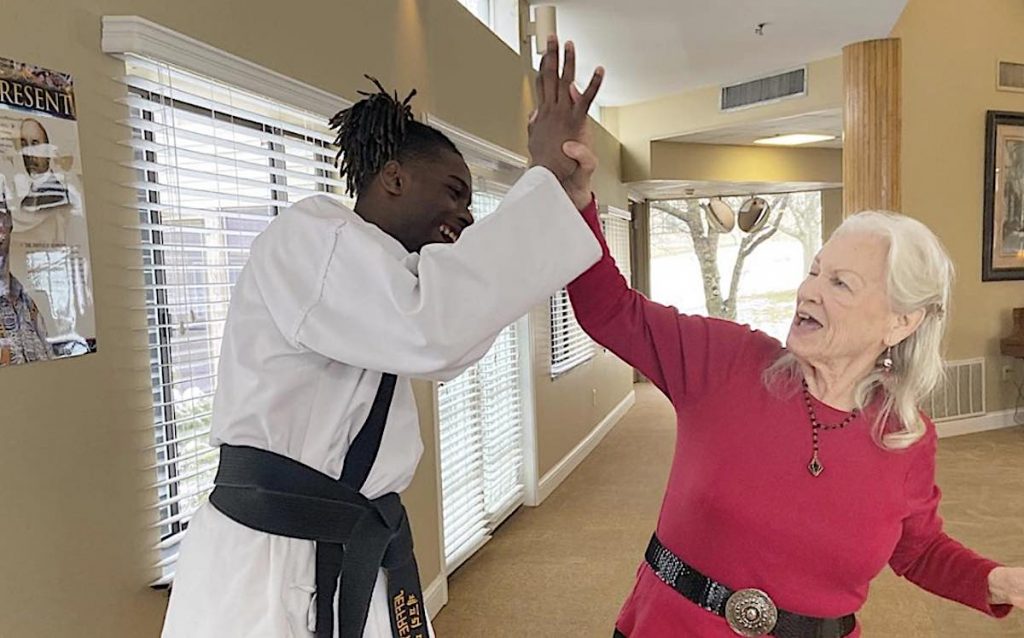
This young karate teacher hopes his YouTube channel is more contagious than the current pandemic—because he wants to keep seniors active, even if they’re stuck inside.
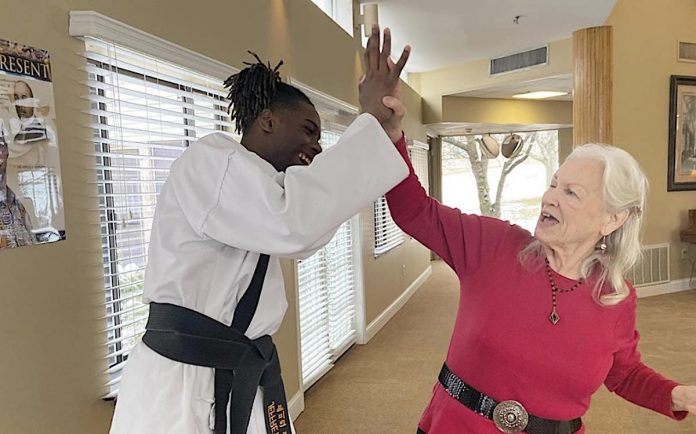
Jeffrey Wall just turned 15, yet he is the founder of Golden Age Karate, an outreach program he began last October to teach seniors at the Friendship Village nursing home in his hometown of Dayton, Ohio.
Then, two days before the final class, the shelter-in-place order came down from the Ohio governor halting his personal fitness crusade for the elderly—or did it?
Wall began studying karate at the age of six and, just four years later, was inducted into the USA Martial Arts Hall Of Fame. He earned his black belt at age 13 and—like his personal journey—his dedication to students is unwavering.
“I knew that they would be super disappointed,” Wall said of the new quarantine.
So he started a YouTube Channel to help them keep up their lessons. Now younger students are taking the classes, too—and the love he shows his seniors is spreading.
In fact, many of Wall’s Instagram followers are making ornaments and crafts to help decorate the walls of the nursing home on a future visit.
Before the pandemic began, each hourlong class would attract between 5-10 residents in their golden years—and they didn’t come just to watch.
Wall used demonstrations in the beginning so his seniors would know what to expect. His first example was showing how he does push ups on his knuckles—a good way to take the pressure off your wrists. Suddenly he saw students aged 90 and older on the floor doing pushups alongside him.
“My mom and I tried to help them up, but they wanted to keep going,” he told Good News Network. “One 95-year-old student did 10 pushups in her nice sweater and pearls and she did great! We laugh about that at every class.”
Wall also has a personal client who is 90 and reminds him of his own grandmother. Her soft voice and gentle nature can’t hide her enthusiasm. Before the quarantine she never held back when throwing punches at the target pad, especially when Wall would encourage her to let loose. But at the end of a lesson she would always ask, “That’s not too hard is it?”
“It has never been too hard,” Wall told GNN, “but I always told her, ‘Just a little,’ and she would laugh.”
Golden Age Karate
Before classes stopped, she had six months of perfect attendance. Wall was planning to promote her to a yellow belt.
Videos on YouTube reveal the enthusiasm that Wall’s students bring to each session. Wall holds the target pad and encourages each student to fire punches while seated in a chair. In the video below, one white-haired lady landed a series of seated kicks so hard that he jokingly reminded her not to break the target.
Wall’s growing popularity has led to requests from nursing homes outside of Dayton. His present desire is to stay in his community. However when the shelter-in-place order is lifted, he is willing to consider branching out.
“I hope that I can help in different cities,” Wall said, “and eventually countries.”
WATCH the inspiring video below—and check out his classes on YouTube or Instagram.
SHARE the Online Opportunity With Kids and Elderly on Social Media…
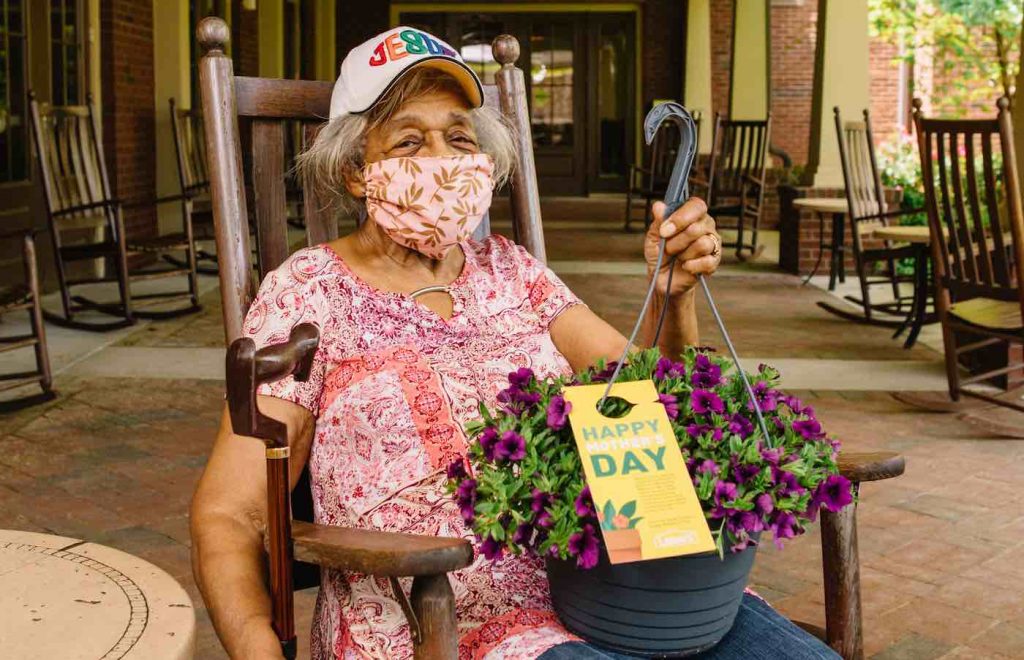
Mother’s Day may feel lonelier than it ever did for some aging moms in senior homes with quarantines that restrict visitors.
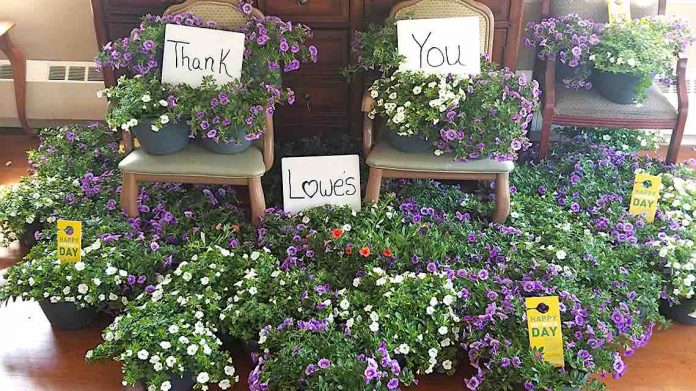
That’s why Lowe’s has partnered with local nurseries to bring those moms some flowering love.
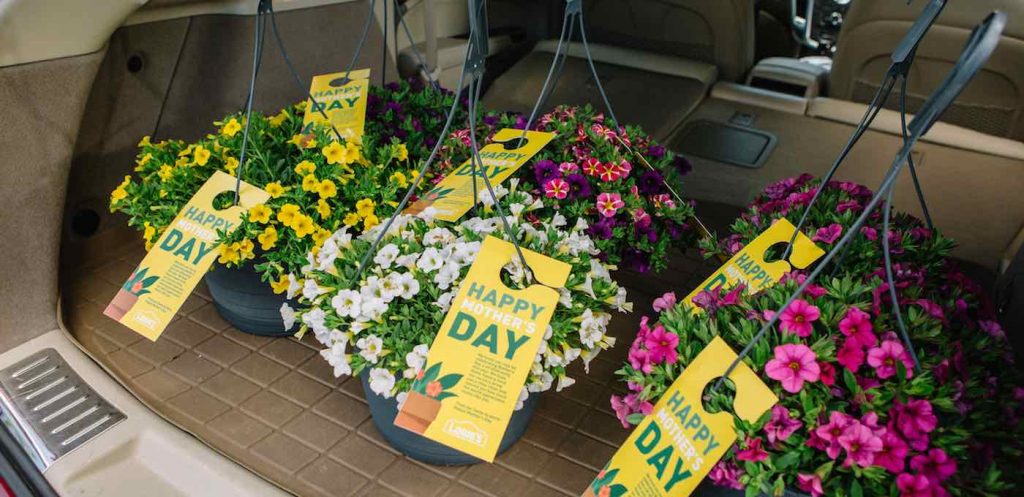
In the days leading up to Mother’s Day, the company has been calling Uber to deliver $1 million worth of flower baskets nationwide—while at the same time giving a boost to its local network of growers and nurseries.
The pink, yellow, white, and purple baskets will be delivered to more than 500 long-term care and senior living facilities in ten hard-hit cities, including New York, Seattle, Chicago, Boston, Houston, Miami and more. Each basket will be wrapped individually and include a special note of appreciation from Lowe’s.
“Mother’s Day is a special time of celebration between mothers, grandmothers and their children, and our hearts go out to the millions of families nationwide who won’t be able to be with their loved ones this year,” said Marisa Thalberg, Lowe’s chief brand and marketing officer. (See more inspiring gestures from Lowe’s on GNN, here)
Louise McMillan in Charlotte, N.C.
Lowe’s sourced the flower baskets from local nurseries and growers nationwide that may have experienced slowed or ceased business operations due to the pandemic.
The initiative will also support earnings for Uber drivers who will be delivering flowers in select cities as they continue to “help move what matters” during the pandemic.
“Thank you for your generosity in this difficult time and for for thinking of us,” said a spokesperson at the Sippican Healthcare Center in Massachusetts. “Lowes brought sunshine to both the residents and essential staff.”
This initiative builds on Lowe’s $250 million commitment to COVID-19 relief, including recently announced special payments for associates and $3 million to help support small businesses.
SHARE the Mother’s Day News to Brighten Your Social Media Page…
This is just one of many positive stories and updates that are coming out of the COVID-19 news coverage this week. For more uplifting coverage on the outbreaks, click here.
Andy Serkis, the celebrated actor who played the role of Gollum in The Lord of The Rings and The Hobbit is raising money for COVID-19 response in the UK by reading the entire JRR Tolkien book The Hobbit, live, cover to cover.
“So many of us are struggling in isolation during the lockdown,” he wrote on his GoFundMe page. “While times are tough, I want to take you on one of the greatest fantasy adventures ever written, a 12 hour armchair marathon across Middle Earth whilst raising money for two amazing charities which are doing extraordinary work right now to help those most in need in the UK: Best Beginnings and NHS Charities Together.
Starting at 10am in England on Friday, May 8th, BST (5am EST / 2am PST), he’ll be embarking on a marathon reading he calls a Hobbitathon.
“From an unexpected party to the last stage, join Bilbo and me on this tale of high adventure. Together we’ll face the might of the trolls, journey to the magical Rivendell, encounter the giant spiders in the labyrinths of Mirkwood, and the evil goblins living among the roots of the Misty Mountains, until we meet the dragon Smaug, and see the Battle of the Five Armies.”
He will announce on GoFundMe the link for live streaming—and while you are there, you can donate.
All funds raised will be split equally between NHS Charities Together and Best Beginnings, a charity for which he has been “a proud ambassador” for over six years.
Best Beginnings is working tirelessly during the pandemic to support babies, toddlers, pregnant families and new parents and to reduce inequalities, a cause which Andy says is “close to my heart.”
NHS Charities Together is the umbrella organization that brings together all the official charities of the NHS, which has raised over £100 million in just 6 weeks.
With a reading sure to be true to life—featuring the actual voice of Gollum—the actor promised, “If we hit our target of £100,000, there may be a special surprise later in our journey.”
Already having received donations totaling £35,841, you can promote the adventure on social media, and ensure the delivery of that ‘special surprise’ by using the hashtag #Hobbitathon
(WATCH his video below…)
This is just one of many positive stories and updates that are coming out of the COVID-19 news coverage this week. For more uplifting coverage on the outbreaks, click here.
SLAY The Dragon of Boredom and Share the Literature Lesson on Social Media…
For the second straight year, there will be no whale hunting season in Iceland, and conservation groups are celebrating.
After the international moratorium against whaling began in 1986, two Icelandic companies, Hvalur and IP-Utgerd, carried on hunting fin whales and minke whales.
This year, IP-Utgerd cited financial difficulties involving the increased number of no-fishing zones off Iceland’s coast, while Hvalur reported stiff competition from Japanese whaling companies which the Japanese government subsidizes.
Its CEO, Kristján Loftsson, said that Japan has created stricter measures for imported Icelandic whale meat, and the COVID-19 outbreak would make the close quarters work involved in whaling difficult and unsafe, with social distancing guidelines being hard to observe.
“This is indeed terrific news that for a second straight year, vulnerable fin whales will get a reprieve from Hvalur hf.’s harpoons, the sole fin whaling company,” Fabienne McLellan, co-director of international relations at Ocean Care, told Mongabay.
According to Hard to Port, a German organization working to end whaling in Iceland, Loftsson will want to keep Hvalur—a family business—operational, despite pressure from conservation groups.
Whales, as GNN has reported, represent a keystone species in global oceanic ecosystems, as well as a significant ally in the fight against climate change.
For conservationists in Europe who are concerned with whaling, Iceland’s industry, which has ignored the international moratorium for almost 40 years, could be ended by increasing financial pressure from Japan.
In 2018, Japan exited the International Whaling Commission, and still subsidizes the industry to the tune of $10 million a year, according to Whales US. But as reported by Science, it is a niche profession feeding an ever-shrinking niche market. Japan decided “to stop large-scale whaling” on the high seas in 2018, and will only hunt in Japanese coastal waters, given the declining demand.
Japanese whale meat consumption dropped from 203,000 tons in 1965 to just 4000 tons in 2015. Reduced demand has resulted in a 2019 catch during whaling season of 2000 tons.
With only 3% of Icelandic citizens saying they eat minke meat, there’s only so much time Hvalur and IP-Utgerd’s boats can remain stationary through the summer before market forces take their toll, and whaling is consigned to history.
Quote of the Day: “Love recognizes no barriers. It jumps hurdles, leaps fences, penetrates walls to arrive at its destination full of hope.” – Maya Angelou
Photo: by Azrul Aziz, public domain, cropped
With a new inspirational quote every day, atop the perfect photo—collected and archived on our Quote of the Day page—why not bookmark GNN.org for a daily uplift?
These nuns are spending three hours every day exercising the physical, alongside the spiritual—and you wouldn’t want to face them down in a fight.
The Buddhist Drukpa Order is the only one in Nepal in which the nuns practice martial arts.
Their empowering claim to fame includes daily training, during which they break bricks with their bare hands.
Real super heroes in the Himalayas, these strong women were able to deliver supplies after an earthquake struck Kathmandu in 2015—successfully aiding hard-to-reach villages.
The kung fu nunnery has also taught self-defense classes for women and the devotees have biked over 14,000 miles to protest the human trafficking of women and girls.
(WATCH the fascinating video from our partners at Great Big Story)
SHARE The Empowerment of These Women on Social Media…
A repayment of gratitude 170 years in the making has rekindled an affectionate bond linking the Great Irish Potato Famine of almost two centuries ago with a Native American tribe in Oklahoma suffering today from the coronavirus pandemic.
In 1847, when Ireland was experiencing years of starvation due to a potato blight, the North American Choctaw tribe joined a compassionate campaign in the U.S. to help these strangers an ocean away.
Despite their own suffering, having been forced to relocate hundreds of miles from their native land, the tribe pooled their pennies and raised $170 (almost $5,000 in today’s currency) to send to the Emerald Isle through a relief fund.
Returning the Kindness
Today, the Navajo and Hopi tribes have been hit hard by the COVID-19 pandemic. Their high rate of infection is thought to be due to a lack of running water in one-third of all homes and shortage of groceries, forcing families to leave the reservation for supplies.
To finance a plan to provide bottled water and other supplies directly to the reservation, a GoFundMe campaign was set up by Navajo and Hopi families. Now, almost $2.7 million has been raised so far, with many donations flowing in from Irish citizens expressing gratitude for the help they received so many decades ago.
“Ours is a debt that can never be repaid, but please consider this a small token of love and solidarity from your Irish brothers and sisters. Praying for the strength, wellbeing and prosperity of your community always” said Caroline Kelly, adding a Gaelic message of unity. “Ar scáth a chéile a mhaireann na daoine.”
“When the Choctaw people had nothing, they gave Ireland all they could at a time when we needed it most. I know it’s not much, but I hope this helps our friends in their time of need,” added Ciaran Mc brearty.
“Sending Irish blessings, hope, faith and love to our dear Native American brothers and sisters whose ancestors gave us hope in our time of need so many years ago, too,” wrote Aoife Galway. “Thank you agus sláinte, Aoife ☘❤”
Honoring the Choctaw
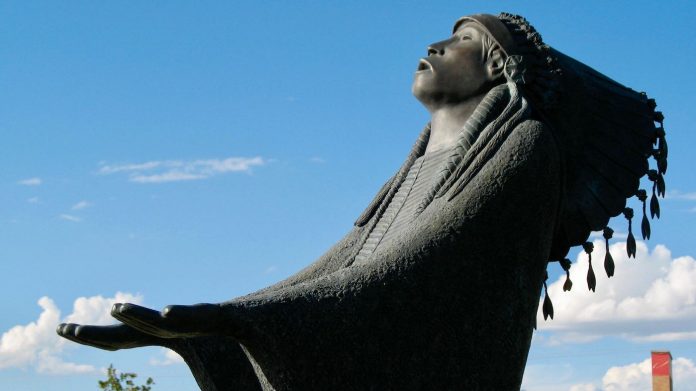
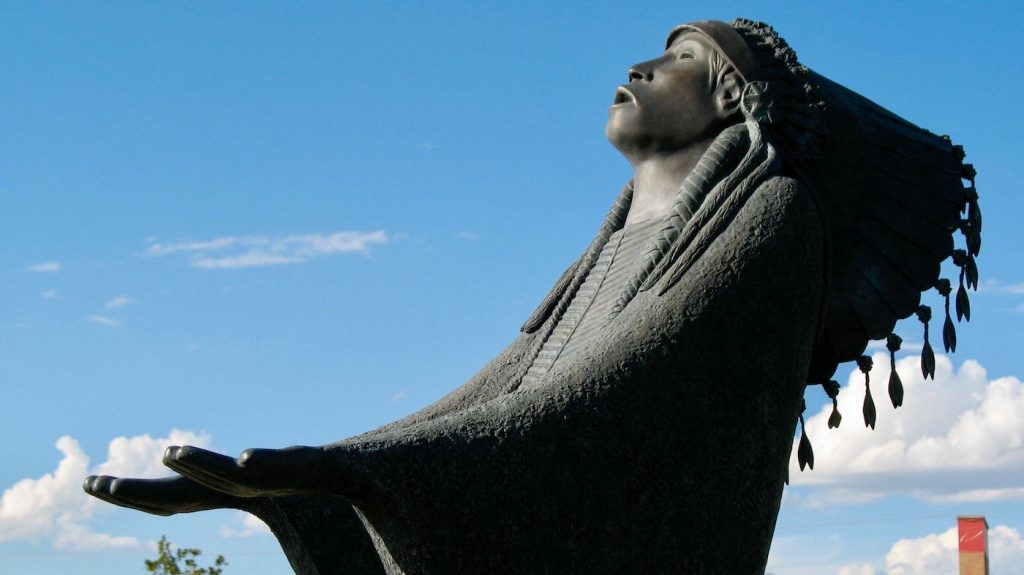
Three years ago, a soaring silver monument to honor the donations from Native Americans was unveiled in County Cork, Ireland—and Choctaw leaders were invited to the grand unveiling.
Asked about his inspiration to create the huge stainless steel sculpture of nine eagle feathers, the local artist Anex Penetek said, “I wanted to show the courage, fragility and humanity that they displayed.”
The financial support continues to pour in, hour by hour, along with messages of solidarity linking two cultures who uniquely know the meaning of widespread suffering—and the value of supporting one another through it.
SHARE the Sweet Story of Brotherhood on Social Media…
We’ve seen some incredible displays of creativity during the long weeks of COVID-19 self-isolating. (GNN even produced a fun television pilot.) But nothing quite matches the brilliant strategy of a California animal shelter which is struggling to pay its bills during the lockdown.
Sweet Farm Animal Shelter, a nonprofit sanctuary started by a Silicon Valley tech employee, is using the animals’ daily empty schedules to inject humor into hundreds of business meetings taking place—by necessity, now—over Zoom, Google Hangouts, or other video chat program.
Teleconference organizers can contact Sweet Farm and for less than $100 have one of the farm animals make an appearance during their next video-conference call—sitting in as a rather distracted member of the group.
The initiative is known as Goat 2 Meeting, which is a pun based on another popular teleconference software, GoToMeeting. Not only goats are available, though. You can arrange visits from turkeys, sheep, pigs, and llamas, as well.
For readers who haven’t used Zoom, the caller who is speaking is the one who appears on the screen, so imagine a goat bleat not only interrupting your boss, but replacing his face with a goat’s!
Speaking with Business Insider, Anna Sweet, the brains behind Goat 2 Meeting reported that more than 300 requests for animals have come in since the middle of March when they launched the program. One video conference set up for lawyers sent notices that their kids were invited to the call to take a virtual tour of the farm.
“I think we’re all a little stressed with what’s going on — many of us have been sitting inside,” Sweet told Business Insider. “We’re just hoping to bring some smiles to people’s faces, while bringing them out to the farm at the same time.”
If you are interested in bringing a farm animal onboard for your next teleconference, fill out the request form on the Goat 2 Meeting website.
SHARE the FUN Idea With Friends and Coworkers on Social Media…
After designing a special athletic shoe for healthcare workers that can withstand 12-hour shifts, Nike has donated 30,000 pairs to hospitals across the United States and 2,500 to hospitals in Europe.
The company is also sending more than 100,000 additional apparel items, including compression socks and sportswear kits, as a ‘thank you’ to frontline workers.
Nike described the Air Zoom Pulse, released in November, as the “first shoe designed for the healthcare athlete, an everyday hero.”
The kicks are made of a special material that is easy to wipe down and clean, and designed to be worn for the 12-hour shifts that include five miles of walking with less than an hour of sitting.
Nike’s nonprofit partner, Good360, will distribute the shoes to workers in U.S. veterans hospitals, as well as hard-hit health systems in Chicago, Los Angeles, Memphis and New York City. In Europe, the shoes will go to hospitals in Barcelona, Berlin, London, Milan, Paris and Belgium.
To date, the company says “the Nike Foundation and Nike have committed more than $25 million” to COVID-19 response efforts—with its apparel donations valued at $5.5 million. Additional support has been given to the World Health Organization (WHO) and community support efforts for its employees in Oregon, Memphis, Amsterdam, Belgium, and China.
Nike provided more than 290,000 pieces of personal protective equipment and 250,000 disposable face masks to hospitals across the United States.
New York Mayor Bill de Blasio tweeted his appreciation, saying “thank you so much for supporting our front line health care heroes.”
In 2015, the company personified its ‘Just do it’ philosophy when it teamed up with a disabled teen to design an easy-entry shoe.
Nike is also offering its Training Club Premium subscription service for free during the pandemic. Download the app here to access body weight workouts, yoga classes, and more.
This is just one of many positive stories and updates that are coming out of the COVID-19 news coverage this week. For more uplifting coverage on the outbreaks, click here.
JUST DO IT: SHARE the Shoe-Love With Friends on Social Media…
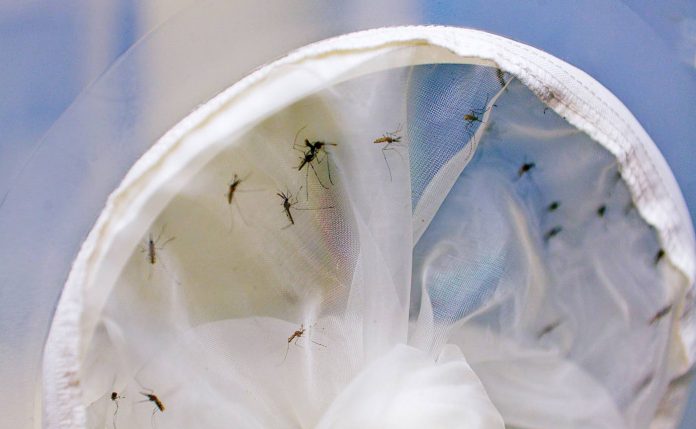
A team of scientists in Kenya and the UK are hailing the “enormous potential” of a new strategy to control malaria, after discovering that a microbe completely protects mosquitoes from infection.
“The data we have so far suggest it is 100% blockage,” Dr. Jeremy Herren of the International Center of Insect Physiology and Ecology told BBC News. “Quite a surprise… I think people will find that a real big breakthrough.”
Now, they are developing plans to spread the microbe through mosquito populations in infected regions, in an unprecedented effort to eliminate the 400,000 deaths that result from the disease each year.
While studying mosquitoes near the waters of Kenya’s Lake Victoria, the researchers unexpectedly came across a protective fungus called ‘Microsporidia MB,’ which was already in the bodies of the insects.
Now, their goal is to disseminate the microbe in at least 40% of mosquitoes in malaria-infected regions.
Two main methods are being considered: the mass release of spores of the microbe in areas where many mosquitoes live, or implanting the microbe in male mosquitoes (who don’t bite) in the lab, who would then spread it to female mosquitoes, who spread the disease through their bites.
Equally important is the fact that neither of these approaches would kill the mosquitoes, thus preserving the delicate balance between ecosystems and food chains.
Their promising lab research was published in the prestigious scientific journal, Nature, where they wrote “These findings are significant in terms of regional malaria transmission and epidemiology as well as risk-mapping.”
Such a program would be the biggest leap forward in the effort to eradicate malaria since infections had dropped by 40% leading up to 2014 due to mass mosquito net distribution by UNICEF and their partners such as the Global Fund.
– Photo by Dean Calma / IAEA, CC license
SHARE the Breakthrough With Friends on Social Media…
Quote of the Day: “Everything that irritates us about others can lead us to an understanding of ourselves.” – Carl Jung
Photo: by Kairat Murataliev, public domain, cropped, colorized
With a new inspirational quote every day, atop the perfect photo—collected and archived on our Quote of the Day page—why not bookmark GNN.org for a daily uplift?
Since the COVID-19 outbreaks have disrupted many of the traditional festivities of Ramadan—such as going to mosque and sharing meals with loved ones—one Michigan town has launched a sweet new initiative to celebrate the Islamic holiday from quarantine.
The city of Dearborn—which is known for having the largest Muslim population in the US—has been celebrating the holy month by inviting its residents to decorate their homes for the first ever Ramadan Lighting Contest.
Since the contest launched on April 23rd, more than 65 families have festooned their homes in lanterns, lights, and decorative signs.
City residents can nominate their own home or their neighbor’s household for the contest by filling out the Ramadan Lights Contest nomination form before May 11th. Members of the public can then vote for their favorite households in each of the city’s 10 districts.
The contest winners will be announced prior to Eid al-Fitr—the celebration marking the end of Ramadan—and presented with a gift basket of goodies from a local restaurant.
Filmmaker Razi Jafri, who works for the Center for Arab-American Studies, launched the initiative in partnership with several local Muslim organizations in hopes of cheering Dearborn residents during the novel coronavirus outbreaks.
“This will help raise spirits by providing a positive, pro-social project for the community to get involved with,” Jafri told CNN. “It’s amazing because both Muslims and non-Muslims in the community are getting so excited about it. There’s been so much positive energy that has come out of this already.”
“This project is just the perfect blend of American and Muslim culture,” he added. “American Muslims are such an important part of the fabric of American culture and this is a great expression of that.”
This is just one of many positive stories and updates that are coming out of the COVID-19 news coverage this week. For more uplifting coverage on the outbreaks, click here.
(WATCH the video of the lights in action below)
Shine A Light On Positivity By Sharing The Good News With Your Friends On Social Media…
A must-have in green building design, solar chimneys can slash energy costs up to 50%—now research reveals they could also help save lives in a building fire.
In a world-first, researchers designed a solar chimney optimized for both energy saving and fire safety, as part of the sustainable features of a new building in Melbourne, Australia.
Modeling shows the specially-designed solar chimney radically increases the amount of time people have to escape the building during a fire—extending the safe evacuation time from about 2 minutes to over 14 minutes.
A solar chimney is a passive solar heating and cooling system that harnesses natural ventilation to regulate the temperature of a building.
With an estimated 19% of the world’s energy resources going to heating, ventilating and cooling buildings, integrating solar chimneys into new builds and retrofitting to existing structures offers great potential for reducing this massive environmental cost.
In the new project, a collaboration between RMIT University and the City of Kingston, researchers designed a solar chimney to maximize its efficiency for both ventilating fresh air and sucking smoke out of a building in case of fire. The study was published this week in the journal Energy and Buildings.
Researcher Dr. Long Shi said solar chimneys have well established environmental credentials, but their potential for improving fire safety had not been explored.
“In an emergency situation where every second counts, giving people more time to escape safely is critical,” Shi said. “Our research demonstrates that solar chimneys offer powerful benefits for both people’s safety and the environment.
“Delivering on two important functions could boosts the already strong cost-effectiveness of this sustainable technology,” he added. “We hope our findings will inspire more investment and development of solar chimneys in Australia, and around the world.”
Kingston Mayor Georgina Oxley said Council was excited to be a part of the groundbreaking project.
“Creating new and innovative ways of reducing energy consumption in our building design is something that is a priority for Council,” Oxley said. “The solar-chimney that has been installed at the new state-of-the-art Mentone Reserve Pavilion not only allows us to harness clean green energy to heat and cool the building, helping Council achieve its environmental goals, but it also has the potential to save lives in the event of a fire. This is a truly remarkable design.”
While calculations around the 6-fold increase in safe evacuation time were specific to the new building, previous research by the team from RMIT’s School of Engineering has confirmed solar chimneys can successfully achieve both functions—ventilation and smoke exhaustion.
Hot air rises: how a solar chimney works
The passive design approach behind solar chimneys operates on the well-known principle that hot air always rises.
Modern solar chimneys usually feature a wall of glass next to a wall that is painted black, to maximize the absorption of solar radiation. Vents at the top and bottom control the airflow in and out of the chimney for heating or cooling.
As the sun warms the chimney, this heats the air inside it. The hot air rises and is then vented out of the top of the chimney, which draws more air in at the bottom, driving ventilation through a building to naturally cool it down.
When it’s cold outside, the chimney can be closed, to direct the absorbed heat back into the building and keep it warm.
It’s an ingeniously simple concept that is relatively cheap to retrofit and adds almost no extra cost to a new build, but can drive energy consumption down.
The solar chimney helps control temperature in case of a fire. Modeling shows temperature at 16 minutes with a solar chimney (top) and at 3 minutes without a solar chimney (bottom). Photo by RMIT University.
Reducing smoke, increasing safety
During a fire, the same principle—hot air rises—enables the solar chimney to suck smoke out of the building.
Less smoke means better visibility, lower temperatures and reduced carbon monoxide—all of which contribute to increasing the amount of time people have to safely evacuate.
To understand exactly how much evacuation time a solar chimney could deliver for a specific building, you need to model for that exact design, Shi said.
“This will differ from building to building, but we know that any extra time is precious and improves fire safety, which could ultimately help to save lives,” he said.
The new research offers a technical guide for optimizing the design and engineering of solar chimneys in real buildings, to expand their application across the two functions.





































 A repayment of gratitude 170 years in the making has rekindled an affectionate bond linking the Great Irish Potato Famine of almost two centuries ago with a Native American tribe in Oklahoma suffering today from the coronavirus pandemic.