










Most kids look forward to gifts and cake on their birthdays, but a 9-year-old Mississippi boy had a selfless wish for his special day…and called on his friends to help make it a reality.
Instead of presents, 9-year-old Carson Atkins asked for monetary donations for the children of local police officer Benjamin Deen, who was killed in the line of duty last month.
“Because Father’s Day was coming up and police officers give to us every single day, so I thought that (for) one day I could give to them,” Atkins said.
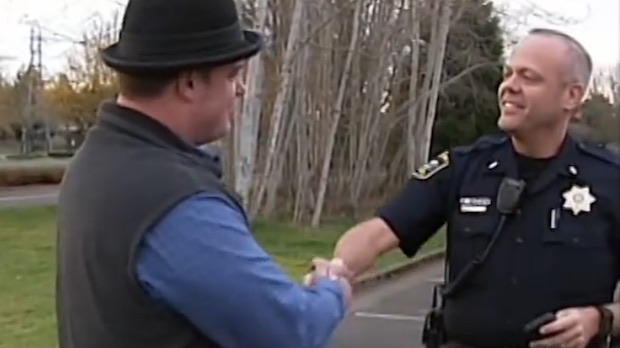
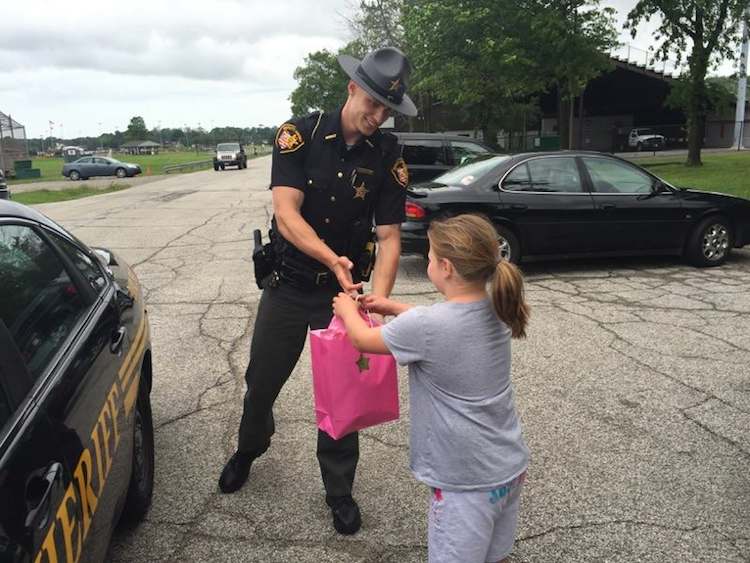
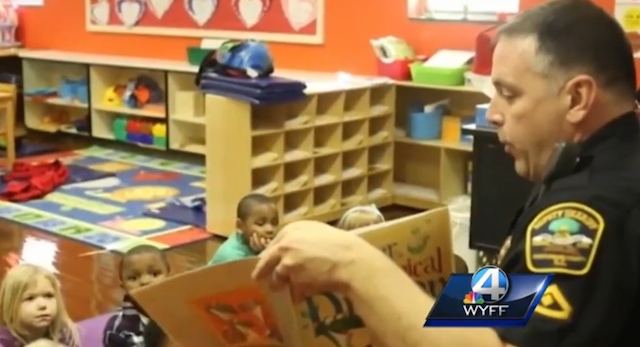
When the Lamar County Sheriff’s Department heard that Carson raised $1,000, they made a surprise visit to his birthday party for their fallen comrade, giving him badges and medals in thanks.
The most touching reward for Carson came from the officer’s brother, who brought over a shoebox of baseball cards that had belonged to the deputy, who shared Carson’s love of the sport.
When Lulu the goldendoodle has her vest on, she knows her job — to comfort mourners in her family’s funeral home. She even “prays” when directed, kneeling and bowing her head between her front paws.
Matthew Fiorillo offers Lulu’s services, free of charge, to every mourner who walks into his White Plains, New York funeral home. The trained therapy dog is part of a growing trend among funeral homes.
No one keeps numbers on exactly how many such dogs are working in funeral homes, but the National Funeral Directors Association say they hear more and more from their members about using animals to comfort mourners.
The trend is a fairly recent one, but therapy dogs for mourners were rare in 2001 when Mark Krause’s Portuguese water dog, Oliver, went to work in his Milwaukee, Wisconsin funeral home.
The funeral director remembers a seven year old boy who had lost his three-year-old sister. The boy had withdrawn and stopped talking, until Oliver came in — and the boy began reminiscing with the dog about his sister.
Just call him “The Big Rac-kahuna” – a surfing raccoon that hitched a ride on the back of an alligator.
A Florida man says his son startled the raccoon during a family walk in the Ocala National Forest and it scurried onto the gator’s back. Richard Jones says he snapped the shot just before the furry critter realized he was riding a carnivorous reptile and jumped to safety.
It may look ‘photoshopped’, but birds frequently ride alligators — as seen in the photo at right of a great white egret “hanging six” on one of the gators at the Kissimmee, Florida, Gatorland reptile park.
So maybe, like the Beach Boys sang in Surfin’ Safari, it’s a case of, “Everybody’s learning how.”
Photos by Richard Jones, (Egret) Terry Turner, CC
Send this web surfing to your friends and followers…
According to the Centers for Disease Control, 50% of Americans fail to take medicines as prescribed.
That statistic led a young entrepreneur and pharmacist’s son, TJ Parker, to come with up a better alternative. His medication management service eliminates some of the hassles that arise when patients are given multiple prescriptions– traveling to the pharmacy, sorting pillboxes for time and date, and chasing down prescription refills.
“We started PillPack to eliminate this frustration and replace it with a simple end-to-end experience,” said the California company’s CEO.
The company delivers personalized packets of pre-sorted medicines and vitamins to your home labeled with the exact date and time you need to take them.
(WATCH the video from NBC News below) – Story tip from carilyn
Prescribe this to your friends and followers. Share below…
Hope is no ordinary dog. After nearly being killed 2 years ago, she’s using her new ‘leash’ on life to help others.
The 6-year-old Goldendoodle lost her hind leg after being struck by a hit and run driver. Since her recovery, she’s made quite a difference in the lives of elderly people and children with autism – traveling on just 3 legs.
As part of the Pawsitive Friendship organization in Phoenix, Arizona, Hope does therapy work on home visits. She also travels to see hospital and hospice patients, and serves on a crisis team to help calm trauma victims.
This multi-talented pooch is also an accomplished actress. She’s portrayed the beloved dog, Sandy, in community theater productions of Annie – with more than 32 performances under her belt – er, collar.
(WATCH the video below or READ at USA Today *NOTE- auto-playing audio, so adjust your speakers) – Photo KPNX Video
Does this make you Hopeful? Share it with your pack…
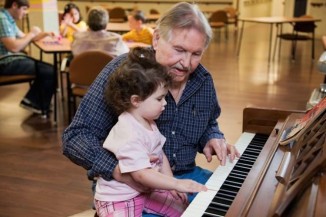
A hospital chain has found a way of caring for both the young and the old by having them take care of each other – and in the process, built a bridge across generations.
The Intergenerational Learning Center consists of a preschool inside the Mount St. Vincent nursing home in Seattle, Washington.
The 400 adults in the assisted-living center join the kids in daily activities from music and dancing to storytelling and just plain visiting.
The Center’s managers say the children learn from their elders and are nurtured by the adults while the invigorated seniors get a new sense of purpose and well-being from the playful tots.
Filmmaker Evan Briggs launched a Kickstarter page to finish a documentary about the place.
His film “Present Perfect” portrays what he calls the “very real experience of aging in America – both growing up, and growing old.”
The plane to Houston, Texas, had already left the gate when six-year-old Owen Lake realized he’d left his favorite toy, a stuffed tiger named Hobbes, at the airport in Tampa, Florida. The tiger was one of a kind, made by Owen’s grandmother to look like the one in the comic strip “Calvin and Hobbes.”
Owen’s mother called Tampa International and discovered that the staff didn’t just rescue the lost tiger, but also took it on an adventure – taking pictures of Hobbes’ travels throughout the airport and made them into a picture book for Owen.
Hobbes checked out the control tower…
…learned how to run the Operations Center…
…ate at the food court…
…helped out at the airport hotel…
…and volunteered as a firefighter…
…before finally being reunited with Owen.
The pictures were on the Tampa International Airport’s Facebook page.
Airport Operations Manager Tony D’Aiuto spent his lunch hours taking Hobbes on the tour and paid for the picture book he gave to Owen along with his missing — but very busy — tiger.
(READ more at the Tampa Bay Times) — Photos: Tampa Bay International Facebook page
The Food and Drug Administration announced Thursday it would begin requiring food companies to gradually phase out artificial trans fats — the artery-clogging oils found in crackers, cookies, pizza, doughnuts, and many other products.
Cholesterol levels in children have improved significantly in the U.S. since snack foods and some fast food restaurants, like KFC, began cutting trans fats as an ingredient.
FDA commissioner Margaret Hamburg said the rule, which will end the use of trans fats in three years, could potentially prevent 20,000 heart attacks a year and 7,000 deaths.
Businesses have been gradually going trans-fat-free in recent years, with McDonald’s switching to zero-trans fat for its iconic french fries in 2008 and California banning the fat in statewide restaurants the same year.
If the thought of holding a plank for those few agonizing minutes at the gym makes you cringe, imagine doing it for five hours.
Make that 5 hours, 15 minutes and 15 seconds– a new world record achieved by 57-year-old U.S. Marine George Hood, of Carlsbad, California. His motivation? Raising money and awareness for injured service members.
The former officer and retired Drug Enforcement Administration agent held the marathon abdominal plank at an event last month in Oceanside, California, near San Diego. Hood broke the previous Guinness World Record for planking that was set in 4 hours and 26 minutes by a Chinese police officer.
Hood – who’s now a personal trainer and group exercise instructor – said he wasn’t there just to crush the world record, but also to raise money for the Semper Fi Fund, a charity that supports injured U.S. troops.
“There are injured Marines that come back from the fight, who have suffered life-altering injuries and the discomfort that I feel right now pales in comparison to that which they feel,” Hood told KMFB-TV.
Hood spent nine months training for his record attempt, including 30 hours of plank time each week, with 20 and 40-pound weights on his back to build up his endurance and strength.
Hood’s family and friends kept him company during the plank and offered welcome distractions from the pain of holding his body up hour after hour.
(WATCH the video below from KMFB-TV or READ more at USA Today) –Photo by KMFB-TV
Do you remember being a teenager or even a tween girl? At school. Those friendships? Those girls? Those troubles? I do. And now as I see mine and other friends’ kids get older, I’m seeing these issues all over again.
Female friendships can be amazing – but they can also be not-so-amazing, can’t they? Especially at school. They can be fraught. They can be mean. They can be nothing like we want them to be, and that can be hard.
So that got me thinking…what would I really want every tween or teenage girl to know about female friendships? Here are my top 5:
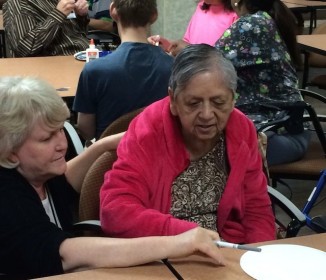
5. You don’t need a best friend; you need to be your own best friend.
I think this is true for all us – young or old. However, when we’re young, we often get sold the line of wanting or needing a best friend. Someone who is always there for you. Someone who stands by you. Someone who knows you. The only problem is that when you’re young and not sure of yourself, it can be difficult to be that person for someone else. So we can get let down by our best friends and we can let down others. So I don’t think we necessarily need one ‘bestie’ or ‘BFF’. We can have a range of friends – and we can also be our own best friend.
4. Other people’s behavior is about them and not about you.
This is such an important one. We can take so much so personally, can’t we? We think someone is dissing us because we’re not cool. But no, they are dissing us because they don’t feel good enough about themselves. They’re trying to make themselves feel better. They don’t feel confident about who they are so they are bitchy about others. They exclude others to make themselves feel more special. We can’t interpret other people’s behaviour as always being about us. It is more likely to be about them.
3. Your feelings are about you and not about other people.
This one is equally important. If you feel upset or frustrated or angry or hurt that is telling you something about yourself. Yes, the trigger may have been someone else’s behaviour or being in a particular situation, but that other person or situation didn’t necessarily make you feel that way. We all make interpretations of what’s happening in our world, and that influences how we feel. Someone might diss us, but we don’t take any notice. We don’t care. But someone else might diss us and we feel incredibly hurt. What’s the difference? We’ve made a judgement. We’ve made a choice to ignore one person’s opinion of us, but fully own someone else’s. We have choices.
2.We can be kind anyway.
When we are feeling dissed or excluded it can be hard. Absolutely. But we can be kind anyway to that person and more importantly, to ourselves. Because when you’re a tween or teenager and you’re not sure of yourself, you can make mistakes. Others can be mean or fake or un-thinking, but we don’t necessarily want retaliation – more meanness, fakery or thoughtlessness. Instead, we can try to be kind, have a big heart, and forgive. That doesn’t mean we have to be ‘besties’ or even remain friends with mean girls. But we can be understanding, which makes for a better overall vibe amongst the girl collective.
1. Having a bigger world than just your school friendships makes for a healthier life.
School can feel like a fish-bowl. A hot house. And if friendships aren’t going well at school, we can feel our whole world crumbling. So that’s why it helps to have a life that’s bigger than school. Other activities. Other relationships. Other friends. People who aren’t at school who we can relate to and hang out with. A bigger world means we won’t get caught in the school friend vortex quite as much. We can dip in and out.
Not all of these ideas are easy. But they can be practiced. And they can make a difference. What else would you want to teach girls about friendship?
Jodie Benveniste is a psychologist, parenting author, TEDx speaker, and author of four parenting books, including Intuitive Parenting: Unlocking the secrets to raising incredible kids. Visit her website at jodiebenveniste.com.
A Swedish phone app to help people in cardiac arrest will alert people nearby who are trained in hands-on CPR. Use of the app increased immediate response by 30%.
Every time an ambulance was dispatched, SMS Lifesavers sent text alerts to any of the study’s 10,000 CPR-trained volunteers within 500 yards of the reported case. Those volunteers gave CPR before professional emergency responders arrived in 62% of the cases — a 30% improvement over the rate before the system was launched.
“Traditional methods such as mass public training, which are now used throughout the world, are important but have not shown any evidence of a similar increase,” reports Dr. Jacob Hollenberg, a cardiologist and associate professor at the Center for Resuscitation Science at the University of Gothenberg.
The average wait time in the U.S. for professional emergency responders to reach the scene is more than seven minutes, but if someone can start administering CPR within the first three minutes after cardiac arrest, there’s a much higher survival rate.
Cardiac arrest victims in the study had a 10% chance of surviving beyond 30-days if they got the SMS Lifesavers help — more than double the rate of those who had to wait longer for the professionals. The researchers published their findings in the New England Journal of Medicine.
The app isn’t available yet, but if some communication and health rules change in the U.S., it could help the roughly 359,000 Americans who suffer cardiac arrest every year.
The American Heart Association video below shows you how to administer CPR so you can be ready when the app launches in your city.
(WATCH the AHA video or READ more at CBS News) – Photo by Jhaymesisviphotography, CC
One man who was willing to share his blood has saved the lives of more than two million babies.
With his weekly donations to the Australian Red Cross for over 60 years, 78-year-old James Harrison has more than repaid a debt he felt he owed, and earned the nickname “The Man with the Golden Arm.”
In the 1960s, thousands of newborns in Australia were born with rhesus disease — a condition where the mother’s blood actually attacks the blood in the baby she’s carrying.
It was discovered that Harrison’s blood carries a rare antibody that can prevent the disease and scientists worked with him to create an injectable drug called Anti-D. The Red Cross claims Harrison’s contributions have saved the lives of 2.4 million babies — including his own grandson’s.
Researchers never would have found Harrison if he hadn’t started donating blood when he turned 18-years-old. Harrison, who lives in Australia’s Central Coast, started donating blood because donors had saved his life four years earlier when he needed 27 pints during lung surgery.
Tomorrow will mark James Harrison’s 1,106th donation, which was celebrated yesterday on World Blood Donor Day.
(READ more at ABC News) Photo: Red Cross – Story tip: Ossie Sharon
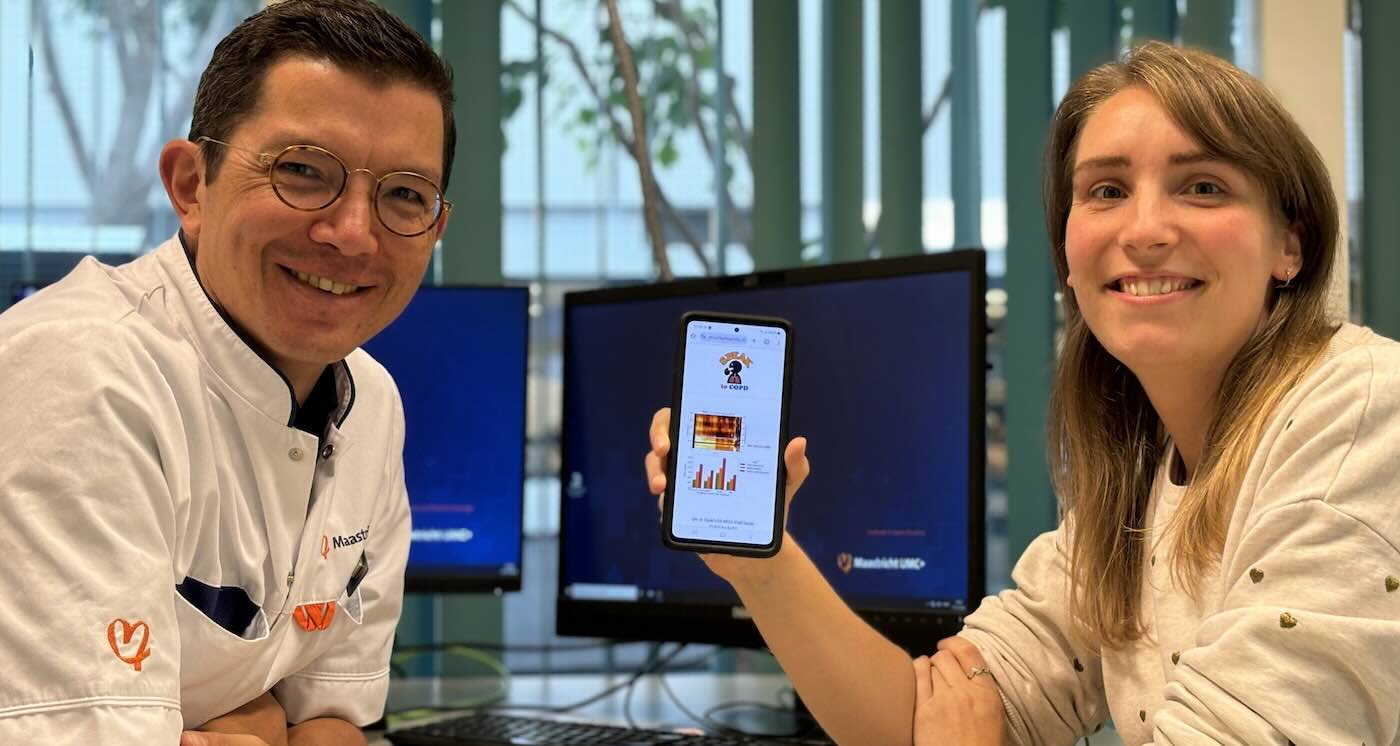
Nuts and peanuts may protect against several major causes of death, according to a study that began in 1986 involving 120,000 Dutch adults.
A paper published last week in the International Journal of Epidemiology found that people who eat at least 10 grams of nuts or peanuts daily have a lower risk of dying from a range of serious illnesses.
The reduction in mortality was strongest for respiratory disease, neurodegenerative disease, and diabetes, followed by cancer and cardiovascular diseases, according to researchers from Maastricht University in the Netherlands.
“It was remarkable that substantially lower mortality was already observed at consumption levels of 15 grams of nuts or peanuts on average per day,” said epidemiologist Professor Piet van den Brandt, the project leader. The small amount is equivalent to about half a handful.
“A higher intake was not associated with further reduction in mortality risk,” researchers said.
Peanuts and tree nuts each contain various compounds, such as monounsaturated and polyunsaturated fatty acids, vitamins, fiber and antioxidants, that could possibly contribute to lower death rates, researchers said.
However, no association was found between peanut butter intake and mortality risk. Peanut butter also contains added components like salt, vegetable oils and possible trans fatty acids. Researchers say the adverse health effects of salt and trans fats could inhibit the protective effects of peanuts.
In utter amazement, a woman broke into tears when she was reunited with her dog Sammi. The once-paralyzed pooch actually walked up to her — then ran — to the therapists who rehabilitated him after surgery.
The California Animal Rehabilitation group in Santa Monica, CARE, got him back on his feet – and talked about how the pup didn’t want to lay down anymore.
The heartwarming 2008 video just resurfaced, but we are sharing now with Good News Network fans because scenes like these never get old.
(WATCH the video from CARE below) Photo: CARE video
A little boy’s big dream is becoming reality, thanks to his parents and a journal found after his tragic death.
10-year-old Mohamed Fofana was killed in a landslide in 2013 during a school field trip, when part of a Mississippi River bluff collapsed at a park in Lilydale, Minnesota.
Mohamed’s mother, Madosu Kanneh, later discovered his journal, and a touching entry he had written about what he would do if he were the President:
“I would do everything. I would give money so school kids can read. And I would give money to the poor people. I would build soccer fields for schools to play in.”
“It was very heartbreaking for me,” Kanneh told KARE-11 News. “I called my husband, and I showed him this book. I said, ‘We have to work to make his dream come true.’”
Mohamed’s parents say the boy was inspired by a trip to his father’s hometown in Guinea, where he witnessed kids his age, far less fortunate – playing soccer without clothes or shoes. Inspired by his wish, his parents vowed to make something positive of their son’s death.
After receiving a settlement from the landslide tragedy, they are using their share to build a new school in Suiguiri, a small mining town in the Republic of Guinea.
The town currently has no school, so parents must send their children away if they want them educated. Below is an artist’s rendering of the new campus, for which Mohamed’s father broke ground last month and placed the first stone.
Since the family’s settlement won’t cover all the costs, they’ve set up a crowdsourcing page to raise contributions to help further fund the school in hopes that classes will start next year. More than $9,300 has been raised toward their goal of $3o,000.
The school grounds will include a library, a basketball court, and a soccer field — just as Mohamed dreamed.
(WATCH the video from KARE-11 below, or READ and Listen to the story at MPR News)
MULTIPLY the Good – Share the story, so others might help…
When a neighbor’s expensive wheelchair was stolen, Ryan Czech wanted to help — but how much of a difference can an eighth-grader make? It turns out, he was able to buy her a new chair within a single day.
His 10-year-old neighbor, Jerylyn, has Cerebral Palsy and needs a stroller-style wheelchair to get around. They’re expensive — more than $2,300.
Ryan’s mother helped him set up a GoFundMe page to raise the money and in just 24 hours, his page had raised more than enough — a total of $2,763 before the campaign was closed.
“We met our goal and Jerylyn will get her new orange wheelchair/stroller,” Czech posted on the fundraising page. “We can’t wait. Thank you again from the bottom of our hearts.”
(WATCH the WTXF News video below) — Photo: WTFX video
Raise the spirits of your friends and followers, share this story…
Looks CAN be deceiving, as you’ll see in this video, reportedly shot at Yorktown High School in New York, when a bookish nerd instantly became a high-school hero with all the right moves.
After some smooth and confident steps, one boy seems to win the dance-off in the school’s cafeteria, until an unassuming teenager in glasses wows the crowd, sending the room into a shocked frenzy.
A 19-year-old Chicago teen who is very passionate about cancer research has already achieved success in a lab that might go a long way toward a vaccine for colon cancer.
While working at a Rush University lab while still in high school, Kevin created tests with an experimental colon cancer vaccine that proved 100 percent effective in tests on young mice.
“My friends, family members have died from cancer,” Stonewall, who is a rising freshman at the University of Wisconsin said in an Intel video. “A lot of people are impacted by cancer. So I felt it was my role to step up and do something about it.”
The results of his research were presented at the national meeting for the Society for ImmunoTherapy of Cancer in Washington, D.C., and he is listed as lead author.
A family from Columbus, Ohio set out to show the world that people can do anything, even despite their greatest obstacles.
Bob Headings last hiked to the bottom of the Grand Canyon eleven years ago, one year before he fell off a ladder and became paralyzed from the waist down.
Even after the 2005 accident, Bob was a role model of perseverance and positive thinking for his three grown sons and 8 grandsons.
“When the kids say they can’t do something,” said Bob’s son, “I always tell them, ‘Go call grandpa and see what he says about CAN’T.’”
To personify that spirit of never giving up, and just in time for Father’s Day, Bob’s son, Randy, came up with the idea of a very ‘grand’ family outing. They set out to hike all the way down the Grand Canyon, 7.4 miles over rocky trails, and all the way back, towing their paralyzed father.
“It just seemed like a way for us as a family to give back to Dad,” Randy said. “A little payback to him for the investment that he put into us.”
For the grandsons, it would be a lesson in endurance. The 240-pound one-wheeled Trail Rider, with long handles on the front and back had to be lifted over weathered logs more than 3,000 times.
“I think it’s something they’ll never forget,” said one of the parents.
“I kept looking back and just thinking, ‘There is no way we are going back up that,” recalls grandson Tyler Headings.
Filmmaker John Honaker, whose video company helps set up elaborate marriage proposals for people in the Columbus area, documented the trek after getting a call from the family.
Several canyon park rangers who were consulted about the hike, thought that because Bob’s transporting device used a wheel, the journey down would be really easy. In reality, Honaker said it was a huge surprise that some of the logs were two feet off the ground and once they’d lifted the chair, loaded with food and water, to clear the log, there’d be another one five or six feet away.
“In my mind it was an epic film,” Honaker told the Good News Network, “and one that I was so unprepared for.”
They had planned for one rest day at the bottom, but Honaker said the relentless Headings family “trying to give granddad that awesome experience,” would not rest. They hiked two miles down the Colorado river that day just so he could enjoy the scenery.shopp
“I didn’t think we should hike the bridge trail on our day off,” recalls Honaker. “We knew that the way down was extremely hard and it took everything we had.”
So, when badgered for his opinion, he reluctantly told them, “Honestly, it’s going to take us two days to get back up.”
After that, he could see the determination in the men to do the climb in only one. “When we set off at 6:45 that next morning, they were booking it.”
They chose the 10-mile-long Bright Angel Trail. Honaker wrote on his website, “It was inspiring to look back and see how much ground you covered, but it seemed impossible to have to keep going up. It was like it never ended.”
Hikers along the way, particularly on the journey back up – ascending the 4380-foot elevation – were brought to tears by the spectacle of dedication displayed by the 11 family members.
When Honaker climbed ahead to get some overhead shots he heard from above distant cheering. “At first I thought it was just the family (the wives waiting at the top), but it was too loud to be just them.
“All the hikers who had passed us, a whole bunch of people, were assembled and shouting encouragement.”
The 12 men and boys had been taking frequent breaks because they were so tired, but when they heard those cheers from above, they found new energy for the last mile and didn’t stop until they reached the top.
I Can’t Believe We Just Did That was chosen as the name for the 40-minute documentary.
WATCH the 5-minute video below… (Photos courtesy of John Honaker)
You may not know this, but a great deal of yoga is about breaking free of the stereotypes and compartments that you have agreed to fit into. Does that sound intense?
It kind of is.
Yesterday, I watched this great TED Talk with Natalia Khosla discussing how our perception of gender roles displayed through body language will determine whether a woman is a b*tch or whether a man is weak.
This is damaging to both genders and is holding back our society from bringing out the very best in collaboration, leadership, compassion, and innovation from people that have undiscovered talents and qualities, despite their gender.
This TED Talk got my wheels turning about the deeper work of a yoga practice.
At the root of yoga we are guided to contemplate one of the most profound philosophical questions known to man…
“Who am I?”
This question is in almost every spiritual text as a practice of self-actualization and discovery. Asking “who am I” begins a process of peeling away the layers of a lifetime of stacking identities and mannerisms needed to fit into society. As you peel away the layers, your true essence can be revealed.
Throughout the questioning process we can unlock and release identities and stereotypes that we’ve been trying to fit into for years, but have never really felt right.
Imagine freeing yourself from years of pain and suffering from trying to be something that you aren’t. Imagine stepping into your fullest potential with the confidence created from loving your truest self. Imagine being comfortable in your skin without ever comparing yourself to anyone else.
This is all possible and it starts with one simple question…
Who am I?
You are never too old, too young, too busy, too cool, too big, too small, or too spiritually mature to ask this question. You are ready right now.
Take a 10 minute workout for your spirit. Grab a timer, paper and pen. At the top of the paper write, “Who am I?” Start your 10 minute timer.
Answer the question for 10 minutes. At first, you will usually get the superficial answers such as your name, gender, skin color, graduate degree, career, etc. Write these down and then continue to go deeper and deeper and deeper.
This could feel like the longest 10 minutes of your life. If you get stuck, ask the question again, “Who am I?” and write the first word that comes up.
After 10 minutes – stop. Sit back, take a deep breath, and detach from the exercise.
Everything that you wrote down is how you identify yourself. These are the compartments and stereotypes that you have agreed to fit into. They may define part of who you are, but they still aren’t who you are.
Deepak Chopra believes that we should start every day with this question, perhaps to open ourselves up to more possibilities and begin to break unconscious patterns that are holding back our interconnected greatness.
Doing this work is taking yoga off of your mat and into every aspect of your life. Now is your time to be yoga, love openly, and express freely.
Thank you for reading and for doing your inner work to make our collective world a better place.