While a $5 lottery scratch-off ticket may not seem like a hefty tip for an Uber ride, it eventually paid off for the lucky driver who received it.
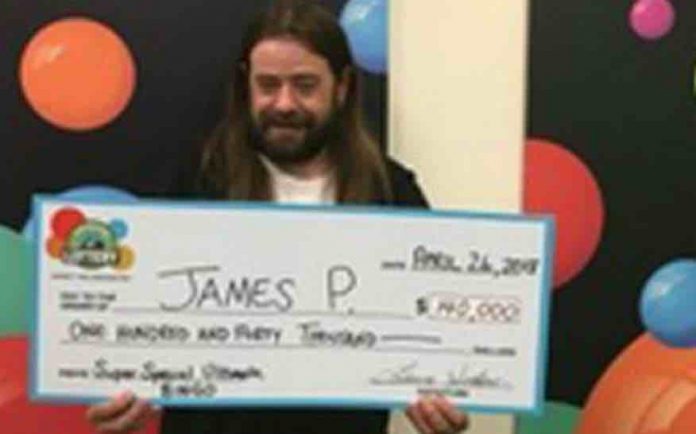
A Colorado driver named James P. was given a $5 Super Special Ultimate Bingo Scratch ticket as a tip from one of his regular passengers.
When he scratched off the prize, he found that he had won $30.
He then used his winnings to buy six more scratch-off tickets. Since James continued to win small prizes from the tickets, he kept using his winnings to buy more scratch-offs – until finally, his efforts paid off.
Six weeks after receiving the first ticket, he hit the $140,000 jackpot.
James says that he plans on giving some of his winnings to his parents and using some of the funds to fix up his car.
The driver also says that he has given rides to the generous passenger several times in the past, but he has not seen the man since he gave James the scratch-off.
“I haven’t been able to find him yet and tell him about this, but I hope I do,” James said.
Click To Share The Lucky Story With Your Friends – Photo by Colorado Lottery
Quote of the Day: “Avoiding danger is no safer in the long run than outright exposure. Life is either a daring adventure or nothing.” – Helen Keller
Image: by Jack Lazar, CC
With a new inspirational quote every day, atop the perfect photo—collected and archived on our Quotes page—why not bookmark GNN.org for a daily uplift?
The Lesson: Everyone has value and there are no throwaway people – which is why Dr. Edgar Cahn invented Time Banking: a currency built off reciprocating talents, time, and experience that is bringing communities around the world together and opening up new worlds of value and connections.
Notable Excerpt: “I feel that people, if you give most people a chance, would say, ‘I’d love to think of myself as a kind, decent human being. How can I do that?’ When you ask them politically, they feel alienated from a system that has sent them a message that they don’t matter; that their voices don’t matter. I think it’s a matter … of using vehicles that say you can create alternatives. I think we need a whole mentoring squad to make that feel real. I think Peace Corps did that. I think that there were times when we had that as a dominant culture. When the hot thing to do was not to be negative, but at least being negative gives you an identity if you don’t have any other options and I just think that time banking is neither left nor right – [it is] only respect for human beings, only respect for capacity and if we begin to appeal to the capacity of people to be bigger than themselves, I think they will respond.”
The Guest: Dr. Edgar Cahn, the inventor of Time Banking, is a legal professor and former counsel and speech writer to Robert F. Kennedy. After attending the London School of Economics, he created Time Banking in 1995. There are now Time Banks in over 30 countries around the world.
The Host: Julie Pilat works in music and tech in Los Angeles while also participating in many community activities. After growing up in radio, she missed interviewing people and decided to create “The Idea Fountain: Life-Changing Conversations” monthly podcast in which she interviews someone who has changed her life.
(LISTEN to the inspiring talk below) – Photo by Chiara Cremaschi, CC
Good Advice? SHARE It – And, CHECK OutMoreon our Good Talks Page…
Jaron Johnson may only be 8 years old, but he is already well on his way to being an upstanding citizen after his compassionate display of integrity last week.
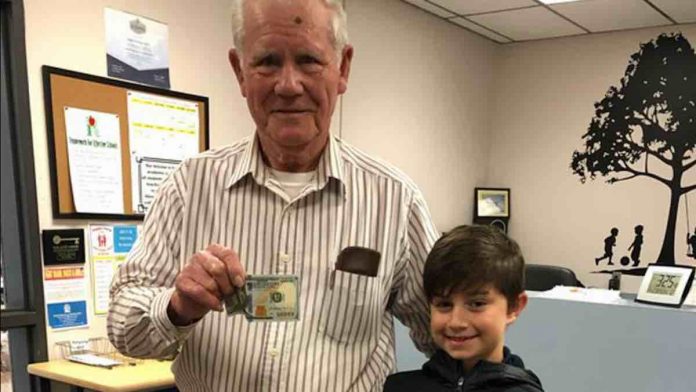
The youngster was out running errands with his mom when he found a $100 bill in the parking lot of a Walmart in Pineville, Louisiana.
“He was a few steps behind me and said, ‘Mom, look what I have in my pocket,’ and he said, ‘Can we turn it in to Walmart and give it to the rightful owner?’” Jaron’s mom Jodie told Inside Edition.
Jodie was aware of how an employee could simply pocket the money for themselves, so she told Jaron that they would go home and work out how to return the money the following day.
The next day, Jaron told his mom to call Walmart and ask if anyone had reported the missing money. Jodie then called the store and left her phone number with the clerk. She did not, however, mention exactly what the missing property was.
Later that same day, she received a call from the daughter of James Grice: an 86-year-old man who had lost the $100 while he was shopping.
Because the senior lives on a fixed income, he had been unable to buy his groceries without the money; so when he discovered that someone had kept his finances safe, he was overwhelmed with joy.
Grice and James met each other a few days later so the youngster could give him the money. As a means of expressing his gratitude, Grice gave Jaron $20 and a permanent invitation to the fresh tomatoes in his vegetable garden – which also happen to be one of Jaron’s favorite snacks.
“Jaron’s got a big heart,” Ms. Johnson said. “He has a passion for others. He has always shown his integrity and heart for others.”
Pay It Forward: Click To Share The Sweet Story With Your Friends – Photo by Jodie Johnson
42 of the UK’s biggest retailers, supermarkets, manufacturers, and brands have taken a historic pledge to completely transform the plastic packaging sector by 2025.
Corporate giants such as Asda, Nestle, Lidl, Coca-Cola, Aldi, PepsiCo, Unilever, Tesco, Waitrose, Morrisons, Sainsbury, and Pret a Manger have joined the UK Plastics Pledge to eliminate single-use plastic packaging. Together, the signatories represent roughly 80% of the plastics sold in UK supermarkets.
The initiative, which is orchestrated by waste advisory charity WRAP in collaboration with the UK’s largest nonprofits, recyclers, and governments, has set a series of goals to cut wasteful packaging over the course of the next seven years.
For starters, the initiative will ensure that 100% of plastic packaging must either be recyclable, compostable, or reusable in order to make it onto supermarket shelves. Some supermarkets have gone even further and declared that plastic packaging will no longer be used on fruits and vegetables.
Additionally, the pact seeks to increase the amount of properly recycled plastic from its current rate of 30% to at least 70%.
Environment Secretary Michael Gove, who is backing the pact, said in a statement: “Our ambition to eliminate avoidable plastic waste will only be realized if government, businesses, and the public work together.”
“Industry action can prevent excess plastic reaching our supermarket shelves in the first place. I am delighted to see so many businesses sign up to this pact and I hope others will soon follow suit,” he added.
The Ellen MacArthur Foundation, one of the industry groups supporting the initiative, will also be helping to expand the initiative to other countries so more governments, businesses, and manufacturers can replicate the goals.
Dame Ellen MacArthur of the MacArthur Foundation said: “This bold new pact will bring together businesses, policymakers and the public to create a circular economy for plastics that tackles the causes of plastic waste and pollution, not just the symptoms. Focusing on innovation, better packaging design and end-of-use systems will not only generate long-term benefits for the environment, but is also a huge economic opportunity.”
“We encourage others around the world to help drive this momentum towards global solutions to what is a global problem.”
The pact comes as a welcome follow-up to the UK’s recent promise to eliminate wasteful plastic packaging by 2042.
(WATCH the video below)
Pass On The Historic News To Your Friends: Click To Share – Photo by WRAP
An anonymous New England man had been told by a dozen people that his gold coin was a worthless fake – until coin experts verified that the antique was real.
Not only that, but the coin is easily worth millions of dollars.
The 164-year-old coin was minted as a $5 denomination during the California Gold Rush in 1854. Records indicate that only 268 of the coins were made by the San Francisco Mint, only three of which have survived to this day. The man’s coin has now been verified as the fourth.
The coin’s validity was authenticated by the Numismatic Guaranty Corporation (NGC), an organization that has verified over 40 million rare coins since 1987.
“It’s like finding an original Picasso at a garage sale. It’s the discovery of a lifetime,” said Mark Salzberg, NGC Chairman.
“The owner of the coin is a life-long New England resident who wants to remain anonymous. He was stunned when we informed him that it is a genuine, multi-million dollar rare coin. He had shown it to a few collectors and dealers at a recent coin show, but everybody said they thought it was a fake because until now there were only three genuine surviving 1854 San Francisco Mint $5 gold pieces known,” explained Salzberg.
“Our initial reaction on examining the coin was utter disbelief that a rarity of this magnitude could still be discovered in this era,” said NGC President Rick Montgomery. “But upon seeing the coin in person for the first time it was apparent that the coin is genuine.”
Click To Share The Cool Story With Your Friends – Photo by NGC
6 people with severe spinal injuries have regained motor function in their hands and fingers for the first time in years thanks to an inexpensive, noninvasive, nonsurgical spinal treatment.
At the beginning of the UCLA-led study, 3 of the patients were unable to move their hands at all, and none of the participants could perform simple tasks such as opening a water bottle, turning a doorknob, or operating a cell phone. Some of the patients had been paralyzed for over 10 years – others had been without motor function for as little as one year.
Over the course of eight therapy sessions in four weeks, researchers attached electrodes to the patients’ skin that applied electrical currents at varying frequencies and intensities to stimulate the spine’s circuitry. The researchers called the treatment “transcutaneous enabling motor control,” or tEmc.
After just four sessions, patients started seeing positive results.
“About midway through the sessions, I could open my bedroom door with my left hand for the first time since my injury and could open new water bottles, when previously someone else had to do this for me,” said Cecilia Villarruel, one of the participants, whose injury resulted from a car accident 13 years earlier.
“Most people with a spinal cord injury say they just want to go to the bathroom like a normal person again,” she Villarruel. “Small accomplishments like opening jars, bottles and doors enable a level of independence and self-reliance that is quite satisfying, and have a profound effect on people’s lives.”
60 days after undergoing the treatment, two of the patients returned to the laboratory and displayed their maintained grip strength, from opening doorknobs to managing cell phones. The treatment had also improved their bladder function, blood pressure, and cardiovascular function. Not only that, but they were able to dress and feed themselves without the help of a caregiver.
The research team has conducted the treatment on two dozen other patients outside of the study participants and all of them showed improved motor function after the therapy.
“Improved hand function can mean the difference between needing around-the-clock care and living more independently,” said Peter Wilderotter, president and CEO of the Reeve Foundation. “These findings bring great hope to those who were told recovery following paralysis would be impossible. As new discoveries and breakthroughs are uncovered, it is clear the word ‘impossible’ no longer applies to spinal cord injury.”
The research team is currently seeking FDA approval for the inexpensive therapy so that the equipment can be given to rehabilitation clinics in poor communities that cannot afford advanced medical treatments.
“I get criticized a lot for giving ‘false hope’ but we follow where the science tells us to go and just give the research results,” Edgerton said. “Everything is telling us the nervous system is much more adaptable than we’ve given it credit for, and can relearn and recover from severe injury.”
“Nearly everyone thought the only people who would benefit from treatment were those who had been injured for less than a year; that was the dogma. Now we know the dogma is dead,” said V. Reggie Edgerton, senior author of the research. “All of our subjects have been paralyzed for more than a year. We know that in a high percentage of subjects who are severely injured, we can improve their quality of life.”
(WATCH the video below)
Click To Share The Exciting News With Your Friends
Pepper the Cat, lost on 4/20/18 in Terminal 4, JFK, has been sighted. #PAPD is now attempting to rescue Pepper. Humane traps have been set up in hopes the PAPD can reunite Pepper with its owner. #PAPDPROTECTSNYNJ#Pepperpic.twitter.com/qOnTN2OxUk
An elusive feline named Pepper was finally rescued after eight days of running from the authorities at JFK airport.
The 4-year-old tabby had been curled up inside her carrier while her owner was getting ready to check-in for her flight to China.
As they were waiting in line, however, Pepper’s carrier fell on its side, popped open, and unleashed the anxious feline into the airport. The tabby seized her chance for escape and jumped onto the check-in counter before leaping up onto the low ceiling and disappearing into the facility.
Distraught by her cat’s escape, Pepper’s 29-year-old owner missed her flight so she could help search for the cat, although she was eventually forced to follow through with her relocation and take a plane to China without her cat.
The Port Authority police officers, determined to reunite the feline with her owner, continued to search the airport.
Over the course of eight days, there were several sightings of Pepper in various hard-to-reach spots. When the cat stubbornly remained out of arm’s reach, they set up humane animal traps with cat food for bait – but they still had no luck.
Finally, one of the JFK International officers thought to enlist the help of Nuan Tang, a friend of the cat’s owner who has watched Pepper in the past.
With a little cat food in hand, Tang started calling out for “Dai Meng”, which is Pepper’s Mandarin name that loosely translates to “little dork”.
Pepper still remains elusive in JFK Airport's Terminal 4 but, Pepper appears healthy. #PAPD police officers are continuing their efforts to rescue Pepper and return to her owner. Officers have been leaving food for Pepper in the areas of her sightings. #PAPDPROTECTSNYNJpic.twitter.com/owuBgCLq3b
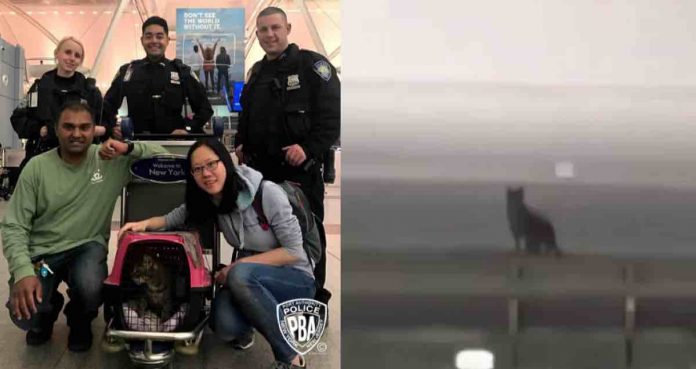
Within 15 minutes, Pepper recognized Tang’s voice and scampered from her hiding place all the way to the cat carrier. Once the cat was safely secured in the carrier, Port Authority officers secured the box with duct tape so she wouldn’t be able to escape again.
Pepper is currently recovering at Tang’s house until she is ready to be reunited with her owner.
Port Authority Police rescue Pepper the Cat in Terminal 4, JFK. P.O. Kameel Juman (front, left) led the effort which included enlisting Pepper's owner's friend Nuan Lang (front, right). Rear, L-R #PAPD POs Ann Armstrong, Alfred Morgado & Sean McCafferty. #PAPDPROTECTSNYNJ#Pepperpic.twitter.com/kfEj6O8S38
Quote of the Day: “Anyone who has lost track of time when using a computer knows the propensity to dream, the urge to make dreams come true and the tendency to miss lunch.” – Tim Berners-Lee (launched the World Wide Web)
Image: by Geralt, CC
With a new inspirational quote every day, atop the perfect photo—collected and archived on our Quotes page—why not bookmark GNN.org for a daily uplift?
LISTEN to this Good News Guru story, as broadcast on the radio with Ellen K and Geri on KOST-103.5. (Subscribe to our new podcast on iTunes – or for Androids, on Podbean) — or Read the story below…
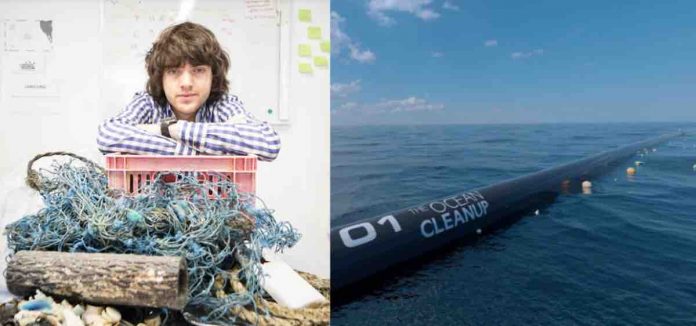
Do you remember the teenager who six years ago invented a machine that he said could get rid of the plastic that was gathering in the ocean?
Well, just in time for Earth Day, the young Dutch genius announced that he is almost ready to launch his ground-breaking initiative designed to purge the seas of the “Great Pacific Garbage Patch.”
This patch is a massive island of trash drifting halfway between California and Hawaii. Over a trillion pieces of debris have collected there because of the swirling vortex of current—a floating mass roughly twice the size of Texas.
After discovering the patch in the 90s, scientists said it would take thousands of years to clean it up—but Boyan Slat said in his TEDx talk that he could do it in less than ten, if he could get his special machinery built.
Though his claim caused many skeptics to raise their eyebrows, Slat dropped out of college so he could bring his plans to life. In addition to crowdfunding $2.2 million for his idea, he garnered millions more dollars through interested investors.
His nonprofit Ocean Cleanup Project now employs 70 engineers, researchers, and scientists — all dedicated to cleansing the sea of plastic.
After patiently conducting years of research, they are launching 60 custom-built trash-picker-uppers out of the San Francisco Bay to start collecting the rubbish in July.
Each floating machine is essentially a mile-long screen that harnesses the ocean’s currents to passively collect floating trash of all sizes without using large amounts of energy or resources. Since the screen stays on the surface, fish can pass underneath without being harmed.
At 42 years old and with only 2% of her vision remaining, San Diego resident Amy Dixon, also known as “Super Woman,” will represent the United States in the Triathlon event in the 2020 Paralympics in Tokyo.
Amy will be competing with women half her age and more than double her sight, but that does not discourage her – it only motivates her to push harder for herself, her country and for those with visual impairments.
Prior and during her journey to Tokyo, Dixon has continued to break through tough barriers on and off the track so she can prove that anyone is capable of achieving their dreams and overcoming their disabilities.
When Dixon is not working to improve her best personal race time, she is working on improving the lives of those in our community. For the past two years, she has held camps that teaches the visually and audibly impaired how to race in triathlons. Additionally, Dixon has been able to raise enough money each year to provide this camp at no cost to its participants.
While working to better the lives of those impaired, she is actively working on saving the sight of others through her work as the Vice President of the Glaucoma Eyes International foundation.
Since she is such an inspiration to San Diego, Senator Joel Anderson recently honored Dixon’s efforts by presenting her with a certificate of recognition for her tremendous athletic achievements and her dedication to better the lives of those in our community.
Photos by Amy Dixon
Click To Share The Athlete’s Inspiring Story With Your Friends…
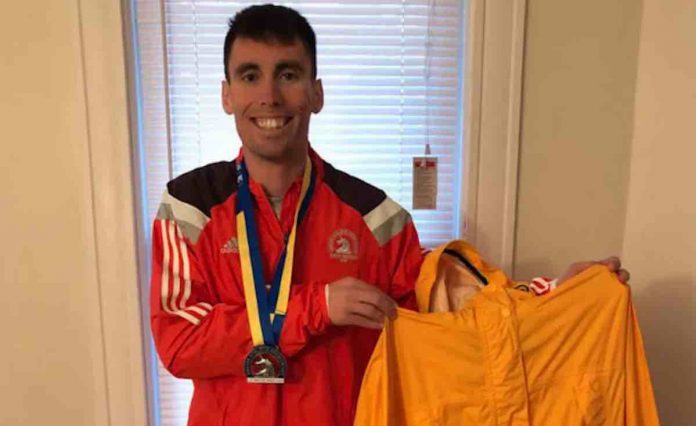
For the last 20 years, Renee Bercury’s yellow raincoat has been her constant companion throughout every adventure – but when she saw a runner who was desperately in need of warmth, she didn’t hesitate to give it up.
Bercury and her family were in the midst of watching the Boston Marathon last week when one of the runners became overwhelmed by the rain and freezing temperatures.
“He had just such a look of despair and desperation on his face,” Bercury told Boston.com. “I remember him asking, ‘Can I have a jacket? Can I have a jacket?’ And I felt like he was looking at several people.”
Bercury immediately took off her raincoat and passed it to the runner. He zipped it up, quickly thanked her, and continued to run.
“He struck me as a person who was drowning and reaching his hand out for somebody to save him. It was that dramatic. It hit me that hard… So I had no qualms. It was just instinct to take the jacket off and hand it to him.”
Judging by his exhaustion, Bercury’s family doubted whether the runner would be able to finish the marathon. When her son ran past them a little later, she says that he looked just as bad. (His condition eventually forced him to drop out.)
The guy with her jacket, however, made it across the finish line—and immediately after completing the race, he took to social media in search of the jacket’s rightful owner.
His mission was shared thousands of times until it was picked up by news outlets. A few days later, Bercury received a text from her son containing a link to a news story about the man.
“I looked at the message from my son … and I just burst into tears,” said the 62-year-old woman. “I was just kind of overcome that he managed to finish, and what he said — that (the jacket) made the race for him… I was just really happy.”
The runner, 27-year-old Steven Stallis, managed to get Bercury’s phone number so they could swap stories about the marathon. Though she told him he could keep the jacket, he insisted on sending it back to her home in Slippery Rock, Pennsylvania.
“She said she’s had the jacket for over 20 years, and it’s been all over the country on really cool trips,” he told Boston. “Now it’s crossed the Boston finish line, so it’s a new story for her to have that jacket back.”
San Francisco is the land of trolleys, tech companies, niche coffee shops, and increasingly, the land of social mobility for the homeless.
Because the city has been at the heart of the tech boom, many of San Francisco’s at-risk citizens have been burdened by the corresponding sky-rocketing housing costs.
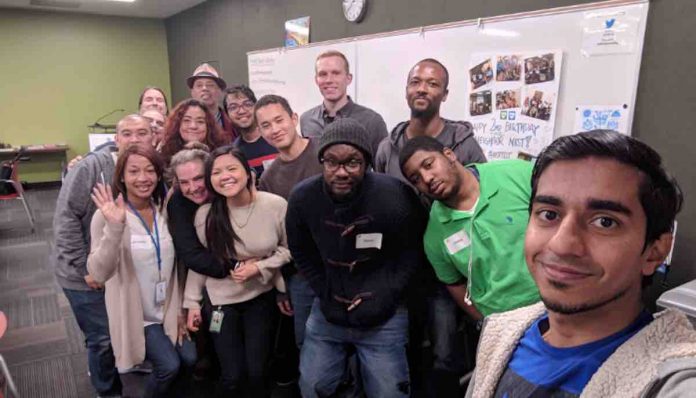
That’s why a formerly-homeless poet and writer, Del Seymour, founded Code Tenderloin: a nonprofit that seeks to rehabilitate, train, and find employment for the disenfranchised residents of Tenderloin, the Bay city’s poorest and most ethnically diverse neighborhood.
So far, 300 students have graduated from the program and a third of them have already found employment in the tech sector. Some of the grads have even been hired into six-figure jobs.
In an interview with Business Insider, Victoria Westbrook, who is the director of programs and operations at Code Tenderloin, gave some background about her journey and the organization. Westbrook says that for 20 years, she was a drug user who was living in a halfway house. Then her friend told her about Code Tenderloin. There, she learned networking skills, built a business relationship with Seymour, and condensed her resume from four pages down to one.
“My past shapes me, but it doesn’t define me unless I let it,” Westbrook said.
She explained that Code Tenderloin accepts everybody into its program unless they are an active addict – but even then, the organization doesn’t just give them the cold shoulder. Instead, Code Tenderloin will help the applicant find the help they need to get back on their feet. Once applicants are within the program, the varied skills they learn can help them in any field: networking, resume building, elevator pitches, and more.
Since 2015, Code Tenderloin has used its connections in the industry to place 100 of their applicants into job positions. Thus far, 35% of them have stayed with their employer for over 12 months.
Westbrook expressed hope for the future, saying that they are planning on offering mentorship to their students after graduation so they can continue to flourish in the business world.
Click To Share The Good News With Your Friends – Photo by NeighborNest
Quote of the Day: “Teach me to appreciate what I have, before time forces me to appreciate what I had.” – Susan L. Lenzkes
Photo: by just One More Book podcast, CC
With a new inspirational quote every day, atop the perfect photo—collected and archived on our Quotes page—why not bookmark GNN.org for a daily uplift?
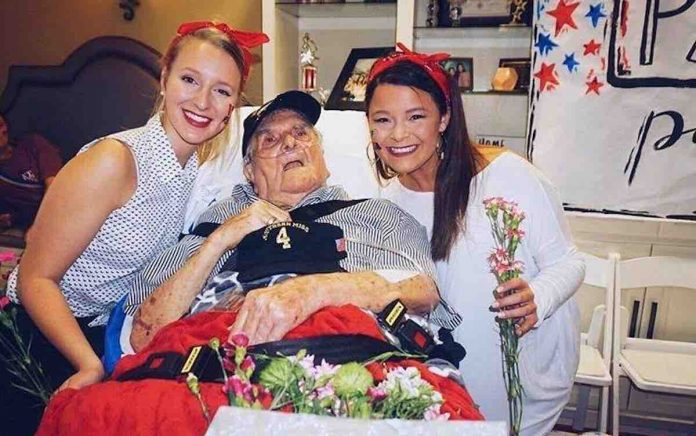
92-year-old Paul Sonnier harbored one final wish that he wanted to fulfill before leaving this life, and it was to have one more dance with a beautiful woman.
Thankfully, dozens of girls were happy to oblige.
As a means of granting his wish, the Phi Mu sorority sisters at the University of Southern Mississippi held a dance for the ailing senior on Monday.
Sonnier, who was in WWII and the attack on Pearl Harbor, first met sorority sister Jessica Moreau when she worked as a social work intern at the SouthernCare Hospice Services in Hattiesburg. The Navy veteran always told Moreau that he someday would teach her how to waltz and jitterbug.
Then during one of her visits, he expressed his wish for one last dance. The sorority then orchestrated the event in the veteran’s honor.
“We had such a great time dancing, singing, and eating lemon cookies with him!!” says a Phi Mu Facebook post.
Though Sonnier was not actually able to get up and dance, he was delighted to hold the students’ hands as they boogied.
“We’re super grateful, because he hasn’t been out the house in so long,” Sonnier’s granddaughter Samantha Owen told WDAM. “All these ‘pretty women’ get to come around him. He gets to hand out flowers and just be himself. He hasn’t been himself for awhile. So, he’s super happy.”
Click To Share The Sweet Story With Your Friends – Photo by Phi Mu at USM
13 truck drivers are being praised for their impressive coordination after they used their hulking vehicles together to help dissuade a suicidal man from jumping off of a bridge.
The Michigan State Police Department first got a call about the man around 1AM on Tuesday morning. He was observed threatening to jump from a bridge over Interstate 696 in Oak Park.
As police shut down all the highway lanes, law enforcement officials got the idea to coordinate with nearby truck drivers so they could steer their semis under the bridge and prevent a possibly fatal injury.
Chris Harrison, a man who says that he was the driver in the yellow truck located closest to the left of the line, recounted the story in a Facebook group for truckers.
“The cops came up and waved 6 or 7 of us through and then stopped us under the bridge,” wrote Harrison. “Same thing on the west bound side.”
After state police and negotiators spent several hours talk with the man, he eventually agreed to come down from the ledge so he could be escorted to Beaumont hospital for evaluation. Then, officials wanted to thank the truckers.
Zach Anner is a comedian and an adrenaline junky. He also happens to have cerebral palsy, but that hasn’t stopped him from living an exciting life.
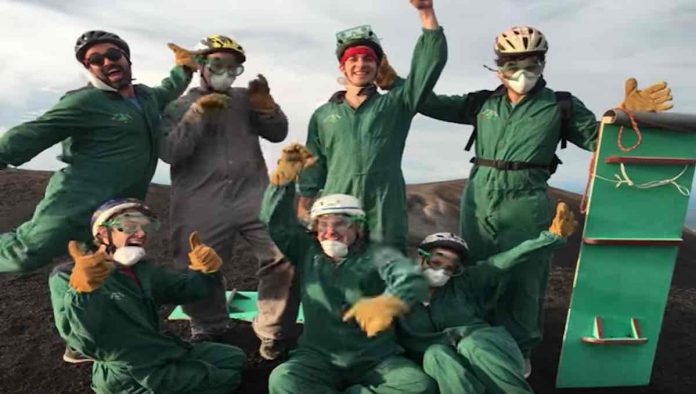
The man from Austin, Texas has done everything from bungee jumping to zip-lining. More recently, he went “volcano surfing” thanks to a little help from his friends.
As a means of raising awareness for UCP Wheels For Humanity, a nonprofit organization that delivers wheelchairs to the poor, Anner traveled to Nicaragua.
Over the course of an hour, Anner’s loyal friends took turns carrying him on their backs as they hiked up the side of the Cerro Negro volcano. Then, in three “magical” minutes, they all slid back down on a wooden boards.
Anner not only hopes that his stunt raises money and awareness for charity, he hopes it will inspire other people with disabilities.
“These are the kinds of things that Zach does. He really pushes his limits,” said Ron Cohen, CEO of UCP Wheels for Humanity. “He creates awareness about what people with disabilities are capable of doing.”
“You really can’t talk about Zach with a disability because he does things that people without disabilities would be too afraid to try,” he added. “I wouldn’t do half the things that he does.”
(WATCH the video below)
Click To Share The Inspiring Story With Your Friends
Quote of the Day: “How beautiful upon the mountain are the feet of the messenger who announces peace, who brings good news.” – Isaiah 52:7
With a new inspirational quote every day, atop the perfect photo—collected and archived on our Quotes page—why not bookmark GNN.org for a daily uplift?
Karen Soeffker started serving “green ice cream” in her toy store — and sales went up.
Rita Healy said the hotel she manages advanced its corporate sustainability goals — and started hosting more guests at its local conferences.
Even the town’s top leader has gone green. Mayor Dale Ross went from not being a “gung ho environmentalist who thought about climate change,” to rubbing elbows with top environmental experts around the world.
All of these changes have occurred because Georgetown — a city 25 miles north of Austin with a population of about 61,000 — is now powered by 100 percent renewable energy, becoming one of the largest cities with municipally owned utilities in the nation to do so.
“It’s sort of neat to be a trailblazer,” Ross said. “It may not work for everyone. You use what works for you. In Washington, it’s hydropower. In Texas, it’s wind and solar power.”
Since 2015, the city has been powered by a 144-megawatt wind farm in Adrian, Texas, 500 miles from Georgetown. Beginning in July, a solar plant owned by NRG Yield, operated by NRG Renew and financed by Wells Fargo in Pecos County, Texas, about 300 miles from Georgetown, will provide 150 megawatts of energy, supplying about half of Georgetown’s power.
A ‘green’ decision, so to speak
Ross is quick to say that the decision to power the city with renewable energy was first and foremost a business decision.
In 2014, the city was in a dispute with its energy provider and didn’t agree with its mandates, so city officials began exploring different options, Ross said. City staff members realized they could sign a seven-year contract and continue with fossil fuels as a power source or agree to a 20- or 25-year contract for wind and solar power.
“If you’re paying $18 for solar and coal is $25, who are you going to buy from?” Ross said. “Are we going to have more fossil fuel or wind and sunshine in Texas? The wind factor is off the charts.
For most people, at the end of the day, it’s about how much they’re paying for electricity. We know exactly what we’re paying for 25 years.”
The longer-term contract would also mean that power bills wouldn’t fluctuate. “Usually you see spikes in the winter and summer,” said Jim Briggs, general manager of utilities and assistant city manager for Georgetown. “That doesn’t happen here.”
While some pups might resort to begging for treats, this proud dog insists on paying for his own meals.
Although, it does help that his form of currency literally grows on trees.
Negro the dog is the furry campus resident of the Diversified Technical Education Institute of Monterrey Casanare in Colombia. For the last five years, he has been a watchful companion to all of the students throughout their studies. In exchange for his presence, the faculty provides him with food, love, and a safe place to sleep.
During Negro’s time on campus, however, he noticed that some of the students were giving green pieces of paper to the campus shopkeeper in exchange for cookies. Intrigued by the economic exchange unfolding before him, the clever canine decided to try something similar.
“He would go to the store and watch the children give money and receive something in exchange,” teacher Angela Garcia Bernal told The Dodo. “Then one day, spontaneous, he appeared with a leaf in his mouth, wagging his tail and letting it be known that he wanted a cookie.”
The shopkeeper then took the leaf and gave him a cookie in return as a reward for his impressive ingenuity.
Since discovering the magic of commerce, Negro has returned to the shop every day to “buy” a dog-safe treat; although the shopkeepers are careful not to feed him too much.
“When you first see it, you almost want to cry,” says the store attendant. “He’s found a way to make himself understood. He’s very intelligent.”
Click To Share The Pawesome Story With Your Friends – Photos by Angela Garcia Bernal