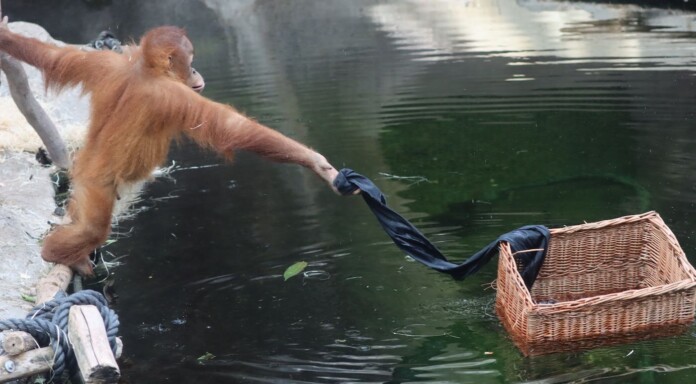
Orangutan crafts a tool in Prague Zoo by Lucie Štěpničková - SWNS
This is the awe-inspiring moment that a wild orangutan offered its hand to a man wading through snake-infested waters.
The brief interaction was captured by amateur photographer Anil Prabhakar as he was on a safari with his friends through a conservational forest on the Indonesian island of Borneo last month.
The forest, which is maintained by the Borneo Orangutan Survival Foundation (BOS), is a sanctuary for the critically endangered apes who may need refuge in the face of injuries, poaching threats, or habitat loss.
Since venomous snakes are the orangutan’s only real predator in the forest, it is quite likely that this particular ape knew the consequences of approaching the muddy waters.
The man in the photo was a conservancy guard who was busy clearing off the snakes for Prabhakar and his friends when the orangutan offered its hand. Prabhakar later told CNN it was as if the orangutan was saying “May I help you?”
Due to the unpredictability of wild orangutans, the warden ended up circling around to a different point in the bank and climbing out of the water on his own—but not before Prabhakar snapped a photo of the breathtaking interaction.
“I just grabbed that moment,” he said. “It was really emotional.”
Quote of the Day: “Try not to get lost in comparing yourself to others. Discover your gifts and let them shine!” – Jennie Finch
Photo: by David Clode – public domain
With a new inspirational quote every day, atop the perfect photo—collected and archived on our Quotes page—why not bookmark GNN.org for a daily uplift?
Over a third of Americans have felt judged about their cooking skills—and no wonder. Four in Ten said in a new survey that they can only prepare one meal without outside help, and that is breakfast—eggs and French toast.
A survey of 2,000 adults found that a “Top Chef” appearance probably isn’t in the future for these Americans, as one in five (just 21%) say they have only one standout dish in their arsenal.
The survey, conducted by OnePoll on behalf of Mazola corn oil, asked respondents what makes them feel most confident in kitchen.
The top five meals that they can make without consulting a recipe are eggs over easy (49%), scrambled eggs (46%), hard boiled eggs (44%), poached eggs (44%) and french toast (41%).
But even the simplest recipes can cause chaos for these folks in the kitchen. On average, respondents said they forget four ingredients per month while cooking. And, over half admitted they’ve had a full-on kitchen disasters, prompting 31% to trash it and start from scratch.
The best news of all? Kitchen mishaps will not keep these intrepid cooks from taking on new culinary challenges in 2020.
49% plan on tackling more complex recipes in the new year and 45% hope to diversify the types of cuisine they cook.
They also aspire to update their skills with 42% hoping to master air frying, which claims to mimic deep frying with nothing more than hot air and a few drops of oil—just in time for Healthy Heart Month in February. 36% are dreaming of becoming a baking maestro, and a third want to set their grill skills on fire.
WHAT MEALS CAN YOU MAKE WITHOUT A RECIPE? … SURVEY SAYS:
1. Eggs over easy 49%
2. Scrambled eggs 46%
3. Hard boiled eggs 44%
4. Poached eggs 44%
5. French toast 41%
6. Soup 36%
7. Grilled cheese 36%
8. Pasta 36%
9. Rice 36%
10. Salad 36%
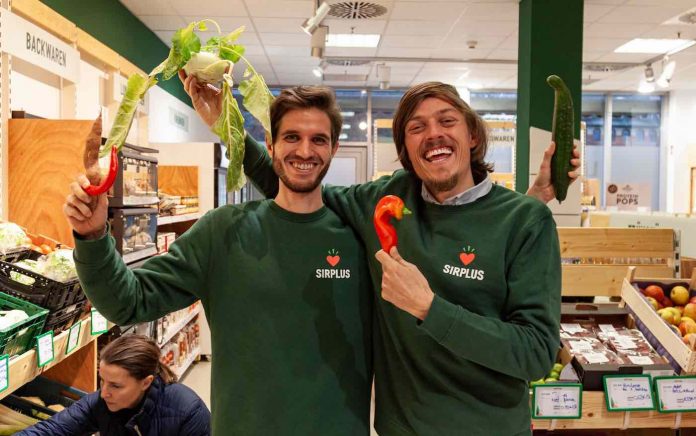
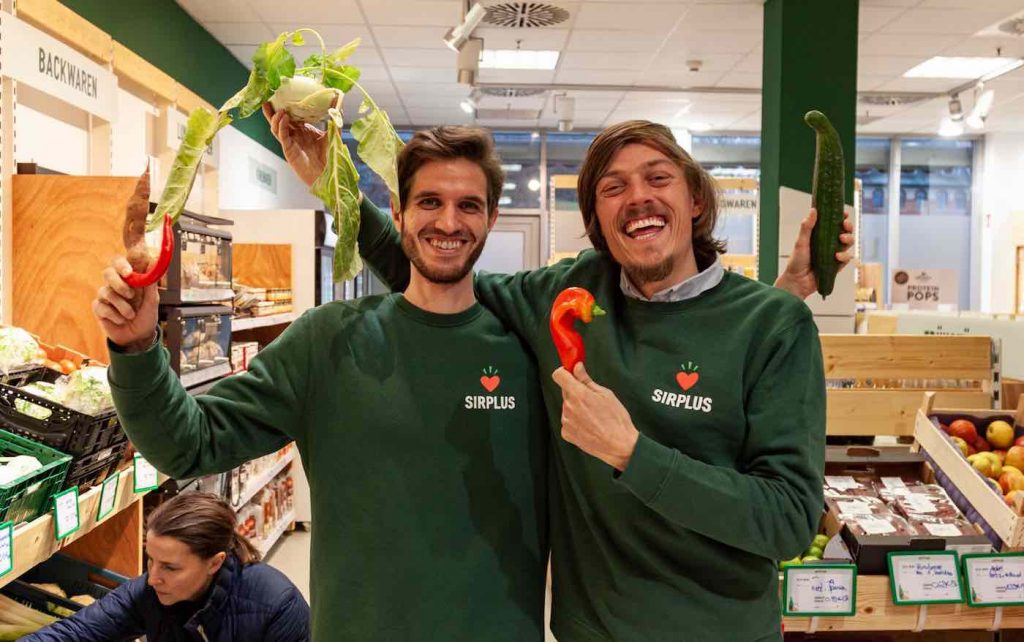
Sirplus founders Martin Scott and Raphael Fellmer.
A Berlin supermarket is tackling the challenge of reducing food waste by reselling all of the unattractive products that other grocery stores refuse to carry.
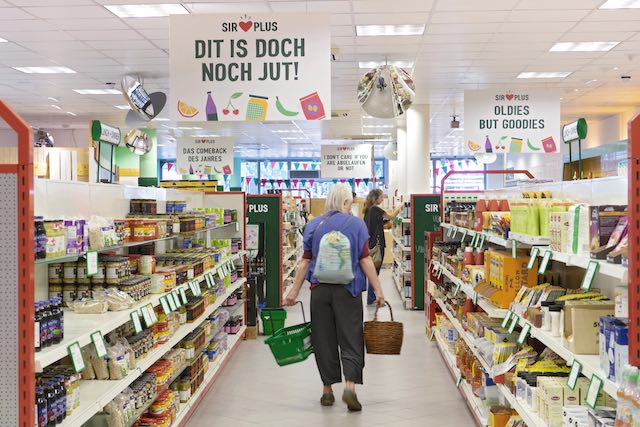
Sirplus Rettermarkt in Berlin Steglitz. Photo by Sirplus.
The SirPlus grocery store stocks their shelves with foodstuffs and produce that is expired, near to expired, misshapen, or just a bit odd, and offers it to shoppers for up to 80% less than the regular supermarket prices.
According to the United Nations Food and Agriculture Organization, 1.3 billion tons of food are thrown out or wasted every year across the world. This amounts to one third of all food produced worldwide, at the same time as trash landfills are filling rapidly.
The majority of the global waste comes from Europe and North America, with the average European wasting 210 to 254 pounds (95 to 115 kilograms) of food every year.
Some of the food rejected by other supermarkets, restaurants, or wholesalers—which SirPlus quality assurance specialist Timo Schmitt and his team inspect every day—is discarded because of something as little as a cucumber that has grown at a 90-degree angle, or a jar of jam that is mislabeled.
Others, like items past their expiry date, are carefully inspected to ensure that it is safe to eat. “We check smell, taste, consistency and packaging,” Schmitt told Klaus Sieg, a Hamburg journalist. “If in doubt, we call in a laboratory.”
As long as food has been deemed safe to eat and the customer understands the risks inherent in what they are purchasing, expired biscuits or even castaway yogurt and meat is legal to sell under German law.
Sirplus founders Martin Scott and Raphael Fellmer.
“Suppliers such as farmers, […] wholesalers [and] retailers have a strong economic incentive to partner with us,” explain the founders of SirPlus in an interview in 2017. “When buying or trading their surplus via our marketplace […] we’re saving them significant disposal costs, while providing a new revenue source”.
France passed a law four years ago that supermarkets must not throw away food that has reached its sell-by date. This could mean donating to food banks, composting it, or recycling it for use in pet food or biofuel—but all of the above require larger operational expenses than simply selling it.
Fellmer and Schott allow producers and distributors to save storage and disposal costs by selling or donating their food to SirPlus, which if their own storage space can’t accommodate, will be offered for free to NGOs.
In 2019, SirPlus saved 2000 tons of food (4.4 million pounds). The company also has bold plans for 2020 and wants to continue opening stores in Berlin while expanding into other cities, to launch their own product line with the SirPlus label made specifically from food that’s been rescued, and create an online platform that allows for home grocery delivery—all to distribute the increasingly larger amounts of donated food coming SirPlus’ way, which includes one million croissants last year.
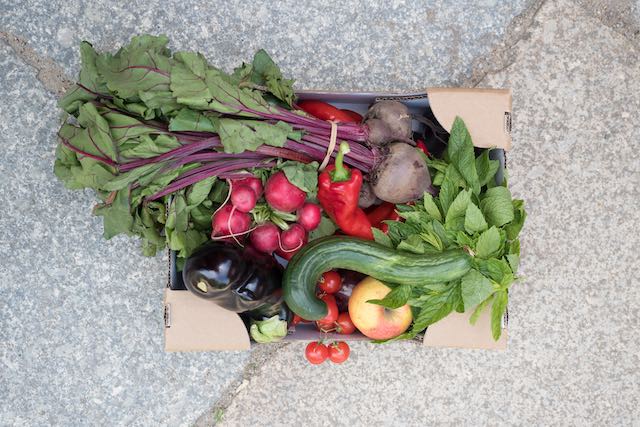
Sirplus produce.
They also have a subscription service called the “Retterbox” (Rescue Box) containing a random assortment of quality-controlled products that have been saved from the dumpster and delivered to your house on a monthly basis with free shipping throughout Germany.
Inspire Copycats in Your Area by Sharing The Good New On Social Media…
A new ban on “conversion therapy” for minors has been enacted in the traditionally conservative Republican state of Utah, which joined 18 other states outlawing the practice.
Last year lawmakers sought to get a ban through the state legislature but failed after repeated amendments left the bill wayward. So, Republican Gov. Gary Herbert, the longest serving governor in the United States, requested that state regulators look into the practice and assess the evidence supporting either its damaging or benign effects on youth.
“I certainly have concerns about some of the abuse that I’ve heard talked about, but I’m not a psychologist,” Herbert said during a news conference last June, when he announced his request.
“This is not my background. I’m going to rely upon the experts to tell us what should be done, or not be done, or how it should be done.”
The practice of attempting to convert a homosexual adolescent into a heterosexual one has been widely discredited by major psychological organizations like the American Psychiatric Association and the American Academy of Pediatrics.
“The American Psychiatric Association (APA) today reiterates its long-standing opposition to the practice,” reads a statement from 2018 on the APA’s website.
“Therapy directed specifically at changing sexual orientation is contraindicated, since it can provoke guilt and anxiety while having little or no potential for achieving changes in orientation,” reads a statement from 2000 on the American Academy of Pediatrics.
“The American Psychological Association expressed support for a report released today by the Substance Abuse and Mental Health Services Administration calling for an end to the practice of ‘conversion therapy’ for children and youth,” reads a statement from 2015 on the APA’s website.
“We want to thank Governor Herbert and his administration for not allowing this issue to be politicized,” the executive director of Equality Utah Troy Williams said at a Wednesday news conference announcing the news according to NPR.
“He saw how polarizing this was becoming, and he made the decision to allow science to prevail over politics. He kept his word to the LGBTQ community, and we are deeply grateful to him.”
Even though Republicans control both houses of the Utah state legislature and the governorship, it joined a group of 18 states that have banned conversion therapy—all but a few of which have democratic majorities: California (2012); New Jersey (2013); Oregon and Illinois (2015); Vermont (2016); Rhode Island, New Mexico, Connecticut, and Nevada (2017); Washington, Maryland, Hawaii, New Hampshire, and Delaware (2018); and New York, Massachusetts, Colorado, Maine, and, now, Utah (2019).
Be Sure And Share The Good News With Your Friends On Social Media – File photo by Mkomarova11, CC
There’s been a lot of conversation about artificial intelligence over the last decade, as the controversial science fiction-turned-non-fiction technology begins to trickle into various economic sectors. Now, for the first time in history, an AI system created by British company Exscienta has invented a drug molecule that is entering phase 1 human trials.
The molecule has been found to treat obsessive-compulsive disorder (OCD), but the noteworthy news is that the normal 5-year period for synthesizing a drug and preparing the best version for trial was cut down to just 12 months because it was placed into the brain of an intelligent machine.
Exscienta chief executive Prof Andrew Hopkins described the breakthrough to the BBC as a “key milestone in drug discovery”.
“We have seen AI for diagnosing patients and for analyzing patient data and scans, but this is a direct use of AI in the creation of a new medicine,” said Hopkins.
“There are billions of decisions needed to find the right molecules and it is a huge decision to precisely engineer a drug,” he added. “But the beauty of the algorithm is that they are agnostic, so can be applied to any disease.”
Hopkins went on to predict that by the end of the year, all drug molecules could be discovered or created by artificially intelligent systems.
This could significantly bring down costs of drug R&D for pharmaceutical companies since the process of discovery, synthesizing, and trialing a drug in most countries is so expensive. The enormous costs place enormous risks on any new drug endeavor, especially during the 5 years of groundwork that needs to be done by well-educated and well-paid employees.
If the attempts to bring an experimental drug to market fail after phase I, II, or phase III clinical trials, the development cost is even greater. AI could reduce costs of labor and R&D of pharmaceuticals by 80%.
The front-loaded savings means that more drugs for more diseases can be synthesized and moved into trials. This would be especially valuable for patients with diseases that are uncommon, because a smaller market might be one that pharmaceutical companies would otherwise avoid.
Stay Smart—Share The Exciting News With Your Friends On Social Media…
Quote of the Day: “Every great dream begins with a dreamer. You have the strength, the patience, and the passion to reach for the stars to change the world.” – Harriet Tubman
Photo: by Jeff Burak @jburak1271 – public domain
With a new inspirational quote every day, atop the perfect photo—collected and archived on our Quotes page—why not bookmark GNN.org for a daily uplift?
You may have cheered some of the many GNN reports of critically-endangered species rebounding after human intervention—like, declining numbers of humpback whales, green sea turtles, and bald eagles entirely reversed by conservation heroes.
Another area of environmental degradation that is now turning around in the right direction is the surprising recovery of fish stocks.
In the most comprehensive review of fisheries’ management and fishing management on a per region basis, to date, an international team of researchers concluded that fish stocks are mostly increasing in these world waters.
In their paper published in the Proceedings of the National Academy of Sciences, the research team gathered data from 50% of the world’s fish stocks, which include harvest rate, recovery rate, fishing pressure, and population numbers, as well as 50% of the world’s fisheries—including management strategies, fluctuations, and predictions in maximum sustainable yield.
The conclusion provided in their paper is striking—good news that may be surprising to most. Where commercial fishing is managed, stocks are growing.
“This article compiles estimates of the status of fish stocks from all available scientific assessments, comprising roughly half of the world’s fish catch,” the authors begin, “and shows that, on average, fish stocks are increasing where they are assessed.”
“Where fisheries are intensively managed, the stocks are above target levels or rebuilding.”
Teach a man to fish, feed him for a lifetime
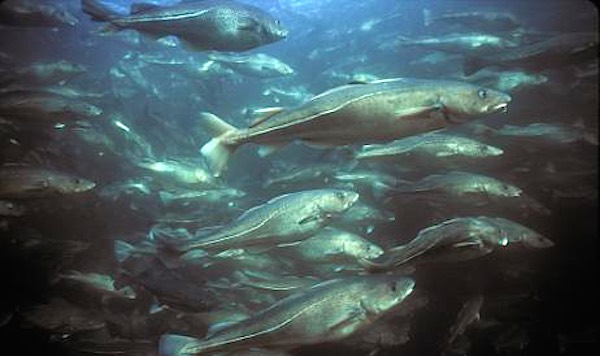
Atlantic Cod, by NOAA
While the last major dataset accumulated for fish stocks only included North America, South Africa, New Zealand, Australia and Europe, the researchers added the Black Sea, the Mediterranean, Northwest Africa, South America, Russia, and Japan.
Fish stocks declined on average globally until 1996, when the trend began to halt. In 2005 it started going the other way, and in 2016 the biomass of animals was higher than the maximum sustainable yield marker and fishing pressure was lower than the unsustainable maximum yield marker—averaged across all measured fish stocks worldwide.
The team’s study modeling also gives nations looking to increase the biomass of their fish stocks a very simple and concrete solution—keep the fishing pressure below the unsustainable maximum yield marker, and fish stocks will recover. Their paper details that 19% of fish stocks that are still depleted are poised to recover based on fishery management along this basic principle.
“Scientifically managed and assessed fish stocks in many places are increasing, or are already at or above the levels that will provide a sustainable long-term catch,” concludes the paper.
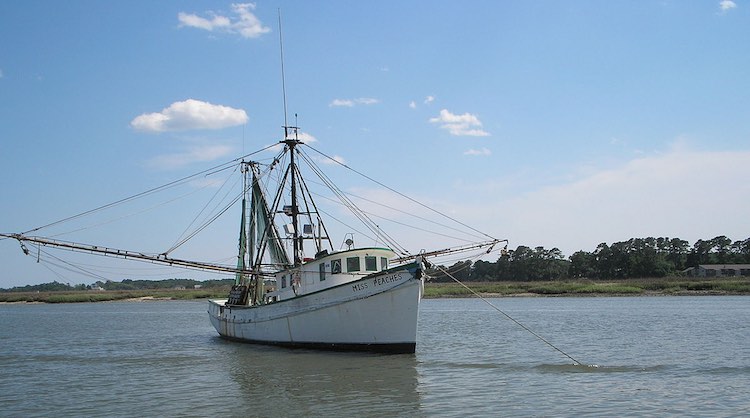
Share The Positive Trend With Negative Nellies On Social Media… (Fishing boat photo by VladUK, CC license)
Carbon capturing and carbon sequestering, meaning the uptake and storage of CO2 molecules in a solid object, like a building or a tree which it can’t escape from, is one of the many tools for entrepreneurs, manufacturers, and businessmen, who want to do their part to combat the climate crisis.
Similarly, a startup working in Israel is eradicating one environmental toxin by placing it inside of another. UBQ Materials is taking household waste that would normally end up in landfills, and embedding it in liquefied recycled plastic to create “a thermoplastic, composite, bio-based, sustainable, climate-positive material”.
The trash is sorted, passed over a magnet to remove metals, before being dried and shredded into a kind of trash-confetti. It’s then added to plastic that’s ready for recycling and melted together before finally being dried and chopped into little pellets.
The resulting pellets can be easily shipped out and used in various manufacturing processes like injection molding and composite brick-making. Dye can be added at any point along the way to ensure the customer can have plastic of any color he desires.
The company’s founders were so confident that the science behind their revolutionary recycling process would prove successful they commissioned Swiss environmental consulting firm Quantis to perform an analysis on just how green their operation was.
Quantis found that substituting a ton of UBQ’s pellets for the same amount of polypropylene saves the equivalent of about 15 tons of carbon dioxide emissions, making it the most sustainable thermoplastic material on earth.
The concept of taking landfill-bound trash, which would generate harmful greenhouse-methane gas, and encasing it inside recycled plastic can be traced back, according to The Post, to an Israeli military man who thought that by mixing mud from the polluted Kishon River with plastic he might help the river recover. This idea never worked, but encasing environmentally-damaging substances in plastic that would then be used to make other materials and products and thereby ensuring it doesn’t have a chance to pollute (or further complicate the climate of) our planet, was a core concept which wasn’t abandoned.
Generating a $50 million dollar fortune as a hummus food mogul, Rabbi Yehuda Pearl has helped the company go from a bankrupt idea to the brink of international acclaim and wealth through $3.5 million in slow savvy investing and R&D. UBQ, short for Ubiquitous. is already selling its thermoplastic composite plastic granule to Plasgad, an Israeli company that manufactures pallets, crates, and recycling bins—2,000 of which are on their way to the Central Virginia Waste Management Authority.
The UBQ facility on the Tze’elim Kibbutz can produce about one ton of their special material in an hour, resulting in between 5,000 and 7,000 tons produced annually. The company’s success is leading to a new facility that will produce 100,000 tons annually.
Share The Exciting News With Your Friends On Social Media – File photo by Michael Manas, CC license
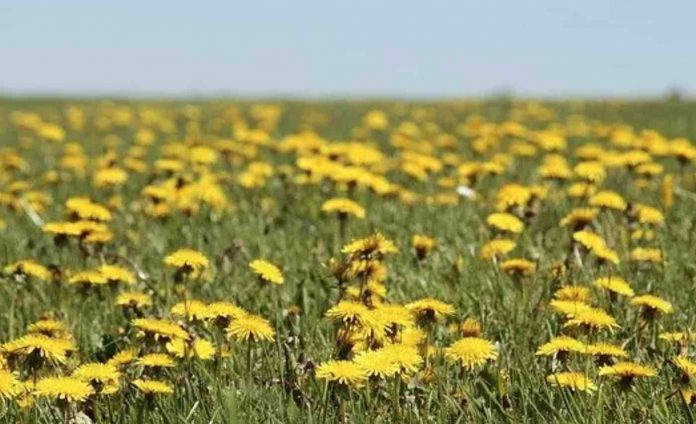
If you ever wanted to help dwindling honeybee populations, ecologists are encouraging that you “learn to love weeds” and leave the dandelions alone this coming spring.
At the start of her tenure as the new president of the oldest ecological society in the world, Jane Memmott reminded everyone last week that working to live in harmony with nature can be as simple as keeping your lawn pollinator-friendly.
The Bristol University professor admitted she mows around the dandelions and buttercups when she cuts her grass because “you can’t personally help tigers, whales and elephants, but you really can do something for the insects, birds, and plants that are local to you.”
“Think about what you’ve had for breakfast,” she began. The pumpkin seeds in your muesli, apples, whatever made the marmalade on your toast, or even the coffee beans and tea leaves that make up your morning cuppa—all of these products rely on pollinators to survive and thrive.”
The new leader of the British Ecological Society dismissed as silly the origins of lawn fussiness—and most people in America can relate with what she sees in England: “This whole business of keeping your lawn clipped and pulling the weeds out is part of some British obsession with tidiness.”
Whether you have a community allotment, a balcony garden, a front or back garden and lawn, or simply a potted plant, the choice of plants you make can have an impact on your local ecology.
Everyday Ecology
David Poe, CC license
Memmott explains a few general rules for planting pollinators—namely that one should “learn to love weeds,” avoid planting too many pom pom-shaped flowers that focus too much energy into petal production and not enough into producing nectar and pollen. She says that any plant with nectar and pollen parts that you can see without pulling back the petals means that pollinators can see—and use them—too.
“Dandelions are fantastic for early season pollinators. The UK has about 270 species of solitary bee and they love dandelions,” she explains, adding later that if they were rare, people would be fighting over them.
Interacting with ecology in everyday life is the kind of thing Memmott knows can benefit people, as well.
There’s a mound of scientific evidence to support claims she makes that if you act charitably towards nature, it will repay your kindness many times over. For instance, a massive study found that people who spend at least 120 minutes per week visiting natural settings—such as town parks, woodlands, and beaches—are significantly more likely to have good health and higher psychological wellbeing. Another case-control study found that self-esteem, mood, and confidence were all improved, some significantly, by gardening in the UK.
A summary on well-being from Wildlifetrusts.org found that being present in various natural settings from a room with several houseplants to raw wilderness can lead to reductions in stress and anxiety, improvements in well-being and mood, improvements to immunity, attentiveness and physical fitness, reductions in symptoms of ADHD in children, and even in criminal activity.
HELP the BEES By Sharing The News On Social Media…
Quote of the Day: “Travel is never a matter of money, but of courage.” – Paulo Coelho
Photo: by Anthony Tran – public domain
With a new inspirational quote every day, atop the perfect photo—collected and archived on our Quotes page—why not bookmark GNN.org for a daily uplift?
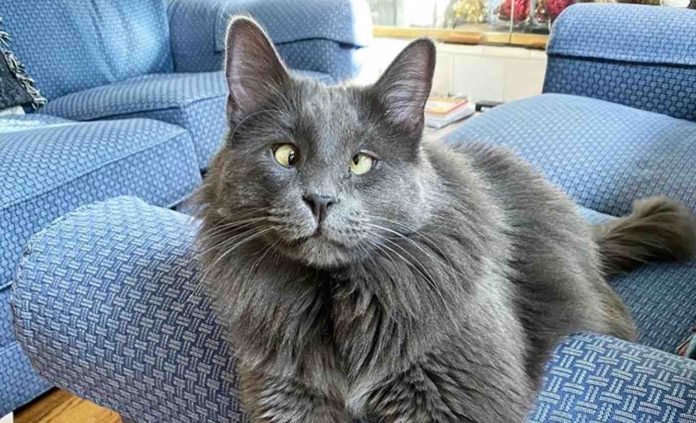
This fluffy feline may look confused, but he is simply showing off his singular set of eyes that has earned thousands of dollars for other rescue cats just like him.
Belarus has chronically crossed eyes as a result of a condition called strabismus, which causes his pupils to point in different directions.
Although it is just one of his many charming traits, it is the one that caused Rachel Krall to fall in love with him back in June 2018.
Krall first saw pictures of Belarus as a kitten in a Facebook post from the San Francisco Animal Care and Control. Although Krall had never lived with a cat before, she went to go meet the feline at the animal shelter—and she ended up adopting him that very same day.
“When I first saw him, I just thought he was the most hilariously adorable cat ever,” Krall told reporters. “I had never really been a cat person before, but thought he would be the perfect cat. I sent his adoption picture to my family and their reactions were quite similar. They told me ‘you have to go see him’, so I did.”
Krall has since created an Instagram account for her cross-eyed companion which has racked up more than 250,000 followers.
As a means of wielding his social media fame for good, Krall started selling shirts and hoodies emblazoned with Belarus’s face and donating 100% of the proceeds to animal rescues.
Collectively, Krall says she has already been able to donate several thousand dollars to pet charities thanks to Belarus’s endearing condition.
“Last year, we donated $6,000 to shelters, with $4,000 to Belarus’ shelter SFACC, $1,000 to Sonoma Community Animal Response Team for their efforts saving animals from the Sonoma wildfire, and $1,000 to Cat Town of Oakland,” says Krall.
If you want to purchase some Belarus merchandise of your own, be sure and visit his online Bonfire store.
We are now one step closer to efficiently generating electricity from a single drop of water.
A research team led by scientists from the City University of Hong Kong (CityU) has developed a droplet-based electricity generator (DEG): a device that can power up to 100 small LED bulbs simply by harnessing the power of a raindrop.
The device uses a field-effect transistor (FET)-like structure that allows for high energy-conversion efficiency and instantaneous power density increased by thousands times compared to its counterparts without FET-like structure.
The research, which was led by the CityU’s Department of Mechanical Engineering, was published in the latest issue of journal Nature.
Hydropower is nothing new. About 70% of the earth’s surface is covered by water. Yet low-frequency kinetic energy contained in waves, tides, and even raindrops are not efficiently converted into electrical energy due to limitations in current technology.
For example, a conventional droplet energy generator based on the triboelectric effect can generate electricity induced by contact electrification and electrostatic induction when a droplet hits a surface. However, the amount of charges generated on the surface is limited by the interfacial effect, and as a result, the energy conversion efficiency is quite low.
In order to improve the conversion efficiency, the research team has spent two years developing the DEG. Its instantaneous power density can reach up to 50.1 W/m2, thousands times higher than other similar devices without the use of FET-like design. And the energy conversion efficiency is markedly higher.
Professor Wang Zuankai from CityU pointed out that there are two crucial factors for the invention. First, the team found that the continuous droplets impinging on PTFE, an electret material with a quasi-permanent electric charge, provides a new route for the accumulation and storage of high-density surface charges. They found that when water droplets continuously hit the surface of PTFE, the surface charges generated will accumulate and gradually reach a saturation. This new discovery helped to overcome the bottleneck of low charge density encountered in previous work.
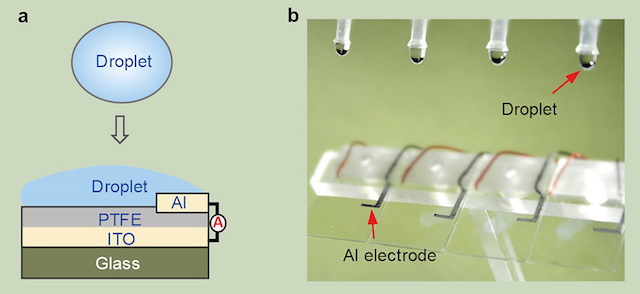
Figure “a” is the schematic diagram of DEG: an ITO glass slide is coated with a thin film of PTFE and an aluminium electrode is put on top of it. Drops of water act as the gate of the transistor and complete the circuit when they hit the surface of the glass. Figure “b” is the optical image showing four parallel DEG devices fabricated on the glass substrate. Photo by CityU.
Unique field-effect transistor-like structure
Another key feature of their design is a unique set of structures similar to a FET, which is a Nobel Prize in Physics winning innovation in 1956 and has become the basic building block of modern electronic devices.
The device consists of an aluminium electrode, and an indium tin oxide (ITO) electrode with a film of PTFE deposited on it. The PTFE/ITO electrode is responsible for the charge generation, storage, and induction. When a falling water droplet hits and spreads on the PTFE/ITO surface, it naturally “bridges” the aluminium electrode and the PTFE/ITO electrode, translating the original system into a closed-loop electric circuit.
With this special design, a high density of surface charges can be accumulated on the PTFE through continuous droplet impinging. Meanwhile, when the spreading water connects the two electrodes, all the stored charges on the PTFE can be fully released for the generation of electric current. As a result, both the instantaneous power density and energy conversion efficiency are much higher.
“Our research shows that a drop of 100 microliters (1 microliter = one-millionth of a liter) of water released from a height of 15 centimeters can generate a voltage of over 140V—and the power generated can light up 100 small LED light bulbs,” said Professor Wang.
He added that the increase in instantaneous power density does not result from additional energy, but from the conversion of kinetic energy of water itself.
“The kinetic energy entailed in falling water is due to gravity and can be regarded as free and renewable,” he said. “It should be better utilized.”
Their research also shows that the reduction in relative humidity does not affect the efficiency of power generation. Also, both rainwater and seawater can be used to generate electricity.
Professor Wang hoped that the outcome of this research would help to harvest water energy to respond to the global problem of renewable energy shortage. “Generating power from raindrops instead of oil and nuclear energy can facilitate the sustainable development of the world,” he added.
He believes that in the long run, the new design could be applied and installed on different surfaces, where liquid is in contact with solids, to fully utilize the low-frequency kinetic energy in water. This can range from the hull surface of a ferry or a coastline to the surface of umbrellas or even the insides of water bottles.
Although people are using their phones more than ever before, studies say that people across all age groups—particularly millennials—are lonelier than ever.
That’s why this new texting platform is aiming to spread kindness and connection all over the world by allowing people to send and receive compassionate texts from strangers.
Text for Humanity, the world’s first texting switchboard, was launched by cloud communications company Sinch in partnership with Mental Health America as a means of fighting social isolation from people’s cell phones.
“Today, nothing is as personal and emotional to us as our phones. But although we use them 24/7 to communicate, we seem to feel lonelier, not happier,” Sinch CMO Jonathan Bean told Good News Network. “At Sinch, we believe mobile communication is the solution, not the problem. So what if people could start to get unconditional love from the phones we love unconditionally?
“We made the world’s first texting switchboard, where you send a text you would love to get, to a stranger,” he continued. “And in turn, you receive a text that someone in the world right now needs to hear. Because we’re more open and honest with strangers, these words have the potential to be relevant, personal and powerful. After all, we are human.”
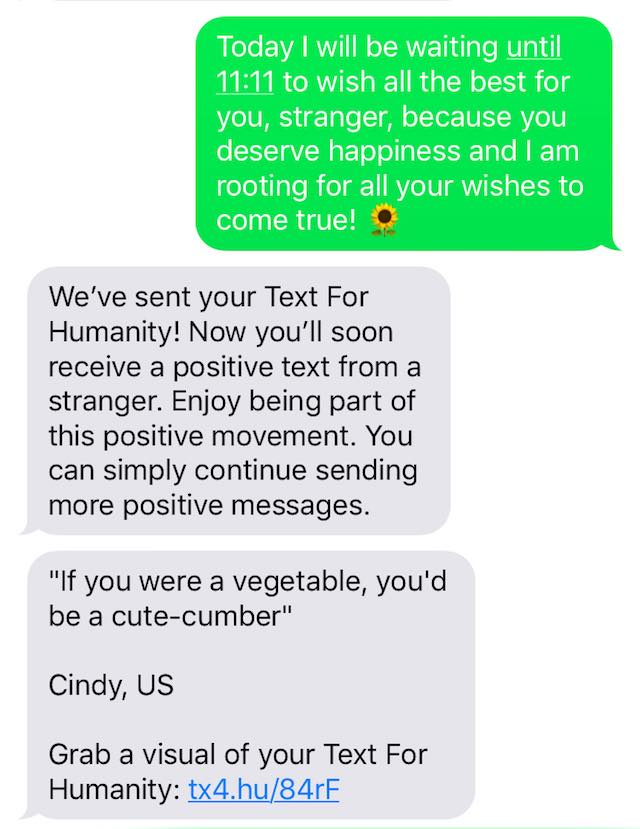
After that, users will simply be asked for their first name and country of origin before they’re ready to write a kind message up to 160 characters long. Each text is then sent to another random user somewhere in the world. In return, the user receives a sweet text from another random stranger.
Users can send and receive up to five texts every day. Since the service launched across 23 different countries last month, more than 7,000 kind texts have already been exchanged.
Mental Health America CEO and president Paul Gionfriddo said: “We know there is a lot of negativity online these days—and by taking a minute to deliver a simple, positive message to someone who may need it, each of us can help brighten someone’s day and lift up their overall mental well-being.”
Photo by Text for Humanity
Send Some Positivity Over To Your Friends By Sharing This Cool Story To Social Media…
Firefighters across the fire-stricken provinces of Australia are rejoicing over the arrival of some much-needed rain.
In just one single day, torrential rainfall across New South Wales and the Australian Capital Territory extinguished about one-third of the active bushfires—and officials say the downpour could put out even more of the fires during the days to come.
Collectively, the rainfall has extinguished 20 of the active fires, leaving 42 fires still blazing across the coast. According to the Sydney Morning Herald, only two of those fires are above the “low-moderate” safety rating.
This is also the largest single-day drop in active wildfires since the fire season began.
Although the downpour has resulted in some flooding across the provinces, the NSW Rural Fire Service says they are “over the moon” to see the rainfall aiding them in their fight against the bushfires.
Many of the bushfires have been fueled by the drought conditions that have plagued eastern Australia for the last three years.
Thanks to the rain, however, Sydney—which is the largest city in Australia—enjoyed their wettest day on record in about 15 months, and weather services are calling for another 350 millimeters of rain this weekend.
It was fantastic to wake up to much-needed rain this morning!
Today has already been the wettest Sydney day in 15 months, and thankfully it’s raining across NSW where we need it most. https://t.co/FsBxow8Zuv
According to The Guardian, the last time the city received more than 100 millimeters of rain in a day was back in November 2018.
“It was fantastic to wake up to much-needed rain this morning!” says Sydney Lord Mayor Clover Moore. “Today has already been the wettest Sydney day in 15 months, and thankfully it’s raining across NSW where we need it most.”
The NSW Rural Fire Service says that more than 1,200 firefighters are currently taking advantage of the weather conditions to continue containing the fires while their division simultaneously prepares for the upcoming flood warnings.
So nice listening to rain falling last night & driving with windscreen wipers on for a change this morning. @BOM_NSW indicates continued rain this next week & importantly, falls across our fire areas which will be so welcomed by our farmers, fire fighters & all affected. #NSWRFSpic.twitter.com/gJ3aFRQlzF
This is the incredible moment a hungry skydiver managed to have pizza delivered to her at more than 2,000 feet in the air.
24-year-old McKenna Knipe, who is known for her high altitude “food reviews” was filmed during her 300th jump at Skydive City in Tampa, Florida.
The footage shows fellow skydiver Brain Stempin perching himself atop Mckenna’s parachute before producing a Dominos pizza and delivering it to her during the duo’s descent.
“This jump took place at Skydive City on my birthday, January 14, 2020,” said McKenna. “It was my 300th jump, along with my first CRW jump. CRW stands for ‘canopy relative work’—it is considered one of the most dangerous disciplines in skydiving.
“I met Brian Stempin about two hours before we did the jump. Brian is what the skydiving world calls an experienced CRW Dawg.”
“He said he had the idea to deliver a pizza to me during a CRW jump for quite some time … so we met and immediately made it happen. My lose friends Anthony Zerbonia and Charlie Mather picked up a Dominos pizza while Brian gave me an hour-long safety debriefing (listing all the things that could go wrong and how to handle it).”
“We jumped at 13,000 ft and Anthony Zerbonia and Garth Baker trailed behind us getting outside video.
“We managed to pull off several docks, a down plane, and pizza delivery by 2,000 feet. It was the most epic jump I have done to date. Life is awesome.”
(WATCH the video below)
Fall For The Good News By Sharing It With Your Friends On Social Media…
Quote of the Day: “The world is full of temptations… Always let your conscience be your guide.” – Walt Disney’s Pinocchio (debuted 80 years ago)
Photo: by Benjamin Davies – public domain
With a new inspirational quote every day, atop the perfect photo—collected and archived on our Quotes page—why not bookmark GNN.org for a daily uplift?
Photo by Kathrin Pienaar / University of Washington
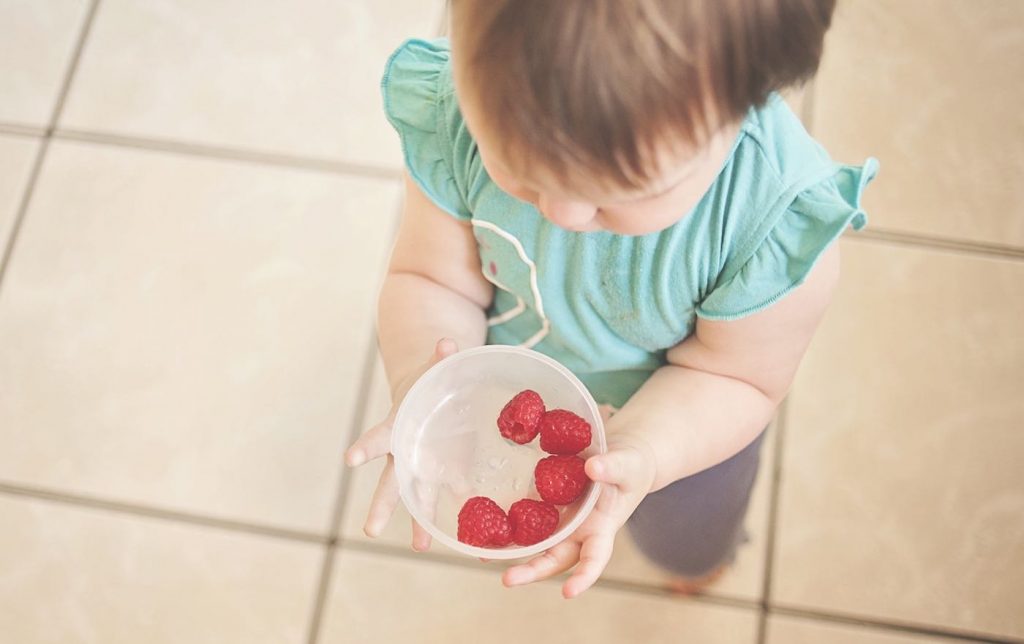
Altruistic helping—the act of giving away something desirable, even at a cost to oneself—is perhaps most evident when it comes to food.
Photo by the University of Washington
Human adults often respond to hungry people, whether through food banks or fundraisers, or by simply handing over their lunch. But when does that spirit of giving start?
New research by the University of Washington’s Institute for Learning & Brain Sciences (I-LABS) finds that altruism may begin in infancy. In a study of nearly 100 toddlers who were 19 months-old, researchers found that the children gave a desirable snack to a stranger in need, even when they, themselves, were hungry. The findings not only show that young tots engage in altruistic behavior, but also suggest that early social experiences can shape that altruism.
The study is published online this week in Scientific Reports, an open-access journal from the Nature Publishing Group.
“We think altruism is important to study because it is one of the most distinctive aspects of being human. It is an important part of the moral fabric of society,” said Rodolfo Cortes Barragan, a postdoctoral researcher at I-LABS and lead author on the study. “We adults help each other when we see another in need and we do this even if there is a cost to the self. So we tested the roots of this in infants.”
Non-human primates have been found to cooperate, and to share resources under restricted conditions—but non-human primates, such as chimpanzees, don’t actively hand over delicious food that they need themselves.
Photo by Kathrin Pienaar / University of Washington
I-LABS researchers wanted to test whether human infants were able to act beyond self-interest when faced with one of the most fundamental biological needs: food.
For this study, researchers chose kid-friendly fruits—including bananas, blueberries, and grapes—and set up an interaction between child and researcher. The goal was to determine whether the child would—without encouragement, verbal instruction, or reinforcement—spontaneously give an appealing food to an unfamiliar person.
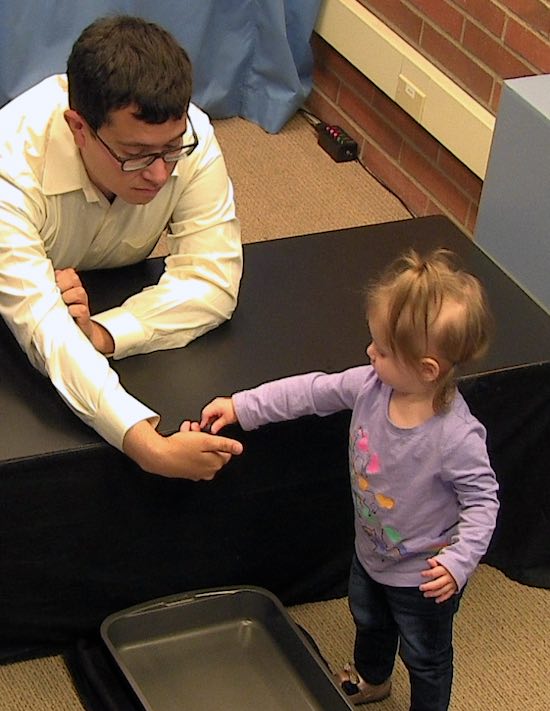
In the experiment, the child and the adult researcher faced each other across a table at I-LABS, and the researcher showed the child a piece of fruit. What happened next was determined by whether the child was in the control group, or the test group. In the control group, the researcher gently tossed the piece of fruit onto a tray on the floor beyond reach but within the child’s reach. The researcher showed no expression and made no attempt to retrieve the fruit.
In the test group, the researcher pretended to accidentally drop the fruit onto the tray, then reach for it unsuccessfully.
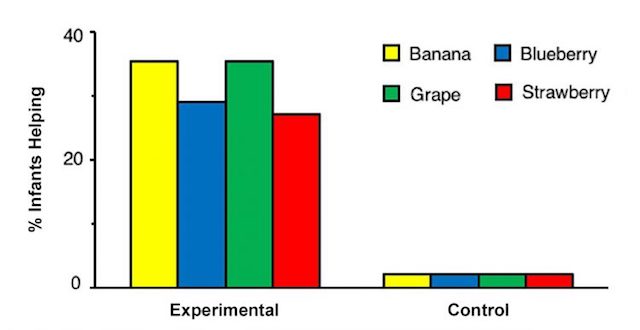
That reaching effort—the adult’s apparent desire for the food—seemed to trigger a helping response in the children, researchers said: More than half the children in the test group picked up the fruit and gave it to the adult, compared to 4% of children in the control group.
In a second experiment with a different sample of children, parents were asked to bring their child just before their scheduled snack or mealtime when the child was likely to be hungry. Researchers reasoned that this would raise the “cost to self” that defines altruism. The control and test group scenarios were repeated, but with children who were now more motivated to take the fruit for themselves. The results mirrored those from the previous study. Fully 37% of the test group offered the fruit to the researcher while none of the children in the control group did so.
“The infants in this second study looked longingly at the fruit, and then they gave it away!” said Andrew Meltzoff, who is co-director of I-LABS and holds the Job and Gertrud Tamaki Endowed Chair in psychology. “We think this captures a kind of baby-sized version of altruistic helping.”
Scientific Reports/Barragan, et al.
The research team also analyzed the data in different ways—whether children offered fruit on the first trial of the experiment or got better during the process, for example, and whether children from particular types of family environments helped more.
The researchers found that infants helped just as well on the very first trial of the experiment as on later trials, which Barragan said is informative because it shows that the children did not have to learn to help during the study and needed no training. Indeed, children spontaneously and repeatedly helped a person from outside of their immediate family.
The researchers also found that children with siblings and from certain cultural backgrounds were especially likely to help the adult, indicating that the expression of infant altruism is malleable. These results fit well with previous studies with adults that show positive influences of having a cultural background that emphasizes “interdependence,” that is, a background that places particular value on how much an individual feels connected to others.
“We think certain family and social experiences make a difference, and continued research would be desirable to more fully understand what maximizes the expression of altruism in young children,” says Barragan. “If we can discover how to promote altruism in our kids, this could move us toward a more caring society.”
A novel salt-tolerant bacterium cultured from the Red Sea effectively removes nitrogen from salty wastewater—and it could be used to treat sewage coming from toilets that use seawater for flushing in place of freshwater.
Less than 1% of Earth’s water is fresh and also accessible for human use. The world’s population is expected to grow to about ten billion by 2050 and will continue to place increasing pressure on this already rare resource.
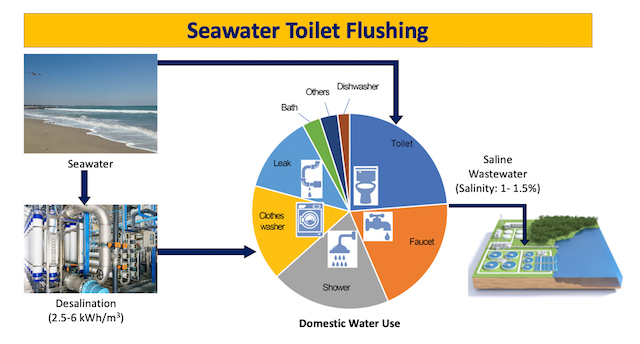
Currently, toilet flushing accounts for about 30% of the world’s total domestic water demand, and using seawater could alleviate that pressure on freshwater resources. A research team from King Abdullah University of Science and Technology (KAUST) believes they have figured out how it can be done efficiently.
“Seawater toilet flushing is already in practice in Hong Kong, Singapore and Tokyo,” says KAUST research scientist Muhammad Ali.
More coastal cities might follow suit except that the high salt content of seawater would limits the performance of conventional nitrogen-removing bacteria used in the treatment processes “because they have low salt tolerance.” Nitrogen needs to be removed from wastewater due to its negative effects on the environment and human health.
Ali and Dario Rangel Shaw, both in Pascal Saikaly’s lab, conducted three years of tests to find whether the bacterium Candidatus Scalindua sp. AMX11, which they cultured from the Red Sea, could effectively remove nitrogen from salty wastewater.
Photo by Muhammad Ali / KAUST
Currently, the most energy-efficient method to do this involves the use of granules containing two types of nitrogen-removing bacteria. But one of these, an anaerobic ammonium oxidation bacteria, or anammox bacteria for short, has a very low tolerance for and effectiveness in saltwater.
On the other hand, Candidatus Scalindua sp. AMX11 was around 90% effective in treating wastewater with a salinity of about 1.2% and demonstrated high nitrogen removal rates. The tests were on real seawater—unlike other studies that used artificial versions.
“The findings demonstrate a proof of concept, and the next step is to demonstrate this technology in a microbial granular system containing Candidatus Scalindua sp. AMX11 bacteria and the other types of bacteria necessary for a full-scale wastewater treatment process,” explains Saikaly.
Muhammad Ali tests the effectiveness of Candidatus Scalindua sp. AMXII at treating salinated wastewater – Photo by Anastasia Khrenova / KAUST
The team is also working with a Saudi fertilizer company to test its bioprocess for treating industrial wastewater.
Check out the pawsome moment that an ingenious cat came to the rescue of his owner after she found herself locked out of her home without her keys one year ago.
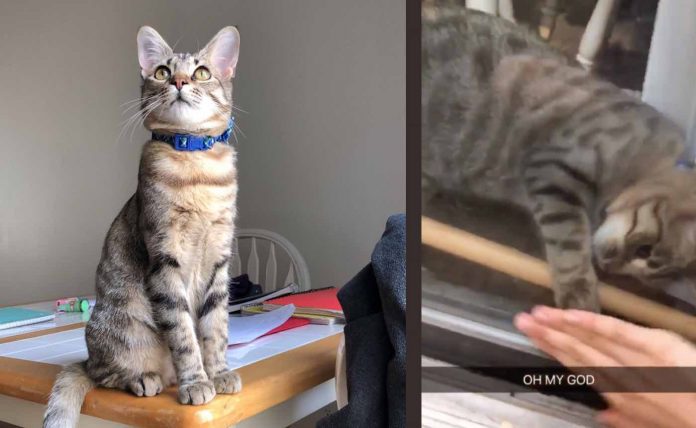
Boko the cat and Gabriella Tropea have been virtually inseparable since she rescued him as a stray on her college campus—and after Tropea was locked out of her house in Austin, Texas, he finally got to repay the favor by rescuing her in return.
Back in February 2019, Tropea briefly stepped outside of her home in Austin, Texas so she could walk her little sister Isabelle to school.
Upon returning to her house, however, Tropea was dismayed to find that her sister had accidentally locked the door behind them—and Tropea had left her keys inside.
“I got to the front door and Boko could hear me trying to get in,” Tropea told The Dodo. “He started crying and scratching at the door.”
Tropea ended up circling around to the rear patio where the back sliding door was kept closed by a wooden stick jammed into the door frame—and that’s when the dynamic duo got an idea.
“He started rubbing his face on the stick and I was encouraging him to mess with it. I was coaching him to lift it up,” Tropea told the news outlet. “He understood what I was trying to tell him and he started lifting it up!”
My sister accidentally locked me out of the house so I went to check if the back door was unlocked and this happened pic.twitter.com/2zkjeyFJk5
After some brief coaxing, Boko finally managed to pull the stick free so Tropea could get back inside her house.
Since she shared the video to social media, it has been viewed more than 7 million times, although Tropea says she was “not surprised this blew up because Boko is a hero and he deserves this.”
Although Boko did not comment on his sudden rise to internet stardom, Tropea did reassure Twitter users that the cat was appropriately showered with kitty treats and snacks.