It took a determined filmmaker an entire year to film this mini-documentary about a 9-year-old girl and her life on the grasslands of Tibet – and the results are breathtaking.
Martin Buzora is the cinematic mastermind behind the 5-minute film “The Story of Pema”. The short film, which he says is the first Western film of its kind to come out of Tibet, portrays the simple life and beliefs of a Tibetan girl named Pema.
“Peace is all around me,” proclaims the young girl whose happy nomadic family lives off the land.
Buzora told Good News Network that he was inspired to make the documentary after spending years of his life dreaming about the magical nature of the region. Since it was released last month, the director hopes his creation has given people an understanding of the cultural significance of the Tibet and its people.
“I wanted to pay respects to a culture I love very much,” Buzora wrote in an email. “It has been my fever dream since I was a boy reading ‘The Adventures of Tintin’ to visit this enchanted and mysterious land—and getting the opportunity to make a film in Tibet has been the greatest opportunity of my career.
“With the continual modernization of China, the nomadic cultures of the Tibetan grasslands are rapidly disappearing,” he added. “This documentary portrait about Pema is not only a love song to an ancient nomadic way of life, but also an anthropological record of a culture whose survival into the future is unclear.”
If you want to check out Buzora’s other cinematic works and world travels, you can check out his website or Instagram page.
(WATCH the gorgeous mini-doc below)
Be Sure And Share The Incredible Story With Your Friends On Social Media…
Quote of the Day: “Let go of those grand fantasies that make us strive to be perfect instead of compassionate.” – Mark Nepo
Photo: by zervas, CC license
With a new inspirational quote every day, atop the perfect photo—collected and archived on our Quotes page—why not bookmark GNN.org for a daily uplift?
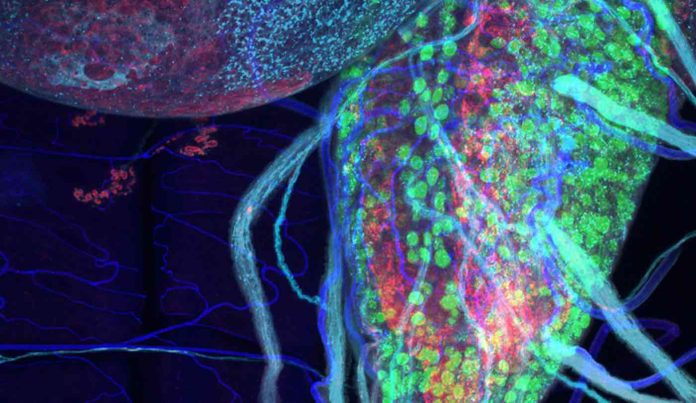
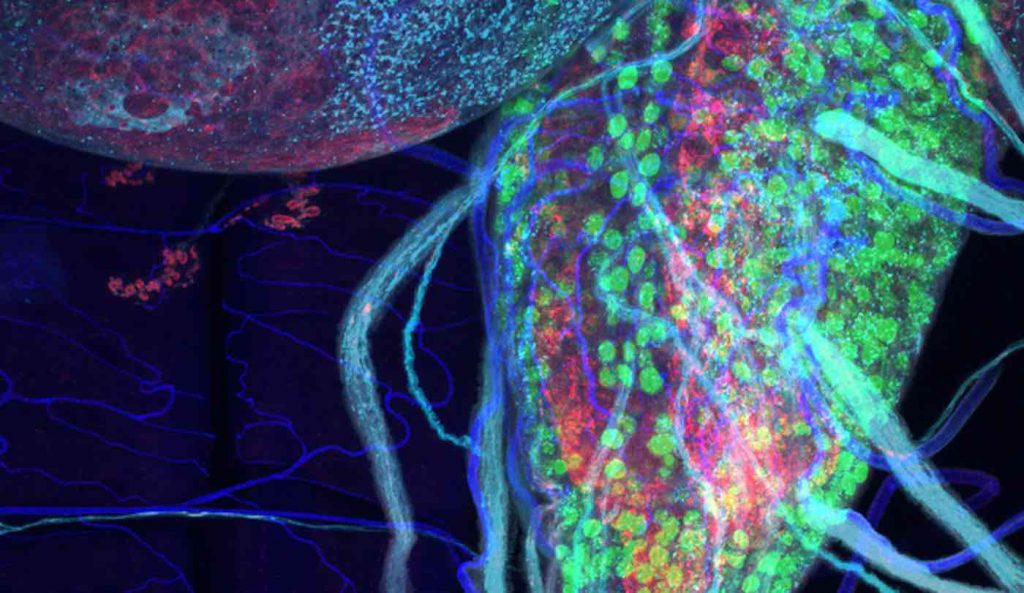
The researchers observed brain lobes of ALS-affected fruit flies under a microscope. Pictured is a nerve cord, populated with green-stained motor neurons, expressing human glucose transporters. Areas of neurotransmitter release are shown in red, while muscles are shown in blue. (Courtesy of the Zarnescu Lab)
Increased glucose, transformed into energy, could give people with ALS improved mobility and a longer life, according to a new study.
Physicians have long known that people with ALS experience changes in their metabolism that often lead to rapid weight loss in a relentless cycle called hypermetabolism, according to the University of Arizona-led research team.
People with ALS use more energy while resting, compared to those without the disease, while simultaneously they often struggle to effectively make use of glucose, the precise ingredient a body needs to make more energy. Experts have not known exactly what happens in a patient’s cells to cause this dysfunction or how to alleviate it.
“This project was a way to parse out those details,” said the study’s lead author Ernesto Manzo, who described the results, published online in eLife, as “truly shocking.”
The study revealed that when ALS-affected neurons are given more glucose, they turn that power source into energy. With that energy, they’re able to survive longer and function better. Increasing glucose delivery to the cells, then, may be one way to meet the abnormally high energy demands of ALS patients.
“These neurons were finding some relief by breaking down glucose and getting more cellular energy,” Manzo said.
ALS is almost always a progressive disease, eventually taking away patients’ ability to walk, speak and even breathe. The average life expectancy of an ALS patient from the time of diagnosis is two to five years.
Previous studies on metabolism in ALS patients have focused primarily on what happens at the whole-body level, not the cellular level, explained Daniela Zarnescu, UA professor of molecular and cellular biology and senior author on the study.
The researchers observed brain lobes of ALS-affected fruit flies under a microscope. Pictured is a nerve cord, populated with green-stained motor neurons, expressing human glucose transporters. Areas of neurotransmitter release are shown in red, while muscles are shown in blue. (Courtesy of the Zarnescu Lab)
“The fact that we uncovered a compensatory mechanism surprised me,” Zarnescu said. “These desperate, degenerating neurons showed incredible resilience. It is an example of how amazing cells are at dealing with stress.”
The novelty of the findings partially lies in the fact that metabolism in ALS patients has remained poorly understood, Zarnescu said.
“It’s difficult to study, in part because of limited accessibility to the nervous system,” she said.
Because scientists can’t scrape away neurons from the brain without causing irreparable damage to a patient, the researchers used fruit flies as a model.
“Fruit flies can teach us a lot about human diseases,” Manzo said.
In the lab, he and Zarnescu used high-powered microscopes to observe the motor neurons of fruit flies in their larval state, paying close attention to what happened as they provided more glucose.
They found that when they increased the amount of glucose, the motor neurons lived longer and moved more efficiently. When the researchers took glucose away from the neurons, the fruit fly larva moved more slowly.
Their findings were consistent with a pilot clinical trial, which found a high carbohydrate diet was one possible intervention for ALS patients with gross metabolic dysfunction.
“Our data essentially provide an explanation for why that approach might work,” Zarnescu said. “My goal is to convince clinicians to perform a larger clinical trial to test this idea.”
These breathtaking new photographs show a sprawling English countryside bursting with color after hundreds of thousands of poppies bloomed for the first time in years.
The landscape is a lush sea of dazzling red flowers against a backdrop of mist gathering over the rolling Worcestershire hills.
The stunning snaps were taken by photographer Verity Milligan on farmland near Bewdley just before dawn of the day after the summer solstice.
36-year-old Milligan said the poppy field has returned to its former glory after it had been dug up in 2013. The blossoms will only be in bloom for a couple of weeks.
“I got up super early, around 2:25AM, and there was a one-hour drive from Birmingham,” said Milligan.
“There was mist on the valley which was great – we photographers are always chasing mist.
SWNS
“I looked round to find the best vantage point and then waited for the sunrise at around 4:40AM.
“They have been like this for a good week, but they will probably only be around for another week. They are looking their best about now.
SWNS
“We have had a lot of rain, so they may well hang around a bit longer than usual.
“There used to be poppies every year. Its a truly magical sight and I was delighted with the result,” she added.
SWNS
Plant Some Positivity Amongst Your Friends By Sharing These Gorgeous Photos To Social Media…
Scientists have published an intriguing new study on how coffee may be relied upon to do much more than just wake us up in the morning.
Researchers from the University of Nottingham have discovered that drinking a cup of coffee can stimulate “brown fat”, the body’s own fat-fighting defenses, which could be the key to tackling obesity and diabetes.
The study, published earlier this week in the journal Scientific Reports, is one of the first to be carried out in humans to find components which could have a direct effect on “brown fat” functions, an important part of the human body which plays a key role in how quickly we can burn calories as energy.
Brown adipose tissue (BAT), also known as brown fat, is one of two types of fat found in humans and other mammals. Initially only attributed to babies and hibernating mammals, it was discovered in recent years that adults can have brown fat too. Its main function is to generate body heat by burning calories (as opposed to white fat, which is a result of storing excess calories).
People with a lower body mass index (BMI) therefore have a higher amount of brown fat.
“Brown fat works in a different way to other fat in your body and produces heat by burning sugar and fat, often in response to cold,” said Professor Michael Symonds, from the School of Medicine at the University of Nottingham who co-directed the study.
“Increasing its activity improves blood sugar control as well as improving blood lipid levels and the extra calories burnt help with weight loss. However, until now, no one has found an acceptable way to stimulate its activity in humans.
“This is the first study in humans to show that something like a cup of coffee can have a direct effect on our brown fat functions. The potential implications of our results are pretty big, as obesity is a major health concern for society and we also have a growing diabetes epidemic and brown fat could potentially be part of the solution in tackling them.”
The team started with a series of stem cell studies to see if caffeine would stimulate brown fat. Once they had found the right dose, they then moved on to humans to see if the results were similar.
The team used a thermal imaging technique, which they’d previously pioneered, to trace the body’s brown fat reserves. The non-invasive technique helps the team to locate brown fat and assess its capacity to produce heat.
“From our previous work, we knew that brown fat is mainly located in the neck region, so we were able to image someone straight after they had a drink to see if the brown fat got hotter,” said Professor Symonds.
“The results were positive and we now need to ascertain that caffeine as one of the ingredients in the coffee is acting as the stimulus or if there’s another component helping with the activation of brown fat. We are currently looking at caffeine supplements to test whether the effect is similar.
“Once we have confirmed which component is responsible for this, it could potentially be used as part of a weight management regime or as part of glucose regulation program to help prevent diabetes.”
This German circus has replaced their animal performances with a stunning animal-themed hologram light show – and they hope that it will inspire other circuses to do the same.
According to German news outlets, the Circus Roncalli has been entertaining audiences since 1976, yet they started phasing out the use of performing animals in the 1990s.
Recently, the circus decided to employ a production team to create an elaborate new hologram show that uses the images of animals.
It takes 11 different projectors to display the 360º light show, and audiences have been enthralled. The show depicts dazzling herds of horses, a performing elephant, and even a massive golden goldfish in the middle of the stage.
Animal rights activists are hailing the circus as a role model for eliminating the exploitation of live performing animals, while still giving audiences a look at their magnificence.
With various states and countries implementing legislative bans on the use of animals as performers, Circus Roncalli provides a stellar example that others can— follow.
(WATCH the holograms in action in the video below) – Photo by Optoma EMEA
Be Sure And Share The News With Your Friends On Social Media…
Quote of the Day: “Until he extends his circle of compassion to include all living things, man will not himself find peace.” – Albert Schweitzer
Photo: by brian donovan, CC license
With a new inspirational quote every day, atop the perfect photo—collected and archived on our Quotes page—why not bookmark GNN.org for a daily uplift?
This story was submitted as a nomination to the Reader’s Digest “Top 50 Nicest Places in America” contest: a crowd-sourced effort to uncover nooks where people are still kind and respectful in an era of cultural and political divides. Be sure and vote for which story you think should be nominated as the Nicest Place by visiting the Reader’s Digest website.
Photo by Mike Miller
After an ugly incident split this town, the citizens found common ground when they anointed a homeless poet their “adopted grandfather.”
Ask people what they like about Kingman and they’ll bring up the man known as Santa James. Santa James, AKA James Zyla, is a former real-estate salesman turned wandering poet who has become the town’s “adopted grandfather,” according to the local police chief. He’s also homeless.
When residents discovered his thoughtful nature and musical gifts, they teamed up to make sure he always has a place to stay, gigs to play, and a helping hand when he needs it. In return, he shares hugs, songs, and his one-of-a-kind free spirit.
“There exists in Kingman a spirit of generosity,” Santa James told the Los Angeles Times last year. “It’s not just the young or the old. It permeates the generations.”
The town of about 25,000 people sits on the legendary Route 66, about 100 miles south of Las Vegas. Once home to a major military base and mining economy, later bypassed by the interstate and half-forgotten, Kingman got a black eye a few years ago when comic Sacha Baron Cohen’s television cameras captured a rowdy crowd of locals shouting down a proposed mosque. Kingman residents decried the intolerance—the city has had a mosque for thirty years, along with a well-established immigrant population—and locals stepped up their efforts to showcase the city’s best qualities.
“The community was very upset,” says our nominator, Coleen Haines, who has been at the heart of that effort as a city PR specialist. “Kingman is a welcoming place.”
Santa James has become the symbol of the town’s best spirit, Haines says. His story shows that Kingman is the kind of place that finds room for anybody who helps make it better, even if it’s just with a smile and a song.
“The mayor gave him a key to the city,” she says. “It showed how we really go out of the way to help people.”
Reprinted with permission from Reader’s Digest. To learn more about GNN’s part in searching for the Top 10 Nicest Places, click here.
(WATCH the poet in action as he plays the piano in the video below)
Be Sure And Share This Sweet Story Of Community With Your Friends On Social Media…
It has been 50 years since this iconic Ohio river caught fire – but now, it has become a poster child for environmental transformation.
Running through the city of Cleveland, the Cuyahoga River had already caught fire several times prior to the infamous blaze on June 22nd, 1969. The flames were a byproduct of the sheer amount of oil, chemicals, sewage, and pollution from the city’s heavily industrialized infrastructure.
“It smelled like a septic tank,” one Cleveland native told Nat Geo. “It literally bubbled and produced methane in July and August. It wasn’t bad—it was terrible. You can’t describe it using printable language.”
Though it was not the first fire on the river, it was to be the last. Cleveland lawmakers became tired of companies and manufacturers treating the river like their own personal dumping grounds and they went before Congress to demand a change.
After city legislators rallied for federal intervention, the fire on the Cuyahoga River sparked the passage of the Clean Water Act and helped to inspire the creation of the EPA.
Over the course of the last 50 years, the act has helped to protect and preserve hundreds of waterways across the US – including the Cuyahoga River.
The river now boasts over 70 species of fish, all of which are edible. In addition to the shoreline now supporting dozens of birds and local wildlife, the waters are now open for swimming, paddle-boarding, and other recreational activities.
“People can see fish leaping out of the water here in the industrial shipping channel,” Jane Goodman, executive director of Cuyahoga River Restoration, told Nat Geo. “We had become the poster river for everything that could go wrong with a river. Now we’re a poster river for everything that can go right. It’s the Lazarus river—it came back from death.”
(WATCH the news coverage below or our international viewers can watch the footage on the CBS News website)
Clean Up Negativity By Sharing The Good News To Social Media…
A Chick-Fil-A employee is being hailed as a hero after he rushed to help a choking child who had somehow managed to get tangled in his seatbelt.
Logan Simmons had been working a shift at the restaurant in Hall County, Georgia when a distressed mother started calling for help from the drive thru lane.
While the woman was in the driver’s seat of her car, her 6-year-old son had gotten the seatbelt wrapped around his neck – and his face was quickly losing color.
When Logan heard the calls for help from the drive thru window, he leapt out of the window and rushed over to the woman’s car. He then climbed into the vehicle and used his pocketknife to cut the boy free from the seatbelt.
Needless to say, the frantic mother was overwhelmed with gratitude for the teen’s intervention.
Simmons’s mother also expressed pride in her heroic son when she told WSB-TV: “I’m amazed he didn’t panic. As his mother, I would have panicked. I’d be running around going, ‘Oh my gosh! What do we do?’”
Logan, on the other hand, says that he is just happy that he was in the right place at the right time.
(WATCH the news coverage below)
Save Your Friends From Negativity By Sharing The News To Social Media…
For the first time in 17 years, there will be no whaling in Icelandic waters this summer.
Due to a shrinking international market for whale meat and the expansion of a no-fishing coastal zone, both of the nation’s major whaling companies have decided to abandon their summer hunting season altogether, meaning that no whales of any kind will be hunted in Iceland.
IP-Utgerd – a company specializing in harpooning minke whales – said that the expansion of the no-fishing zone would force their ships to travel farther out to sea, making the venture far more costly than usual. The company now says that they will be focusing on collecting sea cucumbers for the summer, according to Icelandic news platform RUV.
Hvalur, the other Icelandic whaling company, specializes in harpooning fin whales – an endangered species that is hailed for being the second largest whale in the world.
Though the company typically exports 100% of their catch to Japan, a shrinking demand for whale meat has prompted them to abandon their summer harpooning.
Whalers have been hunting in Icelandic waters since the country lifted their restrictions on whaling in 2003. Though the companies may reconsider their whaling ventures next summer, environmentalists and marine biologists are rejoicing over this year’s harpooning respite.
Be Sure And Share This Whale Of A Tale With Your Friends On Social Media – File photo by Mike Pennington, CC
Whether it was divine intervention or just a serendipitous signal from the sky, an anxious Chinese college student was given the perfect sign of encouragement earlier this month.
The student had been studying for her exams in Shaoguan, Guangdong when she saw a cloud that was shaped like a thumbs up.
“I had been feeling very low, and after I saw the cloud I became much happier,” the student told Chinese video platform Pear. “I was so excited.”
Since the unidentified student shared the photo to social media, it has been shared thousands of times.
The cloud’s similarity to a social media “Like” button prompted one user to say: “You photographed the ‘Like’ cloud, so it means you will do well on your exam!”
Another enthusiastic commenter said: “Even the universe is encouraging you!”
A third Weibo user, who is also a university candidate, said: “I feel confident about my exam too after seeing the pictures.”
Perhaps the cloud’s formation was just a sweet coincidence, but it has apparently done a fine job of encouraging internet users to do their best.
Encourage Your Friends By Sharing The ‘Like’ Cloud To Social Media…
Quote of the Day: “Hope is the thing with feathers that perches in the soul and sings the tune without the words—and never stops at all.” – Emily Dickinson
With a new inspirational quote every day, atop the perfect photo—collected and archived on our Quotes page—why not bookmark GNN.org for a daily uplift?
Photo by Akshar Foundation / View Finder Photography
Rather than requiring families to pay for kids’ education, this clever little school is asking students to collect plastic waste from around their communities. Hear our Good News Guru tell the inspiring story on the radio in Los Angeles—during the June 7, 2019 Ellen K. Morning Show on KOST-103.5.
This story was submitted as a nomination to the Reader’s Digest “Top 50 Nicest Places in America” contest: a crowd-sourced effort to uncover nooks where people are still kind and respectful in an era of cultural and political divides. Be sure and vote for which story you think should be nominated as the Nicest Place by visiting the Reader’s Digest website.
Photo by Lydia Clark-Sumpter via Reader’s Digest
Crimes of compassion are nothing new in this melting pot, where everyone gets along, no matter what part of the world they came from.
Three years ago, when Lydia Clark-Sumpter moved to Harding Park, a blue-collar neighborhood of 236 tidy homes on the East River in New York City’s Bronx borough, there was a big smiley-face balloon tied to her front gate, and no clue as to who left it.
She didn’t know it at the time, but Clark-Sumpter, a pediatric nurse practitioner at Mount Sinai St. Luke’s hospital, was the victim of a crime of compassion. She would soon find out that there were kindness vigilantes on the loose in her new neighborhood, a diverse enclave, where 22 flags representing the nationalities of the people who live there fly outside the homeowners association.
That winter, after a bad storm, Clark-Sumpter opened her door, ready to dig herself out, only to find that someone had already saved her the trouble.
“Not only did they shovel, but they came in the gate and all the way up to the front door,” she says. Later that year, she returned from work to find a bag of fresh-picked tomatoes, cucumbers, and eggplants on her patio.
Clark-Sumpter wasn’t the only victim. Retired NYPD detective Elbin Mena, who has lived in Harding Park for 35 years, also found his walk mysteriously shoveled that winter. He knew to expect such things and was prepared. He has motion-sensor cameras, and when he reviewed the video footage, he was able to identify—and thank—his neighbor.
On that same block, garbage cans are mysteriously hauled back up driveways on garbage day. José Gonzalez, president of the Harding Park Homeowners Association, knows who is responsible: It’s Mena who is sparing his neighbors that little pain. (Until now, Gonzalez had kept Mena’s secret.)
As for the welcoming neighbor who tied a balloon to Clark-Sumpter’s front gate? The perpetrator is still on the loose. When you live in Harding Park, you have to get used to that kind of thing. That’s just life in a high-crimes-of-compassion neighborhood.
Reprinted with permission from Reader’s Digest. To read the full Cedar House nomination, you can visit the Reader’s Digest website. To learn more about GNN’s part in searching for the Top 10 Nicest Places, click here.
Be Sure And Share This Inspiring Story Of Recovery With Your Friends On Social Media…
Imagine if your printer had an “unprint” button that used pulses of light to remove toner, curbing environmental impacts compared with conventional paper recycling.
A Rutgers-led team has created a new way to unprint paper that, unlike laser-based methods, can work with the standard, coated paper used in home and office printers. The new method uses pulses of light from a xenon lamp, and can erase black, blue, red and green toners without damaging the paper, according to a study in the Journal of Cleaner Production.
“Our method makes it possible to unprint and then reprint on the same paper at least five times, which is typically as many times paper can be reused with conventional recycling,” said study co-author Rajiv Malhotra, an assistant professor in the Department of Mechanical and Aerospace Engineering in the School of Engineering at Rutgers University–New Brunswick.
“By eliminating the steps involved in conventional recycling, our unprinting method could reduce energy costs, pollution and greenhouse gas emissions.”
Conventional recycling of coated paper is a major contributor to climate change emissions, chemical pollution and energy use, according to the study. Extending the life of paper while avoiding these recycling steps would yield significant environmental benefits.
The engineers’ next steps are to further refine the method by testing additional toner colors on a wider range of paper types. Unprinting can be done with simple equipment and a wipe with a very small amount of benign alcohol, and the engineers are working to integrate unprinting with typical office and home printers.
This story has been reprinted from its original publishing date in July 2015 for #ThrowbackThursday.
Usually when you hear stories about older people crashing cars into buildings, it’s by accident.
But when 91-year-old Walter Thomas of Woodstock, Illinois rammed a car through a garage door, it was a very deliberate dream come true.
When Thomas told his granddaughter Becky that his one and only fantasy was to drive through a garage door, she got to work figuring out how to make it happen.
Eventually, she and her family were able to track down both a demolition car and a garage door that was already worn down and going to be replaced anyway.
When Thomas came crashing through the garage in reverse, Becky said “it was like he was a little boy again.”
Thomas also said that the garage stunt was so much fun, he might consider sky diving next.
(WATCH the stunt below or our international readers can watch the video on the CBS News website)
Be Sure And Drive Your Friends To This Story BySharing It To Social Media…
It’s already challenging enough for environmentalists to keep beaches clear of washed up trash and plastic debris – but the most difficult problem lies in cleaning up all of the millions of tiny microplastics that are impossible to pick up and separate from the sand.
Fortunately, a group of engineering students succeeded in developing a massive new vacuum cleaner that can collect microplastics without removing any of the sand from the beach.
The 12 Canadian students from the University of Sherbrooke in Quebec built their Hoola One plastic vacuum cleaner as a class project.
“We did some research and we realized there was no machine around the world to do this kind of job,” Hoola One co-founder Sam Duval told Hawaii Public Radio. “So we told each other, ʻWe will invent it,’ and we did it.”
Using a handheld hose, the machine sucks up plastic and sand and dumps it all into a massive tank of water. Since rocks and sand are heavier than plastic, they sink to the bottom of the tank so they can be dumped back onto the beach. The plastic, on the other hand, floats to the top of the tank.
As a means of testing their machine’s efficiency, they recently used it on the sands of Hawaii’s Kamilo Beach – which is also notorious for being one of the dirtiest beaches in the world.
Though their first prototype experienced a number of technical issues, the students managed to fix the problems and tidy up the beach.
According to Hawaii Public Radio, the team left the Hoola One vacuum on the island as a donation to the state department. They are now researching the ecological impacts of the vacuum on the beach while they search for funding and sponsorships to produce more Hoola One vacuums.
Assuming they are successful, then the machines could start cleaning up beaches around the world.
(WATCH the video below) – Photo by Hawaii DNLR
Clean Up Negativity By Sharing The Good News To Social Media…
Feuzi was concerned when he saw the child approach the open window. Shortly after he crossed the street, Doha tumbled out of the window – but luckily, she fell straight into the arms of the teenager.
Grateful for the teen’s rescue, Doha’s family gave Feuzi 200 Turkish Lira ($35) as a reward – but he insists that he was simply happy to do the right thing.
(WATCH the video below)
Save Your Friends From Negativity By Sharing The Story To Social Media…
Quote of the Day: “Think well of yourself and proclaim this fact to the world, not in words but in great deeds.” – C. Larson
Photo: Women in Nepal – by World Bank Collection, CC license
With a new inspirational quote every day, atop the perfect photo—collected and archived on our Quotes page—why not bookmark GNN.org for a daily uplift?