All News - Page 873 of 1724 - Good News Network
Home Blog Page 873

Wild Dog Thought to Be Extinct Resurfaces in the Mountains

For the first time in over half a century, a wild dog thought to be extinct was sighted in New Guinea.

The New Guinea Wild Dog, similar to the New Guinea Singing Dog (NGSD), is the rarest, most ancient canid currently living (Prior to this discovery, there were only known to be about 200 to 300 NGSDs living in captivity).

With no confirmed reports of wild specimens and only two potentially credible photographs, many feared that the New Guinea Wild Dog had become extinct in its native range and habitat along New Guinea’s remote central mountain spine.

RELATEDBaby Tortoises Survive on Galapagos Island for First Time in 100 Years

Then in September 2016, inspired by nearly three decades of study by Dr. I. Lehr Brisbin of the University of Georgia, and after 3 and a half years of preparation, scientists from the University of Papua conducted a rapid assessment survey that was able to locate and document definitive proof of an apparently healthy, viable population of New Guinea Wild Dogs.

Based on that evidence along with reports from locals, trail cameras were deployed which captured over 100 photographs of at least 15 individuals, to include males, females, and pups ranging in age from about 3 to 5 months, living in isolated locations across the mountain range.

The New Guinea Wild Dog is likely the best living canid example available to scientists outside the fossil record, predating human agriculture and representing a critical “missing link” species having evolved little – and more importantly, free from selective breeding influences imposed by humans – since the time before the dawn of agriculture.

Click To Share This Pawesome Story With Your Friends (Photo by New Guinea Highland Wild Dog Foundation)

El Salvador Becomes First Country to Ban Toxic Metals Mining

The smallest country in Central America has just passed a pretty big law regarding metal mining.

El Salvador has just become the first country in the world to totally prohibit the exploration and mining of metals above or within the earth.

The law was passed by 70 different lawmakers on Wednesday in an effort to protect the environment, as well as the country’s water sources. According to El Salvador’s Ministry of the Environment and Natural Resources in 2013, 90% of surface water was polluted from agricultural runoff.

RELATEDZimbabwe Finally Bans the Beating of Children

Though mining for minerals such as salt and sand will still be allowed, the use of mercury and cyanide in the mining process is included in the ban.

“Large scale mining can cause environmental contamination and contribute to the violation of the rights of local communities to protect their personal security and livelihoods,” wrote 10 members Congress, discouraging the act of mining.  “In recent years, many countries of Latin America have experienced violence and conflict related to mining.”

“Mining is not an appropriate way to reduce poverty and inequality in this country,” said Ivan Morales, country director for the charity Oxfam in El Salvador, according to DW. “It would only exacerbate the social conflict and level of water contamination we already have.”

Click To Share The News With Your Friends (Photo by Game of Light, CC)

Shy 3-Year-Old Boy Hugs Police Officer: “It meant the world to me”

Kids are often told not to talk to strangers, but little T.J. Hubbard couldn’t resist expressing his appreciation for a police officer whom he met in a restaurant.

The Fort Worth, Texas cop first caught the 3-year-old boy’s eye when he rode up on a motorcycle outside of a McDonald’s.

When the boy asked if he could take the bike for a spin, the officer sensibly denied his request – but he did offer T.J. a police badge sticker as a peace offering.

WATCHAfter Child’s Collection is Stolen, Cop Replaces Pokemon Cards with His Own

Though the youth was incredibly excited over the gift, he is also apparently very shy; so it took him a while to work up the courage to thank the officer.

When he was finally ready, he wandered up to the officer’s table as his mother Jamie exclaimed: “He wants to give you a hug!”

The officer was more than happy to oblige, making for the most heart-melting video encounter in the world.

The cop later told Jamie that the hug “meant the world to him”.

(WATCH the video below)


Click To Share This Sweet Story With Your Friends

Watch Villagers Pour Water into the Mouth of Thirsty King Cobra

Most people standing face-to-face with a 12-foot long King Cobra might run in the other direction, but these villagers are accustomed to reptilian visitors. In fact, they usually step forward to offer aid.

In a recently released video that has since gone viral, a massive King Cobra slithers into a populated village in search of water. A man in khakis can be seen pouring some of his own bottled water into the serpent’s mouth, which the creature peacefully accepts.

During the hot summer months of the Karnataka’s Kaiga township in India, snakes often wander into the residential areas looking for sources of water. Before calling animal control or police officials, locals offer water to the venomous snakes in order to quench their thirst and encourage them to move on.

WATCHThis Couple May Not Have Children But They Do Have a Bear

The man in the video, the Deputy Range Forest Officer of the Karwar forest range named CN Naykka, has refuted claims that the cobra was dying of thirst because of the area being affected by drought. According to the News Minute, CN says that the incident is reportedly a very common occurrence whenever temperatures run high.

“Whenever a snake wanders into civilian-populated areas, we first offer it water. There is nothing sensational about it. The Kali River, which runs through the Karwar Forest Range is flush with water and so are the backwaters located near the Kaiga Power Plant. During summer, many different birds and animals come for water, including cobras,” Naykka told the News Minute.

(WATCH the video below)

Click To Share The Sssssweet Video With Your Friends

Do Cats Prefer People or Food? Surprising Study Will Have You Purring

Even though cat lovers will vouch for their feline friends until the day they die, cats often receive a bad rap for being perceived as less affectionate than dogs – but this new study examining their behavior proves otherwise.

An endearing report published in Behavioural Processes showed that the majority of cats preferred social interaction with humans over food – or any other stimulation, for that matter.

Researchers placed a mixture of 50 different shelter cats and household cats in a room without entertainment or stimuli; no food, no toys, and no people. After letting the cats sit for a few hours, they were presented with all three options at the same time.

RELATEDDogs Dream About How Much They Love Their Humans, Says Harvard Psychologist

Though there was some degree of individual variability, the overwhelming majority of felines preferred to interact with the humans over food. Only 37% of the cats preferred the nourishment.

“While it has been suggested that cat sociality exists on a continuum, perhaps skewed toward independency, we have found that 50% of cats tested preferred interaction with the social stimulus even though they had a direct choice between social interaction with a human and their other most preferred stimuli from the three other stimulus categories,” the study concluded.

If you’re still skeptical over the reliability or relationship of cats to humans, just check out our cat stories – they will be sure to change your mind.

Click To Share This Pawesome Story With Your Friends (Photo by A. Davey, CC)

Shaq Tipped Waitress $4,000 Because That’s What She Requested

Shaquille O’Neil isn’t just an iconic basketball player – he is also an extraordinarily generous tipper.

The 45-year-old retired player appeared on Jimmy Kimmel last week to discuss the unveiling of his new statue outside of the Staples Center in Los Angeles, California when he mentioned his habit of leaving hefty gratuities for his servers and valets.

On average, the player tips his valet $300 “to show his appreciation” – if he isn’t carrying cash when he is passing his valet, he “just keeps driving”. But Shaq says that the largest gratuity that he has ever left for a worker was a $4,000 tip that he gave to a waitress.

RELATEDGeorge Clooney Surprises 87-Year-old Fan With Birthday Flowers

Why the specific amount? Because he asked each and every server at the restaurant what they would like to receive as a tip.

When a woman asked for $4,000, Shaq happily granted her wish.

“I said ‘okay, no problem’,” Shaq told Kimmel during last week’s show. “It was a young lady. She started crying and saying ‘oh my god, you just paid my rent for two months’.”

Though Kimmel was aghast at the compassionate gesture, Shaq simply said that he wouldn’t go out if he couldn’t tip his workers properly.

(WATCH the video below)


Score Big With Your Friends: Click To Share

Secret Tiger Breeding Ground Equals Hope For Nearly-Extinct Species

A newly-discovered breeding ground located deep in the jungles of Thailand has revived hope for conservationists working to protect the critically endangered Indochinese tiger.

While most people are familiar with the Siberian and Bengal tigers – both of which have populations ranging above 3,000 – this specific subspecies is estimated to only have a few hundred big cats left, most of which reside in animal sanctuaries or in the jungles of Thailand or Myanmar.

However, recent video footage of 4 mother tigers and their 6 cubs has been hailed “miraculous”, as this is the first evidence ever captured of the big cats breeding since conservationists set up wildlife cameras in 2016.

RELATEDIndia Saves Its Tigers Instead of Mining For $330M in Diamonds

The cameras were set up as a collaboration between Panthera, the Thai Department of National Parks, Wildlife and Plant Conservation, and the Freeland Foundation in order to monitor the Indochinese tiger population.

The survey became the first to ever attempt observing the big cat subspecies, making the footage a rare find indeed.

“Combing through camera trap images is always exciting, but this time was unlike any other,” says Chris Hallam, monitoring advisor of Panthera. “In addition to establishing the first ever scientific estimate of tigers in that area, the cameras captured images of cubs, providing evidence that this is a breeding population of tigers—only the second known breeding population of the Indochinese subspecies in the world!”

Though poaching still remains a threat, officials say that Thailand is one of the best protected regions for tiger conservation in the world. The video discovery of the tigers residing in the eastern jungles is evidence of this.

(WATCH the video below)


Click To Share This Roaring Good News With Your Friends (Photo by DNP/Panthera/Freeland)

Simple Contraption Saves Women From Having to Break Their Necks Just to Carry Water

Over 750 million African people live in areas so devoid of clean water, they’re forced to walk miles every day just to carry painstakingly heavy buckets of water back on their heads.

This results in severe neck and spinal damage for all the women and children forced to make the daily journey, as well as less time for getting an education and other household duties.

However, this simple invention is revolutionizing the way that families gather water in Africa.

RELATEDAfrican Farmer Delivers Water to Wild Animals During Drought

The Hippo Roller is a durable, 25-gallon drum that can be rolled across any terrain. The sealed containers provides more hygienic and safe storage of the water instead of families having use open 20-liter buckets.

Instead of having to travel across the land for water every day, families can now make one trip per week. Since the design is more accessible, men are also less self-conscious to participate in the journeys along with the women and children.

Since the Hippo Roller was developed in 1994, over 51,000 contraptions have been distributed throughout 20 countries, benefitting over half a million people.

(WATCH the video below)


Click To Share The News With Your Friends

Beer Giant Commits to 100% Renewable Energy

Anheuser-Busch InBev has just announced their commitment to becoming 100% dependent on renewable energy sources by 2025.

75% to 85% of the electricity is planned to be provided through direct power purchasing agreements, while the rest is expected to come from on-site power sources like solar panels.

The strategy, which will reportedly reduce the company’s carbon footprint by 30%, is the environmental equivalent of taking 500,000 cars off of the road. It will also make the beer giant the number one leading corporate consumer of renewable electricity in the consumer goods sector worldwide.

RELATEDCalifornia Breaks Solar Record, Generates Enough Electricity for 6 Million Homes

The shift was made in solidarity with the RE100, a global initiative of businesses that have committed to using 100% renewable electricity in accordance with the United Nations Sustainable Development Goals.

Other such corporate giants that have joined the RE100 include IKEA, Adobe, Apple, Bank of America, Coca-Cola, Facebook, Google, Microsoft, and Nike.

Anheuser-Busch InBev has already begun the process by signing a power agreement between Iberdrola and their largest brewery based in Mexico for 490 gigawatt-hours per year.

“Climate change has profound implications for our company and for the communities where we live and work,” said AB InBev CEO Carlos Brito in a statement. “Cutting back on fossil fuels is good for the environment and good for business, and we are committed to helping drive positive change. We have the opportunity to play a leading role in the battle against climate change by purchasing energy in a more sustainable way.”

Raise A Glass With Your Friends: Click To Share

Blood Test Unlocks New Frontier in Treating Depression

Doctors for the first time can determine which medication is more likely to help a patient overcome depression, according to research that pushes the medical field beyond what has essentially been a guessing game of prescribing antidepressants.

A blood test that measures a certain type of protein level provides an immediate tool for physicians who until now have relied heavily on patient questionnaires to choose a treatment, said Dr. Madhukar Trivedi, who led the research at UT Southwestern Medical Center’s Center for Depression Research and Clinical Care.

“Currently, our selection of depression medications is not any more superior than flipping a coin, and yet that is what we do. Now we have a biological explanation to guide treatment of depression,” said Dr. Trivedi.

RELATEDSimple Blood Test Could Detect Cancer Ten Years Before Symptoms Show

The study demonstrated that measuring a patient’s C-reactive protein (CRP) levels through a simple finger-prick blood test can help doctors prescribe a medication that is more likely to work. Utilizing this test in clinical visits could lead to a significant boost in the success rate of depressed patients who commonly struggle to find effective treatments.

A major national study Dr. Trivedi led more than a decade ago (STAR*D) gives insight into the prevalence of the problem: Up to a third of depressed patients don’t improve during their first medication, and about 40% of people who start taking antidepressants stop taking them within three months.

“This outcome happens because they give up,” said Dr. Trivedi, whose previous national study established widely accepted treatment guidelines for depressed patients. “Giving up hope is really a central symptom of the disease. However, if treatment selection is tied to a blood test and improves outcomes, patients are more likely to continue the treatment and achieve the benefit.”

CHECK OUT: Simple Checklist Leads to 82% Drop in Mental Health Patient Suicides

The new research measured remission rates of more than 100 depressed patients prescribed either escitalopram alone or escitalopram plus bupropion. Researchers found a strong correlation between CRP levels and which drug regimen improved their symptoms:

For patients whose CRP levels were less than 1 milligram per liter, escitalopram alone was more effective: 57% remission rate compared to less than 30% on the other drug.

For patients with higher CRP levels, escitalopram plus bupropion was more likely to work: 51% remission rate compared to 33% on escitalopram alone. Dr. Trivedi noted that these results could readily apply to other commonly used antidepressants.

“Both patients and primary-care providers are very desperately looking for markers that would indicate there is some biology involved in this disease. Otherwise, we are talking about deciding treatments from question-and-answer from the patients, and that is not sufficient,” said Dr. Trivedi.

Treat Your Friends To The Good News: Click To Share

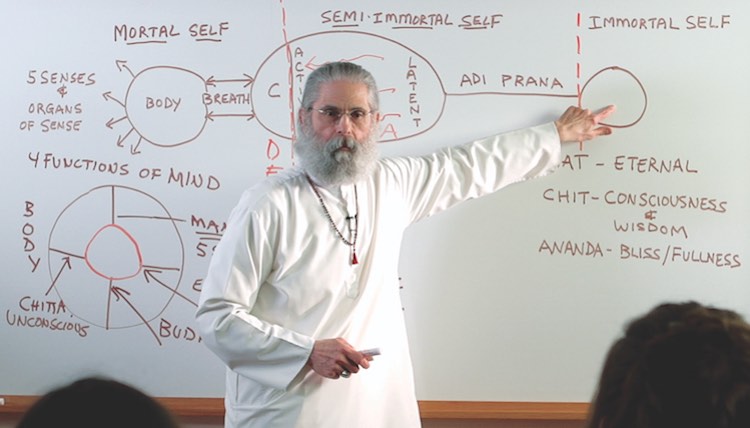
How Yoga Turns Your Bad Thoughts into Good Thoughts

You learned in grade school science class that energy can appear in either the potential or kinetic form. The electricity in the wiring of your home is available for any use you choose. When you turn a light switch to the “on” position, energy appears in the form of light. This is the kinetic state because the energy is being used or expended. However, when you turn the light switch to the “off” position, the energy remains in the potential state – ready to be used at the flick of a switch.

The inherent power of fear, anger, and self-willed desire can also be stored potentially or expended kinetically, and it is your personal attention that determines in which state the energy resides. If the mind’s conscience (known as “buddhi” in Sanskrit) defines a particular thought as a form of energy that will enable you to fulfill the purpose of your life (a shreya), it is suggesting that you transform the state of that thought energy from the potential into the kinetic by taking some appropriate action. In other words, you are encouraged to think about the shreya, speak in service to the shreya, and take some physical action in service to the shreya.

Such emotions as fear, anger, and greed are not inherently bad or negative, for if they’re handled skillfully, they can become helpful resources. If the conscience (buddhi) recognizes them as merely an ego or sense gratification that conflicts with your own inner wisdom, you are being asked to renounce your attachment to them so that their intrinsic power can be transformed and stored for your future use.

MOREGoat Yoga Offers Adorable Twist For Your Regular Routine

The laws of physical science state that energy cannot be created nor destroyed, but it can be transformed. Viewing yoga as a sister science, the ancients experimented with controlling, conserving, and transforming the energy of thought. Through trial and error they realized that when they renounced a single preya desire – what could be seen as a momentary temptation or a negative thought – the energy of that desire manifested in a different form.

Recognizing this process, imagine what would happen if, instead of gasoline, twenty gallons of crude oil directly from the fields of Saudi Arabia were pumped into your car’s gas tank. It would wreck your engine. Crude oil is simply of no use in a combustion engine. To become an appropriate fuel for your automobile, the raw oil must first be refined.

Each of us has the capacity to employ a refining process that can transform the raw, inherent power of every thought, desire, and emotion. When the mind’s conscience, the buddhi, intuitively advises that the unusable, destructive and constrictive power of a particular fear, anger or self-willed desire is appearing in your awareness in the form of preya, you, as a yoga scientist, have access to a mechanism for capturing and transforming that power. This refinement process is accomplished by consciously and willingly renouncing your attachment to the preya.

RELATEDFirst Ever Study Shows Chair Yoga is Effective Arthritic Treatment

Remember, in every moment, the buddhi is always present to advise you that it’s not in your best long-term interest to give the preya your continued attention. If you consciously or unconsciously choose to serve the preya in thought, word or deed, you will experience some form of physical, mental, emotional or spiritual dis-ease.

Every thought, word and deed is a means for spiritual unfoldment. Recognizing that desire is the fuel for human action, the ancient sages conceived a scientific formula that might well be called the spiritual equivalent of Albert Einstein’s E=MC2. The formula they discerned was D = E + W + C.

Every desire is composed of three basic components: energy, will power, and creativity (consciousness). When you align every thought, word, and action with the wise and good counsel of the buddhi by serving the shreya, you’ll be led for your highest and greatest good. When you willingly and consciously surrender your attachment to the merely pleasant, comfortable, familiar, and attractive preya, you really give up nothing of value. The intrinsic power of the preya is not lost to you. Instead, your voluntary act of sacrifice automatically transforms the preya into internal reserves of energy and will power, and opens the doorway to the superconscious mind – your access to the divine source of intuitive wisdom and creativity.

MOREStudy Shows Yoga and Meditation May Help Reduce Childhood Anxiety

Conversely, when you go against the advice of the mind’s conscience by serving the ego or sense gratification that conflicts with inner wisdom in thought, word, and deed, your internal strategic reserves of energy, will power, and creativity are diminished.

The major crisis of our culture today is not one of IQ – but rather the problem we face individually and collectively is one of WQ – will quotient. In 21st century America, countless people possess the intellectual capacity to make brilliant decisions, but because they are habituated to serving the limited perspective of the ego, senses, and unconscious mind, their reserves of will power have become bankrupt. Without sufficient will power to exercise discrimination, their reserves of energy and creativity are similarly diminished. The more these reserves are depleted, the more frequent and severe the tension, stress, anxiety, burnout, and pain.

As in banking, our personal balance sheet always reflects whether deposits or withdrawals have been made. The choice of solvency or bankruptcy is up to each individual.

In modern life, you need plentiful reserves of energy, will power and creativity to fulfill your many duties and responsibilities. You have obligations to yourself, your family, friends, business associates, society, the animal kingdom, and the good earth herself. Yoga science teaches that everything you need for a happy, healthy, and secure life is always available in the form of your thoughts, desires, and emotions. A ready supply of power arises within you daily in the form of fear, anger, and selfish desires. If you do not expend this power kinetically in the present moment, you can consciously conserve and transform it for use at another time. Yoga science offers a systematic, practical method for conserving and transforming energy. It’s very simple, and all it takes is knowing how to direct your attention appropriately, based on the intuitive wisdom already within you.

Leonard Perlmutter, founder of the American Meditation Institute (AMI), is the author of an acclaimed book The Heart and Science of Yoga: The American Meditation Institute’s Empowering Self-Care Program for a Happy, Healthy, Joyful Life, an encyclopedic guide to meditation and the Yoga Science that supports it.

Click To Share With Your Friends

Corruption Money Seized From Ex-Governor to Pay Backlog of Employee Wages

Though Brazil is well known for its corruption and impunity, state employees are rejoicing over the reclamation of government funds from the former Governor of Rio de Janeiro.

Ex-Governor Sergio Cabral is being forced by justice to return $100 million worth of corruption money that he collected over the course of his seven-year term. The returned funds are being used to pay a two-month backlog of state employee wages.

While the full investigation of Cabral takes place, authorities have identified roughly $450 million in corruption money and valuables. Though they have only been able to prove about $100 million, the cash will be returned to government accounts, which will then be used to pay Rio de Janeiro workers their rightfully-earned salaries.

RELATED$70K Minimum Wage is Paying Off for CEO Who Took Pay Cut to Lift Workers

Cabral ran the State of Rio de Janeiro from 2007 to 2014. During this period, he and former President Lula da Silva were incredibly popular within the nation.

But now, with the Petrobras scandal along with the State’s delicate financial situation causing the government to put holds on employee salaries, the former Governor has been put behind bars while a full investigation is launched into the extent of his dealings.

“Our employees are suffering and this is a great relief – we have lots of needs, but salaries is a simple way to put food on the table of many families,” said Governor Luiz Pezao.

Click To Share The News With Your Friends (Photo by SEAP)

Boy Saves Mom’s Life By Doing the Opposite of What She Said

Kids are taught to do what their parents tell them to do – but in this case, it’s good that Camdyn Smith didn’t follow his mother’s orders; otherwise she may not be alive today.

Camdyn returned to his home in Sedro-Woolley, Washington after school earlier this month to find his mother Kimberly suffering from chest pains and trouble breathing.

Though his mother insisted that she just wanted to take a nap and sleep off the pain, the 9-year-old kept telling her that she needed to go to the hospital.

WATCHInmates Break Out Of Jail To Save Life Of Officer Guarding Them

“I kept saying that we needed to go. So, I just went and got my shoes and coat on and told her we needed to go,” Camdyn told KING.

After sufficient pestering, Kimberly relented and went to see a doctor.

The mother wasn’t there very long, however, because medical officials immediately called her an ambulance and sent her to the emergency room.

MORE: McDonald’s Worker Jumps Through Window to Save Cop

This is because doctors found that Kimberly was suffering from pulmonary embolisms, a condition in which the arteries in both of her lungs had become blocked by blood clots.

If Kimberly had taken the nap like she wanted, she may not have ever woken up. She says that after spending seven days in the hospital being treated for the condition, she can honestly say that she owes her life to the persistence of her son Camdyn.

(WATCH the video below)


Click To Share The News With Your FriendsPhoto by KING

Women Rebuilding Gaza Brick by Brick Out of City’s Old Ashes

These two female engineers are stopping at nothing until they literally rebuild their city straight from the ashes.

Since Gaza has endured three wars in six years, Majd Mashharawi has watched her home city crumble in Palestine.

Majd, who works as a civil engineer, started thinking about ways that she could efficiently rebuild the city despite the obvious lack of materials.

RELATEDMan Creates ‘Shoes That Grow’ So Poor Kids Don’t Outgrow Them

That’s when her and her friend Rawan Abdullatif created Greencake; an environmentally friendly, low-cost, heat-resistant, sound-proof brick made out of the very ashes recycled from Gaza’s debris.

With Gaza reportedly producing 60 million tons of ash per year, they have more than enough materials to meet the daily demand for building blocks.

The civil engineers are currently raising money via an Indiegogo page to start a small production line in the city and rebuild the houses that were destroyed over the course of the last ten years under siege.

(WATCH the video below)


Build Up Some Positivity: Click To Share

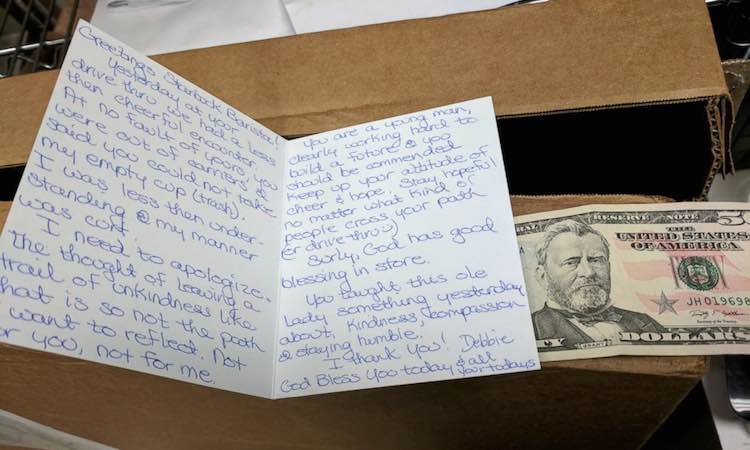
Starbucks Worker Receives Apology Note, Tip From Sassy Customer

Baristas are pretty accustomed to getting an earful from annoyed customers, but it’s a rare occurrence when they receive an apology card for it.

However, that is exactly what happened to 20-year-old Andrew Richardson last Tuesday while he was working at the Starbucks in Bishop, California.

The day before, Andrew had been chatting with a customer at the drive-thru when inconvenience led the woman to become a bit sour.

“On the 20th, this woman, Debbie, came through the drive through while I was working. She was extremely pleasant, and we had some friendly conversation while her drinks were being made,” Richardson told ABC News. “She had multiple drinks, and we didn’t have drink carriers. I informed her and she was a touch frustrated like anyone would be.”

RELATEDLady is Thrilled by Starbucks Ability to Take Order in Sign Language

She then asked Andrew if he could throw away the trash that was inside her car, but since that would be a California health code violation, he explained that he couldn’t.

She became slightly more frustrated, but still drove away with her beverages and Andrew quickly forgot about the incident.

But then the next day, the woman returned to the drive-thru when Andrew was working once more.

MORECustomer Admires Chick-fil-A Employee So Much, He Built Him a New Home

After apologizing for her behavior, she gave the barista a card. When Debbie left, Andrew opened the card to discover a $50 bill along with the most meaningful note he had ever received.

“I returned to it later, opened it, and I was completely shocked,” said Andrew. “Without the money, this was one of the most beautiful and heartfelt things I have ever read. It absolutely made my day when I read it. The money was unnecessary. The card alone was the best part. I would have turned the money down had I opened it when she was there. It’s hard to take things like that.”

Andrew and the store supervisor both said that even though customers have often gotten much nastier than Debbie, no one has ever received such a sincere response from a consumer. The experience became one that Andrew says he will never forget, especially while working in the food industry.

Click To Share This Grande Story With Your Friends (Photo by Andrew Richardson)

New Plan to Eliminate 90,000 Hepatitis B and C Deaths

Since hepatitis B and C kill more than 20,000 people in the United States every year, this exciting new report has presented a strategy to eliminate these diseases as serious public health problems and prevent nearly 90,000 deaths by 2030.

“Viral hepatitis is simply not a sufficient priority in the United States,” said Brian Strom, chair of the committee that carried out the study. “Despite being the seventh leading cause of death in the world – and killing more people every year than HIV, road traffic accidents, or diabetes – viral hepatitis accounts for less than 1% of the National Institutes of Health research budget.”

About 1.3 million people in the United States have chronic hepatitis B, and about 2.7 million have chronic hepatitis C. These infections also increase risk of liver cancer. Together, hepatitis B and C cause about 80% of the cases worldwide of liver cancer, which has been steadily increasing in both new cases and deaths in the United States since the early 2000s.

RELATEDSimple Checklist Leads to 82% Drop in Mental Health Patient Suicides

The world has the tools to prevent these deaths. Hepatitis B is preventable with vaccination, and recent advances in treatment make hepatitis C curable with short and easily tolerable courses of medicines. The committee said the number of deaths from hepatitis B could be cut in half by 2030 by diagnosing 90% of the nation’s chronic hepatitis B patients, bringing 90% of those to care, and treating 80% of those for whom treatment is warranted. These actions would avert more than 60,000 deaths and also reduce liver cancer and cirrhosis from hepatitis B infection by about 45%. Similarly, treating everyone with chronic hepatitis C would reduce new infections by 90% by 2030 and reduce hepatitis C deaths by 65% over the same time. These actions would avert 28,800 deaths by 2030 and depend on diagnosing 110,000 new cases a year between now and 2020, gradually dropping off to 70,000 a year by 2025.

CHECK OUT: Bar’s Simple But Clever Way of Combatting Sexual Assault

The committee said eliminating hepatitis B and C as public health problems in the U.S. by 2030 will require a significant departure from the status quo – including aggressive testing, diagnosis, treatment, and prevention methods, such as needle exchange. It called for a coordinated federal effort to manage hepatitis elimination, and it recommended expanding syringe exchange for people who inject drugs, free hepatitis B vaccine in pharmacies and other easily accessible places, and unrestricted treatment for everyone with hepatitis C.

Because the medicines that cure chronic hepatitis C are expensive, the committee gave considerable attention to novel ways to pay for them and recommended a voluntary licensing agreement between the federal government and a patent-holding pharmaceutical company as a way to make the drug more affordable for Medicaid beneficiaries and other underserved patient populations.

Prevention is the first step to eliminating the public health problems of hepatitis B and C, the committee said. About 90% of U.S. children were fully immunized against hepatitis B in 2013, but only about a quarter of adults over 19 were immunized. If states supported hepatitis B vaccination to the same level as the seasonal influenza vaccine, great improvements could be made. Offering vaccination in pharmacies is one way to reach a wider cross-section of society, but some states restrict the types of vaccines offered in pharmacies and the circumstances under which pharmacists may administer them. The committee recommended that states expand access to adult hepatitis B vaccination, removing barriers for free immunization in pharmacies and other easily accessible settings.

MOREFirst Ever Quadriplegic Treated With Stem Cells Regains Motor Control in His Upper Body

Hepatitis B virus can easily pass from mother to baby, and the committee was concerned with preventing such cases. Children born to women with chronic hepatitis B require immunization within 12 hours of birth, and other children should receive it within a day of birth. The committee recommended that the National Council on Quality Assurance monitor the delivery of the first dose of hepatitis B vaccine, thereby drawing attention to this essential service.

Until there is a vaccine for hepatitis C, prevention will be mostly a matter of limiting exposure to the virus. People who inject drugs account for 75% of the roughly 30,500 new hepatitis C infections every year in the United States, so ending transmission depends on reaching this population. The best strategies to prevent hepatitis C combine both safer injection and treatment for the underlying addiction. Opioid agonist therapy uses prescription medicines – one example is methadone – to relieve the symptoms of drug withdrawal. Such treatment can prevent drug overdose and transmission of blood-borne infections, but 30 million Americans live in places where no providers prescribe these medicines. Syringe exchange programs are also essential, but they currently do not have sufficient reach, even in cities. Rural and suburban areas are home to about half of the people who inject drugs in United States, but these areas have only 30% of the nation’s syringe exchange programs and distribute 8% of the total syringes. Syringe exchange programs do not encourage new drug users or increase drug use among clients, but laws in some states impede their functioning. The committee recommended expanded access to syringe exchange and opioid agonist therapy in accessible venues. Pharmacies, for example, may be a promising setting for syringe exchange, as they are easy to reach in most of the country and reasonably well equipped to provide a confidential space for counseling. Exchanges operating from a van or bus could also reach people in remote areas and may face less community opposition than a fixed-site exchange.

RELATEDSimple Blood Test Could Detect Cancer Ten Years Before Symptoms Show

The direct-acting antiviral drugs that cure hepatitis C make elimination feasible in the United States, but their cost is an obstacle to large-scale treatment, creating inequities. While these drugs are very expensive, they are also cost-effective, when compared to other health care interventions. A recent study found that almost half of Medicaid patients were refused hepatitis C treatment, compared to only 5% of Medicare patients and about 10% of patients with commercial insurance. Furthermore, less than 1% of prisoners with hepatitis C have been treated. Faced with the unenviable task of allocating scarce treatment, some payers give first priority to the sickest patients – those at immediate risk of cirrhosis or end-stage liver disease. But delaying treatment increases a patient’s risk of cirrhosis, liver cancer, and death. It also hurts society, as the untreated patient can still transmit the virus. Treating everyone with chronic hepatitis C, regardless of disease stage, would avert considerable suffering in hepatitis C patients and would pay off in a reduction in new infections.

Unrestricted, mass treatment of hepatitis C is necessary to eliminate the disease as a public health problem by 2030, but no direct-acting agent will come off patent before 2029. Delaying mass treatment until generic medicines are available would result in tens of thousands of deaths and billions of dollars in wasted medical costs. At the same time, innovator drug companies have the right to compensation for the risk they took to bring a valuable product to market, and society benefits from the financial incentive for pharmaceutical breakthroughs that patent protection offers. In an effort to balance these competing needs, the committee recommended that the government purchase a license or assignment to the patent on a direct-acting antiviral drug, and use it only in those market segments where the government pays for treatment and access is now limited, such as Medicaid and prisons. The committee proposed a voluntary transaction where six innovator pharmaceutical companies bid to sell a license to the government for use in a narrow market that the companies would not otherwise reach. This limitation will also control costs, because the government should not have to pay as much as if it were compromising the lucrative private market. The voluntary nature of this process guarantees the drug company reasonable compensation, and the patent holder has the option to walk away if the price is too low.

The committee’s calculations suggested a patent license should cost about $2 billion, after which states and the federal government would pay about $140 million to produce the medicines needed to treat about 700,000 neglected patients. For comparison, under the status quo, it would cost about $10 billion over the next 12 years to treat only 240,000 of the same people.

CHECK OUT: FDA Finally Bans Antibacterial Soaps Containing Triclosan and 18 Other Chemicals

Another challenge of eliminating hepatitis B and C in the U.S. is that people who have or are at risk for contracting the diseases often are not engaged in care and can be difficult to reach, including people who are born abroad, are uninsured, have substance use problems, and are or have been imprisoned. The committee recommended that the U.S. Department of Health and Human Services work with states to build a comprehensive system of care and support for such patients on the scale of the Ryan White system, which brought HIV services to millions of poor HIV patients.

Working through primary care providers can also improve the reach of hepatitis services. There is precedent for managing hepatitis C in primary care, but treating viral hepatitis carries risks that providers in small practices may be reluctant to accept, causing a disparity where viral hepatitis care is out of reach for people in rural and underserved communities. The committee recommended that the American Association for the Study of Liver Diseases and the Infectious Diseases Society of America partner with primary care providers and their professional organizations to build capacity to treat hepatitis B and C in primary care.

People in jails and prisons bear a particularly high burden of viral hepatitis. The committee found an opportunity in this problem because correctional facilities are an ideal place to test and vaccinate for hepatitis B and to cure hepatitis C. The committee recommended that the criminal justice system screen, vaccinate, and treat hepatitis B and C in correctional facilities according to national clinical practice guidelines.

(Source: National Academies of Sciences, Engineering, and Medicine)

Click To Share The News With Your Friends

Watch Students Go Nuts When Classmate is Accepted into Cornell

No man is an island – especially not Brendon Gauthier when he found out that he was accepted into his dream college.

Brendon is a senior at TM Landry College Prep in Louisiana. It has always been the student’s dream to go to Cornell University – so when he and his fellow classmates finally viewed his acceptance letter together, their excitement was immeasurable.

WATCHBoy Throws Opening Pitch at Baseball Game 1 Year After Double Hand Transplant

In a video that has been viewed millions of times on the school’s Facebook page since December, the teacher can be seen hoisting Brendon onto his shoulder while the other students scream their congratulations.

The school reportedly only plays host to about 100 students grades 1 through 12, but every graduate is set to go to a 4-year university.

(WATCH the video below)


Click To Share The Sweet News With Your Friends

Watch Two Runners Pick Up Collapsed Competitor, Carry Her to Finish Line

This half-marathon may have been a race to the finish line, but not for these men who stopped running to help an exhausted woman in need.

During the Philadelphia Love Run Half-Marathon on Sunday, a female runner was 100 yards away from the finish line when her knees started to give out and she started shuffling in pain.

When cousins Joseph McGinty and Bryan Crnkovic saw the woman collapse, Crnkovic and another unidentified man rushed to her side to catch her while McGinty got help. After McGinty returned, he scooped the injured runner into his arms and carried her the rest of the track until he could set her down and she could cross the finish line herself.

RELATEDBoston Marathon Bombing Survivor Set to Marry the Man Who Saved Her

Paramedics assisted the woman into a wheelchair and escorted her away to get medical attention. She has since been confirmed to be healthy and relatively unharmed.

The two men didn’t know that they were being hailed as heroes until they later received a phone call from a family member saying that the video of their good deeds had been viewed by millions.

(WATCH the video below)


Click To Share This Sweet Deed With Your Friends: Click To SharePhoto by FOX29 News

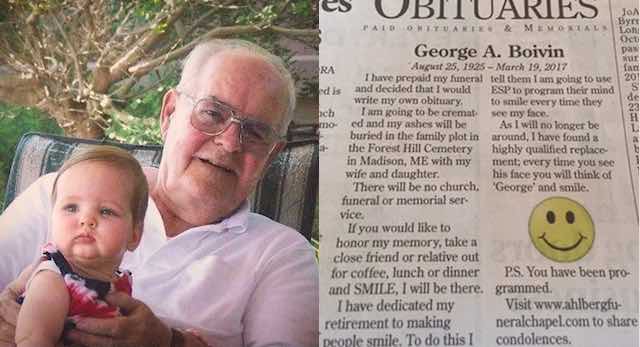
Man Who Penned His Own Obituary Asks Simple Request of Readers

Most people don’t know what’s going to be written about them in their obituaries – that is, except for the late 91-year-old George Boivin who passed away on Sunday in his retirement home.

George had had his obituary penned out in 2010 in preparation for whenever he kicked the bucket. Following his death on Sunday, the Longmont Times-Call of Longmont, Colorado published the late grandfather’s last written word.

Though everyone was grieving the man’ passing, his obituary had a very simple last request for his friends, family, and readers.

The obituary read: “I have prepaid my funeral and decided that I would write my own obituary. I am going to be cremated and my ashes will be buried in the family plot in the Forest Hill Cemetery in Madison, ME with my wife and daughter. There will be no church, funeral or memorial service.

RELATEDDaughter Fulfills Dad’s Last Wish With Side-Splitting Obituary

“If you would like to honor my memory, take a close friend or relative out for coffee, lunch or dinner and SMILE, I will be there.

“I have dedicated my retirement to making people smile. To do this I tell them I am going to use ESP to program their mind to smile every time they see my face.

“As I will no longer be around, I have found a highly qualified replacement; every time you see his face you will think of ‘George’ and smile. P.S. You have been programmed.”

MOREDying Writer Pens Heartfelt Plea For Someone to Marry Her Husband

The “his face” that George is referring to is a classic yellow smiley face sticker. The stickers are synonymous with George since he would give one to his manager every time he paid his rent, leaving her desk plastered with tiny smiles.

According to KSDK, George was notorious for only every planning out two aspects of his day: where he would eat breakfast and where he would eat lunch. This was because mealtimes were his favorite time to laugh, smile, and make new friends amongst strangers.

Though his passing is sad, it’s important to keep in mind how George wanted to be remembered; fondly and with a smile on your face.

Click To Share This Sweet Story With Your Friends (Photo by Shani Ablicki)

Man Breaks Up Street Fight, Won’t Leave Until Teens Shake Hands

Ibn Ali Miller has received mountains of praise since a video of him breaking up a street fight between two teenagers has gone viral.

The video, which includes a crowd of other youths encouraging the brawling teens, shows Miller marching up to the group and demanding that they stop fighting and work out their problems as men.

“You’re almost men, you’re not kids no more,” says Miller. “Start acting like it. You’re going to get nowhere like this.”

RELATEDKarma Comes Back Around for Man who Broke Religious Rule to Help Boy

Though some of the teens start snickering at the man’s lecture, he reprimands the kids with reminders of their heritage: “I know where you’re from, humble beginnings. Your mom and dad worked hard to get where they’re at, yo.”

He then turns to another student and says: “Your dad’s doing life, you think it’s a game out here? It’s no game out here. It’s real out here, little bro.”

The Atlantic City man then eggs the duo into shaking hands and calling a truce.

WATCHInmates Break Out Of Jail To Save Life Of Officer Guarding Them

The video was viewed 33 million times and praised by the likes of Snoop Dogg and LeBron James. Miller was then honored by the city for his noble peacemaking actions.

“A dozen positive lessons could be taught from that four-minute video alone,” Atlantic City Mayor Don Guardian said in a statement. “He fearlessly spoke so much truth to those young kids. We need more adults in the world that are willing to step in to help pull back our youth from the edge.”

(WATCH the video below)


Click To Share The Inspiring News With Your Friends