A hospital in California has come up with a clever way to soothe anxious young patients on their way to the operating room.
Rather than being wheeled into surgery on a gurney, youngsters at Doctors Medical Center in Modesto can now drive into surgery in little toy mini-cars.
The tiny surgical patients have the choice of driving either a black Mercedes or a pink Volkswagen Beetle – and if the children are incapable of driving the hot rods, they can also be piloted by an adult with a remote control.
Though the Mercedes was purchased by the hospital last year, the Volkswagen was recently donated by an employee and her family.
Thus far, the cars have been a huge hit amongst the patients, and staffers say that they have been hugely successful in relieving the children’s anxieties.
“When they find out they can go into the operating room riding in a cool little car, they light up and in most cases, their fears melt away,” hospital spokeswoman Krista Deans told KTVU. “And when parents see their children put at ease, it puts them at ease as well.”
The hospital started using the cars after one of their nurses started researching how she could help her pediatric patients cope with the stress of surgery. Upon investigating various techniques, she found that using the toy cars was surprisingly successful.
“It can be traumatizing for a young patient to be peeled away from their parents as they head into surgery,” added Deans. “[But] this truly helps everyone involved.”
(WATCH the cars in action below)
Drive The Good News To Your Friends By Sharing This To Social Media…
Rather than calling the cops on a teenage boy who was caught stealing snacks, this compassionate 7-Eleven owner sent him home with even more food.
Jitendra Singh had been managing his branch of the convenience store in Toledo, Ohio over the weekend when one of his employees alerted him to the young man’s suspicious activity.
Upon reviewing his security footage, Singh saw that the youngster had been secretly pocketing snacks as he wandered the aisles.
When the teen approached the counter, Singh asked him to reveal all of the merchandise hidden in his clothes – otherwise, he would call the police.
The teen responded by saying that he was only stealing food because he and his younger brother were hungry and had nothing to eat.
Singh then told the teen to go and collect more pizzas, chicken, sandwiches, fruits, and meals from the aisles so he could take them home – all free of charge.
Cedric Bishop, who is a regular customer at the store, said that he was stunned as he watched the event unfold. He later described the incident in a Facebook post, praising the owner for his kindness.
“The cashier had the 911 operator on the phone and the owner told her to hang up,” recalled Bishop. “The owner [then told the teen] ‘This is not food. You want food, I’ll give you food.’”
In addition to Sing sending the teen home with several bags of free food, Bishop also felt inspired to give the youngster $10.
“I thought that was an amazing thing the owner did,” said Bishop. “Some young people just need to know that someone cares.”
Singh, on the other hand, was very nonchalant about his good deed. Since he has been a store owner for the last five years, he says that he always tries to use his position to help the community – and this was just another chance for him to give back to someone in need.
“It’s not going to make any difference to me if I give him some food because we make a lot of food, we sell a lot of food,” Singh told WTVG. “If he goes to jail then he’s definitely not going to do anything good in life.”
(WATCH the news coverage below) – File photo by chrisinphilly5448, CC
Be Sure And Pass On This Positive Story To Your Friends On Social Media…
Quote of the Day: “Everyone has a gift for something, even if it is the gift of being a good friend.” – Marian Anderson (on the 80th anniversary of her Lincoln Memorial concert)
Photo: by Pascal Böhme, CC license via Flickr, cropped
With a new inspirational quote every day, atop the perfect photo—collected and archived on our Quotes page—why not bookmark GNN.org for a daily uplift?
Today is MOTH Monday on Good News Network: In partnership with The Moth, a nonprofit dedicated to the art of storytelling, we bring you the most uplifting speakers from live stages across the world.
Roseanne Cash may be the eldest daughter of the legendary Johnny Cash, but that does not mean that she has not experienced her fair share of hardships and difficulties.
In her earlier years, her music achieved commercial success and she became a trailblazer for female artists in the music industry.
Rather than continuing to make chart-topping hits, however, she decided to create an album that embodied her truest self. She then released Interiors, a “dark and troubling” record that received its fair share of bad reviews from critics.
Cash’s life then took some harsh turns, and as she lived paycheck-to-paycheck in the harsh urban landscape of New York City, she struggled to find hope.
Then, she received a very unexpected phone call that taught her the importance of being true to oneself.
Listen to her story below…
The Moth gives people an opportunity to tell a true story in front of a live audience, and sometimes their stories are chosen to air on the radio show, now celebrating its tenth year, and broadcasting on 485+ public radio stations—and on The Moth podcast, which is downloaded over 52 million times a year.
Art enthusiasts and world travelers are being given the once-in-a-lifetime opportunity to spend the night with a legendary host: the Mona Lisa.
You and a lucky friend now have the chance to participate in a one-night slumber party at the Musée du Louvre on April 30th.
The Parisian museum joined forces with AirBnb in order to launch the historic contest this week. The winner, along with a guest of their choosing, will be able to spend a special evening in the institute after the tourists are finally sent home.
As the sun is setting on the French city, the contest winner and their guest will be led on a specialized art-history tour of the museum – an experience that has also been offered to the likes of the Obamas, Jay-Z, and Beyoncé.
After that, the guests will share a Renaissance-inspired aperitif with the Mona Lisa painting followed by an extravagant feast alongside Venus of Milo in a pop-up dining room.
The guests will then end be treated to an acoustic concert in the lavish living quarters of Napoleon III.
As the evening comes to a close, the two guests will be able to cozy up for a good night’s sleep in a luxury tent underneath the Louvre’s iconic glass pyramid.
“We are happy to offer this unique and special experience for two people to stay in the museum overnight, in a bespoke pyramid shaped bedroom,” said Anne-Laure Béatrix, Deputy Managing Director of the Musée du Louvre.
“We know that many people would love the opportunity to wander alone at night through the Louvre and we want this to be a magical and unforgettable experience. With Airbnb’s partnership, we hope to encourage more people to discover how truly accessible and inspiring the wonders of art can be.”
“Paris is one of the most attractive cities in the world and the Louvre is one of the most loved and celebrated institutions in Paris,” added Emmanuel Marill, General Manager of Airbnb France. “We are thrilled to partner with them and to offer exciting and unique experiences that will celebrate our community and welcome Parisians and international travelers to rediscover the museum in a new and authentic way.”
If you would like to enter the contest, you simply have to apply on the AirBnb website before April 12th and answer the question: “Why would you be the Mona Lisa’s perfect guest?”
(WATCH the promo video below) – Photos courtesy of AirBnb
Oh La La! Be Sure And Share The News With Your Friends On Social Media…
Last week, a beautiful thing occurred in the classroom of a 4th grade teacher at Chino Valley School District.
It is Autism Awareness Month and every classroom on the California campus had been asked to have each student decorate a paper puzzle piece and hang it on their classroom doors.
When Ms. Lisa Moe handed out the puzzle pieces, most of her students were familiar with the idea of autism—and they were aware of the reason for decorating the puzzle pieces. What her students did not know was that autism was present within their own classroom in their fellow classmate: Rumari.
With excitement, Rumari rose his hand and said “May I please say something?” Moe nodded and said “of course”, but never could she have imagined what was to follow.
She explained in a Facebook post: “Rumari has faced challenges and barriers beyond what any of us will ever be able to fully understand. But today, he stood in front of the classroom with full confidence, enthusiasm, and courage and showed us that there is no challenge or barrier that can stop him.
“He brought to life the meaning of ‘Yes I Can’ as he explained to his fellow classmates that he was autistic. With full knowledge, he explained the differences that may come when being autistic and how the spectrum is vast. He courageously spoke about his own differences and quirks, while defining what it means to make everyone feel like a someone.”
Both teacher and students were enraptured and hanging on every word he spoke. For a long time, Moe never thought to get out her phone to capture this moment – but finally, she realized the treasure that was unfolding, and without any of the students knowing, she hit record and captured the final moments of Rumari’s talk, along with the authentic and raw reactions of the other students as they raised their hands to ask questions.
Moe’s daily classroom mottos of “Be Kind” and “Yes I Can” merged in that moment and the tears could not be stopped, as his peers expressed their admiration and love for him.
Rumari’s mother was thrilled by the video and told Moe: “Watching Rumari so courageously speak about autism and how it relates to him and others is beyond what I can properly express. It brings me great joy to watch him be so unapologetically proud to be autistic… Thank you for creating such a comforting, loving and supportive environment that my baby felt safe to express himself. You’re doing great things and giving others the courage to do the same. ”
Moe told Good News Network, “One of the biggest lessons I have learned through this is that kids are still kids. They sometimes say things they shouldn’t or do something they know isn’t right.”
“When they entered my class at the beginning of the year, many lacked confidence and struggled with a negative mindset. But in the right positive environment where I stress the importance of kindness, empathy, compassion, and self-confidence every day through our class motto of ‘Yes I Can!’, to me, it solidified my position as an educator and the impact and influence of being the ‘positive teacher’. We can make our world a feel-good, happy place.”
“If I were unable to ever teach again or if there was ever a question to my path into this role as an educator, this moment solidified my purpose.”
(Note: Ms. Moe got permission from all parents whose child spoke on camera.)
STAND UP and Say Something—Share This For Autism Awareness Month!
Over 1 million homeowners and gardeners from around the world have joined the fight to save dwindling pollinator populations – and you can join the team too.
The National Pollinator Garden Network has surpassed their goal of registered pollinator gardens with just over 1,040,000 gardens now registered with their Million Pollinator Garden Challenge.
Though most of the registered pollinator gardens are concentrated in the United States, the ambitious project has also recruited members in Canada, Mexico, and Europe. The registered spaces, most of which are comprised of private yards and public gardens, all add up to a network of approximately 5 million acres of enhanced or new pollinator habitat.
Currently, the US metro areas with the highest number of registered gardens include Atlanta, Chicago, Miami-Ft. Lauderdale, Philadelphia-Camden, Washington, D.C, and New York City.
The initiative was launched back in 2015 by the National Pollinator Garden Network with the goal of saving pollinators, which are responsible for about one in three bites of food that we eat every day.
According to the National Wildlife Federation (NWF), one of the project’s partnering organizations, protecting pollinators is crucial to our food supply.
“Together, through collaborative conservation we are restoring pollinator populations that provide the foundation of our ecosystems and our food supply,” said NWF CEO Collin O’Mara. “When we save wildlife, we save ourselves.”
In order to contribute to the network, gardeners are asked to plant large amounts of pollinator-friendly plants and wild grasses that are both native and non-invasive species. The space should also offer breaks from the wind, exposure to direct sunlight, a watering source, and a minimized amount of pesticides.
The result of this challenge is now a nationwide network of pollinator habitat within America’s cities, towns, and neighborhoods.
Since the campaign launched, many gardening centers have also contributed to the challenge by offering more pollinator-friendly plants, services, and education.
“The passion for pollinators is clearly evident. Let’s pass it on and encourage the 35 million Americans who garden with flowers, to each put in one new pollinator friendly plant per season each year. Imagine the transformation!” says Mary Phillips, NWF coordinator.
If you have a yard or garden, or even just a small piece of outdoor property, you can contribute to the pollinator network by planting at least three different pollinator-friendly plants that bloom in spring, summer and fall. You can find more information and resources on the Million Pollinator Garden Challenge official website.
“Our collective efforts have accomplished great things for bees, butterflies, and other pollinator species that play a critical role in our natural world,” said Val Dolcini, president of the Pollinator Partnership, which is another organization involved in the project. “From enhancing our food supply to increasing the biodiversity of our environment, these hard-working pollinators need to be protected at all costs. By protecting their lives, we’re preserving ours.”
Bee Sure And Share The Buzz With Your Friends On Social Media – Photo by USDA
Ever since he was a kid, Kevin Gatlin has been bored by the monotonous environments of hospital rooms – so as a means of making sure that his children were never forced to endure the same tedium, he came up with a simple solution to help with the hospital doldrums.
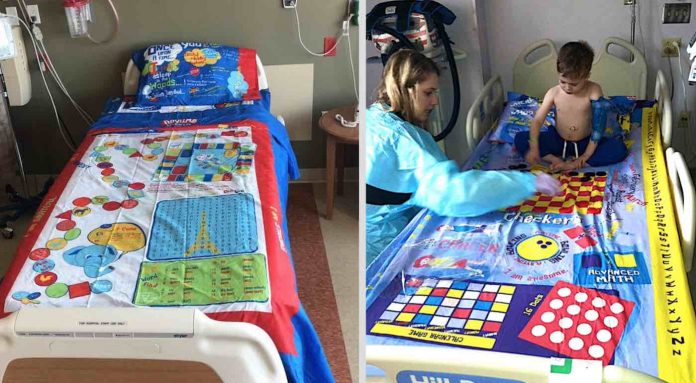
Gatlin is the mastermind behind Playtime Edventures, an interactive set of bed sheets that feature dozens of games and lessons for children confined to their hospital beds.
The entrepreneur from Charlotte, North Carolina first got the idea for the bed sheets after he went to go visit his friend’s hospitalized child several years ago.
Heartbroken by the idea of a child spending hours upon hours in a plain white room, he thought about how his wife had always played games on his son’s bed in order to help him fall asleep.
Gatlin then spent the next two years developing the sheets so that children could be entertained from the comfort of their own bed.
He also worked with several school teachers in order to make the games educational.
“We put together bedsheets and slumber bags that cover everything from geography, math, science, grammar, word find games… all on a three-piece set,” Gatlin told KWES.
To date, Gatlin knows that his sheets are being used in 10 different hospitals across the country – but since his customers are able to donate bedsheets to their own local hospitals, that number could be much higher.
Parents can also buy the interactive sheets for their own children at home, but Gatlin hopes that his invention will soon make its way into hospitals around the world.
Quote of the Day: “Health is the greatest gift, contentment is the greatest wealth.” – Gautama Buddha (on the celebration day of his birth)
Photo: by italo losero, CC license via Flickr
With a new inspirational quote every day, atop the perfect photo—collected and archived on our Quotes page—why not bookmark GNN.org for a daily uplift?
This 26-year-old engineer could not bear to see his country’s rivers and lakes plagued by drought and pollution – so he decided to do something about it.
Ramveer Tanwar had just been finishing up his final year of university in 2013 when he became concerned over the state of his home village in Greater Noida, Uttar Pradesh. The region had experienced 13 droughts in just 15 years, and the local communities were suffering as a result.
Even though many of the older villagers were oblivious to the seriousness of the situation, Tanwar felt compelled to take action and galvanized his younger peers to make a change.
“I had been talking to the kids in the village back then and even they felt that they had to do something about the dying water resources,” Tanwar told NDTV. “When they tried talking to their parents, the adults refused to believe that there could be any such thing as ‘lack of water.’”
Tanwar began traveling from house to house in order to teach the residents about the critical condition of local water supplies. He recruited his fellow students to gather villagers together for weekly classes so they could discuss how to resuscitate their lakes and rivers.
As Tanwar’s teachings began to inspire more and more people, they collectively started hauling all of the trash out of their water supplies and planting tree saplings around the water’s perimeter in order to protect the shoreline – and the trees are apparently still flourishing today.
In order to prevent any more trash from ending up in the water, Tanwar and his crew installed double water filtration systems made of wood and grass. He also urged local fish farmers to bring in aquatic bottom feeders so they could eat up the smaller bits of particle waste and keep the water clean.
Since Tanwar began his “Jal Chaupal” clean-up efforts in India five years ago, he has helped to revive 10 lakes across the region, and his initiative has sparked conservation efforts in over 50 villages.
Inspired by his success, the government of Uttar Pradesh launched separate “Groundwater Army” conservation groups in each district of the state – and they hired Tanwar as the program’s coordinator.
Since the government doesn’t have much funding, Tanwar admits that he is often forced to pay out of pocket for various expenses and supplies for the program.
He is also works 6 days a week from dusk till nighttime—but he says that he doesn’t mind the long hours or meager salary; he is simply excited to continue his conservation efforts so he can protect India’s water.
Clean Up Negativity By Sharing The Good News To Social Media…
If you’re a woman who speaks German, then congratulations—you may qualify for a new study that is paying female participants thousands of dollars to lie in bed for two months straight.
The study was commissioned by NASA and the European Space Agency as a means of researching how to counteract the negative effects of microgravity on the bodies of astronauts.
Since the weightlessness of microgravity reduces physical stress on the human body, astronauts have been shown to experience degenerated bone and muscle mass following their time in space.
Scientists now hope to simulate these cosmic conditions of space through consistent bed rest. Astronauts are currently required to fight the negative effects of weightlessness by spending the bulk of their days on the space station exercising – but if the study proves to be successful, then researchers could develop a less exhausting method of fighting physical degeneration.
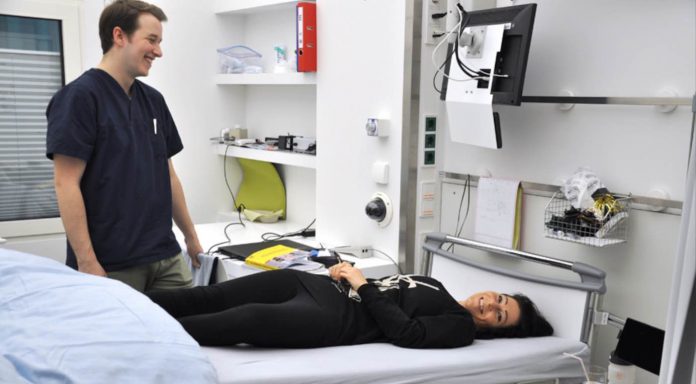
The study will be taking place at the German Aerospace Center in Cologne between September and December 2019. Non-smoking women between the ages of 24 and 55 are being offered $19,000 (€16,500) to participate in the study by lying in bed nonstop for 60 days.
Meals will be prepared by a team of nutritionists in order to ensure that the health of the participants won’t be compromised. All activities, including showering, eating, and going to the bathroom, must be done from the comfort of a very slightly downward inclined bed.
A woman named Janja participated in a similar study that was conducted at the research center in 2017, and she said she had a surprisingly good time over the course of the experience, despite being mostly immobile.
“What surprised me the most: after a few days my body got used to the bed rest, it was much easier than I had imagined,” said the former test subject. “I didn’t get bored by the many exciting experiments. On the contrary, time flew by.”
“Participation in the study was a very special and good experience for me. Who can say, ‘I participated in a study for NASA!’?” said Janja, adding that the anecdote has also proven itself to be “impressive for job interviews.”
If you would like to apply for the study, and you speak German well, you can visit the German Aerospace Center website for more information.
Don’t Let Your Friends Sleep On This Story: Share It To Social Media – Photo by German Aerospace Center
A compassionate team of police officers is being praised for giving a landscaper a helpful new start after he was robbed of his car and the tools needed for his livelihood.
Adrian Salgado was getting ready to start his work day in Santa Ana, California last week when two thieves hijacked his pickup truck and drove off with all of his equipment.
In addition to losing his vehicle, cell phone, leaf blower, hand tools, and mower—which police say was collectively worth about $3,000—Salgado also lost $1,000 in rent money which he had stashed away inside the truck.
Distraught, Salgado went back home and told his daughter Elizabeth what had happened. After she reported the theft to the Santa Ana Police Department, she managed to use an iPhone app to locate the stolen truck.
The two thieves were arrested, but Salgado’s equipment was nowhere to be found. Since Salgado is also the sole financial provider for his family, the law enforcement officers were particularly sympathetic about the misfortune.
“We all came from working-class families,” Sgt. Michael Gonzalez told CNN, adding that Salgado reminded him and his colleagues of their own fathers. “It was like, ‘hey, that’s my dad.’”
Rather than leaving the landscaper to fend for himself, however, a rookie policewoman suggested that the officers all pitch in to replace Salgado’s equipment.
The team managed to pool together $500 of their own money. They then reached out to the regional police association for additional donations, which resulted in a $500 match from the president.
When several cops were browsing the aisles of Home Depot with Salgado in order to replace the equipment, the store pitched in another $100 and offered military discounts to several of the officers.
Adding to the profound generosity, CNN says that a random shopper was also inspired to throw in $40 of their own money after hearing about the story from one of the officers.
In an interview with the Santa Ana Police Department, Salgado’s daughter expressed her overwhelming gratitude towards the officers. “Now I can see my dad with a smile because he can go back to work,” she said.
(WATCH the video below) – Photo by Santa Ana Police Department
Pass On The Positive Story By Sharing It With Your Friends On Social Media…
Quote of the Day: “The things you do out of truly loving it and wanting to enjoy your life are also the things that are sensible businesses.” – Francis Ford Coppola (80-years-old today)
Photo: by Mark Faviell, CC license via Flickr
With a new inspirational quote every day, atop the perfect photo—collected and archived on our Quotes page—why not bookmark GNN.org for a daily uplift?
A daredevil has revisited the British bridge where he claims he carried out the world’s first bungee jump—and he recalls that no one even test the rope first.
75-year-old David Kirke took a leap into the unknown on the morning of April 1st, 1979, using a new invention developed by his cohorts in the Dangerous Sports Club at Oxford University.
The group, who had been up all night partying, took their new device to the Clifton Suspension Bridge in Bristol, England to try it out.
Kirke reportedly took the plunge while he was wearing a top hat and clutching a bottle of champagne.
This week, 40 years later, he went back to the bridge and says they made the jump without testing the rope first—as that wouldn’t have been in the spirit of their adventure.
“We were called the Dangerous Sports Club, and testing it first wouldn’t have been particularly dangerous,” says Kirke.
“I was confident though. We had some very clever guys with us – Alan Weston went on to be head of development at NASA – and they told me it was going to be okay.
SWNS
“They were elastic ropes used to catch jet fighters landing on aircraft carriers, so I thought it would be okay. The mathematics of it were not something I really understood, but I did it.”
The Oxford boffins got the idea for their mission from the “land–diving” ceremony practiced by the inhabitants of Pentecost Island in the South Pacific.
The initiation rite requires young men to tie vines to their ankles and jump 60 to 80 feet from specially constructed wooden towers to prove their mettle.
Baker said when his girlfriend found out about the plan to recreate the death-defying stunt, she pretty much dumped him. The two sisters of Alan Weston also called the police several times the day before the stunt in a bid to stop it from happening.
Police staked out the bridge early that morning, and Kirke said that the officers approached them.
“They came up and talked to us and decided it was an April Fool, that we couldn’t possibly be considering throwing ourselves off the bridge with a bit of rope,” Kirke said. “So they wandered off again, and that was our chance.”
So with the vigilant eye of the law temporarily looking elsewhere, Kirke took the leap.
“The main thing going through my mind was ‘whoooppeeee’, really, in one word,” he said. “It’s a completely different feeling to anything else, traveling through the air at that speed.
“I didn’t fasten my top hat, so the wind blew it off,” he added.
Upon realizing that it was not an April Fool’s joke, the police returned, hauled up the men, and promptly arrested them.
“We were taken to the cells, but it was alright really,” said Kirke. “The police were very amiable. Although bemused is the word, rather than amused.
“They brought us in for the half-drunken bottles of wine we’d left at the bridge, and we were fined or something,” he remembered.
In the 40 years since, Kirke has rocked and rolled from one adventure to another, taking bungee jumping around the world with the Dangerous Sports Club—and it eventually took off in New Zealand.
“I am pleased it took off, it was what we hoped for at the time,” he added.
The Suspension Bridge and the authorities now take an even more dim view of such antics in comparison to 1979, but Kirke did manage to repeat his stunt again on the 21st anniversary of his first jump—with his lawyer driving the getaway car.
Share the Story of this Pioneering Human Yo-Yo With Your Friends…
This exciting new international report shows that renewable energy now accounts for one-third of all global power capacity.
The decade-long trend of strong growth in renewable energy capacity continued in 2018 with global additions of 171 gigawatts, according to new data released by the International Renewable Energy Agency (IRENA) earlier this week.
The annual increase of 7.9% was bolstered by new additions from solar and wind energy, which accounted for 84% of the growth.
IRENA’s annual Renewable Capacity Statistics 2019, the most comprehensive, up-to-date and accessible figures on renewable energy capacity, indicates growth in all regions of the world, although at varying speeds. While Asia accounted for 61% of total new renewable energy installations and grew installed renewables capacity by 11.4%, growth was fastest in Oceania with a 17.7% rise in 2018. Africa ranked in third place with 8.4% growth, and nearly two-thirds of all new power generation capacity added in 2018 was from renewables, led by emerging and developing economies.
“Through its compelling business case, renewable energy has established itself as the technology of choice for new power generation capacity,” said IRENA Director-General Adnan Z. Amin. “The strong growth in 2018 continues the remarkable trend of the last five years, which reflects an ongoing shift towards renewable power as the driver of global energy transformation.”
“Renewable energy deployment needs to grow even faster, however, to ensure that we can achieve the global climate objectives and Sustainable Development Goals,” continued Mr. Amin. “Countries taking full advantage of their renewables potential will benefit from a host of socioeconomic benefits in addition to decarbonizing their economies.”
Growth in hydro continued to slow in 2018, with only China adding a significant amount of new capacity in 2018 (+8.5 GW).
Global wind energy capacity increased by 49 GW in 2018. China and the USA continued to account for the greatest share of wind energy expansion, with increases of 20 GW and 7 GW respectively. Other countries which expanded their wind energy capacity by more than 1 GW included Brazil, France, Germany, India, and the UK.
Solar energy capacity increased by a whopping 94 GW last year (+ 24 per cent) with Asia continuing to dominate global growth with a 64 GW increase (about 70% of the global expansion in 2018). Maintaining the trend from last year, China, India, Japan and Republic of Korea accounted for most of this. Other major increases were in the USA (+8.4 GW), Australia (+3.8 GW) and Germany (+3.6 GW). Other countries with significant expansions in 2018 included Brazil, Egypt, Pakistan, Mexico, Turkey, and the Netherlands.
Finally, geothermal energy increased by 539 MW in 2018, with most of the expansion taking place in Turkey (+219 MW) and Indonesia (+137 MW), followed by the USA, Mexico and New Zealand.
Globally, total renewable energy generation capacity reached 2,351 GW at the end of last year – around a third of total installed electricity capacity. Hydropower accounts for the largest share with an installed capacity of 1,172 GW – around half of the total. Wind and solar energy account for most of the remainder with capacities of 564 GW and 480 GW respectively. Other renewables included 121 GW of bioenergy, 13 GW of geothermal energy and 500 MW of marine energy (tide, wave and ocean energy).
The full report is available here and more highlights of key findings can be found here.
Power Up With Positivity By Sharing The Good News With Friends Online…
Most school buses arrive to take students to class – but this bus brings the class to the students.
This refurbished bus is equipped with all the resources, equipment, supplies, and facilities needed to allow 5,000 kids and adults to pursue higher education without having to worry about consistently attending a school campus.
The Self-Determination Project bus, which was launched by the Five Keys Charter School in 2017, travels through some of the poorest neighborhoods and housing projects of San Francisco so it can offer its mobile classroom to disadvantaged residents – particularly single parents, students who don’t have access to transportation, and youngsters who are afraid to cross gang territories.
The bus is equipped with a library, Chromebooks, internet access, desks, study nooks, and a teacher – and all of it is available to students for free and anyone can start learning as soon as they sign up.
“When I was 14 and 15, I couldn’t go to school,” said Emerald Montes, a 17-year-old Five Keys student who grew up surrounded by gang violence. “I was just doing so much bad stuff, it prevented me from going to school. At Five Keys, the difference is they are more flexible. I’m a busy young woman now. I have a job and an internship.”
The nonprofit school was originally created in 2003 as a means of offering education to inmates in California jails and ending the repetitive “catch and release” system of incarceration. Since its inception, the first-of-its-kind jail-based school has rapidly expanded to 70 additional partner sites.
More than 5,000 students are currently enrolled with Five Keys so they can finally earn their high school degree – and many of them will later go on to pursue higher education and employment.
Not only that, the recidivism rate for ex-convicts who became Five Keys students currently stands at 26% – which is 39% less than the state’s average of 65%.
Rena Ortiz, a recent graduate, said it best: “I feel as if this bus is going to change so much. Being able to walk out of my house and see a bus that’s full of education—that is hope on wheels.”
(WATCH the video below) – Photos by Five Keys Charter School
Be Sure And Drive This Inspiring Story To Your Friends On Social Media…
Quote of the Day: “Keep your face to the sunshine and you cannot see a shadow.” – Helen Keller
Photo: by Grant, CC license via Flickr
With a new inspirational quote every day, atop the perfect photo—collected and archived on our Quotes page—why not bookmark GNN.org for a daily uplift?
This small town in Ireland is taking “love thy neighbor” to a whole new level.
Melanie and Jeremy Zanni first settled down in Co. Galway after they migrated from France to the west of Ireland ten years ago.
Upon falling in love with a cozy thatched cottage in Fartown, Glenamaddy, the couple started working as bakers for the local restaurants.
But due to an accidental chimney fire last month, the Zannis suddenly found themselves without a home last month when they woke up early one morning to find that their thatched roof had caught on fire. Within hours, their cottage had burned to the ground.
Not only that, the French couple did not have house insurance because they had been denied coverage due to the cottage’s thatched roof.
As firefighters got the blaze under control, however, local politician Michael Fitzmaurice approached the distraught family and promised to rally the community into getting them a new home.
Over the course of the following three weeks, Fitzmaurice led a team of volunteer tradesmen, apprentices, and retired carpenters in building a new house from scratch. The determined community members worked around the clock until they were finally able to unveil the Zanni family’s brand new home last week.
Needless to say, the family was overwhelmed by the community-driven effort.
“The neighbors are not just neighbors – they’re superheroes,” Jeremy told RTE in the interview below.
Fitzmaurice, on the other hand, says that the laborers were just happy to help a neighbor in need.
“The lads weren’t doing it for the pictures and the stories, they were doing it to help,” Fitzmaurice told The Sun. “There’s a lot of talk about rural Ireland and how they deal with people from different nationalities, but this will show you what these people have done… to help people that were in distress.”
Jeremy told The Sun that he and his wife now plan on using their new home to throw the “biggest party that Fartown has ever seen” as a means of thanking everyone for their kindness.
“It restored my faith in humanity big time. It’s incredible. Five minutes on site and you understand how crazy the whole thing is,” he added.
“Something is looking out for us. I’m not religious or superstitious or spiritual but I’m starting to be after what is happening; there is a higher force at stake.”
Patagonia has always been a role model for eco-friendly business practices – and now, they’re showing brewing companies how it’s done.
The outdoor clothing company’s food division has just announced that they will be mass-producing a new kind of sustainable beer that is made from a perennial grain called Kernza.
Kernza is ideally suited for organic regenerative agriculture because its long roots and perennial growth allow it to thrive without pesticides and use less water than conventional wheat, while also helping to reduce erosion and remove more carbon from the atmosphere.
Back in 2016, Patagonia Provisions produced the first commercially available beer ever made with the grain: the Long Root Pale Ale.
Now, thanks to their partnerships with Hopworks Urban Brewery in Portland and The Land Institute in Kansas, they have just released Long Root Wit, a Belgian-style wit beer made with organic ingredients and Kernza grain.
The beers will be available in select Whole Food Markets and other independent grocers in California, Colorado, Oregon, and Washington.
Furthermore, Patagonia Provisions has collaborated with agricultural researchers and other sustainable companies in order to create the Regenerative Organic Certification (ROC): a framework of high-bar standards for ensuring soil health and animal and worker welfare so that other companies and brewers can follow their eco-friendly example.
“I am very excited to introduce our second beer made with Kernza,” says Birgit Cameron, managing director of Patagonia Provisions. “Through [the] pioneering work at The Land Institute, Patagonia Provisions has been able to help bring this important regenerative perennial grain to the forefront with the hope that others take notice and implement similar practices. Beer is the perfect vehicle for this and a delicious byproduct of our collaborative work in regenerative agricultural practices.”
Brew Up Some Positivity By Sharing The News With Your Friends On Social Media…
This 82-year-old English man was barely able to walk because of crippling osteoarthritis in his right ankle.
Now, he is one of the first patients in the UK to receive an artificial ankle made from the materials of bulletproof vests – and he says that he did it so he could walk arm-in-arm with his wife once more.
Neil Shuttleworth says he has “gotten his life back” thanks to the high-tech surgery which uses plastics in the vests to create a hard-wearing implant.
Problems began for Shuttleworth when he tore ligaments in his left ankle after accidentally stepping into an unseen pothole while on holiday in Cyprus several years ago. The pain steadily worsened until it became unbearable due to bone-on-bone contact.
Shuttleworth took regular doses of painkillers until he got a consultation at Spire Leeds Hospital and was diagnosed with severe primary osteoarthritis in his ankle joint. Thankfully, his options for treatment included a newly-available total ankle replacement surgery.
Shuttleworth, who is a retired printing specialist from Huddersfield, West Yorkshire, self-funded the ankle replacement surgery since it is not currently available on the NHS.
When he finally opted to undergo the surgery, he says it is because he had just one ambition: to walk down the Promenade de la Croisette in Cannes eating ice cream with Christine, his wife of 34 years.
“When my surgeon asked me what I was wanted from the operation, I said I wasn’t expecting to run a marathon, but I wanted to be the best I could be for my age,” says Shuttleworth. “I said I would like to walk along a promenade hand-in-hand with my wife eating an ice cream, but without the pain I had lived with for far too long.
“The photo we had taken of us doing this was titled ‘mission achieved’. I sent a copy to my surgeon.”
SWNS
The surgery – known as Rebalance Total Ankle Replacement – uses polyethylene materials that are used to make bulletproof vests, but with extra added vitamin E. Since the hard-wearing implant is made from the durable plastic fibers, it is expected to last much longer than current replacements.
Prior to his injury, Shuttleworth had always led an active lifestyle which involved running and cycling across the UK and Europe. After he stepped into the pothole, which was several inches deep, he says he could not walk more than a few hundred yards as the pain in his ankle was so severe.
“I knew I had to do something about it. My condition had become intolerable, I had virtually no cartilage and if I went over on my ankle the pain was agonizing,” says Shuttleworth. “I have now got my life back.”
SWNS
The senior is now one of the first patients in the UK to undergo a Rebalance Total Ankle Replacement operation.
After using crutches and wearing a special walker boot for the six weeks following his surgery, Shuttleworth underwent a strict six-week physiotherapy regime. He is now able to walk a couple of miles, and he uses a treadmill on an incline setting in order to build his fitness levels even further.
He recently celebrated his renewed mobility by fulfilling his lifelong dream of flying in a Spitfire plane.
SWNS
“It was a never-to-be-forgotten experience as I took the controls for quite a while before the pilot took over again and performed the famous ‘victory roll’. It was exhilarating.”
Professor Nick Harris, who performed the surgery, said: “The use of E-poly with its better wear characteristics is an exciting development and will hopefully mean ankle replacements will last longer. The results of Neil’s surgery are excellent and there is at least an 80 to 90% chance the ankle replacement will survive for at least 10 to 15 years.”
Be Sure And Share This Inspiring Story Of Transformation With Your Friends On Social Media…