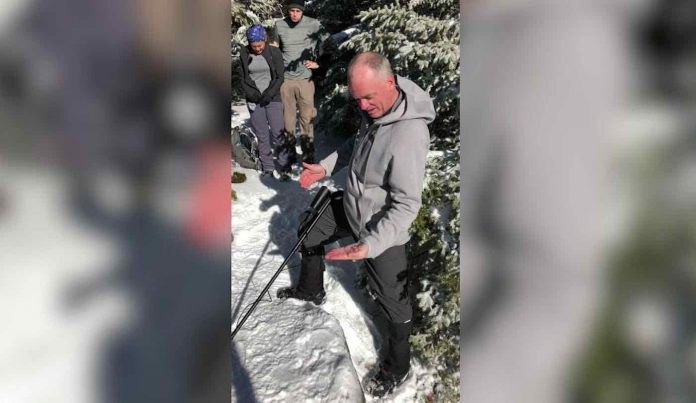











When Vince Rozmiarek first started volunteering as the official manager of his community’s roadside message board six years ago, he probably didn’t think that it would make him internationally famous.
Rozmiarek—who lives in the tiny town of Indian Hills, Colorado with a population of about 1,000 people—says that he took on the job in 2013 because he had been left with an abundance of time on his hands after all three of his kids had grown up and left home.
Initially, he took his job very seriously and only used the highway sign to display relevant messages to the community.
On April Fool’s Day, however, he decided to have a little fun by using the message board to make a joke about the neighboring town. After that, he couldn’t resist sharing more of his dad jokes with the community.
Using his stash of joke books, the 56-year-old dad starting using the message board to leave amusing quips and puns for the neighbors, such as “I looked up the definition of opaque; it wasn’t very clear” and “I periodically make bad science puns.”
“Obviously, I’m a man with time on my hands,” he told The Washington Post. “My three kids are all grown, and people could use something to smile about. So, why not, I thought.”
Despite his enduring career as the community jokester, Rozmiarek says that he has never posted a pun more than once and he has never used a joke that someone else has taken credit for.
He also says that he tries to avoid making political or offensive jokes so he doesn’t alienate any of his readers.
Up until 2015, Indian Hill residents were the only ones privy to his jokes—but then one of his neighbors felt inspired to create a Facebook page so he could share his jokes with the world.
“I wanted him to be able to post his … signs for everyone to enjoy,” she told The Post. “Vince’s puns are absolutely brilliant. He’ll text me now and then with new ones and I just die laughing.”
Since creating the Indian Hills Community Sign Facebook page, the photos of Rozmiarek’s signs have racked up more than 84,000 followers from 54 countries.
Multiply The Laughs By Sharing These Amusing Jokes With Your Friends On Social Media…
A new geothermal energy project is now being piloted in Canada—and experts say that it could be a “game-changer” for clean energy.
The Eavor Loop is a scalable closed-loop system that could soon allow us to generate consistent, unlimited electricity from the heat emanating from the Earth’s core.
The system works like a radiator. The Eavor Loop consists of two wells that are drilled about 2 miles deep (3.5 kilometers) and 3 miles apart (5 kilometers) with several connecting pipes between the two. The wells then circulate proprietary fluid through the loop in order to absorb the Earth’s heat and use it to make electricity.
The closed-loop design means that—unlike other geothermal projects—the system requires no fracking or water; it generates zero greenhouse gas emissions; it doesn’t run the risk of polluting nearby water sources; and unlike wind or solar power, it does not depend on external elements to generate electricity.
“It’s just a much more benign system and it’s something that you can implement across 80% of the world instead of 5% of the world like traditional geothermal,” Eavor Technologies CEO and President John Redfern told CBC News.
“You can put it almost anywhere. It’s not like a windmill or solar panel … almost everything’s underground so you can literally put it in someone’s backyard.”
Photo by Eavor Technologies Inc.
Eavor Technologies recently began construction on a new $10 million testing facility in Alberta. With the first-of-its-kind pilot project expected to conclude by the end of the year, government representatives have helped to fund the project with the hopes that it will provide new jobs for regional oil and gas workers who may want to transition into the green energy sector.
“Projects like [this facility] advance new technologies and can create highly skilled jobs. They show how investing in innovation reduces GHG emissions while growing the economy,” said Laura Kilcrease of Alberta Innovates (AI), a provincially-funded corporation that contributed $1 million to the project.
“Projects like this are possible because of the experience and unique approaches in energy services, drilling and technology development that are found in Alberta,” she added.
After testing is finished, Eavor will be working to launch a dozen more commercial facilities around the world. According to Global News, one commercial facility is estimated to generated roughly 4 megawatts of energy.
(LISTEN to the radio interview with John Redfern below)
Power Up With Positivity By Sharing The Good News To Social Media…
This powerful photo of three Italian grandmothers holding migrant children on their laps has been shared across the internet as a gorgeous example of humanity at its finest.
The picture was originally uploaded to a closed Facebook group called “Sei di Campoli se…” which means “You’re from Campoli if…” in English.
According to Rowena De Nigris, the woman who published the photo, the three grannies were taking care of the children at a welcome center for migrants in southern Italy.
“I hope to brighten your day with this wonderful photo,” wrote Nigris. “It portrays the ladies of a small village in the province of Benevento that spontaneously and in a completely natural way (human, I dare to say) have become the grandmothers/babysitters of the little guests of the reception center.
“This is integration,” she added, “and it’s beautiful.”
The women pictured in the photo have reportedly been identified as Aunt Nicolina, Aunt Vincenza, and Aunt Maria. Their hometown of Campoli del Monte Taburno has reportedly welcomed many refugees who have sought sanctuary after crossing the Mediterranean Sea from Africa—and these three seniors have made it very clear that they are happy to welcome many more with open arms.
Since the photo has gone viral, a man who claims to be the grandson of one of the women left a nostalgic comment on the picture, saying: “To think that 37 years ago, I was on those same legs, wrapped in the same smile—and now miles away and with a few more years, I’m very happy to be able to share the same emotions with a child I don’t know, but who deserves everything and more. You are beautiful, grandmother.”
Photo by Rowena De Nigris
Be Sure And Share This Sweet Photo Of Humanity With Your Friends On Social Media…
Quote of the Day: “Be daring enough to be different, humble enough to make mistakes, wild enough to be burnt in the fire of love.” – Brennan Manning
Photo: by Kevin Jaako, CC license, cropped, via Flickr
With a new inspirational quote every day, atop the perfect photo—collected and archived on our Quotes page—why not bookmark GNN.org for a daily uplift?
As people line up outside of Popeyes restaurants to try the fast food chain’s notorious new chicken sandwich, a 17-year-old boy took advantage of the hype to make a difference in his community.
David Ledbetter spent his Saturday outside of a Popeyes restaurant in Charlotte, North Carolina so he could register customers to vote.
Though the high school senior was pleased to discover that many of the customers were already registered, he was able to help register more than a dozen new voters while handing out sample ballots and pamphlets to people standing in line.
David says that he came up with the idea as he was discussing voter engagement tactics with local attorney Stephanie Sneed who is running for the local school board.
Hundreds of endangered species are being offered essential new protections against international trade thanks to the latest wildlife convention in Geneva.
Most notably, giraffes have been given their first ever international protections through a new Appendix II designation by the Conference of the Parties to the UN Convention on International Trade in Endangered Species (CITES).
Giraffes were recently classified as a “vulnerable” species by the IUCN due to their 36-40% population decline over the past 30 years. However, conservationists expect the new regulations to help “protect this imperiled species in the future.”
“Securing CITES Appendix II protection for the giraffe throws a vital lifeline to this majestic species, which has been going quietly extinct for years,” says Adam Peyman, Humane Society International’s wildlife programs and operations manager. “This listing could not come soon enough. CITES listing will ensure that giraffe parts in international trade were legally acquired and not detrimental to the survival of the species.”
Every three years, delegates from around the world gather at the CITES summit to implement legislation that will help to protect endangered species by regulating the trade of animal byproducts.
Over the course of the last few weeks, 183 summit members have agreed to pass protections on more than 500 species, including the smooth-coated otter, swallowtail butterfly, pancake tortoise, southern white rhino, and mako shark.
“CITES sets the rules for international trade in wild fauna and flora,” said CITES Secretary-General Ivonne Higuero. “It is a powerful tool for ensuring sustainability and responding to the rapid loss of biodiversity—often called the sixth extinction crisis—by preventing and reversing declines in wildlife populations. This year’s conference will focus on strengthening existing rules and standards while extending the benefits of the CITES regime to additional plants and animals threatened by human activity.
“Clear and enforceable rules based on sound science and effective policies are vital for protecting natural wealth and achieving the 2030 Sustainable Development Goals that have been adopted by the world’s governments. Because it is science-based, implementation-oriented and pragmatic, CITES plays an essential role in advancing international efforts to conserve and sustainably use our natural capital.
“Wildlife crime continues to pose a serious threat to many species, and the criminal groups involved are increasingly organized, and constantly adapting their tactics to conceal their illegal activities and avoid detection. The good news is that the Consortium will continue to relentlessly work with the law enforcement community, building capacity and making available the tools and services they need to bring these criminals to justice by enabling them to mobilize the same measures against wildlife crime as those used against other serious domestic and transnational organized crimes,” she added.
Protect Your Friends From Negativity By Sharing The Good News To Social Media…

After suffering a massive stroke earlier this month, 65-year-old Dan Magennis is alive and well today—and it is all thanks to a cable company employee who followed her instincts.
Magennis had been getting things done around his house in Walker, Michigan when the incident took place. Instead of doing yard work, Magennis opted to call Comcast so he could discuss his account.
It’s a good thing that he did, too; moments after he began speaking to a customer service rep, he lost feeling in his limbs and found himself unable to speak.
On the other end of the line was 35-year-old Kimberly Williams in Jackson, Mississippi. After she asked for Magennis’s name, she says that she knew something was wrong when his speech suddenly became slurred. When she heard his phone drop to the floor, she immediately began calling emergency services in his area.
Once she was finally able to direct medical crews to the address that was listed on his account, they found him collapsed on the floor of his garage. He was then whisked to a nearby medical center where doctors confirmed that he was indeed having a stroke.
Magennis underwent an hour-long surgery to unclog the artery in his brain. Days later, he was released from the hospital with no discernible signs of ever having a stroke—which is a rare occurrence for such a deadly medical event.
“Had this person not intervened and just hung up the phone, I think [Magennis] likely would’ve had a very large left-sided stroke that would’ve left him with a significant disability,” neurosurgeon Justin Singer told WZZM-TV in the interview below. “Under certain circumstances, someone could even die from a very large stroke.”
(WATCH the news coverage below) – Photo by WZZM-TV
Save Your Friends From Negativity By Sharing The Inspiring Story To Social Media…
Photo by Multidisciplinary Association for Psychedelic Studies
With suicide rates in the US increasing by 33% since 1999, and more than 800,000 veterans getting disability checks from the government because of their PTSD—at an estimated taxpayer cost of $17 billion per year—it is high time to try something new.
As MDMA is now being recognized as a groundbreaking cure for emotional trauma, a new clinic in Pennsylvania could become one of the first legally-sanctioned facilities for using the psychoactive drug on treatment-resistant PTSD in the United States.
Reportedly due to open its doors in Wyndmoore next month, The Landing medical facility will specialize in using several psychoactive drugs to treat a variety of mental health disorders. Particularly, it has been pushing to receive FDA approval on using MDMA-assisted psychotherapy for patients whose Post-Traumatic Stress Disorder has been untreatable.
Overlooking the fact that MDMA has been illegal since 1985 due to its popularity as a party drug, the FDA (Food and Drug Administration) officially granted the substance a “breakthrough therapy” designation in 2017 after several studies proved its surprising success in treating PTSD.
The FDA designation was approved after the nonprofit Multidisciplinary Association for Psychedelic Studies (MAPS) published the results of six phase-2 clinical trials of MDMA-assisted psychotherapy alongside new research published by the psychedelic researchers at Tripsitter.
In the studies, 107 participants with chronic, treatment-resistant PTSD were recruited to receive therapy, including several sessions over the course of one month. Two months after the treatment, 56% of the patients no longer showed symptoms that qualified as PTSD. At the 12-month follow-up, 68% “no longer had PTSD.”
Since scientists have been unable to find any new drug treatments for PTSD in 17 years, the study results were hailed as a groundbreaking achievement.
Photos by the Multidisciplinary Association for Psychedelic Studies
“[It] was astonishing,” Sue Sisley, physician and president of the Scottsdale Research Institute, told NPR. “Even with the best pharmaceutical regimen, you rarely ever see patients go into remission.”
Other studies have helped to illustrate why the drug is so effective as well. Back in April, researchers from Johns Hopkins University found that MDMA triggers a neural response called a “critical period” during which the brain is sensitive to learning the reward value of social behaviors. This means that patients can use this critical period to revisit traumatic events in a clinical setting so that they can form positive associations with negative memories.
MAPS has been sponsoring phase-3 clinical trials for this psychoactive treatment at more than a dozen clinics in Canada, Israel, and the US. The group says that, with the FDA’s breakthrough therapy designation, they are optimistic that the drug will be approved and ready for use as early as 2021.
In the meantime, clinics like The Landing are pushing for the FDA to grant the drug “expanded access”—a designation which allows a patient with an “immediately life-threatening condition, serious disease, or condition to gain access to an investigational medical product (drug, biologic, or medical device) for treatment outside of clinical trials when no comparable or satisfactory alternative therapy options are available.” If approved, the clinic hopes to start offering the treatment to patients by early 2020.
Additionally, patients with treatment-resistant PTSD can apply as participant in a variety of psychoactive drug therapy trials through the MAPS website.
(LISTEN to the emotional All Things Considered interview with an MDMA-treated patient below)
Cure Your Friends Of Negativity By Sharing The Good News To Social Media…

A little boy’s simple gesture of kindness towards his classmate is having a big impact on social media users.
8-year-old Christian Moore was headed into his first day of classes at Minneha Elementary in Wichita, Kansas when he saw another boy curled up in a ball, crying by an outside corner of the school.
Without hesitation, Christian approached the youngster and consoled him until it was time to go inside. He then took the hand of his new friend and walked him inside of the school.
Little did Christian know, the distressed youngster, 8-year-old Connor Crites, had been overwhelmed by his first day of school because he has autism.
Christian’s mother Courtney Moore was so moved by her son’s act of kindness towards his classmate, she snapped a picture of the two young students holding hands and published it to social media.
“I saw him on the ground with Connor as Connor was crying in the corner and he was consoling him. He grabs his hand and walks him to the front door. We waited until the bell rang and he walked him inside of the school. The rest is history. They have an inseparable bond,” Courtney told KAKE.
The photos have since been shared thousands of times, and as the two boys enjoy their newfound friendship, their mothers hope that it will help inspire people to be kind to others.
“One act of kindness can change someone’s life, can change the world,” Courtney said proudly. “That’s all it takes.”
(WATCH the heartwarming interview below) – Photo by Courtney Moore
Be Sure And Share This Sweet Story Of Kindness With Your Friends On Social Media…
Quote of the Day: “No matter what happens, do not lose hope; for once hope is gone, everything is gone.” – Sri Chinmoy (on the anniversary of his birth)
Photo: by Hartwig HKD, CC license, cropped, via Flickr
With a new inspirational quote every day, atop the perfect photo—collected and archived on our Quotes page—why not bookmark GNN.org for a daily uplift?
Aimee Mullins tells her emotional story of celebrating her differences in this week’s edition of MOTH Monday, a Good News Network partnership that features videos from the nonprofit group, The MOTH, showcasing the art of storytelling.
When Aimee Mullins was little, the grown-ups told her that it would be inappropriate if she ever uncovered her prosthetic leg in public. To them, it was most important that other people were never made to feel uncomfortable by her condition.
Thankfully, she didn’t let that stop her. As she grew up, she worked with engineers, designers, and medical professionals to come up with all sorts of designs and styles for new prosthetics—all of which she wore. Multicolored. Glass. Plastic. Feathered. Stiletto. Titanium steel.
Those unique legs would be an asset, taking her from athletic competitions to fashion runways to movie sets.
And this would prove to motivate a six-year-old girl who, inspired by Aimee’s zesty way of flaunting her unique limbs, decided to take her own first steps into boldness.
In this video, Mullins tells her emotional story while onstage at The Moth!
The Moth gives people an opportunity to tell a true story in front of a live audience, and sometimes their stories are chosen to air on the radio show, now celebrating its tenth year, and broadcasting on 500+ public radio stations—and on The Moth podcast, which is downloaded over 61 million times a year. The Moth’s third book, Occasional Magic: True Stories About Defying the Impossible is now available for purchase through your favorite booksellers.
Be Sure And Share This Sweet Story Of Serendipity With Your Friends On Social Media…
When a little boy accidentally dropped his sandal into a muddy ravine, it was returned by none other than a thoughtful duck.
The surprising incident was captured on camera by Myla Aguila as she was walking through her home in the Sitio Madaguldol region of the Philippines earlier this week.
Based on the video that Aguila later uploaded to Facebook, the boy can be seen sitting at the top of a small trench with his flip-flop sitting several feet below him. Though he probably could have retrieved the sandal himself, a random duck took it upon itself to head down the dirt slope in order to fetch the sandal.
The bird can be seen accidentally dropping the sandal into the ravine several times, but it never failed to scuttle back into the trench to retrieve it once more.
Finally after a few failed attempts, the boy manages to take his lost shoe from the bird’s beak, place it back onto his foot, and scurry away from the ravine.
The duck, meanwhile, seems unfazed by its good deed as onlookers cheer from the sidelines.
“I was dumbfounded,” Aguila wrote in a translated Facebook comment. “The duck is kind. He really helped, even though he doesn’t know the child.”
(WATCH the video below)
Fly This Sweet Story Over To Your Friends By Sharing It To Social Media…
This dump truck is the largest electric vehicle in the world—and since it generates all the electricity that it needs for transportation, it does not even need to be manually recharged.
The Elekto Dumper—also known as the eDumper—is a 45-ton construction vehicle which is used to transport limestone and rock from Swiss mountaintops.
The vehicle works by ascending steep inclines with an empty cargo. Once it is loaded with up to 65 tons of ore, it uses a “regenerative braking system” to capture all of the energy that is created by traveling downhill so that it can completely power itself for its next uphill journey.
Kuhn Schweitz, the German manufacturing company responsible for creating the eDumper, says that by making an average of 20 trips up and down a mountain every day, the trucks are able to generate more than 200 kilowatt hours of surplus energy daily, or 77 megawatt-hours per year.
Collectively, the trucks have already saved an estimated 76,000 liters of diesel fuel and 200 tons of CO2 from entering the atmosphere since it was unveiled in April. Researchers estimate that the vehicles will continue to save up to 1,300 tons of CO2 and 500,000 liters of diesel over the course of the next ten years.
“This is pure magic,” Formula E driver Lucas di Grassi told CNN after being introduced to the trucks. “That’s the real-world application of EV. Making it cheaper, more efficient and greener.”
(WATCH di Grassi talk about the groundbreaking truck in the video below)
Drive The Good News To Your Friends By Sharing This To Social Media…
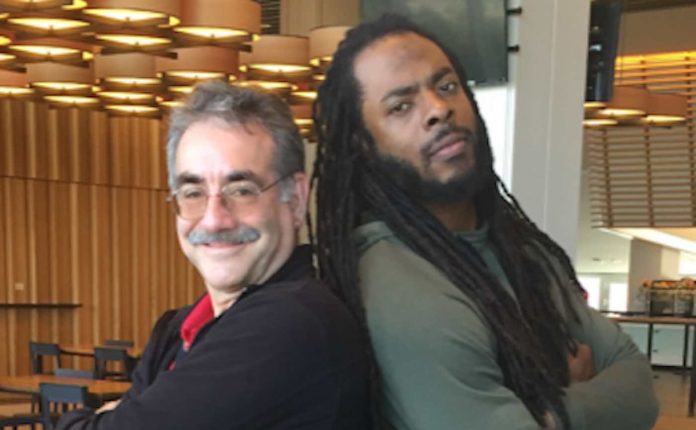
Chris Barrington with teacher Michell Girard – by Jimmy Bennett / JMB Fishing Foundation
A 30-year-old man with special needs has been given a whole new lease on life thanks to his former teacher who he had not seen in years.
Two months ago, police found Chris Barrington wandering the streets of Gatesville, Texas. Since Barrington’s father had been struggling with late-stage leukemia, he had lost the ability to move, leaving him unable to care for his son.
Barrington, who can only function at the cognitive level of a 6-year-old, had been lost in the city for two days before he was picked up by police officers. He told the department that he had no other living family members—but he did remember the name of Michell Girard, his former junior high school teacher.
It had been years since Girard had been in contact with her former student, but when police reached out to her about Barrington’s predicament, she couldn’t help but feel responsible for him.
“I said ‘what happens if I don’t take him? Will he get in a group home?’ They said, ‘no he’ll go in to an institution,’” Girard told KWTX. “I said not on my watch he’s not.”
Girard then took Barrington into her care. Since his father passed away on August 1st, Girard has been applying to become the young man’s official guardian.
Not only that, she threw him his first ever birthday party earlier this month.
“He’s never had a birthday present, a birthday party, he’s never had Christmas, thanksgiving, nothing,” she added. “So this year is going to be full of firsts.”
(WATCH the news coverage below) – Photo by ABC News
Be Sure And Share This Sweet Story Of Kindness With Your Friends On Social Media…
Leonardo DiCaprio has always been an outspoken environmental activist and conservationist—and now, he is helping to lead the fight against the wildfires raging through the Amazon rainforest.
While wildfires in the Amazon are not uncommon, there has been an increase of 32,000 blazes recorded in Brazil this year compared to the same time in 2018. This week alone, there have been about 9,000 fires recorded throughout the region.
That’s why the Hollywood actor is contributing $5 million to the Amazon Forest Fund: an emergency response fund created by the Earth Alliance earlier this week.
The Earth Alliance was created by DiCaprio and philanthropists Laurene Powell Jobs and Brian Sheth last month. The independent nonprofit has thus far recruited teams of scientists and conservationists to protect vulnerable ecosystems, promote renewable energy growth, and secure the rights of indigenous people worldwide.
“Earth Alliance has formed an emergency Amazon Forest Fund with an initial commitment of $5 million to focus critical resources on the key protections needed to maintain the ‘lungs of the planet,’” reads the organization’s website. “These funds will be distributed directly to local partners and the indigenous communities protecting the Amazon, the incredible diversity of wildlife that lives there, and the health of the planet overall.
Collectively, the fund will help finance conservational groups such as the Instituto Associacao Floresta Protegida, Coordination of the Indigenous Organizations of the Brazilian Amazon (COIAB), Instituto Kabu, Instituto Raoni, and Instituto Socioambiental.
This emergency fund is not the only way that governments and citizens are helping to fight the Amazon wildfires. Tree-planting search engine Ecosia says that they recorded a 1,150% increase in downloads as global media coverage of the wildfires intensified earlier this week.
The group uses ad revenue to finance tree-plants around the world. Since their launch, the nonprofit tech group says that they have helped to plant over 650 million trees around the world. On an average day, they usually welcome 20,000 new users—but on Thursday, over 250,000 new users downloaded the search engine.
Additionally, the Bolivian government recruited the help of the largest airtanker in the world to help firefighters extinguish the blazes from above.
The Colorado-based B747-400 SuperTanker, which was deployed to Bolivia earlier this week, is capable of discharging more 19,000 gallons of water per trip.
Quote of the Day: “I can only have peace of mind when I forgive rather than judge.” – Gerald Jampolsky
Photo: by Michael Levine-Clark, CC license, cropped, via Flickr
With a new inspirational quote every day, atop the perfect photo—collected and archived on our Quotes page—why not bookmark GNN.org for a daily uplift?
Millions of Americans have started a business on the side that allows them to pursue their passions, while boosting their incomes, according to a new survey.
A poll of 2,000 adults with full-time employment found that more than one-quarter of them have already turned a hobby into a side hustle while staying in their current jobs.
And more than half, 55 percent, admitted that they would like to turn their passions into a money-making venture, but have yet to take the leap.
Those who do get started on a business add to their annual income with an average of $14,705 per year after taxes.
14 percent of side hustlers report making up to $22,800 annually – well more that the U.S. federal minimum wage of $15,080 pre-tax, for a full-time employee working 40 hours a week.
The research was commissioned by Vistaprint – an online provider of printing services to small businesses.
Beauty and wellness was found to be the most popular side business sector, which includes hairdressers, personal trainers and dietitians.
Artists, DJs, and designers—along with retail businesses, selling in online shops—are also popular areas.
For instance, Amy Grant in Colorado designs and sells wine charms on Amazon and also Etsy.com that feature fun cabin lore, motorcycle sayings, popular movie quotes, book club titles, and rock and roll bands.
Generating extra cash was found to be the top reason Americans either have started or would like to start a side business (62 percent). But 37 percent started a side business to pursue a passion and more than a third (41 percent) did so to spend more time doing what they enjoy.
“America’s side business economy is booming, as employees increasingly look for financial, professional and personal fulfillment that may not be present in their main job,” says Simon Braier, Customer Strategy Director at Vistaprint.
And these ventures don’t always stay small.
“Side business owners can test their venture’s long-term viability, growth and marketing opportunities in a safer setting, helping them to ease the transition into full-time entrepreneurship and spend more time doing what they love.”
The study also found that more than half of entrepreneurs (59 percent) treat their enterprise as a ‘5-9’ pursuit, working on it in the evenings to fit around their workday. A typical side business takes up 16 hours a week, while 34 percent of those polled spend 20+ hours a week working on it.
Successful hustlers recommend starting with something you already enjoy, focusing on tasks which generate revenue, building a strong social media presence, and networking with people who have succeeded.
TOP 6 TIPS FOR SIDE BUSINESS OWNERS
1. Ensure your side business is something you enjoy
2. Focus on tasks that generate revenue
3. Build a strong social media presence
4. Set long term goals
5. Leverage word-of-mouth marketing
6. Network with people who run side businesses
One-quarter of those who want to start a business admitted that a lack of confidence is one of their biggest obstacles, but take it from these 500 creators, and get started today. Author Sydney Harris reminds us all that “regret for the things we did can be tempered by time; it is regret for the things we did not do that is inconsolable.”
Be Sure And Share The Survey With Your Friends On Social Media – File photo by Ray From LA, CC
When Nerissa Cannon became disabled in 2013 and had to use a wheelchair full-time, she felt like she had lost her entire identity. As an active ‘outdoorsy’ person, she was not sure how she could continue doing the things she loved.
“The fear of being a burden on anyone consumed me—and as depression further weighed me down, I withdrew from friends, family, and society in general.”
Then, she found an organization called No Barriers. They reminded her of her value by teaching her to focus on the strengths she still had. She was inspired by all those who were creatively used technology and teamwork to accomplish incredible feats.
“I swore I would do my best to live a “No Barriers Life” from that point on,” she told Good News Network. “I want to inspire others to believe that even if you’re dealing with illness or injury, you don’t have to give up on your sense of adventure.”
She went rock climbing with the group’s co-founder, Erik Weihenmayer. As the first blind person to summit Mount Everest, Erik taught her that while we may have disabilities, we can learn to magnify and use each other’s strengths to gain more independence.
As a result, she was able—with the help of 27 friends and fellow climbers—to make it to the summit of the 14,000-ft peak of Mount Bierstadt in Colorado.
Photo of Nerissa Cannon and Erik Weihenmayer byLloyd Garden / No Barriers
Because she was tackling outdoor adventures again, despite her injury, Winnebago, in partnership with No Barriers, asked if she wanted to dive into a road trip with a wheelchair-ready motorhome. The journey would begin at Winnebago headquarters in Forest City, Iowa, and take her 2,300 miles—all the way to the No Barriers Summit in Lake Tahoe, California.
“While I am fiercely independent, this was not a journey I wanted to do alone. So I asked my partner of two and a half years, Kelsom Owens, to join me and my service dog Cash.” .
The journey would end up covering six states, three national parks, and multiple wilderness recreation areas. Traveling around these places forced her to go well outside her comfort zone and helped her grow by continuing to push the boundaries of what she knew she could accomplish. For example, in Badlands National Park, she stopped at an overlook that included a descent of stairs to a lower platform. To enjoy a better view, she rolled herself down the stairs by holding onto the handrail, and got back up to the top on her own.
“Another highlight of the trip was the time I spent at Flaming Flaming Gorge National Recreation Area (above). Here we enjoyed the pristine waters and magnificent views from our kayak. And even better, I was also able to do some spur of the moment bouldering at this location, pulling myself right out of the kayak to climb the rock wall. It was an indescribable experience.”
They made sure to visit Little Wild Horse Canyon in Utah. The main attraction of that state park is a stretch of very narrow slot canyons that have been beautifully sculpted by time. “I was able to utilize my forearm crutches, and while it was exhausting to hike with crutches, I was determined to finish.”
The Winnebago, as it turns out, was a huge part of her growth on the trip. Last January the RV company unveiled three new floor plans with wheelchair-ready features, like expanded hallways, roll-in showers, lighting and controls at waist height, and more.
The integrated wheelchair lift made it easy for Nerissa to get in and out of the Winnebago on her own. And it also proved to be a big conversation piece in the small towns where they stopped along the way.
Driving the RV itself was a big fear that she wanted to conquer. While Winnebago does install custom hand controls by request, the vehicle provided did not have that feature. So, the No Barriers photographer, Ryan Salm, did most of the driving.
“Although I was incredibly intimidated, I wasn’t going to let that stop me from driving it. After some coaching from Kelsom, I drove the RV over the finish line at the No Barriers Summit in California. The personal pride I felt in that moment was a reward in itself.”
Nerissa also discovered that RV travel fosters a sense of closeness and community that is unmatched in other methods of travel. “One of the sweetest benefits on the trip was the togetherness, and camaraderie with fellow travelers on the road.”
Though previously harboring a fear of being a burden on others, especially when traveling, the innovative RV, along with the support and encouragement from the team at No Barriers, allowed her to stand (pun intended) equal to those around her.
“In a world that doesn’t always feel designed for me, having a community of like-minded friends—and, on this trip, a comfortable place to inhabit while I adventured with loved ones—was priceless.”
Auto-immune diseases like multiple sclerosis (MS) occur when the body’s immune cells attack healthy tissues. In the case of MS, the cells target the protective layer surrounding the nerves. While the reason for this happening is still unclear, a new medical breakthrough has opened the door to reversing any autoimmunity—and even repairing old damage.
Dr. Su Metcalfe, senior research associate at Cambridge University, discovered a switch within the immune cell that could be “reset” in order to return it to its normal activity.
One of the major elements of her promising pre-clinical trial research involves the leukemia inhibitory factor (LIF): a small signaling protein that acts on stem cells in the body.
“[LIF] is able to activate these cells in order to replace damaged cells during tissue repair—for example, repair of a torn muscle,” says Metcalfe. “A further key role of LIF is to sustain a healthy central nervous system, protecting nerves and maintaining myelin.”
In 2013, she founded the Cambridge company LIF-NanoRx to further the research. Her idea was to guide a measured dose of the tiny, specialized particles to damaged nerves and repair them. However, when the LIF particles were deployed as a therapeutic agent, she found that the body broke down LIF after only 20 minutes.
Enter ultrafine nanoparticles. ‘Nano’ simply refers to the very small size. They’re so tiny that the surface area is much greater than their mass—and they actually have their own name to differentiate them from mere clumps of atoms. Their special properties and size make them uniquely suited to delivering therapies to the interior of cells.
Dr. Metcalfe brilliantly sourced nanoparticles using the same type of material as dissolving stitches. She combined them with the LIF protein to extend the life of the repair agent in the body—and thus far, her testing has been very successful. Not only does the LIF have time to reach the damaged areas and work their magic, the nanoparticles eventually dissolve within the body, leaving behind only carbon dioxide and water.
This means that Metcalfe’s “double whammy” treatment can reverse autoimmunity while simultaneously repairing the damage it has wrought on a patient’s brain.
Although Dr. Metcalfe’s research has been focused on MS, she hopes to fine-tune these discoveries to do the same for psoriasis and diabetes—and if she can develop the technique so that it can pass the blood-brain barrier, it could potentially be used to heal dementia.
“We’re not using any drugs, we’re simply switching on the body’s own systems of self-tolerance and repair,” Metcalfe told Cambridgeshire Live.
“There aren’t any side effects because all we’re doing is tipping the balance. Auto-immunity happens when that balance has gone awry slightly, and we simply reset that. Once you’ve done that, it becomes self-sustaining and you don’t have to keep giving therapy, because the body has its balance back.”
Depending on the interest of pharmaceutical companies and private investors for funding, human trials could begin as soon as 2020.
Seth Craven had already journeyed from the other side of the world in order to witness the birth of his son when a storm caused his final flight to be delayed—but thankfully, a compassionate airline passenger offered to go out of his way to help him.
Sgt. Craven, who had been stationed with the National Guard in Afghanistan, had just landed in Philadelphia from Kuwait when poor weather forced the airline to cancel his flight home to Charleston, West Virginia last week.
Since Craven’s wife was scheduled to deliver the baby by C-section on Friday morning, the young 26-year-old sergeant went ahead and bought another plane ticket home for early on Thursday.
Unfortunately, that flight was also delayed several times, leaving Craven stranded in Pennsylvania—and he was quickly running out of options. The previous delays had already spurred most passengers to claim rental cars, and they were all gone.
As Craven became increasingly more distressed, word of his predicament circulated amongst the passengers until it reached the ears of Charlene Vickers.
Vickers and several of her acquaintances were on a deadline to attend a health conference in Charleston on Friday afternoon—and since she is from the Philadelphia area, her car was already parked at the airport, ready for a road trip.
“They kind of pointed to this gentleman and said that ‘poor soul really needs to get back,’” Vickers told WV Metro News. “That’s when I introduced myself … and said, ‘I’m getting to West Virginia tonight, come hell or high water. So are you willing to join this crazy party of ours?’”
Without waiting for his baggage, Craven hopped into the car and traveled with Vickers for the eight-hour trip. He was dropped off at his house just after midnight, and he was standing next to his wife’s bedside when their son Cooper was born the following morning.
“If it wasn’t for Charlene I never would have made it,” Craven told the news outlet. “All she wanted in return was pictures of the baby.”
And, this is the gift of thanks she will treasure for a lifetime: