A baby bird has been given a new lease on life after a resourceful partygoer made sure that it could be transported to a rescue center in the safest – and most modern way possible.
Animal rescuers from the Wildlife Rehabilitation Center of Northern Utah (WRCNU) were surprised to find an Uber waiting outside of their front doors last week. The only passenger that had been waiting in the backseat of the car was a tiny baby bird.
Tim Crowley and his friends had rescued the bird as they were in the middle of enjoying a weekend get-together in Clinton.
They had been sitting outside when the bird suddenly fell out of the sky – and they could not figure out where it had come from.
Upon calling the WRCNU, rescuers said that Crowley ought to bring the bird in for treatment as soon as possible. Since Crowley had been drinking, however, he and his friends did not feel capable of driving the little lesser goldfinch to the animal hospital.
“At first it was a joke, like, ‘Hey, maybe we should just call Uber!’” he told KSTU. “Then we were like, ‘No, really. Why not? We’re paying them.’”
Crowley and his friends then called an Uber for the bird and told the driver about their unusual passenger. When the driver canceled the trip due to the bizarre nature of the journey, Crowley then waited to tell their second driver about the feathery passenger until she had already arrived.
Luckily, the woman agreed to drive the bird to the rescue center.
Though WRCNU rescuers were confused by the arrival of the little bird, they quickly took it under its wing and made sure that it got the proper treatment.
The bird, who has fondly been named “Petey Uber” by the rescuers, will most likely be ready to be released back in the wild just in time for the migration season at the end of the summer – and it’s all thanks to Crowley’s quick thinking.
(WATCH the news coverage below) – Photo by the WRCNU
Fly This Sweet Story Over To Your Friends By Sharing It To Social Media…
Quote of the Day: “Useful pain comes to you when you are taking risks, and acting out of love and adventure…The pain is demanding we rise to the occasion.” – Rob Brezsny
Photo: by Thomas Hawk, CC license

With a new inspirational quote every day, atop the perfect photo—collected and archived on our Quotes page—why not bookmark GNN.org for a daily uplift?
He grew up in a Newark, New Jersey tenement, and when his Russian Jewish immigrant parents didn’t have the money to send him to medical school, he worked to become a pharmacist. But, later it was his business acumen that landed him the CEO job for a home improvement company in California. When he was fired from the job in a power struggle, he didn’t give up and go back to being a pharmacist—he co-founded a store that went on to revolutionize the home improvement industry with its warehouse concept.
Now, the co-founder of The Home Depot says he intends to give most of his remaining fortune to charity, after already having donated nearly two billion dollars to philanthropic organizations across the world.
When the Atlanta billionaire dies, 80 to 90 percent of the remainder of his wealth will be transferred to his foundation.
His current estimated net worth is $4.5 billion, and Bernie and his wife Billi Marcus are signatories of The Giving Pledge, along with 200 others—like Michael Bloomberg, Richard Branson and Elon Musk—a coalition Bill Gates and Warren Buffet designed to recruit wealthy families to pledge at least half their fortunes to charity.
The Marcus Foundation, which has no website of its own, focuses on veteran care, medical research, hospitals, and Jewish causes. Bernie has given instructions to the board to invest in “medical discoveries and treatment for kids with autism (and) creating 20 to 25 centers around the nation to help veterans suffering from brain injuries and post-traumatic stress.”
Though he is 90 years old today, he recently told the Atlanta Journal Constitution that he feels young and hopes to give away most of his money while he’s alive to enjoy it.
”Everything I live for now is finding the right things to put my money into and that can give me a rate of return in emotion and doing good things for this world.”
In April, Marcus donated $25 million to the Marcus Autism Center to spearhead research on the causes and cure for autism, as well as feeding problems known to effect pediatric patients with the disorder.
In 2017, Marcus also funded and founded The Marcus Institute for Brain Health with a $38 Million grant, a Colorado facility devoted to innovative and intensive treatment of U.S. military veterans who now suffer from PTSD, post-traumatic stress disorder.
Share the Wealth of Goodwill by Sharing This on Social Media
Around 0.9 billion hectares (2.2 billion acres) of land worldwide would be suitable for reforestation, which could ultimately capture two thirds of human-made carbon emissions.
The Crowther Lab of ETH Zurich has published a study in the journal Science that shows this would be the most effective method to combat climate change.
The Crowther Lab at ETH Zurich investigates nature-based solutions to climate change. In their latest study, the researchers showed for the first time where in the world new trees could grow and how much carbon they would store.
Study lead author and postdoc at the Crowther Lab Jean-François Bastin explains: “One aspect was of particular importance to us as we did the calculations: we excluded cities or agricultural areas from the total restoration potential as these areas are needed for human life.”
The researchers calculated that under the current climate conditions, Earth’s land could support 4.4 billion hectares of continuous tree cover. That is 1.6 billion more than the currently existing 2.8 billion hectares. Of these 1.6 billion hectares, 0.9 billion hectares fulfill the criterion of not being used by humans. This means that there is currently an area of the size of the US available for tree restoration. Once mature, these new forests could store 205 billion tonnes of carbon: about two thirds of the 300 billion tonnes of carbon that has been released into the atmosphere as a result of human activity since the Industrial Revolution.
Photo by Crowther Lab / ETH Zurich
According to Prof. Thomas Crowther, co-author of the study and founder of the Crowther Lab at ETH Zurich: “We all knew that restoring forests could play a part in tackling climate change, but we didn’t really know how big the impact would be. Our study shows clearly that forest restoration is the best climate change solution available today. But we must act quickly, as new forests will take decades to mature and achieve their full potential as a source of natural carbon storage.”
The study also shows which parts of the world are most suited to forest restoration. The greatest potential can be found in just six countries: Russia (151 million hectares); the US (103 million hectares); Canada (78.4 million hectares); Australia (58 million hectares); Brazil (49.7 million hectares); and China (40.2 million hectares).
Many current climate models are wrong in expecting climate change to increase global tree cover, the study warns. It finds that there is likely to be an increase in the area of northern boreal forests in regions such as Siberia, but tree cover there averages only 30 to 40%. These gains would be outweighed by the losses suffered in dense tropical forests, which typically have 90 to 100% percent tree cover.
A tool on the Crowther Lab website enables users to look at any point on the globe, and find out how many trees could grow there and how much gamset carbon they would store. It also offers lists of forest restoration organizations. The Crowther Lab will also be present at this year’s Scientifica (website available in German only) to show the new tool to visitors.
The Crowther Lab uses nature as a solution to: 1) better allocate resources – identifying those regions which, if restored appropriately, could have the biggest climate impact; 2) set realistic goals – with measurable targets to maximize the impact of restoration projects; and 3) monitor progress – to evaluate whether targets are being achieved over time, and take corrective action if necessary.
This story was submitted as a nomination to the Reader’s Digest “Top 50 Nicest Places in America” contest: a crowd-sourced effort to uncover nooks where people are still kind and respectful in an era of cultural and political divides. Be sure and vote for which story you think should be nominated as the Nicest Place by visiting the Reader’s Digest website.
Photo by Elizabeth Shook
When illness nearly caused a beloved shop owner to close the doors, one group came to the rescue: Her customers.
For 10 years, Joan Peterson had tried to make life better for the people of Hidden Springs, Idaho. When the community had the chance to return the favor, it did.
In 2008, Peterson and her husband bought the Dry Creek Mercantile, a cluster of stores and services that sits at the heart of Hidden Springs. It’s the place where kids meet after school, where adults gather for a drink or a meal, where families come to host a wedding or graduation. It was hard work for just the two of them, running such a big operation. Things got a lot harder when her husband fell ill. And that’s when her neighbors showed her what they were made of.
“I was driving to the hospital, maybe three days before my husband passed away, and I went past the business and there were all these cars in the parking lot,” she says. “Later I found out that about 125 people came in and gave it a cleaning. Top to bottom, like it was new. I didn’t ask for it. They just did it.”
After losing her husband two years ago, Peterson briefly considered leaving “the Merc,” but discovered that her neighbors were not going to let her go that easily.
“It’s a big operation to run by myself. But they just kept helping me,” she says. “I could have walked away. But I can’t, because I love it. This is my family.”
Hidden Springs is a planned community of about 800 homes, just outside Boise, designed by its founders to avoid typical suburban sprawl and replicate an old-fashioned American small town. Instead of cul-de-sacs and rows of identical homes, it features walkable streets, unique homes, and a network of trails and carefully-preserved open spaces. Instead of strip malls and parking lots, it has the Merc and its big green space, where concerts and events take place all year.
But residents say it’s the people who truly make it special.
“We were out walking, and we heard the sound of laughter, so we went over,” recalls B. J. Shook, who nominated Hidden Springs. They found about thirty kids and parents goofing around on a homemade ice-skating rink that a bunch of dads had built next to an old barn. “It was like a Norman Rockwell picture,” she says.
Reprinted with permission from Reader’s Digest. To learn more about GNN’s part in searching for the Top 10 Nicest Places, click here.
Be Sure And Share This Sweet Story Of Neighborly Kindness With Your Friends On Social Media…
It’s not uncommon to see singing and dancing during the talent show segment of the Miss America pageant – but this lovely young biochemist was recently crowned the new Miss Virginia of 2019 thanks to a more unconventional performance.
24-year-old Camielle Schrier won the competition after she donned a white coat and rubber gloves for an on-stage science experiment.
Using hydrogen peroxide and potassium iodide, Schrier demonstrated the process – – and colorful results – of catalytic decomposition.
After pouring the iodide into the peroxide, the young biochemist immediately stepped away from the table to distance herself from the colorful foam that shot several feet into the air.
In addition to the performance impressing the audience, the science display clearly impressed the judges as well. Schrier was later crowned Miss Virginia 2019 – and since she is now preparing to compete in the Miss America Pageant in September, she hopes that her chemistry performance will inspire other young women to pursue their passions in STEM.
“I am more than Miss Virginia. I am Miss Biochemist, Miss Systems Biologist, Miss Future PharmD looking toward a pharmaceutical industry career,” she said in a release. “Now was the time for me to create a mind shift about the concept of talent by bringing my passion for STEM to the stage. To me, talent is not a passion alone, but also a skill which is perfected over years of learning.”
(WATCH the video below)
Be Sure And Share This Sweet Story With Your Friends On Social Media…
Quote of the Day: “These are times in which a genius would wish to live. It is not in the still calm of life that great characters are formed… Great necessities call out great virtues.” – Abigail Adams (in a letter to her husband John Adams)
Photo: by Zooey, CC license

With a new inspirational quote every day, atop the perfect photo—collected and archived on our Quotes page—why not bookmark GNN.org for a daily uplift?
After creaky floorboards kept waking up his newborn daughter, an exhausted dad invented a unique spray that managed to silence his whole house – and it is now helping other sleep-deprived parents has well.
45-year-old Paul Lanzarotti reckons that he has helped thousands of weary parents with his floorboard tonic, which is made from the same lubricant on Teflon pans, but is safe, and nontoxic, categorized as a “food grade” coating by the UK government.
He came up with the idea after his brand new Italian laminate floor shrank in size due to underfloor heating. With the flooring laid throughout his entire house, it squeaked every time he took a step.
Lanzarotti and partner Tracy McCreary put up with the squeaking until they welcomed their newborn baby daughter Sienna.
Every time they put Sienna to bed, they were forced to perform a Mission Impossible-style escape. Just walking out of her bedroom would wake her – and the creaks were so loud, little Sienna would hear them from any room in the house.
“It was incredibly infuriating,” said the self-employed digital innovator from Hendon, London. “We were exhausted and it was a nightmare. Our house wasn’t fun to live in anymore.
Lanzarotti said flooring experts told him that the only solution for the creaking was to rip up and replace the floor for the whopping cost of £5,000 ($6,300).
So the “obsessive problem solver” decided to take matters into his own hands and spent hours trawling the web for a solution.
He learned that the noise was caused by friction, which could be stopped if properly lubricated. Lanzarotti also found out that a safe chemical compound found in Teflon was one of the world’s best lubricant elements.
The determine dad eventually discovered that mixing the Teflon compound PTFE with an acrylic fluid could be used to spray the flooring and stop the creaking. He then called a chemical engineering company and commissioned them to manufacture the spray into a product which he called “Stop Creak”.
Upon using the spray on his floors, he was stunned by its success.
SWNS
“I tested it at home and just couldn’t believe the result. I sprayed it in Sienna’s room first and the floor was immediately silenced,” said Lanzarotti. “Eight months later, it is still silent.
“It felt like a huge relief. When Tracy saw the difference for the first time, her face just lit up.
“You can treat a couple of rooms in an hour and it was such an easy product to come up with. To be honest I have no idea how long it lasts for,” he added. “But I’m baffled there was nothing like it before. It was such a simple problem to fix.”
Manufactured by the respected chemical company that makes WD-40, the ingredients used in the product are “pure Polytetrafluoroethylene (PTFE) and Silicon.” PTFE is known to be stable and nontoxic at lower temperatures, though it begins to deteriorate in cookware in high heat about 260 °C (500 °F). The controversial chemical used in the creation of Teflon pans, which has raised safety concerns, is PFOA. PTFE, on the other hand, is often used as a valve oil to lubricate musical instruments, in other aerosol lubricant sprays, and in Gore-Tex, an insulating material incorporating a fluoropolymer membrane with micropores.
Having nailed his invention, Lanzarotti arranged for a batch of Stop Creak to be shipped out to him so he could share cans of it between friends and family.
When they were just as “amazed” by the result, they suggested he try to sell it online. So Lanzarotti built a website, designed product labels, and listed the cans for sale on eBay for £19.99.
Sales were slow at first, and in the first couple of months, Lanzarotti only sold a handful of cans each week. Eight months later, he now sells up to 130 cans a week, and he has so far made a gross revenue of around £37,000 ($47,000).
He reckons he has collectively sold between 8,000 and 10,000 cans, and his financial projection predicts that he may end up hitting £100,000 in sales by the end of the year.
With orders flying in, Lanzarotti says he has had to put his full-time job on hold in order to manage Stop Creak.
“It started out as a side project just because we really needed a good night’s sleep,” said Lanzarotti. “But now I’m just really happy to be helping other people. I thought there must be other people who are being driven mad by creaky floors.
“It’s a no-brainer for any parent with squeaky floors, but a lot of people just live with it. It is a living nightmare for people, but it doesn’t have to be,” he added. “People don’t realize the difference it makes. It’s life-changing.”
As an “Amazon Prime” merchant, StopCreak had to pass the safety checks required by Amazon to sell to their customers. They are also required by UK law to provide a data sheet to accompany the product, which states the product should be applied in a well-ventilated area and user should avoid contact with skin and eyes.
Be Sure And Share The Story With Your Friends On Social Media…
A groundbreaking piece of research shows that groups of people can communicate wordlessly by concentrating on the right answer—and they were correct 13 out of 16 times. And, the receiver of information was able to throw out the answer when someone was not telling the truth.
A team from the University of Washington created a method that allows three people to work together to solve a problem using only their minds.
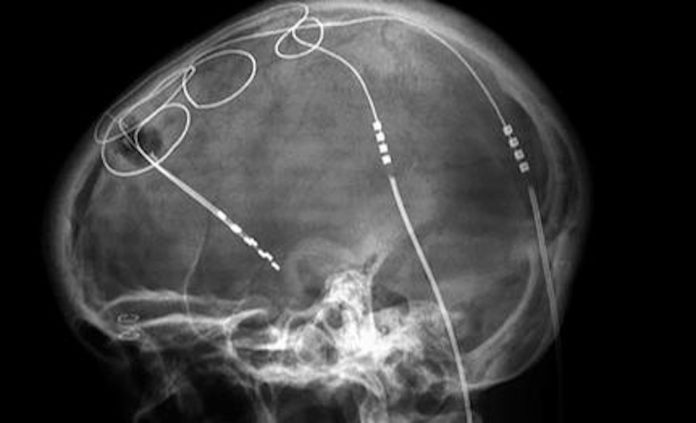
In BrainNet, three people play a Tetris-like game using a brain-to-brain interface. This is the first demonstration of two things: a brain-to-brain network of more than two people, and a person being able to both receive and send information to others by concentrating, using only their brain. The team published its results in the Nature journal Scientific Reports.
“Humans are social beings who communicate with each other to cooperate and solve problems that none of us can solve on our own,” said corresponding author Rajesh Rao, co-director of the Center for Neurotechnology. “We wanted to know if a group of people could collaborate using only their brains. That’s how we came up with the idea of BrainNet: where two people help a third person solve a task.”
As in Tetris, the game shows a block at the top of the screen and a line that needs to be completed at the bottom. Two people, the Senders, can see both the block and the line but can’t control the game. The third person, the Receiver, can see only the block but can tell the game whether to rotate the block to successfully complete the line. Each Sender decides whether the block needs to be rotated and then passes that information from their brain, through the internet to the brain of the Receiver. Then the Receiver processes that information and sends a command – to rotate or not rotate the block – to the game directly from their brain, hopefully completing and clearing the line.
The team asked five groups of participants to play 16 rounds of the game. For each group, all three participants were in different rooms and couldn’t see, hear or speak to one another.
The Senders each could see the game displayed on a computer screen. The screen also showed the word “Yes” on one side and the word “No” on the other side. Beneath the “Yes” option, an LED flashed 17 times per second. Beneath the “No” option, an LED flashed 15 times a second.
An example of the game. A Receiver sees the panels on the left and two Senders see the panels on the right. Top row shows the screens at the beginning of the trial. The Senders (right panels) can see the green line at the bottom, but the Receiver can’t. Middle row is when Senders have a chance to review the Receiver’s decision, and can suggest that the Receiver change their mind. Bottom row: Success! The two screens after the Senders have changed the Receiver’s mind. Photo by Jiang, et al. 2019, Scientific Reports.
“Once the Sender makes a decision about whether to rotate the block, they send ‘Yes’ or ‘No’ to the Receiver’s brain by concentrating on the corresponding light,” said first author Linxing Preston Jiang, a student in the Allen School’s combined bachelor’s/master’s degree program.
The Senders wore electroencephalography caps that picked up electrical activity in their brains. The lights’ different flashing patterns trigger unique types of activity in the brain, which the caps can pick up. So, as the Senders stared at the light for their corresponding selection, the cap picked up those signals, and the computer provided real-time feedback by displaying a cursor on the screen that moved toward their desired choice. The selections were then translated into a “Yes” or “No” answer that could be sent over the internet to the Receiver.
“To deliver the message to the Receiver, we used a cable that ends with a wand that looks like a tiny racket behind the Receiver’s head. This coil stimulates the part of the brain that translates signals from the eyes,” said co-author Andrea Stocco, a UW assistant professor in the Department of Psychology and the Institute for Learning & Brain Sciences, or I-LABS. “We essentially ‘trick’ the neurons in the back of the brain to spread around the message that they have received signals from the eyes. Then participants have the sensation that bright arcs or objects suddenly appear in front of their eyes.”
If the answer was, “Yes, rotate the block,” then the Receiver would see the bright flash. If the answer was “No,” then the Receiver wouldn’t see anything. The Receiver received input from both Senders before making a decision about whether to rotate the block.
The Receiver, who also wore an electroencephalography cap, usedd the same method as the Senders to select yes or no.
Photo by Mark Stone/University of Washington
The Senders got a chance to review the Receiver’s decision and send corrections if they disagreed. Then, once the Receiver sent a second decision, everyone in the group found out if they cleared the line. On average, each group successfully cleared the line 81% of the time, or for 13 out of 16 trials.
The researchers wanted to know if the Receiver would learn over time to trust one Sender over the other based on their reliability. The team purposely picked one of the Senders to be a “bad Sender” and flipped their responses in 10 out of the 16 trials – so that a “Yes, rotate the block” suggestion would be given to the Receiver as “No, don’t rotate the block,” and vice versa. Over time, the Receiver switched from being relatively neutral about both Senders to strongly preferring the information from the “good Sender.”
The team hopes that these results pave the way for future brain-to-brain interfaces that allow people to collaborate to solve tough problems that one brain alone couldn’t solve. The researchers also believe this is an appropriate time to start to have a larger conversation about the ethics of this kind of brain augmentation research and developing protocols to ensure that people’s privacy is respected as the technology improves. The group is working with the Neuroethics team at the Center for Neurotechnology to address these types of issues.
“But for now, this is just a baby step. Our equipment is still expensive and very bulky and the task is a game,” Rao said. “We’re in the ‘Kitty Hawk’ days of brain interface technologies: We’re just getting off the ground.”
As a means of tackling loneliness and social isolation in English towns, local police forces have begun designating specific public benches that can be used for making friends and having conversations.
The “Chat Benches”, which are now located in two different parks and outdoor areas in Somerset, are identified by little signs reading: “Sit here if you don’t mind someone stopping to say hello!”
The Avon and Somerset Police Department Facebook page recently published photos of their two new “Chat Benches” in Burnham and Taunton with an encouraging note for readers to stop by and use them for socialization.
“The sign simply helps to break down the invisible, social barriers that exists between strangers who find themselves sharing a common place. We can all play a part…” says the police department. “Simply stopping to say ‘hello’ to someone at the ‘Chat Bench’ could make a huge difference to the vulnerable people in our communities and help to make life a little better for them.”
According to the department, 17% of older people are only in contact with family, friends and neighbors less than once a week, which can leave them feeling isolated. Collectively, this amounts to roughly 9 million UK residents who suffer from loneliness and isolation each year.
The police force launched the Chat Bench initiative earlier this month to coincide with United Nations World Elder Abuse Awareness Day. Though the officers say that there are many different forms of elder abuse which deserve our concern, they hope that the Chat Benches will help to tackle senior loneliness in their communities.
“The Chat Bench is fantastic new initiative that I hope encourages those of all ages to start many more conversations in the future,” says Police and Crime Commissioner Sue Mountstevens. “I encourage you to stop by and say ‘hello’. It really could make a huge difference to that person.”
Be Sure And Share The Good Idea With Your Friends On Social Media…
For three months, Frank Sereno had been asking city officials to fill up a particularly pesky pothole on his neighborhood street. When he finally got tired of complaining about the problem, he opted to celebrate instead – and it actually worked.
Sereno is just one of the many citizens of Waldo, Missouri who have been fed up by the persisting potholes that have pervaded community roads.
This particular pothole is just one of many mini-craters that Sereno has reported to the city’s construction department over the course of the last few months. Rather than continuing to gripe about the unstable neighborhood roads, however, he decided to take a more creative approach for motivating the repair crews.
Sereno put a positive spin on the pothole’s presence in the community by buying a slice of cake with a little candle to celebrate its 3-month-birthday.
“I thought, ‘What I can I do to have a little fun,’” Sereno told WTVR. “Everyone is always complaining about the potholes, but complaining doesn’t seem to be getting anything done. So I said, I want to keep it top of mind. I know my fellow Waldo neighbors are just as disgusted as I am so I said, let’s just celebrate its birthday. Its third birthday.”
Upon posting photos of the birthday celebration to Facebook, Sereno’s neighbors expressed their amusement over his gimmick. Not only that, the pothole was patched and filled by construction crews only days later.
City workers told local reporters that poor weather conditions have prevented repair crews from being able to patch up potholes as quickly as they would like, but a little sweet cajoling was apparently just the right amount of nudging to get the job done.
(WATCH the news coverage below) – Photo by Frank Sereno
Quote of the Day: “You are under no obligation to be the same person you were 5 minutes ago.” – Alan Watts
Photo: by Allen Skyy, CC license
With a new inspirational quote every day, atop the perfect photo—collected and archived on our Quotes page—why not bookmark GNN.org for a daily uplift?
Slowly, ever slowly, the sloth moved each claw to eventually grab hold of the limb, which allowed the drenched animal to be carried by the kind men through a field of boulders and released into the forest once more.
It seemed grateful for the lift back to its leafy habitat and it started eating immediately—and probably surveying for a place to sleep, because that’s what the species does for 15 hours every day.
(WATCH the video below)
SHARE the Clever Rescue With Your Friends on Social Media…
A cheeky feline has learned how to open drawers so he can raid its owner's sweetie stash. in the kitchen to nab a snack. See SWNS story SWSYcat; Tabby cat Muffin, four, got hungry and stalked about the kitchen looking for cat treats to munch on June 13 in Sunderland. He sat by the drawer for a minute, before he suddenly leapt onto his hind legs, pounced onto the handle, putting both front paws around it, and pulled it open. Muffin then rummaged around for a few seconds to nab the treats, bought earlier that day by owner Sarah Taylor, 23, and strolled off with them in his mouth. Sarah said: "Muffin's been opening drawers for a year or more now, but I've never seen him open one until I started filming him. "I almost think he did it to show me that he's so bright. "Obviously I wasn't going to let him have all the treats, though it didn't seem right not to give him one after doing that little trick. "I hope he doesn't draw the wrong lesson from this, and keep showing off." Muffin isn't the only cat in Sarah's household, though - his sister Molly likes to jump in the drawers that he opens.
SWNS photo
A sneaky feline has learned how to open kitchen drawers and raid its owner’s stash of sweets.
The cat burglar named Muffin apparently was hungry and stalked about the kitchen looking for treats on which to munch.
Owner Sarah Taylor filmed the four-year-old Tabby on June 13 as it balanced on its hind legs, pounced on the drawer handle, and used its front paws to pull open the cabinet.
He immediately spotted what he wanted, pulled it out, and strolled calmly away with the packet of treats in his mouth.
“Muffin’s been opening drawers for a year or more now, but I’ve never seen him open one until I started filming him,” said Sarah, 23, of Sunderland, England.
“Obviously, I wasn’t going to let him have all the treats (but) it didn’t seem right not to give him one after doing that little trick.
Sarah’s other cat Molly is not, however, quite as bright and simply loves to jump into the drawers that Muffin opens.
(WATCH the video below, courtesy of SWNS)
SHARE the Giggle with Cat Lovers on Your Social Media Feeds…
The Castle of Mey with wall and keep, CC photo by Emma Henderson

The prince who is next in line to the throne of England has opened a new bed and breakfast in Scotland, overlooking the picturesque North Sea on the grounds of the Castle of Mey, where he has vacationed annually for much of his life.
The 10-bedroom facility was funded by Prince Charles to open the grounds to the public in order to boost tourism in the local Caithness village that he loves.
Called the Granary Lodge, the luxury accommodations are quite affordable—for being intertwined with royalty—and have earned eight 5-star reviews on TripAdvisor.com since opening their doors on May 15.
The starting price for a double room is £145.00 per night, with the Super King Double Suite costing £155.00. The price includes breakfast and access to a relaxing drawing room, also fully renovated.
“We are delighted that the prince’s vision for the Granary Lodge has been realized and hope the development means more people will visit the north Highlands of Scotland to experience its unique offering to tourists,” said Robert Lovie, director of outreach for the Prince’s Foundation, at the hotel’s unveiling.
“Our team has completed a wealth of hard work in recent months and is pleased with the result, which we hope will encourage people to spend longer in beautiful Caithness – an area so close to the heart of His Royal Highness”.
The Granary Lodge Bed & Breakfast
Built between 1566 and 1572 and bought in 1952 by the Queen Mother, the late Queen Elizabeth, the Castle of Mey rises above the shores of Pentland Firth and became a favorite holiday destination for her family who regularly visited, especially after the death of her husband King George VI.
The castle itself comprises some 38 rooms, including 15 bedrooms, 3 reception rooms, a library and a billiards room. An imposing double staircase from the entrance hall leads to the principal rooms on the second floor. A trap-door in the floor of the dining room leads to a dungeon. The well-tended gardens are occasionally open to visitors.
The Castle of Mey with wall and keep, CC photo by Emma Henderson
Shirley Farquhar, administrator of the Queen Elizabeth Castle of Mey Trust, said: “We welcome HRH to the Castle of Mey each year for his holiday and, given his strong affinity and family connection to Caithness, it was fitting that he paid us the honor of formally opening the Granary Lodge”.
Ms. Farquhar said the development would secure “year-round employment for local people and provide a valuable asset to tourism in Caithness”.
She added: “As luxury accommodation, a unique wedding venue, and a conference center, the Granary Lodge will, we hope, create a considerable positive ripple effect within the local economy”. Visit their website for more information.
Hat tip to: World At Large, a news website reporting on nature, science, health, and travel. (Granary Lodge photo by CastleOfMey.org)
Quote of the Day: “A problem is never as permanent as a solution.” – from the 1988 film, Torch Song Trilogy
Photo: by bartb_pt, CC license
With a new inspirational quote every day, atop the perfect photo—collected and archived on our Quotes page—why not bookmark GNN.org for a daily uplift?
This birthday gift to the United States may have gone down in history as one of the sweetest gestures of international appreciation for the country’s independence.
Two years ago, the Library of Congress’s website published the entirety of a Polish birthday card that was given to the United States on the 150th anniversary of when America claimed independence.
And when we say entirety, we mean all 111 volumes of well wishes – including 5.5 million signatures from the Polish people.
The Polish Declarations of Admiration and Friendship, which also served as a thank you from the Polish people who were grateful for American aid during World War I, were presented to President Calvin Coolidge in 1926. The collective 30,000 pages are rich in color and history, with pressed flowers, drawings from famous Polish artists, and notes from religious, social, business, military, and educational institutions.
The signatures basically serve to represent about one sixth of the Polish population from that time. As the volumes took eight months to create, they were also delivered some time after the Fourth of July.
To summarize the message of the Declarations, the Polish committee in charge of the project wrote: “Noble Americans, your national holiday is sacred not for you alone. It finds a warm reverberation over the whole world.”
“We, the people of Poland, send to you, citizens of the great American union, fraternal greetings [and] . . . our deepest admiration . . . for the institutions which have been created by you.
“In them, Liberty, Equality and Justice have found their highest expression and have become the guiding stars for all modern democracies.”
“With eternal gratitude in our hearts,” the Poles declared, “we . . . desire . . . to wish your country and your nation all possible prosperity. . . . Long live the United States of America!”
Be Sure And Share The Sweet Story Of History With Your Friends…
In what is being called a “world-first”, Nestlé will begin wrapping their Yes! snack bar range in a new kind of recyclable paper that can biodegrade in six months.
Researchers working at the company’s English confectionery R&D center in York have found a way to use a recyclable paper wrapper in a high-speed “flow wrap cold seal” packaging line, which – thus far – has been a process that has only been suitable for plastic films and laminates.
The Yes! range of fruit- and nut-based bars, which will become the first brand to convert to the new recyclable paper wrapper, will be rolled out this month.
Additionally, the Swiss company says that they have not patented the technology as a means of encouraging other companies to adopt the packaging method starting from April of next year, according to the Financial Times.
“We’ve turned our attention to the wrapper so that the packaging is sustainable and easy to recycle. It’s an important step as we work to make all of our packaging recyclable or reusable by 2025,” said Stefano Agostini, CEO for Nestlé in the UK and Ireland.
Though Nestlé did not disclose when their other products would adopt the biodegradable packaging, the company has already made notable strides towards their sustainability goals. At the start of the year, Nestlé began to replace all of the plastic straws from its products with eco-friendly materials like paper; they started rolling out paper packaging for Nesquik; and they announced that Smarties candy would soon begin using plastic-free packaging.
Additionally, the company announced in April that they had managed to certify three-quarters of their supply chain as deforestation-free ahead of their deadline for being entirely deforestation-free before 2020.
Now with their latest packaging breakthrough for the Yes! brand, the snack bar wrappers will now carry the message “carefully wrapped in paper” in order to reflect the work that has been done in adapting production lines to handle the new packaging more gently during the manufacturing process.
The new packaging is made of a coated paper that is widely recyclable with other paper. The paper itself comes from sustainable sources, certified by the Forest Stewardship Council (FSC) or The Programme for the Endorsement of Forest Certification.
The innovation has been a significant project for the company’s R&D centre in York and a small team has worked independently and creatively to focus on finding the breakthrough required over the course of the last ten months.
The challenge for experts was to find a way to use paper on high speed production lines that have been designed for more durable plastic or laminate packaging. The new wrapper then had to be tested extensively to make sure it would keep Yes! bars in perfect condition during production, transport and storage.
“This launch is the result of a lot of hard work at speed with our R&D teams delivering a recyclable paper solution for our YES! bars in less than 10 months,” said Jas Scott de Martinville, Global Confectionery R&D lead for Nestlé. “It is an incredible achievement and one that we are all very proud of.”
Although the bars are not yet available in the United States, the new paper wrapped-bars are now being launched in more countries, including Austria, Belgium, the Czech Republic, France, Germany, Ireland, Luxembourg, Malta, the Netherlands, Portugal, Slovakia, Spain, and the United Kingdom. More countries in Europe and beyond will follow soon.
Be Sure And Share The Good News With Your Friends On Social Media…
Most Americans enjoy the fireworks displays that light up the skies every 4th of July – but dogs generally aren’t as thrilled, especially shelter pups living in crowded kennels.
Over the years, more and more animal shelters have recruited community volunteers to comfort their shelter dogs during Independence Day firework shows, but one Florida police department has found the perfect team of helpers to look after anxious pups.
Spending time with canines has been shown to be particularly therapeutic for inmates – and that’s why the Brevard County Sheriff’s Office of Florida recently announced that they would be employing a team of inmates to comfort the dogs at the local Animal Care Center on Independence Day.
Throughout the holiday, the inmates will be snuggling, comforting, offering treats, and reading to the dogs to keep them calm.
The department’s Sheriff Wayne Ivey made the announcement on Facebook after he received several calls from concerned community members about the wellbeing of the shelter animals in anticipation of the holiday.
“While we greatly appreciate the offer of assistance and truly love the fact that our community partners with us to help our homeless pets, our agency has designed a new program that will not only help our dogs, but will also help add purpose to the lives of inmates incarcerated at the Brevard County Jail,” wrote the sheriff.
“Our goal is to not only help calm the dogs but also to help build and instill a sense of purpose and compassion in the inmates that will hopefully aid them as they transition back into society once the have served their time,” he continued.
Be Sure And Share This Pawesome Story With Your Friends On Social Media…
Quote of the Day: “I believe in America because we have great dreams, and because we have the opportunity to make those dreams come true.” – Wendell L. Wilkie (Happy Independence Day!)
Photo: by Michael Dougherty, CC license
With a new inspirational quote every day, atop the perfect photo—collected and archived on our Quotes page—why not bookmark GNN.org for a daily uplift?