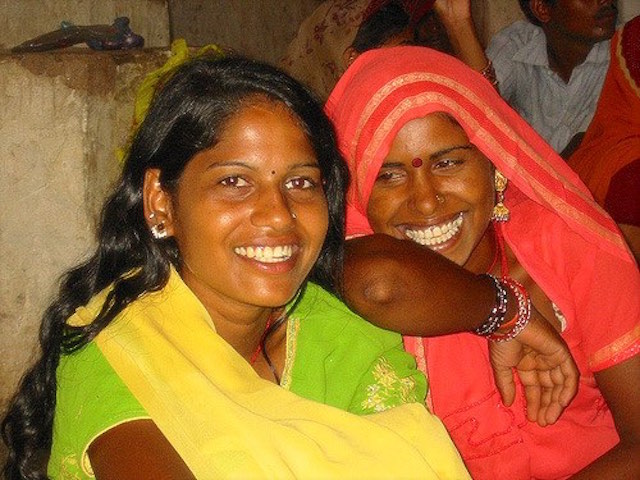
Indian women have won the right to be considered the head of a household.
Previously, the role of “Karta” in any family residing in one home was only available to men. The Delhi High Court changed that, announcing that they have overturned the long standing law in favor of equality for women.
As the designated leader of a family, the Karta is in charge of property, inheritance, and other family decisions.
The case before the court was brought by an eldest daughter who wanted to take over the family business after her father, brothers, and uncle had all passed away. Under a 1956 law, the role of Karta passed to one of her nephews.
Her lawyers argued that a 2005 amendment granting women the right to inheritance should also extend the “fundamental right of equality guaranteed by the Constitution” to women who want to serve as head of a household.
“If a male member…by virtue of his being the first born eldest, can be a Karta, so can a female member,” Justice Najmi Waziri of the Delhi High Court said in the December judgment which was only made public in February.
The rule allows the eldest woman member of a family to become Karta, and applies to India’s Hindu Undivided Family (HUF) — which is the country’s legally recognized family group created by Hindu, Buddhist, Jain, and Sikh Indians through marriage.
(READ more at The Hindu) — Photo: Michael Coghlan, CC
The 61-foot tall bath toy will be floating at the annual spectacle alongside replica ships that include a Spanish Galleon and a Viking longboat.
Dutch artist Florentijn Hofman hatched the idea of giant rubber ducks in 2007. His 50-foot tall duck has migrated to five continents around the world.
Craig Samborski’s “Mama” duck, which is the one headed for Duluth this summer, is even bigger. He created it when he needed something splashy for Tall Ships Los Angeles in 2013.
Samborski also has a baby duck called “Timmy,” that floats alongside Mama at many events.
Football fans who’ve cut the cord will still be able to watch the Super Bowl, even if they’ve given up their cable connection and have no broadcast signal.
CBS plans to stream the big game live at CBSSports.com. You’ll be able to watch it on televisions with devices including Roku, Apple TV, Chromecast, and XBOX One.
Verizon Wireless customers can also use the NFL Mobile App to watch on their tablets or smart phones.
You can still the see the Carolina Panthers play the Denver Broncos for the NFL championship over free broadcast television on your local CBS affiliate in the U.S., but if you can’t bring in a signal with your antenna, the online version is a game changer.
Super Bowl 50 airs Sunday, February 7 at 6:30pm Eastern Time on CBS.
Photo: Mike Morbeck, CC; Mobilus In Mobili, CC; Jeffery Beall, CC
A five-year-old boy passed up birthday presents in favor of toys and treats for animals in local shelters.
With his birthday early in the year and his Christmas toys still new, Dalton Shaw’s parents asked him if he’d like to do something different for a birthday present.
The little boy with a big heart decided to ask people to donate money for shelter animals. The family already has rescued two dogs and two cats, and Dalton wanted to help the ones he couldn’t bring home.
People showed up at his bowling alley birthday party carrying bags of pet food, treats, and dog and cat toys. Others donated to a pile of cash that totaled $225–this really delighted Dalton.
The boy’s proud father, Marcus, posted the picture above to Imgur showing off his pile of donations.
“This kid is awesome,” commented the Imgur user ProLicks. “Tell him I’m making a donation to my local humane society because of him, too.”
Dalton will get to see some of the animals he helped as he accompanies his parents to drop off the items at three animal shelters around Savanna, Illinois.
MULTIPLY the Good… Share It. Photo: MarcusShaw, Imgur
After a three decade-long battle, the Israeli government has agreed to let women pray alongside men at Jerusalem’s Western Wall, one of Judaism’s holiest sites.
The Wall is one of the few remaining remnants of the Second Jewish Temple, and rules allowed both men and women to pray at the wall — but never together.
A group called Women of the Wall has held monthly protests for the past 27 years demanding the Israeli government bring down the virtual wall between genders and allow women and men to pray alongside one another.
Under a compromise approved by Prime Minister Benjamin Netanyahu’s cabinet, a former archeological site will be turned into a plaza allowing mixed-gender prayers.
Costing nine million dollars, the plaza will be able to accommodate 1,200 people at a time, reports the CS Monitor.
“This landmark decision gives expression to a fundamental truth: there is more than one way to be Jewish,” Rabbis Noa Sattah and Gilad Kariv, of the Israel Religious Action Centre and the Israel Movement for Reform and Progressive Judaism said in a joint statement. “There is more than one way to pray. There is more than one way to connect to Jewish traditions and identity.”
(WATCH the video below from the Associated Press) — Photo: Edmund N Gall, CC
While news reports throughout the past year raised anxiety that New York City was slipping back into the crime rates of its bad old days, 2015 turned out to be one of the best years ever — and crime rates continued historic declines.
The city’s police department reports an overall drop of two-percent in serious crime and a 13% decrease in criminal arrests.
The improvements were obvious even before the year ended. During a December 17 promotion ceremony, Police Commissioner William Bratton said New York City would mark 2015 as the “safest year in its…modern history, as it relates to crime.”
Over the past two years, the NYPD has been changing their approach to law enforcement and community relations, relying more on problem solving instead of making arrests.
Police also launched “Operation Ceasefire” in 2015 as a new approach to gang-related violence. The experiment across 12 precincts combined strict enforcement for violence, police officers talking directly with gang members, and social programs to move people out of gangs.
In those precincts where the program was tried, shootings dropped by 11% compared to 2014.
Students awaiting test scores in the mail might have been worrying about how well they did. But when they tore open the results, they received words of reassurance from their school, a life lesson for the future.
Teachers and administrators went the extra mile to remind kids that testing isn’t what matters most in life.
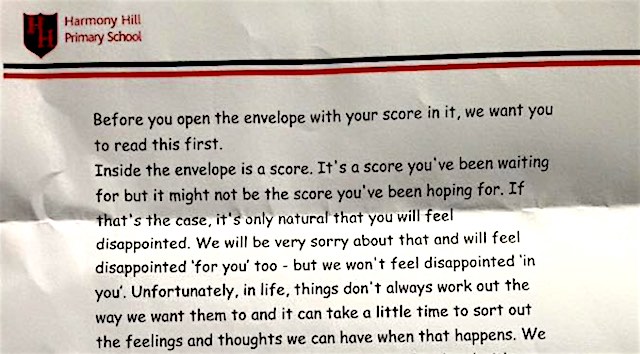
“Inside the envelope is a score,” the letter from the Carrickfergus Grammar School Music Society begins. “It’s a score you’ve been waiting for but it might not be the score you’ve been hoping for.”
The scores are for the “Transfer Test,” an exam Northern Ireland grammar school students take to determine which high school they will attend.
The letter told students that even if they are disappointed in their results, “we won’t feel disappointed ‘in you.’”
The school officials insisted that growing up to be “kind, caring, generous, loving adults who make a positive difference” is more important than test scores.
“Remember, the score in the envelope is just a mark for some tests,” the letter concludes. “It cannot measure how amazing you are! So, no matter what happens in the next few minutes, today you must celebrate YOU!”
More than 2,000 women used crochet hooks to join together blankets and shatter a world record, while at the same time creating a patchwork that will keep thousands of people warm in their beds.
Mother India’s Crochet Queens (MICQ), a Facebook group based in Chennai, put out the call for women to contribute to the effort, with the promise that the finished blanket would be broken up and given to the needy after the record was broken.
In just six months, 2,472 women and girls — the youngest four and the oldest 93 — from around India, UAE, and other countries, crocheted sections and shipped them off for the world record attempt.
When all the pieces were finally assembled, representatives from the Guinness Book of World Records declared it the biggest in the world.
At 120,000 square feet, the blanket is more than three times the size of the previous world record holder from South Africa, and would cover two American football fields with plenty left over.
By comparison, quilting contributors to the 1987-88 AIDS Memorial Quilt, which was first assembled on the National Mall in Washington, DC, but kept growing as it traveled the country, grew to be 108,000 square feet.
The MICQ blanket has now been broken down into its individual parts and will be sent to disadvantaged children, nursing homes, and handed out to other poor people in what should be some kind of record setting act of kindness.
(WATCH the video from News Vikatan below) — Photo: Mother India’s Crochet Queens, Facebook
Two years after a woman’s baby son died, she got to hear his heartbeat again — in the chest of another child, whose life he saved.
Heather Clark’s son, Lukas, died when he was just seven-months-old. After ordering that his organs be donated for transplanting his heart went to Jordan Gonzalez, an 18-month-old girl who’d struggled her entire, short life with a faulty heart valve.
Lukas save two other children’s lives with the donation of his liver and kidneys.
“He did more in 7 months in life than I’ve done in 25 years of life,” Heather told KPNX News.
Two years after the life-saving surgery, Jordan was the epitome of health, running through hospital halls as her mother, Esther, met Heather for the first time, to thank her for a selfless choice at a difficult time.
A smart sweatband gives medical technicians instant information that once required hours of lab work.
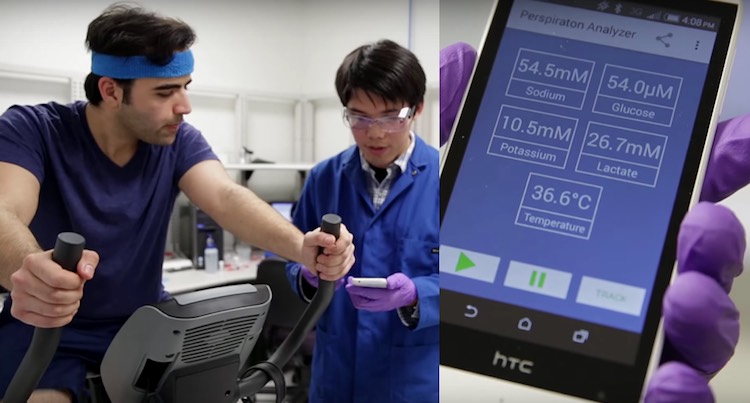
A small sensor array, that can fit inside a sweatband or the back of a watch, measures changes in a person’s sweat and sends the information to a handheld device. Technicians can immediately diagnose dehydration, muscle fatigue, and other body changes brought on by intense physical activity.
“Sweat provides us with a wealth of information about our body’s condition,” engineering professor Ali Javey, who headed the sweat sensor’s design, said in the video below.
Javey’s team at the University of California, Berkeley designed the device to measure four different chemicals in a person’s sweat: sodium, potassium, glucose, and lactate. By measuring their levels — individually or in combinations — they were able to determine the changes going on inside the bodies of people wearing the device while they exercised.
Previously, to get the same information, technicians had to gather a blood sample and measure the same chemical levels in a lab — a process that usually took hours.
Individuals can use the sweat sensor to monitor their hydration levels at the gym, or athletic team medics can use it to monitor the conditions of players on a court, track, or field.
But its developers say the sweat sensor could have far more uses including monitoring the stress levels of astronauts or critical care patients.
When Angus got the upper hand — or paw — Georgia Louise changed the game. The little dog hid under the chair and waited patiently.
Angus couldn’t fit under chair, and in the video below, he barks to complain — leaving the toy unguarded on the ground in the process. Watch how the Dachshund steals the toy for good and keeps it out of Angus’ reach.
(WATCH the video below from Stephanie Young Johnson, Facebook)
Wait for it....Georgia Louise (1 year old mini dachshund)Angus (4 month old bloodhound / black lab)Jukin Media Verified (Original)* For licensing / permission to use: Contact - licensing(at)jukinmediadotcom
The children under her care were too fragile and ill to play in the snow, so a nurse ran into a blizzard several times, bringing snow inside for the kids.
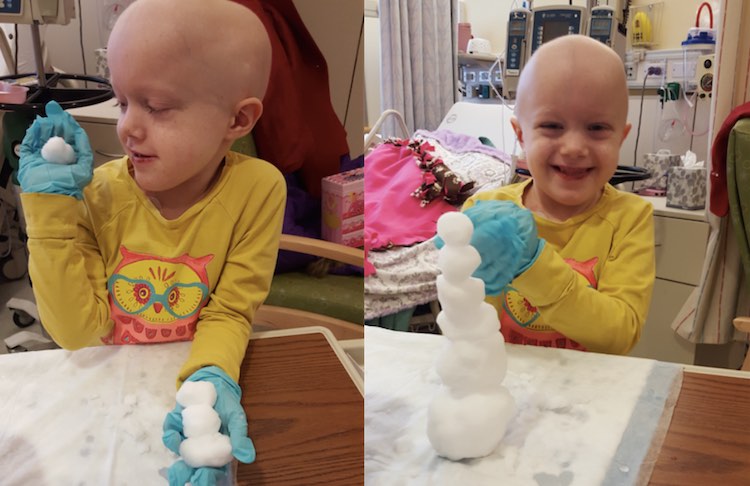
It started with seven-year-old Lucy Wiese, a little girl who’s a big fan of the movie “Frozen.” When snow started falling outside her hospital window in Maryland, she wanted to go play in it.
Lucy had been hospitalized for eight weeks recovering from a bone marrow transplant for her immune disorder and couldn’t leave the room.
Clinical research nurse Alex Classen decided that if Lucy couldn’t go outside, she’d bring the snow inside for the little girl.
As a winter storm began dropping two feet of snow across America’s East Coast, Classen ran out in just her lightweight hospital scrubs, scooping up bowls full of snow.
She brought a batch in for Lucy — then made more trips into the ever worsening storm to gather more snow for other children at the National Institutes of Health Clinical Center.
“Anything I can do to make these kids smile is awesome,” Classen told the Washington Post. “So whenever they’re happy, it just makes my day.”
As the snow piled up outside, Lucy, all safe and warm in her hospital room, stood beneath a movie poster of “Frozen” and fashioned her own little Olaf the Snowman, smiling throughout the special snow day nurse Classen had delivered.
Photos: National Institutes of Health Clinical Center, and Facebook
Warm Your Friends’ Hearts With This Story, Share It…
An army of 300 union plumbers from across the state and country joined local workers to fan out across Flint, Michigan to update faucets for residents in the wake of the city’s lead contamination problem.
They installed water filters and new faucets in 1,100 homes in a single day. An international union and a trade group representing plumbing manufacturers donated the money, faucets and supplies to make it happen.
The state has been providing free water filters to the citizens of Genesee County, but when the homes have old or odd shaped faucets, the filters can’t be connected.
Dozens of union plumbers with United Association Local 370 inside the county have been going door-to-door since October volunteering to install filter and give free faucets and services.
Plumbing Manufacturers International, representing the companies that manufacture plumbing fixtures, donated thousands of faucets for Saturday’s citywide project. The local’s parent union called in members from across the U.S. to help in a one day show of solidarity, giving away free cases of water, too.
The filters are necessary since lead levels in Flint’s water supply skyrocketed after the city switched water sources about two years ago. Corrosive water from the Flint River damaged pipes, letting lead leech into drinking water.
You may end up re-thinking your choice of career once you find out that “Baby Panda Cuddler” is an actual job.
The Giant Panda Protection and Research Center is hiring someone for an annual salary of $32,000 to spend every waking hour hugging and playing with these adorable fur babies.
You have to be at least 22-years-old, like taking pictures of baby pandas, have a working knowledge of the breed, and be willing to hug, hold, and otherwise stimulate them while “sharing in their joys and sorrows.”
The person who lands the full-time gig in China will be working year-round alongside volunteers from the U.S., Europe, and Japan who only get to be panda nannies for a week or two at a time.
It sounds like it demands sweatshop hours, but with the panda perks, it may be worth looking into.
(READ more at China Daily and WATCH the video below)
Alert Your Friends to The Possibilities… Hug Them With This Story…
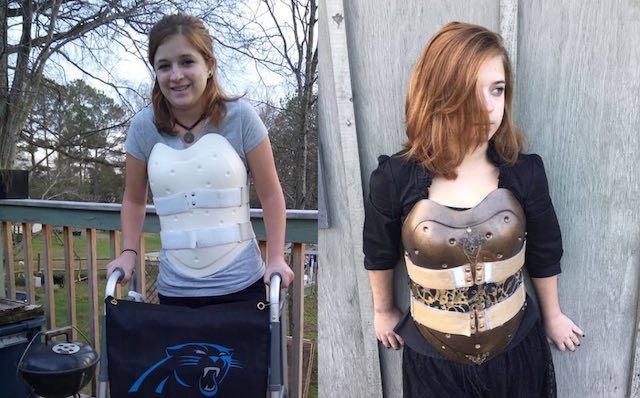
When a teenager was forced to wear a body brace, she transformed the sterile medical device into stylish steampunk armor.
Maddie Cable was in a car crash in November that fractured one of her vertebrae. After surgery, she found out she’d have to wear the bulky brace for two months.
While most teens would have balked at appearing in public in the brace, Cable saw potential. The rivets, straps, and full body shell of the brace gave it all the basic fashion elements of the retro-tech design trend called steampunk.
The Charlotte, North Carolina teen has “steampunked” items before and created a theater set for the steampunk version of “A Christmas Carol” performed at her school.
Maddie called up friend and fellow steampunk enthusiast Sarah Chacko and the two went to work.
Some copper-colored paint, stenciled gears, appliqués, buckles and five hours of work transformed the bland, plastic brace into retro-futuristic armor for a ‘Victorian-era warrior princess’.
Death is a natural part of life that everyone must deal with, but when the financial burdens of funeral costs and burial services mount, families are often heaped with an unnatural amount of stress after losing a loved one.
That’s why one mortician in Boring, Oregon decided to make a difference—bringing her big heart and lower-cost biodegradable options to the funeral business in her small town.
Since she opened Cornerstone Funeral Services eleven years ago, Elizabeth Fournier has given hundreds of mourners affordable services, and sometimes foregone fees altogether.
“As long as the mortuary board is happy with me, and I am being ethical I tend to march to my own drum,” Elizabeth told Good News Network. “If a family is truly having a hardship, I have no issue giving services away.”
Elizabeth guesses she has excused over forty parents from paying any money for child burials or cremation services, and has financially assisted over 20 families with regular services. Typical funeral costs in America average around $7,500 or more, but Elizabeth charges only $2,000.
As well as offering steadfast affordability, Ms. Fournier cares about the environment and has earned the nickname “The Green Reaper”.
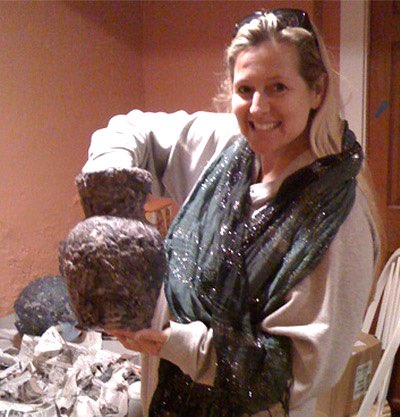
She creates her own biodegradable urns out of dryer lint, flour, and water which she has donated to poorer families. The urns are just one of the many ways the Green Reaper cares for Mother Earth, such as using biodegradable shrouds and wooden coffins rather than concrete, embalming fluids, or expensive caskets.
“Being an undertaker has helped me with many daily things,” says Elizabeth, “from wearing my seatbelt and always telling my family that I love them, to bigger things such as knowing that I am on this earth for a greater purpose outside myself. I truly view my job as my ministry.”
Elizabeth has always had a close relationship with death and has followed an unwavering interest in funeral science since her childhood at age 8 when her mother and grandparents passed away. She was a mass communications student in college before studying to be an undertaker while working odd jobs.
“The funeral industry seemed like a natural life path for me. I started to read about different cultures death rituals in National Geographic Magazine. When a friend’s pets died, I’d perform the funeral. Black quickly became my favorite color. I watched the burial scenes on TV with great interest.”
Fournier discovered 20 years into her career that several of her family members on her father’s side had been morticians.
“One day he started telling me about his life on the South Side of Chicago: his church and his school, and oh yeah, his aunt and uncle had a funeral parlor in the Polish neighborhood. What? What were you telling me? I was completely blown away. I asked him why he had never told me about them– and other relatives in the past– and he told me simply, it just never came up.”
Most of the students at her Catholic school in Portland, Oregon had living parents, so Ms. Fournier became a resource for peers who suffered loss: from pets to family members, Elizabeth became renowned as always knowing just what to say.
“Everybody looked at me as their go-to girl for death.”
Photos submitted by Elizabeth Fournier
Now a 47-year-old mom with a husband who coincidentally met her at a crematorium, Fournier continues to serve the families of Oregon with her motto “Cornerstone Funeral Services: Where Compassion Guides.”
“Dealing with loss is hard. I advocate for people to dialogue and have conversations and go to support groups and read on the Internet and get whatever nourishment or guidance they need to work through the loss. When someone dies, the rug really is pulled out from underneath you. You are cracked wide open. It’s important to fill that crack with positivity and love.”
European polecats, once pushed to the brink of extinction in the UK, are making a surprising comeback across Great Britain.
The furry little carnivores, part of the weasel family, once thrived throughout the UK, but by 1915, were found only in parts of Wales and a small corner of Scotland. Polecats have a taste for fowl and would steal chickens and kill small game birds leading farmers to hunt them until they were eradicated.
UK Conservationists put up a fight to save the bandit-masked critters and succeeded in passing laws forbidding the killing of polecats.
A recent survey by the Vincent Wildlife Trust found the species can now be spotted in places where they hadn’t been seen in a century — an expansion from two small pockets into an area covering nearly a third of England, Scotland, and Wales combined.
“This is something we really need to celebrate, the recovery of a native carnivore that we once almost lost completely,” Lizzie Croose of the Vincent Wildlife Trust told BBC News.
New York City is making it easier for the city’s homeless to receive mental health care.
Mayor Bill de Blasio announced plans to increase the number of mental health workers at homeless centers. The idea is to let health care workers place someone who needs care into the city’s mental health system as soon as that homeless person enters a shelter for the first time.
Those needing care will be included in the city’s mental health tracking system called “The Hub.” It lets agencies determine the best mental health options for homeless people. Without it, many in the past were simply placed into the criminal justice system instead of getting the health care they needed.
The additional mental health workers, along with additional security officers, will be sent to 27 homeless shelters across the city.
The added security is on top of the 108 “peace officers” the mayor added to 12 homeless shelters last year. Their presence is not only to protect the people in the shelters, but also to combat a perception among the homeless that shelters can be violent.
That fear keeps many on the street rather than checking into shelters.
A brave diver effectively hypnotized a shark in distress, long enough to give it some life-saving first aid.
Michael Dornellas was freediving without an air tank off the Florida coast when the shark approached him. With a large hook caught in its mouth, the 10-foot dusky shark was face to face with a person who just happened to have the right amount of skill, expertise, and courage to help.
The marine conservationist works around sharks and has seen the damage hooks can do. Some will rust away and let the shark recover from the cut, but this was a stainless steel hook. Since it was rust resistant, it might remain in the fish’s mouth for its whole life causing damage or even killing the animal.
Dornellas knew he had to help, but he also needed to use extreme caution around the shark’s mouth–and he had to do it all while holding his breath.
Once the hook was removed, the shark came out of its trance-like state and swam away, and Dornellas could bolt back above the water to puff out his chest — with some pride, and much-needed deep breaths.
(WATCH the video from Barcroft TV below) — Photo: Jose Debassa, Video
Today is the first day of Black History Month in the U.S., a day when some pretty savvy college kids made history 56 years ago. Today’s youth would say these guys had game.
On February 1, 1960, four black students from North Carolina A&T State University sat down at the “whites only” lunch counter inside a Greensboro Woolworth store. Although they were refused service, they stayed until closing. More joined them over the next few days and sit-ins spread to other North Carolina cities. On July 25, 1960, after losing $200,000 in sales to boycotts, the Greensboro store abandon its segregation policies.
Four years after the Greensboro Four (Joseph McNeil, Franklin McCain, Ezell Blair, Jr., and David Richmond) staged their sit-in, The Civil Rights Act of 1964 mandated desegregation in all public accommodations, including beaches, libraries, parks and museums.
A section of the lunch counter from the Greensboro Woolworth (pictured, above) is preserved in the Smithsonian Museum of American History, and the original building at 132 South Elm Street now houses the International Civil Rights Center and Museum.