











The boss at this Los Gatos, California-based company is telling his 2,200 employees to take six weeks of vacation every year, just like he does — and he’ll pay them to do it.
“I take a lot of vacation and I’m hoping that certainly sets an example,” Netflix CEO Reed Hastings said Tuesday. “It is helpful. You often do your best thinking when you’re off hiking in some mountain or something. You get a different perspective on things.”
Netflix actually offers unlimited vacation time, but opponents to the idea say it makes people less likely to use it, for fear of losing their jobs because they don’t look like hard workers.
Hastings hopes his example of taking lots of time off sends a different message — easing workers’ fears, and letting them relax on more vacations.
As of November 5, there are dozens of Netflix job openings listed for their 2 California locations in need of IT staff, and various other positions, and one opening in Utah for their call center.
Basketball star Yao Ming led his Houston team to four championship tournaments in America, but his greatest victory may be his work in China to save millions of sharks.
Yao joined a campaign in 2006 to ban shark fin soup, which is a delicacy in his native China, and nine years later his involvement has been hailed as crucial in transforming Chinese attitudes about the tradition.
U.S. based conservation group WildAid recruited Yao as the face of its media blitz designed to make people aware of how their food habits were destroying shark populations around Asia.
In a television ad, the star athlete is about to dine on soup. He hears that 70 million sharks are killed each year just for their fins, and looks up from his soup to see a wounded shark in an aquarium tank. He pushes his soup away in disgust and other people in the restaurant, watching him, follow his lead and do the same.
That’s pretty much what happened in real life.
The campaign first gained traction during the 2008 Beijing Olympics, where Yao was a huge draw playing for the Chinese National Team in basketball.
Yao’s TV ad so moved Chinese businessman Jim Zhang, he turned into a full time environmentalist who successfully lobbied the National People’s Congress (China’s parliament) to ban ‘shark wing’ soup, as it’s called, from state banquets. Hong Kong, Malaysia and India did the same.
The cause became a centerpiece of Chinese social media, which led to five hotel groups, three shipping companies, and 24 airlines banning the transport or serving of the dish. Chinese television stations gave the WildAid’s PSAs $11.6 million in free airtime.
By 2014, WildAid reported sales of shark fin soup had declined 82%, and nearly two-thirds of Chinese people credited awareness campaigns with their decision to quit eating the soup.
Maybe Yao’s advocacy on behalf of the fierce fish came from his early days as a member of the pro basketball team in China — the Shanghai Sharks.
(WATCH the pivotal ad below – *Warning: contains image of wounded shark) – Photos by voyagedeslivres; World Economic Forum, CC
The town of Geel has been a sanctuary with a tradition of hospitality toward anyone with mental illness since the 1400s – and such ground-breaking integration was the key to healing success.
Resident families volunteer their homes to people affected by mental disabilities by signing agreements with health authorities to let them move in. After families receive a $750 monthly stipend to support their ‘boarders’, as the patients are called, the guests are free to come and go as they please.
The community in Belgium has replaced stigmatizing labels such as ‘mentally ill’ and ‘madness’ with words that have more positive connotations, like ‘different’ and ‘special.’ As boarders live in an environment that has eliminated the prejudice, dramatic positive effects on their emotional wellbeing can be observed.
Psychiatrists throughout history have praised this communal treatment for its efficacy in helping patients live better lives.
“So much of what makes [us] think that people like that are different is people’s response to them – a bit scared, a bit awkward, they don’t really know how to handle them,” cultural historian Mike Jay told the Independent. “But when people open up, a lot of the problems we perceive just melt away.”
Oddly enough, this revolutionary model of health care originated when an Irish princess named Dymphna fled to Geel escaping her crazed father in Flanders.
Dymphna began to nurse the sick and was able to ease the pain of the mentally-afflicted, leading locals to believe she had divine healing abilities. After her father murdered her, she was deemed a saint and the town built a shrine in her honor that eventually evolved into a church.
Seeking similar healing, thousands of pilgrims came from far and wide to obtain shelter from oppression at Saint Dymphna’s holy house. Because it was always filled to capacity, the town residents stepped in.
Housing the asylum-seekers was seen as a Christian homage to Dymphna, but also beneficial for farmers who needed extra hands. Over the years, the number of boarders has shrunk to about 300, yet Geel is still happy to accommodate the visitors with open arms.
Click to Share This With Your Friends… Photo by Erf Goed Be, CC

When it comes to handicap accessibility, it’s no secret that public transportation in a number of cities is given a failing grade—taxis and rental cars are also ill equipped to accommodate wheelchairs.
So it was not surprising, but still frustrating, when a woman from Paris, France visited Florida and found she couldn’t find a wheelchair-accessible ride around town.
Once Charlotte de Vilmorin arrived back home, she decided to create her own solution in the form of a company called Wheeliz.
An “Uber” for people with disabilities, Wheeliz pairs the owners of handicap accessible vehicles equipped with lifts and other amenities to people who need them.
While there are 100,000 adapted cars in existence throughout the city of Paris, very few of them are in use all the time. Her business, therefore, earns drivers some extra cash while creating more transportation options for people who need them.
“I really believe there is an opportunity there for the collaborative economy and sharing economy to make mobility more accessible for wheelchair users,” she told Mashable.
Jon Stewart’s quiet retirement as a gentleman farmer didn’t last long.
Just three months after leaving “The Daily Show,” the comedian and commentator has signed a four year contract with HBO to produce short, online videos and other content – just in time to poke fun at, or prompt serious thinking about, the 2016 election season in the U.S.
“Appearing on television 22 minutes a night clearly broke me,” Stewart said a statement. “I’m pretty sure I can produce a few minutes of content every now and again.”
Unlike most HBO content, viewers won’t need to have a cable TV subscription to see Stewart’s new videos, but you’ll still have to pay for the HBO Now app for tablets, smartphones, and other devices, which may cost up to $14.99 per month. The new content will also stream on HBO Go.
HBO hasn’t announced when Stewart’s work will debut.
Three and four-year-olds in Seattle, Washington are trading preschool classrooms for the great outdoors.
In a new partnership with Seattle Parks and Recreation, Tiny Trees Preschool will foster learning in nine city parks beginning in September of 2016.
Andrew Jay, one of the school’s founders, maintains that anything kids can do indoors, they can do at a city park—plus, there are so many added opportunities in the natural world for discovery. Using a skill set Jay developed at Outward Bound working with middle and high school students, he is ready to bring outdoor learning into the mainstream.
“When I heard about outdoor preschools, how they can make it much more affordable for families and provide a rich, vibrant program for kids, I was really inspired,” Jay told Good News Network.
Children will use park bathrooms, nap on mats inside park shelters, and take their lessons under picnic pavilions when it rains. And, because Seattle gets a lot of precipitation each year, the kids will each be issued “award-winning Oakiwear rain suits” to keep for the whole year.
The outdoor classroom will have different stations, similar to a Montessori school, where students can explore different layers of the woods. Jay says a science station might involve making a mud pie to learn about surface adhesion or using a magnifying glass to identify bugs, and an art station might use piles of sticks and leaves to make sculptures. Traditional story time, with lots of books will be standard, too.
Without the overhead cost of buildings, Tiny Trees can make year-round preschool more affordable, and spend more money on quality teachers — it will cost about $7,000 a year, compared to $12,000, which is the average cost in Seattle.
The inspiration for Andrew is a school for fifty families begun two years ago at the University of Washington. Fiddleheads Nature School is a successful outdoor model for Seattle, with teachers saying they are thrilled by classroom sightings of bald eagles mating, young owlets fledging, and praying mantids hunting.
The concept was developed in Denmark and Sweden in the 1950s, before it spread to other European countries, including Germany, where currently 1,000 outdoor preschools operate. In the U.S. there are schools operating in Maine, San Francisco, and Georgia.
Tiny Trees points to the UK’s Forest School Association, featuring the video below, as a model of what they plan to create in Washington.
“Teaching preschool is pretty magical,” Jay said. “Instead of being a teacher pouring knowledge by the cupful into each student, you are helping each child collect raindrops of knowledge.”
True to that natural analogy, Jay said the name “Tiny Trees” was chosen because preschool age is when kids “create their first memories and develop roots in their community that last a lifetime.” The school chose a sprouting acorn as it’s logo, and hopes that a total of 20 outdoor schools will sprout up locally by the year 2020.
(WATCH the video below) — Photos by Heaton Johnson, CC; Forest School Association, video
It was “The Paper Man,” a happy, singing, dancing man she saw every Sunday hawking the Cincinnati Enquirer to passing motorists. Rain, shine, or snow, the stranger kept a smile on his face and entertained people stopped at his intersection.
“He sells the paper with such enthusiasm that I often want to buy one just to reward his work,” she wrote online.
She had noticed he rode a rickety, old bicycle with a cart behind it to haul his papers. She thought maybe she could help him buy a new rig, so Alysun took the five dollars and set up a fundraising page called “Bless the Paper Man.”
He tried carrying his brother, at first, but soon realized he wouldn’t be able to cover even a fraction of the distance to the finish line 13 miles away.
The duo had another idea: tie some rope to the wheelchair—maybe Brent could hoist it up and act as a human wheel the rest of the way. When it became clear the weight was too much for Brent alone, other runners stepped in to save the day.
When little Sam Campanella noticed the Halloween pumpkins missing from his front porch, he knew he had to call 911.
His parents tried to explain to him the number was only for emergencies, but to a six-year-old kid, stolen pumpkins at Halloween is the very definition of an emergency.
His parents dialed the Wilmington, Massachusetts Police Department business line, instead, and let Sam explain the missing gourds.
The officers listened to Sam’s official statement and a description of the Jack-O’-Lanterns, then said they’d send over a squad car to investigate. A quick collection arose at the station to surprise the little boy.
A half-hour later, three officers rolled up at Sam’s house, and they asked Sam to open their squad car. Pumpkins rolled out the door, big and small. They also bought a bag of candy to jumpstart the boy’s Halloween.
Science has just given every boy and girl ample evidence to argue their case for a new puppy— kids with dogs are less likely to develop asthma.
Growing up in homes with dogs reduces an infant’s chances of developing asthma before age six by 13%, and exposure to horses and other farm animals reduces the risk by a whopping 52%.
“To let children have a pet in their home is likely to enrich the family life in many ways, and perhaps also enriches the child’s microbiome and immune system,” the study’s lead author, Tove Fall of Uppsala University in Sweden, told Newsweek.
Fall and his team studied meticulous data on more than a million children in Sweden from 2001 through 2010. It identified the link, but didn’t pinpoint the reason why children exposed to animals are less likely to get asthma.
Scientists have long known that people who grew up on farms tend to have far fewer issues with allergies and asthma than people who didn’t. Now families in the suburbs have a suitable substitute for boosting their immunity, without having to give up the benefits of urban living.
Their findings were published in the journal JAMA Pediatrics.
After 25 years of coaching football, you’d think Gregg Farnetti would have a lot of stand-out memories. But his proudest moment came in the final home game of his career, on an extra point kick — by the homecoming queen.
The coach’s life has been consumed with football; all his free time has gone into the team. With his older daughter, Jody, in her last year of high school, Farnetti decided to take a sabbatical to spend quality time with both daughters before they aged another year.
He never had sons to play on his football team, but Jody was able to give him a special moment he would never forget.
So, in that final home game, after her dad escorted her onto the field at halftime where she was named homecoming queen, she traded her gown for pads and her crown for a helmet, and waited on the bench for a chance to enter the game.
Her extra point kick in the final seconds made no difference to the outcome, but it made all the difference in the world for Coach Farnetti, the man who always wanted a son to play football for him.
When a black Labrador saw an intruder entering her home, the dog sprang into action, scaring him away.
In the process, the dog named Egypt was injured by the broken window, and was badly bleeding when members of the Seattle Police Department crawled through that window.
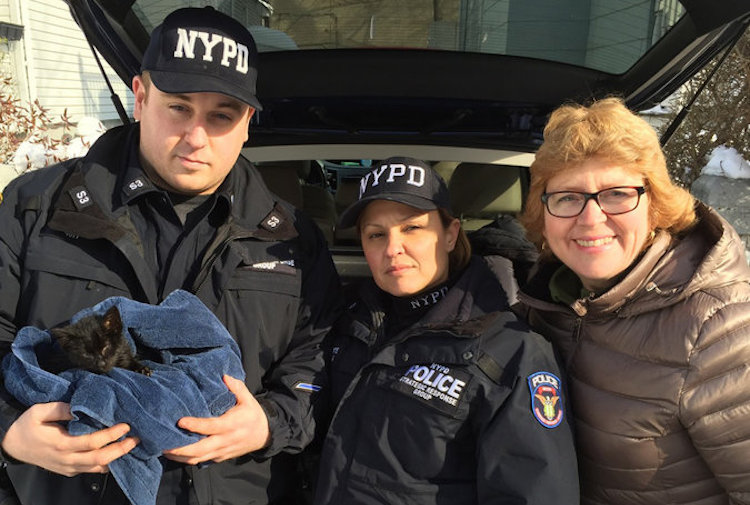
Officers found her and immediately raced out to their squad car to grab the materials needed to bandage her legs. They then high-tailed it to the vet’s office so the seven-year-old mixed-breed could undergo surgery.
One week later, Egypt is doing great, and enjoyed a happy reunion with the officers.
“This brave dog risked her life to protect her home, and it’s thanks to these officers that she’s alive today and recovering at home with her family,” said PETA Senior Vice President Lisa Lange.
The animal rights group presented a Compassionate Police Department Award to the officers along with a box of vegan chocolates.
Because the family’s vet bills were so high, a campaign was started to help pay for them—and the fundraising goal reached in a few days.
There are few worse things that could happen to a limited edition Jeff Gordon Chevrolet Monte Carlo than going up in flames on the highway.
That’s what happened to a woman named Loraine, who had no choice but to watch as her car burned to a crisp along the side of the road.
When the NASCAR racing legend himself found out what had happened to his namesake car, he decided to surprise Loraine with the gift of a lifetime.
Gordon, whose life revolves around cars–and his charities– still had in his possession a couple of the Monte Carlos from 2003, when they cost $28,000. So when he heard about Loraine’s loss, he decided to just go ahead and give her one of them.
The replacement is the same 12-year-old model, but with only 124 miles on it. It looks exactly like it did when it rolled off the assembly line — except for Gordon’s new autograph to Loraine scrawled in silver marker across the dashboard.
(WATCH the video below) – Photo: Jeff Gordon, Twitter
Cedya is back in the game, now that a UK charity has leveled the video playing field for hundreds of kids like her.
The little girl has cerebral palsy, making it almost impossible to maneuver around standard video gaming controllers. But with her custom-build system of buttons, levers, and switches, she can take on any one of her friends.
“I’m a gamer!” Cedya exclaimed the first time she took the controls.
The equipment is built by SpecialEffect: The Gamers Charity, which is dedicated to making video games accessible to all, regardless of physical disability.
SpecialEffect is based in Oxfordshire, UK. Its headquarters, the Accessible Games Center, is staffed with a mix of gaming technology experts who work alongside therapists.
The charity says there’s no “one size fits all solution” for what they do. They create technology ranging from modified joypads to eye-control that lets people play games to the very best of their abilities.
Just as they have done for hundreds of other people they help every year, members of SpecialEffect visited with Ceyda to gauge her particular needs. They then custom-built game controls that fit her abilities.
Her mother says she used to watch friends and family play games while she sat frustrated on the sidelines. Now her mother loves watching while Cedya plays.
(WATCH the video below – And Share With the Gaming Lovers in Your Life)
Imagine boarding a plane to find that the person sitting in your seat looks exactly like you?
That’s what happened to photographer Neil Thomas Douglas as he got ready to travel from Glasgow, Scotland to Galway, Ireland on Thursday night.
The two just had to take a once-in-a-lifetime selfie—and they thought that was the end of it.
Later, however, they discovered their doppelganger had checked into the same hotel. And that night, the pair ran into each other again at the same pub–and took a final selfie with a pint.
The photos were retweeted thousands of times, with media outlets clamoring for their story. Guys with full ginger beards were even tweeting photos saying they were twins.
Douglas, who says his bearded buddy is now a Facebook friend, tweeted, “Internet. You are crazy. Thanks for a surreal few days, highly amusing!”
(WATCH the video below from Inside Edition) Photo: Neil Thomas Douglas
The last Sumatran rhino in the entire western hemisphere has officially arrived in Indonesia to help save his species from extinction.
The 8-year-old hero, Harapan (“Hope” in Indonesian), left Ohio and traveled nearly 10,000 miles to the Sumatran Rhino Sanctuary at Way Kambas National Park–and officials expect he is ready to save the day.
Fewer than 100 Sumatran rhinos are left in the wild, yet only a handful of zoos and sanctuaries have been working to improve captive breeding programs to help keep the species alive.
The Cincinnati Zoo is the only one in the world to have successfully bred the rare rhino.
Harapan was born at the zoo eight years ago in a program that has provided some of the most important breakthroughs in Sumatran rhino breeding.
The zoo’s discoveries have been in practice at the Sumatran Rhino Sanctuary since at least 2007 when Harapan’s brother, Andalas, was flown there from Cincinnati to become part of the breeding program.
After he saved a baby deer’s life, he had a hard time returning it to the wild–the little thing refused to leave his side.
A Lithuanian outdoorsman happened upon a doe as she gave birth to twin fawns. He hung around to watch the baby deer take their first few steps, and that’s when he noticed something was wrong.
One of the fawns had an injured leg, causing the mother to instinctively abandon it.
Darius Sasnauskas couldn’t leave the little deer alone in the woods, so he brought it home to rehabilitate and release it.
Like the Australians did for this lamb, he made a leg brace from an oatmeal box and worked to get the fawn back on its feet.
The fawn quickly settled into life with his new family, sticking by Sasnauskas’ side and playing with their two big dogs.
When the fawn was ready to return to the woods, Sasnauskas hiked out to find a doe who might adopt the baby. It took several tries because the fawn didn’t want to leave the man who’d “fawned” over it for so long.
On his first attempt, the fawn rejected the herd to chase Sasnauskas home as the wild deer looked on.
“The deer are looking like, ‘What the heck is going on,’” Sasnauskas says in the video below.
He searched every evening for several days, until he found the deer he believed to the fawn’s natural mother. That time, the little deer left with its original family.
A few months later, he ran across the fawn and its family again. Sasnauskas and the herd eyed each other for a time, before the deer galloped away into the woods – the fawn able to keepe up just fine with the rest of its family, thanks to the man’s healing hand.
(WATCH the video below) — Photo: Darius Sasnauskas, video
Over the weekend, a team effort led to the successful rescue of a leatherback sea turtle that measured a full 1.4 meters (4-and-a-half feet).
The reptiles have normally already migrated through Massachusetts coastal waters by late October, but this one, entangled in fishing gear, was slow to get going off the coast of Pamet Harbor in Cape Cod Bay.
Fortunately, The Center for Coastal Studies’ Marine Animal Entanglement Response team and the US Coast Guard Truro Harbor Master successfully disentangled the turtle, and he swam off virtually unscathed—and pretty quickly—after he was freed.
Report any sightings of wildlife in trouble near Massachusetts waters to the USCG or the CCS hotline immediately (1-800-900-3622)
It’s been ten years since the glorious Frauenkirche church in Dresden, Germany, became the city’s jewel again, after being destroyed in firebombing during World War II and left in a heap of memorial ruins for almost 50 years.
The rebirth was only possible thanks to scores of archaeological volunteers and dedicated enthusiasts who raised $100 million in donations from around the world.
The Lutheran “Church of Our Lady” was two centuries old, a stunning example of architectural skill, when bombs in 1945 caused the huge stone dome to topple, leaving only small sections of two walls and an alter, amid a pile of rubble 55-feet high (17m).
Rebuilding the Baroque masterpiece was out of the question following the devastating war. Officials in East Germany left it as a memorial to the fallen in war. The blackened stones would lie in wait in the center of the city for the next 45 years.
Martin Luther statue in foreground of ruins
It was not until the fall of the Berlin Wall and the reunification of Germany in the 1990s that people began to dream of resurrecting the old skyline of Dresden, with its crown, the bell-shaped dome that rose higher than a football field over the city.
A citizens’ initiative founded by Dresden musician Ludwig Güttler began raising the $200 million needed to rebuild the church. Thousands of watches containing tiny fragments of Frauenkirche stone were sold, and people from other nations got involved. In the end, half of the money was collected from individuals.
One of those people was Günter Blobel, a German-born American who had seen the original church as a boy when his refugee family took shelter in a nearby town in the days before the city was bombed. He heard about efforts to reconstruct the church, and became a major backer, creating the US nonprofit Friends of Dresden. In 1999, he won the Nobel Prize for medicine and donated the award money, nearly $1 million, and became the single largest individual contributor to the project.
Meanwhile, hundreds of architects, art historians, and engineers sorted the thousands of stones, identifying and labeling each for reuse in the new structure.
Some large chunks of statues, like the one depicting Moses, and two thousand pieces of the original altar were cleaned and incorporated into the new structure. Nearly 80 percent of the altar (see photo at bottom) was reconstructed using the original materials.
About 46 percent of the original stones in the rubble heap were reused in the new structure. A computer imaging program that could move the stones three dimensionally around the screen in various configurations was used to help architects find where the original stones sat and how they fit together. The older blackened stones are easy to identify within the walls of the rebuilt church.
The new golden cross that tops the dome was funded by the British people and the House of Windsor and was made, using the original 18th-century techniques, by a British silversmith whose father was on one of the airplanes that dropped bombs on the city. The cross that once topped the dome, now twisted and charred, stands to the right of the new altar.
Most striking of all the church features was the towering dome. Dresden architect George Bähr had built a structure that critics of the day ridiculed. There was no way the eight slender church pillars and walls would withstand the weight of the colossal stone dome.
An engineering feat comparable to Michelangelo’s dome of St. Peter’s Basillica in Rome, the church’s 12,000-ton sandstone dome framed in wood proved to be exceptionally stable. So strong, witnesses during the Seven Years’ War in 1760 said that while the dome had been hit by more than 100 cannonballs, the projectiles bounced right off.
Today, the Frauenkirche can hold 1,800 people in the light-flooded interior, with a glowing painted ceiling applied in the same techniques of old. Not only church services, but concerts are held there, a tradition that goes as far back as 1843, when the famous composer Richard Wagner premiered the only piece he ever composed for choirs, involving some 1,200 singers.
The historical cobblestone streets and buildings surrounding the church were also restored to their former glory. With nearly 20 million visitors in the past 10 years, Dresden’s Frauenkirche has become not only a tourist magnet, but a landmark symbol of reconciliation between former warring enemies.
Photo credits: (top) David Müller; Bundesarchiv, Bild; (aerial) Wolfgang Pehlemann (interior) In Digo Photography and Gryffindor – CC