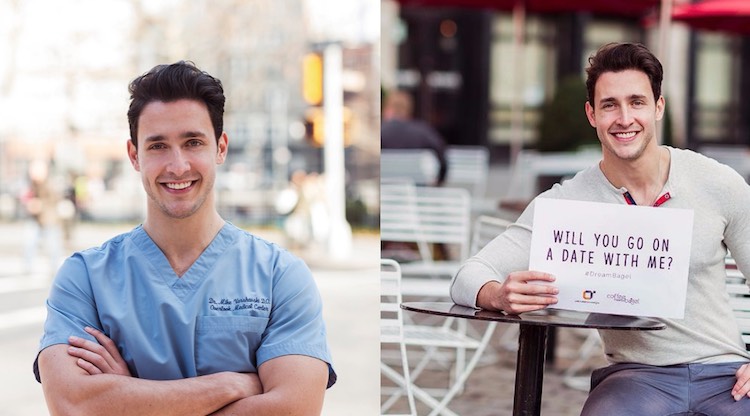
How much would you pay for a date with People magazine’s “Sexiest Doctor Alive?” Well, it only costs $10 to get a chance to glimpse the bedside manner of this attractive bachelor.
Dr. Mike won the title last year and is using it to raise money for his favorite charity — Limitless Tomorrow — which helps underprivileged youth realize their full potential.
The 26-year-old, Russian-born, New Jersey-based medical resident named Mikhail Varshavski is leveraging his title by partnering with a dating app called Coffee Meets Bagel.
It only takes a $10 donation to enter the drawing to win a date with “The Real Life McDreamy” in New York City.
Coffee Meets Bagel will fly the winner to New York for dinner with the doctor at a Michelin Star restaurant and provide a stay at a 4-star hotel.
A baby elephant and retired service dog have become almost inseparable in a friendship that may have saved the elephant’s life.
Ellie the elephant was only a few weeks old when abandoned by his herd.
The Thula Thula Rhino Orphanage in South Africa cares for baby rhinoceroses as its name suggests, but the caretakers couldn’t turn their backs on the pint-sized pachyderm.
Even so, Ellie needed more than just food and medical care. Elephants, being herd animals, need companionship. With no other elephants around, he started losing weight and his health started failing.
That’s when Duma, a former service and sniffer dog, came to the rescue. The two quickly bonded, digging together in a huge sandpile.
“It immediately cheered the elephant up,” Karen Trendler, a rehabilitation expert at the orphanage told Earth Touch. “He suddenly started getting a little bit of interest in life again.”
Dogs and elephants display much different instincts and behavior, but sometimes they do create strong bonds, as seen in this video from 2011.
Thanks to Duma, Ellie has steadily improved and the team at the orphanage are already looking at conditioning him for a return to his herd, or to one at an elephant refuge one day.
(WATCH the video from Earth Touch below) — Photo: Karen Trendler, Video
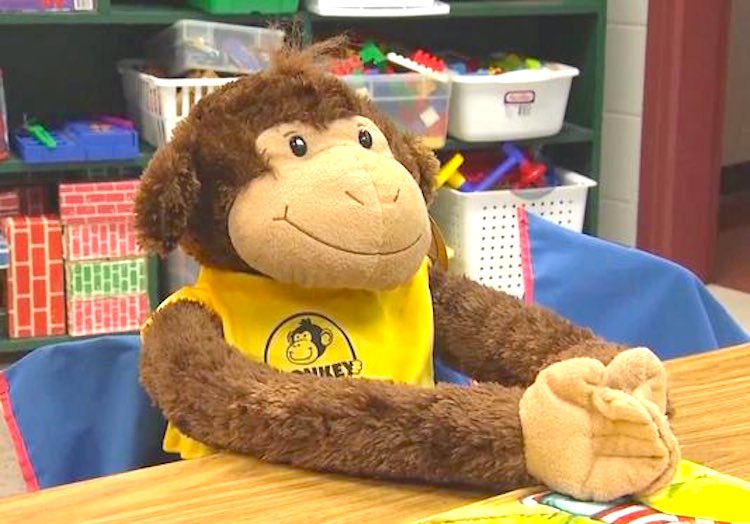
When children go to the hospital for cancer treatments, these monkeys save their seats back at school.
“Monkey in My Chair” is the national program that places the stuffed monkeys at kids’ desks to maintain a connection with their classmates. The huggable animal is a reminder for students of what their classmate is going through, and helps them remember their friend.
Children eagerly take the monkey with them on their daily routines around the classroom, and to recess and lunch throughout the school.
Each monkey comes with its own backpack, to send classwork, as well as encouraging messages to the little patient. There’s also a book to help teachers answer questions from their students.
(WATCH the video below from KING-5 News) — Photo: KING video
I realized the other day while rehashing a memory with a friend of mine that our “truths” about what happened were not the same.
It could be that one of us has a better memory or pays closer attention, but there is something greater at play happening here.
As the behavioral science of human beings becomes clearer, we’ve learned that we each individually believe that our reality is the true reality. This is no longer a fact.
We can all be in the same room when an experience happens, but the experience will be defined by how it is occurring for each of us – not as the experience itself. Depending upon our attitudes, beliefs, thought systems, stories, and biases, every single experience will simply be a state of mind.
Don’t believe me?
Recall a time that you were with the most negative person you know and you experienced something with that person that you thought was fun, but when he or she retold the experience to someone in front of you, he or she found reason after reason to find the experience was sad or boring.
And so it is true for extremely positive people as well. It’s not that optimistic people are fake or don’t live in reality. Life experiences are occurring differently to them.
This is happening all of the time. Even right now while you’re reading this. This blog post is occurring differently for you than it is for someone else reading the same blog post.
Your experiences aren’t really the truth of what is happening in reality, but the truth of how they are occurring for your reality. Think of reality as a blank canvas and you’re the artist designing your experience on it.
You have the ability to change your artwork to create new perspectives and stories to believe in.
The power of true reality is that you can create a happier truth for your life right now.
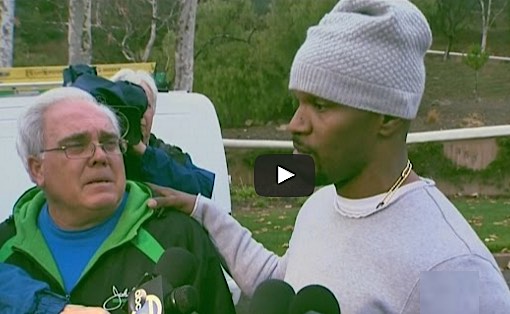
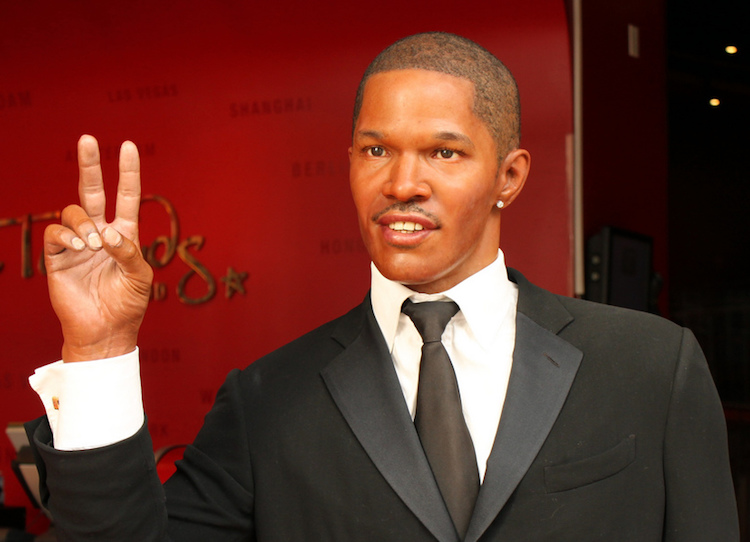
Oscar-winning actor Jamie Foxx was cast as a real-life super hero after a pick-up truck crashed and caught fire outside his house.
Brett Kyle lost control of his truck Monday night, which ran through a drainage ditch and rolled several times before catching fire outside Foxx’s home northwest of Los Angeles, California.
The star of “Ray” and “Django Unchained” heard the noise and, along with another, unnamed witness, rushed to the crash. Foxx smashed a window, cut a seatbelt, and dragged Kyle 30 feet away as flames engulfed the truck.
Ventura County firefighters arrived in the Hidden Valley neighborhood shortly after the rescue, putting out the fire and taking Kyle to the hospital where he’s expected to recover from his injuries.
“Met the father of the young man from last night,” Foxx wrote. “This is all that matters. That a man, a son, a brother’s life was spared last night. God had his arms wrapped around all of us…No heroes…Just happy fathers.”
(WATCH the video from KCBS News below) — Photo: Prayitno, CC
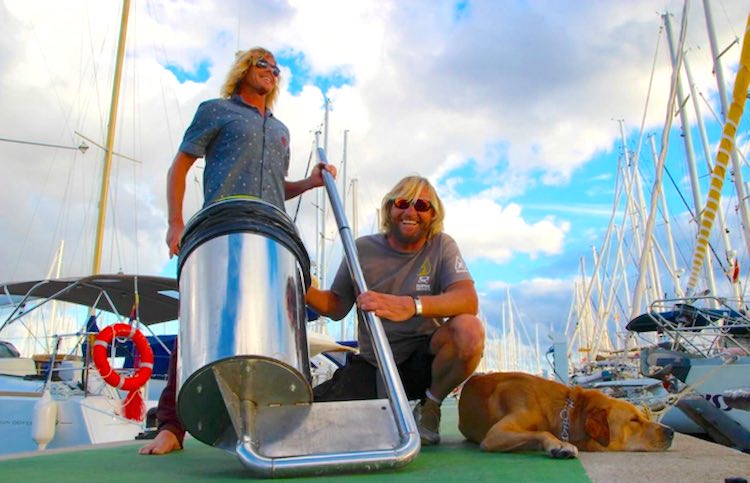
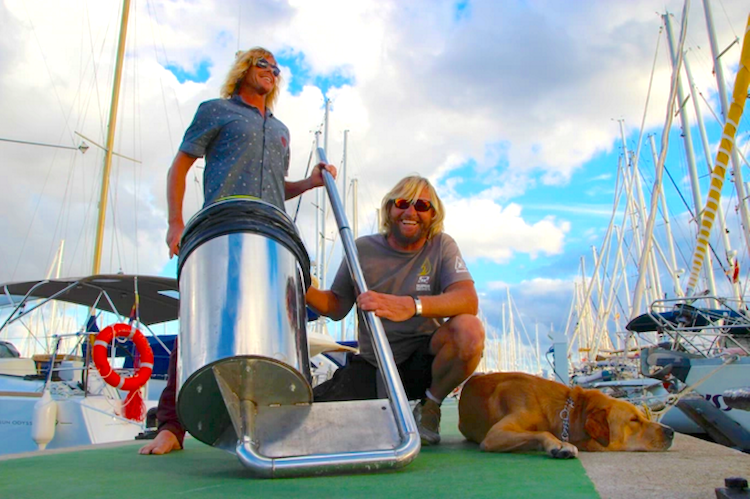
A water-level trashcan has been designed to catch pollution close to shore before it can make its way into rivers, lakes and oceans.
The Seabin is something of an industrial-scale swimming pool cleaner —designed to collect trash like plastic bottles and bags, and even floating fuel at the edges of marinas and harbors. Simply attach it to the end of the pier so that it sits just below the waterline.
Debris and liquids are sucked into the bin where a natural fiber “catch bag” filters the water. A user can then dispose of or recycle the pollution properly.
The water is continually pumped out through a pipe and into a device that separates oil, fuel, and other liquids before releasing the water.
In the four years of testing their invention, Andrew Turton and Pete Ceglinski have never caught or harmed any fish with the device. They’re working with a marine biologist to see how it may affect microscopic sea life.
The sea-loving surfers recently raised nearly $268,000 in a successful Indiegogo campaign to bring their product to market. They plan to have the first Seabins ready for delivery next month.
At $3,800 each, they’re designed for large scale operations like Yacht Clubs and Marinas.
(WATCH the video from Seabin Project below) — Photo, Seabin Project
Recycle This Story, Share It With Your Friends…[icopyright_one_button_toolbar]
A small band of musicians, on their way to a gig in Eureka, were among those stranded.
After about an hour-and-a-half, they decided to put on a concert for the stranded travelers. A video shows the mud still flowing behind the musicians as they play.
“I was ridiculously excited and told them that this was the coolest thing ever,” said Mary Vellutini. “Within minutes they had set up and started playing.”
As small crowd of admirers surrounded them, the Trinity Alps Chamber Players also handed out flyers inviting their captive audience to their concert later.
(WATCH the video below or READ more from Kym Kemp) — Photo: Kym Kemp
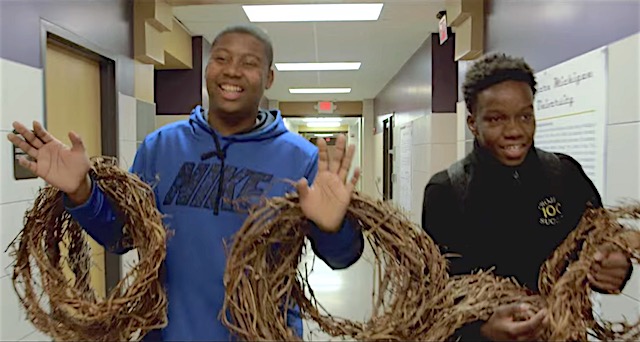
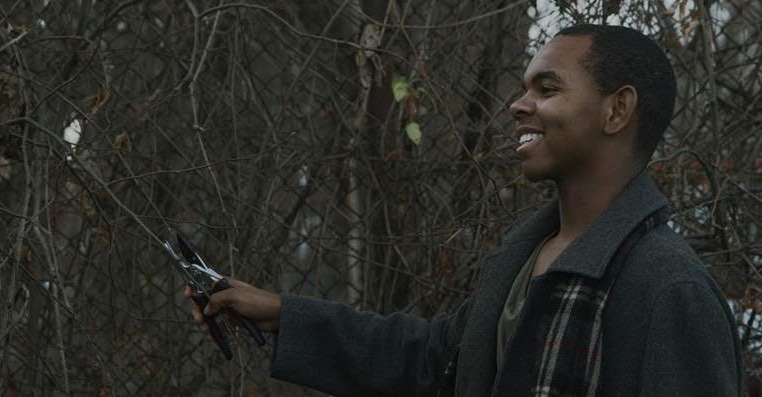
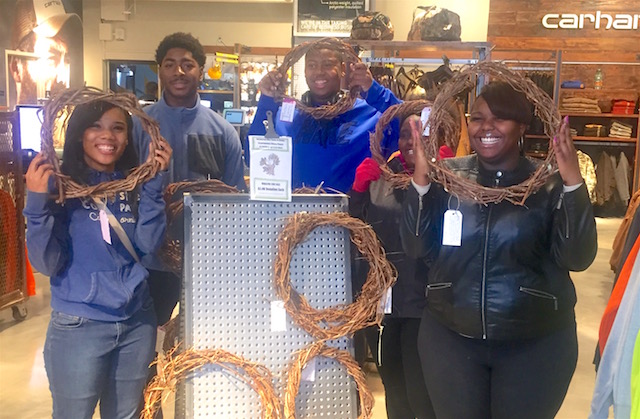
They stripped overgrowth from fences and vacant lots and fashioned the vines and other plants into decorative wreaths.
Working with the Hantz Foundation — committed to enhancing the lives of Detroit’s people “one square mile at a time,” the students were able to attract the attention of Carhartt, an international clothing brand, which offered to sell the wreaths in its flagship store.
Students who thought the project would be boring were surprised at the excitement of building and running their own business. Those who thought they’d be wasting their time were amazed at how quickly their complete inventory sold out.
All learned to believe in themselves as capable business people.
“People say Detroit is run-down and dirty, but this is a project that’s cleaning up [the city] and starting a business,” Mi’Cole Owens, one of the students, said. “It shows that teenagers from Detroit do have business skills and know how to keep their own city clean.”
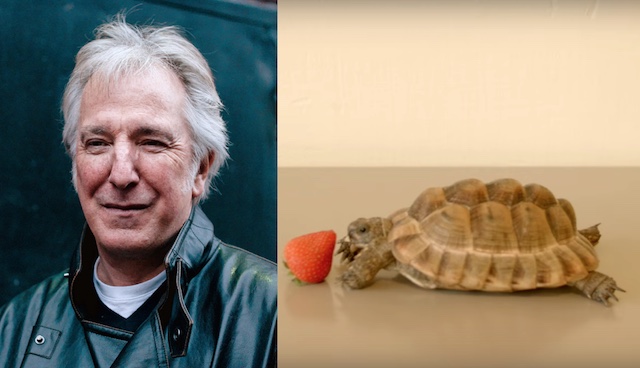
Oxford University students created the ad which will generate ad revenue each time it’s played. The proceeds will be donated to refugee relief groups Save the Children and Refugee Council.
Rickman agreed to voice it with the idea that his star-power could help it go viral and raise even more money. It has more than three million views on YouTube currently.
The beloved actor who played Professor Snape in the blockbuster Harry Potter series, among other notable roles, will also appear in at least two movies that finished filming before his death January 14 at the age of 69.
“Eye in the Sky,” a thriller that also stars Helen Mirren and “Breaking Bad’s” Aaron Paul, hits theaters in March. He will also be the voice of the Caterpillar in Disney’s “Alice Through the Looking Glass” coming in May.
(WATCH “This Tortoise Could Save a Life” above, and the two other trailers below)
Eye in the Sky
Alice Through the Looking Glass
MULTIPLY the Good… Share the Video.[icopyright_one_button_toolbar]
Early risers are going to have a heavenly view starting Wednesday. All five visible planets will be aligned — forming a straight line across the sky — for the first time in 11 years.
From the horizon, extending upward, Mercury, Venus, Saturn, Mars and Jupiter will be visible in that order just before dawn.
The full set will only be visible for 10 minutes on January 20, but the window will widen to an hour by February 20. Exact times vary from depending on where in the world you are viewing the sky.
An added event to the sky show will be the position of the moon during the alignment. It will pass by each planet beginning Jupiter on January 28 and ending with Mercury on February 7.
Working to help a friend who was paralyzed in a skiing accident, engineer Kevin Halsall spent four years modifying a Segway to become a wheelchair.
The user simply leans in the direction they want to go — no need for even a joy-stick to make it move. The steering involves a lot of core muscles, leading Halsall to say it’s “got the occupational therapists very excited.”
The two powered wheels can be changed quickly for all-terrain tires, allowing a user to race down a sandy beach at 12 mph — the average adult running speed or twice as fast as most people jog.
The Ogo won the National Innovators Award in New Zealand and Halsal has started a company to bring his invention to market. His company, Ogo Technology, hasn’t set a price or delivery date yet but he wants to make it as affordable as possible.
(WATCH the video from Ogo Technology below) — Photo: Ogo Technology
INSPIRED by Innovation? Share it.[icopyright_one_button_toolbar]
When it opens in the spring of 2017, the show will be the first new production of “Hello, Dolly!” on Broadway since the original opened fifty years ago. The original, starring Carol Channing, won 10 Tony Awards.
Midler, who turned 70 on December 1, made her broadway debut in “Fiddler on the Roof” in 1967 and as a singer has since sold 35 million albums. She has also won a Tony, three Grammys and twice been nominated for an Oscar.
Rudin says she has the “outsized personality for a 21st Century Dolly.”
“I am looking forward to portraying one of the most beloved characters in all of American musical comedy,” Midler said. “I know I’m going to have the time of my life.”
(WATCH a great video of Bette spontaneously singing for Barbara Walters) –Photo: Alan Light, CC
A photographer has made it possible for a Texas couple who lost three children, to be able to see their youthful presence every day.
Recently, when Laura McBride came across a touching photo in which photographer Brandy Angel included the spirit-like image of a son lost to cancer in a woman’s wedding photos, she decided to get one made that would honor the two sons and a daughter she and her husband Tony lost in childbirth.
The Texas woman reached out to the Atlanta, Georgia-based photo wizard for an “Angel” picture of her own, especially so she could surprise her husband.
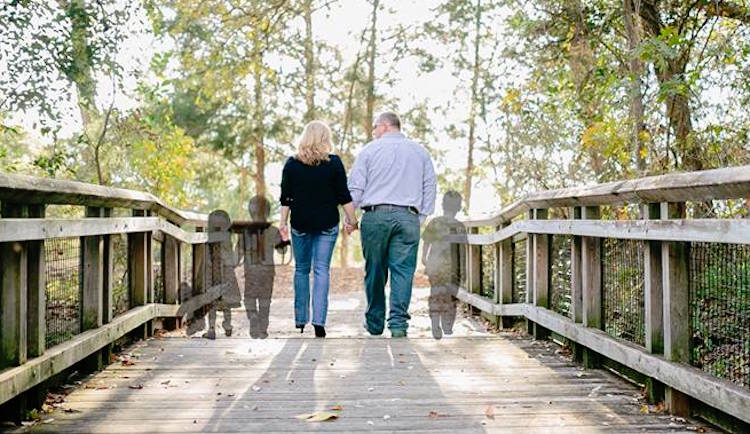
Tony thought they were just having outdoor portraits of the two of them made. But when he saw the finished photos, there were the images of three kids — portrayed as young children — walking alongside them.
“What you see is our family. Me, Tony, our two sons, Christopher and Tyler, and our baby girl, Kieran Shane. This picture shows that although not here physically, I believe they are with us every day,” Laura told WAGA News.
When the groom got cold feet, the bride did something that will warm your heart — she turned her luxurious wedding reception into a party for homeless women and children.
Just six weeks before her dream wedding, Dana Olsen’s fiancee decided he no longer wanted to get married.
Too late to cancel plans and get her family’s money back, Olsen and her mother decided to donate it all to a good cause. What better way to begin erasing the sad memories.
They partnered with Mary’s Place Shelter in Seattle, Washington to treat 150 women and children living there to a grand night out.
A stylist will be on hand to do hair and makeup and others have donated jewelry and dresses for the 42 women.
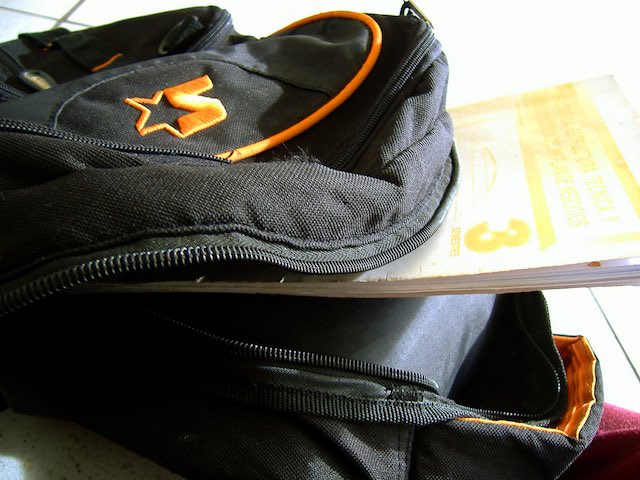
Dozens of children went to work stuffing 500 backpacks with school supplies Saturday, to make sure arriving Syrian refugee children don’t fall any further behind in their schoolwork.
The Canadian student volunteers raised about $7,000 for the supplies, and the Hamilton-Wentworth District School Board Foundation provided the backpacks.
The kids, ages 8-14, from the Islamic Cultural Center of Toronto, stuffed the bags with pens and pencils, notepads, calculators, and everything else a new student would need.
Two busloads of students traveled to Hamilton, Ontario’s Sir John A. Macdonald Secondary School for the chore. They divided up supplies by age and school grades — elementary, middle, and high school — and loaded all the backpacks in under two hours.
“This is a fun way to get to do good deeds,” nine-year-old Mariam El Hewaily, told the Hamilton Spectator. “I’m happy we’re helping them.”
The backpacks will be kept at Macdonald Secondary until they are needed, handed out as refugee students arrive. The school has a student body representing more than 80 countries of origin and 50 native languages.
Canada has agreed to take in 25,000 people fleeing the civil war in Syria. The first group of refugees from that country arrived in Hamilton on December 21. The city has been accepting refugees from other countries for years and city leaders say it has a strong system in place for placing them in new homes and schools.
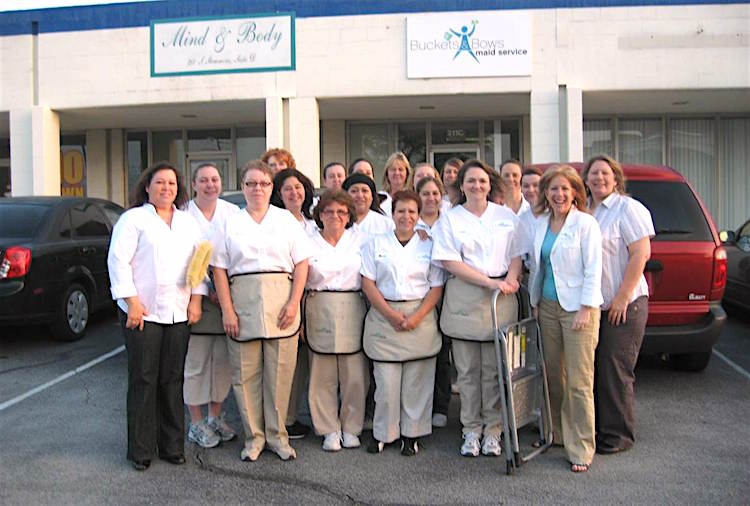
When a cancer patient never called back after getting an estimate for cleaning services, Debbie Sardone decided to find a way to grant a free house cleaning to anyone who is struggling with the disease–and, wow, did she ever.
Over the past ten years, her nonprofit “Cleaning for a Reason” has provided $5.5 million in free house cleaning services to women with cancer.
With money going to chemotherapy or medicine, many patients can’t afford to hire a cleaning service and they don’t have the energy or strength to do it themselves. Since that first call, Sardone has helped 19,000 people with cancer, and still runs her own Buckets and Bows Maid Service in Lewisville, Texas.
Her organization gets about 1,400 new requests each month and Sardone works with more than 1,000 house cleaning services across the U.S. and Canada to award one free cleaning each month for four months to people in need.
Cancer patient Stacey Steele called Cleaning for a Reason because she was so weak she could barely make it through her morning shower, much less clean her house. She says the service changed her life.
“Knowing your house is being taken care of when you don’t have the energy to get out of bed helps lift a huge stress from you,” Steele told TODAY. “When you’re not feeling good, the last thing you want to do is go into a dirty bathroom.”
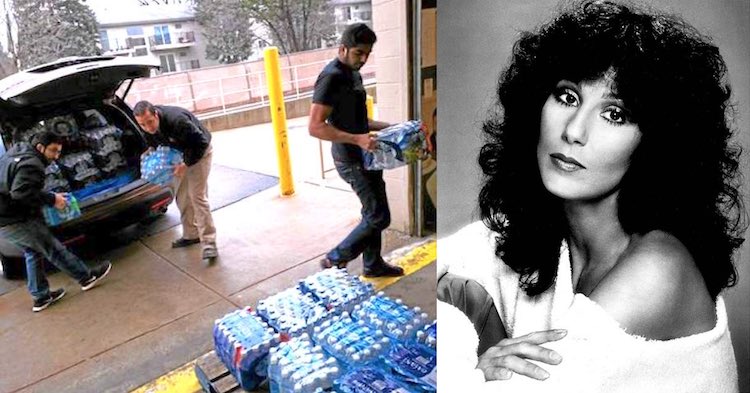
Clean drinking water is flowing into Flint, Michigan again thanks to volunteers and celebrities like Cher.
Flint’s tap water became contaminated with lead after the city switched from Detroit’s water system to the Flint River as a water source, which caused lead to leach out of pipes last year. The federal government announced a disaster assistance program over the weekend, but volunteers had already jumped in to help.
Entertainer Cher called a friend at bottled water company Icelandic Glacial about sending a shipment of drinking water to the city. The company not only arranged it, but agreed to match her purchase.
The singer and actress announced Saturday that more than 180,000 bottles will be arriving at the Food Bank of Eastern Michigan (FBEM) on Wednesday to help those with the lowest incomes in the city.
The empty bottles can be returned to the food bank to be recycled with all proceeds going to charity.
Over the weekend, poor residents got help from the non-profit Communities First, which sent volunteers door-to-door Saturday, delivering and installing 2,000 water filters at every affordable housing development in Flint.
#Thankyou to the Michigan State Housing Development Authority for supplying thousands of water filters to their housing...
Two Muslim charities have delivered nearly 8,200 gallons of water in the past two weekends.
The Michigan chapter of “Who is Hussain?” delivered 30,000 bottles of water to the American Red Cross Sunday.
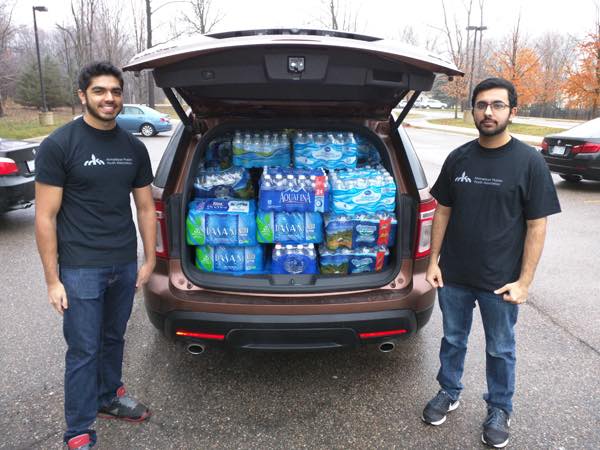
Ahmadiyya Muslim Youth Association members in Flint, MI, submitted by Mahir Osman
A week earlier, members of the Rochester Hills branch of the national youth group, Ahmadiyya Muslim Youth Association, delivered another 1,000 bottles to FBEM. Generosity is something the youth group is known for. Nationally last year, the young Muslims helped feed more than 180,000 people and donated more than 5,000 pints of blood across its 70 chapters.
“We saw what needed to be done and we decided to do it.” Dr. Aziza Askari with Who is Hussain? told the Washington Times. “We reached out to schools, neighbors, friends, mosques, anyone and everyone to help us by donating a case of water, or money towards a case.”
The city had returned to sourcing from Detroit water in October once higher levels of lead were found in more children.
Even as the UN removed a virtual wall of sanctions from around Iran this weekend, the Iranian people were busy transforming the actual walls in their country into destinations for clothing the cold and feeding the hungry.
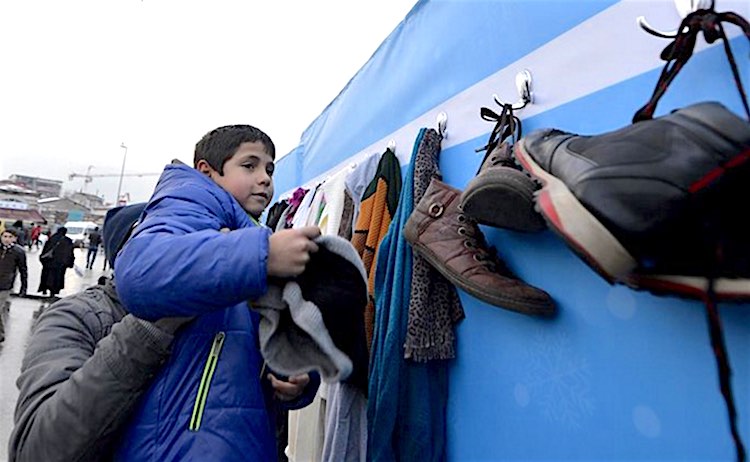
No one is quite sure who started the trend, but “Kindness Walls” are spreading across the country.
The first ones started with splashes of bright color and bold letters saying “Wall of Kindness” above a row of hooks. Instructions inform people to leave “what you don’t need” and “take if you need” it.
Coats, jeans, dresses, and shoes have appeared on the pegs and hooks — and disappeared whenever the needy find the items they can use.
The trend isn’t just limited to walls; The Guardian reports a shop in Tehran put out a box with a sign reading, “Bread is free for those who can’t pay,” and Iranians have posted pictures of a “Fridge of Kindness” to feed the hungry set up inside a store.
From the 'wall of kindness' to the 'fridge of kindness' - Iranians looking out for the needy this winter. #Iranpic.twitter.com/QrWKHSma8D
Some Iranian charities had found it difficult to import medicine and food during the years of international sanctions set up because of the country’s nuclear weapons program. Lifting those is expected to create a resurgence of the country’s charitable organizations, but Kindness Walls show the Iranian people’s spirit of giving is already strong.
(WATCH the video below from Aparat)
Photos: Humanitarian Relief, Twitter
Hang This Story Out For Your Friends To Take, Share It…[icopyright_one_button_toolbar]
Would you believe gas prices dropped down to 47 cents per gallon last night in Michigan? GasBuddy.com has the photo to prove it.
Filling stations in the rural Michigan town of Houghton Lake competed for customers and began slashing prices in a gas war Sunday.
Who Will Go The Lowest?
WILX news reports that after Marathon and Citgo slashed their prices for regular gas to 95 cents a gallon, the Beacon and Bridge Market dropped theirs to 78 cents.
Then, that same station went even lower, cutting the cost to a very nostalgic 47 cents, as shown in this photo taken by Bethany Bartlett and submitted to GasBuddy.com.
Currently all three stations are hovering back up around $1.47.
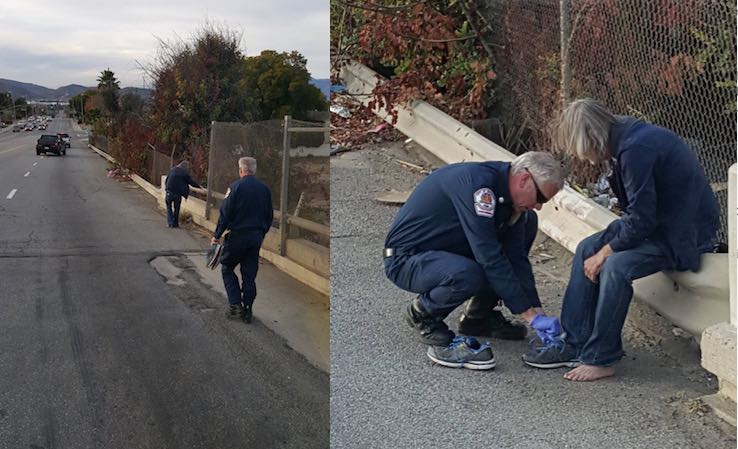
A fire truck from Engine 6-C was returning from a training exercise in Riverside, California Thursday when the crew aboard noticed an elderly homeless man walking very slowly without shoes on the side of a freeway overpass.
The firefighters pulled the truck over because one of them, Dave Gilstrap, wanted to give him a pair of tennis shoes he had in the truck. Captain Rob Gabler jumped out and helped the man put on the shoes and gave him some water.
“Just another great example of the City of Riverside Fire Department helping our members of the community,” the department wrote on their Facebook page.
Gabler’s wife, Connie Fox Gabler commented on the post, saying, “SO in love with that man of mine.”