All News - Page 659 of 1726 - Good News Network
Home Blog Page 659

Despite Language Barrier, Family Develops the Sweetest Connection With Japanese Neighbor

A Japanese man’s sweet note for his American neighbors was shared across the internet after the appreciative family posted a photo of the letter to Reddit back in 2013.

Reddit user Theresa52 says that she and her husband had moved to Yokosuka after he had been stationed at the nearby Navy base. Upon moving into their new neighborhood, they set about delivering beer and chocolate to each of their neighbors—including a man named Hiroshi Yamashita.

A few hours later, Yamashita visited the American family’s home and presented them with toilet paper, stuffed animals for their daughter, and a note.

LOOK: When Son Posts Photo of Sad Dad in His Empty New Donut Shop, the Tweet Attracts Hundreds of Customers

The note read “I can’t speak English. Thank you for the present. My name is Hiroshi Yamashita. I’m 52 years old. [I’m divorced] and I live alone.”

Though the rest of the letter had some translation letters, Theresa inferred that the man was asking whether her husband was in the Navy and expressing his hope that the family would appreciate the toilet paper and toys.

At the end of the note, Yamashita said: “Thank you for your friend operation.”

Moved to Japan... met my neighbor. from r/funny


Though he may have been thanking the family for their gesture of friendship, other internet users assume that he was referring to Operation Friendship, which was the United States’ response to the 2011 earthquake in Japan.

Needless to say, Theresa and her husband were in awe of the heartfelt note.

“It was adorable! We had brought him a six pack and some chocolate and tried to introduce ourselves to him,” wrote Theresa. “A couple hours later he brought over this letter with a pack of toilet paper and some stuffed animals for our daughter.

MORE: Dying 86-Year-old Bought 14 Years Worth of Christmas Gifts for His 2-Year-old Neighbor

“Yamashita wrote this note himself with some help from a translate app. His mom dated an American Sailor when Yamashita was a child so he knew a small amount of English.

“We were so impressed with his handwriting and we were totally not expecting a letter or a gift in return. Our introduction to him was a mix of Japanese words and pointing to Google Translate on our phone all while trying to hand him our gifts.”

WATCH: Every Night for the Last 10 Years, Community Has Made Sure That Woman in Wheelchair Gets to Bed

With several thousand Reddit users vying for an update on Theresa’s new friendship with her neighbor, she later published a photo of her daughter enjoying her new toys—all courtesy of Yamashita.

“[Yamashita] will be getting more presents,” she added. “We never expected anyone to be so nice back to us.”

It has been six years since Theresa originally published a photo of the note to Reddit, but she recently made a post about how her friendship with Yamashita continued after their original interaction.

“Yamashita was a great neighbor! We did have daily morning chats,” she mused. “I had four elderly male neighbors who were all so sweet.

LOOK: Family Was Filling Up Swimming Pool Using Only Pots and Pans Until These Firemen Came Along

“We all exchanged gifts and food regularly for the four years I lived there. We would go to neighborhood festivals and have dinners together as well. I miss them all and think about them often.

In short, Theresa says that they did indeed end up sharing “a wonderful friend operation” of their own.

Be Sure And Share This Sweet Story Of Friendship With Your Own Acquaintances On Social Media…

“We must learn to regard people less in the light of what they do or omit to do, and more in the light of what they suffer.” – Dietrich Bonhoeffer

Quote of the Day: “We must learn to regard people less in the light of what they do or omit to do, and more in the light of what they suffer.” – Dietrich Bonhoeffer

Photo: by Theophilos Papadopoulos, CC license

With a new inspirational quote every day, atop the perfect photo—collected and archived on our Quotes page—why not bookmark GNN.org for a daily uplift?


Robotic Arm Named After Luke Skywalker Enables Amputee to Touch and Feel Again: ‘It almost put me to tears’

Keven Walgamott and the LUKE Arm – Photo by University of Utah Center for Neural Interfaces
Photo by Dan Hixson/University of Utah College of Engineering

Thanks to a groundbreaking new technological accomplishment, amputee Keven Walgamott had a good “feeling” about using his new robotic arm to pick up an egg without crushing it.

What seems simple for nearly everyone else can be more of a Herculean task for Walgamott, who lost his left hand and part of his arm in an electrical accident 17 years ago. When he picked up the egg, however, he was testing out the prototype of a high-tech prosthetic arm with fingers that can not only can move, but also move with his thoughts—and thanks to a biomedical engineering team at the University of Utah, he “felt” the egg well enough so his brain could tell the prosthetic hand not to squeeze too hard.

That’s because the team, led by University of Utah biomedical engineering associate professor Gregory Clark, has developed a way for the “LUKE Arm” (so named after the robotic hand that Luke Skywalker received in Star Wars: The Empire Strikes Back) to mimic the way a human hand feels objects by sending the appropriate signals to the brain.

Their findings were published in a new paper co-authored by U biomedical engineering doctoral student Jacob George and other colleagues in the latest edition of the journal Science Robotics.

CHECK OUT: ‘It’s Not Quite the Ant-Man Suit’ But Researchers Discover How to Shrink Objects to 1000th Their Original Size

“We changed the way we are sending that information to the brain so that it matches the human body. And by matching the human body, we were able to see improved benefits,” George says. “We’re making more biologically realistic signals.”

That means an amputee wearing the prosthetic arm can sense the touch of something soft or hard, accurately understand how to pick it up, and perform delicate tasks that would otherwise be impossible with a standard prosthetic with metal hooks or claws for hands.

“It almost put me to tears,” Walgamott says about using the LUKE Arm for the first time during clinical tests in 2017. “It was really amazing. I never thought I would be able to feel in that hand again.”

Keven Walgamott and the LUKE Arm – Photo by University of Utah Center for Neural Interfaces

Walgamott, a real estate agent from West Valley City, Utah, and one of seven test subjects at the University of Utah, was able to pluck grapes without crushing them, pick up an egg without cracking it, and hold his wife’s hand with a sensation in the fingers similar to that of an able-bodied person.

“One of the first things he wanted to do was put on his wedding ring. That’s hard to do with one hand,” says Clark. “It was very moving.”

How those things are accomplished is through a complex series of mathematical calculations and modeling.

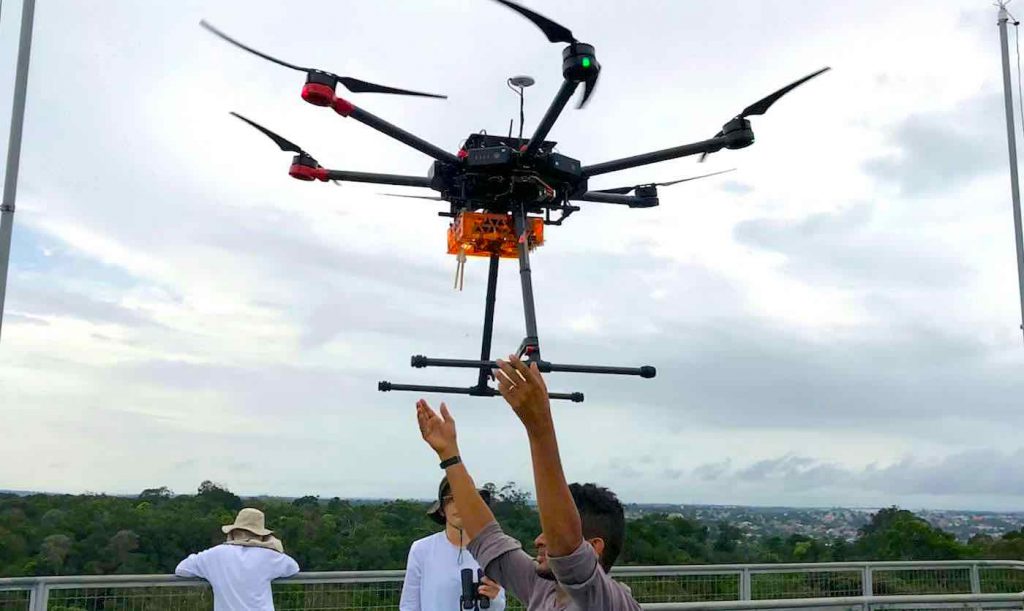
LOOK: Dad Designs a Floating Drone That Could Prevent Dozens of Potential Drownings

The LUKE Arm has been in development for some 15 years. The arm itself is made of mostly metal motors and parts with a clear silicon “skin” over the hand. It is powered by an external battery and wired to a computer.

Meanwhile, the University of Utah team has been developing a system that allows the prosthetic arm to tap into the wearer’s nerves, which are like biological wires that send signals to the arm to move. It does that thanks to an invention by called the Utah Slanted Electrode Array. The Array is a bundle of 100 micro-electrodes and wires that are implanted into the amputee’s nerves in the forearm and connected to a computer outside the body. The array interprets the signals from the still-remaining arm nerves, and the computer translates them to digital signals that tell the arm to move.

But it also works the other way. To perform tasks such as picking up objects requires more than just the brain telling the hand to move. The prosthetic hand must also learn how to “feel” the object in order to know how much pressure to exert because you can’t figure that out just by looking at it.

MORE: First Smartphone App to Detect Ear Infections in Children Could Save Unnecessary Doctor’s Visits

First, the prosthetic arm has sensors in its hand that send signals to the nerves via the Array to mimic the feeling the hand gets upon grabbing something. But equally important is how those signals are sent. It involves understanding how your brain deals with transitions in information when it first touches something. Upon first contact of an object, a burst of impulses runs up the nerves to the brain and then tapers off. Recreating this was a big step.

“Just providing sensation is a big deal, but the way you send that information is also critically important, and if you make it more biologically realistic, the brain will understand it better and the performance of this sensation will also be better,” says Clark.

To achieve that, Clark’s team used mathematical calculations along with recorded impulses from a primate’s arm to create an approximate model of how humans receive these different signal patterns. That model was then implemented into the LUKE Arm system.

LOOK: Inspired By High School Book, Scientists Create Rose-Shaped Water Purifier That Only Costs 2 Cents to Make

In addition to creating a prototype of the LUKE Arm with a sense of touch, the overall team is already developing a version that is completely portable and does not need to be wired to a computer outside the body. Instead, everything would be connected wirelessly, giving the wearer complete freedom.

Clark says the Utah Slanted Electrode Array is also capable of sending signals to the brain for more than just the sense of touch, such as pain and temperature, though the paper primarily addresses touch. And while their work currently has only involved amputees who lost their extremities below the elbow, where the muscles to move the hand are located, Clark says their research could also be applied to those who lost their arms above the elbow.

Clark hopes that in 2020 or 2021, three test subjects will be able to take the arm home to use, pending federal regulatory approval.

Reprinted from the University of Utah

(WATCH the arm in action in the video below)

Be Sure And Share The Force Of Good News With Your Friends On Social Media…

US School Teaches Refugee Kids in Universal Language of Soccer—And Sees 100% College Acceptance Rate

This story was submitted as a nomination to the Reader’s Digest “Top 50 Nicest Places in America” contest: a crowd-sourced effort to uncover nooks where people are still kind and respectful in an era of cultural and political divides. Be sure and vote for which story you think should be nominated as the Nicest Place by visiting the Reader’s Digest website.

Photo by the Fugees Academy

This non-traditional school uses soccer to help refugees learn, and it has a 100% college acceptance rate.

In 2019, every single student of the graduating class at the Fugees Academy in Clarkston, Georgia, was accepted into college, and every single one of them was the first in their family to make it past middle school.

It’s a point of pride for the few schools that manage it. For Fugees, it’s extra impressive given the struggles faced by some of its students.

Established in 2004, the school is uniquely designed to help refugee children thrive. Founder Luma Mufleh, who fled her native Jordan and was given political asylum in the United States in 1999, got the idea when she stumbled upon some boys playing street soccer. She joined their game, and soon the boys—refugees from Liberia, Sudan, and Afghanistan—opened up with their stories. They had fled the horrors of war and famine and were struggling in America, where they weren’t getting the attention they needed to succeed in school.

RELATED: This Clever Little School Has Been Requiring Students to Pay for Tuition With Plastic Waste Instead of Money

Mufleh asked herself what she would do if these were her kids. “What’s really awesome about this country is that you can build solutions to problems,” she says.

So she sought out the students with the greatest academic need and used soccer as a way in. At Fugees, all 90 kids play soccer every day; they read about soccer; they write papers comparing and contrasting the styles of Messi and Ronaldo. Each pupil reads his or her report card to the entire school, and if a grade is slipping, the student body must decide how they, together, will get that grade back up.

Photo by Fugees Academy

“We want them to see that there’s no shame in struggling,” Mufleh says. “We’re going to help you no matter what.”

One Iraqi pupil, who survived kidnapping, bombing, and other hardships, recently wrote a brief biographical essay reading: “I attend a small private school called the Fugees Academy—and I’m sad when we get days off during snowstorms and holiday breaks.”

Fugees recently opened a second school, in Ohio, with a third one soon to follow.

Reprinted with permission from Reader’s Digest. To learn more about GNN’s part in searching for the Top 10 Nicest Places, click here.

Score Big With Your Friends By Sharing This Inspiring Story With Your Friends On Social Media…
Cannabis Can Be 30x More Powerful Than Aspirin for Inflammation, Says New Study Eyeing Future Opioid Substitute

Medical marijuana is quickly being recognized as a viable alternative for pain relief—and now for the first time ever, researchers have uncovered exactly how the cannabis plant creates important pain-relieving molecules that are 30 times more powerful at reducing inflammation than Aspirin.

The discovery, which was made by researchers from the University of Guelph, unlocks the potential to create a naturally derived pain treatment that would offer potent relief without the risk of addiction of other painkillers.

“There’s clearly a need to develop alternatives for relief of acute and chronic pain that go beyond opioids,” said Professor Tariq Akhtar, Department of Molecular and Cellular Biology, who worked on the study with MCB professor Steven Rothstein. “These molecules are non-psychoactive and they target the inflammation at the source, making them ideal painkillers.”

Using a combination of biochemistry and genomics, the researchers were able to determine how cannabis makes two important molecules called cannflavin A and cannflavin B.

RELATED: In Historic Announcement, the World Health Organization (WHO) Proposes Removing Cannabis From Most Dangerous Drug Category

Known as “flavonoids,” cannflavins A and B were first identified in 1985, when research verified they provide anti-inflammatory benefits that were nearly 30 times more effective gram-for-gram than acetylsalicylic acid (sold as Aspirin).

However, further investigation into the molecules stalled for decades in part because research on cannabis was highly regulated. With cannabis now legal in Canada and genomics research greatly advanced, Akhtar and Rothstein decided to analyze cannabis in order to understand how Cannabis sativa biosynthesizes cannflavins.

“Our objective was to better understand how these molecules are made, which is a relatively straightforward exercise these days,” said Akhtar. “There are many sequenced genomes that are publicly available, including the genome of Cannabis sativa, which can be mined for information. If you know what you’re looking for, one can bring genes to life, so to speak, and piece together how molecules like cannflavins A and B are assembled.”

CHECK OUT: Study to Test Cannabis in Head-to-Head Trial with Fentanyl to Find Alternative for Severe Pain

With the genomic information at hand, they applied classical biochemistry techniques to verify which cannabis genes were required to create cannflavins A and B. Their full findings were recently published in the journal Phytochemistry.

These findings provide the opportunity to create natural health products containing these important molecules.

“Being able to offer a new pain relief option is exciting, and we are proud that our work has the potential to become a new tool in the pain relief arsenal,” said Rothstein.

MORE: Back Pain May Soon Be a Thing of the Past After Scientists Successfully Implant Lab-Grown Spinal Discs

Currently, chronic pain sufferers often need to use opioids, which work by blocking the brain’s pain receptors but carry the risk of significant side effects and addiction. Cannflavins would target pain with a different approach, by reducing inflammation.

“The problem with these molecules is they are present in cannabis at such low levels, it’s not feasible to try to engineer the cannabis plant to create more of these substances,” said Rothstein. “We are now working to develop a biological system to create these molecules, which would give us the opportunity to engineer large quantities.”

The research team has partnered with a Toronto-based company, Anahit International Corp., which has licensed a patent from the University of Guelph to biosynthesize cannflavin A and B outside of the cannabis plant.

CHECK OUT: Want Instant Pain Relief? New Report Says You Could Go For a Swim in Cold Water

“Anahit looks forward to working closely with University of Guelph researchers to develop effective and safe anti-inflammatory medicines from cannabis phytochemicals that would provide an alternative to non-steroidal anti-inflammatory drugs,” said Anahit chief operating officer Darren Carrigan.

“Anahit will commercialize the application of cannflavin A and B to be accessible to consumers through a variety of medical and athletic products such as creams, pills, sports drinks, transdermal patches and other innovative options.”

Reprinted from the University of Guelph

Be Sure And Share This Far Out Breakthrough With Your Friends On Social Media…

When Mortuary Intern Invites Strangers to Veteran’s Funeral, 3,000 People Travel From All Over for the Service

A deceased 67-year-old veteran was given a funeral fit for a king thanks to a compassionate intern and thousands of American neighbors.

According to his obituary, Wayne Lee Wilson passed away on May 28th without any surviving family members. His funerary service was shaping up to be a small memorial ceremony with just 10 of his close friends.

As his service was being orchestrated by Brown Funeral Home and Cremation Service in Nile, Michigan, one of the mortuary’s interns, Drew Mickel, felt compelled to honor the late Vietnam veteran by inviting additional people to the memorial.

Mickel worked with the funeral home and local newspaper in order to publicize the funeral and ask readers to stop by the service on July 17th—and he was stunned by the amount of people who responded.

RELATED: Watch ‘Lieutenant Dan’s’ Emotional Reaction to Heartfelt Thank-You Video From Veterans

Over 3,000 people from Michigan, Iowa, Tennessee, Indiana, and Florida arrived at the service to pay their respects.

“It turned out that a lot of people showed up, saying that he might not have family but I’ll be his family for the day,” Mickel told ABC News.

“It was unlike any other funeral I’d been to,” he added. “This one was very uplifting and just [had] the message of you’re never alone.”

(WATCH the news coverage below) – Photo by Brown Funeral Home and Cremation Services

Multiply The Good By Sharing The Inspiring Story With Your Friends On Social Media…

“Recognize that the discomfort or confusion you feel is actually directing you to take charge of your life and make choices that will break you out of stagnation or misery.” – Caroline Myss

Quote of the Day: “Recognize that the discomfort or confusion you feel is actually directing you to take charge of your life and make choices that will break you out of stagnation or misery.” – Caroline Myss

Photo: by liz west, CC license

With a new inspirational quote every day, atop the perfect photo—collected and archived on our Quotes page—why not bookmark GNN.org for a daily uplift?


7-Eleven Starts College Fund for Baby Girl After Serendipitous Birth on 7/11 at 7:11, Weighing 7’11”

Photo by 7-Eleven

7-Eleven stores traditionally celebrate July 11th by giving away free slurpees to all of their customers—but one lucky baby is being gifted much more than that.

A Missouri infant named J’Aime Brown is being featured on national news outlets after she was born on July 11th at exactly 7:11PM weighing 7 pounds and 11 ounces.

Her parents, Rachel Langford and Johntez Brown from St. Louis, were so startled by the coincidence, they immediately made plans to tell 7-Eleven staffers about their baby daughter’s serendipitous birth.

LOOK: Hoping to Be a Grandma One Day, She Bought a Tiny Dress – 7 Years Later, it Turns into Sweet Coincidence

One week after company officials learned of J’Aime’s birthday, they told reporters that they would be making a donation to the little girl’s college fund.

“After catching wind of the incredible news, 7-Eleven decided to pledge $7,111 to the newborn’s college fund to honor her entry to the world,” 7-Eleven representatives told USA Today.

“Along with this pledge, the brand has also provided the family with diapers, 7-Eleven onesies, and other newborn goodies to help her parents along the way,” they added.

MORE: Restaurant Offers Sweet Note of Forgiveness to Manager Who Accidentally Served $6,000 Bottle of Wine

Needless to say, Langford and Brown were delighted to hear the news.

“It’s hard for anybody to even get a trust fund for their children. To get a blessing like that, it just helps a lot,” Langford told CNN.

Be Sure And Share This Sweet Coincidence With Your Friends On Social MediaFeature photo by Rachel Longford

Take a Warm Bath 1 to 2 Hours Before Bedtime to Get Better Sleep, Researchers Find

Representative file photo by Witches Falls Cottages, CC

Taking a hot bath might do much more for your body than just offering you a chance to relax—new research says that it also helps you to get a better night’s sleep.

Systematic review protocols —a method used to search for and analyze relevant data—allowed biomedical engineers at The University of Texas at Austin to analyze thousands of studies linking water-based passive body heating, or bathing and showering with warm/hot water, with improved sleep quality.

To be more exact, researchers in the Cockrell School of Engineering found that bathing 1 to 2 hours before bedtime in water of about 104 to 109 degrees Fahrenheit (40 to 43 degrees Celsius) can significantly improve your sleep.

“When we looked through all known studies, we noticed significant disparities in terms of the approaches and findings,” said Shahab Haghayegh, a Ph.D. candidate in the Department of Biomedical Engineering and lead author on the paper. “The only way to make an accurate determination of whether sleep can in fact be improved was to combine all the past data and look at it through a new lens.”

RELATED: Want to Stop Eating Junk Food? New Research Says You Should Get More Sleep

The paper explaining their method was recently published in the journal Sleep Medicine Reviews.

In collaboration with the UT Health Science Center at Houston and the University of Southern California, the UT researchers reviewed 5,322 studies. They extracted pertinent information from the publications in order to explore the effects of water-based passive body heating on a number of sleep-related conditions: sleep onset latency (the length of time it takes to accomplish the transition from full wakefulness to sleep); total sleep time; sleep efficiency (the amount of time spent asleep relative to the total amount of time spent in bed intended for sleep); and subjective sleep quality.

Meta-analytical tools were then used to assess the consistency between relevant studies and showed that the optimum temperature of 104 to 109 degrees Fahrenheit improved overall sleep quality. When scheduled 1 to 2 hours before bedtime, they also found that bathing can also hasten the speed of falling asleep by an average of 10 minutes.

LOOK: Taxi Driver Saves His Marriage By Inventing Anti-Snore Pillow That He Dreamt Up in His Sleep

Much of the science to support links between water-based body heating and improved sleep is already well-established. For example, it is understood that both sleep and our body’s core temperature are regulated by a circadian clock located within the brain’s hypothalamus that drives the 24-hour patterns of many biological processes, including sleep and wakefulness.

Body temperature, which is involved in the regulation of the sleep/wake cycle, exhibits a circadian cycle, being 2 to 3 degrees Fahrenheit higher in the late afternoon/early evening than during sleep, when it is the lowest. The average person’s circadian cycle is characterized by a reduction in core body temperature of about 0.5 to 1º F around an hour before usual sleep time, dropping to its lowest level between the middle and later span of nighttime sleep. It then begins to rise, acting as a kind of a biological alarm clock wake-up signal. The temperature cycle leads the sleep cycle and is an essential factor in achieving rapid sleep onset and high efficiency sleep.

The researchers found the optimal timing of bathing for cooling down of core body temperature in order to improve sleep quality is about 90 minutes before going to bed. Warm baths and showers stimulate the body’s thermoregulatory system, causing a marked increase in the circulation of blood from the internal core of the body to the peripheral sites of the hands and feet, resulting in efficient removal of body heat and decline in body temperature. Therefore, if baths are taken at the right biological time—1 to 2 hours before bedtime—they will aid the natural circadian process and increase one’s chances of not only falling asleep quickly but also of experiencing better quality sleep.

CHECK OUT: Give Yourself a ‘Dry January’ – You’ll Sleep Better, Save Money, and Lose Weight

The research team is now working with UT’s Office of Technology Commercialization in the hopes of designing a commercially viable bed system with UT-patented Selective Thermal Stimulation technology. It allows thermoregulatory function to be manipulated on demand and dual temperature zone temperature control that can be tailored to maintain an individual’s optimum temperatures throughout the night.

Reprinted from University of Texas at Austin

Don’t Snooze On This Good News; Share It With Your Friends On Social Media – File photo by Witches Falls Cottages, CC

When Animal Shelter Uses Area 51 Internet Meme to Appeal for Adoptions, They Are Flooded With Support

It all started with a guy on the internet making a satirical Facebook event for people to “storm Area 51” as a means of exposing evidence of alien life to the public—but now, it has become so much more.

The online prankster in question created the social media event earlier this month for the sake of getting a few laughs from his online followers. Since it started to go viral, however, the event has garnered over 3 million interested participants.

Though the joke has resulted in its own fair share of trouble between government officials and social media users, one Oklahoma animal shelter decided to take advantage of the amusing alien meme by asking their followers to “storm their shelter” instead.

CHECK OUT: 7-Year-old Boy Starts ‘Underground Railroad’ to Rescue Over 1,000 Dogs From Kill Shelters

The OKC Animal Welfare center in Oklahoma City published a series of photos to Facebook last week depicting several of their resident pups dressed up in their best alien costumes.

“We have great animals ready to protect you from the Area 51 aliens,” wrote the shelter. “Adoption isn’t that far out of this world!”

Within days, the post was shared thousands of times with the hashtag #StormOurShelter.


Dozens of the shelter pups have been adopted in the week following the shelter’s Facebook post. Not only that, internet users have donated over $2,500 to the shelter.

OKC Animal Welfare has not detailed exactly how many of their dogs and cats have been adopted since they started the hashtag, but their Facebook page says that their social media campaign has been a resounding success.


“The response to #StormTheShelter has been out of this world! Thank you all who have supported, shared, donated and adopted,” wrote the shelter.

“Let’s continue to show everyone that adoption isn’t that far out of this world and support your local shelters!”


Be Sure And Share The Pawesome Story With Your Friends On Social Media…

There Are Now 100 New Sign Language Terms for Scientific Words Thanks to This Deaf Student

Photo by University of Dundee

It can already be difficult to say a scientific word like “deoxyribonucleotide” let alone spell it out in sign language—but that’s why this determined young university student is being praised for inventing brand new ways for deaf scientists to communicate.

Liam Mcmulkin, who was born deaf, was the first person in his family to pursue a higher education after he enrolled at the University of Dundee to study life sciences in 2015.

Like most first-year students, Mcmulkin had already been anxious about being able to keep up a college workload. Since he was also the only deaf student at the university, he also feared that he would have trouble keeping up with the course lectures.

Though there are some British Sign Language (BSL) translations for scientific vocabulary words, the lexicon becomes fairly limited for college-level communication. As Mcmulkin continued studying in university, he became more and more frustrated by how his translator would be forced to spell out long complex words.

LOOK: Smart Caption Glasses Allow Deaf Audience Members to Watch Live Theater Performers Directly

“Watching the interpreters for a one-hour lecture is very tiring,” Mcmulkin told BBC. “There are a lot of new words and scientific words are often very long, like ‘deoxyribonucleotide’ and ‘deoxyribonucleoside’.

“Sometimes the interpreter would be finger spelling for ages and I was having to watch it,” he added. “We would make up new signs which meant it was easier next time, but it also meant I had to learn new signs which was very tiring.”

Photo by University of Dundee

Mcmulkin finally resolved to develop a whole new set of BSL vocabulary words for himself and future life sciences students. To date, he has created over 100 new signs for scientific words that have been officially recognized in formal BSL, which is used by approximately 87,000 people across the UK.

“Liam’s effort towards creating new signs is crucial to the future of the life sciences,” said Dr. Marios Stavridis, Principal Investigator at the School of Life Sciences and supervisor of Mcmulkin’s project. “During his two years of study, he has already developed signs for biology specialist terms ‘on the fly’ and it will be so rewarding to see these terms used in BSL.

MORE: 15-Year-old Melts the Hearts of Airline Passengers When She Befriends Blind and Deaf Passenger

“If you imagine having to finger spell highly technical terms whilst sitting in a lecture or having a quick conversation with a colleague, you can appreciate how taxing and difficult it has been for Liam,” he added. “With these signs, Liam and other deaf students will be able to access science on a whole other level.”

As Mcmulkin prepares to study for his master’s degree in September with the goal of eventually becoming a researcher, he is excited to see his new words ease the struggles of other deaf scientists who are following in his footsteps.

(WATCH the interview below)

Spread The Word By Sharing The Good News With Your Friends On Social Media…

Tom Hanks Becomes Mr. Rogers in Newly Released Trailer for ‘A Beautiful Day in the Neighborhood’

Fred Rogers may have been one of the most influential and beloved people on television—and now he is being portrayed by one of the most influential and beloved people on the silver screen today.

In this brand new trailer from Sony Pictures Entertainment, Tom Hanks can be seen taking on the role of Mr. Rogers in a new biopic called A Beautiful Day in the Neighborhood.

The film is about the friendship that developed between Mr. Rogers and a cynical journalist named Tom Junod who was assigned to write a feature on the television icon back in the late 90s.

LOOK: New Mr. Rogers Documentary is Out and It’s Incredibly Sweet How It’s Making Adults Feel

As a result of his time with Mr. Rogers, Junod later published an emotionally captivating article on the Pittsburgh hero called “Can You Say… Hero?

This is not the first time that Mr. Rogers has continued to inspire Americans since his death in 2003; adoring moviegoers were making headlines last year after they all experienced the same emotional reactions to watching the Fred Rogers documentary Won’t You Be My Neighbor? in theaters back in January 2018.

The new movie is set to come out on Thanksgiving—and if it is anywhere near as heartwarming as the trailer, then it is already set to be a hit in everybody’s neighborhood.

(WATCH the trailer below)

Be Sure And Share This Sweet Movie Trailer With Your Own Neighbors On Social Media…

“There is no such thing as a problem without a gift for you in its hands.” – Richard Bach

Quote of the Day: “There is no such thing as a problem without a gift for you in its hands.” – Richard Bach

Photo: by barbara w, CC license

With a new inspirational quote every day, atop the perfect photo—collected and archived on our Quotes page—why not bookmark GNN.org for a daily uplift?


Listen to Woman’s Exuberant Tale of How She Went From Being a Wallflower to Wowing James Brown

Today is MOTH Monday on Good News Network: In partnership with The Moth, a nonprofit dedicated to the art of storytelling, we bring you the most uplifting speakers from live stages across the world.

When Audrey Pleasant was just a 13-year-old girl growing up in Harlem, she wasn’t a very good dancer. She regularly attended community dances where there was a boy who would humiliate her for her poor dancing skills.

The day finally came when Audrey got sick and tired of letting the boy dance in circles around her—so she resolved to learn how to properly shake a tail feather.

Every night for a month, Audrey practiced her dance moves in front of her mirror until she finally became confident enough to bust a move in public.

Not only did Audrey become the star of the community dances, her funky talent ended up landing her on stage with the legendary James Brown—and it’s all thanks to the boy who had once danced in circles around her in Harlem.

(LISTEN to her captivating story below) – Feature photo by Sarah Stacke / The Moth

The Moth gives people an opportunity to tell a true story in front of a live audience, and sometimes their stories are chosen to air on the radio show, now celebrating its tenth year, and broadcasting on 485+ public radio stations—and on The Moth podcast, which is downloaded over 52 million times a year.

The Moth’s third book, Occasional Magic: True Stories About Defying the Impossible is now available for purchase through your favorite booksellers.

Be Sure And Shake A Tail Feather By Sharing This Funky Story With Your Friends On Social Media…

First US National Park to Offer Heavy-Duty Wheelchairs for Disabled Visitors to Enjoy the Scenery

Photo by Friends of Sleeping Bear Dunes

This national park in Michigan has just become the first to implement heavy-duty wheelchairs as a means of allowing disabled visitors to enjoy their trails.

The “track chair” is a wheelchair that has been equipped with treads to navigate the steep hills and sandy trails of Sleeping Bear Dunes National Lakeshore.

The track chair program, which was launched in May, was created by Friends of Sleeping Bear Dunes—an organization that specializes in making the park more accessible to visitors.

“Here at Sleeping Bear Dunes, about half the park is designated wilderness so in those areas we can’t do a lot of maintenance or changes [to increase accessibility,]” group board chairman Kerry Kelly told CNN. “So the better option is to have a vehicle that can take the person into these areas so they can experience the trail as it is without having to make major modifications.”

RELATED: Cyclists Volunteer to Give Nature Rides to Wheelchair Bound

The track chair can currently only be rented out for use on the 1.5-mile long Bay View Trail; however, the organization says that the track chair has already been utilized by dozens of visitors.

The track chair is free for visitors to use so long as they reserve it several days in advance.

Friends of Sleeping Bear soon hope to purchase an additional track chair for young visitors to use by the end of the summer. They also hope that other national parks will implement similar programs in their own parks so that everyone can enjoy the beauty of nature—regardless of their disability.

Be Sure And Share The Good News With Your Friends On Social Media…

After Friend Flaked on Red Sox Game, Guys Give the Ticket to Homeless Man Who Could Use the Smile

When three young men found themselves with an extra ticket to a Red Sox baseball game, they decided to give their ticket to a homeless man who was happy to be given the chance to relax.

Sean Wetzonis, Pedro Lugo, Francisco Rios, and another one of their friends had been preparing to see the Sox play against the Toronto Blue Jays at Fenway Park in Boston last week when a family emergency forced their fourth companion to cancel his plans for the game.

As the three young men were on their way to the park, they were trying to decide who they could invite to the game—and that’s when Lugo got an idea.

“I wanted to take someone who would appreciate the ticket and have the time of their lives,” Lugo told CNN.

CHECK OUT: Major League Baseball Pitcher Donates $9.4 Million Estate So It Can Bring Joy to Special Needs Kids

Lugo eventually found the perfect recipient for the spare ticket after they passed a homeless man named John. In addition to offering the man some money, Lugo asked if he wanted the spare Red Sox ticket—to which John immediately said “Hell yeah, let’s go.”

The young men happily escorted John to his seat and bought him a beer to enjoy during the game. As they all sang songs and cheered from the stands, Lugo says that John seemed to greatly enjoy the atmosphere of the stadium.

Before John left the stands, he shook the hands of his three new friends and took a picture with them in front of their seats.

WATCH: Pitcher Runs, Not to Cheering Teammates but, to Comfort the Batter After Season-Ending Strike-Out

“He thanked us for everything and he expressed his gratitude,” Lugo told CNN. “Maybe [the game] helped alleviate the stressors that come with being homeless for the few hours at the game.”

Since posting the photos to Twitter, Lugo hopes that the pictures will help to show other people just how far a small good deed can go.

Hit A Home Run With Your Friends By Sharing The Story To Social Media…
Canada Passes Most Progressive Fishery Act Yet, Requiring the Rebuilding of Fish Populations

Photo by Carlos Suarez/Oceana Canada
Oceana Canada Campaign Director Kim Elmslie and Fin Donnelly, Member of Parliament. (Photo by Oceana Canada)

Last month, a modernized Fisheries Act became law in order to set the stage for rebuilding the abundance of fish in Canada’s oceans.

For the first time since its inception in 1868, rebuilding plans are now required for depleted fish populations. The Act also ends the import and export of shark fins in Canada.

These changes, among others, unlock tremendous potential for renewed ocean health.

“Today is a great day for our oceans. The overhauled Fisheries Act has the potential to be one of the most transformative things that has happened for our oceans in many years,” says Oceana Canada Executive Director Josh Laughren. “We thank Fisheries Minister Wilkinson and former Fisheries Minister Dominic LeBlanc for prioritizing rebuilding fish populations. The Act now lays a strong foundation to support healthy oceans for generations to come.”

CHECK OUT: World’s Second Largest Coral Reef Has Just Been Removed From Endangered List

Around the world, the catalyst for fishery recovery—and the social, cultural and economic benefits that come along with it—has been a legally binding requirement to rebuild fish populations and prevent them from becoming depleted.

In Canada, only 34% of fish populations are healthy while more than 13% are critically depleted. Of 26 critically depleted stocks, only five have rebuilding plans. The Act’s new provisions should change this, mandating that rebuilding plans be created for all fish populations in the critical zone, with the target of rebuilding them to sustainable levels.

“Rebuilding fish populations can increase revenue and jobs in coastal communities. The United States has some of the most stringent and effective legislation in the world mandating fisheries rebuilding. It has successfully rebuilt a total of 45 fish stocks resulting in more resilient ecosystems and greater economic opportunities for the fishing industry,” says Laughren.

MORE: 633 Divers Just Set the World Record for Largest Ocean Cleanup After Collecting 1,600 Pounds of Trash

The Act also bans importing and exporting shark fins in Canada. Fins from as many as 73 million sharks end up in the global shark fin trade every year, including many endangered species. Canada has been the largest importer of shark fins outside of Asia.

“Billions of people worldwide depend on our oceans for their food and livelihood. By rebuilding its fisheries, Canada is helping lead the way toward healthier, more sustainable, and more resilient oceans,” said Michael Bloomberg, the UN Secretary-General’s Special Envoy for Climate Action.

Photo by Carlos Suarez/Oceana Canada

“This is a huge victory for sharks and for the many Canadians, advocacy groups and politicians who joined together to champion the ban of this cruel practice,” says Oceana Canada Campaign Director Kim Elmslie. “We applaud everyone’s efforts, including Senator Michael MacDonald and MP Fin Donnelly who initiated and championed the private members bill calling for a ban.”

LOOK: Adidas Test to Sell Shoes Made of Ocean Plastic Was So Successful, They’re Going Even Further

The Act’s amendments also uphold the rights of Indigenous Peoples and recognize Indigenous knowledge; incorporate modern fisheries management practices, such as the precautionary and ecosystem-based approaches; restore important habitat protection measures; and feature a clear purpose to manage and control fisheries.

Oceana Canada worked closely with Fisheries and Oceans Canada, First Nations, advocacy groups, fishers and others to bring the changes to the Act to fruition and will continue to advocate for fisheries rebuilding in Canada.

It’s Not Hard To Sea That You Should Share The Good News With Your Friends…
Woman Can’t Walk, So She Teams Up With Blind Man for Hiking: ‘He’s the Legs, I’m the Eyes’

This Colorado pair brings new meaning to the word “determination”. When one couldn’t walk and the other couldn’t see, they teamed up to share their love of the great outdoors.

Melanie Knecht was born with spina bifida, so she uses a wheelchair to get around. Trevor Hahn only recently became blind after he contracted glaucoma five years ago. Both living in Fort Collins, Colorado, the two met at an adaptive boxing class—and they soon ran into each other again at an adaptive rock-climbing class.

They immediately bonded over Knecht’s lifelong hobby of camping and Hahn’s passion for outdoor sports. When she told him about her recent trip to Easter Island, where she got the opportunity to be carried on another person’s back, it was a “eureka” moment.

Even though his sight was gone, he’d been able to scale a Himalayan peak, using poles and spoken directions from his companions.

They started small, but next month—with her vision and his strength—they will trek to the top of a 14,000-foot mountain.

“It just seemed like common sense,” Knecht told Good Morning America. “He’s the legs, I’m the eyes — boom! Together, we’re the dream team.”

At the start of each hike, a friend lifts Knecht into a carrier on Hahn’s back. From that point on, she gives him verbal directions to navigate the trail. Since February, they have been sharing their hiking adventures on Instagram.

“It made me so happy to help someone experience what I’ve been able to experience my whole life,” Hahn told GMA. “The best part is being able to make her smile—that gives me purpose.”

In addition to this sense of purpose, the two share an understanding of how difficult it can be asking able-bodied or sighted people for assistance in everyday life. They get immeasurable satisfaction from being able to do this on their own.

RELATED: The Heart-Melting Moment a Toddler Hugs a Stranger After Recognizing They Both Have Limb Differences

“That’s the human spirit,” Hahn told Outside magazine. “If you want something bad enough, and you find the right people—who also want what you want—you can do anything.”

View this post on Instagram

Hello, friends! We are Trevor and Melanie AKA Hiking with Sight, and together we are going to hike a 14,000 foot mountain in our beautiful home state of Colorado. In 2013, Trevor lost his vision to glaucoma, but has since been guided up mountains all over the world using a bell/voice system. Melanie, born with spina bifida, uses a wheelchair to get around. Trevor and Melanie became friends through their love of adaptive sports, which gave them the idea of utilizing both of their strengths to get outside! Melanie is the eyes of the operation, guiding Trevor as he hikes with Melanie on his back! Stay tuned to see how we creatively overcome challenges and summit mountains! #hikingwithsight #noeyesnolegsnoproblem

A post shared by Trevor & Melanie (@hiking_with_sight) on

While the two accept that others appreciate what they’ve been able to do, they’re not looking for accolades—they just want others to encourage inclusive and adaptive solutions for their friends with disabilities.

“Don’t not include them because you think they won’t be able to do something.”

(WATCH a video from Good Morning America) – Photos from Hiking_with_Sight on Instagram


POPULAR: Blind 6-Year-old ‘Prodigy’ Who Taught Himself to Play Piano Has Become an Internet Star 

Inspired? Help This Story Ascend To The Top Of Your Social Media Feed…

“Humanity has advanced, when it has advanced, not because it has been sober, responsible, and cautious, but because it has been playful, rebellious, and immature.” – Tom Robbins (turns 87 today)

Quote of the Day: “Humanity has advanced, when it has advanced, not because it has been sober, responsible, and cautious, but because it has been playful, rebellious, and immature.” – Tom Robbins (87 years old today)

Photo: Copyright McKinley Claire, 2011

With a new inspirational quote every day, atop the perfect photo—collected and archived on our Quotes page—why not bookmark GNN.org for a daily uplift?


Another Chick-fil-A Worker Turns into Good Samaritan, Going Above and Beyond For WW II Veteran

Photo credit: Rudy Somoza, manager Chick-fil-A

Sending a jet ski to rescue someone during a flood; donating 200 sandwiches to a gay pride event; paying their employees during a 5-month shut-down for building renovations; and, delivering free sandwiches to stranded drivers in a freak snowstorm—these are just some of the examples over the years featuring Chick-fil-A workers going ‘above and beyond the call’ of serving fast food.

It happened again on July 11, when a manager at the fast food franchise in Severn, Maryland responded with a “beautiful” act of kindness for a 96-year-old World War II veteran who was “shaking” and “almost in tears.”

Mr. Lee came into the store saying he had a flat tire. That’s when a store manager Daryl Howard jumped into action.

“As soon as he finished his sentence, Daryl informed me he needed to help this gentleman right now,” another store manager, Rudy Somoza told CNN.

While the employee was changing the tire, which only took about 15 minutes, Somoza snapped a photo to capture the selfless act of service.

This now joins the many other stories about Chick-Fil-A generosity in our GNN news archives.

(WATCH the video from WTVT) – Photo courtesy of Rudy Somoza

SHARE the Act of Kindness on Social Media…