Quote of the Day: “Being deeply loved by someone gives you strength, while loving someone deeply gives you courage.” – Lao Tzu
Photo: by Marco – CC license on Flickr, cropped
With a new inspirational quote every day, atop the perfect photo—collected and archived on our Quotes page—why not bookmark GNN.org for a daily uplift?
Dozens of volunteers have been offering romantic advice to the world’s most lovelorn souls—and they’ve been doing it all on behalf of William Shakespeare’s most iconic heroine.
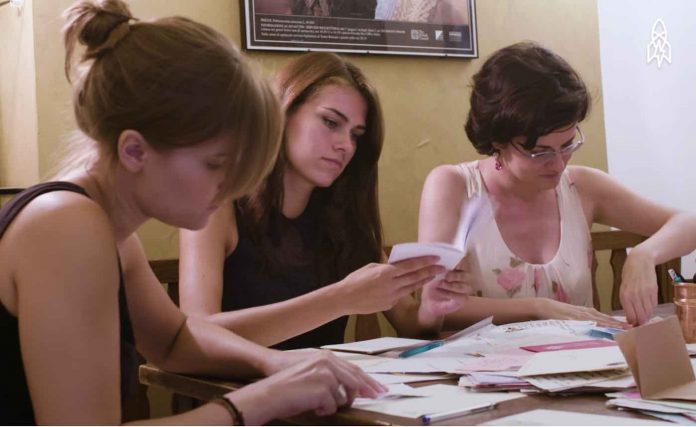
The Juliet Club is a nonprofit organization that responds to letters that have been sent to Juliet Capulet, the tragic figure in Shakespeare’s Romeo and Juliet which takes place in Verona, Italy.
Addressed simply to “Juliet, Verona” thousands of letters arrive from all over the world from people lamenting their various romantic woes and heartache—and the Juliet Club volunteers have always done their best to offer up some valuable advice in return.
41-year-old Martin Hopley told BBC that he has now been a Juliet Club volunteer for several years, motivated to continue after receiving a response to one of his own replies based on his experience with a particularly devastating breakup.
Hopley says that he often takes several days to respond to some of the letters because he wants to send them the most thoughtful answers possible.
The club hosts a multitude of writers who have had a variety of unique relationship experiences so they can respond to every different form of inquiry.
“From the woman who’s fallen in love with a close friend, to the man whose wife has passed away, to the boy who’s coming to terms with his sexuality, to the girl who doesn’t believe she’s beautiful enough to find love… Juliet has probably heard every possible scenario you can think of,” Hopley told BBC.
“When people write to Juliet, [their] hearts are often frustrated, confused and in a mess,” he concluded. “But she takes all those feelings, calms them down, and reads them back to you as a beautiful song that’s easier to understand.”
(WATCH the Great Big Story video below)
Friends, Romans, Countrymen! Be Sure And Share This With Your Friends On Social Media…
The US Food and Drug Administration (FDA) has just approved a groundbreaking new treatment for cystic fibrosis—and it is the first treatment that has been developed for the disease in several decades.
The newly-approved Trikafta medication, which was developed by Vertex Pharmaceuticals, can be used to treat patients 12 years and older with cystic fibrosis who have at least one F508del mutation in the cystic fibrosis transmembrane conductance regulator (CFTR) gene.
While there are approximately 2,000 known mutations of the CFTR gene, the most common mutation is the F508del mutation—and Trikafta is the first approved treatment that is effective for these cystic fibrosis patients, which make up approximately 90% of the those with the disease.
Cystic fibrosis, a rare, progressive, life-threatening disease, results in the formation of thick mucus that builds up in the lungs, digestive tract, and other parts of the body. It leads to severe respiratory and digestive problems as well as other complications such as infections and diabetes. Cystic fibrosis is caused by a defective protein that results from mutations in the CFTR gene.
Trikafta is a combination of three drugs that target the defective CFTR protein. It helps the protein made by the CFTR gene mutation function more effectively. Currently available therapies that target the defective protein are treatment options for some, but many patients have mutations that are ineligible for treatment, until now.
The efficacy of Trikafta in patients over 12-years-old with cystic fibrosis was demonstrated in two trials. The first trial was a 24-week, randomized, double-blind, placebo-controlled trial in 403 patients while the second trial was a four-week, randomized, double-blind, active-controlled trial in 107 patients who had two identical F508del mutations.
In each trial, the primary analysis looked at increases in the percent predicted forced expiratory volume in one second, known as ppFEV1, which is an established marker of the lung disease’s progression.
Trikafta increased the ppFEV1 in both trials. In the first trial, it increased mean ppFEV1 13.8% from baseline compared to placebo. In the second trial, it increased mean ppFEV1 10% from baseline compared to tezacaftor/ivacaftor. In the first trial, treatment with Trikafta also resulted in improvements in sweat chloride, number of pulmonary exacerbations (worsening respiratory symptoms and lung function), and body mass index (weight-to-height ratio) compared to placebo.
The Cystic Fibrosis Foundation (CFF)—which is the world’s leader in the search for a cure for CF—hailed the FDA’s approval of the treatment as “the single greatest therapeutic advancement in the history of CF.”
Back when the foundation formed in 1955, there were no available treatments for the disease. Now, CFF President and CEO Dr. Preston Campbell says: “We at the CF Foundation, and many in the CF community, have dreamed about this milestone for decades.
“Throughout my decades as a clinician caring for people with CF, I’ve looked forward to the day when we would be able to dramatically transform the treatment of this disease. I’m deeply grateful to be able to say that day is here.”
A Vertex representative told KXAN that the drug will be commercially available for roughly $311,000 per year, but he says they are confident that insurance companies will be ready to alleviate the financial burden of the treatment based on their research results.
(WATCH the interview below)
Be Sure And Share The Groundbreaking Good News With Your Friends On Social Media…
This architect was so appalled by the plans for two new homes in her English village, she bought the land for herself so she could design and build better houses for her neighbors.
66-year-old Fran Bradshaw says that she was “horrified” when developers revealed their plans for the two houses that they planned to build on the plots next to her home in Hickling, Norfolk.
She wanted to design houses which enhanced the village and helped the environment—so she decided to match their price for the plots.
Bradshaw, who has been an architect for over 30 years, then designed and built eco-homes which she says are more in keeping with the area.
“A developer had expressed interest to build two houses and put in a planning application for two homes on the plot next door [which was formerly a car garage],” says Bradshaw. “Our neighbor … approached us and asked if we wanted to purchase the plot ourselves instead.
“The plans from the developers were, in my opinion, horrible. It was price maximizing and I was cross about it. They were badly designed, didn’t fit on the site, and were designed only to increase the site value.
“It made me so angry because I hate designs like those,” she continued. “I believe houses should be built for the people living in them, not the developer’s pockets.
Fran Bradshaw’s design for eco-homes. SWNS
“I thought ‘was that really what people wanted?’ So I matched the offer to buy the plot and have designed two semi-detached houses [and] the village has been very supportive and encouraging of us building the new homes.”
Bradshaw, who is also a partner at an architectural firm in London, specializes in low-energy sustainable design and detailing, using natural materials and the Passivhaus standard buildings.
The Passivhaus design is known for combining traditional styles and cutting-edge technology that improves a building’s energy efficiency.
“It’s good for people to know about Passivhauses because they’re so much more beneficial in the long-run for health, comfort, and energy efficiency than conventional homes,” says Bradshaw. “They give people a very even temperature and they’re also so energy efficient that—in the long-run—they end up becoming more cost-efficient than any other house design because they can naturally regulate the temperature to about 21 degrees Celsius.
SWNS
“People are seeing it works with sensible, long-term savings.”
Insulation for the houses will even include newspaper and sheep’s wool and have each piece numbered so they are assembled like a big jigsaw puzzle.
The plot, which was bought last Christmas, cost Bradshaw and her retired partner Georg Hermann just over £200,000. It’s taken local, specialist builders only nine weeks to get the houses almost finished in basic structure.
SWNS
Bradshaw’s 82-year-old neighbor Anne Savage said the houses have already had a positive impact on the community.
“The local schoolchildren have been on a school trip up there to study them because they’re eco-friendly,” says Savage. “I think they look quite nice and they look better than the other house that’s a bit further up.”
Bradshaw built her own home with the same Passivhaus design five years ago, although her roof is thatched.
“What’s good about the Passivhaus system is that is uses a timber framed system and is very good at controlling heat-loss and banishing drafts.
“In this country moisture has always been a big issue but this design is perfect for combatting that and regulating a house’s temperature.
Fran Bradshaw and George Hermann’s home — SWNS
“I think we’re as a country, very conventional in our building methods and I think perhaps more sustainable methods are not adopted because to teach the labour industry and turn it into a highly-skilled industry would be very difficult. These really are the houses everyone should be building.”
Build Up Some Positivity By Sharing The Empowering News To Social Media…
More than 250 teen activists are being hailed for launching creative campaigns to fight plastic pollution around the world—and 15 projects have been awarded prize money for their efforts.
Last week, Bow Seat Ocean Awareness Programs (Bow Seat) announced the winners of its Marine Debris Creative Advocacy Competition, which challenged middle and high students from around the world to design and lead creative campaigns to inspire action and reduce or prevent ocean pollution.
The students working to protect the sea—and their local watersheds—hailed from the U.S., Australia, Canada, India, Nigeria, Pitcairn, Vietnam, and elsewhere.
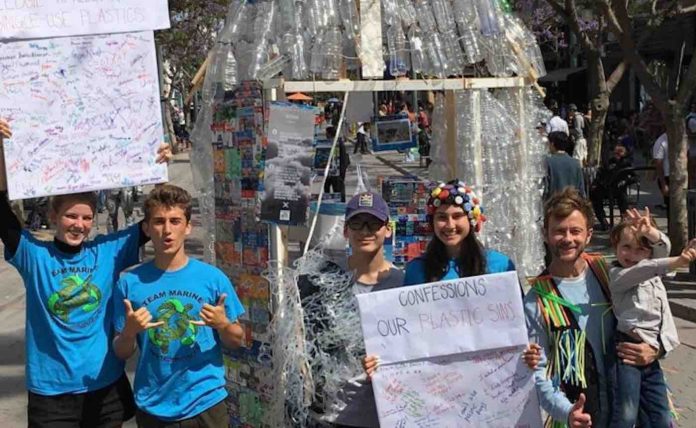
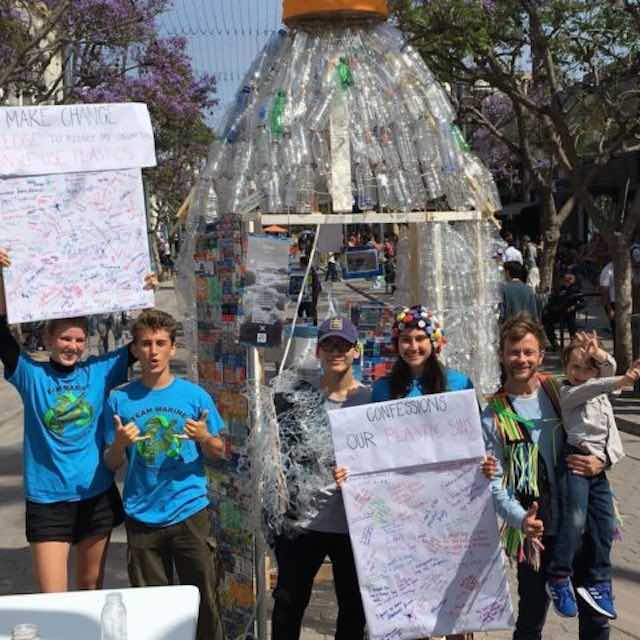
Team Marine, an environmental club from Santa Monica High School in California, won the Competition’s Gold award and a $5,000 prize. As part of their comprehensive top-down, bottom-up campaign, Team Marine educated 800 high school freshmen about plastic pollution and successfully lobbied the school district to pass a sustainability plan that ensures support for integrating environmental literacy and stewardship into the school curriculum.
Team Marine’s campaign culminated in a giant public art installation—made out of 600 plastic water bottles—that provided a platform for the group to educate more than 400 community members about marine debris and alternatives to single-use plastics.
“We are now even more committed to improving environmental awareness because we saw the impact our actions can have,” said Team Marine member Siri Storstein-Norgaard.
Photo of Team Marine plastic installation by Bow Seat
“From the mom who came back to our booth to show us her purchase of a metal straw to the six-year-old who was disgusted by the video we showed of plastic flowing into the ocean—we saw the difference we were making.”
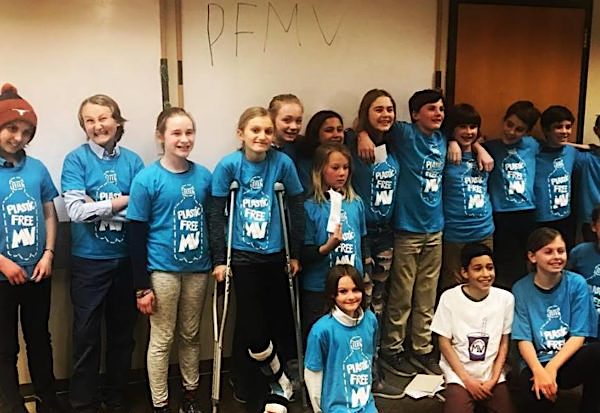
One of two Silver prize winners was Plastic Free MV, a group of students who helped make their community “the first in North America to ban the sale of both single-use plastic water and soda bottles”.
Residents of idyllic Martha’s Vineyard, in Massachusetts, the middle schoolers of Plastic Free MV understand that the ocean is the backbone of their fishing and tourist island home. But after doing several beach clean-ups, they recognized that marine debris is an increasing threat. Therefore, they wrote a bylaw to ban the sale and distribution of single-use plastic water and soda bottles and got it included on the town dockets of three neighboring communities—then went to work convincing residents to vote in their favor.
Plastic Free MV, photo courtesy of Bow Seat
The group held five public forums to present their campaign, spoke at town meetings, and met with local politicians and business owners. To help alleviate business owners’ concerns, the students partnered with local organizations like the Vineyard Conservation Society to distribute information, add refill stations, and find solutions, such as alternative materials and distributors.
Other competition participants also realize that living sustainably means not creating trash in the first place—so they educated their peers and community members about an emerging “R” in waste management—“refuse”—and provided solutions and resources to support a waste-free lifestyle.
In addition to making tangible impacts in their schools, communities, and local watersheds, students reported that participating in the competition strengthened their personal environmental attitudes and behaviors—and their belief that they can make a difference by influencing others to refuse single-use plastic items and increase recycling.
After presenting Team Marine with $5,000 for their Gold-winning campaign, and two Silver Award winners, including Plastic Free MV, with $2,500 each, Bow Seat awarded one Bronze Award winner with $1,000. Three teens won $750 for their Distinguished Honorable Mention Awards; two Honorable Mention Award winners earned $500; and six won $100 for Notable Submissions. See all the winners here.
“Water connects us all—whether we live in island nations, landlocked communities, or coastal cities—and marine debris is a global, borderless problem that requires a large-scale effort,” said Linda Cabot, founder and president of Bow Seat. “We are so impressed by the creative, sophisticated, and impactful campaigns. These projects reflect the leadership of today’s youth, who are directing incredible social movements to advocate for the changes they want to see in their communities and for their futures.”
“Having the opportunity to review the entries was so inspiring and uplifting,” said Competition guest judge Doorae Shin, chapter coordinator of Surfrider Foundation O’ahu. “I loved being able to be reminded of all the hope there is out there.”
Bow Seat’s Marine Debris Creative Advocacy Competition was launched in 2016 with a two-year grant from the National Oceanic and Atmospheric Administration (NOAA) Marine Debris Program, which supports projects that use outreach and education to inspire people to reduce and prevent marine debris.
(WATCH the Team Marine video project below)
It’s Not Hard To Sea That You Should Share This Good News With Your Friends On Social Media…
MIT engineers have developed a new way to remove carbon dioxide from air. The process could work on the gas at virtually any concentration—from power plant emissions to open air.
Written by David Chandler | MIT News
A new way of removing carbon dioxide from a stream of air could provide a significant tool in the battle against climate change.
Most methods of removing carbon dioxide from a stream of gas require higher concentrations, such as those found in the flue emissions from fossil fuel-based power plants. A few variations have been developed that can work with the low concentrations found in air, but the new method is significantly less energy-intensive and expensive, the researchers say.
The technique, based on passing air through a stack of charged electrochemical plates, is described in a new paper in the journal Energy and Environmental Science, by MIT postdoc Sahag Voskian, who developed the work during his PhD, and T. Alan Hatton, the Ralph Landau Professor of Chemical Engineering.
The device is essentially a large, specialized battery that absorbs carbon dioxide from the air (or other gas stream) passing over its electrodes as it is being charged up, and then releases the gas as it is being discharged. In operation, the device would simply alternate between charging and discharging, with fresh air or feed gas being blown through the system during the charging cycle, and then the pure, concentrated carbon dioxide being blown out during the discharging.
Photo by MIT News
As the battery charges, an electrochemical reaction takes place at the surface of each of a stack of electrodes. These are coated with a compound called polyanthraquinone, which is composited with carbon nanotubes. The electrodes have a natural affinity for carbon dioxide and readily react with its molecules in the airstream or feed gas, even when it is present at very low concentrations. The reverse reaction takes place when the battery is discharged—during which the device can provide part of the power needed for the whole system—and in the process ejects a stream of pure carbon dioxide. The whole system operates at room temperature and normal air pressure.
“The greatest advantage of this technology over most other carbon capture or carbon absorbing technologies is the binary nature of the adsorbent’s affinity to carbon dioxide,” explains Voskian. In other words, the electrode material, by its nature, “has either a high affinity or no affinity whatsoever,” depending on the battery’s state of charging or discharging. Other reactions used for carbon capture require intermediate chemical processing steps or the input of significant energy such as heat, or pressure differences.
“This binary affinity allows capture of carbon dioxide from any concentration, including 400 parts per million, and allows its release into any carrier stream, including 100 percent CO2,” Voskian says. That is, as any gas flows through the stack of these flat electrochemical cells, during the release step the captured carbon dioxide will be carried along with it. For example, if the desired end-product is pure carbon dioxide to be used in the carbonation of beverages, then a stream of the pure gas can be blown through the plates. The captured gas is then released from the plates and joins the stream.
In some soft-drink bottling plants, fossil fuel is burned to generate the carbon dioxide needed to give the drinks their fizz. Similarly, some farmers burn natural gas to produce carbon dioxide to feed their plants in greenhouses. The new system could eliminate that need for fossil fuels in these applications, and in the process actually be taking the greenhouse gas right out of the air, Voskian says. Alternatively, the pure carbon dioxide stream could be compressed and injected underground for long-term disposal, or even made into fuel through a series of chemical and electrochemical processes.
The process this system uses for capturing and releasing carbon dioxide “is revolutionary,” he says. “All of this is at ambient conditions—there’s no need for thermal, pressure, or chemical input. It’s just these very thin sheets, with both surfaces active, that can be stacked in a box and connected to a source of electricity.”
“In my laboratories, we have been striving to develop new technologies to tackle a range of environmental issues that avoid the need for thermal energy sources, changes in system pressure, or addition of chemicals to complete the separation and release cycles,” Hatton says. “This carbon dioxide capture technology is a clear demonstration of the power of electrochemical approaches that require only small swings in voltage to drive the separations.”
In a working plant—for example, in a power plant where exhaust gas is being produced continuously—two sets of such stacks of the electrochemical cells could be set up side by side to operate in parallel, with flue gas being directed first at one set for carbon capture, then diverted to the second set while the first set goes into its discharge cycle. By alternating back and forth, the system could always be both capturing and discharging the gas. In the lab, the team has proven the system can withstand at least 7,000 charging-discharging cycles, with a 30% loss in efficiency over that time. The researchers estimate that they can readily improve that to 20,000 to 50,000 cycles.
The electrodes themselves can be manufactured by standard chemical processing methods. While today this is done in a laboratory setting, it can be adapted so that ultimately they could be made in large quantities through a roll-to-roll manufacturing process similar to a newspaper printing press, Voskian says. “We have developed very cost-effective techniques,” he says, estimating that it could be produced for something like tens of dollars per square meter of electrode.
Compared to other existing carbon capture technologies, this system is quite energy efficient, using about one gigajoule of energy per ton of carbon dioxide captured, consistently. Other existing methods have energy consumption which vary between 1 to 10 gigajoules per ton, depending on the inlet carbon dioxide concentration, Voskian says.
The researchers have set up a company called Verdox to commercialize the process, and hope to develop a pilot-scale plant within the next few years, he says. And the system is very easy to scale up, he says: “If you want more capacity, you just need to make more electrodes.”
Artwork by cea + on Flickr, entitled: [ P ] Pablo Picasso - Le Peintre
Quote of the Day: “Everything you can imagine is real.” – Pablo Picasso
Original work: by cea + entitled [ P ] Pablo Picasso – Le Peintre (CC license on Flickr)
With a new inspirational quote every day, atop the perfect photo—collected and archived on our Quotes page—why not bookmark GNN.org for a daily uplift?
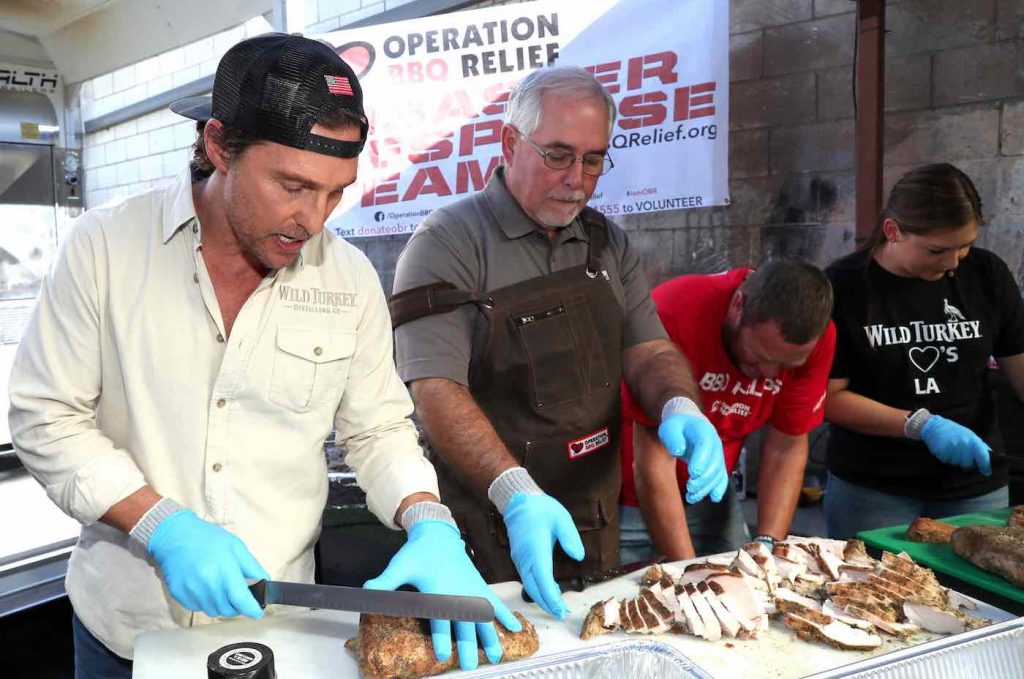
With more than 10 wildfires currently burning in the state of California, Matthew McConaughey teamed up with a group of volunteers from Wild Turkey to cook, prepare and deliver meals to first responders battling in the Los Angeles area.
The team visited more than 20 fire houses Friday to drop off 800 BBQ turkey dinners to firefighters—and also brought 800 additional meals to a local homeless shelter.
McConaughey (who considers LA his second home) listened to stories from the brave men and women who were just returning from the front lines, and thanked them for their bravery, dedication and hard work.
To start the day, the Academy Award winning actor from Texas rallied volunteers and jumped behind the grill to help cook and carve the turkey dinners that were then delivered to the heroes who are battling the wildfires that are raging across Southern California.
McConaughey took to Facebook Live to encourage folks nationwide to volunteer and donate to help support the disaster relief operations of Operation BBQ Relief (OBR), including their current deployment in Northern California, which is providing hot meals to first responders and those affected by the wildfires.
Matthew McConaughey and Wild Turkey Master Distiller Eddie Russell prepare food (Photo by Rich Polk/Getty Images Wild Turkey, released to media)
“Little did we know when planning this annual event that California, my second home, would once again be hit with devastating fires,” said McConaughey, a husband and father of three. “Being able to provide meals to the men and women who put themselves on the line is an honor for me—and hopefully inspire others to get involved and help in their own communities.”
McConaughey has been the Creative Director for Wild Turkey since 2016, when the actor visited the iconic Kentucky distillery where he was introduced to the Kentucky bourbon master distillers, a father and son team.’
The bourbon brand had already planned to partner with OBR throughout November and December to give thanks to first responders nationwide, as part of the bourbon brand’s “With Thanks” annual charitable giving campaign. Last year, McConaughey and Wild Turkey visited and thanked Hurricane Harvey first responders in Houston.
(All photos by Rich Polk/Getty Images Wild Turkey, released to media)
OBR was established in 2011, following a devastating tornado in Joplin, Mo. Since then, the organization has deployed to disasters including, in 2018, Hurricane Michael in Florida, Hurricane Florence in North Carolina, and the Carr fire. OBR has served more than 3 million meals, with the help of more than 14,000 volunteers.
In 2017, its president and CEO Stan Hays was recognized by CNN as one of their “CNN Heroes” for his work with OBR. The charity depends on donations, so find out how you can help at Operationbbqrelief.org.
SAY THANKS to Firefighters By Sharing This Opportunity to Help Pay For Meals…
With millions of used diapers ending up in landfills every year, this new kind of reusable diaper has been shortlisted as one of the 20 international finalists for the prestigious James Dyson Award.
These Sumo diapers are made out of a recyclable material called SeaCell: an antibacterial, absorbent, and biodegradable textile that is made out of seaweed and eucalyptus.
Not only is the material rich in antioxidants that are good for the skin, the diaper components can be sustainably harvested and recycled.
“The unique properties of seaweed help to protect our skin against harmful environmental influences,” reads the SeaCell website. “The seaweed is pure and rich in essential substances such as vitamins, trace elements, amino acids and minerals.”
The company continues, “The substances found in seaweed help to activate cell regeneration, which in turn can help to relieve skin diseases, reduce inflammation and soothe itchiness. Its high level of antioxidants protects the skin against harmful free radicals, which damage our skin cells.”
Many machine-washable diapers on the market today are not recyclable because they are lined with polyester or polyurethane in order to keep the textiles waterproof.
According to the design magazine Dezeen, the Sumo diapers are sustainably waterproofed thanks to an environmentally-friendly kind of waterproofing technology called EcoRepel.
Swiss designer Luisa Kahlfeldt was inspired to develop the diapers for her masters project at the Ecole cantonale d’art de Lausanne after she was struck by how wasteful and inefficient traditional diapers are for the European Union.
“Disposable diapers are the third largest single item contributor to landfills—in the EU alone, 17 million diapers are disposed of each day,” says Kahlfeldt. “Composed of a mix of cellulose fibers, super-absorbing polymers, and synthetic fabrics, a diaper takes up to 500 years to decompose.
“Disposable diapers also contain potentially harmful chemicals and toxins that have been linked to causing serious skin conditions, diaper rash and recently even cases of cancer,” she added. “This observation inspired me to re-engineer this everyday product and design a 100% mono-material SeaCell diaper that fully utilizes the materials inherent skin protection and hygiene properties.”
This police officer took his vows to ‘serve’ the public to a whole new level after a little boy dialed 911 to order food for his sister.
Mesa Police Department dispatcher Anthony Bonilla was surprised—and amused—to receive a call earlier this week from a 5-year-old boy named Charlie Skabelund.
In an adorable audio clip that was released by the department on social media, Charlie can be heard asking the police dispatcher if he is currently speaking to McDonald’s. When Bonilla tries to tell the youngster that he is not a fast food representative, Charlie simply asks for a Happy Meal before hanging up the phone.
Bonilla then calls back and asks to speak to Charlie’s father. Upon explaining the conversation to Mr. Skabelund, the two men share a hearty laugh and Bonilla says that an officer would be stopping by to make sure that there wasn’t an emergency.
Fifteen minutes later, the Arizona family is visited by Officer Randolph “Scott” Valdez—and Charlie was delighted when the policeman handed him a Happy Meal from McDonald’s.
Though Valdez was more than happy to deliver the food, he also took advantage of the opportunity to officially explain to Charlie when it was appropriate to call 911.
“Officer Valdez was really sweet and went over the rules with Charlie about when you’re supposed to call 911, ” Charlie’s mom Kim Skabelund told TODAY. “He explained how if he’s busy bringing Happy Meals to kids, he can’t help people who really need him. He couldn’t have been nicer.”
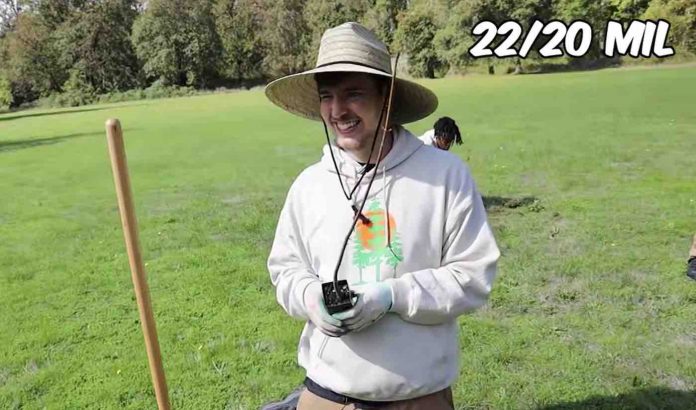
What started as a celebratory milestone for one YouTube star has turned into a worldwide tree-planting initiative.
Jimmy Donaldson—more commonly known by his YouTube channel name MrBeast—has become famous for using his internet fame and income for random acts of kindness.
So when his channel’s popularity hit 20 million subscribers earlier this month, he asked his fans how he should celebrate the occasion.
His viewers responded by petitioning for him to raise $20 million by January 1st (a dollar for each one of his 20 million subscribers) and use it to plant 20 million trees. Jimmy accepted the challenge with enthusiasm.
Since launching the #TeamTrees campaign last week, some of the most popular YouTubers on the web have joined Donaldson in making donations and pledges of their own.
Not only that, Elon Musk, Twitter CEO Jack Dorsey, Shopify CEO Tobi Lutke, and YouTube CEO Susan Wojcicki have all made big contributions to the cause.
According to the #TeamTrees website, which has a prominent ticker, the campaign has already raised enough money to plant more than 12 million trees. Once their goal of 20 million is reached, the Arbor Day Foundation will plant the saplings from January 2020 until December 2022.
The nonprofit will be choosing native tree species for public and private lands across every continent except for Antarctica.
(WATCH MrBeast’s video below)
Plant Some Positivity and Multiply the Good On Social Media… Share Now!
Quote of the Day: “Welcome sweet November, the season of senses and my favorite month of all.” – Gregory F. Lenz
Photo: by LadyDragonflyCC – >;< –CC license on Flickr, cropped
With a new inspirational quote every day, atop the perfect photo—collected and archived on our Quotes page—why not bookmark GNN.org for a daily uplift?
This compassionate nurse is responsible for saving the life of a 27-year-old man with autism after she volunteered to become his legal guardian just two days after meeting him.
Lori Wood, who is an ICU nurse at Piedmont Newnan Hospital in Georgia, first met Jonathan Pinkard after she was assigned to his care back in December 2018.
Pinkard was in desperate need of a heart transplant—but since his grandmother passed away several years earlier and his mother was in rehab, he was ineligible for the transplant list.
This is because—with thousands of people waiting on transplant lists every year—doctors require organ recipients to have stable support systems so that patients are guaranteed to have someone to take care of them after an operation.
So for four months, Pinkard was in and out of the hospital without hope of receiving a heart. Not only that, he was often discharged to a men’s shelter because he had nowhere else to go.
Thankfully, his luck changed after he met Wood.
Pinkard and Wood quickly bonded over their love of football and Family Feud—and as the 57-year-old nurse became more and more familiar with her patient’s circumstances, she knew she had to help him.
Two days after meeting Pinkard, Wood offered to adopt him and become his legal guardian so he could be placed on the transplant list. Needless to say, he accepted.
Pinkard underwent a successful heart transplant back in August. Wood—who Pinkard affectionately calls “mama”—has been monitoring the young man’s various medications and caring for him after his operation. She has even been teaching him different life skills so he might one day live more independently.
When Piedmont Healthcare asked Wood about her decision to adopt Pinkard, she simply said: “When you’re a nurse and you’re wanting to fix and help people, that can be very frustrating. At some point, God places people in situations in your life, and you have the choice to do something about it. And I guess … for this situation there was no choice. It really wasn’t anything I struggled about. He had to come home with me.”
If you want to help finance Pinkard’s medical expenses and hospital transportation, you can donate to his GoFundMe campaign.
(WATCH the inspiring hospital video below)
Be Sure And Share This Sweet Story With Your Friends On Social Media…
One of the most significant problems facing any ecosystem and the conservationists who work therein is the problem of non-native, invasive species. Goats nearly destroyed the Galapagos Islands; feral cats and foxes are devastating the rich diversity of marsupial species in Australia; and large species of Asian python are too much to bear for many creatures in the Everglades.
The same is true for the lionfish within the reefs of the western Atlantic Ocean where the motto among local fisherman is “If you can’t beat it, eat it”.
Coveted by marine aquarium enthusiasts in the 1980s, the lionfish entered the Atlantic ecosystem similarly to how most invasive species are introduced all over the globe: its owner released it into the wild without knowing any better.
While the charismatic Indo-Pacific fish may prove to be a stunner on an aquarium catwalk with its bold stripe pattern and mane of long diaphanous fins, it’s a plague on reef ecosystems where it devours defenseless fish species that have never been forced to evolve to protect themselves against such a threat.
“They can eat fish up to half their body size and a single lionfish can eat dozens of fish in a day,” says Stephen Gittings, a coral reef ecologist for the National Marine Sanctuary System. “Since no native species prey on lionfish, you’re not losing very many of them over the course of time so they just dominate and take over.”
As if all that wasn’t enough, female lionfish can lay up to 2 million eggs a year enclosed within a protective and inedible sack. All of these characteristics make for the perfect invader—but a man and his Roomba are seeking to turn back the tide on this unchallenged fish.
Roomba of the Sea
In addition to being a passionate diver, Collin Angle is also the co-founder of the iRobot company, creators of the famous Roomba automated vacuum. He believes robots can be utilized to tackle environmental problems, which led him to create his non-profit company called Robots for Environmental Services (RSE).
Angle directed RSE to create a robotic submersible that was capable of diving to depths unreachable by the average hobbyist spear fisherman. The result of their efforts was the Guardian: a 20-pound submersible robot armed with lights, cameras, and stun guns capable of delivering non-lethal jolts of electricity to unsuspecting lionfish.
Like the Roomba, the Guardian is also a vacuum cleaner—only instead of dust and cat hair, it vacuums up the stunned lionfish into an onboard water tank that can hold up to 20 fish. Once full, the Guardian can return to the surface with its catch.
Adam Cantor, director of engineering at RSE, explains to CSM that while many coastal communities in the United States host spearfishing competitions to see who can bag the most lionfish, it’s not enough to prevent the effects of the invasive species on nearby reefs because they breed at a depth of 200-400 feet, which is far past the diving range of humans.
Moreover, lionfish aggregate together as far down as 1,000 feet, putting them out of reach for line and net fishing as well.
RSE is trying to market the Guardian for $1,000 per unit—and considering how markets like Whole Foods will buy up nutritious and tasty lionfish catches for $5 per pound, the Roomba of the sea makes for a sensible financial investment that can boost the economic livelihood of coastal fishing communities and protect sensitive Atlantic reefs at the same time.
“I think absolutely there’s a market for it. There’s a ton of lionfish down deeper that we can’t get to,” Andy Lowe, a professional diver and lionfish hunter tells CSM. “The thousand-dollar price point is very good, but for me to personally consider buying one I’ll need to see it get a lionfish off a reef at depth. If it can do that it’s got great potential”.
Be Sure And Share The Good News With Your Friends On Social Media — File photo by Larry D. Moore
Electric vehicle owners may soon be able to pull into a fueling station, plug their car in, go to the restroom, get a cup of coffee and in 10 minutes, drive out with a fully charged battery, according to a team of engineers.
“We demonstrated that we can charge an electrical vehicle in ten minutes for a 200 to 300 mile range,” said Chao-Yang Wang, professor of chemical engineering and professor of materials science and engineering. “And we can do this maintaining 2,500 charging cycles—or the equivalent of half a million miles of travel.”
Lithium-ion batteries degrade when rapidly charged at ambient temperatures under 50 degrees Fahrenheit because, rather than the lithium ions smoothly being inserted into the carbon anodes, the lithium deposits in spikes on the anode surface. This lithium plating reduces cell capacity, but also can cause electrical spikes and unsafe battery conditions.
Batteries heated above the lithium plating threshold, whether by external or internal heating, will not exhibit lithium plating.
The researchers had previously developed their battery to charge at 50 degrees F in 15 minutes. Charging at higher temperatures would be more efficient, but long periods of high heat also degrade the batteries.
“Fast charging is the key to enabling wide-spread introduction of electric vehicles,” said Wang.
Wang and his team realized that if the batteries could heat up to 140 degrees F for only 10 minutes and then rapidly cool to ambient temperatures, lithium spikes would not form and heat degradation of the battery would also not occur. They report their results in this week’s issue of Joule.
“Taking this battery to the extreme of 60 degrees Celsius (140 degrees F) is forbidden in the battery arena,” said Wang. “It is too high and considered a danger to the materials and would shorten battery life drastically.”
The rapid cooling of the battery would be accomplished using the cooling system designed into the car, explained Wang. The large difference from 140 degrees to about 75 degrees F will also help increase the speed of cooling.
“The 10-minute trend is for the future and is essential for adoption of electric vehicles because it solves the range anxiety problem,” said Wang.
Adding to the reduction of range anxiety—fear of running out of power with no way or time to recharge—will be, according to Reuters, the establishment of 2,800 charging stations across the U.S., funded by the more than $2 billion penalty paid by Volkswagen after admitting to diesel emissions cheating. These charging stations will be in 500 locations.
The self-heating battery uses a thin nickel foil with one end attached to the negative terminal and the other extending outside the cell to create a third terminal. A temperature sensor attached to a switch causes electrons to flow through the nickel foil to complete the circuit. This rapidly heats up the nickel foil through resistance heating and warms the inside of the battery.
The U.S. Department of Energy supported this work.
When an Oklahoma library was preparing to move from their old brick building to their new location down the street, they put out a call on social media for a few extra sets of hands to help move their children’s books—but they ended up receiving a lot more assistance than that.
The Norman Public Library—which serves three surrounding counties—originally posted about their moving event on Facebook as a means of getting volunteer book lovers together for a community event.
To their delight, more than 650 kids, adults, and seniors showed up at the library to help them move their books into the new building. Together, they formed a human chain between the two buildings and moved all of the kids’ books simply by passing them one by one down the line.
With the line of people stretching the quarter-mile distance between the two libraries, the entire process took about 45 minutes.
“I’ve never done anything like that before,” one of the participants told The Washington Post. “My daughters thought it was awesome. We can’t wait for the new library to open up.
Another participant told The Post: “It’s my hometown library, and we wanted to be part of history … At the very end, we were told to take a book and put it on the new library shelf in its forever home. Doesn’t that just give you the chills?”
The library managed to capture the magic of the event by attaching a GoPro camera to a copy of “Chicken Little” as it was passed down the line—and the resulting video is pretty endearing.
Quote of the Day: “The wiser mind mourns less for what age takes away than what it leaves behind.” – William Wordsworth
Photo: by Jennifer C, CC license on Flickr – cropped
With a new inspirational quote every day, atop the perfect photo—collected and archived on our Quotes page—why not bookmark GNN.org for a daily uplift?
It’s been four years since Chastity Patterson lost her beloved father figure—and just as she was finally preparing to let go of her grief, she got an astonishing text message out of the blue…
Jason Lignon passed away in 2015, and though he wasn’t her ‘biological’ dad, he had never missed a school dance or sporting event, and became a role model for her—and her friends—doling out love and advice.
“Blood could not make him any closer,” writes Patterson. “I’ve cried with him, told him everything, and even became very independent because he took the time to love me and show me what happiness looks like.”
Through four years of college, the 23-year-old has been texting Jason’s old phone number every day, sending him messages about her life, telling him about her challenges and troubles.
Finally the day came in October when she felt ready to let go. On eve of the fourth anniversary of his death, she texted him one last time recapping everything he’d missed—how she overcame cancer and graduated college.
After summing up her feelings, Patterson finally concluded her text by saying that she would always love and miss him—so imagine her surprise when she suddenly got a text message back.
It said: “Hi sweetheart, I am not your father, but I have been getting all your messages for the past 4 years. I look forward to your morning messages and nightly updates.
“My name is Brad and I lost my daughter in a car wreck August 2014 and your messages have kept me alive. When you text me, I know it’s a message from God.”
“I’m sorry you lost someone so close to you, but I have listened to you over the years and I have watched you grow—and go through more than anyone,” it continued. “I have wanted to text you back for years, but I didn’t want to break your heart.
“You are an extraordinary woman and I wish my daughter would have become the woman you are.”
“I’m sorry you have to go through this but if it makes it any better, I am very proud of you!”
Needless to say, Chastity was in awe of the response—and shared the messages on Facebook hoping that other grieving people might find peace from the serendipitous reassurance that everything was going to be alright.
“Today was my sign that everything is okay and I can let him rest!” she exclaimed.
Be Sure And Share This Sweet Story Of Fate With Your Friends On Social Media — Feature photos by Demarcus Rhodes / Chastity Patterson
People with life-threatening food allergies may soon be free from having to worry about whether their meals might secretly contain hints of deadly allergens.
Israeli scientists have developed the handheld Allerguard device to detect trace amounts of allergens in a meal simply by analyzing food vapors—and it can identify the allergens in just 30 seconds.
“Before you eat, simply hold the Allerguard device over the plate of food. Allerguard’s nanotechnology then absorbs the vapor molecules for detection,” reads the website.
“Once absorbed, electrochemical sensors then identify any potential allergen molecules. Finally, artificial intelligence analyzes the chemical structure of the vapor molecules to identify any allergen presence down to the maximum allowable presence of an allergen deemed safe to eat.”
Other modern methods of allergen detection usually require a physical sample of the food for analysis—but this is considered to be a flawed method of detection since allergens can still be hidden somewhere else in the meal.
The Allerguard scientists, on the other hand, are confident that their gadget can guarantee food safety on a molecular level.
The developers recently told ISRAEL21c that the device still requires another 18 months of research and development before it is commercially available to the masses, but the company has already raised more than $2.2 million in funding—and the gadget has already proven itself to have “unprecedented accuracy” in laboratory tests.
Once the Allerguard is available for purchase, they hope to sell the gadget for roughly $150.
Photo by Allerguard
Protect Your Friends From Negativity By Sharing The Exciting News To Social Media…
It’s the most spook-tacular time of the year—and this English artist is celebrating the holiday by painstakingly carving dozens of spine-chilling jack-o-lanterns.
36-year-old Jamie Jones—also known as the “Pumpkin Freak”, spends up to 27 hours on each of his elaborate pumpkin creations.
Jones manages to create the images without actually breaking the surface of the pumpkins. Instead, the dad-of-two shaves off ultra-thin layers from the surface of the vegetables so that varying amounts of light are able to shine through.
SWNS
This means that the stunning drawings are only revealed when the pumpkins are finally lit up.
His pumpkins feature drawings of TV and film characters like Predator, Chucky, and Beetlejuice.
“I shave the surface so thin, I have to be really careful not to go through,” said Jones, who is a media salesman from Chester, Cheshire
SWNS
“It can take me 27 hours to do each one because if you make a mistake, then that’s it—the whole thing is ruined,” he continued. “Most people don’t realize what is possible with pumpkins. It takes a huge amount of patience to do something like this.
“You have got to have a lot of commitment. I come home from work and spend three or four hours a night on them.”
SWNS
Jones starts by drawing his chosen design onto the surface of the pumpkin. He then delicately chisels, shaves, and etches out the design onto the pumpkin’s fragile outer shell.
To stop the pumpkins from rotting away, Jones seals the surfaces with a spray and protective resin so they last for several weeks.
SWNS
Jones has been carving pumpkins for several years, but he only recently decided to take things to the next level.
He now creates the bespoke designs for local businesses and event organizers at Halloween.
SWNS
“When I show people for the first time, they are blown away,” said Jones. “[The jack-o-lanterns] are so much better than your bog-standard pumpkins, but are so much more complex. It’s really good fun and I genuinely enjoy it.
“Halloween is a great time of year and if you put the work in, you can make some amazing decorations,” he added.
If you want to check out more of Jones’s pumpkin art, be sure and check out his Pumpkin Freak website.
(WATCH the artist in action below)
Be Sure And Share The Spookiness With Your Friends On Social Media…



























 With more than 10 wildfires currently burning in the state of California, Matthew McConaughey teamed up with a group of volunteers from Wild Turkey to cook, prepare and deliver meals to first responders battling in the Los Angeles area.