All who are old enough to remember the tragedy of September 11, 2001 might not recall with equal vividness the inspiring outbreak of helpfulness and kindness that erupted in the wake of the terrorist attacks in New York, Washington, DC, and Shanksville, Pennsylvania.
Good News Network, in existence for four years, had been publishing an 8-page print newsletter when shortly after 9/11 it released its Autumn edition to highlight some of the good news stories about people around the world coming together in the aftermath.
Download the PDF file here, and read all the many heartwarming stories related to 9/11 covering the pages (1, 2, 4, 5, and 8).
These are stories you may not have heard—from the Las Vegas used car lot to the German warship, a Maine restaurant, and the tiny town of Gander, which hosted 53 airliners full of people who couldn’t fly home.
Today I recorded a special Good News Guru radio segment for the Ellen K. Morning Show in L.A., telling one of the most inspiring stories of all, which I hadn’t learned about until 2015.
Sandler O’Neill, & Partners lost 66 colleagues in the World Trade Center—and the New York investment banking firm’s response will echo for a century because they made the most memorable investment they would ever make. LISTEN to the story below, from KOST-103.5.
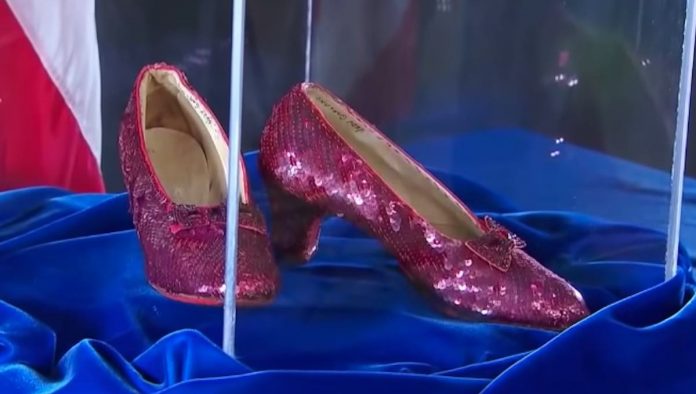
It has been 13 years since the legendary ruby slippers were stolen out of their display at The Judy Garland Museum.
Even though they did not reappear on Dorothy’s feet, however, they have finally been recovered by the FBI.
The slippers, which were worn by the beloved movie starlet in The Wizard of Oz, had been taken from the museum in Grand Rapids, Minnesota back in 2005. There was no security footage of the theft, and apart from the broken shards of plexiglass that had formerly housed the slippers, all that was left of the slippers was a single red sequin.
The FBI announced the return of the slippers at a press conference earlier this week after a specialist verified that the shoes were authentic. Investigators disclosed few details on how the slippers were recovered, but they did say that the investigation was ongoing and there may be arrests in the future. In the mean time, anyone with information about the crime is encouraged to contact law enforcement.
The future of the shoes is currently unknown. There are currently three other surviving pairs of the slippers that were used during the filming of the movie, and this particular pair had previously belonged to a private collector named Michael Shaw.
Before they were stolen, Shaw would loan the slippers to museums, displays, and exhibits in exchange for money which he would often donate to children’s charities, according to The New York Times.
Though it is “unlikely” that the slippers will be returned to Shaw after he was paid by the insurance company following the theft, he says that he “teared up” upon hearing about their recovery.
(WATCH the video below)
You Don’t Have To Click Your Mouse Three Times To Share This Great Story To Social Media… Just The One Time Will Do! – Photo via Inside Edition
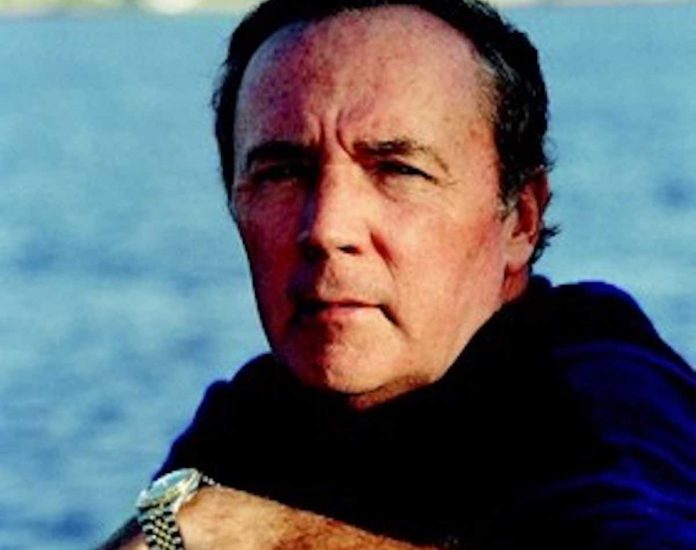
Over the course of the last four years, best-selling novelist James Patterson has donated more than $7 million to teachers across the country – and now, he’s donating even more.
The 71-year-old writer is giving away $2 million to 4,000 American teachers.
The massive donation is part of his “Patterson Pledge” campaign, which is in its 4th year of making $500 contributions to classrooms in need.
Additionally, each donation will be matched in “Bonus Points” by Scholastic Books to ensure that no student will have to live without books.
“Our amazing teachers need help filling their libraries with books kids will LOVE reading,” Patterson wrote on Twitter.
“There is NO such thing as a kid who doesn’t like to read. Just kids who haven’t found the right book yet!”
Patterson has a colorful history of donating to literacy programs and independent booksellers. Back in February, the novelist made a $3 million donation to the University of Florida as a means of helping the state double its literacy rate amongst children.
Help Your Friends Read About The Good News By Sharing To Social Media – Photo by Susan Solie-Patterson, CC
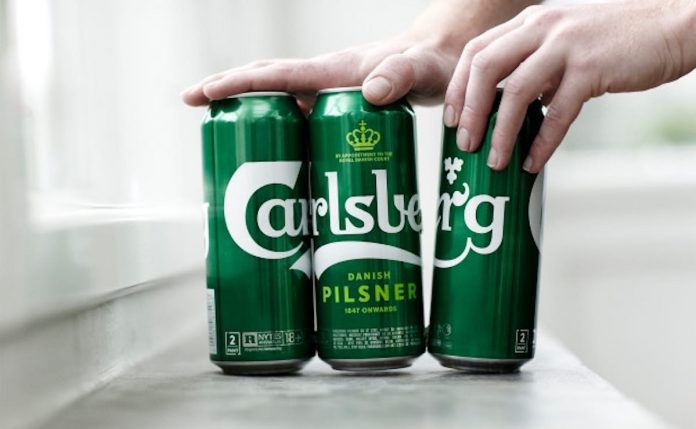
In a “world-first”, beer company Carlsberg has replaced their 6-pack plastic rings for glue.
After testing out 4,000 different adhesives, the brewer has settled for a glue that is strong enough to hold their beers together for shelving and travel, but relaxed enough for the consumer to break apart when it’s finally time to crack open a cold one.
The new design is projected to reduce the Danish company’s plastic usage by 75%, which is roughly 1,300 tons, or the equivalent of 60 million plastic bags.
Inventor Christopher Stuhlmann says he got the idea after he paid a visit to his local hardware store.
This is not the first time that brewers have tried to move past the plastic ring packaging; in 2016, a craft beer maker in Florida created an edible, biodegradable 6-pack ring made out of wheat and barley waste leftovers, but the costs of production were too high to make the design very accessible.
However, the brewer hopes that if more beer companies adopt the design, then it will bring down the costs of manufacturing.
Brew Up Some Positivity With Your Friends And Share The Good News – Photo by Carlsberg
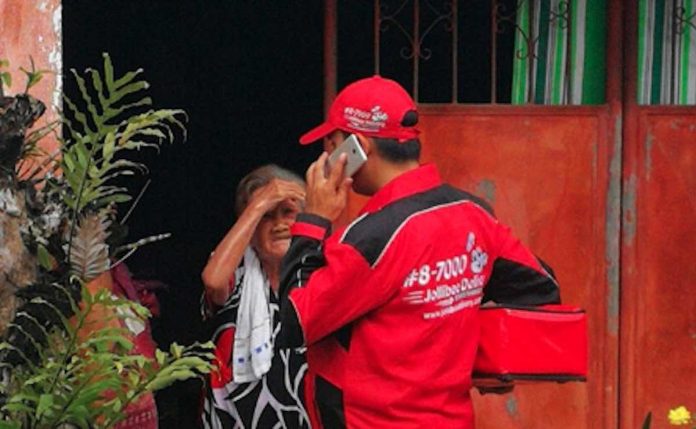
As we get older, technology can be a tricky thing to understand – so when a 92-year-old woman approached a delivery guy with a special request, he was more than happy to help.
Maris Mayol Tian recently made a Facebook post about how she had ordered breakfast from Jolibee earlier this week to her Bacolod City home in the Philippines.
Her 92-year-old neighbor – who is only known as Naynay, a maternal name of respect – saw Tian speaking with the delivery guy and called the young man over to her so she could ask him what he did for a living.
When he said that he delivered food, she proceeded to ask him for a bowl of macaroni soup and spaghetti, not knowing that orders are placed directly with the restaurant over the phone.
“I honestly thought he would just ignore her, laugh and be on his way, but he actually took out his own cellphone, dialed a number, and ordered for her!!!” wrote Tian.
“There was a time when I hated Jollibee’s delivery service because they messed up a few times, but now I think I’m going to order more delivery from them.”
The young man was later identified as Elpegie Palmares Sicor and praised for his patience and kindness.
“Not a lot of people show kindness and pay attention to old people, but this guy did and I think that is very commendable and heartwarming,” wrote Tian, according to Yahoo! News.
Be Sure And Share This Sweet Story With Your Friends – Photo by Maris Mayol Tian
Quote of the Day: “Peace begins when expectation ends.” – Sri Chinmoy
Photo: by ilmungo, CC license
With a new inspirational quote every day, atop the perfect photo—collected and archived on our Quotes page—why not bookmark GNN.org for a daily uplift?
Many people are grappling with this year’s depressing and disturbing news—meaning, they want to turn away, but they just can‘t.
The constant focus on partisan politics—as well as murders and mayhem—is taking a real
toll on peoples’ psyches.
The surgeon Dr. Christiane Northrop says our nervous systems simply weren’t designed to handle a daily barrage of bad news which contains the worst of humanity, brought to you from every corner of the globe. The inundation is too much for most people.
The trend toward sensational bad news on television began in the 1990s. At the same time as the U.S. homicide rate was dropping in that decade by 42%, television news coverage of murders skyrocketed—rising more than 700%, according to the Center for Media and Public Affairs.
During that time, TV network news audiences and newspaper circulation began to fall. We can only guess that this was due to the increased focus on crime coverage.
Instead of gorging on an endless media diet of conflict, some people have taken drastic action, by closing their eyes and turning off the news altogether. (They are also unfriending their angry brother-in-law or friend whose partisan posts contaminate their Facebook feed.)
Completely tuning out the news, however, is not a great solution. To be an informed citizen and voter, we need to know what’s going on. Instead, I recommend that people become “selective sifters”, choosing what kind of news they take in daily. Headline news from the BBC or NPR, or perusing newspapers and magazines is enough to provide the basics.
Most people will need to make a conscious effort not to get sucked into the rancorous trivial debates of the day, like how much Melania Trump’s jacket costs when she travels into a poor neighborhood—and the inference that it should make anyone angry if they are a Liberal.
It’s not enough, though, to just sift through the bad news.
Norman Cousins, a political journalist and 30-year editor of the Saturday Review said, “If news is not really news unless it is bad news, it may be difficult to claim we are an informed nation.”
There is another crucial step that people can take to relieve some of their anxiety around current events. They can write themselves a prescription for a daily dose of good news. Like a “Vitamin G” in their media diet it can provide some balanced nutrition beyond the negative news menu.
I look at it this way: If a child is only given junk food, then that’s all he knows and wants, but if he is given some sweet carrots, watermelon or apples, he learns to appreciate them, and gets the benefit of an enriched diet and healthier body.
Thomas Jefferson said the job of journalists was to portray accurately what was happening in society. As a former TV news freelancer, I created Good News Network (GNN) because the media was failing to report enough of the positive—and it was simply too hard to find good news in large enough quantities to make a difference in one’s mental health.
An overabundance of pessimistic, depressing stories can create a perception of a crime-and-greed-filled-world that is out of proportion with reality.
Benefits to Physical Health
According to letters from GNN readers, the website is playing a major role in relieving depression and anxiety symptoms—and basic physical health, too, can be altered when you make an effort to balance the depressing news. Scientific studies have shown the startling benefits.
In a study of nearly 3000 healthy adults, a London University found that those who reported upbeat moods had lower levels of cortisol—the ‘stress’ hormone that leads to high blood pressure, weakened immune systems, and even abdominal obesity. In the study, women who reported more positive emotions were less prone to chronic inflammation, which is related to heart disease and cancer. The authors of the paper published in the American Journal of Epidemiology in 2008 said, “People need to recognize the things that make them feel good.”
Researchers at the Harvard University School of Public Health found that optimism cuts the chances of developing heart disease and the rate of lung-decline as we age. They followed 1300 men in their early 60’s for ten years. “Lung function declined significantly faster in pessimists, even taking into account major biological risk factors.”
A Dutch study of elderly men found that those who were identified as “optimistic” were associated with a stunning 50 percent lower risk of cardiovascular death during the 15-year study.
Benefits of Mental Well-Being
A study by J. P. Harrell in 2000 found that when participants watched concentrations of positive news and media, they had decreased levels of stress and anxiety. A study by Huffington Post and Harvard Researcher Shawn Achor showed that if people watched even 3-4 minutes of negative news, 27% of participants were more likely to be depressed for the next 6-8 hours of their day.
Testimonials sent to Good News Network provide self-reported anecdotal evidence that supports the notion that positive news can actually improve your health.
15 year old Lisa says, “Daily, I was affected by panic attacks which were triggered from the news and all it’s negative content. This site has helped me tremendously.”
Mike says, “I suffer from depression and paranoia. I feel like I can never truly be happy as I always get this sense of encroaching doom and most of my fears are heightened by media sensationalism. Your website is JUST what I need to focus.”
Get our bumper stickers and shirts like these on CafePress.com/goodnewsnetwork
And finally a clinical and police psychologist, Dr. Kevin Keough, wrote this, “A 13 year-old boy was depressed and suicidal as he entered my office. He cited TV news as proof that there was no point to living, ‘Everything is out of control, it’s all bad news, people are killing each other, terrorism, corruption, kids being slaves.’ After I let him cry, I explained how TV news worked—that it didn’t reflect reality accurately—and I showed him your site. He started to cheer up. He smiled and gave me a hug. Life was okay again.”
Tal Ben-Shahar was a lecturer at Harvard University and his positive psychology course was the most popular class on campus. Author of ‘Happier’, and ‘Choose the Life You Want’, he believes the Good News Network can benefit everyone: “It’s an extremely important initiative. I recommend that each person makes it a habit to visit the website at least once a day to counter the barrage of negativity in the media. Being exposed to positive information benefits us emotionally, physically, and mentally. It can contribute in a meaningful way to a happier and healthier life.”
A 2005 study by Bayer concluded that an overwhelming 93% of Americans wanted more good news, and 77% percent believed there was not enough good news offered by mainstream media. The study also showed that people believed they are more productive in their jobs after hearing good news.
Fortunately, good news is now easy to find. With the GNN website, free APP, daily email with ‘Morning Jolt of Good News’, weekly podcast, and social media posts on Facebook, Twitter, and Instagram, a daily dose of ‘News to Enthuse’ is always at your fingertip. The New York Times even has a Saturday email with the good news of the week.
What we think in our minds directly affects our health. Through the mind-body connection, our thinking leads to stress or happiness. It is your choice—and your health depends on it.
Geri Weis-Corbley worked in TV news in the 80s covering the White House and Capitol Hill. After quitting the business to raise a family, the World Wide Web came along, and in 1997 she acted on her long belief that there should be more good news and created Good News Network, the #1 site on Google for inspiring news. Adopted from a speech given June 2, 2017 to the Holistic/Integrative Medicine Study Group in Santa Barbara, CA.
There’s a first time for everything, including haircuts – but this little girl explaining how she feels about her short new ‘do’ is especially memorable.
The 5-year-old’s mother takes a video of the youngster plaintively describing all the practical—and emotional—benefits of having short hair.
In addition to saying that she feels like a big kid, the little girl compares her happiness to the sensation of eating ice cream and watching a movie with all of her friends, family, and friends’ families.
(WATCH the cute clip below)
Be Sure And Share This Cute Clip With Your Friends – Photo by RM Videos
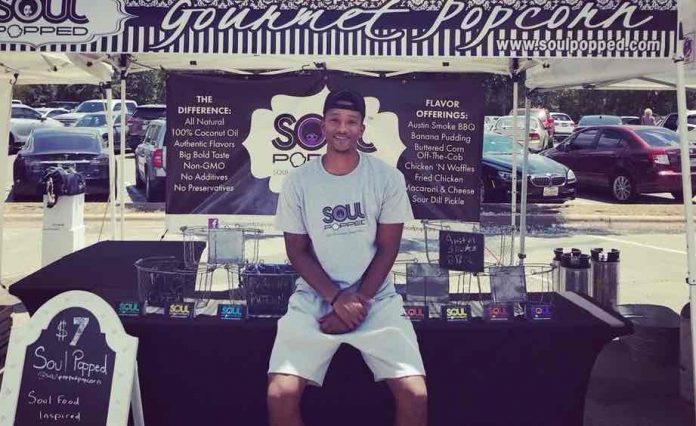
Peter Dutton isn’t just an American popcorn seller—thanks to an unlikely accident of mistaken identity, he now holds the title of “The People’s Prime Minister of Australia”. Hear The Good News Guru tell the happy story (from the September 7, 2018 Ellen K. Morning Show on KOST-103.5 radio in Los Angeles).
LISTEN to this story here, as told by The Good News Guru, from Friday’s radio broadcast with Ellen K and the GNN founder, on KOST-103.5 — Or, READ the story below… (Subscribe to our podcast on iTunes – or for Androids, on Podbean)
Even though he’s 9000 miles away, a 30-year-old popcorn-seller has become the ‘People’s Prime Minister of Australia’.
Peter Dutton started receiving nasty messages on his Twitter feed in Austin earlier this year, and he couldn’t figure out why people were so angry with him.
He created the Soulfood Gourmet Popcorn brand, which people love. But, he also shares the same name as the ultra-conservative politician who just lost the race for prime minister in Australia.
Throughout the election, the American Peter Dutton took the barrage of messages with a grain of salt, tweeting:
“I wish the people of Australia would look at my profile and realize I’m a 30-yr-old black man before sending me tweets and DMs.”
When Aussies on Twitter caught wind of his polite and good-natured reactions, as a result of the mistaken identity, they immediately showered his social media account with love—and his popcorn business with a flood of support.
They collectively nominated the popcorn-maker as the “PEOPLE’S Prime Minister of Australia”.
Dutton accepted the title with gusto. His wife has even accepted the title of “First Lady”.
“The support you’ve shown our growing popcorn business, calling my wife the First Lady…is something I’ll cherish forever,” replied Dutton.
Like a newfound second family, people begged him to visit and offered to host him, with promises of bottomless beer.
A GoFundMe page allowed his 6,000 new Twitter followers to donate money for the plane tickets—and now Peter and his wife are packing up loads of popcorn to share across the country, planning soulful meet-ups with the folks down under.
“We can have a big Soul Popped Popcorn party, take some pictures, and [you can] show me around your beautiful country…”
Pass On This Sweet Story Of International Fun To Your Friends – Photo by Audreana Dutton
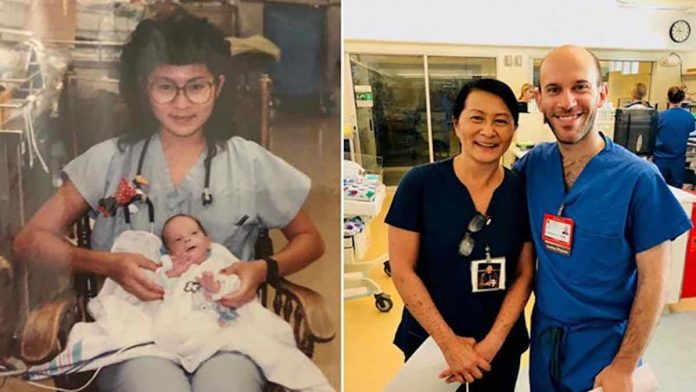
Vilma Wong has cared for a lot of babies over the course of her 32-year career, but she never expected to be working alongside one of them.
Earlier this month, as a nurse at Lucile Packard Children’s Hospital in Meredith, California, Wong got a chance to introduce herself to a new colleague who’d just started working at the facility.
His name was Brandon Seminatore, a second-year pediatric resident who is training to become a child neurologist.
Brandon was just 28 years old, but Wong felt that she had somehow met him before. When she heard his name, she realized where that feeling came from.
Wong asked Brandon if, by any chance, his father was a police officer.
“Brandon was on my team and taking care of one of my patients. I asked who he was and his last name sounded very familiar,” Wong told her hospital communications team. “I kept asking questions, like where he was from and he told me he was from San Jose, and that as a matter of fact, he was born at our hospital.”
“I remember being the primary nurse to a baby with the same last name. To confirm my suspicion, I asked him if his dad was a police officer. And there was a big silence. Then he asked me if I was Vilma. I said yes!”
Wong had cared for Mr. Seminatore 28 years ago when he was born prematurely at the hospital.
His parents were delighted to be reunited with the nurse who had kept their son alive back in 1990. After digging through some old photos, they even managed to find a photo of Wong holding young Brandon in her lap as a newborn.
“Meeting Vilma was a surreal experience,” said Brandon. “When Vilma recognized my name, it truly sunk in that I was one of these babies. I’ve come full circle and I’m taking care of babies with the nurse that took care of me.”
Be Sure And Share The Fateful Story With Your Friends – Photo by Lucile Packard Children’s Hospital
Quote of the Day: “This may sound corny, but, love is the answer.” – Elon Musk, September, 2018, on the Joe Rogan podcast
With a new inspirational quote every day, atop the perfect photo—collected and archived on our Quotes page—why not bookmark GNN.org for a daily uplift?
The Lesson: Are you easily overwhelmed by things likes crowded places, strong smells or loud sounds, and violent movies? Do you have complex inner emotions that sometimes give you a hard time; or prevents you from sleeping at night? If the answer is yes, then you may be classified as a highly-sensitive person—but you are not alone. 15% to 20% of the population is made up of HSP (Highly-Sensitive People). They are normal human beings who have a sensitive nervous system that make them more easily overwhelmed by the world around them; feel every emotion very deeply; empathize easily with the people around them; and also makes them highly creative. Elena Herdieckerhoff is one of these highly-sensitive people who wants to help people embrace their own sensitivity, transform it into power, and raise loving awareness among her fellow HSPs.
Notable Excerpt: “I would like to address the two big elephants in the room when it comes to HSP stereotypes. The first assumption is that HSP must simply be undercover introverts who want a fancier name. The fact of the matter is that 30% of HSP are actually extroverts. Many assume that HSP are women. It may come as a surprise that 50% of HSP are, in fact, men. In our society men are not supposed to be sensitive, but aggressive and competitive. Sadly, the notion that men can be both sensitive and strong is still too much of an alien concept.”
“HSP should not hide away from the pain of this world in a protective incubator. It is their role to step up and share their sensitive gifts with all of us. I believe, as humans, we are all united by our experience of sensitivity and empathy. Also, I don’t believe that we need to be an HSP to care, to make a difference.”
The Speaker: Elena Herdieckerhoff is the founder of Entreprincess, a self-help organization for highly-sensitive people. She is also a business mentor for HSP entrepreneurs, a motivational speaker on the topic of highly-sensitive people and a corporate trainer for companies interested in better understanding their HSP Workforce.
(LISTEN to the inspiring talk below) – Representative photo by Vic Xia, CC
Good Advice? SHARE It – Or Check OutMoreOn Our Good Talks Page…
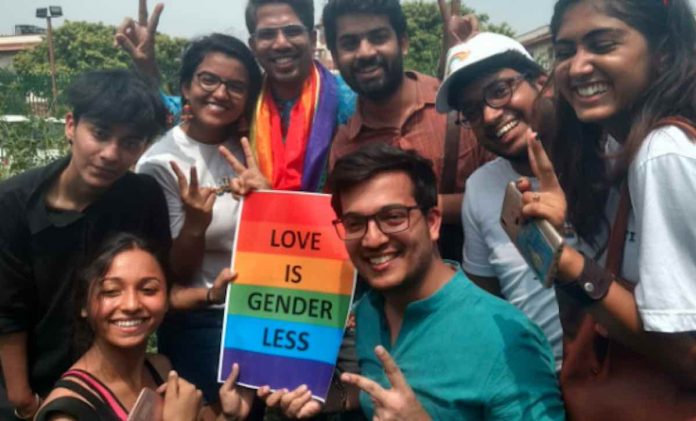
The Supreme Court of Indian has just passed a historic ruling: homosexuality is no longer a criminal offense.
The court repealed Section 377, a 150-year-old law that was instated during British colonial rule which made consensual sexual activity that went “against the law of nature” punishable by up to a lifetime in prison.
The new ruling, which was announced by a 5-judge panel in Delhi earlier this week, marks the end of a century’s worth of anti-gay legislation.
“The LGBTQ community has the same fundamental rights as citizens. The identity of a person is very important and we have to vanquish prejudice, embrace inclusion and ensure equal rights,” said Chief Justice of India Dipak Misra, according to TIME.
“Intimacy and privacy is a matter of choice. We have to bid adieu to stereotypes and prejudices,” he added.
(WATCH some of the reactions below)
If You Love This Story, Be Sure And Share The Good News With Your Friends – Photo tweeted by Nikhil Kumar
Quote of the Day: “May your trails be crooked, winding, lonesome, dangerous, leading to the most amazing view.” – Edward Abbey
With a new inspirational quote every day, atop the perfect photo—collected and archived on our Quotes page—why not bookmark GNN.org for a daily uplift?
One major city wants to tackle the plastic waste problem head-on, and they’re creating positive action through people’s fare cards.
Istanbul’s answer is an innovative new incentive for commuters in the historic city; allowing them to exchange plastic waste for credit on the city’s metro cards which can be used for multiple forms of public transit.
The sophisticated machines, which are called “Smart Mobile Waste Transfer Centers”, will have the onboard equipment to scan and assign a value to whatever piece of plastic is put inside before crushing it, shredding it, and sorting it into bins which can be emptied just like vending machines.
With 25 of the machines currently installed in the city, the Istanbul Metropolitan Municipality has set a goal of installing 100 by the end of the year with the hopes of reducing the 17,000 tons of garbage they produce every day, according to The Daily Sabah.
Istanbul isn’t the only city tackling environmental problems using their transit systems. A 27-year-old designer in London created an ingenious way of generating wind power that uses cloth-like material to generate electricity from the wind that comes from subways and train cars speeding by.
Pass On The Positivity By Sharing With Your Friends
Andy Corbley is the founder and editor of World At Large, a small environment, travel, and lifestyle focused journal that stresses integrity, nuance, and honesty which launched in early March 2019.
This college football player isn’t simply a star on the field; he has shown himself to be a shining citizen off the field, as well.
Garrett Johnson, who is a junior defensive back for the University of Tennessee, was walking through Knoxville earlier this week when he met a homeless man who was having trouble walking in the tattered shoes he was wearing.
Johnson then leaves and comes back with two pairs of new shoes. He offers one of the boxes to the homeless man while a woman who says she is the athlete’s sister films the exchange with her phone.
“These are comfortable tennis shoes,” says Johnson. “They’re New Balances.”
The man hesitates, and then asks if they’re free – and Johnson says yes.
As the man slips the shoes on, Johnson offers the second pair of shoes to another homeless man sitting on a nearby bench. When the man declines, Johnson simply leaves them with his new friend.
Johnson then shakes the man’s hand before he leaves. He later posted the video of the exchange to Twitter in hopes that he would inspire others to act similarly.
“I walked to the strip to get food and a homeless man (Lala) couldn’t walk because his feet were hurting from the torn shoes he had on,” wrote Johnson. “I told him I would come back and 15 mins later I did. Don’t know those people, but I do care.”
(WATCH the video below)
I walked to the strip to get food and a homeless man (Lala) couldn’t walk because his feet were hurting from the torn shoes he had on. I told him I would come back and 15 mins later I did. Don’t know those people but I do care. Love. #GBOpic.twitter.com/STDaiXiUkX
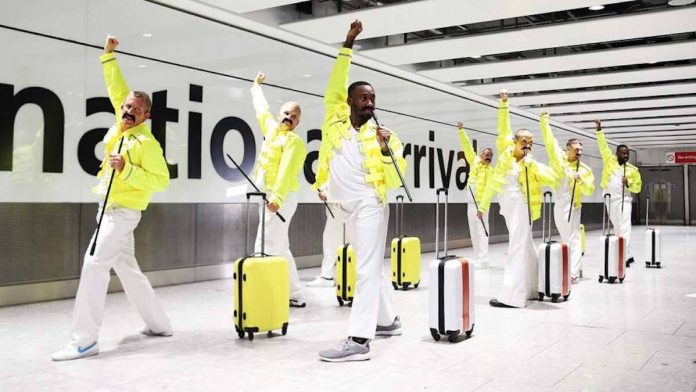
Travelers at London’s Heathrow airport were blessed by a special kind of royalty this past week.
As a means of honoring Freddie Mercury’s 72nd birthday, members of the baggage handling team broke out into song and dance to perform the Queen hit “I Want to Break Free”.
The staff came out in full costume to perform the choreographed number, sporting Mercury’s signature yellow jacket and mustache as an homage to the singer who was once a baggage handler at Heathrow before joining Queen.
British Airways, the company who sponsored the performance, didn’t stop there, either.
The airline allowed any customer with the name “Freddie”, “Frederick”, or “Farrokh” (which is Mercury’s birth name) to use the airline’s first lounge, assuring them that they were the champions in the airport that day.
Some celebrities have had the good fortune of being able to enjoy their retirement in comfort and style – but unfortunately, the same can not quite be said for Dawn Wells.
Wells was the beloved young actress who played Mary Ann Summers on the CBS show “Gilligan’s Island”. According to her dear friend and hairstylist, the starlet has fallen on hard times.
Dugg Kirkpatrick recently created a GoFundMe page for Wells, asking for help from her fans.
“After 2008, like many of us, Dawn suffered through the banking crash and lost everything including her life savings, in addition to a life-threatening surgery which came close to killing her,” wrote Kirkpatrick. “Dawn was a victim of an unexpected accident that required hospitalization for two months and a very long time to rest and heal.”
So as a means of helping his friend pay her hospital bills and find her a place to live out her senior years, Kirkpatrick set the goal for $180,000.
“Should any of you out there wish to contribute a small (sum) to help a woman who gave so many people joy over the years, it would be so appreciated.”
Thousands of “Gilligan’s Island” fans contributed to the page and offered their love to the actress. The campaign has raised $191,000 in 20 days, enough money to pay off some of the actress’s debt and move her into a retirement village in California.
Wells eventually took to Facebook to express just how “amazed” she was by the support.
“A dear, dear friend of mine with a big heart was trying to help me with some common issues we all understand and some must face,” wrote Wells. “He created that page with the love an emotion (of) someone protecting their child.
“I don’t know how this happened,” she continued. “I thought I was taking all the proper steps to ensure my golden years. Now, here I am, no family, no husband, no kids and no money. I’m grateful that God has given me so many friends and fans who care, or it would all be too …overwhelming.”
“I am grateful to any of my fans who are willing to offer support. However, please know that my outlook is positive and I look forward to seeing you all in my travels.”
If This Story Floats Your Boat, Be Sure To Share It With Your Friends – Photo by Dugg Kirkpatrick via GoFundMe
To feel better faster, a dose of reassurance might be just what the doctor ordered.
According to a new study, when a health care provider offers a few encouraging words about their patient’s recovery time from an allergic reaction, symptoms are significantly reduced.
“For many conditions, the simple act of being reassured by a medical professional can aid in the healing process, and we needn’t always rely on medication and procedures to make us feel better,” said the study’s lead researcher, Alia Crum, an assistant professor of psychology at Stanford University’s School of Humanities and Sciences whose research explores how patient mindsets can affect health outcomes and healing.
“My hope is that findings like this one inspire additional research on the physiological mechanisms of assurance as well as promote training and compensation for physicians to more effectively leverage psychological forces in their practice,” she added.
Graduate student Kari Leibowitz, lead author on the paper, said the findings on doctor reassurance are in line with what people had known about the placebo effect. “Research on the placebo effect has long shown the importance and power of a physician’s words: When a physician gives people an inert treatment, such as a sugar pill, and tells them it will help them feel better, that pill is often effective,” she said.
The question, Leibowitz said, is whether a doctor’s reassurance is enough.
“Our experiences talking to both patients and physicians suggest that we know that physician assurance, by itself, is powerful and can make people feel better, but there is surprisingly little empirical work to back that up,” she said.
To test the effects of a physician’s words on patient symptoms, the researchers set up a simple experiment with 76 study participants.
They began their experiment by inducing a harmless, allergic reaction in study participants. A health care provider administered a histamine skin prick, a test traditionally used as a baseline to diagnose allergies. Histamine causes reactions like swelling, rashes and itching.
Following the skin prick, participants rated how itchy they were on a scale of zero to 100 at 3, 9, 12, 15 and 18 minutes after the skin prick.
Six minutes in, the health care provider came back in to check on the participants.
With approximately half of the participants, the provider assured them that “from this point forward your allergic reaction will start to diminish, and your rash and irritation will go away.”
But with the other half of participants (the control group), the provider offered no remarks about their reaction.
The researchers found that when the health care provider offered a few assuring words, the feeling of itchiness declined significantly faster than in participants who were given no explanation about their reaction or recovery.
The biggest difference was 3 minutes after the brief intervention, at 9 minutes in. Assured participants reported their itchiness at an average of 20.19, compared to the control group who rated their irritation at almost 29, on average. The researchers saw that the difference between the two conditions was somewhat maintained over time, but shrank as the overall reaction got less itchy.
“Going to the doctor is largely a psychological experience,” said Crum. “Often we simply want to be reassured that what we are experiencing is ‘normal’ and will go away. And yet, the response we often get is complicated diagnoses, expensive medications and added uncertainty, all of which which may not only fail to harness psychological aspects in healing but may actually generate mindsets that could make us feel worse.”
For Leibowitz, interpersonal interactions are central to what it means to practice medicine, not tangential to it.
Her advice to health care providers is that instead of saying something like “I can’t see anything wrong with you,” physicians could say something like “I think your issue is likely to resolve on its own, and I believe you’ll feel better in a few days,” said Leibowitz.
“There is a growing recognition of the power and importance of these psychological and social forces in health care, and so I hope the system will change to reflect and value things like providing reassurance and setting positive expectations as part of good medicine,” said Leibowitz.
The work was funded by the National Institutes of Health and the Joan Butler Ford Stanford Graduate Fellowship, and the findings were published in the Journal of General Internal Medicine.