It has been 14 years since this momma elephant was rescued from the wild as an orphaned calf—and now, she has returned many years later so she can introduce her own baby to the humans who saved her.
Loijuk was only 5 months when rescuers from the Sheldrick Wildlife Trust (SWT) found her stranded in an arid, drought-stricken region of northern Kenya. After nursing her back to health, the happy pachyderm spent her adolescence surrounded by an adopted herd of other orphaned and rescued elephants just like her.
Though Loijuk now lives in the wild, she often returns to the SWT’s Ithumba Stockades so she can visit her human caregivers.
Loijuk’s most recent visit on September 1st, however, marked a very special occasion: she had just given birth to a female calf and she wanted to introduce the baby to the SWT rescuers.
“It is so special to witness Loijuk welcome and encourage the interaction, inviting head Keeper Benjamin to enjoy her newborn baby, unperturbed by their shenanigans together, and to immediately see the joy this new life brings the whole Ithumba Unit of dependent orphans and ex-orphan’s alike,” writes the SWT staffers.
“Watching her heal, flourish and transition to a wild independent life again in the span of 14 years, surrounded by ex-orphans and wild elephant friends, and now to see her transform into a mother is the ultimate affirmation of a job well done.”
The calf, which has been named Lili, is the 31st recorded offspring born to a rescued SWT elephant. Since it is currently the dry season in Kenya, Loijuk has stayed close to the wildlife shelter so she and her calf can enjoy extra support from the human rescuers until the weather cools off.
(WATCH the video below) – Photo by Sheldrick Wildlife Trust
Show Off This Sweet Story To Your Friends By Sharing It On Social Media…
This clever online game is helping people to passively plant trees around the world simply by answering trivia questions.
Plant the Peace is an internet game that quizzes its players on geography, English vocabulary, and the environment. For every 10 questions that are answered correctly, the game sponsors donate enough money to plant one tree in Africa.
The initiative works similarly to Free Rice, an internet trivia game that donates rice for every English vocabulary question that a user guesses correctly. Since the World Food Program began using the game to generate donations from their sponsorships, Free Rice players have been helping to donate millions of grains of rice every day.
“Many people have asked us why it’s necessary or fair to ask people to play a game in order to help people in need. Why can’t the sponsors just donate the money in advance?” says the Free Rice organizers. “We could, in theory, ask our players to just look at these sponsor messages, unattached to any sort of game. But answering questions and challenging yourself is more motivating than just re-loading a page over and over. Without the game itself, our users would have no reason to return to the site.
“If you have fun with the game, and get smarter by playing it, you are more likely to answer more questions, see more messages, and generate more payments to WFP,” they concluded.
The Plant the Peace trees, meanwhile, are planted by Trees for the Future: a Maryland-based nonprofit dedicated to ending hunger and poverty in sub-Saharan Africa by planting trees. Since the nonprofit only recently launched the game, they have helped to plant about 1,500 trees.
Plant Some Positivity By Sharing The Good News With Your Friends On Social Media…
When a 24-year-old’s amusing handwritten sign helped to propel him into the national limelight, he decided to use his 15 minutes of fame to help sick children instead.
Carson King was just one of the many spectators attending ESPN’s “College GameDay” event in Ames, Iowa last week, where football fans vie for air-time with homemade signs.
The former Iowa State University student hoped to scrape together some party money for himself and his friends on Game Day, so he made a sign emblazoned with his Venmo e-banking account name and the words: “Busch Light Supply Needs Replenished.”
Carson held it up during the live broadcast, but had no idea that viewers from all over the country were sending him money until his friend saw notifications popping up—one after another, on Carson’s phone.
After his Venmo balance began to climb over $1,000, however, he knew that he couldn’t keep all the money for himself. He then announced that he would be donating all of the money—save for the amount he would need for a 24-pack of beer—to the University of Iowa Stead Family Children’s Hospital.
University of Iowa football fans, located in Iowa City, are renowned for their tradition of waving at the children in the neighboring hospital during their games. Now, since Carson began gathering donations for the hospital, his spontaneous fundraiser has racked up over $90,000.
Additionally, King used his brief segment of news coverage to ask businesses and individuals to match his donations. Since Carson’s call to action was aired on KCCI, Anheuser-Busch and Venmo said they both would match his final donation.
King says that he will be keeping his #ForTheKids fundraiser open until the end of September, and his mother, Dana Archer-King, says that she could not be more proud of her son.
“Anyone who know Carson can tell you he’s a fun-loving, yet honorable individual with great character,” says Archer-King. “Trust me, he could have kept all the money to himself (and with a mortgage payment, living expenses, and $700 per month student loans, he could use it!) but that’s not who he is.”
.@CarsonKing2 this is the best thing we have read all year, we’re inspired.
We’re going to match your donation to University of Iowa Hospitals & Clinics, and we’ll throw in some of that Busch Light you were looking for. https://t.co/NPPrPp6zJg
Quote of the Day: “Some scarcely see nature at all. But to the eyes of the man of imagination, nature is imagination itself.” – William Blake
Photo: by Danny Coen, CC license
With a new inspirational quote every day, atop the perfect photo—collected and archived on our Quotes page—why not bookmark GNN.org for a daily uplift?
A Detroit police officer is being praised for reaching out to help a homeless man who had been having trouble shaving his facial hair on the street.
62-year-old Stanley Nelson had been attempting to shave in the rain outside of Comerica park last week after a woman on the street handed him a bag full of toiletries and supplies, including a disposable razor and shaving cream.
Since he didn’t have running water on hand to help him shave, Nelson had been using water from a nearby downspout and rinsing his newly-acquired razor in a sidewalk puddle.
That’s when Detroit Police Department Officer Jeremy Thomas spotted Nelson and immediately felt spurred to offer his assistance.
“He had shaving cream on his hands, his coat, his face, his eyes,” Officer Thomas recalled to WXYZ. “So I walked up and said ‘Excuse me, sir,’ and … he said ‘I’ll leave, I’ll leave,’ and I said ‘No, do you need some help?’”
After insisting that Nelson didn’t have to leave, Thomas then helped the man shave his face.
Little did he know, the heartwarming exchange was captured by Jill Metiva Schafer and her husband as they were leaving a baseball game. After she published the photos to Facebook, they were shared by hundreds of social media users and news outlets.
Nelson later met with reporters so he could express his gratitude for the officer’s kindness.
“That was beautiful, what he did, and God is gonna bless him for doing that for me because he didn’t have to do that,” Nelson told WXYZ. “I really appreciate [it] because, you know, I’m going through my thing and I feel bad about myself, you know? But I’m gonna be alright.”
(WATCH the news coverage below)
Clean Up Negativity By Sharing The Story With Your Friends On Social Media…
Swedish and Chinese scientists have developed a new kind of organic solar cell that has been optimized to convert ambient indoor light into electricity.
The power they produce is low, but is probably enough to feed the millions of products that the internet of things will bring online.
As the internet of things expands, it is expected that we will need to have millions of products online, both in public spaces and in homes. Many of these will be the multitude of sensors to detect and measure moisture, particle concentrations, temperature and other parameters. For this reason, the demand for small and cheap sources of renewable energy is increasing rapidly, in order to reduce the need for frequent and expensive battery replacements.
This is where organic solar cells come in. Not only are they flexible, cheap to manufacture and suitable to manufacture as large surfaces in a printing press, they have one further advantage: the light-absorbing layer consists of a mixture of donor and acceptor materials, which gives considerable flexibility in tuning the solar cells such that they are optimized for different spectra—for light of different wavelengths.
Researchers in Beijing and Linköping, led by Jianhui Hou and Feng Gao, have now developed a new combination of donor and acceptor materials, with a carefully determined composition, to be used as the active layer in an organic solar cell. The combination absorbs exactly the wavelengths of light that surround us in our living rooms, at the library and in the supermarket.
The researchers describe two variants of an organic solar cell in an article in Nature Energy, where one variant has an area of 1 cm2 and the other 4 cm2. The smaller solar cell was exposed to ambient light at an intensity of 1000 lux, and the researchers observed that as much as 26.1% of the energy of the light was converted to electricity. The organic solar cell delivered a high voltage of above 1 V for more than 1,000 hours in ambient light that varied between 200 and 1000 lux. The larger solar cell still maintained an energy efficiency of 23%.
“This work indicates great promise for organic solar cells to be widely used in our daily life for powering the internet of things,” says Feng Gao, senior lecturer in the Division of Biomolecular and Organic Electronics at Linköping University.
Jianhui Hou, professor at the Institute of Chemistry, Chinese Academy of Sciences, added: “We are confident that the efficiency of organic solar cells will be further improved for ambient light applications in coming years, because there is still a large room for optimization of the materials used in this work.”
The result is a further advance in research within the field of organic solar cells. In the summer of 2018, for example, the scientists, together with colleagues from a number of other universities, published rules for the construction of efficient organic solar cells (see the link given below). The article, which involved 25 researchers from seven universities led by Feng Gao, was published in Nature Materials. These rules have proven to be useful along the complete pathway to efficient solar cell for indoor use.
The Biomolecular and Organic Electronics research group at Linköping University, under the leadership of Olle Inganäs (now professor emeritus), has been for many years a world-leader in the field of organic solar cells. A few years ago, Olle Inganäs and his colleague Jonas Bergqvist, who is co-author of the articles in Nature Materials and Nature Energy, founded, and are now co-owners of a company, which focuses on commercializing solar cells for indoor use.
A tiny pet fish weighing less than one gram (0.03 ounces) has just become the smallest surgical patient in the UK after veterinarians successfully removed a tumor from its belly.
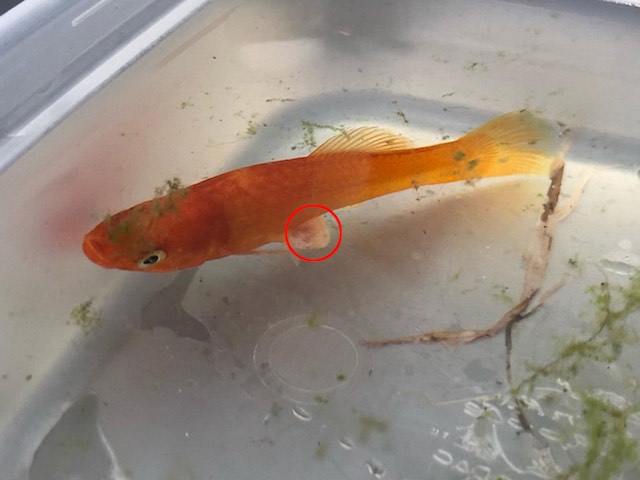
The molly fish, which was named Molly after its species, was rushed into the Highscoft Rabbit, Small Mammal, and Exotic Vets practice in Bristol, England after its owners noticed a large lump on its tummy.
The vets, who normally operate on the likes of iguanas, snakes and crocodiles, says the 1g-fish is the smallest animal to go under the knife.
“A couple had been given the molly fish by an elderly neighbor, but after a few weeks they noticed a lump on her underbelly and brought her in,” said exotic species vet Sonya Miles. “It was definitely the smallest animal we’ve seen here. It barely registered on our scales.
“It’s not common across the UK to bring your fish to the vets, but it is here,” she added. “We are seeing more and more fish, which is great. It used to be the odd one or two every few months, but more and more people are realizing we are happy to see them.”
Immediately after vets diagnosed the lump as a tumor, they prepared Molly for emergency surgery.
SWNS
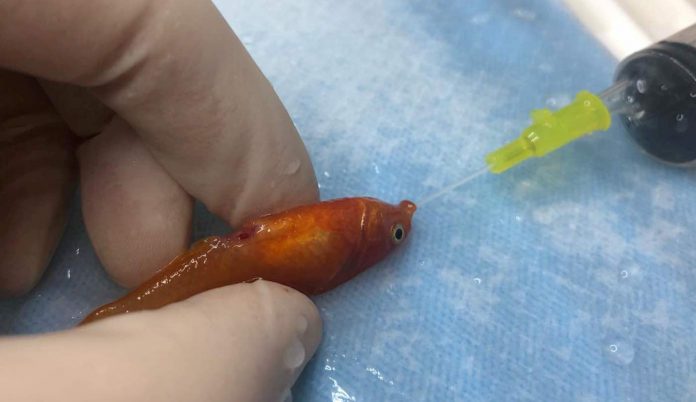
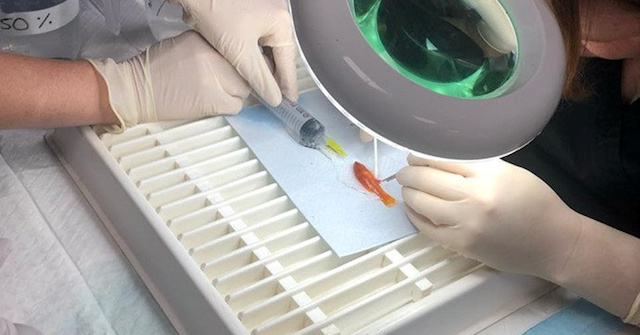
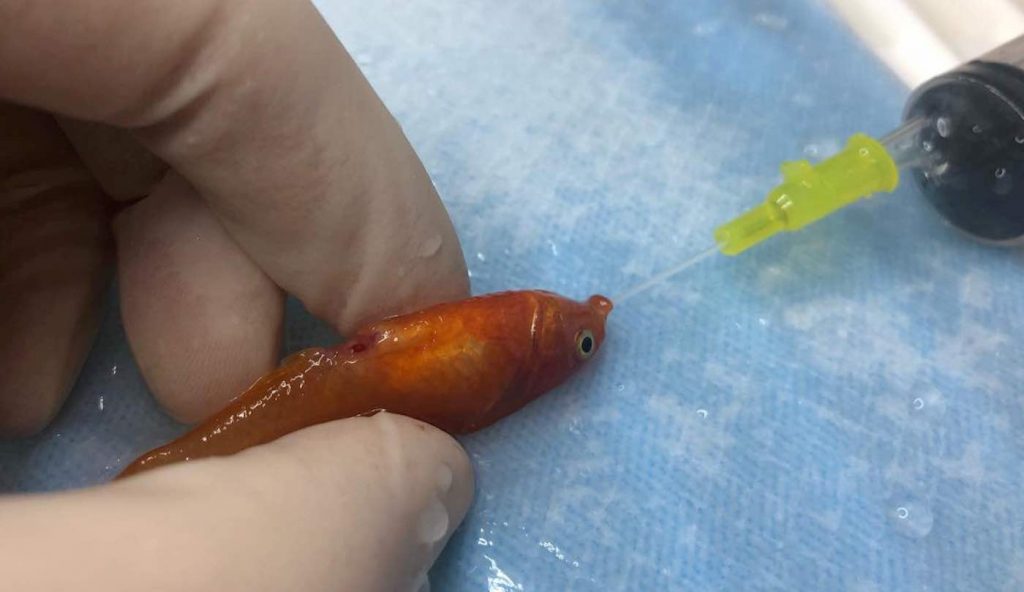
The vets catheterized the molly fish’s mouth, anesthetizing its exterior, and removed the mass—all within 40 minutes.
The operation, which cost less than £100 ($124), was hailed a success after Molly woke up within minutes of the anesthetic being removed and returned home to her tank later that day.
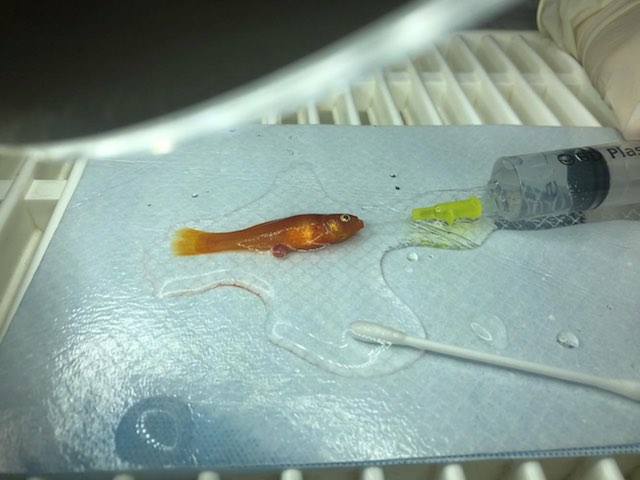
“It’s a pretty simple procedure and took no longer than thirty or forty minutes,” explained Miles. “We submerged the fish in a container of anesthetic solution. Once the righting reflex was lost and the fish was asleep, it was laid on the operating area.
SWNS
“The fish was kept wet (which makes the puddle), the mouth was catheterized, and different concentrations of anesthetic were injected over the gills to keep the fish at a stable level of anesthesia.
“The incision was covered with a water-proof paste, as stitching the skin closed isn’t a possibility,” she continued. “The fish was then woken up in fresh oxygenated water. The operation was a success as we were able to remove the tumor before it started to upset the fish’s balance.
“You definitely have to have steady hands and good eyesight,” concluded Miles. “It was definitely a team effort.”
SWNS
If This Story Floats Your Boat, Be Sure And Share It With Your Friends On Social Media…
In what is being hailed as the world’s first telethon devoted to protecting the climate, Denmark has raised enough money to plant almost 1 million trees across the country.
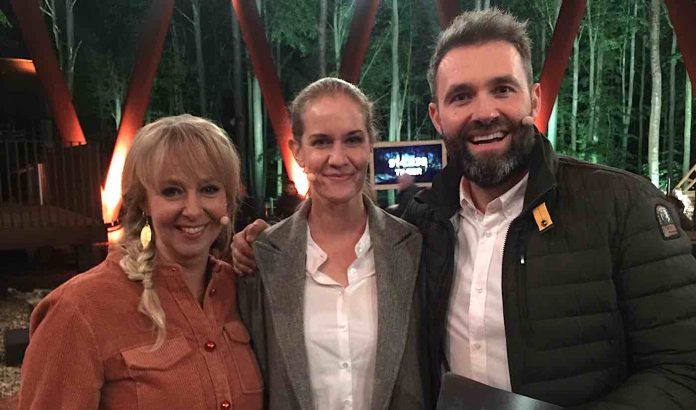
This weekend, the two-and-a-half hour live benefit event “Denmark Plants Trees” was broadcasted on the public television channel TV2. Musicians, actors, philanthropists, sports icons, and politicians all participated in the event as it was filmed from within the Gisselfeld Klosters Skove forest.
The organizers of the event planned to raise roughly 20 million Danish kroner ($2.67 million) in order to plant one million saplings, which equates to about 20 Danish kroner ($3) per tree. Though the event did fall slightly short of their goal, they did raise enough money to plant 914,233 trees—and they are still accepting donations.
Furthermore, 20% of the money raised has already been set aside for preserving pre-existing Danish forests and protecting tropical rainforests abroad.
The telethon organizers at the Danish Society for Nature Conservation say that 600 hectares (1,482 acres) of national land have already been identified for future tree-planting events.
“All potential areas have been evaluated and prioritized based on suitability by forest experts from the Danish Society for Nature Conservation,” said event producer Martin Sundstrøm. “After Saturday, there will be a number of tree-planting events all over Denmark. The first events will be this autumn and then in spring 2020, a larger number of events will take place depending on how much we raise. If we raise the funds to plant one million trees, we expect around 30 events.”
Additionally, the Danish organization hopes that the event will inspire other countries and media conglomerates to host similar fundraisers for fighting the climate crisis.
Sara Lom, who is the CEO of the UK-based charity Tree Council, said she hopes to help orchestrate a telethon in her own home nation, according to The Guardian.
“To plant enough trees to help tackle climate change we will need everyone to get involved—and fast,” said Lom. “A national TV telethon—or a tree-athon if you will—would be a wonderful way of engaging people around the country to raise money to plant and care for more trees.”
Plant Some Positivity By Sharing The Good News With Your Friends On Social Media…
This fun-loving Colorado family has brought the beloved Pixar film Up to life for a youngster’s birthday—and the results are adorable.
5-year-old Elijah Perman has been obsessed with the movie since he was born—so when his mother Rachel offered to host one magical-themed photoshoot for his birthday, he knew exactly what he wanted to do.
For starters, Elijah gathered all the garb he needed to dress up as Russell, the bombastic Boy Scout character from the film. He then recruited his great-grandparents, Richard and Caroline Bain, to dress up as the iconic cinematic couple Carl and Ellie.
Despite how 90-year-old Richard and 89-year-old Caroline have never seen the film, they were more than happy to participate.
Carl went to the local thrift store so he could get his costume together for the photoshoot earlier this week. He could not technically whisk his house away with a million balloons, but he did attach a few inflatables to a toy house specifically for the shoot.
Needless to say, Elijah “loved the photos”.
The photoshoot wasn’t just to celebrate the boy’s birthday, either; Rachel says that she was inspired to take the pictures in celebration of being cancer-free.
Shortly after Elijah and his twin sister Emilee were born five years ago, Rachel was diagnosed with cancer—and she was horrified to think that she may not be alive to celebrate their birthdays in the future.
“I had fears if I would even get to see their fifth birthday,” Rachel told CNN. “My oldest [child] was 5 at the time and I hated not knowing if I would get the same time with them that I got with her.”
Thankfully, since the 32-year-old photographer is now cancer-free, she can celebrate her health and her children’s birthdays by capturing the spirit of what they love most.
While Elijah may have opted for an Up-themed photoshoot, his twin sister chose to stand next to a unicorn instead—although it seems that her magical steed was equally as convincing as Elijah and his great-grandparents in costume.
If you want to check out more of Rachel’s photography, you can visit her website or Facebook page to learn more.
Be Sure And Share This Sweet Story With Your Friends On Social Media…
Quote of the Day: “Let yourself be silently drawn by the strange pull of what you really love. It will not lead you astray.” ― Rumi
Photo: by Uppy Chatterjee, CC license
With a new inspirational quote every day, atop the perfect photo—collected and archived on our Quotes page—why not bookmark GNN.org for a daily uplift?
Hear an amusing tale of scientific determination in this week’s edition of MOTH Monday, a partnership with Good News Network that features inspiring videos from The MOTH, a nonprofit group showcasing the art of storytelling.
Back when Deirdre Bowen was in middle school, her father always pressured her to pursue “hard science” in order to win the science fair.
Rather than continuing his suggested research on monkey skulls, however, Deirdre defied her father’s wishes by opting for “soft science” projects on dreams and education.
He later told Deirdre that she was the only one of her siblings who had been brave enough to go against his coaching methods—but it turned out to be a good thing that she did.
(LISTEN to the amusing story below)
The Moth gives people an opportunity to tell a true story in front of a live audience, and sometimes their stories are chosen to air on the radio show, now celebrating its tenth year, and broadcasting on 485+ public radio stations—and on The Moth podcast, which is downloaded over 52 million times a year. The Moth’s third book, Occasional Magic: True Stories About Defying the Impossible is now available for purchase through your favorite booksellers.
Be Sure And Share The Live Story With Your Friends On Social Media…
One of the world’s largest trials ever undertaken in the realm of mental health is now underway in the classrooms of hundreds of schools in England—and GNN has learned new details about the curriculum, as outcomes are being evaluated for the first round of data.
Thousands of children and teens are being taught wellness techniques aimed at providing the students with better coping skills and self-awareness of their mental health. The London-based researchers expect their study to show how investing in training and setting aside class time devoted to relaxation, mindfulness, and mental health will pay off for our youth—with less depression and anxiety, and fewer suicidal thoughts.
Organized by the Anna Freud National Centre for Children and Families, this long-range study began in January 2019 and has enrolled 370 schools. In partnership with University College London and funded by the UK’s Department for Education, these interventions have been shown in smaller studies to be promising for students in other countries. This much-larger study is expected to make clear that a small investment of time can put young people in the driver’s seat of their own inner lives with knowledge and skills they can practice on their own.
“Schools and teachers don’t have all the answers, nor could they, but we know they can play a special role, which is why we have launched one of the biggest mental health trials in schools,” UK Education Secretary Damian Hinds said in a statement. “These trials are key to improving our understanding of how practical, simple advice can help young people cope with the pressures they face.”
The randomized control trials were set up to evaluate two major age groups: one for 9th graders, and another one for students in grades 4, 5, 7, and 8. The schools then were assigned to different groups, with each linked to a specific age-appropriate wellness curriculum, or no curriculum at all—so that effective comparisons could be made.
At least 8,600 ninth-graders participated in the trial. Ninety high schools set aside 45-60 minutes in a class once per week for 6 consecutive weeks, so that a specially-trained instructor could present a lesson from a mental health curriculum.
Dr. Daniel Hayes, the Trials Manager for the Education for Wellbeing project, told GNN that one group of teens was assigned to The Mental Health and High Schools Curriculum Guide, developed in Canada by Dr. Stan Kutcher. It was originally a web-based curriculum, but was adapted for the UK study to include more resources from England and less emphasis on PowerPoint presentations in favor of interactive discussions. The lessons contained units on bipolar disorder, panic disorder, schizophrenia, eating disorders, depression, OCD, ADHD, stress, support, and where to get help.
Another high school group participated in the Youth Aware of Mental Health (YAM) curriculum. The primary focus here is reducing symptoms of depression. Statistics show that seeking help at 14 years old can result in a sevenfold decrease in depressive symptoms at 17. In a different randomized controlled trial in Europe using the YAM, the data showed reduced suicidal ideation or attempts at the 12-month follow up.
In the primary and middle school groups, most of the children are involved more experientially, with 5-minute coaching sessions in mindfulness, progressive muscle relaxation, and deep breathing. School staff members complete a half-day face-to-face training course and are provided with manuals appropriate to the grade level, containing many activities, apps, and online games.
Photo by unsplash, CC license
The Mindfulness intervention was developed for the trial based on the concept as defined by Jon Kabat-Zinn: “paying attention in a particular way: on purpose, in the present moment, and non-judgmentally”. It consists of mindful breathing exercises and other activities focused on self-awareness of sensations, emotions and thoughts, with exercises divided into three types: (1) those focusing on the mind; (2) those focusing on the body; (3) those focusing on the world around us.
Another group was paired with a curriculum designed to bring awareness to aspects of mental health in 8 consecutive weekly lessons:
It’s safe to talk about mental health
We all have mental health
What is safety?
Early warning signs – noticing our bodies
Early warning signs – noticing our feelings and thoughts
Developing our safety networks
Safe friendships
Safe ways of managing emotions.
The curriculum for the younger kids was created by Dr. Bajaj, the lead developer at the Anna Freud Centre’s schools program, who consulted with experts in Protective Behaviors interventions for the Safety and Wellbeing lessons.
Opt-outs were offered to parents who didn’t want their child’s data collected for the study, but the pupils could still take part in the interventions, even if they or their parents chose not to take part in the evaluation. And after the study is complete, the faculty at the inactive “control” group schools will be offered the opportunity to receive specialized training, so that no one is left behind without something to share with students.
The researchers are evaluating the student outcomes now, 3-6 months after the intervention commenced—and they will look at the long-range effects of each intervention by surveying students again after a year, with the final data being released in 2021.
Outcomes measured will include changes to: positive well-being, behavioral difficulties, support from school staff, stigma-related knowledge, attitudes, behaviors, and mental health first aid. An economic evaluation will also assess the cost-effectiveness of the interventions.
As the data from the first wave of the trial is collected and processed, researchers will determine the impact of the interventions on mental health and wellbeing, and whether this is money well spent.
– Co-written by Jennifer Zolper with GNN; Photo by Dystopos, CC license
This obituary for a Philadelphia street pole has struck an odd emotional chord with social media users around the world—and it’s strangely heartwarming.
Since the city’s power company is updating its technology, the ancient, staple-riddled post on the corner of 3rd and Federal is due to be replaced with a newer wooden pole in order to support the new infrastructure by the end of the month.
After the pole was marked for retirement earlier this week, local journalist Brad Pearson noticed a new sign appear on the post during one of his daily walks through the square.
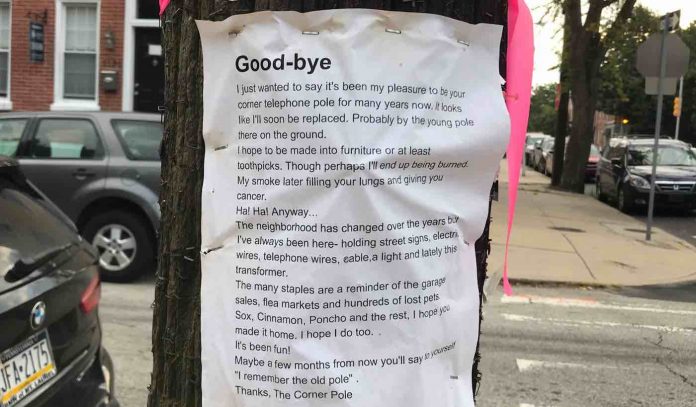
The 150-word goodbye note was written from the perspective of the telephone pole bidding adieu to all of the local residents.
“I just wanted to say it’s been my pleasure to be your corner telephone pole for many years now. It looks like I’ll soon be replaced. Probably by the young pole there on the ground,” said the note. “The neighborhood has changed over the years but I’ve always been here—holding street signs, electric wires, telephone wires, cable, a light, and lately this transformer.
“The many staples are a reminder of the garage sales, flea markets, and hundreds of lost pets,” it continued. “Sox, Cinnamon, Poncho and the rest, I hope you made it home. I hope I do too.
“It’s been fun! Maybe a few months from now you’ll say to yourself ‘I remember the old pole.’ Thanks, The Corner Pole.”
Pearson was so impressed by the sign’s personal message, he posted a photo of the obituary to Twitter where it has since been shared thousands of times.
Some users have expressed their skepticism and dismay over an inanimate object evoking such powerfully complex emotional reactions; others have simply been touched by an inanimate object taking on such an intimate role in a community.
Regardless, thousands of viewers have agreed that the anonymously-written sign is a sweet reminder of how we can appreciate the little details of our neighborhoods.
The power company has confirmed that it will be repurposing the wooden pole through their recycling program, so concerned readers need not be afraid of the pole being turned into smoke.
Now after 12 years of standing tall in the community, local residents are paying homage to the pole before it is retired from its long career of being an upstanding citizen.
Scientists have determined a new way to protect the hair follicle from chemotherapy in an effort to prevent hair loss as a result of cancer treatments.
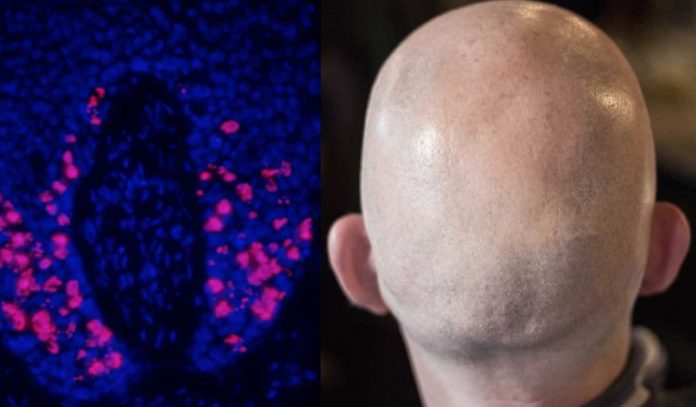
Researchers based at The University of Manchester have discovered a new strategy for how to protect hair follicles from chemotherapy, which could lead to new treatments that prevent chemotherapy-induced hair loss—arguably one of the most psychologically distressing side effects of modern cancer therapy.
Published in the journal, EMBO Molecular Medicine, the study from the laboratory of Professor Ralf Paus of the Centre for Dermatology Research describes how damage in the hair follicle caused by taxanes, cancer drugs which can cause permanent hair loss, can be prevented.
To do this, scientists have exploited the properties of a newer class of drugs called CDK4/6 inhibitors, which blocks cell division and are already medically approved as so-called “targeted” cancer therapies.
Dr Talveen Purba, lead author on the study explains: “Although at first this seems counter-intuitive, we found that CDK4/6 inhibitors can be used temporarily to halt cell division without promoting additional toxic effects in the hair follicle. When we bathed organ-cultured human scalp hair follicles in CDK4/6 inhibitors, the hair follicles were much less susceptible to the damaging effects of taxanes.”
Taxanes are very important anti-cancer drugs commonly used to treat, for example, patients with breast or lung carcinoma and particularly cause anxieties among breast cancer patients for the very distressing and sometimes long-lasting hair loss taxanes can induce. Thousands of patients in the US are currently suing pharmaceutical company Sanofi over a lack of warning of the risk of permanent hair loss after treatment with the taxane drug Taxotere.
Dr Purba emphasizes: “A pivotal part of our study was to first get to grips with how exactly hair follicles responded to taxane chemotherapy, and we found that the specialized dividing cells at the base of the hair follicle that are critical for producing hair itself, and the stem cells from which they arise, are most vulnerable to taxanes. Therefore, we must protect these cells most from undesired chemotherapy effects—but so that the cancer does not profit from it.”
The team hopes that their work will support the development of externally applicable medicines that will slow or briefly suspend cell division in the scalp hair follicles of patients undergoing chemotherapy to mitigate against chemotherapy-induced hair damage. This could complement and enhance the efficacy of existing preventive approaches i.e. scalp-cooling devices.
The researchers underscore that more work is desperately needed in this lamentably under-funded field of cancer medicine, where patients have waited for so long to see real breakthroughs in pharmacological hair loss prevention.
“Despite the fact that taxanes have been used in the clinic for decades, and have long been known to cause hair loss, we’re only now scratching the surface of how they damage the human hair follicle,” said Purba.
“We also don’t really know why some patients show greater hair loss than others even though they get the same drug and drug-dose, and why it is that certain chemotherapy regimens and drug combinations have much worse outcomes than others.
“We need time to further develop approaches like this to not only prevent hair loss, but promote hair follicle regeneration in patients who have already lost their hair due to chemotherapy.”
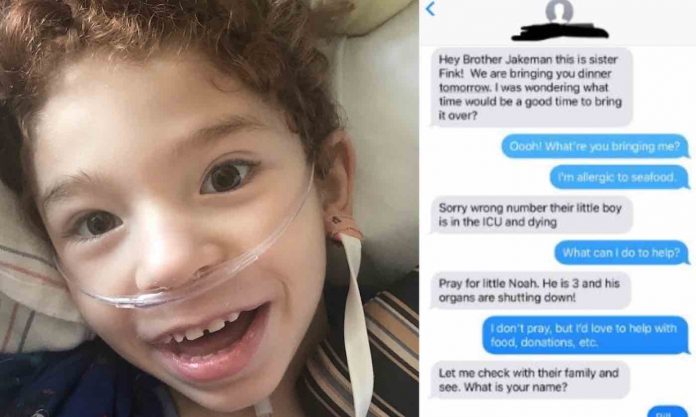
An accidental text to a wrong phone number has sparked an unexpected wave of kindness towards a family in need.
Abby Fink had been trying to get in contact with her friend from church named Alex Jakeman so she could bring some dinner over to his house.
Jakeman and his family have been having a rough time since their 4-year-old son Noah recently suffered a massive seizure which landed him in the ICU at Phoenix Children’s Hospital.
Jakeman’s family told CNN that in addition to the non-verbal youngster having Lennox Gasteau Syndrome, which is a severe form of epilepsy and cerebral palsy, he also has brittle bones, abnormal brain development, impaired motor functions, and autism.
So when Fink sent her text message intended for the Jakeman family, it did not take her long to realize that she had sent it to the wrong number.
“Hey Brother Jakeman, this is Sister Fink, we are bringing you dinner tomorrow, I was wondering what time would be a good time to bring it over,” said Fink in her text message. She then received a joking response from a man named Bill, saying: “Oh what are you bringing me? I don’t like seafood.”
Fink then noticed that she had sent the message to a phone number that was one digit off from Jakeman’s. She quickly apologized and explained how she had meant to send the message to a grieving family.
On the other end of the conversation, Bill realized the seriousness of Fink’s inquiry. Upon learning about the Jakemans and their son, he offered to start his own social media fundraiser in order to gather gifts, donations, and contributions from his friends list.
Since Noah was recently released from the ICU, Bill plans on stopping by the hospital so he can present the cards, gifts, and donations to the Jakeman family.
“It’s amazing. He is a total stranger and he just wanted to jump into action,” Fink told CNN. “I told him he was an angel sent to help this sweet family.”
If you want to donate to the Jakeman family, you can also contribute to their GoFundMe campaign, which has almost reached its goal of $12,000.
(WATCH the news coverage below)
Multiply The Good By Sharing The Good News To Social Media…
Quote of the Day: “Life is like a landscape. You live in the midst of it but can only describe it from the vantage point of distance.” – Charles Lindbergh
Photo: by GWC, Copyright 2019
With a new inspirational quote every day, atop the perfect photo—collected and archived on our Quotes page—why not bookmark GNN.org for a daily uplift?
There are an estimated 785,000 new heart attack cases in the United States each year, with no established treatment for repairing the resulting damage to cardiac tissue.
For the first time ever, researchers have successfully conducted an FDA-approved Phase 1 human clinical trial of an injectable hydrogel that aims to repair the damage and restore cardiac function in heart failure patients who previously suffered a heart attack.
The trial, which was conducted by the University of California San Diego spin-off company Ventrix, was the first test of a hydrogel designed to repair cardiac tissue. It was also the first to test a hydrogel made from the natural scaffolding of cardiac muscle tissue, also known as extracellular matrix, or ECM.
This is significant because ECM hydrogels have been shown in preclinical studies to potentially be effective for other conditions, such as poor blood circulation due to peripheral artery disease. The trial showed that the hydrogel, known as VentriGel, can be safely injected via catheter into patients who had suffered a heart attack in the past 2 to 36 months.
“Although the study was designed to evaluate safety and feasibility and not designed to show whether VentriGel effectively helps improve heart function, we observed some improvements in patients,” said Karen Christman, the paper’s senior author and a professor of bioengineering in the Jacobs School of Engineering and the Institute of Engineering in Medicine at UC San Diego. “For example, patients could walk longer distances. We also observed signs of improving heart function in patients who experienced a heart attack more than one year prior to treatment.”
Researchers from Ventrix, led by Christman, reported their findings this week in the Journal of the American College of Cardiology: Basic to Translational Science.
After a heart attack, scar tissue develops, which diminishes muscle function and leads to heart failure. This is where VentriGel comes in. Once injected in damaged cardiac muscle, VentriGel forms a scaffold that acts as a reparative environment where healthy cells migrate, leading to increases in cardiac muscle, less scar tissue, and improvements in heart function.
Additionally, VentriGel can be easily injected into heart muscle using a minimally invasive procedure that does not require surgery.
The Phase 1 trial evaluated the gel in 15 patients who sustained moderate damage in the left ventricle chamber of the heart following a heart attack. Each patient received up to 18 injections of VentriGel into the damaged region via catheter. Researchers followed the patients for six months after treatment. All patients completed the full follow-up.
Photo by UCSD
Twelve of the 15 patients were men. All 15 were experiencing mild to moderate heart failure following a heart attack. Half had suffered a heart attack within the past year.
Patients took a six-minute walking test as well as a heart function assessment and a heart health questionnaire before the injections. They retook the tests three and six months later. In addition, patients underwent an MRI at three and six months after the procedures.
Ventrix is now gearing up for a Phase 2 clinical trial that will expand on this successful first-in-human study. They are planning a larger, randomized trial that will evaluate how effectively VentriGel can improve cardiac function and quality of life for patients experiencing heart failure.
Toy Story 4, which opened in theaters this June, became the biggest box office animated film blockbuster yet—and it’s no wonder, with beloved toys like Mr. Potato Head playing a starring role.
Toys that engage the body, mind, and imagination, still hold the #1 place in the hearts of children, despite the pervasiveness of digital devices.
In fact, Mr. Potato Head and Play Doh are the top vintage toys that have withstood the test of time, according to new a study of 2,000 American parents.
Other toys that are still starring in American homes and continue to enchant kids after decades of familiarity include trolls, toy phones, teddy bears, and plastic dinosaurs.
Board games have proven to be timeless, as well. Whether you grew up in the ’70s, ’80s, or 90s, families can’t get enough of classic board games—particularly, Scrabble, Monopoly, Candy Land, the Game of Life, and Mouse Trap. They all ranked in the top 30 of toys that were played with by both parents and, later, their children.
Conducted by OnePoll on behalf of Mr. Potato Head, who has undergone several iterations of his own, the survey revealed that adults are still kids-at-heart who love playing with these toys.
Nearly half of parents said their favorite childhood toy is still on the market—and 84% have purchased, or plan to purchase, that toy for their own child.
When it comes to buying any toy for a child, parents are on the look out for a certain set of qualities. Three in five parents want a toy that’s educational, but just behind that is a toy’s ability to make their kid laugh (60%). Fifty-nine percent are on the hunt for a toy that’s colorful, while 56% look for something interactive.
TOP TIMELESS TOYS (ENJOYED OVER MULTIPLE GENERATIONS)
1. Play Doh
2. Mr. Potato Head
3. Trolls
4. My Little Pony
5. Furby
6. Puzzles
7. Toy phone
8. Bop It
9. Building blocks
10. Bicycle
11. Yoyo
12. Guess Who?
13. Water blasters
14. Teddy bear
15. Scrabble
16. Tricycle
17. Candy Land
18. Game Boy
19. Spinning tops
20. Toy cash register
21. Plastic animals
22. Monopoly
23. Mouse Trap
24. Game of Life
25. Transformers
26. Clue
27. Baby Alive
28. Plastic food/kitchen supplies
29. Scattergories
30. Perfection
ALSO CHECK OUT THE TOP TOYS LOVED BY ADULTS WHEN THEY WERE KIDS
1. Mr. Potato Head
2. Trolls
3. Play-Doh
4. My Little Pony
5. Toy phones
6. Furby
7. Puzzles
8. Building blocks
9. Yoyo
10. Bicycles
11. Bop It
12. Teddy bears
13. Baby dolls
14. Spinning tops
15. Candy Land
16. Guess Who?
17. Tricycle
18. Scrabble
19. Plastic animals
20. Toy cash register
21. Yahtzee!
22. Monopoly
23. Rubber duck
24. Clue
25. Mouse Trap
26. Game of Life
27. Plastic food/kitchen supplies
28. Perfection
29. Scattergories
30. Hungry, Hungry Hippos
31. Scooter
32. Bead maze
33. Sorry!
34. Operation
35. GI Joe
36. Super Soakers
37. Chutes + Ladders
38. Taboo
39. Trouble
The GNN staff loved the surprise of seeing Mousetrap and other favorites making the list of toys that are not in the attic. Tell us which ones have been passed down or repurchased in your family?
Street lights may be helpful for motorists, but they can be particularly worrisome for bats. Caring about their health, one English county has come up with an ingenious solution.
The county of Worcestershire is preparing to switch on an array of bat-friendly street lights—and they are the first of their kind in the UK.
Research shows that certain species of bat are light-shy and will not cross roads that are lit by white lights, which can stop them accessing food supplies and water. Bright street lights also attract the flies and insects the bats feed on, and so reduce the food available for bats and other mammals in their typical feeding areas.
These LED lights, on the other hand, are red in color and use a unique “recipe” of light which does not affect bats and their flying and feeding habits.
Similar lighting schemes in the Netherlands have proved successful, helping to preserve bat species and other nocturnal wildlife.
The new Worcestershire lights are spread across a 60-meter swath of highway near the Warndon Wood nature reserve.
Councillor Ken Pollock, Worcestershire County Council’s Cabinet Member with Responsibility for Economy and Infrastructure said: “These ground-breaking lights are a great example where we have been able to adapt the usual standards to better suit the local environment.”
“The adapted lighting being used may look a little different at first, but we’d like to assure those using the area at night that the color of the lights has been through stringent testing and adheres to all safety checks.”
Visibility for drivers and pedestrians is not affected by the red light and is fully compliant with the required standards. The light “recipe” not only meets the needs of road users and residents, but, like an immune booster, supports the daily nutrition requirements of their winged wildlife neighbors.
You’ve heard of New Yorkers taking their pets for walks in baby strollers? This gnarly pup is touring the town balanced upon his own set of wheels.
A man was spotted striding down the city streets with a dog on a leash—nothing new there, except the dog was calmly gliding alongside him on a skateboard.
If that isn’t enough, the dog was wearing a cool hat, too.
(WATCH the video below for a quick Sunday funny…)
Be Sure And Share The Pawesome Clip With Your Friends On Social Media…