










Montreal’s most historic hospital, closed since 2015, has been transformed into a temporary homeless shelter to ensure that no man (nor beast) will be forced to sleep in the winter cold.
Patient rooms in the former Royal Victoria Hospital have been converted into an 80-bed homeless shelter that is now open to women and men—and their pets.
The temporary refuge was launched last week after city homeless shelters found themselves filled to capacity and struggling to accommodate rough sleepers amidst falling temperatures.
And because the overwhelming majority of shelters do not allow pets, officials worked to create a situation where people and their animals would be welcomed.
Though the hospital will ensure warmth and safety for Montreal’s homeless until April 15th, provincial legislators will be working with city officials to secure more long-term solutions and permanent housing for when the shelter closes in the spring.
“We’ve been able to move forward quickly on creating this emergency unit for homeless people,” said Montreal Mayor Valérie Plante, according to CBC. “Of course, this is for this winter, but what is a positive sign is knowing that our administration wants to find a solution on the long-term.”
“No one should be outside right now. Everyone deserves a roof,” she added.
Sam Watts, CEO of the city homeless shelter Welcome Hall Mission, said: “We’re making some good progress toward eliminating homelessness in Montreal. But the reality is, right now, we do need a temporary facility over the course of the winter because we don’t want to leave anybody on the streets.”
Share The Good News With Your Friends On Social Media – Photo by Jeangagnon, CC
Antarctica is a frozen, wind-whipped continent, hostile to almost all forms of life—except, apparently, a lone man from Oregon.
33-year-old Colin O’Brady just became the first unaided person to complete a solo trek across Antarctica.
Extreme hikers have managed to cross the continent before, but they have always completed the feat with the assistance of dog teams or kites (to help propel them forward), and air-dropped supplies.
O’Brady, however, traveled the 930-mile journey in 54 days, lugging his entire load of gear— 375-pounds—personally.
Though the adventurer could have been airlifted back to warmth immediately upon completion on December 26, O’Brady waited at the finish line for a special reunion.
In 2016, British explorer Henry Worsley died while attempting the same extreme journey. The late hiker was honor by O’Brady’s friend Louis Rudd, an Englishman who decided to complete the same trek in a race against O’Brady.
While O’Brady finished the hike before Rudd, the American decided to stay in Antarctica to celebrate with his friend—despite fantasizing for two months about eating fresh food and salads while subsisting on freeze-dried food.
Together, Colin could share a beautiful moment with Louis as the only other person alive who has completed the same trip.
(WATCH the news coverage below) – Photo by Colin O’Brady
Hike This Story Over To Your Friends By Sharing It To Social Media
Solar farms are not just addressing the need for renewable energy, they are also becoming a source for food and habitat for dwindling pollinator populations.
According to research from the National Renewable Energy Lab, America is expected to add more than 6 million acres of solar farms and facilities by 2050. In addition to hosting solar panels, however, more and more environmentalists are taking advantage of this energy farmland by planting wildflowers that are critical to the survival of honeybees and butterflies.
Back in August, a research team from the U.S. Department of Energy’s Argonne lab began examining the potential benefits of establishing pollinator habitat at large utility-scale solar energy facilities to help conserve the threatened insects. Looking at some 2,800 of these existing and planned facilities in the contiguous United States, the team found that the area around solar panels could provide an ideal location for the plants that attract pollinators.
Often filled with gravel or turf grass, this land otherwise goes unused. Research has shown that in some locations these grounds offer a perfect place to establish native plant species, such as prairie grass or wildflowers, around which pollinators are prevalent.
Researchers also discovered that planting pollinator habitat on solar farms that are situated near agricultural farmland could dramatically improve crop yields, generating as much as $4 billion in agricultural revenue.
This 2016 UK study supported the findings, saying that “solar farms have a positive impact on biodiversity for a range of plant and animal species when combined with an appropriate land management plan, in particular, broad-leaf plants, grasses, butterflies, bumblebees, and birds.”
One solar company based out of Minnesota has already planted hundreds of acres of pollinator-friendly greenery across their different locations.
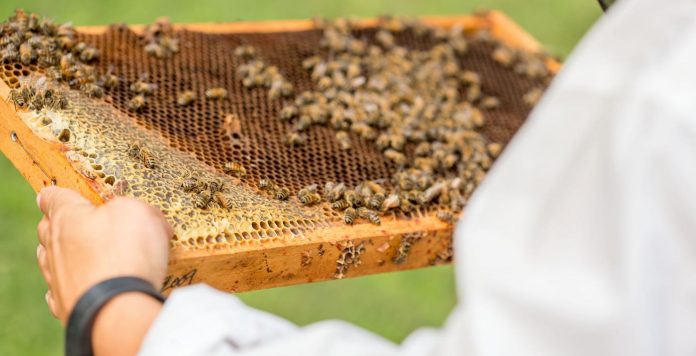
In addition to similar plantings, this solar farm in Oregon has also used their land to host 48 bee hives.
Ecologists from Cornell University are currently conducting research on which combinations of wildflowers and grasses provide the most support for pollinators – but until then, scientists are hopeful that the solar farm strategy could be sweet lifesaver for honeybees.
Be Sure And Share The Buzz With Your Friends On Social Media – Photo by Micha Jost, CC
Quote of the Day: “Hope is leaving room for magic bigger than you.” – Kerry Washington (on Stephen Colbert show, Nov. 2018)
Photo: by Renate Dodell, CC license
With a new inspirational quote every day, atop the perfect photo—collected and archived on our Quotes page—why not bookmark GNN.org for a daily uplift?
From our 50th episode on the radio in Los Angeles…
A man stuck in long airport security lines thought no one cared that he would miss his grandson’s funeral—but employees at this airline delivered the most incredible customer service.
This centenarian had the sweetest reaction to a chivalrous Mountie stepping forward to grant her birthday wish.
As a means of celebrating Elsie Shepherd’s 100th birthday earlier this week, her nursing home in Regina hosted a party at the facility.
In addition to inviting her family members, Shepherd mentioned how she hoped there would be police officers at the celebration – so the nursing home staffers called the RCMP Depot Division and asked if any Mounties could go to the party.
“She was ear-to-ear smiles,” Chernoff told CTV News. “I was able to take her out to the dance floor and we had a conversation there and you could see the smile on her face, she just couldn’t stop.”
Since the RCMP uploaded the video to their Facebook page, it has been viewed thousands of times – and it’s easy to see why.
(WATCH the sweet video below) – Photo by RCMP Depot Division
Be Sure And Share This Heartwarming Clip With Your Friends On Social Media
Tiger populations are rebounding around the world, but conservationists are rejoicing over the big cat’s speedy recovery in Nepal.
In honor of National Conservation Day back in September, Nepal announced that there are now an estimated 235 wild tigers in the country, which nearly doubles the record-low baseline of around 121 tigers in 2009.
If these trends continue, Nepal could become the first of 14 countries to double its national tiger population since international agencies gathered together in 2010 and set the ambitious TX2 goal to double the world’s wild tiger population by 2022.
“Our commitment to the Global Tiger Recovery Program gains new ground with Nepal’s growing tiger numbers and a successful implementation of Nepal’s Tiger Conservation Action Plan,” stated Bishwa Nath Oli, Secretary of the Ministry of Forests and Environment. “Protecting tigers is a top priority of the government, and we are thankful for the able support of our partners, enforcement agencies, local communities and the international community for a common purpose.”
Nepal conducted its national tiger survey between November 2017 and April 2018 in the transboundary Terai Arc Landscape (TAL), a vast area of diverse ecosystems shared with India. Camera traps and occupancy surveys were used to estimate tiger occupancy and abundance, while line transect surveys were used to derive prey density. The last tiger survey in 2013 had estimated the tiger population at 198.
“This significant increase in Nepal’s tiger population is proof that when we work together, we can save the planet’s wildlife – even species facing extinction,” said Leonardo DiCaprio, WWF-US board member and chairman of the Leonardo DiCaprio Foundation, which has funded tiger conservation in Nepal’s Bardia National Park and elsewhere since 2010. “Nepal has been a leader in efforts to double tigers within its own borders and serves as a model for conservation for all of Asia and the world. I am proud of my foundation’s partnership with WWF to support Nepal and local communities in doubling the population of wild tigers.”
The success in Nepal has been largely attributed to the country’s political commitment and the adoption of innovative tools and approaches towards tiger conservation. Nepal was the first country to achieve global standards in managing tiger conservation areas, an accreditation scheme governed by the Conservation Assured Tiger Standards (CATS). With four more years to go, the TX2 goal of doubling tiger numbers globally can only be achieved if all the tiger range countries step up and commit to a similar level of excellence.
Additionally, in May 2018, Nepal celebrated a new benchmark with the achievement of 365 days of zero poaching of rhinos on five occasions between 2011 and 2018.
“Every tiger counts, for Nepal and for the world,” stated Dr. Ghana S Gurung, Country Representative, WWF-Nepal. “While Nepal is but a few tigers away from our goal to double tiger numbers by 2022, it also underscores the continued need to ensure protection, and improved and contiguous habitats for the long-term survival of the species.”
Preserve Positivity By Sharing The Good News With Your Friends On Social Media – Photo by WWF
As a means of putting their plastic to good use, this university is offering bubble wrap to their students to help them de-stress.
The ‘stress-relief packs’ are being handed out at Bristol University to help undergraduates fight exam nerves. The packets of bubble wrap come with instructions: “For immediate stress relief, pop three capsules every 4-6 hours, or as needed.”
Ironically, some students apparently became more stressed by the bubble wrap therapy’s potential to cause plastic waste.
The Bristol University Student Union soothed their anxieties by issuing a reassuring statement via the school’s paper Epigram saying that the bubble wrap was originally used to package new furniture for the Student Union living room.
“We are aware that a number of students have raise concerns about the environmental impact of the bubble wrap,” said a Bristol SU spokesperson. “Sustainability is important to us which is why the bubble wrap being offered is being reused – it was originally the packaging that various living room items arrived in.”
Though it’s unclear how effective the bubble wrap therapy is proving to be for the students, past research has shown that “mindless” fidgeting activities can help people be more productive.
So next time you have an abundance of bubble wrap in your home, don’t feel too guilty about popping a few “capsules” for immediate stress relief.
Pep Up With Some Positivity: Share The Fun Story With Your Friends On Social Media
Though gambling is generally at odds with religion, this 67-year-old Buddhist is making up for his love of poker by donating all of his winnings to charity.
Scott Wellenbach recently came in third place at the PokerStars Caribbean Adventure tournament in the Bahamas, earning him a whopping $671,240 in winnings.
Instead of keeping the cash, however, the Canadian man will be donating it all to charities such as Oxfam and Doctors Without Borders.
Wellenbach first fell in love with poker when he won a free trip to Las Vegas in 2010. Prior to the tournament, the most he had ever won from a game was roughly $72,000; then, he landed a seat at the Bahamian tournament table after winning an online championship.
Wellenbach says that his disciplinary practices often vary depending on the week, but he generally meditates for one hour every day – and he meditates for much longer when he is competing in a tournament.
He also admits that gambling is contradictory to Buddhism, he believes that the game offers some key insights on the religious teachings.
“Poker gives you a tremendous opportunity to work with the heavens and hells of your mind,” says Wellenbach. “You’re winning and losing every minute-and-a-half, and so some sense of how your hopes and fears go up and down with the passing circumstance of the world is brought to fore at the poker table.”
(WATCH the interview below)
How can you not love this guy? Scott Wellenbach explains why he will be giving all of his winnings away. Watch that and then check our live #PCA updates as Wellenbach continues to compete for $1.5 million.
A clever 9-year-old boy has transformed the life of a kitten after he noticed that it was unable to play to play with its siblings.
João, who is from Paraná, Brazil, first met the little feline during a recent visit to his neighbor’s house.
The neighbors were caring for a litter of kittens that had been born only weeks earlier – and while they were all cute as could be, there was one cat in particular that caught João’s eye.
“[He] saw a kitten that couldn’t walk,” João’s mother Rogéria Bello Corazza said in a Facebook post. “He was very sad to see the other kittens playing, and that she couldn’t join them.”
Unable to stop thinking about the disabled animal, João started brainstorming about how he could help her.
Finally, he decided to build her a tiny custom wheelchair using materials he borrowed from a friend. Within minutes of getting her set up with the new set of wheels, she was off and rolling.
Earlier this week, Corrazza posted a heart-melting video of the kitten trying out her wheelchair for the first time, and it has already been shared thousands of times on Facebook.
“I’m very proud of my children, but today was far beyond,” said Corrazza. “His joy of being able to help was the best part.”
(WATCH the video below) – Photo by Rogéria Bello Corazza
Be Sure And Share This Pawesome Story With Your Friends On Social Media
Quote of the Day: “For every minute you are angry you lose sixty seconds of happiness.” – Ralph Waldo Emerson
Photo: by Pedro Ribeiro Simões, CC license
With a new inspirational quote every day, atop the perfect photo—collected and archived on our Quotes page—why not bookmark GNN.org for a daily uplift?
Due to an extremely rare medical condition, this teenager is constantly in danger of being rushed to the hospital simply from being exposed to a strong smell – but now, a canine companion has given her an entirely new leash on life.
15-year-old Martina Baker sufferers from a condition called Mast Cell Activation Syndrome (MCAS). It makes her allergic to “almost everything” including heat, water, cleaning products, perfumes and cologne. Even a whiff of cooking oils or bleach could send Martina into anaphylactic shock, and if she doesn’t receive treatment quickly, she could die.
Now, after raising $10,000 USD, Martina has been partnered with a highly-trained pup named Caiomhe (pronounced Queeva) who alerts her to possible dangers before they occur.
Thanks to Caiomhe, Martina has been able to revisit dozens of normal life activities, such as being able to enjoy a movie theater screening for the first time in years.
“Caiomhe has changed my life,” said Martina. “I feel so much safer with her around, I am able to have a social life again.
“I lost a lot of friends after I developed MCAS. It’s hard for people to handle, for them to watch me collapse and have to take my EpiPen and be rushed to hospital all the time,” added the teen from Wiscasset.
SWNS
Up until two and a half years ago, Martina was a completely healthy teenager – but then, she suddenly became plagued with terrifying symptoms.
“I wasn’t allergic to anything before, then one day I woke up with hives all over my body,” says the teen. “I had to go to the hospital because I had an anaphylactic reaction. My throat started swelling up with hives. They treated me with an EpiPen.”
Martina’s 48-year-old mother Loretta Morse Leighton said: “The hives would flare up all the time, she’d go into anaphylactic shock and we’d to have to rush her to the ER about three times a week. We never knew what was triggering it really.”
For months, doctors were baffled by Martina’s condition. Because of the reactions, Martina was forced to miss school and stay at home in a sealed room in order to avoid anaphylactic shocks.
SWNS
“We took her to see a specialist in every major discipline, everything from cardiologists to psychologists,” said Loretta, who eventually took Martina to an immunologist in Massachusetts who correctly diagnosed her with MCAS.
After Martina finally received a diagnosis, Leighton realized that a service dog might help her daughter.
Caiomhe was trained by Jamie Robinson, a specialist in Tucson, Arizona – one of the only people in the world to train dogs to assist MCAS patients.
“A dog’s nose is about 100,000 times better than a human nose and just about every biochemical process in our bodies is indicated with a change in scent,” said Robinson, who runs her own service dog business called Access to Service Corp.
SWNS
Robinson had Martina send her pieces of clothing she had worn so Caiomhe could get used to her scent and the specific smell of the teenager’s anaphylaxis. The pup was then trained to identify a long list of smells that are life-threatening triggers for Martina.
Because 3-year-old Caiomhe can smell the release of histamine from Martina’s body, the pup can now detect when her owner is having a reaction before anyone even realizes it. Thanks to Caiomhe and regular mast cell stabilizing drugs, Martina’s anaphylactic episodes have reduced from three times a week to once every four to six weeks.
Martina often wears a mask when she goes outside and the family still has to be very careful in their home. Loretta cleans with vinegar instead of cleaning products and has stopped using all detergents on sheets and clothing. They must practice “odorless cooking” and spend a lot of time grilling outside, even in winter.
Martina is also extremely sensitive to warmth, so her bedroom isn’t heated at all, even during the freezing Maine winters.
SWNS
“I don’t know how she tolerates the cold, she lives like a penguin in there,” laughed Loretta.
But despite these difficulties, Martina’s livelihood has been totally transformed.
“I feel that Caiomhe was destined to be my daughter’s guardian angel,” says Leighton. “In the pictures of Martina now with Caiomhe, I see joy, light and life. A spark that has been missing and robbed from her since this awful disease has taken ahold of her. Caiomhe brought that back to her in a new, wonderful and amazing way.”
Be Sure And Share This Pawesome Story With Your Friends On Social Media
Despite how many hangovers they have helped to inflict on college students, this beer company is ensuring that young grads can finish their academic career without the burden of student debt.
The Natural Light beer brand from Anheuser-Busch recently announced that they would be giving away $10 million over the course of the next ten years to eliminate student debt in America.
The initiative is part of the company’s College Debt Relief Program which they launched last year as part of a part of their commitment “to helping graduates remember college for the good times, not the burden of debt that follows.”
In 2018, the company divvied up $1 million between 25 college students who applied for the donations by submitting videos about why they decided to go to college. This year, they will kick off the initiative by dividing another $1 million between 70 students who submit similar videos about their college inspiration.
“Last year, the College Debt Relief Program had a major impact on the Natty community, both financially and emotionally. But, student debt in America continues to rise, so we’re coming back with an even stronger commitment that will make an impact well beyond 2019,” said Daniel Blake, Senior Director of Value Brands, Anheuser-Busch. “We’re making a pledge to give back $10,000,000 over the next decade to help out even more deserving individuals and shine a brighter light on the issue of college debt.”
Additionally, Natural Light will be advertising for the program by airing a 60-second Super Bowl ad in five American cities with the highest rates of student loan debt.
If you would like to apply for a portion of the donation, you can submit a video of your own to the Natural Light website.
(WATCH the video below)
We’ll Cheers To That! Share The Good News With Your Friends On Social Media
Lin-Manuel Miranda is known for being on the Broadway stage, but people are now hailing his recent role in rescuing a struggling bookstore from rising rent prices.
The “Hamilton” star is now one of the four new owners of The Drama Book Shop – a beloved landmark of the New York City theater scene.
Over the course of the last century, the store has peddled hundreds of thousands of scripts, sheet music, plays, and other theater-related goods. It was even given an honorary Tony award for its services to the stage in 2011.
Due to expensive rent rates, however, The Drama Book Shop was preparing to close its doors – until the masterminds behind “Hamilton” rushed in to help.
Miranda has bought out the bookstore alongside the play’s producer, Jeffrey Seller, the play’s director, Thomas Kail, and the president of the Nederland Organization for live entertainment.
The Drama Book Shop will be closing its doors at its current location later this week, but the “Hamilton” owners will be reopening the store in a cheaper part of town later this year.
The owner of the store, Rozanne Seelen, says that she had been resigned to the store’s closure before Manuel and his colleagues saved the day.
“It’s the chronic problem — the rents were just too high, and I’m 84 years old — I just didn’t have the drive to find a new space and make another move,” Seelen told the New York Times. “Lin-Manuel and Tommy are my white knights.”
It can take a lot of courage to admit when you’re not good at something and ask for help – especially for parents.
That’s why social media users flocked to help a “clueless white momma” who posted a Facebook plea for advice on styling the hair of her adopted black daughter.
When Stephanie Hollifield first adopted Haley, the mother-of-five from Georgia says that she obsessively sought advice for how to care for the youngster’s hair.
Despite investing in expensive hair care products and collecting tidbits of wisdom from friends and internet resources, Hollifield was distressed when Haley’s teacher sent her a picture of Haley at school.
The 2-year-old girl was happily absorbed in a coloring book, but Hollifield couldn’t help but notice that Haley’s hair looked unkempt – and she felt that she had failed to take care of her daughter’s appearance.
“Her hair seemed perfectly conditioned and styled when I sent her off to daycare a few hours earlier, but it looked different in the picture,” Hollifield wrote on her parenting blog. “The voices of all the women who had taken their time to tell me the importance of taking care of my daughter’s hair rang in my ear.
“I felt like a failure. I was sure I was missing something simple— that I was making it more difficult than it had to be.”
Hollifield then posted the photo to Facebook and asked for help.
Discussions about race on social media can often take some unexpected turns towards negativity, but Hollifield was stunned by the resulting outpouring of support.
“The response was astounding,” says Hollifield. “Within an hour, I had gotten dozens of comments and handfuls of personal messages. Helpful, encouraging, useful advice. I immediately felt supported by my community.
“One woman, Monica, who I had never met in person, offered to come to my house and help me out. She was so kind and helpful over messenger, that I immediately took her up on her offer.”
True to her word, Monica Hunter stopped by Hollifield’s house a few days after sending the message with a basket of supplies in hand and sat down with Haley in her lap. The little girl immediately took to her new stylist and Hollifield started to understand what she had been doing wrong with her daughter’s hair.
“What I had missed in all of the previous advice I’d received was the idea that I would be able to do simple protective styles at home,” says Hollifield. “[Monica] gave me headbands, products, and combs. She wouldn’t accept my money in return. I was in awe of her grace and her kindness. She took time away from her family to help me, when she had nothing to gain.
“Haley’s hair looked adorable, and she kept looking in the mirror while touching her new puffs saying, ‘So pretty!’ She kept hugging me and then hugging her new friend, Mrs. Monica. I don’t think I had ever seen Haley smile so big.”
Hollifield posted a selfie of Hunter and her daughter to Facebook and was even more astonished by the massive social media response. Thousands of people liked, commented, and shared the photo and dozens of media outlets reached out to her about sharing her story.
Though she was initially surprised by the post’s fame, however, she soon understood why people were so taken with her story.
“In our country, where everything seems so divisive, this quiet act of kindness spoke loudly to people from all walks of life,” says Hollifield. “People are hesitant to reach out to someone who may be different. Conversations are too difficult.
“In these tricky times, it’s hard to know what to say. How to respond. People seem so easily offended, so we stop trying to understand each other. We cling to those who think like us. Those who share our beliefs. Those in our same political party. Those who look like us. In the process, we close the others out.
“The inability to share space with people when it is the slightest bit uncomfortable cements the divide. Underneath the ‘other side’ are amazing people that we are cutting ourselves off from. We have so much to offer each other.
“There is so much more that we have in common than the things that divide us. Thank you, Monica, for reminding me — and so many others — of the importance of kindness.”
Be Sure And Share This Sweet Story Of Kindness With Your Friends On Social Media – Photo by Stephanie Hollifield
Quote of the Day: “Confidence is not the idea that something WILL go right. It doesn’t matter how it goes; you know you have what it takes to respond to it.” – Brian Johnson
Photo: copyright GWC
With a new inspirational quote every day, atop the perfect photo—collected and archived on our Quotes page—why not bookmark GNN.org for a daily uplift?
A grandmother’s purchase from 7 years ago is bringing smiles to social media users after Marjorie Zarbaugh made a Facebook post about the serendipitous incident.
Zarbaugh’s mother has always dreamt of having a granddaughter; in fact, the woman from Winter Haven, Florida was so smitten with the idea, she bought a gift for her future grandchild 7 years before it was even born.
Zarbaugh’s mother had been shopping at Macy’s on September 9th, 2011 when she saw a little girl’s dress for sale on a clothing rack. She bought the dress and tucked it away into storage for the day when it would come in handy.
Then in May 2018, Zarbaugh announced that she was pregnant with an unborn daughter named Madelynn. At Zarbaugh’s gender reveal party, her doting mother finally got to give her the dress as a gift.
“She had bought this little dress years before, hoping she’d have a granddaughter one day,” Zarbaugh wrote in a Facebook post. “I thought it was cool, so I kept the tags on.”
Months later, Zarbaugh was going through her stash of baby clothes when she came across the dress her mother had bought.
Zarbaugh was about to cut the tags off of the dress when she noticed a stunning detail: her mother had bought the dress on Madelynn’s birthday seven years before she was even born.
Hula dancing might not seem like the most obvious pastime for grizzled male prisoners, but it is apparently shaping up to be an unlikely method of reform for California inmates.
The infamous San Quinten State Prison of northern California has been hosting hula classes for the male inmates twice a week – and many of them say that it has become an invaluable source of emotional relief and inspiration.
“Pre-hula, I was a really dark person,” one inmate told Circa. “But hula really spring-boarded it for me. I think, had I not found myself spiritually, I still would be searching.”
Though there are not many studies that have precisely quantified the benefits of hula dancing, experts say that the traditional art form has a tremendous impact on the physical, mental, and spiritual wellbeing of both Native Hawaiians and non-Natives. This study even says that it helps non-Hawaiian dancers to become more culturally aware and appreciative of other lifestyles.
Similarly, this West Virginia nonprofit has found transformational success in teaching yoga classes at local prisons and correctional facilities.
“The need for healing within the prison environment is profound,” the nonprofit’s co-founder told Good News Network. “They’re using these tools to get in touch with what they care about. What kind of person do they want to be while they’re in prison—and how to find that freedom on the inside while they’re incarcerated. It’s really very powerful.”
(WATCH the video below) – Photo by Patrick Makuakane
Be Sure And Share This Intriguing Story With Your Friends On Social Media
This “game-changing” new medical procedure is expected to save thousands of people with its promise to halve the amount of patients on liver transplant lists waiting for a reprieve.
The procedure, which was approved for use in the UK this week, uses a perfusion machine to keep donated livers viable for transplantation for three times longer than current methods. The machine works by reducing the rate of tissue deterioration that occurs after the liver has been removed from the donor and extends how long the liver can be stored before transplantation.
Variations of the technique can also allow the liver to be flushed with blood at body temperature and supplied with oxygen, medications, and nutrients, which allows its viability and function to be assessed.
Liver transplantation is a highly successful treatment for end-stage liver disease, which kills 11,000 people a year in England. By the end of the 2017 fiscal year in March 2018, there were 1,043 liver transplants in the UK and 359 patients on the UK active transplant list, according to NHS Blood and Transplant.
Now that the procedure has been assessed and approved by the National Institute of Health and Care Excellence (NICE), the organization issued final guidelines which recommend that the procedure be used under special arrangements as more data is gathered into its efficacy. However, NICE’s independent advisory committee did not identify any major safety concerns.
Surgeons undertaking the procedure must inform patients about the uncertainty of the procedure’s efficacy, comply with the relevant regulatory and legal requirements of the Human Tissue Authority and should enter details about all patients having this procedure into the NHSBT UK transplant registry.
“In the 30 years I’ve been involved with transplantation, there have been three or four events which have been game-changers and I’m absolutely certain we are looking at a game-changer that will change the way we practice organ storage and transplantation,” said Professor Darius Mirza, Consultant Transplant Surgeon at University Hospitals Birmingham NHS Foundation Trust.
“It is already changing practice at the centers that have been able to use this technology either within clinical trials or within an expansion of service evaluation.”
Professor Kevin Harris, program director and clinical advisor for the Interventional Procedures Programme at NICE, said: “This procedure offers hope for patients needing a liver transplant. It offers another way of preserving the liver, and assessing whether livers which might have previously been considered unsuitable, can be used safely.
“The latest evidence reviewed by a NICE committee concluded that the procedure worked well and was safe to be offered to patients who had been fully informed of the risks and benefits. Clinicians should seek approval from their trust’s management and record all data from the procedure in a database.
“By using this procedure, more patients on the organ transplant waiting list could be offered a chance of a transplant and there-by potentially extending their lives.”
45-year-old Sue Bennett, a mother-of-three from Ranton in Staffordshire, had a liver transplant using this new technique in 2015. She recalled her experience by saying: “I signed up for the trial not knowing I would be one of the first to have this procedure in the country. Before my transplant, I was very ill. I was losing weight, I couldn’t sleep and my quality of life was quite low.
“I had a transplant after the hospital found a donor who was a match. The liver was kept alive using this procedure overnight and I was able to have the operation the following day. Nine days later I was back home,” says Bennett. “My life is unbelievably wonderful. I’m very healthy, I’m very happy and very active. I think I‘ve been very lucky.”
John Forsythe, associate medical director at NHS Blood and Transplant, said: “There has been a huge amount of research in the area of preservation and perfusion methods that allow us to both assess precious donor organs and to enhance their function. This could potentially mean the organ works better and improve transplant outcomes.”
Vanessa Hebditch, director of policy at the British Liver Trust, said: “Every year hundreds of people with advanced liver disease die whilst waiting for a transplant.
“This new device offers real hope as it may improve transplant outcomes and allow livers that were previously thought to be unsuitable to be used and also increase the time that livers are able to be kept.
“It is an exciting development that has the potential to shorten waiting list times and reduce mortality rates from advanced liver disease. After transplant, the vast majority of people go on to lead full and healthy lives and it is truly amazing to see the transformation.”
Unlike most fast food chains, Chick-Fil-A is closed on Sundays for religious reasons – but one particular restaurant made a special exception to their schedule earlier this week.
A Chick-Fil-A in Mobile, Alabama opened their doors on Sunday as a means of granting the birthday wish of a 14-year-old boy with cerebral palsy and autism.
Elijah Sprague was born prematurely at 18 weeks old. His mother, Rene, worked in the NICU where Elijah was born. After 6 months of Elijah living at the hospital, Rene decided to adopt him despite doctors saying that it was unlikely for him to live longer than one year.
Needless to say, Elijah has outlived the grim prognosis and grown up to be a sweet teenager.
Today, the youngster adores Chick-Fil-A and dreams of one day working at a drive-thru window – so as a means of celebrating his birthday, his family asked the owner of the local sandwich restaurant if they could open their doors on a Sunday for Elijah’s special day.
“He was like, ‘Why are you even asking? Absolutely, we have to do it,’” Sprague told CBS News.
True to his word, the store opened on Sunday and staffers baked cookies for Elijah to give away at the drive-thru window.
More than 40 family acquaintances stopped by the window, some of them even going through the drive-thru multiple times. Afterwards, the exuberant teenager and his friends were able to eat dessert and play in the restaurant.
“This is super special to us,” Sprague said. “Elijah’s not going to graduate like our other kids. He’s not going to get married or have kids. So this is just a really cool experience to us for him to have this level of attention… it’s neat for people to recognize he’s a really cool kid.”
(WATCH the video below or our international viewers can watch it on the CBS News website) – Photo by Rene Sprague
Serve Up Some Positivity To Your Friends By Sharing This Sweet Story To Social Media