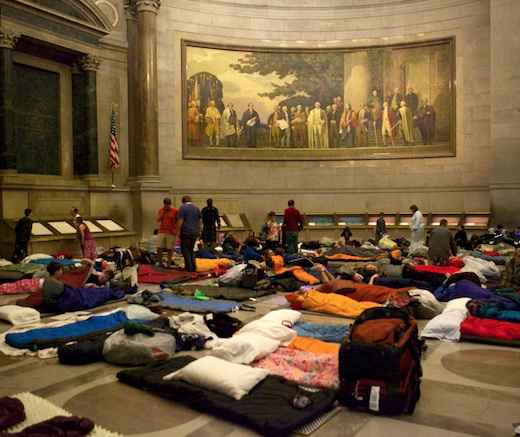
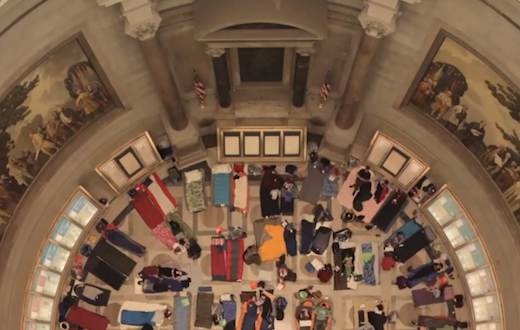
Did you know the US National Archives hosts sleepovers for children 8 to 12 years old inside the awe-inspiring rotunda where the Declaration of Independence, the U.S. Constitution, and the Bill of Rights are displayed?
The sleepovers, scheduled twice each year, allow 100 children to bring one parent and enjoy planned activities, like writing with a quill pen, before rolling out their sleeping bags to spend the night in the historic National Archives Rotunda.
“Our first-ever sleepover in January 2014 was incredibly popular, drawing families from around the country – many of whom had never visited the National Archives before,” said Archivist of the United States David S. Ferriero.
“The demand for tickets was so high and the response so positive that we decided to invite more families during summer vacation and again in the fall. This is a great way to create a meaningful experience for families, to improve civics education, and to inform the public about the role the Archives plays in preserving government records and making them accessible to the people.”
The sleepovers include numerous hands-on activities, including exploring exhibitions of the National Archives Museum. Guests also will be treated to movies in the Archives’ William G. McGowan Theater before turning in for the night, and will enjoy a breakfast of pancakes and more activities the next morning.
Photos from the National Archives
“We’re sleeping with the Declaration, the Bill of Rights and the Constitution,” said History Channel host Brad Meltzer. “Top that, Smithsonian.”
Registration for both of the ticketed sleepovers will begin later this spring. For more information, visit archivesfoundation.org/sleepover.
Watch the VERY cool video from the first sleepover…
A barbecue on the grill, watching fireworks, and waving flags–maybe a parade. Those are the traditional Independence Day activities for most Americans.
If you want to make your annual celebration a little more meaningful, and add some unique fun, remember these few patriotic rituals that can bring to life the history of the day.
My family loves to celebrate our country’s birthday and has followed these traditions every year for a decade now. Check them out and let us know about your own traditions, posting them in a comment below.
Sign Your Own Declaration of Independence
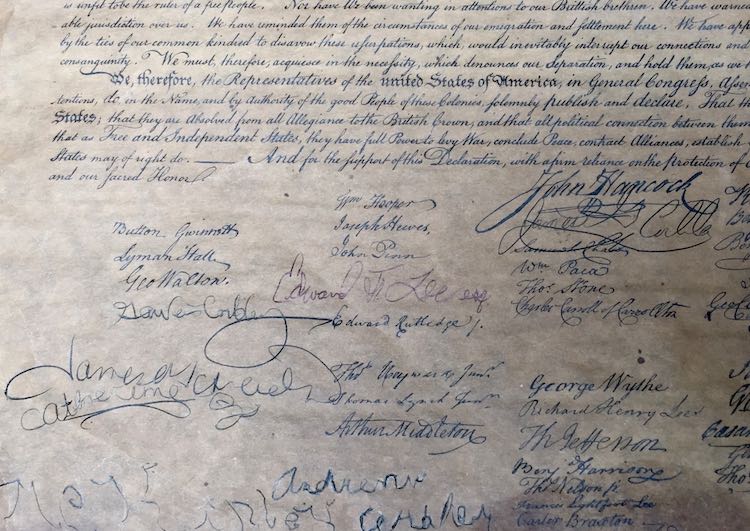
We bought a replica copy of the Declaration document in a museum shop 12 years ago that looked every bit–and felt exactly like–how I would imagine old-fashioned parchments.
Every year, we carefully unfold our Declaration and invite guests to sign it. In between the John Hancock and Thomas Jefferson are James Schneider and his daughter Catherine.
Listen to The Reading of the Declaration
Reading the full five parts of the founding US document, written mostly by Jefferson, takes a bit of commitment and seriousness, but listening to it read by radio professionals is an enjoyable 9-minutes.
2018 will be its 30th year in a row that National Public Radio has aired its annual reading of the Declaration, recorded by twenty-nine of the network’s on-air personalities and reporters. The mood is reverent, with the soft playing of patriot fifes in the background, as Cokie Roberts, Nina Totenberg and their colleagues read aloud.
“When, in the course of human events, it becomes necessary for one people to dissolve the political bands which have connected them with another…”
“We hold these truths to be self-evident, that all men are created equal, that they are endowed by their Creator with certain unalienable Rights, that among these are Life, Liberty and the pursuit of Happiness.”
“We mutually pledge to each other our lives, our fortunes and our sacred honor.”
Make a Flag You Can Eat
Most regions of the country have fresh blue and red berries this time of year, so it’s easy to use blueberries and strawberries in your food and drinks:
You can easily create American flag designs on cakes or plates by using strawberries for the stripes and blueberries for the starred blue background.
Also, make a jug of herbal mixed berry tea or homemade sangria and garnish with a handful of the fresh fruit. Don’t forget to use whipped cream where appropriate to provide the white portion to complete the trio of patriotic colors.
Get a Full-Sized Flag Because They Are Fun to Fold
Some keep flags in their yard all year round. However, it is wonderful to have a full-sized flag to drape during holidays a couple times each year from your deck or garage door. One such flag was presented to our family when a relative passed away and every Fourth we unfold it, and hang it from the tall deck railing. The best part is folding it at the end of the weekend.
You can fold it into a snug triangle using two people pulling it taut–one on each end–and tuck it away until the next time. Here’s how…
Play John Philip Sousa’s March, Stars and Strips Forever
Leonard Bernstein called it one of the greatest songs ever written, and nobody plays it better than the National Symphony Orchestra on the West Lawn of the Capitol on the Fourth of July.
The best way to hear the song is while viewing the fireworks exploding over the Washington Monument on a PBS public television station’s A Capitol Fourth program. Set up to record it on your DVR while you are out for live fireworks, and come home to watch the broadcast, with full symphony and multiple cameras directed live from the nation’s capital from WETA-TV. You can also watch it LIVE online.
Watch the US Air Force Ceremonial Brass on A Capitol Fourth in 2011 performing a medley of marches (Stars and Stripes begins at 5:24)
As a means of protecting their wildlife and region, the city of Aspen, Colorado has opted to swap out their usual Fourth of July fireworks in favor of a synchronized drone show.
Colorado’s recent droughts have spurred law enforcement to issue fire warnings and restrictions across the state.
So instead of endangering the animals, wilderness, and land surrounding the city, Aspen will be hosting a colorful light show of 50 drones synced to patriotic music tonight in Wagner park.
Plus, indoor pets won’t be in danger of being spooked away from their homes by the loud bangs of fireworks.
The show, which is being organized by Aspen Chamber Resort Association (ACRA), starts tonight at 9:15PM local time.
“We had to come up with a highlight for our celebrations so we’re doing a drone show. It should be fun, a bit new age,” said Acra’s spokeswoman Melissa Wisenbaker.
“If we are having these increased fire dangers and risks every year, then we would like to have alternatives so people can end the night on a good note,” she added.
(WATCH a breath-taking example of a drone show below)
Help This Story Go Out With A Bang And Share It With Your Friends – Representative photo by ABC News
Quote of the Day: “Let the beauty of what you love be what you do.” – Rumi
With a new inspirational quote every day, atop the perfect photo—collected and archived on our Quotes page—why not bookmark GNN.org for a daily uplift?
The Lesson: In today’s society, happiness is often deemed as the most important aspect of your life, regardless of how it is achieved. However, in this intriguing TED Talk, a writer discusses why finding meaning in your life is more important than chasing happiness, and how there are four essential pillars to a meaningful life: belonging, purpose, transcendence, and storytelling.
Notable Excerpt: “Happiness comes and goes. But when life is really good and when things are really bad, having meaning gives you something to hold on to.”
The Speaker: Emily Esfahani Smith is an author and journalist who has graced the pages of the Wall Street Journal, New York Times, Time, The Atlantic, The New Criterion and many other publications. In addition to studying psychology and philosophy in school, her work has led her to interview thousands of neuroscientists, researchers, and behavioralists so that she can better explore how people can live more meaningful lives.
Books: Smith is the author of “The Power of Meaning”: a book that is dedicated to helping people find “fulfillment in a world that is obsessed with happiness”.
(LISTEN to the inspiring talk below) – Photo by Mayur Gala
Good Advice? SHARE It – Or Check OutMoreOn Our Good Talks Page…
It can be easy to take friends and family for granted on a day-to-day basis – but this company is aiming to spend the next two weeks inspiring an attitude of gratitude… starting with their employees.
In an emotional video that was released by Liberty Diversified International (LDI), a Minnesota-based manufacturer of packaging and business supplies, company employees were asked to write a letter to someone who they appreciated. Then, they were asked to call the person who they wrote about so they could read their affectionate words out loud.
One woman became tearful when she told her boss how much she appreciated her career and workplace; other people got understandably choked up from reading letters to their parents; and one woman even read a movingly symbolic letter to someone who had passed away.
By the end of the video, it seems that most of them were feeling the love.
The social gesture was released as a means of starting LDI’s cross-country tour to celebrate their 100th anniversary. Company workers will be traveling through 17 cities over 19 days so they can spend millions of dollars on giving back to local communities.
The “Great Gratitude Tour” kicked off yesterday in New York City. At the finale event of the tour in Brooklyn Park, Minnesota, LDI will attempt to set the Guinness World Record title for the most contributions to a greetings scroll in one hour. Employees and community members will be invited to sign their name and write their personal messages of gratitude on a long brown paper scroll. More than 1,000 signatures are needed to set the record.
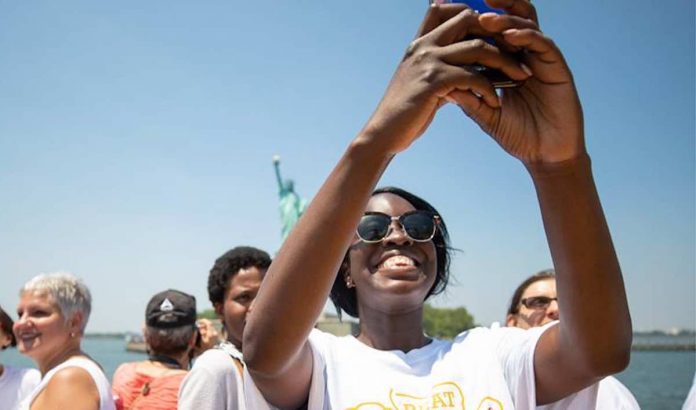
“We’re lighting the torch for the next 100 years by working to inspire people across the country to share their gratitude, do good for others and get involved in their communities,” said Mike Fiterman, chairman of the LDI board. “We are a company born from gratitude. It’s a core part of who we are that continues to this day. As we honor our centennial year, it’s only fitting that we begin our Great Gratitude Tour in New York, the city that is the home to the symbol of freedom, hope and opportunity in America.”
Hair loss can be an unfortunate fact of life for millions of people, and while some may come to terms with their loss of locks, others find it much harder to adjust.
As a result, hair loss treatments have remained in high demand and technological improvements now offer better choices. From less invasive technology used for hair implants, including U-FUE and 3D hair follicle technology, to the stunning realism of wigs, check out some examples of how technology is revolutionizing hair loss solutions.
Hair Transplants
Hair transplant innovations have continued through the years, especially with the introduction of Follicular Unit Extraction technology (FUE). FUE today is a big improvement over earlier follicular unit transplantation, which required taking entire strips of skin from the back of the head and cutting them into separate sections for replacement around the thinning areas of the head—a painful and scarring experience.
FUE, however, simply requires the harvesting of a single hair follicle—one at a time—from an area of healthy growth. The hair follicles are then relocated where they’re most needed, a useful option for receding hairlines. Scarring with FUE is minimal and in most cases, it’s completely painless. What’s more, the follicle is never out of the skin for long, which reduces the chance of damage to the follicle —a huge advantage.
For those with thinning hair across the entirety of the scalp, FUE may not be the best bet. This is where U-FUE, DHI and 3D printing technologies come into play. U-FUE uses similar techniques to FUE, but with more expert surgeons, this can be done without the need for shaving the hair completely.
DHI is the process of Direct Hair Implants through the use of a Choi Implanter Pen. This piece of equipment has helped reduce trauma to the scalp in countless patients, with minimal pain and better potential of a successful graft. It can take longer, but when don’t correctly, the results are worth the wait.
The Future of Transplants
3D Printing of hair transplants is relatively new, but the potential is huge for patients who may not have enough hair available for other methods. In theory, 3D printing would require a digital map of a person’s scalp in order to determine where the cells and components would need to be placed. Through precision printing, follicles could be printed for implantation using bio-ink. Bio-printing is already being tested, but is not ready for consumers yet.
Meanwhile, scientists at UCLA have successfully activated the body’s stem cells in order to stimulate hair growth. GNN reported that the eye-opening research is still in preclinical trials, untested on humans.
Hair Prosthetics
Wig technology has improved by leaps and bounds over the years with hair prosthetics being designed as custom-made wigs to specifically suit each individual patient.
Prosthetics come with countless measurements to ensure the hair is well-fitting and each piece is designed for comfort and protection from the elements. Patients who opt for hair prosthesis tend to have become bald due to a medical condition, and wish to regain the ability to protect themselves from the sun and keep warm in the winter. The material tends to be hypo-allergenic and soft to the touch for optimal comfort.
Hair loss can be devastating for many, but with today’s technology—and the promise of future developments—people have more and better options than ever before.
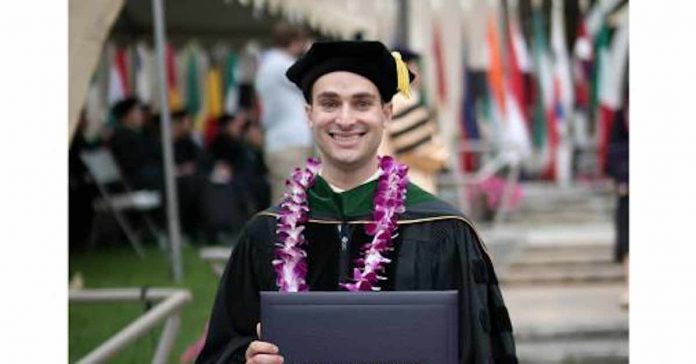
It’s been one month since Dean LaBarba graduated from medical school – but he wasn’t expecting to start his life-saving career so soon.
LaBarba, who had just finished at Loma Linda University School of Medicine, on a 12-hour flight from Zurich to Los Angeles with his wife last month when a female passenger sitting close to them said that she didn’t feel well. Before she could get up to use the restroom, she collapsed.
LBarba immediately rushed to the woman’s side only to find that she didn’t have a pulse. He tried massaging her sternum as a means of improving blood flow – but to no avail.
With the help of another passenger, he had the woman lie across a row of seats so he could begin chest compressions. After six pushes, she started to regain consciousness.
LaBarba, his wife, and the passenger were moved to first class where the newly-graduated doctor monitored her health.
“I remained at her side continually checking on her and asking if she felt any abdominal pain, chest pain, nausea or leg cramps,” LaBarba said. “It’s hard to say what happened in those 15 seconds after she collapsed, but I think she may have experienced a syncope episode.”
A syncope episode is when someone faints as a result of a drop in heart rate or blood pressure. Though the woman was shaken, she made it through the following 10 hours of the flight without any incident.
The passenger expressed her extreme gratitude towards LaBarba, who happened to be the only physician on board the 300-person flight that day. He says that the experience confirmed his “calling and desire to help people.”
LaBarba’s wife Ivy said: “I was so proud to the point of tears.”
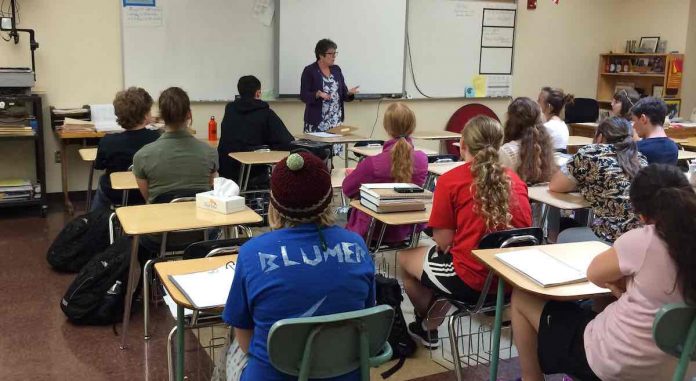
New York and Virginia have become the first US states to enact laws that require mental health education in schools.
Both laws, which were passed on Sunday, do not specify exactly what kind of lessons or structure will be implemented in the curriculums, but legislators say that highlighting the importance of mental health has been long overdue.
The Virginia legislation mandates that mental health education only be added to the health curriculum for the first two years of high school, saying that “such health instruction shall incorporate standards that recognize the multiple dimensions of health by including mental health and the relationship of physical and mental health so as to enhance student understanding, attitudes, and behavior that promote health, well-being, and human dignity.”
Sen. Robert Creigh Deeds (D) introduced the legislation for approval after it was developed and presented by a group of high school students.
“I was impressed by their thoughtfulness, because a lot of these young people had seen bullying. They had seen depression,” said Deeds, according to CNN. “It’s part of tearing down the stigma and providing some equality with those that struggle with mental health.”
The New York legislation is a little more aggressive. Penned in 2015, the bill requires mental health to be a part of the standard health curriculum for grades K through 12, effective immediately.
The New York bill reads: “It has been forty years since New York’s education laws first called for teaching about health matters in our schools. Over the years, state law has expanded to recognize that knowledge about specific public health concerns such as alcohol, drug, tobacco abuse and the prevention and detection of certain cancers is critically important for students.
“Equally critical, but missing from current law and often the classroom, is the recognition that mental health is as important to health and wellbeing as physical health.”
Share The Progressive Step Forward With Your Friends – Representative photo by Oregon Secretary of State, CC
While dogs are definitely man’s best friend, Todd the Golden Retriever is also this woman’s hero.
Paula Godwin had been out for a morning hike with her two dogs near her home in Anthem, Arizona earlier this week when she says she almost stepped on a rattlesnake.
Luckily for her, Todd was ready to protect his beloved human.
“My hero of a puppy Todd saved me,” Godwin wrote in a Facebook post. “He jumped right in front of my leg where I surely would have gotten bit.”
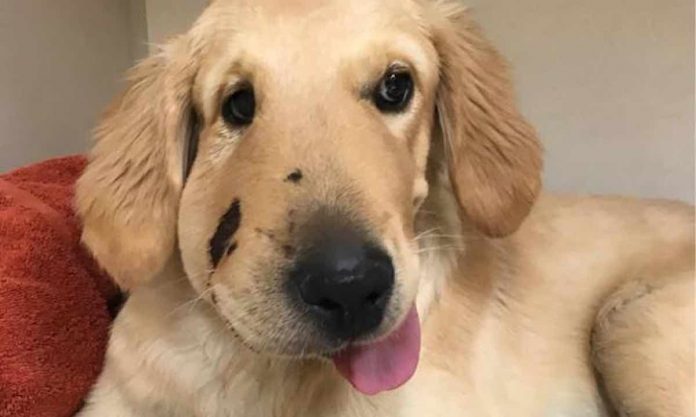
The snake ended up biting the right side of Todd’s face and Godwin immediately rushed her pup to the Anthem Animal Hospital where he was treated with anti-venom.
Though the photos of Todd’s bite may look pretty shocking, Godwin said that “this is what a hero looks like.”
Quote of the Day: “But you know, the darkest hour Is always, always just before the dawn.” – David Crosby, who joined Stills and Nash 50 years ago today (“Long Time Gone”)
With a new inspirational quote every day, atop the perfect photo—collected and archived on our Quotes page—why not bookmark GNN.org for a daily uplift?
The Lesson: In this inspiring Ted Talk, researcher-storyteller Dr. Brene Brown recounts her six year journey to understand the key to human connection: vulnerability. She found that vulnerability sits at a paradoxical balance between being the core of one’s struggle for worthiness and yet also the birthplace of true intimacy and belonging. Through equal parts humorous anecdotes and profound discoveries, Brown defines universal feelings in novel ways and reveals how to apply these teachings to lead a more connected life.
Notable Excerpt: “So very quickly — really about six weeks into this research — I ran into this unnamed thing that absolutely unraveled connection in a way that I didn’t understand or had never seen. And so I pulled back out of the research and thought, ‘I need to figure out what this is’. And it turned out to be shame. And shame is really easily understood as the fear of disconnection: Is there something about me that, if other people know it or see it, that I won’t be worthy of connection? The things I can tell you about it – it’s universal; we all have it. The only people who don’t experience shame have no capacity for human empathy or connection. No one wants to talk about it, and the less you talk about it the more you have it. What underpinned this shame, this ‘I’m not good enough,’ — which we all know that feeling: ‘I’m not blank enough. I’m not thin enough, rich enough, beautiful enough, smart enough, promoted enough.’ The thing that underpinned this was excruciating vulnerability, this idea of, in order for connection to happen, we have to allow ourselves to be seen, really seen.”
The Speaker: Dr. Brené Brown is a research professor at the University of Houston where she holds the Huffington Foundation – Brené Brown Endowed Chair at The Graduate College of Social Work. Brown has and continues to break down the complex topics concerning human nature such as shame, empathy, courage, and vulnerability. Her TED talk – The Power of Vulnerability – garnered over 34 million views as one of the top five most viewed TED talks worldwide.
Imagine waking up from a deep sleep only to find that you have been in a long-term marriage with a man who you don’t know; that’s exactly what happened to Angela Hartung five years ago.
Angela had been crossing an intersection in New York City when she was hit by a car. After spending one month in a coma, she woke up with no recollection of the previous fifteen years of her life.
She thought that she was still married to her first husband, even though he had died some time ago. She thought that her kids were still young, even though they had both grown up into young adults. Additionally, she did not remember anything about her second husband Jeff.
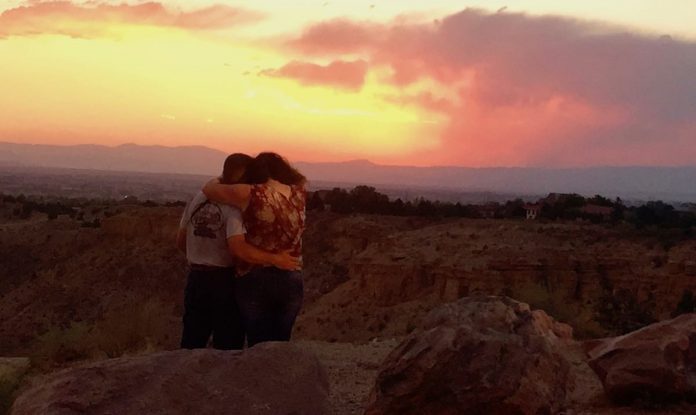
Despite the heartache that came from being a stranger to his spouse, Jeff persisted against their strange circumstances. He lined the walls of their homes with photographs and happy memories – and then, he courted his own wife until she fell in love with him all over again.
And even though some people might disagree, Jeff believes the whole experience was a blessing in disguise.
“I honestly believe that this happened for a reason,” Jeff told CBS News. “How many times have we said, ‘I wish I could go back and do something over again?’ I’ve gotten to do that.”
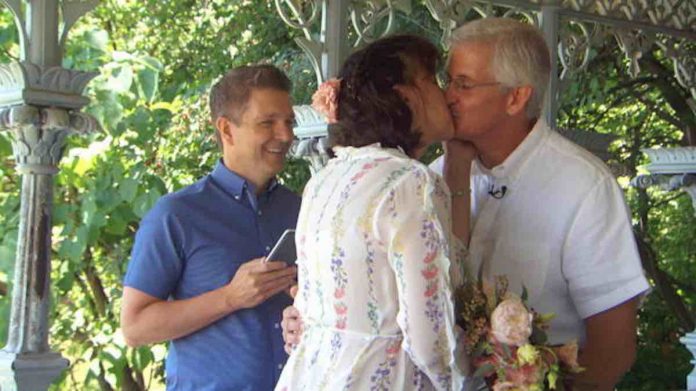
To top off the emotional love story, Jeff and Angela got to renew their wedding vows in Central Park earlier this month.
(WATCH the video below or our international viewers can watch the heartwarming clip on the CBS News website)
Don’t Forget To Share This Tear-Jerker Of A Tale With Your Friends – Photo by CBS News
For the first time in history, scientists have captured a picture of a planet being born.
The international team of researchers made the robust detection of the young planet, named PDS 70b, cleaving a path through the planet-forming material surrounding a young star.
The team of astronomers which was led by a group at the Max Planck Institute for Astronomy in Heidelberg, Germany, captured the spectacular snapshot of planetary formation around the young dwarf star PDS 70 by using the SPHERE instrument on ESO’s Very Large Telescope (VLT) – one of the most powerful planet-hunting instruments in existence.
The SPHERE instrument also enabled the team to measure the brightness of the planet at different wavelengths, which allowed properties of its atmosphere to be deduced.
The planet stands out very clearly in the new observations, visible as a bright point to the right of the blackened centre of the image. It is located roughly three billion kilometers from the central star, roughly equivalent to the distance between Uranus and the Sun. The analysis shows that PDS 70b is a giant gas planet with a mass a few times that of Jupiter. The planet’s surface has a temperature of around 1000°C, making it much hotter than any planet in our own Solar System.
The dark region at the centre of the image is due to a coronagraph, a mask which blocks the blinding light of the central star and allows astronomers to detect its much fainter disc and planetary companion. Without this mask, the faint light from the planet would be utterly overwhelmed by the intense brightness of PDS 70.
Photo by ESO / Davide De Martin
“These discs around young stars are the birthplaces of planets, but so far only a handful of observations have detected hints of baby planets in them,” explains Miriam Keppler, who lead the team behind the discovery of PDS 70’s still-forming planet. “The problem is that until now, most of these planet candidates could just have been features in the disc.”
The discovery of PDS 70’s young companion is an exciting scientific result that has already merited further investigation. A second team, involving many of the same astronomers as the discovery team, including Keppler, has in the past months followed up the initial observations to investigate PDS 70’s fledgling planetary companion in more detail. They not only made the spectacularly clear image of the planet shown here, but were even able to obtain a spectrum of the planet. Analysis of this spectrum indicated that its atmosphere is cloudy.
PDS 70’s planetary companion has sculpted a transition disc – a protoplanetary disc with a giant “hole” in the centre. These inner gaps have been known about for decades and it has been speculated that they were produced by disc-planet interaction. Now we can see the planet for the first time.
“Keppler’s results give us a new window onto the complex and poorly-understood early stages of planetary evolution,” comments André Müller, leader of the second team to investigate the young planet. “We needed to observe a planet in a young star’s disc to really understand the processes behind planet formation.” By determining the planet’s atmospheric and physical properties, the astronomers are able to test theoretical models of planet formation.
This glimpse of the dust-shrouded birth of a planet was only possible thanks to the impressive technological capabilities of ESO’s SPHERE instrument, which studies exoplanets and discs around nearby stars using a technique known as high-contrast imaging – a challenging feat.
Even when blocking the light from a star with a coronagraph, SPHERE still has to use cleverly devised observing strategies and data processing techniques to filter out the signal of the faint planetary companions around bright young stars at multiple wavelengths and epochs.
Thomas Henning, director at the Max Planck Institute for Astronomy and leader of the teams, summarizes the scientific adventure: “After more than a decade of enormous efforts to build this high-tech machine, now SPHERE enables us to reap the harvest with the discovery of baby planets!”
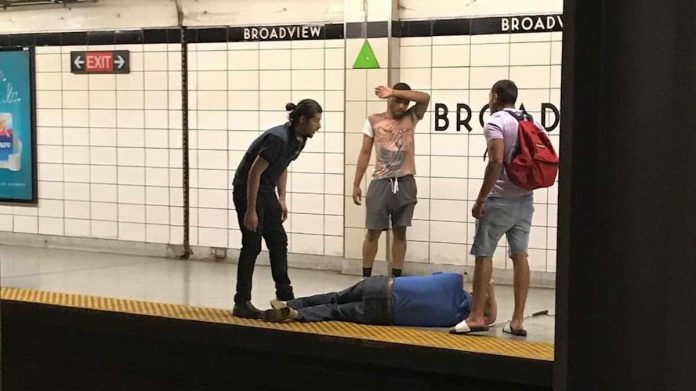
Three young men – two of whom have not been identified – are being hailed as heroes after they saved a blind man who had fallen onto a set of subway tracks last week.
After witnessing the rescue on Thursday afternoon, Julie Caniglia wrote about the incident on Facebook.
According to Caniglia, she had been standing at the Broadview subway station in Toronto when she heard a sound that gave her “the fright of her life.”
“When my subway car pulled up … I heard a faint voice call out ‘help, help me please’,” writes Caniglia. “It wasn’t coming from anyone in the car and after hearing it again I stood up and looked out on the platform.
“Suddenly, and all very quickly, [I] … saw a man with a walking cane lying on the tracks.”
The man was blind, and he had fallen onto the rails below. Thankfully, three bystanders leapt into action.
Without hesitation, 24-year-old Kyle Busquine jumped onto the tracks and – with the help of two other men on the platform – they were able to hoist the blind man to safety.
“We were all just in shock looking at him, hoping and praying a train wouldn’t come,” Caniglia told CBC News. “It was probably all within less than a minute but it seemed like hours.
“Knowing that the worst thing possible could happen and it was out of everyone’s control was really just the most frightening thing I’ve ever seen,” she added.
Though the other two men have not come forward, Busquine says that he wouldn’t have been able to rescue the endangered commuter without their help.
Paramedics reportedly escorted the injured man to the hospital so he could be treated for his minor injuries.
Save Your Friends From Negativity And Share The Inspiring Story – Photo by Julie Caniglia
For years, the city of Huntington, West Virginia experienced a steady climb in drug overdoses. When it finally came to a tee in 2014, the town launched a compassion-based outreach program that has cut the rate of overdoses by more than half in less than one year.
The Quick Response Team (QRT) is a rotating group of paramedics, mental health specialists, and police officers who check up on overdose survivors within 72 hours of their overdose.
The team has found that when addicts and troubled patients are visited by city officials who express concern over their predicament, they are more likely to get better and seek treatment because they feel that someone cares.
“[First responders] are having people say to them, ‘This is the first time that someone has cared enough to come and do this, you’ve saved my life, thank you,’” healthcare worker Karen Yost told the Christian Science Monitor. “Now they’re beginning to see light at the end of the tunnel.”
The program has had such a stunning effect on the city, that the state recently approved a bipartisan bill to implement the initiative in a four-year pilot program across West Virginia.
Huntington officials hope that their treatment model will soon be implemented across the country as well.
“If we find a way to be able to defeat this here,” Mayor Steve Williams told the CSM, “then that becomes a standard that can be utilized certainly throughout the rest of the state, but I believe that it [also] becomes a standard that the rest of the nation will be able to follow.”
Cure Your Friends Of Negativity And Share The Good News – Representative photo by Airman 1st Class Emerald Ralston / U.S. Air Force
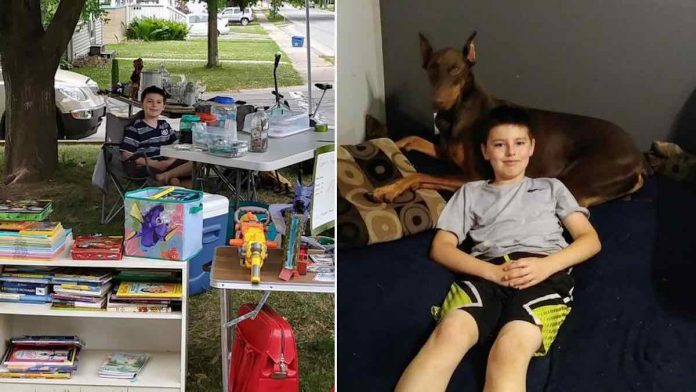
A 10-year-old boy is going above and beyond to save the dog who has spent the last four years looking after him.
Copper the Doberman is Connor Jayne’s service and emotional support dog. In December 2017, the pup developed a limp, which turned out to be Wobbler’s disease.
Diagnosing and treating Wobbler’s disease is expensive – but when Connor heard that his furry companion needed help, he cleaned out his entire toy room to host a garage sale and help pay for the treatment. The youngster even sold lemonade and treats to make a few extra bucks.
“He went and cleaned out his entire playroom because that’s what he wanted,” Connor’s mom Jennifer told Inside Edition. “He is that type of kid.”
“He said the dog was more important than any toys,” she added.
This is not the first time that Copper and Connor have been there for each other, either. Connor struggles with PTSD, anxiety, and chronic headache disorder. He has also been diagnosed with nocturnal seizures as a result of Copper’s watchful eye.
Two years ago, Jennifer was awoken by the sound of Copper barking outside of the boy’s bedroom, insisting that she open the door. When she finally went in to check on her son, she found that he was having a nocturnal seizure.
“Nothing had shown up on any of his studies or neurological reports as nocturnal seizures are the hardest to diagnose,” says Jayne. “It happened again a few weeks later and I was able to catch it on camera to show the neurologist and get my son on the proper medication.
“He is completely managed for seizures at this time thanks to our protector and faithful companion.”
Additionally, Copper helps Connor with his anxiety attacks by lying on top of the boy like a weighted blanket.
Since the family started a GoFundMe campaign to help pay for Copper’s treatment, the page has surged past its original goal and raised almost $18,000 – so it might be pretty safe to say that Copper has a good fighting chance for the future, thanks to his adoring family and fans.
Share This Pawesome Story Of Friendship With Your Own Companions – Photos by Jennifer Jayne
With a new inspirational quote every day, atop the perfect photo—collected and archived on our Quotes page—why not bookmark GNN.org for a daily uplift?
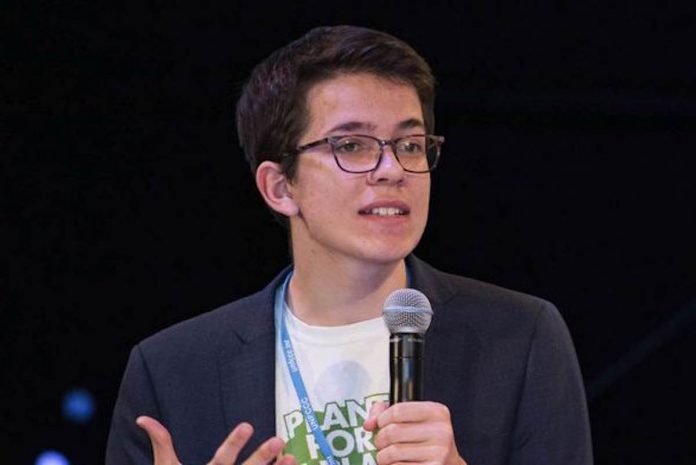
The world is a lot greener thanks to this 20-year-old and his army of “climate ambassadors” who have pledged to plant trees and use youth power to avert climate change.
Ever since he was 9 years old, Felix Finkbeiner has been an international figurehead for saving the planet. In 2007, the German youngster founded a global youth movement called “Plant for the Planet” – an initiative that trains and recruits kids from around the world to plant trees as a means of combatting climate change.
Since its creation, the movement has already made significant progress with the help of over 100,000 enthusiastic youth between the ages of 9 and 12—and he planted his one-millionth tree in Germany when he was just twelve. Alongside the Paris Agreement, Finkbeiner’s campaign is a formidable defense of the planet.
His speeches as a pre-teen to the European Parliament and the United Nations General Assembly inspired kids from over 90 countries to join his coalition, saying “Forests are not only the livelihood of billions, but for us children forests are our future.”
The UN then handed over to Felix the leadership of its Billion Tree Program, which was inspired by the Kenyan Nobel Peace Prize-winning activist Wangari Maathai, whose Green Belt Movement planted 30 million trees in Africa. He is enlarging the program, transforming it into a Trillion Tree Campaign: an audacious international grassroots effort to do exactly that – plant one trillion trees in the next 30 years.
Just for some perspective, there are currently about 3 trillion trees alive in the world today – so planting a trillion more would be an incredible increase. That’s roughly 150 trees for every person on Earth, according to National Geographic.
“Children could plant 1 million trees in every country on earth and offset CO2 emissions all on their own, while adults are still talking about doing it,” said Finkbeiner. His motto, “Stop talking, start planting,” suggests the same sentiment.
The campaign is working in collaboration with organizations such as the World Wildlife Fund and the Wildlife Conservation Society to meet the ambitious goal. The Campeche province of Mexico is already a staging ground for Finkbeiner’s no-nonsense motto. Plant for the Planet recently bought 33,300 acres (13,500 hectares) in the area and they plan to plant 10 million trees by 2020.
Other countries’ have their own plans for reforestation too. One province in Pakistan has planted 1 billion trees; China is creating forests as big as Ireland; a group of African countries (Ethiopia, Niger, Mali, etc.) are reforesting degraded land; India recently smashed the world record for planting the most amount of trees in a day; and Latin American nations are signing on to reforestation efforts in the Amazon, as well.
All of these combined initiatives offer great hope for the planet, but organizations aside, Finkbeiner is a textbook example of what we can all do on an individual level to save the planet if we just stop talking and start planting.
Plant Some Positivity With Your Friends And Share The Good News – Photo by Felix Finkbeiner
A Boston shuttle bus driver is being hailed for an extraordinary act of kindness—doing something he never would have done in earlier days. Hear The Good News Guru tell the inspiring story (from the June 29, 2018 Ellen K. Morning Show on KOST-103.5 radio).













 Did you know the US National Archives hosts sleepovers for children 8 to 12 years old inside the awe-inspiring rotunda where the Declaration of Independence, the U.S. Constitution, and the Bill of Rights are displayed?