It’s not often that banks are praised for their compassion, but Canadian credit card holders are rejoicing over their bank’s recent decision to forgive all outstanding debt on two of their old Visa programs.
After spending a little over a decade in the Canadian credit card market, US-based Chase Bank opted to retire their Amazon.ca Rewards Visa and their Marriott Rewards Premier Visa in March 2018.
As of last week, there were still Canadian cardholders who were making payments on their outstanding card debt—but Chase, rather than selling the debt to third party-collectors, sent letters to all of their Canadian customers this week explaining that their debt had been forgiven.
“Ultimately, we felt it was a better decision for all parties, particularly our customers,” Chase spokesperson Maria Martinez said in an email to CBC.
Despite how financial analysts have been confused by the bank’s decision to forgive the debt, Canadian customers are still in disbelief over their good fortune.
“Its crazy,” one customer told the Canadian news outlet. “This stuff doesn’t happen with credit cards. Credit cards are horror stories.”
Though Chase declined to say how much debt had collectively been wiped out by their decision, their former Amazon credit card boasted a 19.9% interest rate—and some Canadian cardholders told CBC that they had been forgiven for as much as $6,000 in debt.
“I was sort of over the moon all last night, with a smile on my face,” another consumer told CBC. “I couldn’t believe it.”
Bank On Positivity By Sharing The Good News To Social Media — Photo by Paul Adamson
Quote of the Day: “One good conversation can shift the direction of change forever.” – Linda Lambert
Photo: by GWC copyright 2015
With a new inspirational quote every day, atop the perfect photo—collected and archived on our Quotes page—why not bookmark GNN.org for a daily uplift?
These Massachusetts firefighters have had plenty of experience rescuing people from sticky predicaments—but this helpless raccoon proved itself to be in quite a pickle.
The distressed critter, who was spotted by a bicyclist in Newton, Massachusetts earlier this week, had gotten its head stuck firmly in between the bars of a sewage grate. With both of its paws holding onto the grate for support, rescuers say that the raccoon had apparently been stuck for “quite a while” before help arrived.
Despite how none of the firefighters at the Newton Police Department were trained for this kind of rescue, they rushed to rescue the raccoon from its plight.
“We rescue citizens both big and small,” the department later wrote on Twitter.
To their surprise, it took two hours and eight different people to safely dislodge the raccoon from the grate.
Ordinarily, firefighters use soapy water to free people who have gotten themselves stuck, which they say “works 99% of the time”. They were dismayed, however, when the same technique failed to work on the raccoon.
The raccoon was escorted to a nearby wildlife rehabilitation center so it could be monitored until it is ready to be released back into the wild.
After the fire department posted photos of the rescue mission to Twitter, they received heaps of praise from internet users for saving the coon—but even though the humble civil servants say that it was “quite the operation”, they insist that they are “always willing to help their 4-legged friends.”
Always willing to help our 4 legged friends! It was quite the operation. https://t.co/wgFXzrhnWQ
A Finnish company is saying that they have managed to create “food out thin air”—and it could be hitting our grocery store shelves within the next two years.
The engineers at Solar Foods have succeeded in making a protein powder using only CO2, water, vitamins, and renewable electricity.
The powder, which they have called Solein, was created using technology that was developed by NASA. It reportedly looks and tastes just like wheat flour, except it is made up of 50% protein.
Since the single-cell protein can be produced in an indoor environment, it is completely independent of weather and land conditions.
“Conventional food production wastes water at unsustainable and unreasonable levels. We wanted to fix that,” reads the Solar Foods website.
“Solein is 100 times more climate-friendly than any animal or plant-based alternative. Unlike conventional protein production, it takes just a fraction of water to produce 1 kilogram of Solein,” it continues. “As with water use, the same game-changing effect applies to land use efficiency as well, with Solein being 10 times more efficient than soy production by a metric of usable protein yields per acre.”
With the global commercial launch of Solein projected for 2021, Solar Foods say it will likely begin appearing in products like yogurts and protein meals—but they also say that it could quickly become a source of unlimited food for billions of people.
(WATCH the explanatory video from the Solar Foods CEO below)
Feed Your Friends Some Positivity By Sharing The Exciting News To Social Media…
It has been four years since Grandma Joy told her grandson that she had never seen the most breathtaking landscapes of America—and they have since gone on dozens of epic cross-country adventures.
Brad Ryan had been feeling burnt out from veterinary school when he visited his 85-year-old grandma back in 2015. He hoped that spending some quality family time in his Ohio hometown would help to lift his spirits.
As he was regaling his grandma with stories of his travels, however, he was heartbroken to hear her confess that she had never seen the ocean or mountains.
Ryan then spontaneously asked his grandmother if she would like to hike the Smoky Mountains with him. Needless to say, she was more than happy to oblige.
They have since visited 29 different national parks across America—from the breathtaking slopes of the Great Sandy Dunes in Colorado to the shores of Acadia National Park in Maine.
Over the course of the last three and a half years, Ryan says that he and his grandma have collectively driven 25,000 miles through 38 states—and it has dramatically affected his quality of living.
“Seeing it through my grandmother’s eyes, who every morning wakes up and is thankful to be alive, has taught me how to live,” Ryan told WJLA. “With her, I’ve had to slow down and see it in a different way, which has made it a lot more rich.
“I love my grandma so much, and it’s just really giving me a lot of peace that when she eventually does pass on, I can go back to these places and feel her spirit, feel connected to her, that she set her eyes on these same things,” he added.
Ryan, who has been documenting all of their adventures on Instagram and Facebook, hopes that their social media presence will inspire other youngsters to spend more time with their elders.
“I want people who are younger to know, you aren’t too cool to hang out with your grandparents,” Ryan told the news outlet. “I think we’ve lost that as a society. There’s so much perspective and knowledge we stand to gain from our elders.”
People who are the most optimistic tend to be better sleepers, a study of young and middle-aged adults found.
More than 3,500 people ages 32 to 51 were included in the study sample. The participants included people in Birmingham, Alabama; Oakland, California; Chicago; and Minneapolis.
“Results from this study revealed significant associations between optimism and various characteristics of self-reported sleep after adjusting for a wide array of variables, including socio-demographic characteristics, health conditions and depressive symptoms,” said lead researcher Rosalba Hernandez, a professor of social work at the University of Illinois.
Participants’ levels of optimism were measured using a 10-item survey, which asked them to rate on a five-point scale how much they agreed with positive statements such as “I’m always optimistic about my future” and with negatively worded sentences such as “I hardly expect things to go my way.”
Scores on the survey ranged from six (least optimistic) to 30 (most optimistic).
Participants reported on their sleep twice, five years apart, rating their overall sleep quality and duration during the prior month. The survey also assessed their symptoms of insomnia, difficulty falling asleep and the number of hours of actual sleep they obtained each night.
A subset of the participants was part of an ancillary sleep study based in Chicago and wore activity monitors for three consecutive days—including two weeknights and one weekend night. Participants wore the monitors on two occasions a year apart.
The monitors collected data on their sleep duration, percent of time asleep and restlessness while sleeping.
Hernandez and her co-authors found that with each standard deviation increase—the typical distance across data points—in participants’ optimism score they had 78% higher odds of reporting very good sleep quality.
Likewise, individuals with greater levels of optimism were more likely to report that they got adequate sleep, slumbering six to nine hours nightly. And they were 74% more likely to have no symptoms of insomnia and reported less daytime sleepiness.
According to a 2016 report by the Centers for Disease Control and Prevention, about 1 in 3 U.S. adults fails to get adequate sleep, escalating their risks of many chronic diseases.
“The lack of healthy sleep is a public health concern, as poor sleep quality is associated with multiple health problems, including higher risks of obesity, hypertension and all-cause mortality,” Hernandez said. “Dispositional optimism—the belief that positive things will occur in the future—has emerged as a psychological asset of particular salience for disease-free survival and superior health.”
Although a significant and positive association was found between optimism and better-quality sleep, Hernandez suggested that the findings should be interpreted cautiously.
While the scientists aren’t sure of the exact mechanism through which optimism influences sleep patterns, they hypothesize that positivity may buffer the effects of stress by promoting adaptive coping, which enables optimists to rest peacefully.
“Optimists are more likely to engage in active problem-focused coping and to interpret stressful events in more positive ways, reducing worry and ruminative thoughts when they’re falling asleep and throughout their sleep cycle,” Hernandez said.
The findings, published recently in the journal Behavioral Medicine, bolster those of a prior study, in which Hernandez and her co-authors found that optimists ages 45 to 84 were twice as likely to have ideal heart health.
When a 3-year-old boy was left dangling helplessly from a sixth floor apartment building balcony, a group of neighbors pulled off the most ingenious rescue tactic to save him.
CCTV footage from the city of Chongqing shows the boy hanging by his fingertips while a crowd of concerned pedestrians gather below.
Though the boy can be seen trying to climb back up onto the balcony, he is unable to pull himself to safety.
Meanwhile, property management worker Zhu Yanhui was scrambling to find a way to help the boy.
“I looked up and saw a little child was dangling up there. My first reaction was to find something to catch him. I thought about rushing over there and catch him with my bare hands, but that would not have worked,” he told CCTV. “My only thought was to keep him safe.”
With the help of several building residents, sanitation workers, and security guards, he grabbed a blanket and stretched it out underneath the boy as a makeshift safety net.
10 seconds later, the boy fell from the balcony and landed safely in the blanket below.
A neighbor took him to the hospital after the incident, but doctors declared the boy to be unharmed.
(WATCH the video below)
Save Your Friends From Negativity By Sharing This Inspiring Story To Social Media…
Quote of the Day: “Plant seeds of happiness, hope, success, and love; it will all come back to you in abundance. This is the law of nature.” – Steve Maraboli
Photo: by Steven Lilley, CC license, cropped
With a new inspirational quote every day, atop the perfect photo—collected and archived on our Quotes page—why not bookmark GNN.org for a daily uplift?
Many patriotic Americans can appreciate the sight of the star-spangled banner flying high in the sky—but perhaps not as much as 6-year-old Finn Daly.
Because of how the boy has autism and Down syndrome, he is consistently enamored by the American flags hanging throughout his neighborhood in West Hartford, Connecticut. Finn’s parents say that he can spend hours watching the flags flapping in the breeze.
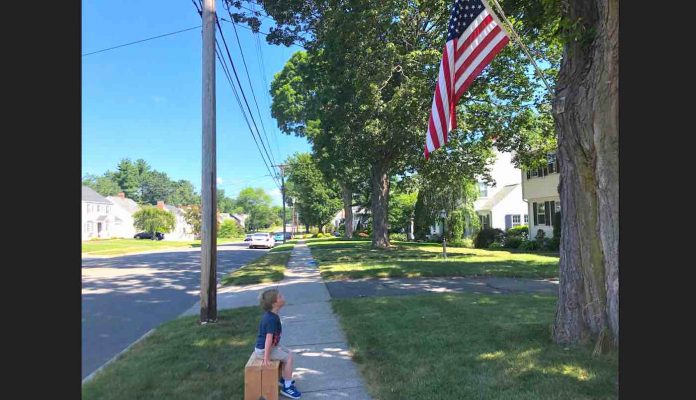
During one such leisurely afternoon when he was out on a walk with his parents, Finn became particularly transfixed by a flag that was hanging from a tree in the yard of Todd Disque.
When Disque happened to catch sight of Finn admiring the flag in his yard, he couldn’t help but be filled with appreciation for the pint-sized patriot.
So as a means of expressing his compassion towards the youngster, Disque went to his workshop and crafted a small wooden bench inscribed with Finn’s name. Upon finishing the little stool, he left it out in front of the flag for the Daly family to find.
Needless to say, they were overwhelmed with emotion when they discovered the bench.
“I’m crying and my daughter is saying, ‘Don’t cry mom, it’s OK, this is exciting,’” Finn’s mother told CBS News. “It’s such a small gesture, but things like this really restore your faith in humanity. Like, there’s still good people out there that want to do kind things for no other reason than just to be kind.”
(WATCH the emotional video below or our international viewers can check out the footage on the CBS News website)
Be Sure And Share This Sweet Story Of Stars And Stripes With Your Friends On Social Media…
On World Autism Awareness Day, the legendary voice of Supertramp, Roger Hodgson, sang his songs in true charitable fashion when he performed a concert proving that no child musician with autism is just ‘Dreamer.’
Hodgson agreed to bring his 4-piece band and a 39-piece orchestra so he could play the song ‘Give a Little Bit’ with four teens on the autism spectrum, after hearing about their fundraising campaign of the same name.
Jake’s House, a Toronto organization dedicated to providing support to families affected by autism, hosted the evening at the Sony Centre, which also included speeches by the city’s mayor and Prime Minister Justin Trudeau.
“I wrote the song Give a Little Bit, but Jake’s House is putting it into action, and that really inspires me,” said Hodgson.
His hour-long performance for the 2000 guests in attendance on April 2nd featured his famous hits like Take the Long Way Home, School, Breakfast in America, The Logical Song, and Dreamer. But the best part was the final song when he launched into Give a Little Bit and invited some of the talented youth from Jake’s House to sing and play the song with him.
In the audience, the parents of the young musicians (Spenser on guitar; Rawan on vocals; Luc on saxophone; and Ron on piano) were filled with awe and pride, as they watched their kids steal the show—and realized the truth of their limitless potential.
Founded in 2004 by Irene and David Bodanis, the nonprofit Jake’s House was inspired by their son, who was diagnosed with Autism Spectrum Disorder in 1995. Primarily through events and programming, they “strive to empower children; offer caregivers support and respite; raise awareness; share resources; and build a close-knit community” in and outside of Ontario.
This is Roger’s first time being involved in an autism charity, but said the concept of Jake’s House fundraising campaign, ‘Give a Little Bit’ resonated strongly with him.
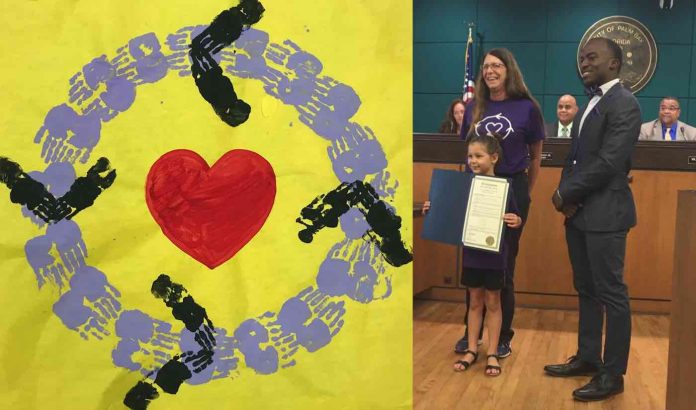
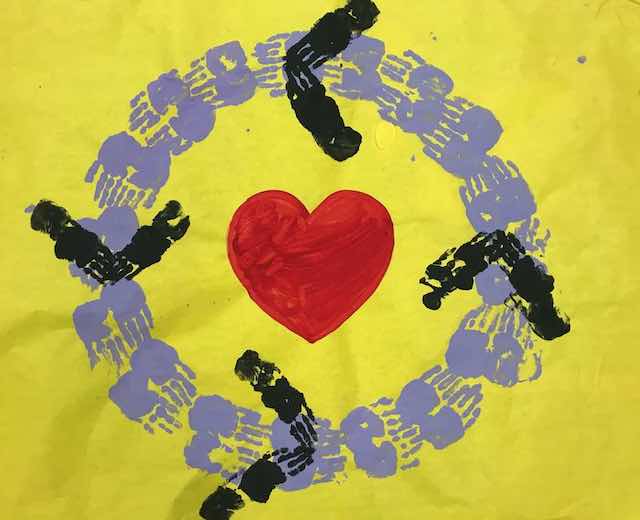
The officially proposed kindness symbol. Photo by Together Kind.
There are already universal symbols for peace and love—but one group of kindergartners has been pushing for there to be a newly-recognized sign for kindness.
The idea was first proposed by the students in the “transitional kindergarten” class of Tropical Elementary School in Merritt Island, Florida.
The transitional, or “TK” class, is for kids who have gone through a year of kindergarten, but for various reasons aren’t ready for first grade. They first launched the project as a part of their writing and geography coursework—although the initiative has since garnered national traction.
The students aged 5 to 7 started their petition to adopt a new National Symbol of Kindness back in January. Since its humble beginnings, it has accumulated over 4,000 signatures from people who are using the campaign to encourage their own state and national legislators to officially recognize the symbol. Once it reaches 5,000 signatures, it will automatically be forwarded to several prominent Senators and House Representatives.
“The Kindness Symbol shows kindness all around, ongoing, never-ending, north/south/east/west, everywhere!” reads the petition.
“Having a recognizable, easy to recreate symbol will remind people to be kind. We already have and use symbols for love, peace, and happiness and a kindness symbol will add to our national focus of being kind.”
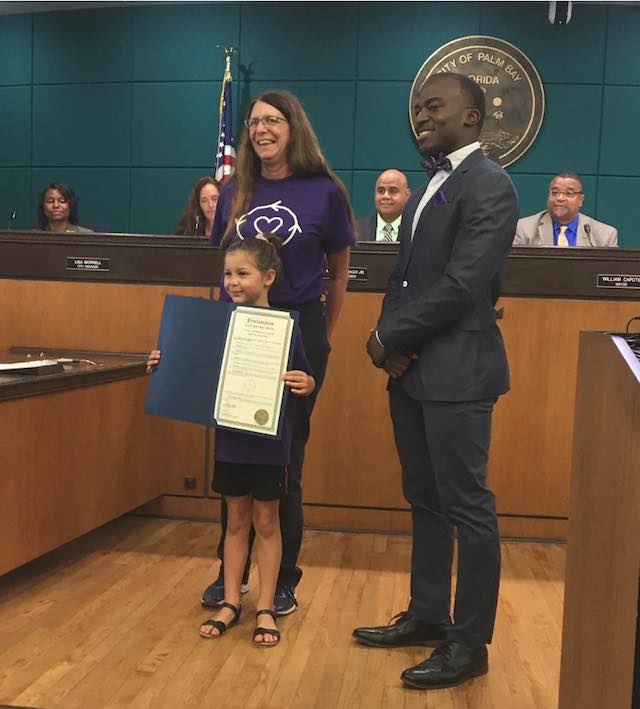
According to the students’ Together Kind website for the campaign, the youngsters have presented their proposal to dozens of school boards, city councils, and municipalities—and many of the ordinances have already agreed to adopt the symbol.
Photo by Together Kind
As of early July, New Jersey Assemblyman Ron Dancer (R-Ocean) introduced a resolution (AR254) urging Congress to adopt the kindness logo as the national symbol of kindness.
“Kindness is contagious,” said Dancer. “People who benefit from acts of kindness are more likely to act graciously towards others. This circle of kindness is embodied in the symbol.”
“It’s always the right time for kindness,” he continued. “Sometimes it feels like our nation is more divided than it is united. Declaring a national symbol of kindness is a small, but not insignificant step toward civility.”
If you want to sign the petition or download a formatted letter for you to send to your own legislators demanding the kindness symbol’s recognition, you can visit the Together Kind website.
Multiply The Good By Sharing The Story Of Kindness With Your Friends On Social Media…
This exciting new Australian study has found that communities with a healthy amount of tree cover—not just grass and green space—were psychologically healthier than those that didn’t.
Specifically, people in urban areas have a lower risk of developing psychological distress and better overall health if they have more trees within a walkable distance from their homes, says the study from the University of Wollongong (UOW).
In neighborhoods with a tree canopy of 30% or more, adults had 31% lower odds of developing psychological distress, and 33% lower odds of rating their general health as “fair” or “poor” over six years.
That being said, urban green spaces with open grass rather than a tree canopy did not deliver the same benefits.
The longitudinal study, which was published in JAMA Network Open tracked the changes in health of around 46,000 people aged 45 and older living in Sydney, Newcastle and Wollongong. Statistical analyses took into account other possible explanations, including differences in age, sex, income, education, employment status, and relationship status.
The study’s lead author, Professor Thomas Astell-Burt, an NHMRC Boosting Dementia Research Leadership Fellow at UOW, said while other studies had indicated that green space was good for mental health, this new research specifically looked at whether the type of green space made a difference.
“Our results suggest the type of green space does matter,” Professor Astell-Burt said.
“We found that the residents of neighborhoods with a higher amount of tree canopy had better mental and general health, but didn’t find the same correlation when the type of green space was open, grassed areas.
“This suggests that protecting and increasing the urban tree canopy could potentially deliver significant community health benefits.”
There are a number of reasons why trees could be beneficial to our health said Associate Professor Xiaoqi Feng, an NHMRC Career Development Fellow at the university.
Other benefits are more subtle. Green, leafy trees can provide sensory relief in urban areas dominated by hard surfaces, right angles, glass and concrete, and intrusive, attention-seeking advertising.
“The vibrant colors, natural shapes and textures, the fresh aromas and rustling of leaves in the breeze all provide distraction and relief from whatever it was you might have been thinking about, or even stressing over,” Associate Professor Feng said.
“Studies back this up. Walks through green space have been shown to reduce blood pressure, improve mental acuity, boost memory recall and reduce feelings of anxiety.”
Tree cover also provide spaces where people can benefit from interacting with each other and with animals, such as birdwatching and walking dogs, which can all be good for our mental health.
It’s been eight years since Steve Greig first began to heal his grieving heart by adopting old shelter dogs that no one wanted—and it has resulted in an unlikely furry family and social media stardom.
Grieg, who is an accountant from Colorado, has always loved animals. Throughout his life, he has cared for a number of cats, dogs, and other oddball pets, although his passion for unloved critters didn’t fully blossom until 2011 when the death of one his pups left him particularly heartbroken.
“I was just so distraught about [that death],” Greig told The Dodo. “A month or two went by and I still felt so horrible about it. I decided that the only way I would feel better was if something something good happened that probably wouldn’t have happened if he had not died.”
He then went to his local shelter and asked for a dog that was having trouble finding a forever home. He ended up adopting a 12-year-old Chihuahua with heart murmurs and knee problems—and the rest is history.
Grieg has since adopted eight senior dogs with health issues. In addition to caring for two other dogs belonging to his sister and roommate, he also cares for a pig, a rabbit, a pond full of fish, and a chicken named Oprah.
Caring for this menagerie of critters isn’t easy. Grieg typically wakes up at 5AM every morning before work so he can prepare each doggie meal according to their health issues and administer their medications.
He then returns home from work around lunchtime so he can take the pups outside and dole out treats accordingly. Over the weekend, he makes sure to take the pups to their grooming and veterinary appointments.
Despite caring for so many different animals, however, Grieg’s passion is for senior dogs.
“They’re just wiser animals,” he told the news outlet. “You kind of know what you want out of life once you become a certain age. These dogs know who they are and it’s easy to develop a relationship with a person or pet who knows who they are.”
Unfortunately, two of Grieg’s senior pups have passed away in the last year—but he has mentioned in the past that he hopes to continue adopting senior dogs to fill their places.
Grieg is not the only one who cares for these dogs, either. His “Wolfgang” Instagram page, which is dedicated to his furry companions, has collectively racked up over 800,000 avid followers.
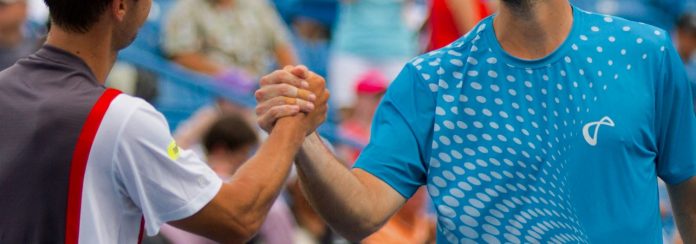
Quote of the Day: “I am a part of all that I have met.” – Alfred Lord Tennyson (born 210 years ago today)
Photo: Tennis players by mirsasha, CC license, cropped
With a new inspirational quote every day, atop the perfect photo—collected and archived on our Quotes page—why not bookmark GNN.org for a daily uplift?
Lucy Huber shares a sweet story of serendipity in this week’s edition of MOTH Monday, a Good News Network partnership that features videos from the nonprofit group, The MOTH, showcasing the art of storytelling.
After Lucy Huber decided that she wanted to propose to her boyfriend Matt, she carried the engagement ring in her purse for months on end, waiting for the right time.
When the right moment never came, she finally decided to create an elaborate game of riddles to take him down memory lane.
She orchestrated the riddles so that when Matt solved all the puzzles, he would be given a note that would say: “Would you marry me?”
In a sweet twist of fate, however, she never ended up giving him the note—but that doesn’t mean that they didn’t end up getting married.
(LISTEN to the sweet story below…)
The Moth gives people an opportunity to tell a true story in front of a live audience, and sometimes their stories are chosen to air on the radio show, now celebrating its tenth year, and broadcasting on 485+ public radio stations—and on The Moth podcast, which is downloaded over 52 million times a year. The Moth’s third book, Occasional Magic: True Stories About Defying the Impossible is now available for purchase through your favorite booksellers.
Be Sure And Share This Sweet Story Of Serendipity With Your Friends On Social Media…
Researchers at Johns Hopkins Medicine may have just found the key to restoring hearing in people with irreversible deafness.
Using genetic tools in mice, researchers at Johns Hopkins Medicine say they have identified a pair of proteins that precisely control when sound-detecting cells, known as hair cells, are born in the mammalian inner ear. A report on the proteins was published in eLife.
“Scientists in our field have long been looking for the molecular signals that trigger the formation of the hair cells that sense and transmit sound,” says Dr. Angelika Doetzlhofer, associate professor of neuroscience at the Johns Hopkins University School of Medicine. “These hair cells are a major player in hearing loss, and knowing more about how they develop will help us figure out ways to replace hair cells that are damaged.”
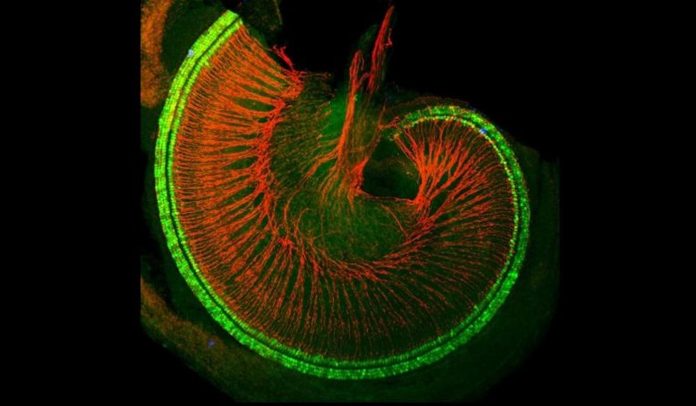
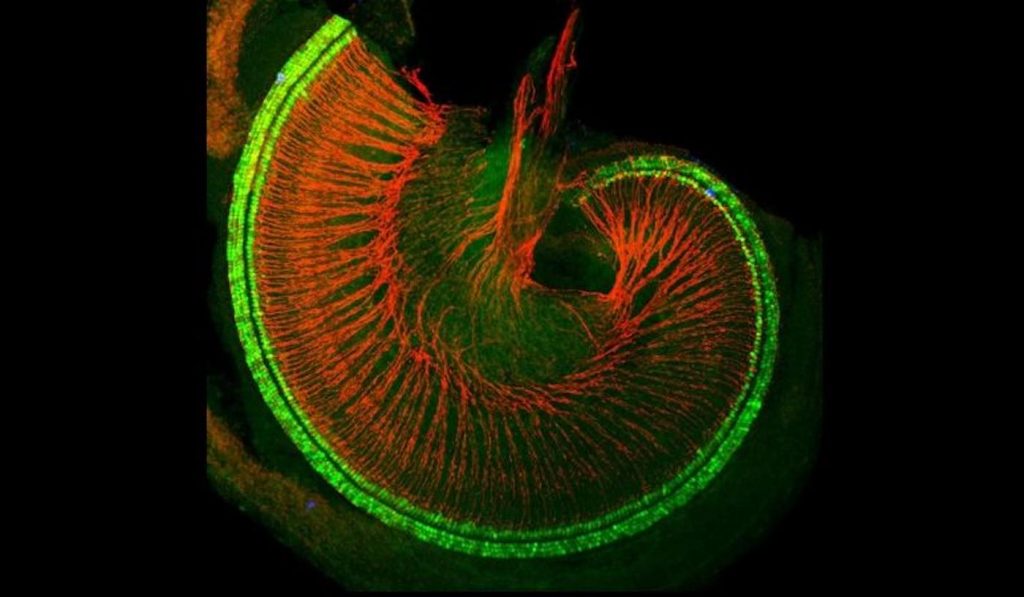
In order for mammals to hear, sound vibrations travel through a hollow, snail shell-looking structure called the cochlea. Lining the inside of the cochlea are two types of sound-detecting cells, inner and outer hair cells, which convey sound information to the brain.
An estimated 90% of genetic hearing loss is caused by problems with hair cells or damage to the auditory nerves that connect the hair cells to the brain. Deafness due to exposure to loud noises or certain viral infections arises from damage to hair cells. Unlike their counterparts in other mammals and birds, human hair cells cannot regenerate. So, once hair cells are damaged, hearing loss is likely permanent.
Scientists have known that the first step in hair cell birth starts at the outermost part of the spiraled cochlea. Here, precursor cells start transforming into hair cells. Then, like sports fans performing “the wave” in a stadium, precursor cells along the spiral shape of the cochlea turn into hair cells along a wave of transformation that stops when it reaches the inner part of the cochlea. Knowing where hair cells start their development, Doetzlhofer and her team went in search of molecular cues that were in the right place and at the right time along the cochlear spiral.
Mouse cochlea with hair cells shown in green and auditory nerves shown in red. Photo by Doetzlhofer Lab / Johns Hopkins Medicine
Of the proteins the researchers examined, the pattern of two proteins, Activin A and follistatin, stood out from the rest. Along the spiral path of the cochlea, levels of Activin A increased where precursor cells were turning into hair cells. Follistatin, however, appeared to have the opposite behavior of Activin A. Its levels were low in the outermost part of the cochlea when precursor cells were first starting to transform into hair cells and high at the innermost part of the cochlea’s spiral where precursor cells hadn’t yet started their conversion. Activin A seemed to move in a wave inward, while follistatin moved in a wave outward.
“In nature, we knew that Activin A and follistatin work in opposite ways to regulate cells,” says Doetzlhofer. “And so, it seems, based on our findings like in the ear, the two proteins perform a balancing act on precursor cells to control the orderly formation of hair cells along the cochlear spiral.”
To figure out how exactly Activin A and follistatin coordinate hair cell development, the researchers studied the effects of each of the two proteins individually. First, they increased the levels of Activin A in the cochleas of normal mice. In these animals, precursor cells transformed to hair cells too early, causing hair cells to appear prematurely all along the cochlear spiral. In mice engineered to either overproduce follistatin or not produce Activin A at all, hair cells were late to form and appeared disorganized and scattered across multiple rows inside the cochlea.
“The action of Activin A and follistatin is so precisely timed during development that any disturbance can negatively affect the organization of the cochlea,” says Doetzlhofer.
“It’s like building a house—if the foundation is not laid correctly, anything built upon it is affected,” she added.
Looking more closely at why overproduction of follistatin results in disorganized hair cells, the researchers found that high levels of this protein caused precursor cells to divide more frequently, which in turn made more of them convert into inner hair cells in a haphazard way.
Doetzlhofer notes that her research in hair cell development, although fundamental, has potential applications to treat deafness caused by damaged hair cells: “We are interested in how hair cells evolved because it’s an interesting biological question,” she says. “But we also want to use that knowledge to improve or develop new treatment strategies for hearing loss.”
When it was finally time for an airline pilot to retire from his decades-long career, the passengers on his final flight asked if they could give him an emotional Irish goodbye—and the results are breathtaking.
Brian Lenzen is a pilot from Chaska, Minnesota who has been happily flying with American Airlines for 34 years—but despite his love of flying, pilots are forced to retire at the age of 65.
So as Lenzen prepared to hang up his pilot’s uniform, he made sure that his last flight was a special one. With a hand-picked crew of beloved colleagues, he chose Dublin as his final destination and had a “wonderful time” at an Irish pub before they all returned home.
As fate would have it, there happened to be an Irish choir on board the plane for their returning flight. When they heard that it was Lenzen’s final flight, they asked an attendant if they could sing an Irish blessing to the pilot to celebrate his retirement.
Upon exiting the plane, the captain was then greeted by the St. Anthony on the Lake choir bidding him adieu—and he could barely contain his emotions.
“It was just a very special moment,” Lenzen told KARE11. “I’m kind of an emotional guy anyway, and so I got a little tearful realizing that was for me.”
(WATCH the video below)
Be Sure And Share This Sweet Story With Your Friends On Social Media…
As a means of providing clean drinking water to countless arid regions around the world, scientists have developed a new technique for filtering salt water using a thin piece of wood.
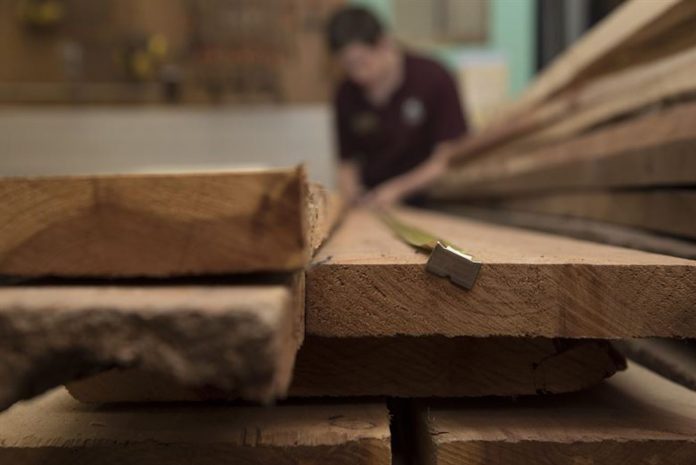
Inspired by the intricate system of water circulating in a tree, a team of researchers from Princeton University figured out how to use a thin slice of wood as a membrane through which water vapor can evaporate.
Rather than using massive amounts of energy to boil water for long periods of time, the filtration method works by gently heating one side of the wood—measuring in at 500 micrometers thick—so that the water is driven evaporate to the colder side of the wood, leaving behind salt or other contaminants.
Most membranes that are used to distill fresh water from salt water are made of polymers, which are derived from fossil fuels and are also difficult to recycle. The wood membrane is a more sustainable material, and according to the researchers, has very high porosity, which promotes water vapor transport and prevents heat loss.
In a paper published earlier this week in the journal Science Advances, the researchers demonstrate that the new membrane they designed—measuring in at 500 micrometers thick—performs 20% better than commercial membranes in water distillation tests.
Collectively, the wood membrane method filtered 20 liters of water per square meter, but the team believes that they will be able to improve the system with additional experimentation.
“If you think of traditional water filtration, you need very high-pressure pumping to squeeze the water through, so it uses a lot of energy,” Princeton researcher Jason Ren told New Scientist. “This is more energy efficient and it doesn’t use fossil-fuel based materials like many other membranes for water filtration.”
Clean Up Negativity By Sharing The Good News To Social Media – File photo by U.S. Airman 1st Class Sadie Colbert
When this little Canadian boy became trapped in a deep hole, he was finally rescued after search crews heard the sound of his giggles.
The 2-year-old youngster wasn’t giggling over his predicament, however—he was giggling with delight at the sight of the Royal Canadian Mounted Police riding horses to his rescue.
Courtlund Barrington-Moss first went missing during a family reunion in Aneroid, Alberta on a Monday evening last week. When his mother noticed that he had disappeared, over 400 people were recruited for the search and rescue mission, from volunteers and family members to emergency crews and a search plane.
Shelby Layman, the deputy fire chief of a neighboring town, told the Star Phoenix: “He saw them before they saw him, actually. He saw their horses and he started giggling and wanted to pet the horses.
“The entire area just erupted with joy. It was pretty emotional. Everybody was yelling and people were running around,” she added.
Photo by Keeley Moat
Upon being taken to the hospital, the boy was found to be sunburnt and scratched, but still in generally good health.
“He was honestly just exhausted and not really sure what had happened,” his mother told NBC News.
Be Sure And Share The Good News With Your Friends On Social Media…
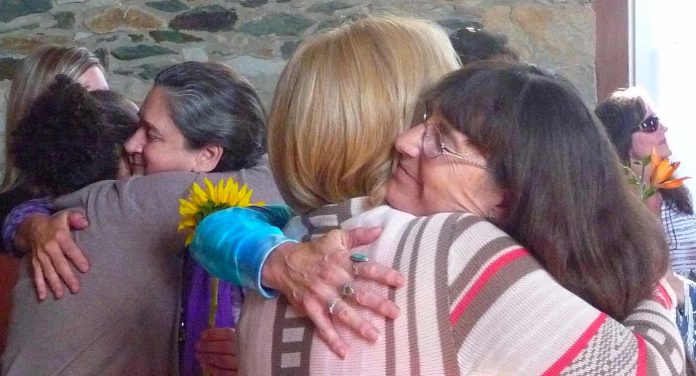
Quote of the Day: “Those truly linked don’t need correspondence. When they meet again after many years apart, their friendship is as true as ever.” – Deng Ming-Dao
Photo: by GWC Copyright 2014
With a new inspirational quote every day, atop the perfect photo—collected and archived on our Quotes page—why not bookmark GNN.org for a daily uplift?