Quote of the Day: “Painting is poetry that is seen rather than felt, and poetry is painting that is felt rather than seen.” – Leonardo da Vinci
Photo: Vancouver mural by GoToVan, CC license on Flickr
With a new inspirational quote every day, atop the perfect photo—collected and archived on our Quotes page—why not bookmark GNN.org for a daily uplift?
After a Canadian hiker used a Metallica song to scare away a hungry cougar in the mountains, she received an unexpected phone call from her Heavy Metal hero.
LISTEN to the inspiring story told on the radio by our GNN founder (in the Good News Guru podcast below) or READ the full story below…
Dee Gallant made international headlines last week after she told reporters about how she and her dog Murphy had been stalked by a big cat on Vancouver Island.
When her initial attempts to scare the cougar failed to work, she resorted to blasting “Don’t Tread On Me” from her phone at full volume—and to her delight, the cougar immediately freaked out and ran away.
Gallant jokingly told reporters that she hoped to one day meet Metallica frontman James Hetfield so she could thank him for saving her life. Shortly after her story went viral, she received a call from the band’s liaison saying that someone would soon be in touch with her.
A few days later, she got a call from an unknown number—and it was none other than James Hetfield calling to chat with his fan and congratulate her for surviving the cougar encounter. He even sent her a selfie after the phone call with a text that said: “Thought you might like some confirmation that it was me.”
“I was a little bit lost for words,” Gallant told CTV News. “The fact that he’s so down to earth and such a great person, I’m very pleased to find that out first-hand.”
“If you had told the 18-year-old me that this would happen, I never would’ve believed it. I would’ve just fallen out of my skin with excitement,” she added.
With flotation therapy emerging as a trailblazing new form of treatment for PTSD, these clinics have given away thousands of free therapy sessions to veterans and military members—and are set to give away thousands more.
Since 2015, True REST Float Spa has given away almost 3,000 free float sessions to US active-duty military and veterans.
To show further support for the sacrifices made by men and women who serve in the US military, the spa has also designated every 11th day of the month—every month—as US Military Appreciation Day, and they offer free, 60-minute floats to any active-duty military member or veteran.
Calling itself the world’s largest floatation therapy brand, with 112 locations and 15 more opening this year, True REST Float Spa has challenged the Department of Veterans Affairs to seriously examine floatation therapy as a covered treatment for PTSD and depression because they believe it reduces the need for other methods of relief, which are not as holistic.
PTSD, depression, panic disorder, social anxiety disorder, stress, and other pain-related conditions have been on the rise in the military community. Rather than treating them with medication, however, clinical studies have shown that float therapy in a sensory deprivation pod is an impactful alternative for people with such conditions.
When a person floats, they lie absolutely still on top of a specialized Epsom salts water solution with zero stimulation. There are no distractions such as movement, sound, light, taste, touch and smell, so areas of the brain responsible for these activities are essentially turned off. The water temperature is calibrated where the air, water and body match perfectly. Because floating creates a weightless sensation, the spinal cord receives respite as well.
Dr. Justin Feinstein, director of the Float Clinic and Research Center at the Laureate Institute for Brain Research, described at the 2018 Float Conference how he had conducted a randomized controlled trial of 20 healthy patients and 37 patients who suffered from anxiety across the spectrum, many who suffered from co-morbid depression (in tandem with another illness).
The patients were randomly selected for two experiences: a float therapy session or watching a DVD of BBC Earth. Every patient did both selections for 90 minutes. Feinstein measured EEG brain waves, electrocardiogram waves and blood pressure during the float and the DVD. He took blood samples before and after each experiment.
What he discovered after the study was that all patients experienced an increase in serenity—or mood—and relaxation post-float; muscle tension and anxiety significantly decreased post-float, dramatically more than those who participated in the Earth study. Additionally, during the float, patients realized improvement with their high frequency heart rate variability, and diastolic blood pressure improved.
Feinstein said, “This is the anti-anxiety effect of floating.” He was also able to state with 95% confidence that the reduction in the patients’ stress, anxiety, and serenity levels continued up to 20 hours post-float.
In April, the National Institute for Health via the National Center for Complementary and Integrative Health funded the first ever floatation therapy research grant. This R34 grant will allow Feinstein to further study the long-term effects of floating on patients with anxiety and depression and research this therapy as an intervention approach for anxiety, addiction and anorexia.
“We must look at alternative wellness therapies … Clinical research and published studies, time after time, prove the pain-relieving effects and mental wellness benefits of floatation therapy,” said True REST Float Spa CEO James Rowe.
In May, the U.S. House of Representatives passed H.R. 2359: Whole Veteran Act which would direct the Department of Veterans Affairs to study alternative health services that it currently offers and determine the amount it would cost in order to expand those services throughout the Veterans Health Administration. They want veterans to try a combination of old and new treatment methods, and use treatments like yoga, meditation and acupuncture before drugs. The bill is awaiting the Senate’s vote.
If This Story Floats Your Boat, Be Sure And Share It With Your Friends On Social Media…
Back in 2016, Janet Fanaki’s family was hit with the devastating news that her husband Adam had been diagnosed with glioblastoma, the most aggressive form of brain cancer.
The two share the same birthday and were 47 years old at the time.
“It was like a bad dream,” said Fanaki. “As soon as we knew why he was experiencing the symptoms we made it our priority to gather the best team around us for support.”
The couple spent all of their available time researching the right medical professionals for Adam’s condition. This led him to undergo a full craniotomy at St. Michael’s Hospital in downtown Toronto, as well as radiation and chemotherapy at Sunnybrook Health Sciences Centre.
Fortunately, the surgery was successful in removing the tumor and the treatments that followed were able to keep the disease at bay.
With the many hours that Fanaki spent watching people in the cancer center, she decided to create Resilient People: a website dedicated to telling the stories of extraordinary people admired for their resilience; the people who have experienced something life-changing and are showing that life can still be fantastic.
As a former public relations professional, Janet wrote stories on behalf of her clients about their products and services, but uses those skills to tell stories of “EXTRAordinary people”.
“I have met some amazing individuals who have overcome and bounced back from adversity,” says Fanaki. “A teenager with autism who is a world-renowned artist; a man who created a foundation to comfort cancer patients in the wake of his wife’s passing; and a woman who became an outspoken HIV/AIDS and hospice advocate when her husband passed away from the disease.”
“The website is inspiring to others, but I am constantly motivated by the people I meet and get to interview.
“We all need to help each other to stay hopeful,” Janet told Good News Network.
“I hope that the stories I share on Resilient People will motivate someone to get out of their rut and do something positive with the negatives in their life.”
Share The Inspirational Website With Your Friends On Social Media…
Despite how tourists are generally warned against interacting with wildlife, conservationists have actually started encouraging people to take selfies with this adorable Australian critter.
Thousands of travelers have been visiting Rottnest Island in order to get a picture with the quokka, which is a species of wallaby renowned for being cute and camera-ready.
The island is home to the largest population of quokkas—and even though tourists are not allowed to touch any of the animals, they are emboldened to take pictures with the little marsupial.
Since quokkas are happy to hang around humans, the critters have posed for plenty of pictures—and the photos have reportedly helped raise funds and awareness for the vulnerable species.
(WATCH the Great Big Story video below)
Be Sure And Share This Cute Conservation Story With Your Friends On Social Media…
Quote of the Day: “The sea is dangerous and its storms terrible, but these obstacles have never been sufficient reason to remain ashore.” – Ferdinand Magellan (500 years ago today launched the first circumnavigation of the globe)
Photo: ‘Voyage” by Cathrine, CC license on Flickr
With a new inspirational quote every day, atop the perfect photo—collected and archived on our Quotes page—why not bookmark GNN.org for a daily uplift?
Since this adorable 8-week-old puppy was born with six legs, there was a strong chance that her breeders were going to have her euthanized.
Now that she has been rescued by a loving family, however, the energetic pup is now bringing joy to a boy who is bullied for his skin condition.
Since the Labrador-mix puppy was born with two extra front legs that hinder her gait, she hops around on her back legs like a kangaroo—that’s why her new owner, 15-year-old Luke Salmon, named her Roo.
“When she jumps up on us she looks like a kangaroo, hence the name,” said Luke’s mother Lauren Salmon. “But when she walks, she sort of staggers on her elbows with her bum in the air, like an army crawl.”
Salmon, who is from Orpington, Kent, bought Roo from breeders in Essex two weeks ago after Luke spotted the special pup online.
When Luke and his mum went to collect Roo, she came “bounding out” of her puppy pen and jumped up at the pair on her hind legs.
SWNS
“It was love at first sight for Luke and Roo from then on,” says Salmon. “Luke is like a protective father. They never leave each other’s sides and she even sleeps in his bed.”
Since Luke suffers from psoriasis—a condition which leaves the skin covered in flaky red patches—he has often been bullied for his disorder at school.
But having Roo as his new canine companion has brought a whole new realm of therapy to Luke’s life.
“Luke feels like the odd one out because of his condition, and now he’s got a best friend to match,” says Salmon. “I think Roo will reduce Luke’s stress and that should help his skin.”
SWNS
Lauren has now contacted Dr. Noel Fitzpatrick—the specialist who stars in Channel 4’s The Supervet—to see if he can help to improve Roo’s mobility, because her extra legs get in the way when she’s walking.
Salmon’s vet was relieved when they asked for Roo to be referred to The Supervet because she feared that they would want the pup to be put down.
“We absolutely love Roo to pieces,” insists Salmon. “She’s is just a normal dog to us—just with a couple of extra bits.
SWNS
Salmon is now waiting to hear back from the doctor after he reviews a report and pictures of Roo’s extraordinary legs.
“Her special legs don’t cause her any pain, and it’s easy to see just how full of life she is. She’s full of puppy energy, so we’d describe her as placid but playful.”
Be Sure And Share This Pawesome Story With Your Friends On Social Media…
Hyundai Motor is launching its first car with a solar roof charging system.
The groundbreaking eco-friendly technology will provide vehicles with additional electrical power, as well as increasing fuel efficiency and driving range.
Hyundai Motor’s solar roof charging system makes its debut on the New Sonata Hybrid. The system supports the vehicle’s electric power source, improving fuel efficiency and reducing CO2 emissions.
The solar roof system includes a structure of silicon solar panels that are mounted on the car’s roof. Being able to charge even while driving, the solar roof system can charge 30 to 60% of the battery per day. With 6 hours of daily charging, it is expected to increase drivers’ travel distance by an extra 1,300 kilometers (800 miles) annually.
The system is composed of a solar panel and a controller. Electricity is produced when solar energy activates the solar panel’s surface, which converts this energy by using photons of light from the sun. This creates the electron-hole pairs in silicon cells, which generate solar electricity.
The electricity from this process is converted to the standard voltage by the controller, then stored in the battery. Hyundai Motor took not only efficiency but also design into account while developing the solar charging system.
While the solar roof system currently plays a supporting role, it opens up perspectives for vehicles no longer need fossil fuel to operate.
In the coming years, Hyundai will roll out the technology to other vehicles across its range. This is the latest application of a smart solution from Hyundai advancing the mobility industry towards a more sustainable future.
“Solar roof technology is a good example of how Hyundai Motor is moving towards becoming a clean mobility provider,” said Heui Won Yang, Senior Vice President and Head of Body Tech Unit of Hyundai Motor Group.
“The technology allows our customers to actively tackle emissions issue. We are striving to further expand the application of the technology beyond eco-friendly vehicle line up to vehicles with internal combustion engine.”
The New Sonata is now on sale in Korea and will soon be sold in North America. Hyundai currently has no plans to expand sales of this model to the European market.
Power Up With Positivity By Sharing The Good News To Social Media…
This latest Major League Baseball announcement is a dream come true for sports fans—or more specifically, it’s a field of dreams come true.
As an homage to the 1989 Kevin Costner cult classic Field of Dreams, MLB is building a temporary 8,000-person stadium on the actual patch of farm land that was used for the film.
The stadium, which is being built on the movie site in Dyersville, Iowa, will allow spectators to watch the White Sox play the Yankees on August 13th, 2020.
Construction will begin on the stadium on August 13th, 2019—exactly one year before the game is set to take place and roughly 30 years after the film was released. It is also set to be the first ever MLB game to take place in Iowa.
“As a sport that is proud of its history linking generations, Major League Baseball is excited to bring a regular-season game to the site of Field of Dreams,” Commissioner Rob Manfred said.
“We look forward to celebrating the movie’s enduring message of how baseball brings people together at this special cornfield in Iowa.”
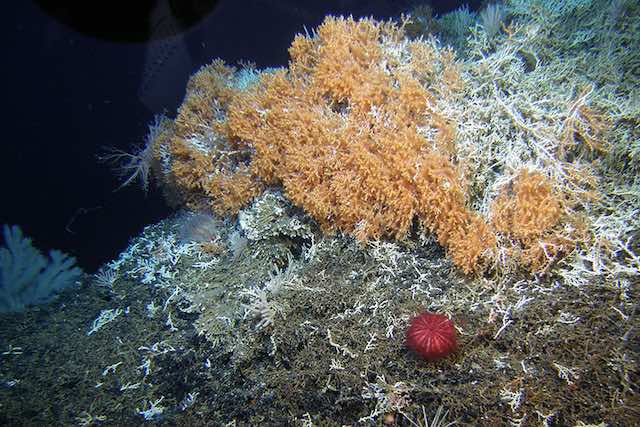
A young colony of H. laauense amid a bed of other octocorals. (Photo by A. Baco-Taylor FSU, E.B. Roark TAMU, NSF, with HURL Pilots T. Kerby and M. Cremer)
For decades, overfishing and trawling had been devastating parts of an underwater mountain range in the Pacific Ocean near Hawaii, wrecking deep-sea corals and destroying much of their ecological community.
But now, after years of federally mandated protection, scientists see signs that this once ecologically fertile area known as the Hawaiian-Emperor Seamount Chain is making a comeback.
Because of the slow-growing nature of the corals and sponges that live on seamounts, “It’s been hypothesized that these areas, if they’ve been trawled, that there’s not much hope for them,” said Florida State University Associate Professor of Oceanography Amy Baco-Taylor.
“So, we explored these sites fully expecting to not find any sign of recovery. But we were surprised to find evidence that some species are starting to come back to these areas.”
“This is a good story of how long-term protection allows for recovery of vulnerable species,” she added.
Baco-Taylor and a team from Florida State and Texas A&M University published their findings this week in the journal Science Advances.
The Hawaiian-Emperor Seamount Chain is a mostly underwater mountain range in the Pacific Ocean. From the 1960s through the 1980s, the area was a hotbed for fishing and a practice called trawling, where fishermen use heavy nets dragged along the seafloor to capture fish. In the process, the nets scrape other animals off the seafloor as well.
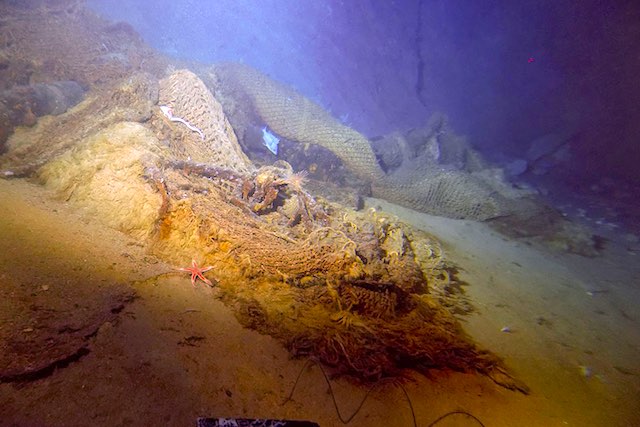
Lost trawl net from on the NW Hancock Seamount at a depth of 400 meters. (Photo by A. Baco-Taylor FSU, E.B. Roark TAMU, NSF, with HURL Pilots T. Kerby and M. Cremer)
The practice of trawling has devastated seamounts around the world and scientists have generally believed that an ecological recovery was unlikely. However, in the case of the Seamount Chain, there is a glimmer of hope.
Baco-Taylor and her colleagues led four research cruises out to the central and north Pacific Ocean to investigate the ecological communities of the region.
They specifically wanted to examine whether there was any recovery of life on the seamount chain because unlike other submerged mountain chains around the world, this one had been federally protected from fishing and trawling for decades.
In 1977, the United States claimed the region as a part of the U.S. Exclusive Economic Zone, which prevented foreign fleets from trawling the area. In 2006, then President George W. Bush included the area as part of the Papahānaumokuākea Marine National Monument, further protecting it from human disturbance.
“People started realizing how vulnerable seamounts were relatively recently, so seamounts in other locations have only been protected for 5 to 15 years,” Baco-Taylor said. “Establishment of the zone in this region, has provided protection for these sites for close to 40 years, providing a unique opportunity to look at recovery on longer time scales.”
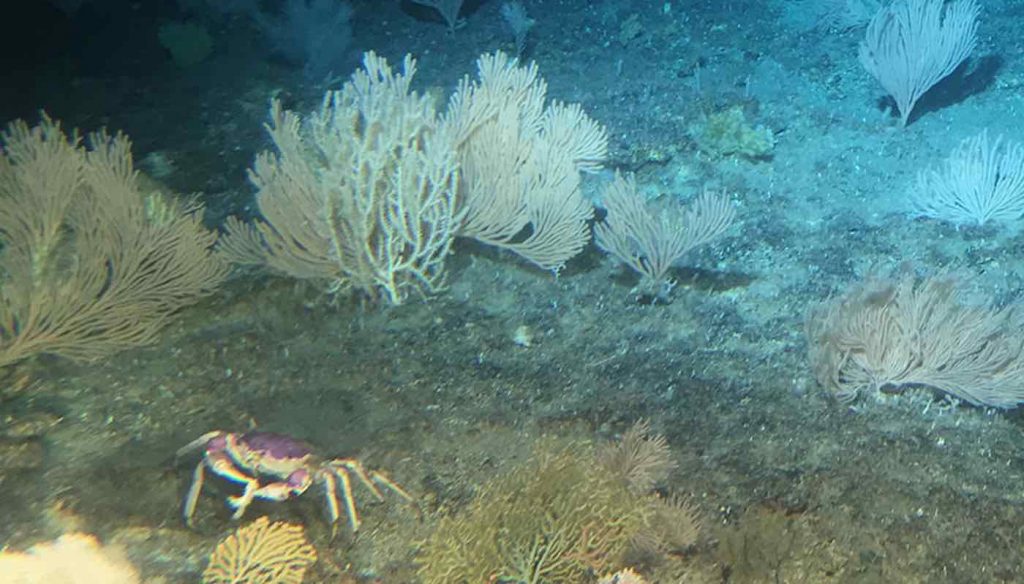
Through the four research visits, scientists sent an autonomous underwater vehicle and used a human-occupied submersible to explore sites along the chain and to photograph the seamounts roughly 300 to 700 meters below the surface.
A young colony of H. laauense amid a bed of other octocorals. (Photo by A. Baco-Taylor FSU, E.B. Roark TAMU, NSF, with HURL Pilots T. Kerby and M. Cremer)
The team analyzed 536,000 images. In them, they could not only see the remnant trawl scars on the seafloor, they also saw baby coral springing up in those areas. They could also see coral regrowing from fragments on fishing nets that were left on the seafloor.
“We know the stuff growing on the net had to come after this practice stopped in the area,” Morgan said.
Most importantly, they found evidence of a few precious areas that were not harmed by the trawling. These untouched areas are crucial to further populating the seamounts with a variety of fauna, researchers said.
It’s too early to say how long it took for the new coral to arrive and whether the area will return to its former glory. Scientists are still analyzing coral samples to determine the age and diversity of species in the area; although, the researchers said this study and the ongoing work provides critical knowledge for policymakers examining the effectiveness of protecting these areas.
A patch of recovering scleractinian reef on the SE Hancock Seamount at 650m. (Photo by A. Baco-Taylor FSU, E.B. Roark TAMU, NSF, with HURL Pilots T. Kerby and M. Cremer)
The news is also a particularly welcoming followup to a January report detailing how Hawaiian coral reefs were finally stabilizing after the mass coral bleaching events of 2015.
Furthermore, a recent study from the University of Queensland examined how an unexplained phenomenon that makes coral spawn more than once a year is improving the resilience of the Great Barrier Reef.
The discovery was made by university researchers investigating how split spawning events can increase the reliability of larval supply as the reefs tend to be better connected and have more numerous, as well as more frequent, larval exchanges.
“This means that split spawning can increase the recovery potential for reefs in the region,” said Dr. Karlo Hock, from UQ’s School of Biological Sciences.
“A more reliable supply of coral larvae could particularly benefit reefs that have recently suffered disturbances, when coral populations need new coral recruits the most.
“This will become more important as coral reefs face increasingly unpredictable environmental conditions and disturbances,” he added.
It’s Not Hard To Sea That You Should Share This Good News With Your Friends On Social Media…
An airline passenger was left “sobbing with happy tears” after she witnessed a man’s compassion towards a frightened elderly woman on their flight.
Megan Ashley had been flying from San Diego to Nashville last month when she overheard a 96-year-old woman saying that she was anxious because she had not flown in 15 years.
When the plane began to take off, the elderly woman asked the young man sitting next to her if she could hold his hand.
“She asked for this man’s hand during takeoff and then hugged him again when experiencing turbulence,” says Ashley. “This gentleman I should say, gladly took her hand, let her hold onto him, calmed her by talking to her and explaining everything that was happening … he helped her stand up to go to the restroom and watched her carefully walk down the aisle.
“He knew just what to do the entire flight to help,” she continued. “This man was her flight angel.”
The man didn’t just show the woman compassion for the duration of the flight, either; after they got off the plane, he insisted on holding her bag, helping her into a wheelchair, and staying with her until she had reunited with her daughter.
Ashley was so touched by the incident, she snapped several photos of the exchange and posted them to Facebook so she could praise the young man for his kindness.
“I walked away sobbing happy tears being so thankful for people like this wonderful human. She was so grateful that she wanted him to have her in-flight pretzels,” wrote Ashley. “Hats off to you sir, for your kind heart and your compassion toward someone whom you’ve never met. I have never been so touched on a flight before. This truly made my week.”
Since Ashley published the photos to social media, they have been shared thousands of times by empathetic internet users.
Fly This Sweet Story Of Kindness Over To Your Friends By Sharing It To Social Media…
Quote of the Day: “Never interrupt someone doing what you said couldn’t be done.” – Amelia Earhart
Photo: by Caitlin Regan, CC license
With a new inspirational quote every day, atop the perfect photo—collected and archived on our Quotes page—why not bookmark GNN.org for a daily uplift?
Everybody says that dogs are man’s best friend, but we beg to differ.
In celebration of International Cat Day, we have put together our top ten favorite stories of cat heroes, heartwarming furry friendships, and feline shenanigans.
So without any ado, here is a list of the best GNN cat stories for this hallowed day of feline fervor.
An injured Hungarian tourist would have had to spend a frosty night in the mountains if it hadn’t been for this friendly little feline leading him to safety.
The hiker had sprained his ankle on one of the many mountain trails of the Bernese Oberland in Gimmelwald, Switzerland. The path that led back to his hostel had just been closed, leaving him lost and stranded in the Alps.
That’s when a black and white cat crossed his path.
We have no idea who this man was, where he was going, or why he was carrying a kitten in his arms—all we know from this image is that he may be the happiest man ever to ride a bus.
Are you a fan of cats? Are you a fan of art and novelties? Then boy, do we have the place for you.
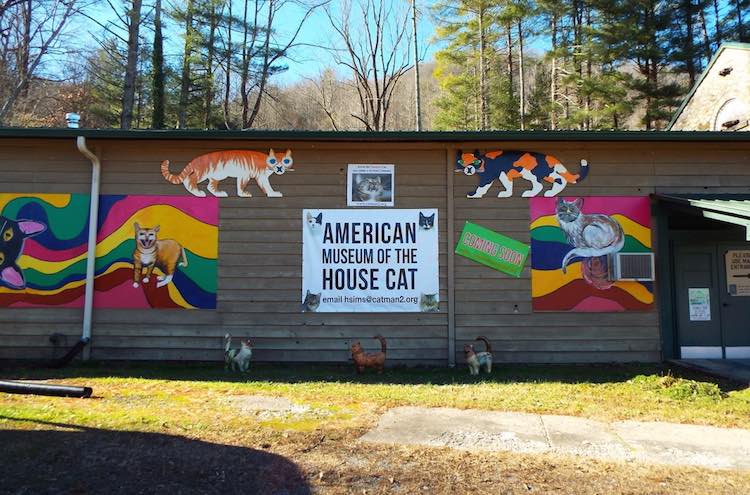
The American Museum of the House Cat in Sylva, North Carolina is exactly what it sounds like: a quirky roadside attraction containing over 10,000 artifacts, art pieces, novelties, and products devoted to the domesticated house cat.
Some people enjoy singing in the shower—but not Pepé the cat.
Pepé apparently hates when her owner Brad Johnsen sings in the bathtub—and that is exactly why he posted a hilarious Youtube video of himself doing just that.
Back in 2018, Billy Browne published a Youtube video explaining how he had been forced to give ear drops to his cat Rufus as a means of treating a nasty ear infection.
Unfortunately, the drops were quite painful and Rufus was less than reluctant to endure the 2-week treatment.
So as a means of reconciling with his beloved feline, Browne built him a castle out of his cardboard boxes. The best part? Rufus actually defied typical feline stereotypes and loved the elaborate fort.
Everybody makes mistakes—even international ambassadors, judging by the contents of an amusing email that was sent out by the US Embassy in Australia back in October.
Social media users were marveling over the email that was sent out by the embassy containing an image of a cat dressed in a Cookie Monster costume holding a plate of pastries. The subject line of the email simply read: “Meeting,” while the image was coupled with an RSVP tab and a caption saying “cat pajama-jam party.”
Cats kill a staggering number of birds in the U.S. every year—estimated to be in the billions—but one feline’s affinity for hunting them has inadvertently led to the salvation of hundreds of thousands of other feathered prey.
In a video that has been shared across the internet, a feline can be seen perched atop of a cabinet in a veterinary office with a kitty bed clutched in its mouth.
With the fearlessness of a trained athlete, the cat jumps from the cabinet onto a table below—and lands perfectly inside of the bed.
Be Sure And Share These Purrrrfect Stories With Your Friends On Social Media…
Iconic Hollywood actor Danny Trejo has just proved that he is more than capable of doing his own real-life stunts after he witnessed a car crash earlier this week.
Trejo, who is best known for his roles in Heat, Con Air, Breaking Bad, and Desperado, was driving through Los Angeles when he watched a woman accidentally speed through a red light and collide with another car.
The 75-year-old actor immediately jumped out of his own vehicle and rushed to the family trapped inside of the overturned car.
Upon approaching the vehicle, Trejo says that the woman was calling for bystanders to help her young special needs son who was still strapped into his car seat.
Trejo and another bystander then pulled the door open and managed to free the youngster from his seatbelt.
As firefighters and first responders rushed to the scene to rescue the mother and grandmother who were still trapped inside the car, Trejo brought the boy away from the scene of the crash and kept him distracted until his family members were freed.
Trejo later told KABC that he was able to form a comforting connection with the boy based on his past experience with special needs kids.
“He was panicked. I said OK, we have to use our superpowers. So he screamed ‘superpowers’ and we started yelling ‘superpowers,” Trejo told the news outlet. “I said do this, with the muscles. He said ‘muscles.’ We got kind of a bond.”
Thankfully, the Los Angeles Fire Department said that no one suffered any life-threatening injuries from the collision, although Trejo is now being hailed as a hero for his quick intervention.
(WATCH the interview below)
Save Your Friends From Negativity By Sharing The Inspiring Story With Your Friends On Social Media…
Peyton Madden is just your average kid who likes superheroes, playing with his friends, and biking around his neighborhood.
The difference between him and his friends, however, is that Peyton is allergic to sunlight.
The youngster from El Dorado, Kansas was diagnosed with a rare genetic disease called xeroderma pigmentosum when he was just 3 years old. The condition, which only affects about 250 people in the United States, makes it so that Peyton’s skin can’t repair itself after being in the sun. Whenever he does go outside during the daytime, he has to wear protective clothing over every inch of his skin.
While the disorder does prevent Peyton from participating in activities that we take for granted, his town wasn’t going to stand by and let him miss out on all the fun.
Back in 2017, the citizens of El Dorado partnered with the National Organization for Rare Disorders (NORD) so they could orchestrate a special day for Peyton in which they turned “daytime into nighttime”.
Peyton had no idea what was in store for him until he biked into town and found that every member of the community had shown up in full force to give him a “day” that he would never forget.
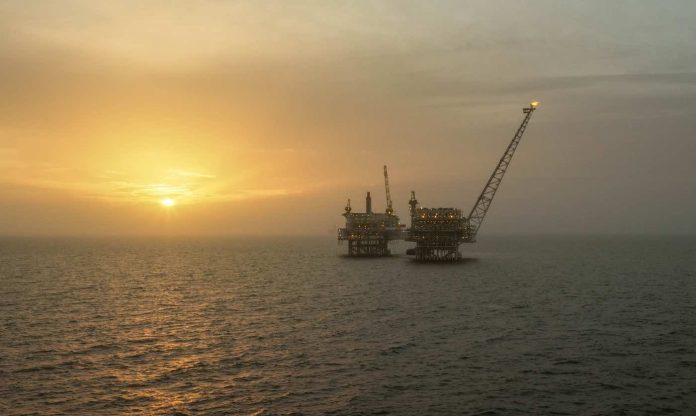
Rather than spending millions of dollars to decommission oceanic oil and gas rigs, new research suggests that they could be used to combat the climate crisis.
A new study from the University of Edinburgh says that North Sea oil and gas rigs could be modified to pump vast quantities of carbon dioxide emissions into rocks below the seabed.
The researchers say that refitting old platforms to act as pumping stations for self-contained CO2 storage sites would be 10 times cheaper than decommissioning the structures.
The sites would store emissions generated by natural gas production, and could also be used to lock away CO2 produced by other sources—such as power stations—helping to combat climate change.
The scientists analyzed data from the Beatrice oilfield—15 miles off the north east coast of Scotland. They found that existing platforms could be re-used as storage sites by making minor modifications.
Using a computer model, they worked out that, over a 30-year period, the scheme would be around 10 times cheaper than decommissioning the Beatrice oilfield, which is likely to cost more than £260 million ($316 million).
Large amounts of natural gas and heat energy can still be extracted from saltwater in exhausted oil and gas fields, the team found. The gas can be used as a fuel or burnt on platforms to generate electricity.
Mixing the saltwater from the oil field with CO2 produced by burning the gas enables it to be injected deep underground for permanent safe storage, researchers say.
The scheme would bring down the costs of storing carbon emissions and postpone expensive decommissioning of North Sea oil and gas infrastructure, the team says.
Lead author Jonathan Scafidi, of the University of Edinburgh’s School of GeoSciences, said: “Removing platforms at large expense is short-sighted. Re-using them to dispose of CO2 in rocks several kilometers beneath the seabed will not only be cheaper, but provides a cost-effective means of cutting the UK’s CO2 emissions to meet the 2050 net-zero target.”
Dr. Stuart Gilfillan, also of the School of GeoSciences, who co-ordinated the study, said: “Our study shows, for the first time, that natural gas production from saltwater can be combined with CO2 storage in the North Sea.
“The potential revenue provided by extending natural gas production in the North Sea could help kick-start a world-leading carbon capture and storage industry in the UK,” he added.
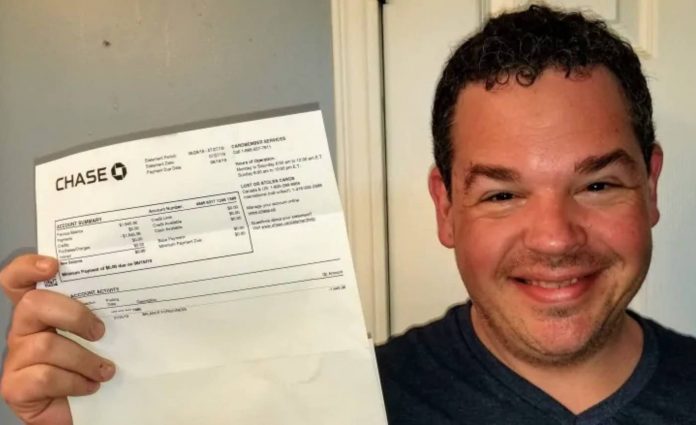
It’s not often that banks are praised for their compassion, but Canadian credit card holders are rejoicing over their bank’s recent decision to forgive all outstanding debt on two of their old Visa programs.
After spending a little over a decade in the Canadian credit card market, US-based Chase Bank opted to retire their Amazon.ca Rewards Visa and their Marriott Rewards Premier Visa in March 2018.
As of last week, there were still Canadian cardholders who were making payments on their outstanding card debt—but Chase, rather than selling the debt to third party-collectors, sent letters to all of their Canadian customers this week explaining that their debt had been forgiven.
“Ultimately, we felt it was a better decision for all parties, particularly our customers,” Chase spokesperson Maria Martinez said in an email to CBC.
Despite how financial analysts have been confused by the bank’s decision to forgive the debt, Canadian customers are still in disbelief over their good fortune.
“Its crazy,” one customer told the Canadian news outlet. “This stuff doesn’t happen with credit cards. Credit cards are horror stories.”
Though Chase declined to say how much debt had collectively been wiped out by their decision, their former Amazon credit card boasted a 19.9% interest rate—and some Canadian cardholders told CBC that they had been forgiven for as much as $6,000 in debt.
“I was sort of over the moon all last night, with a smile on my face,” another consumer told CBC. “I couldn’t believe it.”
Bank On Positivity By Sharing The Good News To Social Media — Photo by Paul Adamson
Quote of the Day: “One good conversation can shift the direction of change forever.” – Linda Lambert
Photo: by GWC copyright 2015
With a new inspirational quote every day, atop the perfect photo—collected and archived on our Quotes page—why not bookmark GNN.org for a daily uplift?
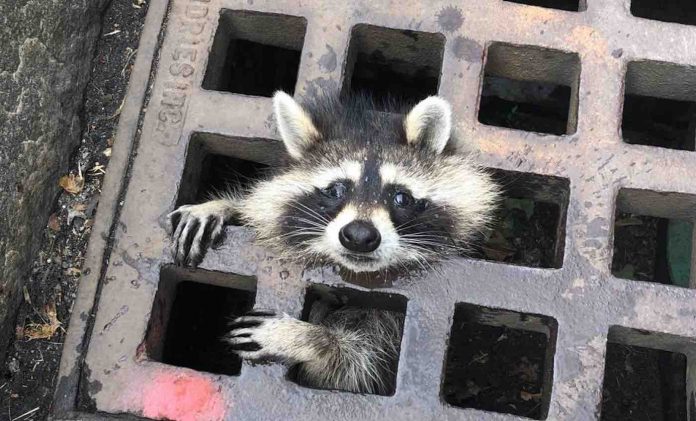
These Massachusetts firefighters have had plenty of experience rescuing people from sticky predicaments—but this helpless raccoon proved itself to be in quite a pickle.
The distressed critter, who was spotted by a bicyclist in Newton, Massachusetts earlier this week, had gotten its head stuck firmly in between the bars of a sewage grate. With both of its paws holding onto the grate for support, rescuers say that the raccoon had apparently been stuck for “quite a while” before help arrived.
Despite how none of the firefighters at the Newton Police Department were trained for this kind of rescue, they rushed to rescue the raccoon from its plight.
“We rescue citizens both big and small,” the department later wrote on Twitter.
To their surprise, it took two hours and eight different people to safely dislodge the raccoon from the grate.
Ordinarily, firefighters use soapy water to free people who have gotten themselves stuck, which they say “works 99% of the time”. They were dismayed, however, when the same technique failed to work on the raccoon.
The raccoon was escorted to a nearby wildlife rehabilitation center so it could be monitored until it is ready to be released back into the wild.
After the fire department posted photos of the rescue mission to Twitter, they received heaps of praise from internet users for saving the coon—but even though the humble civil servants say that it was “quite the operation”, they insist that they are “always willing to help their 4-legged friends.”
Always willing to help our 4 legged friends! It was quite the operation. https://t.co/wgFXzrhnWQ
A Finnish company is saying that they have managed to create “food out thin air”—and it could be hitting our grocery store shelves within the next two years.
The engineers at Solar Foods have succeeded in making a protein powder using only CO2, water, vitamins, and renewable electricity.
The powder, which they have called Solein, was created using technology that was developed by NASA. It reportedly looks and tastes just like wheat flour, except it is made up of 50% protein.
Since the single-cell protein can be produced in an indoor environment, it is completely independent of weather and land conditions.
“Conventional food production wastes water at unsustainable and unreasonable levels. We wanted to fix that,” reads the Solar Foods website.
“Solein is 100 times more climate-friendly than any animal or plant-based alternative. Unlike conventional protein production, it takes just a fraction of water to produce 1 kilogram of Solein,” it continues. “As with water use, the same game-changing effect applies to land use efficiency as well, with Solein being 10 times more efficient than soy production by a metric of usable protein yields per acre.”
With the global commercial launch of Solein projected for 2021, Solar Foods say it will likely begin appearing in products like yogurts and protein meals—but they also say that it could quickly become a source of unlimited food for billions of people.
(WATCH the explanatory video from the Solar Foods CEO below)
Feed Your Friends Some Positivity By Sharing The Exciting News To Social Media…