The last remaining research chimpanzees in the U.S. government are headed for a retirement home.
The National Institutes of Health shut down most research on chimps in 2013, but kept 50 of the apes in case of a public health emergency. On Wednesday, NIH announced those last chimps would sent to a sanctuary to live out their lives in the midst of nature. Another 82 chimpanzees the NIH supports at other research laboratories will also be headed into retirement.
About 300 government chimpanzees have already been sent to Chimp Haven in Louisiana. It has a waiting list and animal advocacy groups are working with the NIH to find new homes for the newly retired research apes.
The federal government relied on chimps for research during the early days of the space program and for decades to test new drugs because the apes are genetically and biologically similar to humans. The need to use them for any kind of research has become increasingly rare in recent years.
Earlier this year, the Fish and Wildlife Service gave research chimpanzees the same protections it provides endangered species. The move banned all invasive research on chimps in the U.S.
“It’s time to say we’ve reached the point in the U.S. where invasive research on chimpanzees is no longer something that makes sense,” said Dr. Francis Collins, Director of NIH, told ABC News.
A historic medical breakthrough in Canada this month gives doctors an effective new way to treat diseases of the brain, including cancer, Alzheimer’s, and Parkinson’s.
A persistent obstacle to treating brain disorders and tumors has been the difficulty in delivering drugs to that location.
There is a natural barrier wrapped around the tiny blood vessels in the brain meant to keep toxins out. The problem is, this “blood-brain barrier” also prevents drugs in the blood stream from leaving capillaries and getting into the brain—until now.
Doctors in Toronto became the first to penetrate the blood-brain barrier. They used ultrasound waves and vibrating microbubbles which allowed life-saving drugs to pass through. Their new process allowed them to treat a woman’s terminal brain cancer.
“It will revolutionize the way we treat brain disease completely,” Dr. Kullervo Hynynen, Director of Physical Sciences at Sunnybrook Health Sciences Center, told CTV News in the video above. “It will give hope to patients who have no hope.”
Bonny Hall, had a tumor called a glioma, which is extremely difficult to treat surgically because it spreads out in a web within a large network of blood vessels. Patients don’t often survive because the complex surgery can rarely remove all the cancer. Chemotherapy isn’t very effective either, since only about 25% of chemo drugs reach the tumor due to the blood-brain barrier.
Researchers first injected Hall with cancer medications, then inserted tiny microbubbles into her bloodstream. They used ultrasound to cause the bubbles to vibrate in targeted parts of capillaries around her brain. The vibrating bubbles gently tore open tiny leaks in the capillaries, allowing the cancer medications to leak out of them and into brain tissue.
The damage is very temporary, with the capillaries healing and the blood-brain barrier restored within 12 hours after the procedure.
Breaching this barrier opens a new frontier for all doctors, not just those at Sunnybrook, who will test nine more patients before publishing their results.
Share This Breakthrough and Give the World Some Hope…
The world could learn a lot from this special education teacher in Florida.
He doesn’t start his lessons until he has complimented every student in his class — one at a time, with a high five as an exclamation point.
It’s part special education teacher Chris Ulmer’s unique way of boosting performance for kids with special needs. He spends the first 10 minutes of class telling each student what he likes about them.
He also uses videos and music to help his kids learn at Mainspring Academy in Jacksonville, Florida.
One of his songs teaches that they shouldn’t be afraid to ask for help finding books — or their courage.
“When it’s dark and scary, just grab your uncle Larry and ask for a little help,” one of his students sings as Ulmer strums away on a guitar.
He posts his videos to the “Special Books by Special Kids” Facebook page he started along with his students to teach everyone outside his classroom about the great kids found within.
“These children deserve to be heard, loved and appreciated,” Ulmer wrote in a post about one of his videos that has been viewed 36 million times. “The world needs to understand that in many ways, the children have it right. We need to learn from them.”
(WATCH the video below from Inside Edition) — Photo: Special Books by Special Kids, Facebook
Give Your Friends A Lesson In Inspiration, Share This…
Want to beat the crowds on Black Friday? One group has a deal that’ll lead you among towering redwood trees instead of looking up at big box stores.
The Save the Redwoods League is sponsoring free visits to 49 California state parks that feature the giant trees. The deal is good for one day, November 27, the day after Thanksgiving — one of the busiest shopping days of the year.
To take advantage of what they call “the best bargain you’re going to find this Black Friday,” just go to the League’s website to download and print an admission pass. It will save you the purchase price of eight to ten dollars per vehicle to get in.
An anonymous donor contributed $50,000 to pay for the day in the parks.
Minnesota state parks are also are offering free admission to 76 of its parks which usually charge five dollars per car. Missouri already offers free admission to its state parks year round, but it’s waiving camping fees for anyone who wants to spend Black Friday camping out in nature — rather than a crowded parking lot.
(The KNTV video below shows the Redwoods near San Francisco) — Photo: Daniel, CC; Allie_Caulfield, CC
People on the Scottish island of Bute are promising dozens of Syrian refugees “a wonderful life” when they arrive in the next few weeks.
In fact, they’re hosting a film screening of the holiday classic, “It’s a Wonderful Life” December 13 to welcome the new community members–and also raise money to help pay for their necessities.
Fifteen families, including 50 children, will be transported by ferry to the island in the coming weeks.
About 6,300 people live in Bute and many have been pitching in to help the new arrivals. A “skills bank” was set up for volunteers to lend talents such as teaching English, translating for the refugees, or simply befriending them.
The local council has set up a Refugee Resettlement Group that’s already made arrangements to house the Syrian families.
“I want Bute to be a place where people who come here with little more than the clothes they are standing in can feel safe and at home.” Craig Borland, editor of local paper The Buteman, wrote in a commentary.
We all know it’s part of your job when you’re a law enforcement officer–to protect and serve. But, serving egg sandwiches?
Two Dutch cops were making their rounds in Eindhoven, Netherlands on Friday when they responded to a call about a hypoglycemic mother suffering from low blood sugar.
After the mother was whisked off to the hospital, five little kids were left alone in the house without dinner.
Stepping up to the call of duty, the two unnamed police officers kept the kids entertained while they made fried egg sandwiches, fresh fruit, and even washed the sink full of dirty dishes.
Before an adult guardian arrived to look after the kiddos, the officers posted a smiling selfie to the Politie Eindhoven page on Facebook.
Don’t Forget to Share the Good Feelings With Friends…
The largest of Austria’s nine states now produces all of its electricity from renewable sources.
The premier of Lower Austria, which surrounds the city of Vienna, made the announcement November 5, to spark inspiration ahead of the international conference on climate change next month in Paris.
Home to 1.6 million people, Lower Austria has invested three billion dollars in new solar, wind, and biomass power plants, and refurbishing the critical hydroelectric stations on the Danube River.
The Danube’s massive flow through the state’s hydro plants generates two-thirds of the state’s electricity needs. The last fossil fuel plants were shut down and replaced this year by the newer renewables.
Your first reaction to some video montages may be, “Someone had too much time on their hands…” But after watching this one, you’ll be glad they put in the effort.
This amazing video pairs clips from a parade of old Hollywood musicals with matching beats from Mark Ronson and Bruno Mars’s “Uptown Funk,” so seamlessly, you’ll swear the hit song had to have been featured in “Singing in the Rain.”
Fred Astaire, Ginger Rogers and Gene Kelly are among the dozens of dancers who are spinning and tapping in perfect time with the modern groove.
The four people behind Nerd Fest UK plowed through hundreds of hours of classic movies to find just the right moves for the music. One of their members, Michael Binder, has written a book about film preservation and the group features links under this YouTube post asking others to donate to the cause.
This video may well revive a lot of old cinema, if younger generations are sufficiently moved by the moves.
A Michigan restaurant is offering a free feast and fellowship for the lonely on Thanksgiving — and it may be more crowded than the owner expected.
A passerby in Northville noticed the sign in the window of George’s Senate Coney Island offering free meals for anyone alone on Thanksgiving Day. He snapped a picture, posted it at Imgur, and thousands of people have seen the generous offer.
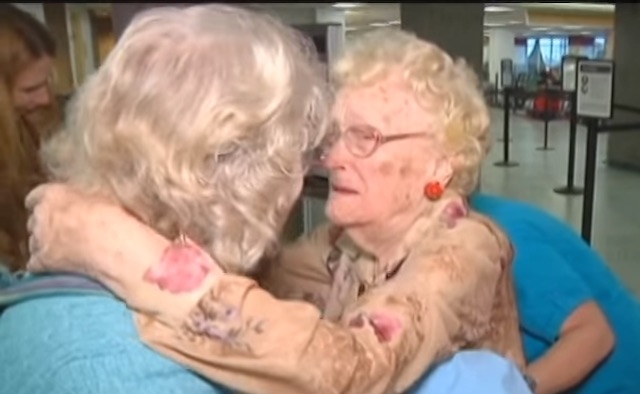
During Olive Horrell’s 97-year lifetime–especially her golden years–a lot has changed. She couldn’t keep up with all the recent technological breakthroughs and so had one bucket wish: to visit Google and see where they get all their good ideas.
Thanks to the Wish of a Lifetime organization that fulfills dreams for the elderly, Olive was given a VIP tour of the tech giant’s Mountain View, California campus where she gleefully experienced cruising in a self-driving car–and was thunderstruck while wearing virtual reality goggles.
The geeky grandma had wanted to be an engineer in her youth, but did not pursue it because her father, who worked in the field, said it wasn’t good for women.
Giddy with excitement, Olive wondered how she would keep up with the wonderful technology that surrounded her, which is how many of us feel sometimes.
Curious about the man’s dilemma, Officer Joyner asked what happened to his shoes.
After he explained that he simply didn’t own any, Joyner walked across the street to the shoe store to make a purchase.
Just as the policeman delivered a brand new pair of boots into the man’s hands, a woman walking by decided to turn on her camera phone and record the exchange.
“I just felt like the gentlemen simply was on hard times,” Joyner told KYW-TV. “He wanted to ride on the bus but he couldn’t afford shoes; there was no need for me to arrest him for that.”
The camera lady, Kayla Palmer, uploaded it to Facebook the next day where it has since received over 60,000 views.
Officer Joyner of the Delaware Port Authority is to be honored by Congressman Donald Norcross in Camden next Monday for his heartwarming act of kindness.
Your Friends Will Be Arrested By How Heartwarming This Story Is… Click To Share
After being on the endangered species list for the last 48 years, the Delmarva Fox Squirrel has bounced back from extinction.
Also called eastern fox squirrels, the large critters which mainly occupy the heavily wooded areas of the Delmarva peninsula in Maryland and Virginia, were at risk due to excessive hunting and logging.
The squirrels are now so abundant that they have expanded their range across the borders of Pennsylvania and New Jersey and increased their population to an estimated 20,000.
Fox squirrels are a larger subspecies of the more common tree-climbers, and can be recognized by their gray, hulking exterior.
Officials in the U.S. Fish and Wildlife Service say that if it hadn’t been for the protections given the fox squirrels under the Endangered Species Preservation Act in 1967, the steely forest dwellers would have died off, never to be seen again.
Pounce On Your Friends With This Story… Click To Share
Hair loss can be a challenge for anyone, no matter their age– but it can be especially heartbreaking for little girls who love their locks.
That’s why Holly Christensen began knitting up a solution for these heroic tots.
Using the long, flowing hairstyles of Disney princesses–and oodles of yarn in bright colors, Holly and her nonprofit known as The Magic Yarn project are crocheting caps that double as wigs for little girls coping with disease.
The yarn is woven into styles worn by famous female characters like Ariel from The Little Mermaid, Elsa from Frozen, and Jasmine from Aladdin. The strands are attached to crocheted beanies made of the softest yarn, so as not to irritate the child’s scalp.
Based in Alaska, the knitting project received donated yarn and beanies, and a staggering $23,000 in donations through their GoFundMe page. Originally managed by Holly and her church group, the organization has expanded to include volunteers from around the world, including female inmates at the Alaskan Hiland Mountain Correctional Facility.
It all started when 3-year-old Lily, the daughter of Holly’s friend, was diagnosed with cancer.
Christensen, being a mother of three and an oncology nurse in the past, knew that it wasn’t going to be easy for Lily to lose her beautiful curly blond hair. Jumping into action with her crochet hooks, Holly whipped up a Rapunzel wig just for Lily.
Inspired by the little girl’s ecstatic response, Holly kept right on knitting – The Magic Yarn Project is currently in production of hi-resolution how-to videos on crocheting the different wigs featured in photos on their website.
“I began to organize what I thought would be a small project creating a few dozen wigs to send to little cancer patients,” says Holly on the Magic Yarn website. “Within hours, I was flooded with responses from around the nation—what started as a small project has snowballed into something much bigger and has many people eager to help.”
(WATCH the video above, and Share This Yarn With Your Friends…)
Virginia has become the first state in the U.S. to be certified as effectively ending homelessness among military veterans.
By incorporating the principles of Housing First throughout the commonwealth, and providing support services to help veterans maintain stability, 1,432 homeless veterans have been housed since October 2014.
The state’s governor, Terry McAuliffe, announced in a ceremony last week that there is more permanent housing for any other veterans who may be found to be in need, and officials are moving to address homelessness in the general public next.
“On a day when we remember those who fought and died for our nation, I am proud to proclaim that Virginia is leading the way in the fight to end veteran homelessness,” said Governor McAuliffe. “This successful effort will serve as the launching pad for our next goal of functionally ending chronic homelessness among all Virginians by the end of 2017.”
The federal homelessness designation, which was earned by cities previously but never an entire state, means that the only homeless veterans in Virginia are those who have been offered housing, but do not want it.
In August, Connecticut became the first state to end “chronic homelessness” among vets, defined as being without a home for one year coupled with a disabling condition, or having at least four episodes of homelessness in the past three years. Utah has slashed its chronic homelessness for all citizens by more than 90% of what it was.
Cities that have met the federal criteria as having solved homelessness among veterans include Las Vegas, and Syracuse and Schenectady in New York, according to the Washington Post.
More announcements are expected in the coming months because more than 850 civic leaders, along with the Virginia governor, have pledged to act, including 684 mayors and 9 governors who have joined the ‘Mayor’s Challenge to End Veteran Homelessness’, launched by First Lady Michelle Obama in June of 2014.
SHARE the great news… (Photo by Elvert Xavier Barnes Photography, CC)
Sometimes, the people who really need it, get a big break.
Sherri Stankewitz quit her career and moved into a mere garage to be near the dogs she has dedicate her life to saving, and spend all her time and money on her animal rescue project that helps abandoned pups.
She was planning the biggest WeCare adoption event ever, and thought the camera crew was there for a documentary. What was really unfolding was a prank–one that would lead to huge surprises for the California animal lover.
An animal enforcement officer showed up and told her she had an hour to send all the dogs to new homes or he’d take them away from her. He was an actor, part of the latest “Prank It Forward” good deeds from the YouTube entrepreneur, DEFY Media.
The prankster YouTube channel also raising money for a homeless charity, by donating one dollar for every 1,000 views of their videos. This one has tallied a million views in just 24 hours. At the same time, they do good deeds for their “victims.” In the past, they’ve given a waitress a new job and car, and totally rocked the world of a housekeeper with a new home.
In this new video, a frantic Sherri had been expecting only five or ten of her dogs to be adopted that whole day, but when the actor returned, instead of bad news, he brought an amazing new animal trailer loaded with dozens of people already cleared to adopt all 30 animals from her shelter.
That was just the beginning of the huge surprises in store for the always-working Long Beach volunteer. They also brought an all-expense paid vacation to Aruba, and fully paid her operating costs for a full year at the shelter.
Hundreds of incarcerated kids were given hope for a better future with an unexpected form of rehabilitation – art.
Painters, writers, DJs, and musicians worked as volunteers at the local juvenile detention center in an 8-week program that teaches the youth there is more to their lives than the labels that come with their convictions as law-breakers.
“It’s inspiring – the moment when they realize that they have the capacity to make change within their own lives,” the program director of Performing Statistics, Taekia Glass, told Good News Network. “even if it’s as simple as writing something down on paper about how they feel. It doesn’t have to be an overtly grand gesture…They can do it one-by-one just by voicing their opinion and by having advocates in the community working with them to be able to get their voices out there.”
Advocates they already have.
Over the weekend, the streets of Richmond, Virginia were flooded by local citizens bearing ‘Prisons Don’t Work’ tee-shirts to rally lawmakers to change how youth are treated in the juvenile justice system.
Hundreds of Richmond locals, paraded down Broad Street chanting ’No incarceration, we need an education!’ and ‘Stop arresting us, you should invest in us!’ The rally gathered momentum until it reached the Art 180 gallery where poetry, sculptures, and projects created by the incarcerated youth were on display.
Armed with petitions, Performing Statistics partnered with the Legal Aid Justice Center and Rise For Youth to advocate for change in the state’s juvenile justice policy.
Richmond, the state capital, has one of the highest incarceration rates of any locality in Virginia; thousands of kids are marched through a prison system that focuses on punishment, rather than treatment and rehabilitation.
With 10,000 children locked away each year, and half of them under age 14, the taxpayers end up paying thousands of dollars for years of punishment instead of community-driven rehabilitation alternatives.
The creativity sparked by the Performing Statistics workshops has not only shaken free the stigmatizing labels on incarcerated youth, but also provided evidence of their attitude improvement.
“I used rapping as a therapeutic tool when I was in and out of prison and institutions,” says one project leader, hip hop teacher Gina Lyles. “I tell them to put their feelings on paper. You can write poetry, you can write stories, you can write words. You think people aren’t listening but folks want to hear your story. We need your words.”
Gina, who rotated through prison for 24 years starting at age fourteen, explained how her experience in the system influenced her passion for the program.
“After having a daughter at 19, I was under stress to find and keep a job, when I came from a background of not having a lot. It was a lot on me so I ended up right back in the [prison] system,” she said. “I tell people prisons don’t work because not only did I go to prison for eight years, I’m now a felon, but I’m not a violent person. I’m a loving person and I would never hurt anybody. Once you incarcerate a child, you put in their minds that they’re a bad kid, they’re a criminal, and they won’t amount to anything. That was a self-esteem killer for me.”
All Photos by McKinley Corbley
To help make a real difference, the creative volunteers worked with the youth offenders to create a training manual emphasizing anti-violent approaches to law enforcement, which, according to the Performing Statistics website, have been used to instruct new police cadets in Richmond.
Leaders have also opened up numerous conversations with lawmakers about policy changes including reduced sentencing, closing costly juvenile detention facilities, and ending zero tolerance in Virginia school districts.
“I want people to know that our kids are amazing no matter what circumstances they’re in, no matter what crime they committed, or what the case may be,” says Taekia. “There is definitely potential in all of them to be great and it’s up to us and the community to realize that it really does take a village.”
A six-year-old girl got a private lesson in skateboarding, while her mother got a lesson in not judging others.
Jeanean Thomas was thrown for a loop the day she took her daughter to the skate park in Hamilton, Ontario for the first time. They were both a bit intimidated by the group of older boys smoking and cursing nearby, but Jeanean pushed Peyton to go ahead and try her board.
After a few awkward tries, and the other skateboarders zipping past her, one of them approached the girl.
Expecting him to give Peyton a hard time, Jeanean controlled her urge to jump in. Within minutes, the boy was giving Peyton all the pointers she needed for a great ride.
An hour later, the little girl was showing off all kinds of new skateboard skills.
The mother never got the boy’s name, but the experience so moved her, she finally wrote an open letter to the local newspaper, to thank him.
She wrote about misjudging the skaters at first, and how her daughter wanted to leave rather than try riding on the same course.
“I secretly wanted to go too because I didn’t want to have to put on my mom voice and exchange words with you,” Jeanean wrote in the Hamilton Spectator.
Then she talked about how the skater was patient, helping Peyton up when she fell, giving her pointers on where to set her feet, and keeping her away from dangerous parts of the course where she wasn’t ready to skate.
“I am proud that you are part of my community, and I want to thank you for being kind to my daughter, even though your friends made fun of you for it,” Jeaneane wrote. “She left the skate park with a sense of pride and with the confidence that she can do anything–because of you.”
The Cambridge Times later learned the helpful “boy” was actually 20-year-old Ryan Carney who brushed off all the fuss made over his actions.
“When you put a smile on someone else’s face, it’s infectious,” Carney told the Times. “If you do something nice for someone, something nice will happen to you.”
Give Your Friends A Lesson in Inspiration, Share This Story… (Photo: Jeanean Thomas)
Carol Suchman has skyrocketed to the top of Santa’s “Nice” list.
The New York City woman donates toys to homeless children every Christmas, but this year her annual good deed is creating buzz all the way to the North Pole: To provide for kids in 2015, she bought an entire toy store.
Suchman was walking past a storefront in her West Village neighborhood when she noticed a “Going Out of Business” sign in the window.
After a bit of negotiating, she was able to purchase the store’s entire inventory — thousands of toys, stuffed animals, art and school supplies — and then turned everything over to the city’s Department of Homeless Services (DHS).
“I’ve been doing this for many years and we have many generous sponsors,” Antonio Rodriquez, director of special events at DHS, told NY1 News. “But I have to say, that this is the first time anybody ever bought out an entire store and donated it.”
If you had friends or family in Paris over the weekend, you might have been notified by Facebook that they were “safe” – and they may have been kept safe with free rides from Uber, free shelter through Airbnb and free taxi rides citywide.
Within 24 hours, Facebook helped four million people in Paris use its “Safety Check” feature to let family and friends know they were safe. Originally developed for natural disasters, this was the first time the tech company activated the feature for a terrorist attack.
The video below shows how it works.
After its activation by company officials, people in the danger zone receive a message from Facebook asking if they are safe. They then click one of two buttons — one saying they are safe or one saying they are not in the area — which shows up as a message to friends.
Tech In the Aftermath
Ride service, Uber, quickly switched off surge pricing – the higher fees that automatically kick in when demand rises. The company quickly realized what was happening and disabled the feature in Paris. Their app displayed a message asking users to shelter in place until a ride arrived, and many drivers reportedly offered free rides.
At the same time, Parisian taxis were living up to their patriotic heritage. Famous for once saving the city by driving soldiers to the front and thwarting a World War I German advance on the City of Light, cabbies drove people away from danger Friday.
They offered free rides to people near the scenes of the multiple attacks. People were able to summon them with a “Le Taxi” app, rolled out less than a month earlier.
Airbnb, the home-renting service, joined Twitter in the #PourteOuverte (open door) campaign to find visitors temporary housing during the crisis. The hashtag allowed Twitter users to let others know they were offering a room for people needing a place to stay.
Airbnb immediately waived all service fees for people checking in to Paris accommodations between November 13-17. Then went even farther, asking its members and hosts in an email to open their homes (pictured above).
“If you are able, we hope you will strongly consider helping those who are in need by making your listing available at little or no cost,” the company’s message read. “Also, if you’re an Airbnb host in Paris and your Airbnb guest is experiencing travel delays as they try to leave Paris, you can allow your guest to extend their stay for free.”
Use The Same Tech To Share This Story… (Photos: Hernán Piñera, CC; Facebook; Airbnb)
Giving increased across the world in 2014 and, despite economic uncertainty, the encouraging news shows people are even more willing to donate money that in previous years.
The world’s most charitable people live in Myanmar, according to the Charities Aid Foundation’s World Giving Index. The Asian country tied the United States the previous year because they gave so much to charity, volunteered their time, and so often helped strangers. Myanmar surged to the top of the latest list, released at the end of 2015, with strong gains, even as American volunteerism was up.
A strong culture of Buddhism pervades the Myanmar society where 92% of people who were surveyed said they donated to charity in 2014. Half of those polled reported doing volunteer work.
When the global goodness is added all together for the 145 countries surveyed, one-third of the world’s population gave money to charity last year — that’s 1.4 billion people, an 11% increase over 2013. Nearly half the people on the planet said they had helped a stranger in need.
Here are the top ten charitable nations on this year’s index, along with the percentage of their people who contributed:
1. Myanmar
92% Donated money; 60% Volunteered time; 55% Helped a stranger
Photo by Jialiang Gao, CC
2. United States of America
76% Helped a stranger; 63% Donated money; 44% Volunteered time
Photo by Ronile CC
3. New Zealand
73% Donated money; 65% Helped a stranger; 45% Volunteered time
Photo by Swisscan CC
4. Canada
69% Helped a stranger; 67% Donated money; 44% Volunteered time
Photo by Anirudh Koul CC
5. Australia
72% Donated money; 66% Helped a stranger; 40% Volunteered time
Photo by Hai Linh Truong CC
6. United Kingdom
75% Donated money; 72% Volunteered time; 63% Helped a stranger
Photo by Aurelien Guichard CC
7. Netherlands
73% Donated money; 59% Helped a stranger; 36% Volunteered time
Photo by Nicola Albertini CC
8. Sri Lanka
60% Helped a stranger; 59% Donated money; 48% Volunteered time
Photo by Ron Saunders47 CC
9. Ireland
67% Donated money; 59% Helped a stranger; 41% Volunteered time
Photo by Sebastien Barre CC
10. Malaysia
62% Helped a stranger; 58% Donated money; 37% Volunteered time
Back in 2010, Sri Lanka was the only Asian country to earn a spot in the top ten list.
This year, some of the biggest improvements were recorded in countries that were dealing with adversity. Donations were up in war-torn Ukraine and in the flood-ravaged countries of Eastern Europe.
“The world is becoming a more generous place,” CAF Chief Executive John Low said. “It is humbling to see how countries which have suffered adversity continue to score highly, with increasing numbers of people giving in some instances.”