








An Eighth-grader Thomas Middle School outside Chicago was everyone’s overwhelming choice to give a commencement speech last week—and now we can see why.
Jack Aiello spoke for eight minutes praising various aspects of the school while impersonating Donald Trump, Ted Cruz, President Obama, Hillary Clinton and Bernie Sanders.
Aiello, who has been interested in politics for several years, especially nailed the Obama voice, as well as the Sanders cadence.
As the Vermont senator, he said lauded the school’s cinnamon rolls as the best he’d ever tasted, “But I do have one improvement for them, though: We need to make them free.”
Who wouldn’t want a retirement home by the sea? It has to be an even bigger treat for these dolphins who’ve spent their lives in an aquarium.
The National Aquarium in Baltimore, Maryland are implementing plans to move its Atlantic bottlenose dolphins to a first-of-its-kind maritime dolphin sanctuary.
Only one of the eight dolphins has ever swum in the ocean, and the last time was 1972. The others were born in captivity and marine biologists worry they wouldn’t survive in the open seas.
No wildlife group has ever built or even attempted what the National Aquarium plans to do. The staff is looking for sites in the Florida Keys and Caribbean and will be drawing up a plan for a site that will give the marine mammals acres of room to swim by the year 2020.
“There’s no model anywhere, that we’re aware of, for this,” aquarium CEO John Racanelli told The Associated Press. “We’re pioneering here, and we know it’s neither the easiest nor the cheapest option.”
The aquarium’s decision has brought praise from animal rights groups and is the latest in reforms for large mammals kept in circuses, zoos, and aquatic facilities.
Even thought the National Aquarium dolphins — ranging in age from seven to 44 years — will have more room to roam around, they’ll be guaranteed human care for the rest of their lives.
Make A Splash With Your Friends, Share This… (Photo: tpsdave, CC)
Pop singer Christina Aguilera is promising 100% of the proceeds from her latest song will benefit those who were affected by the Orlando shooting.
Aguilera released “Change” on iTunes yesterday and all money from its sales through September 14 will go to the National Compassion Fund to help with “the immediate and long-term complex emotional and physical needs of these victims and their families.”
Significantly, it’s her first solo release since 2012, and the lyrics touch on themes thousands have echoed since the terrorist attack on the LGBT nightclub early Sunday morning.
“Waiting for a change to set us free Waiting for the day you can be you, and I can be me. Waiting for hope to come around, Waiting for the day when hate is lost and love is found.”
“We are all in this together, as one, united in love. xo,” Aguilera tweeted upon the release of “Change.”
“The horrific tragedy that occurred in Orlando continues to weigh heavily on my mind,” Christina began in a note on her official website. “Like so many, I want to help be part of the change this world needs to make it a beautiful inclusive place where humanity can love each other freely and passionately.”
Her contribution is the latest in a growing list of help pouring in for survivors and family members of the central Florida tragedy.
This little red squirrel was only 4-weeks-old when he fell four stories behind Decan Anderson’s building in Denmark.
The little guy suffered a nasty chest wound from the fall and was abandoned by his mother, until Anderson came to his aid.
The man quickly fell in love with the squirrel, naming him TinTin and even affectionately fashioning a makeshift t-shirt for him from his sons socks so he wouldn’t scratch his wound.
Normally, keeping a squirrel as a pet is illegal, but officials made an exception in this extraordinary case, and after seeing how much the animal loves every human activity.
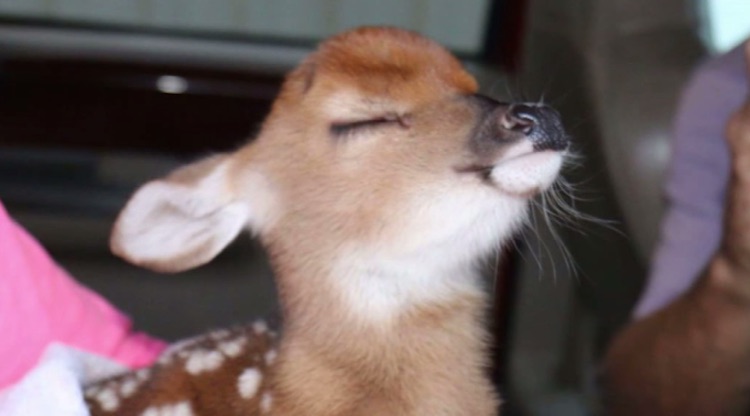
A tourist driving through Alberta performed a make-shift C-section to deliver a fawn, after its mother was struck by a car.
Outdoorsman Sean Steele was taking a vacation road trip across western Canada when he saw an injured deer on the side of the road. He was preparing to humanely euthanize the doe, when he noticed she was pregnant and the accident had put her into labor.
The fawn had breeched, with its hind hoof protruding before its head, which the dairy farmer knew could be fatal. He put his experience to work, using a pocket knife to perform a Cesarean section to save the baby deer.
The fawn wasn’t breathing, but Steele didn’t give up. In a stroke of brilliance, he grabbed a long blade of grass, and tickled the baby’s nose until it sneezed and started breathing on its own.
Then he drove it miles to the Northern Lights Wildlife Society refuge, which reported on its Facebook page the little deer is drinking milk from a bottle “like a champion,” playing with another orphaned fawn, and appears to be recovering well.
(WATCH the post-operation video below from Michele Steele)— Photo: Michele Steele, Facebook; Northern Lights Wildlife Society, Facebook
Deliver This Lucky Moment To Your Friends, Share It…
A few years ago we posted a story about “yarn bombers” in the US making scarves and leaving them hanging from trees in the park for anyone who needed warmth.
The article, with photo of a snowy park with trees and scarves, sparked an idea for Cris Clucas, who works at a university in Canberra, the capital of Australia. In July it is winter ‘down under’, but many international students arrive from the Northern Hemisphere, where they leave their summer behind to discover a very cold climate.
Cris’s idea was for students, staff and professors to get together, which she says normally “never happens,” to knit scarves and hats to give to new students as a welcome gift.
“At first I was thinking just about the new students and making them feel welcome but the end result was the creation of community—across the boundaries of undergrad and postgrad students, of international and Australian students, and across the generations of students and staff,” she told Good News Network. “It had the added benefits of knitting (mindfulness), being creative, and doing something for others.”
After media coverage, the project at Australian National University spread to involve members of the Canberra community; people from “all over” donated yarn and sent messages of support.
“We ended up with a beautiful presentation of warm hand-knitted items to give the new students,” she said. “Each had a tag and a hand written message of welcome from the creator.”
The group is doing it again this year for the second time and Cris is headed to a conference to report on the project as an example of how to create community across boundaries and help new students to feel belonging in the community.
“Thank you for being the inspiration—from across the world—for this project,” she wrote in an email, realizing that ‘community’ now extends way beyond international borders, thanks to the internet.
A high school football team planned a sweet surprise for their teen manager, creating a moment no one will ever forget.
It was Riverside High School’s annual spring football game, but this would be Ross Jeffeaux’s night.
On May 27 in front of a packed Greenville, South Carolina crowd, they pitched the ball to Jeffeaux, who has autism, and he carried the ball running 70 yards and scored the game ending touchdown.
A simple act of kindness for an Orlando shooting victim’s grandmother turned a planeload of strangers into a personal support group.
Luis Omar Ocasio-Capo’s grandmother was on a JetBlue flight to Orlando Tuesday, and one of the flight attendants wanted to do something nice for her. Kelly Davis Karas began circulating a sheet of paper among the passengers, asking them to write a few words of support or condolences.
She was stunned when the passengers, instead, produced paragraphs and pages of emotional support for the grieving woman.
When the flight landed in Florida, every single passenger took their turn in the aisle to offer words of support to Ocasio-Capo’s grandmother—with no one complaining that it took longer to exit the plane.
“I am moved to tears yet again as I struggle to put our experience into words,” Davis Karas wrote on her Facebook page. “In spite of a few hateful, broken human beings in this world…people ARE kind. People DO care.”
SHARE this Emotional High to Remind Your Friends… –Photos: Kelly Davis Karas, Facebook: BrunoSchalch, CC
A Mexican food chain was so inspired by a student’s essay, it donated $100,000 to his mother’s cancer treatment.
Fue Xiong had already won a $20,000 scholarship from Chipotle for his essay that detailed his experience with hunger as a five-year-old Hmong refugee in a Thailand relocation camp. The Chipotle contest, Cultivating Thought, asked people to write about a time that food left a lasting memory.
Xiong wrote about the last meal he had in the camp — three raw sardines and two handfuls of rice shared between 10 people. When he asked his mother if she’d salted the fish, she told him she hadn’t — he was tasting his own tears.
It was the last supper before his family left for America.
Twelve years later, he wrote the essay as a high school senior, after already enlisting in the Minnesota National Guard at age 17 because he wanted to serve the country that had taken him in.
Xiong planned to use his scholarship to start college, but he decided to put it off for six months to care for his sick mother after she was diagnosed with stage 3 gallbladder cancer.
When Chipotle’s home office found out why Xiong was delaying his college plans, the company donated $100,000 to cover his mother’s medical expenses and recovery. A spokeswoman said his story had touched the whole company.
“After my dad passed away, she has always put her kids first,” Xiong told USA Today. “She is a brave, courageous woman who was able to take nine children into a refugee camp and to the United States without speaking any English or Thai.”
(WATCH the video below from KARE News) — Photo: Fue Xiong
When no one sent an RSVP after being invited to a birthday party for an autistic boy, the local police department showed up in force.
Daniel Nicastro’s autism makes it hard for him to make friends–and no one had shown up for his previous two birthdays. His parents didn’t want to see him disappointed again, so they sent an invitation to the North Port, Florida Police Department to invite Daniel’s favorite heroes.
The parents thought maybe one or two officers might stop by, but the cops kept coming. They brought police-themed gifts and seven of them posed for a picture with Daniel.
The photo spread on social media, and Daniel has been receiving belated birthday wishes from around the world ever since.
Not only that, the experience inspired the North Port police to host a community birthday bash July 3, for every child in the community who “has felt left out.”
“We want all our kids to know how special they are and see how much our community cares for them,” the department wrote on its Facebook page.
“I can’t thank [the police] enough,” his father, Daniel Nicastro, Sr., told WFLA News. “I never will be able to—and he’ll never forget this birthday because of it.”
(WATCH the video below from WFLA News) — Photo: North Port PD, Facebook
Airline complaints dropped by a dramatic 20.9 percent in April compared with the same month one year ago, and on-time arrivals improved, according to a new report by the U.S. Department of Transportation.
The Air Travel Consumer Report says carriers achieved an on-time arrival rate of 84.5 percent in April 2016, up three percent since 2015.
Hawaiian, Delta, and Alaska airlines were the best at staying on schedule, while Spirit Airlines scored lowest because more than a quarter of their planes arrived late.
In other bright spots, the number of passengers reporting mishandled or lost baggage fell slightly and complaints about the treatment of disabled passengers have decreased.
May 6, 2016; Notre Dame students Emily Cunningham, Michael Boyle and occupational therapist Heather Beaver work with patient Katelyn Toth at Children's HealthWorks in South Bend. (Photo by Barbara Johnston/University of Notre Dame)
Katelyn Toth and her stepbrother were riding a paddleboat on a small lake near Bremen, Indiana, in 2006 when a storm whipped out of nowhere and unleashed a lightning bolt, the lone strike in a 60-mile radius.
While her stepbrother suffered only a slight shock, Katelyn took the full force of the sudden strike and suffered third-degree burns across her face, neck and torso.
The 12-year-old – who loved softball, played the clarinet, and once brought 27 frogs home to her basement – was not expected to live. She was airlifted to two different hospitals. She lingered in a coma-like state for months, her brain severely shocked. Doctors at a special burn unit in Kalamazoo, Michigan, told her mother, Julie Noblitt, that Katelyn would never walk or talk again.
A year later, Katelyn returned to the burn unit in Kalamazoo and walked through the door with only the help of a walker. The male nurse who’d been most involved in her treatment broke down in tears. But Katelyn and her mother are too focused on recovery for self-pity.
“She brings a lot of light when we go places,” Julie says of her daughter. “I call it her light. It’s an aura, how she projects energy. Her determination. It just draws people to her and makes them smile.”
A group of Notre Dame engineering students, drawn to Katelyn’s light, spent this semester experimenting on how to help her with another step in her recovery: eating on her own. Now 22 years old, she has control of her arms when held close to her torso, but when she extends them, ongoing nerve damage causes tremors that make controlling a fork or spoon nearly impossible.
“When we eat out at a restaurant, I’ve seen her turn away from the other people there so they can’t see her being fed and eating,” Julie said. “It breaks my heart. This project is about self-esteem, giving her the control to eat on her own.”
The students took two different approaches. Emily Cunningham led a team focused on adapting a robotic arm. Michael Boyle led a simpler, mechanical approach that involved PVC pipe pieces to extend Katelyn’s reach.
“She has this beautiful blond hair with a delicate braid that shows her mom is so loving,” Cunningham said. “Katelyn works really hard in therapy, but you can tell eating is frustrating. It would be wonderful for her to get that sense of freedom back.”
Cunningham and Boyle are working with Katelyn through a one-credit course at Notre Dame called Student Engineers Reaching Out (SERO), which grew out of a national service-learning design program in which teams of students partner with local service organizations to address human and community needs. Paul Brenner, associate director of the Center for Research Computing and associate professor of computer science and engineering, volunteers as the faculty mentor of the class of about 10 students.
“It gives a purpose to what we do as engineers,” Brenner said. “It’s a way to apply their learning that can help when they are sitting in their third calculus class and they’re overwhelmed with technical aspects. They also like helping the community.”
Every Tuesday night, session are held in a machine shop. They call the session “Toys” because their longest-running project is adapting toys for children with physical limitations at area hospitals. Activities include putting larger buttons on an MP3 player, building foot straps and different steering handles for toy cars the kids ride, and rewiring larger on-off switches. They even 3-D print special parts to make a toy truck easier to control.
With the semester coming to a close, Boyle and Cunningham met with Katelyn on April 21 to try the latest refinements of the PVC pipe system. Boyle clamped the device to the table while Cunningham helped Katelyn attach a Velcro strap to secure her right arm into the handle portion.
With fresh fruit sitting in front of her, Katelyn pushed down to stab a piece of fruit, and the new spring pushed the fork back up while she manipulated the joints to twist the fork toward her mouth. Next, she stabbed a blackberry and maneuvered the fork to pop it into her mouth. Beaver, her therapist, was overwhelmed, saying with tears in her eyes: “How many years have we waited for this?”
Photos by Barbara Johnston / the University of Notre Dame
Noblitt rubbed her daughter’s shoulders. “Is this cool or what?” she whispered in her ear. “You’re doing it all by yourself.”
The process would take some practice, but it got an immediate thumbs up from Katelyn. She leaned over her iPad and typed a message. She slid the iPad toward the SERO students and pressed a button to speak the words out loud: “Like it. I’m so very happy.”
(WATCH a video below)
Written by Brendan O’Shaugnessy, originally published by the University of Notre Dame
When a group of people in Kazakhstan spotted this dog trapped in rushing waters below a floodgate, they tried, and tried some more, to form a human chain to rescue it.
The dog was standing on the edge of a waterfall, when one man waded in to lead the dog back to the ledge where he fell.
These two women didn’t know just how perfect a match they were when they first met on Tinder.
But Alana Duran’s girlfriend, Lori Interlicchio, found out she was compatible for the kidney transplant Duran needed—and surprised her partner with a Tinder-themed video announcement.
It was even more surprising because the odds of non-family members being a match for a kidney transplant is one in 100,000.
Duran was diagnosed with lupus when she was just 12 and had lived on dialysis for years. She’s been on a transplant waiting list for four years and figured it’d be another two years before a suitable donor was available.
When Interlicchio got her test results back, she surprised Duran with a gift box of everyday items, but hidden at the bottom was a poster made up to look like the screen for their Tinder match — this time announcing the two were a perfect match for a transplant.
At about four minutes into the video below, Duran finds the announcement, and is overcome with emotion when she realizes the real gift her girlfriend is giving her.
“This is amazing,” Duran says through her tears of joy.
(WATCH the video below and SEEmore pics at TODAY) — Photos: Alana Duran and Lori Interlicchio
A pack of peace and love has arrived in Orlando, Florida — professional comfort dogs to help ease the pain and stress of survivors and family members following Sunday’s terrorist attack.
The dogs and their handlers began arriving yesterday from nine states as far away as Texas and Ohio.
Each dog has gone through 12 to 18 months of training to comfort people in stressful situations. Their handlers are all volunteers who go where they’re needed.
The dogs fanned out to community centers serving as gathering points for those affected by the shooting.
One of the Golden Retrievers curled up at the feet of Russell Walker, who worked at the nightclub where the attack happened.
Dana Lee Calabrese was walking to dinner in Hollywood when suddenly a homeless man collapsed in the street right front of her—and it was fortunate for him that he did.
She and her cousin called 911, as anyone might, but when paramedics arrived she cared just a little bit more. She wondered what would happen to the man’s suitcase and small number of belongings and asked the EMT crew if they would be taking the cart. Their response “sent chills down my spine,” she recalls.
“No, are you? A million more dominoes fall a day around here.”
The sign on his cart identified the man in his fifties as a U.S. Marine Corps Veteran named Douglas Dean Hall. The idea of this veteran with a prosthetic limb being treated with disrespected spurred Dana to uncommon valor. She gave the crew her phone number and instructed them to make sure he got it.
Then the Los Angeles woman in her 30s went trudging off down the street pushing the cart with everything the homeless man owned inside.
After she didn’t hear from him, and not knowing if he’d even gotten her phone number, Dana launched a plea on Facebook to help locate the man. It took weeks but finally a reply to her post: “I found him. He is on Highland & Hollywood.”
Maryam Ramezani saw Dana’s original social media post and was reading every homeless sign. “As I saw his name, I couldn’t believe my eyes.”
So, Dana and her husband, and a neighbor, headed to the area, and split up to find the veteran, who was told to stay in the neighborhood because she would be looking for him to return his stuff.
Photos by Dana Lee Calabrese and her cousin, Jackie Lezette
“I had hid the cart in the garage of my condo building,” Dana, who is a creative director, told Good News Network.
“So I was rolling the cart down to the meeting place, and I saw him coming from across to street towards me and I basically just started jumping and clapping cause I was so excited. I was screaming out his name, “DOUGLASSSS!”
“He was looking at me really excitedly but he also looked confused, because I don’t think he actually believed that someone held onto his stuff.”
“He cried several times—and at one point he screamed ‘God is good!’ at the top of his lungs,” she said by telephone. “He just kept telling me that I was an angel and kissing me on the top of my head.”
If that isn’t enough proof that Dana is indeed an angel, listen to what she did next:
“His sign said that he was looking for funds to get to New York. I’m from New Jersey, and I have a lot of friends on the east coast. So when I met him, I said ‘Are you still trying to get to New York?’ He said yes, so I said, ‘Okay, well we’re going to make that happen’. And then when I went home that night I set up a Go Fund Me page.”
It met it’s goal in 24 hours. So far, Dana’s friends–and other people she didn’t know–have donated $1,300 to buy him the cross-country train ticket, along with food and anything else he might need when he gets to the Big Apple.
“I asked him if he had family there and he said he had a lot of good friends there so he just really wanted to go back,” she said.
“I’m actually just overwhelmed by how many people have donated. A lot of the people are actually friends that I’ve known since high school but lost contact with.”
She will probably buy a Visa Gift Card to fill with the money, before meeting him at week’s end. She wants to throw an informal surprise party at an outdoor patio bar on the same corner where he collapsed, to present the gift card wrapped in a box–and celebrate his good fortune.
Dana promised Good News Network a follow-up video, so stay tuned this weekend.
Generosity hit a record high for the second year in a row, with charitable donations by Americans topping $373.25 billion.
Individuals, estates, foundations and corporations gave even more money in 2015 after setting record last year, reports Giving USA’s Annual Report on Philanthropy, released yesterday.
The new peak in contributions is record-setting whether measured in current or inflation-adjusted dollars. Total giving grew 4.1 percent over 2014, an inflation-adjusted increase of 6.1 percent.
But that’s not the only big news about charitable giving in this year’s report.
“If you look at total giving by two-year time spans, the combined growth for 2014 and 2015 hit double digits, reaching 10.1 percent when calculated using inflation-adjusted dollars,” said Giving USA Foundation Chair W. Keith Curtis. “But these findings embody more than numbers—they also are a symbol of the American spirit. It’s heartening that people really do want to make a difference, and they’re supporting the causes that matter to them. Americans are embracing philanthropy at a higher level than ever before.”
Charitable contributions from all four sources went up in 2015, with those from individuals once again leading the way in terms of total dollar amount, at $264.58 billion. This follows the historical pattern seen over more than six decades.
Giving USA, the longest-running and most comprehensive report of its kind in America, is published by Giving USA Foundation, a public-service initiative of The Giving Institute. It is researched and written by the Indiana University Lilly Family School of Philanthropy.
Very large charitable donations—categorized here as gifts of $100 million or more—have garnered an increasing amount of attention over the past 10 to 15 years. In 2015, the very large contributions that were publicly announced totaled at least $3.3 billion.
“Each year, gifts of $100 million or more play a significant role for some individual donors and many different types of charities. However, Americans’ collective generosity would still be enormous even without those jaw-dropping gifts,” said Patrick M. Rooney, Ph.D., associate dean for academic affairs and research at the school. “Philanthropy is quite democratic and always has been—more people give than vote in the U.S.—and $20, $10 and $1 gifts do make a cumulative difference.”
The generosity could be due, in part, to at least two factors: The country’s overall economic environment continuing its path to recovery after recessionary times, and household finances seeming to stabilize during a time of healthy growth in personal consumption, personal income, disposable income, GDP, and, corporate pre-tax profits.
The Numbers for 2015 Charitable Giving by Source:
Individual giving, $264.58 billion, increased 3.8 percent in current dollars (and 3.7 percent when inflation-adjusted) over 2014. Foundation giving, $58.46 billion, was 6.5 percent higher than 2014 (6.3 percent when inflation-adjusted). Charitable bequests, $31.76 billion, increased 2.1 percent (1.9 percent when inflation-adjusted) over 2014. Corporate giving, $18.45 billion, increased 3.9 percent (3.8 percent when inflation-adjusted) over 2014 giving.
The only thing this little girl wanted for her fourth birthday was to take a police officer to lunch.
JadeLynn Hoskinson Gross got her wish, thanks to a Clarksburg, West Virginia officer, who even brought along a bag full of police-themed party favors and gifts.
Officer Markie Waggamon was having so much fun, he hung around to play with the toddler after their meal together. She got to wear his hat and sit in his patrol car.
“I was allowed to witness one of the most beautiful acts of kindness I think I have ever seen today,” family friend Tara Murphy posted to her Facebook page.
Critters in Canadian animal shelters will be eating with tails wagging after a man purchased a pet store’s entire inventory and donated 570 bags and cans of food.
Sean Squires heard a Petculture store was going out of business and bought all the pet food in stock before it closed its doors for good. He paid about $3,000 for $13,000 of food.
The store’s insurance company prevented it from donating the food to shelters directly, so Squires saved it from being dumped into a landfill.
The Newfoundland man has plenty of mouths to feed at home — nine cats he’s acquired as strays over the years — but couldn’t pass up the deal to help other rescue animals.
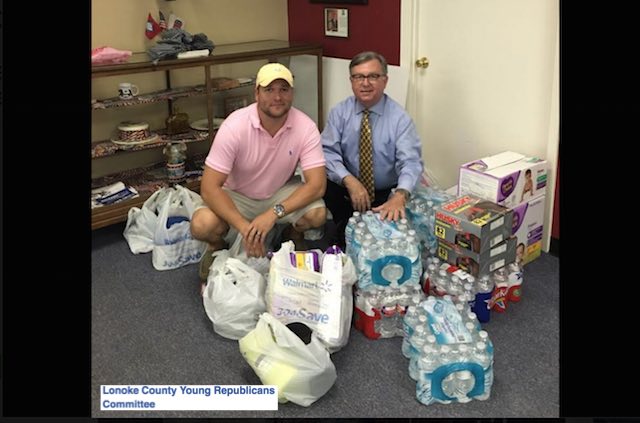
The worst shooting of its kind in U.S. history has brought out the best in thousands of people across Orlando, Florida — with businesses joining volunteers and donors worldwide to offer their support.
After broadcasters announced that doctors were in immediate need of blood donors, thousands of people formed long lines Sunday outside blood banks which triggered good deeds and kindness in a city known for the magic of Disney.
As people waited in the sun, local Sports Authority stores erected tents to shield them from the 97-degree heat while locals began bringing cases of water and cereal bars to distribute throughout the lines that snaked around city blocks.
Fast food chain Wendy’s provided food and drink for hospital workers and handed out meal vouchers to blood donors. Chick-fil-A, famously closed on Sundays, opened for employees around Orlando who wanted to prepare free sandwiches and ice tea to hand out to people waiting in lines, or to emergency personnel still working at the nightclub where the shooting happened.
By midday Sunday, blood banks were at full capacity — unable to store any more donations. Still, donors waited in line — just to schedule appointments to donate at a later time.
Jet Blue, which has a major hub in Orlando, offered free seats for immediate family members and domestic partners of the victims. One caller to a local radio station, who said he couldn’t afford to give money to help victims, offered to let family members stay at his home or use his pick up truck to get around town, for as long as they needed.
Those who could give money raised more than two million dollars in less than 24 hours to help family and partners of the victims. It is the largest and fastest-funded campaign in GoFundMe’s six-year history and had topped three million dollars in donations by this morning.
The shooting happened on “Latin Night” at the popular Pulse nightclub and many of the victims have non-English speaking relatives.
A translation company is making interpreters available for foreign families and is paying lodging for victims’ families.
Marcelo Sano, a Brazilian immigrant in Orlando expressed his joy at being able to help.
“It’s a very sad moment for the city that has hosted me so well,” he wrote on Facebook in Portuguese. “I’m happy to witness these kind acts,” says Sano, who was inspired to give back to the city he now calls home.
With reporting from Terry Turner in Orlando and Joao Freitas in Brazil (Photo: Pulse Orlando, Facebook)